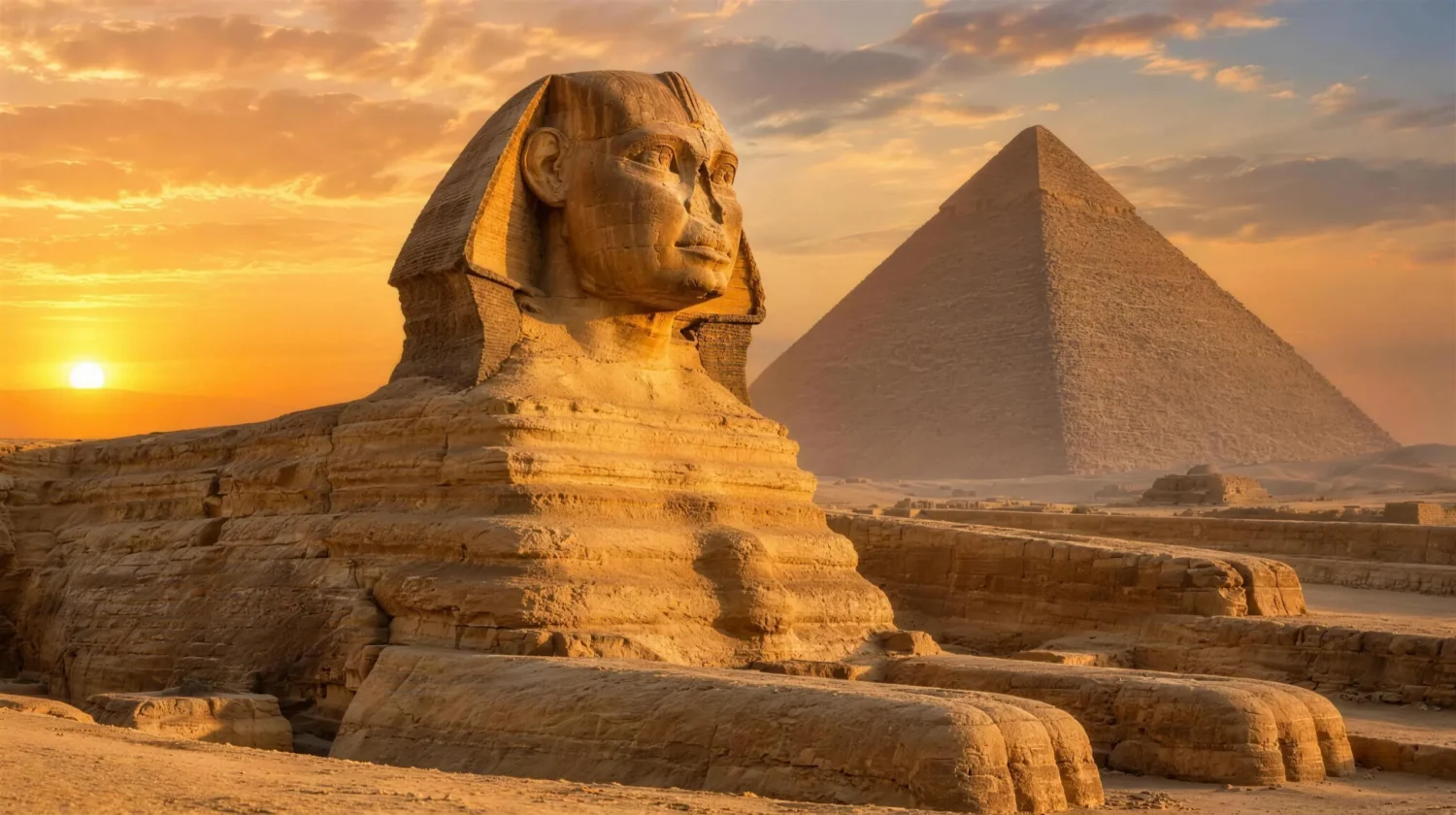
The Great Sphinx of Giza is a limestone statue of a reclining lion with a human head, about 73 meters (240 feet) long, carved from the bedrock of the Giza plateau in Egypt. Egyptologists date it to around 2500 BCE, in the reign of the Fourth Dynasty pharaoh Khafre, and most believe the face is his. A minority view, first argued by geologist Robert Schoch, holds that the weathering on its walls points to a much older origin, a claim most Egyptologists and geologists do not accept.
This guide sets out each side fairly and credits every claim to the person who made it, so you can look at the evidence and decide what rings true. You will also find Edgar Cayce’s Hall of Records readings, the story of the Dream Stele, the riddle of the Greek sphinx, the four creatures of esoteric symbolism, and the reasons seekers have felt drawn to this silent face for thousands of years. For the monument beside it, see our guide to the Great Pyramid of Giza.
Key Takeaways
- Size: the Great Sphinx is about 73 m (240 ft) long, 20 m (66 ft) high and 19 m (62 ft) wide, carved largely from the natural limestone of the Giza plateau.
- Standard dating: Egyptologists attribute it to Khafre (c. 2558 to 2532 BCE), in the Old Kingdom, though no inscription records its construction.
- Water erosion hypothesis: Robert Schoch, building on the work of John Anthony West and R. A. Schwaller de Lubicz, argues the weathering reflects heavy rainfall and an older date. Mark Lehner, Zahi Hawass and others disagree.
- Edgar Cayce: in 1933 readings he described a Hall of Records near the Sphinx’s right paw holding Atlantean knowledge. Surveys have not located a chamber matching his description.
- Dream Stele: around 1400 BCE, Thutmose IV cleared the sand from the Sphinx and recorded a dream in which it asked him to do so.
- Symbolism: the Greek sphinx posed the riddle that Oedipus answered, and later esoteric writers read the sphinx as a union of four powers and four creatures.
What Is the Great Sphinx of Giza?
The Great Sphinx is the largest and best known of all sphinxes: a recumbent figure with a lion’s body and a human head, facing due east across the Giza plateau on the west bank of the Nile, near modern Cairo. Most of it was cut directly from the limestone of the plateau, from rock left behind by the quarrying that supplied the nearby pyramids. The forepaws were extended with separately placed blocks. Around its base runs a deep, man-made hollow, often called the Sphinx enclosure, from which the statue was freed.
It sits within the same ancient complex as the Great Pyramid and the pyramids of Khafre and Menkaure, and a causeway and two temples tie it to the pyramid of Khafre. Stone cut from the Sphinx’s own body was used to build the temple in front of it, and neither the temple nor the enclosure was ever finished, according to the account summarized on Wikipedia.
The Great Sphinx at a Glance
| Question | Answer | Whose view |
|---|---|---|
| How big is it? | About 73 m (240 ft) long, 20 m (66 ft) high, 19 m (62 ft) wide | Measurements summarized on Wikipedia |
| What is it made of? | Natural limestone of the Giza plateau, with added blocks on the paws | Egyptology |
| Who built it? | Most likely Khafre, c. 2558 to 2532 BCE; Khufu and Djedefre have also been suggested | Mainstream Egyptology |
| Is it older? | Possibly, by thousands of years, based on weathering patterns | Robert Schoch, John Anthony West |
| What is under it? | A Hall of Records with Atlantean knowledge, said Edgar Cayce; none has been found | Edgar Cayce and later followers |
| What did the Egyptians call it? | Hor-em-akhet, “Horus of the Horizon” | New Kingdom texts |
| What does the Arabic name mean? | Abu al-Hol, “father of terror” | Medieval Egyptian Arabic |
How Old Is the Great Sphinx? The Standard Egyptological View
The mainstream answer is that the Great Sphinx was carved in the Old Kingdom, in the 26th century BCE, during the Fourth Dynasty. Most Egyptologists credit the pharaoh Khafre, whose reign is dated to roughly 2558 to 2532 BCE and whose pyramid stands just behind the Sphinx. A minority of scholars have proposed his father Khufu, and some have suggested Khafre’s half-brother Djedefre, though the latter is not a consensus view.
Why Khafre?
The case rests on location and context. The Sphinx lies within Khafre’s pyramid complex, and its causeway and temples align with his valley temple. Archaeologist Mark Lehner, who has spent decades excavating at Giza, points out that the Sphinx Temple was built against the northern wall of the Valley Temple, and that both are unfinished, which ties the Sphinx to the Old Kingdom building program. Luminescence dating of the temples, as summarized on Wikipedia, places them in the mid to late third millennium BCE.
It is worth being honest about what is missing. No inscription identifies Khafre with the Sphinx, and no ancient text records who built it or why. The attribution is an inference from archaeology and style, and that open space is where the other theories enter.
What Was the Sphinx Called?
Later Egyptians worshipped it as an aspect of the sun god under the name Hor-em-akhet, “Horus of the Horizon,” which the Greeks rendered as Harmachis. The Arabic name Abu al-Hol, “father of terror,” appears in medieval Egyptian Arabic. The word “sphinx” itself is Greek, and historian Susan Wise Bauer has suggested it may echo the Egyptian phrase shesepankh, “living image.”
What Happened to the Nose?
A popular story blames Napoleon’s soldiers. Wikipedia’s account is that this is a myth: tool marks show the nose was deliberately removed, and the face was already recorded as damaged in the tenth century. The medieval historian al-Maqrizi blamed a Sufi named Muhammad Sa’im al-Dahr in 1378.
The Sphinx Water Erosion Hypothesis
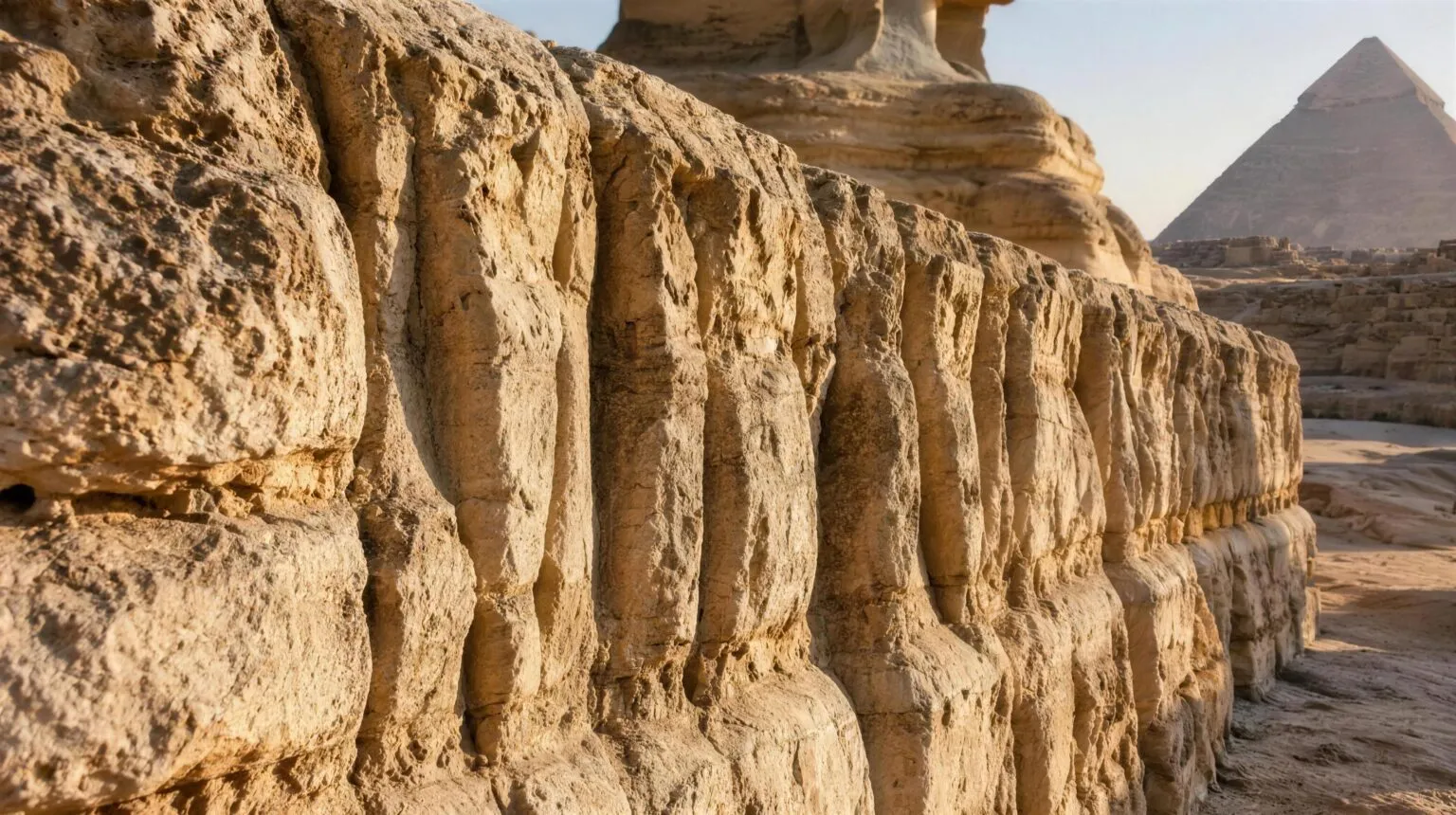
The best known challenge to the standard date is the water erosion hypothesis. Its roots go back to the 1950s, when the French Egyptologist and philosopher R. A. Schwaller de Lubicz speculated that the Sphinx’s body showed the marks of ancient deluges and therefore predated them. In 1979 the author John Anthony West, inspired by Schwaller, attributed the erosion to Nile floods between 15,000 and 10,000 BCE.
The idea moved into science when West brought Boston University geologist Robert Schoch to the site in 1990. Schoch concluded that the deep, rounded, vertical fissuring on the enclosure walls looked like the result of prolonged, heavy rainfall rather than wind and sand. He first estimated that the Sphinx was begun before 5000 BCE and later moved his minimum date to around 9700 BCE, near the end of the last ice age.
Schoch’s Argument in Brief
- He sees an undulating vertical profile on the enclosure walls that he links to rainwater runoff.
- He says many of the weathering features follow pre-existing joints and faults in the bedrock.
- He argues wind erosion forms horizontal bands, while the features he points to are vertical.
- He does not accept salt weathering as the main cause of the vertical features, because the erosion is unevenly distributed.
How Egyptologists and Geologists Respond
Wikipedia describes the hypothesis as a fringe claim, and the published responses are detailed. The table below sets the main positions side by side.
| Person | Position | Main point |
|---|---|---|
| Robert Schoch | Older than Khafre | Rain-formed weathering patterns suggest a date of 7000 BCE or earlier |
| John Anthony West | Older than Khafre | Weathering resembles water erosion more than wind and sand |
| Mark Lehner | Khafre era | The limestone was cut back irregularly, and an earlier builder civilization is very unlikely |
| Zahi Hawass | Khafre era | Poor-quality Giza limestone and rainfall over the last 4,500 years explain much of the erosion |
| Colin Reader | Old Kingdom | Runoff from the plateau was a more important factor than direct rainfall |
| Getty Conservation Institute | Salt weathering | An analysis in 1990 to 1992 found salt crystallization could explain at least some of the damage |
| Gauri and colleagues | Moisture-driven weathering | They favor salt weathering with moisture from sources such as dew |
Critics also raise a practical point. If a culture capable of carving a monument of this scale existed thousands of years earlier, they ask, where are its tools, settlements and other works? Anthropologist Kenneth Feder argues that there is no evidence of such a culture before about 2500 BCE. Supporters of the older date answer that evidence from so deep in the past may simply not survive, and that the Sphinx itself is the evidence.
Hear it from the guests: the water erosion question
Two conversations on the Next Level Soul Podcast take up the age of the Sphinx directly.
How the Pyramids Were Built with Gregg Braden

Gregg Braden. Gregg Braden turns to the Great Sphinx and the water erosion on its body. Citing geologist Robert Schoch, he says the erosion suggests an age of 12,000 to 13,000 years or more. He offers this as his own reading, and mainstream Egyptology dates the Sphinx much later. Watch the full episode and read the show notes.
Mysterious Pyramid Inscriptions with Robert Edward Grant

Robert Edward Grant. Robert Edward Grant talks about the Giza plateau and says he believes, based on the erosion work he links to Robert Schoch, that the Sphinx is approximately 13,000 years old. The conversation also covers pyramid inscriptions and the Emerald Tablets of Thoth the Atlantean. Watch the full episode and read the show notes.
The Alternative History Debate
Schoch’s geology did not stay in the lab. Writers including Graham Hancock and Robert Bauval brought the older date into popular books and documentaries, and combined it with the idea of a lost advanced culture that vanished at the end of the last ice age. Hancock, Bauval and West each adopted the date of about 10,500 BCE, a number that also appears in the Edgar Cayce readings discussed below.
Seekers drawn to this conversation often connect it to other questions about humanity’s deep past, such as the stone temple at Göbekli Tepe, the legend of Atlantis, and the great world cycles taught in the Yugas. On the podcast, Randall Carlson spoke about cataclysms and ancient memory in Cataclysms, Atlantis and Gobekli Tepe, and Robert Edward Grant shared his own geometric research in New Discoveries at the Pyramids of Giza.
A fair summary is that the evidence for the standard date is archaeological, the case for an older date is geological, and the two have not been reconciled. Mainstream researchers say the older date lacks support from the wider record. Supporters say the geology has never been answered to their satisfaction. Both groups agree on one thing: the Sphinx has been weathered, repaired and buried for a very long time.
Hear it from the guests: lost civilizations and cataclysm
If the alternative history debate sparked your curiosity, this conversation explores the wider picture. For a longer look at the lost continent, listen to the The Chronicles of Atlantis, Book 2 audiobook on Next Level Soul TV.
Cataclysms, Atlantis and Gobekli Tepe with Randall Carlson

Randall Carlson. Randall Carlson, who appeared in Graham Hancock’s series Ancient Apocalypse, speaks about ancient cataclysms, Atlantis, Gobekli Tepe and the idea that civilizations move in cycles. It is a good listen alongside the alternative history debate above. Watch the full episode and read the show notes.
Edgar Cayce and the Hall of Records
Edgar Cayce, the American clairvoyant known as the Sleeping Prophet, gave thousands of trance readings between the 1920s and 1940s. Several of them, from October to December 1933, spoke of a hidden Hall of Records. According to the summary on Wikipedia, Cayce said records of Atlantis were stored in three places: Bimini, a site in the Yucatán and a “temple or hall of records” at Giza.
What Cayce Said
- He placed the hall between the Sphinx and the Nile, with an entrance near the Sphinx’s right paw.
- He said Atlantis was destroyed around 10,500 BCE, and that Atlantean refugees built the Great Pyramid and the Sphinx within about a century afterward.
- Later readings, in 1941, described records in Atlantean and Egyptian writing and implied a pyramid-shaped structure.
- Followers tied the discovery of the hall to a period of dramatic change that Cayce predicted for the decades ending around 1998.
For a wider look at how Cayce is remembered, see our entries on the Akashic Records and what happens when you access your Akashic Records, the “book of life” tradition that Cayce also drew on in his readings.
What the Searches Found
The Hall of Records has been searched for in earnest. In 1978 the Association for Research and Enlightenment, the organization that preserves Cayce’s work, cooperated with SRI International on a survey. Ground-penetrating radar showed possible anomalies near the Sphinx’s paws, but test drilling found only natural fissures. In 1991, geophysicist Thomas Dobecki argued that seismic readings showed a possibly man-made chamber under the right paw. Later surveys at Giza have not confirmed a chamber that matches Cayce’s description, as Wikipedia’s article on the Hall of Records reports.
The idea is older than Cayce. The Roman writer Pliny the Elder reported that locals believed the Sphinx was hollow and held the tomb of a king named Harmais, and medieval Arab writers told of passages beneath the pyramids. In the 1930s, mystical writers such as H. Spencer Lewis described hidden temples under the plateau. Whatever one makes of the literal claim, the Hall of Records speaks to something old in the human heart: the hope that a lost library of wisdom is waiting to be found.
The Dream Stele of Thutmose IV
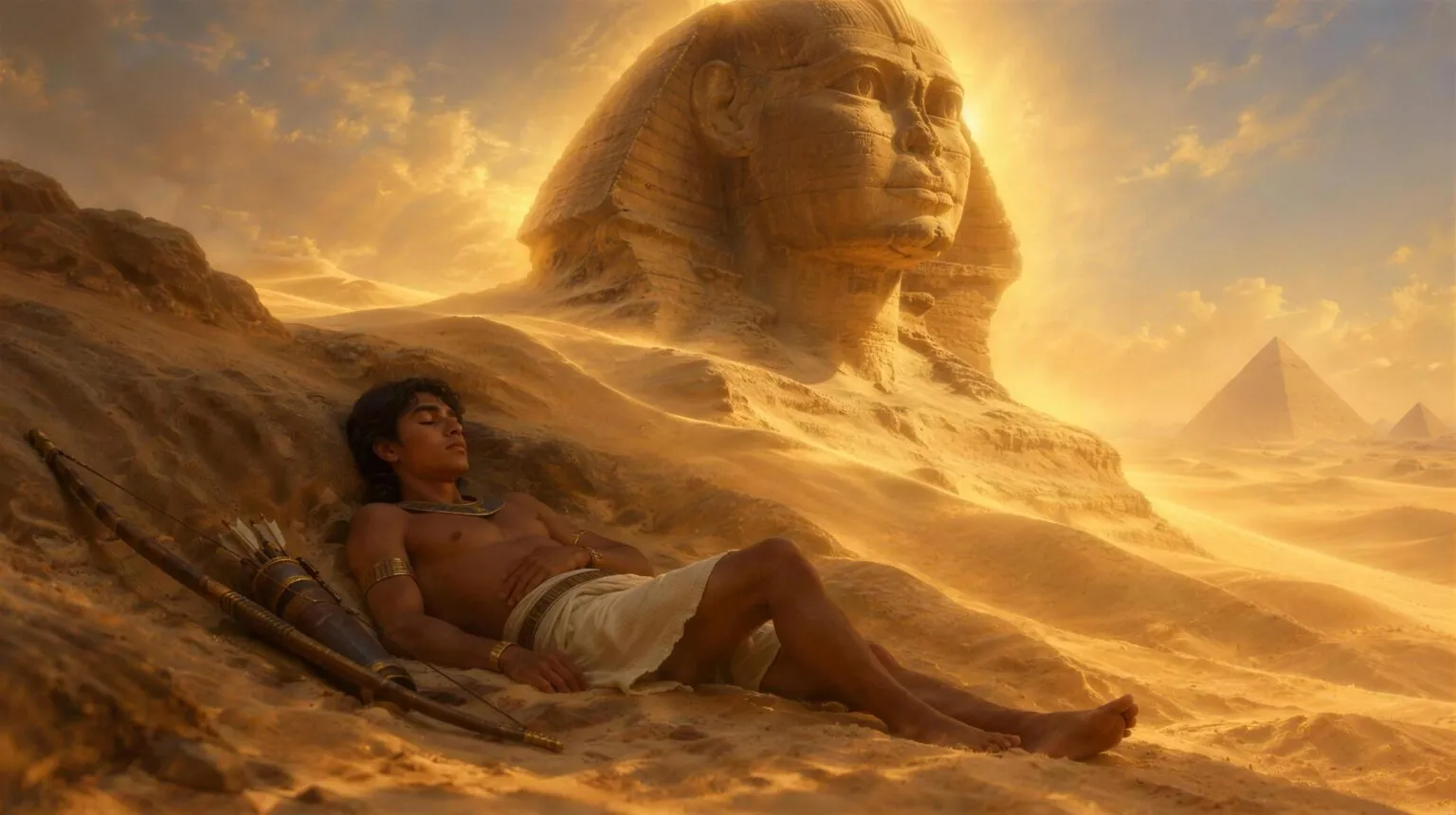
One of the most moving stories about the Sphinx comes from the Sphinx itself. Between its forepaws stands a granite slab known as the Dream Stele, set up around 1400 BCE by the pharaoh Thutmose IV, roughly 1,100 years after the Sphinx was carved.
The text tells of a young prince who, while hunting, rested at midday in the shade of the Sphinx, which was then buried in sand up to its shoulders. He fell asleep and dreamed that the Sphinx spoke to him. It asked him to clear away the sand, and promised him the crowns of Upper and Lower Egypt in return. Thutmose IV did become pharaoh, and he cleared the sand, and archaeologists excavating in 2010 found mudbrick walls about 132 meters long that they believe he built to shield the Sphinx from the wind.
Two details are worth knowing. By this time the Sphinx was worshipped as an aspect of the sun god, which shows how it was understood. And the part of the text that mentions Khafre is damaged, so it is not a clean confirmation of the standard date. For anyone who has had a meaningful dream, the story rings true: a guardian figure appears in the night, asks for care, and offers a destiny in return. Our guide to lucid dreaming and its spiritual roots explores that tradition further.
The Sphinx in Myth: Egypt and Greece
The word “sphinx” names two quite different beings. The Egyptian sphinx is typically male, usually wears the head of a pharaoh, has no wings, and serves as a benevolent guardian often placed at temple entrances. The famous avenue at Thebes was lined with hundreds of ram-headed criosphinxes, associated with the god Amun.
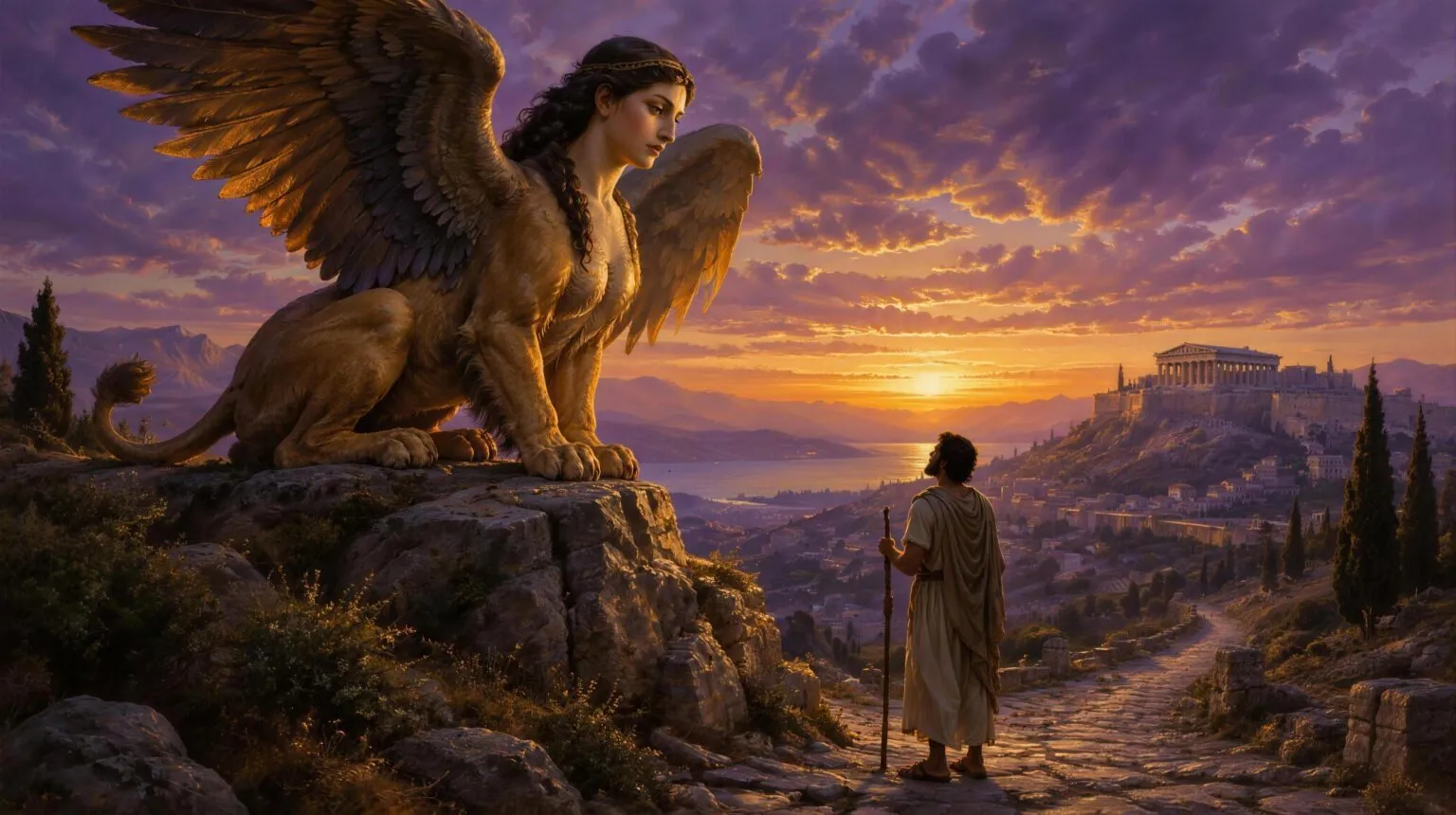
The Greek sphinx is something else: a creature with a woman’s head, a lion’s haunches and a bird’s wings, remembered as a demon of destruction and bad luck. Greek writers connected the name to the verb sphingo, “to squeeze,” a folk etymology that fits her myth.
The Riddle of the Sphinx and Oedipus
In the Greek myth, the sphinx sat on a rock outside the city of Thebes and challenged every traveler with a riddle, devouring those who failed. In the classic wording, she asked: “Which creature has one voice and yet becomes four-footed and two-footed and three-footed?” The hero Oedipus answered: a human being, who crawls as a baby, walks upright in adulthood and leans on a staff in old age. In most versions, the sphinx then threw herself from her rock, though some tell of Oedipus killing her.
Read spiritually, the riddle is a teaching about time. The Sphinx asks each of us to see our whole life as one being passing through changing forms, and to answer from a place of self-knowledge. It is no accident that the Greek temple at Delphi bore the call to “know thyself.” The two stories meet in the same lesson: the question is always about who you are.
Hear it from the guests: the Sphinx as a record keeper
For the mythic and spiritual side, this guest shares an esoteric view of the Sphinx. To explore the wider world of Egyptian myth and the afterlife, try the The Egyptian Book of the Dead audiobook.
Atlantis History Revealed Through Hypnosis with Sarah Breskman Cosme

Sarah Breskman Cosme. Hypnotist Sarah Breskman Cosme shares what she says her sessions have revealed about Lemuria, Atlantis and the Sphinx, which she describes as a record keeper. These are her own accounts and beliefs, offered with an open mind. Watch the full episode and read the show notes.
The Four Creatures, the Four Elements and Esoteric Meaning
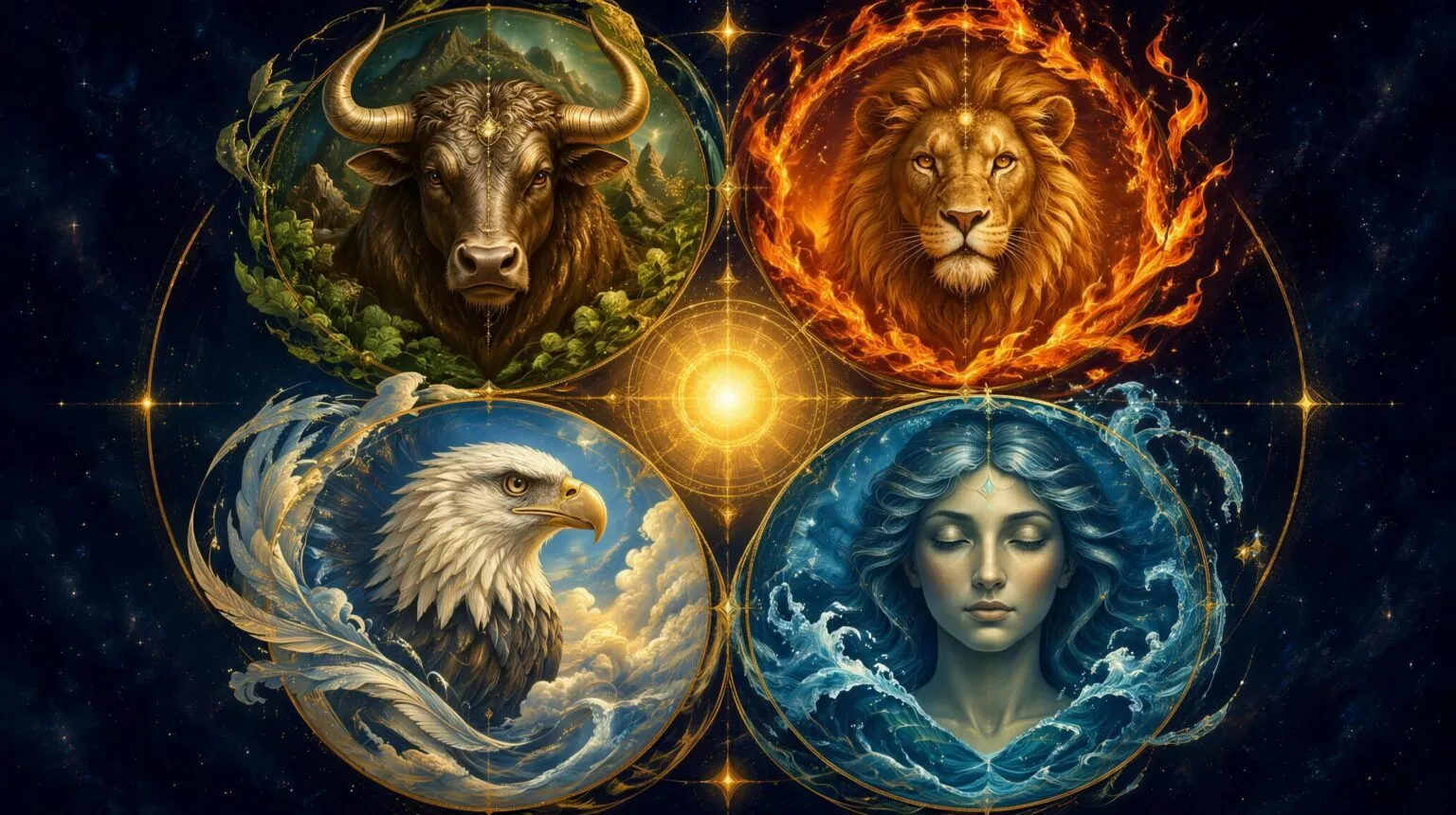
Western esoteric tradition reads the sphinx as a composite of four creatures: a human, a lion, a bull and an eagle. The same four appear in the biblical vision of Ezekiel and in the Christian tradition of the four living creatures, and they line up with the four fixed signs of astrology: Aquarius, Leo, Taurus and Scorpio, whose older symbol is the eagle.
In the nineteenth century, the French occultist Éliphas Lévi taught that the sphinx stands for four powers of the magus: to know, to dare, to will and to keep silent. Later writers in the Hermetic and Golden Dawn traditions linked these four to the four elements, Earth, Air, Fire and Water, though the exact assignments differ from one author to another. Our guide to the four elements of nature explains each one in plain language.
| Creature | Fixed sign | Classical element (common assignment) | Power |
|---|---|---|---|
| Human | Aquarius | Air | To know |
| Lion | Leo | Fire | To dare |
| Bull | Taurus | Earth | To will or to work |
| Eagle | Scorpio | Water | To keep silent |
Assignments of the powers vary between sources, so treat the table as a common pattern rather than a fixed code. The deeper point is that the Sphinx has long been read as a guardian of the mysteries, a threshold figure who asks for courage and silence from anyone who would pass. The same threshold idea runs through the mystery schools, which you can explore through our audio course Mystery Schools of the Ancients and the mystery schools glossary entry.
Hermetic and Alchemical Links
Seekers often place the Sphinx in the same family of ideas as the Egyptian god Thoth, the Greek Hermes Trismegistus, and the sacred texts of The Emerald Tablet and The Egyptian Book of the Dead. The Hermetic principle “as above, so below” and the old art of alchemy are often described as the inner teachings behind the outer monuments.
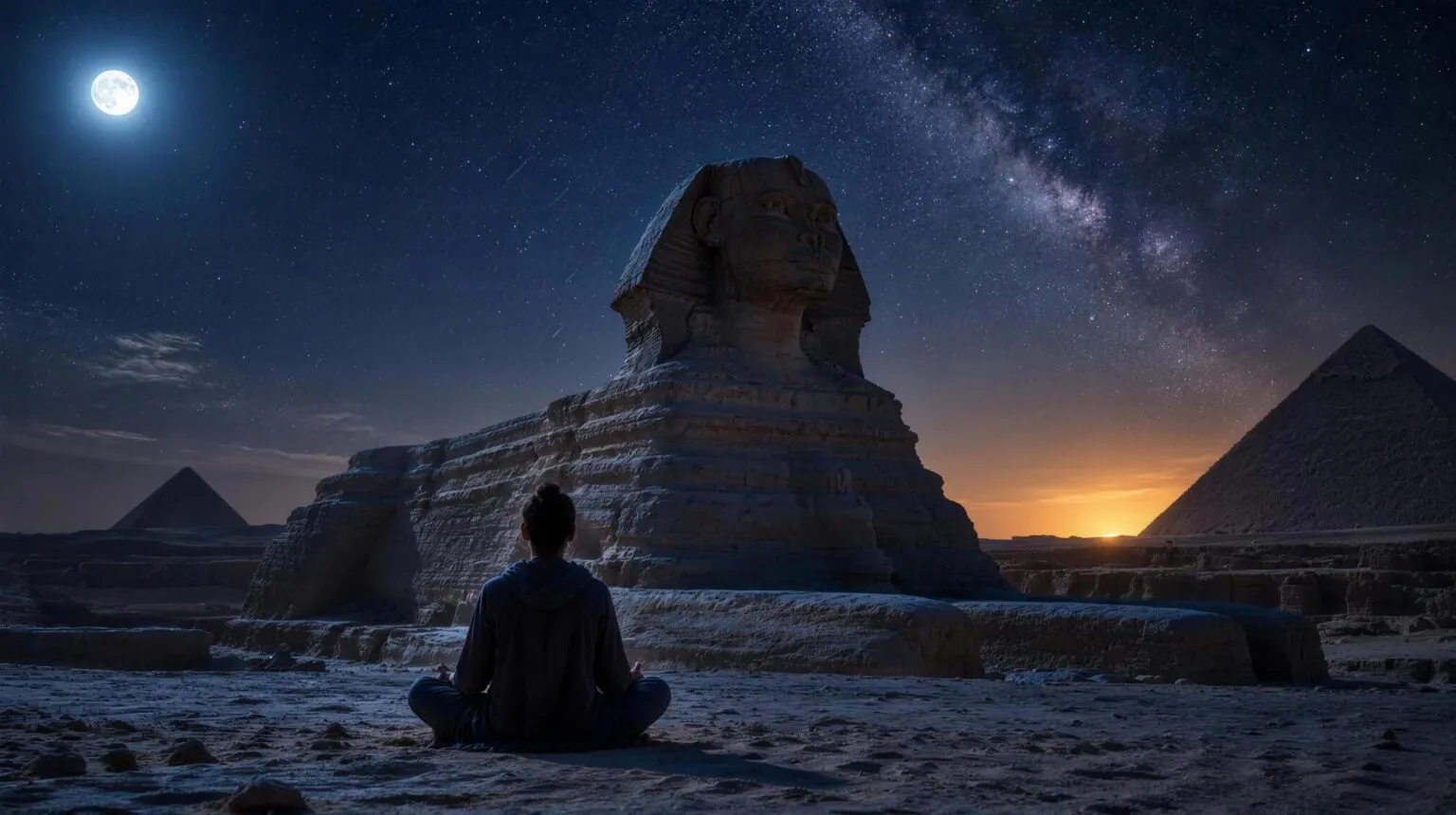
Why Seekers Find the Great Sphinx Meaningful
You do not have to settle the dating debate to feel something in front of the Sphinx. People are drawn to it for reasons that go beyond archaeology.
- It is a guardian. The Sphinx watches the horizon where the sun rises, the same direction a meditator faces to greet the day.
- It asks a question. Whether through Oedipus or through your own life, the Sphinx is the figure who says: who are you, really?
- It holds a mystery. Its age, its purpose and its hidden spaces remain open, and open questions invite the imagination.
- It joins human and animal. A human head on a lion’s body is an old image of mind joined to instinct, wisdom joined to strength.
- It endures. Sand, wind, water and time have worn it, and it still faces east.
Many who feel this pull are drawn to the wider path of inner remembering. Practices such as remote viewing, work with the third eye and reincarnation study often arise from the same longing the Sphinx stirs: to see past the surface of things and to remember where we have been.
How to Explore the Sphinx Further
If you want to go deeper, start with the sources listed below, including the Wikipedia articles on the Great Sphinx and the water erosion debate, then listen to voices from different sides of the conversation. Christopher Dunn and Gregg Braden both explore the Giza plateau from different angles in their NLS conversations. Take the history seriously, take the symbolism seriously, and notice which parts of the story move you.
Go Deeper: Explore the Sphinx and Ancient Mysteries on Next Level Soul
Here is where to continue, from audio to film to conversation.
Audio Courses, Audiobooks and Study Guides
- Mystery Schools of the Ancients, a 22-chapter audio course on the guarded teachings of Egypt, Atlantis and Greece
- Echoes of Atlantis, an audio course of retellings, guided practices and sacred reflections
- Browse the full audio course library, the audiobook library and the guided meditations, all on Next Level Soul TV
- Study guides: The Egyptian Book of the Dead, The Emerald Tablet and Mystics of the Renaissance
Movies and Series on NLS TV
- Jesus in Egypt: The Missing Childhood Years
- The Atlantis Puzzle, with our Spiritual Cinema review
- How the Pyramids Were Built with Gregg Braden
- More in the movies library, series library and audio library
Next Level Soul TV brings movies, series, audiobooks, meditations and audio courses together in one place, and you can learn more on our Join Us page. If you know a seeker who would love it, a Next Level Soul TV gift membership is a thoughtful way to share the journey.
Podcast Episodes to Listen To
- How the Pyramids Were Built with Gregg Braden
- Did NASA Physicists Prove the Great Pyramid’s Purpose? with Christopher Dunn
- New Discoveries at the Pyramids of Giza That Will Change Everything with Robert Edward Grant
- Cataclysms, Atlantis and Gobekli Tepe with Randall Carlson
- Ancient Discoveries That Will Change Humanity with Billy Carson
Browse every conversation on the Next Level Soul Podcast page.
Glossary Terms Worth Knowing
Atlantis, Akashic Records, mystery schools, Thoth, Hermes Trismegistus, alchemy, esotericism and sacred geometry. The full spiritual glossary has hundreds more.
Related Reading
- Great Pyramid of Giza: History, Mysteries and Spiritual Meaning
- Göbekli Tepe: The World’s Oldest Temple, Its History and Its Mysteries
- Atlantis: The Complete Guide to the Lost Civilization
- Serapis Bey: Master of the White Flame and the Ascension Temple
- The Four Elements of Nature: Earth, Air, Fire and Water
- The Lost Years of Jesus Christ: India, Tibet, Egypt, Persia and the Mystery Schools
- Anunnaki: Who They Were and What the Sumerian Texts Say
- Merkaba Meaning: Star Tetrahedron, Symbol and Meditation
Sources and Further Reading
Episodes to Watch Next
These conversations on the Next Level Soul Podcast support the sections above. Four are embedded in the article, and one more is below.
- How the Pyramids Were Built with Gregg Braden, with Gregg Braden.
- Mysterious Pyramid Inscriptions with Robert Edward Grant, with Robert Edward Grant.
- Cataclysms, Atlantis and Gobekli Tepe with Randall Carlson, with Randall Carlson.
- Atlantis History Revealed Through Hypnosis with Sarah Breskman Cosme, with Sarah Breskman Cosme.
- Emerald Tablets & Humanity’s Origins with Billy Carson, with Billy Carson.
Emerald Tablets & Humanity’s Origins with Billy Carson

Billy Carson. Billy Carson shares his view of the Emerald Tablets of Thoth and cites Robert Schoch’s view that weathering suggests the Sphinx is at least 13,000 years old. These are his personal conclusions, and mainstream archaeology dates the monuments much later. Watch the full episode and read the show notes.
Spirituality for the Rest of Us™
Movies, teachings and community on Next Level Soul TV.
Frequently Asked Questions
What is the Great Sphinx of Giza?
The Great Sphinx is a limestone statue of a reclining lion with a human head, about 73 meters (240 feet) long, carved from the bedrock of the Giza plateau in Egypt. It is the largest and most famous sphinx in the world.
How old is the Great Sphinx?
Most Egyptologists date it to around 2500 BCE, in the reign of the Fourth Dynasty pharaoh Khafre (c. 2558 to 2532 BCE). Robert Schoch and others argue it may be thousands of years older, a view most Egyptologists do not accept.
Who built the Great Sphinx?
The standard view credits Khafre, whose pyramid and temples stand beside it. No inscription records its construction, so the attribution is an inference from archaeology and location.
Whose face is on the Sphinx?
Most Egyptologists believe the face is that of Khafre. A few scholars have suggested Khufu or Djedefre, but there is no consensus for either.
What is the Sphinx water erosion hypothesis?
It is the idea, proposed by Robert Schoch and John Anthony West, that the weathering on the Sphinx enclosure was caused by heavy rainfall and therefore points to an older date. Mark Lehner, Zahi Hawass and others attribute the weathering to limestone quality, salt crystallization and runoff.
Did Edgar Cayce say anything about the Sphinx?
Yes. In readings from 1933, Edgar Cayce described a Hall of Records near the Sphinx, with an entrance close to its right paw, holding the knowledge of Atlantis. Surveys have not located a chamber matching his description.
What is the Hall of Records?
The Hall of Records is a purported hidden library of ancient knowledge said to lie beneath or near the Sphinx. Edgar Cayce popularized the idea, and writers such as Graham Hancock and Robert Bauval later discussed it.
What is the Dream Stele?
The Dream Stele is a granite slab between the Sphinx’s forepaws, set up around 1400 BCE by Thutmose IV. It tells of a dream in which the Sphinx asked him to clear away the sand and promised him the crown.
What is the riddle of the Sphinx?
In Greek myth, the sphinx of Thebes asked: which creature has one voice and yet becomes four-footed, two-footed and three-footed? Oedipus answered correctly that it is a human being, who crawls as a baby, walks upright and uses a staff in old age.
What did the Egyptians call the Sphinx?
Later Egyptians called it Hor-em-akhet, “Horus of the Horizon,” linking it to the sun god. The Arabic name Abu al-Hol means “father of terror.”
Did Napoleon shoot the nose off the Sphinx?
No. Tool marks show the nose was deliberately removed, and the face was recorded as damaged centuries before Napoleon arrived. A medieval account blames a Sufi in 1378.
What does the Sphinx mean spiritually?
Seekers see the Sphinx as a guardian of mysteries, a symbol of self-knowledge, and a union of four powers and four elements. In esoteric writing it asks for knowledge, courage, will and silence from anyone who approaches.
Go Deeper with NLS Mastery: The Spiritual Alchemy of St. Germain
The Sphinx has long stood as a symbol of the Hermetic mysteries. This course explores the old art of alchemy as a path of inner transformation, from the four elements to the violet flame. David Christopher Lewis teaches it in The Spiritual Alchemy of St. Germain, part of NLS Mastery. Watch the course preview below.