Atlantis is the most famous island that may never have existed. Plato described it around 360 BCE as a radiant empire of golden temples and concentric rings that sank beneath the sea in a single day and night. Since then it has been a warning, a mystery, a map-maker’s obsession and, for many seekers, a memory of the soul. This guide walks through all of it: Plato’s two dialogues, the long history of the idea, the geography debates, the evidence and the skeptics, and the esoteric tradition from Blavatsky and Steiner to Edgar Cayce and the Akashic Records. We say plainly what is documented, what is speculation and what is belief.
Key Takeaways
- The source: Atlantis first appears in Plato’s Timaeus and Critias, written around 360 BCE. No earlier account is known.
- The mainstream view: Most classicists read it as a philosophical parable. No physical site has ever been confirmed.
- The debates: Santorini, the Atlantic, Antarctica, Sundaland and Bimini have all been proposed. None has won over professional archaeologists.
- The esoteric tradition: Blavatsky, Steiner and Edgar Cayce each described Atlantis through clairvoyance or trance. Their accounts differ, and none has been independently verified.
- The bigger question: Gobekli Tepe and the Younger Dryas keep the lost civilization question alive, while archaeology sees known local builders.
- The practice: You can use Atlantis as a mirror for balance, humility and service, with or without believing it happened.
In This Guide
- What Is Atlantis? A Quick Orientation
- The Timaeus: Where the Story Begins
- The Critias: The City of Rings
- Was It History, Myth or Parable? How Readers Have Judged Plato
- A History of the Idea: From Bacon to Blavatsky
- Where Was Atlantis? The Geography Debate
- The Minoan Santorini Theory
- The Younger Dryas, Gobekli Tepe and the Lost Civilization Question
- Atlantis in Myth Around the World: Dwarka and the Flood Stories
- What the Skeptics Say
- Theosophy: Blavatsky, the Root Races and the Masters
- Rudolf Steiner and the Akashic Records
- Edgar Cayce and the Atlantis Readings
- The Law of One, Channeled Accounts, and a Word on Lemuria and Mu
- How Atlantean Past Life Memories Are Described
- A Practice: Working with Atlantis Themes
- Atlantis in Popular Culture
- Books and Further Reading
- Who Will Connect with Atlantis, and Where to Go Next
- Frequently Asked Questions
What Is Atlantis? A Quick Orientation
Atlantis is the most famous place that may never have existed. It is an island, a city, an empire and a warning. All of it begins with two short texts by the Greek philosopher Plato, written around 360 BCE. Everything after that is interpretation, imagination, argument and, for many people, memory.
This guide holds all of it in one place. First comes the documented part: what Plato actually wrote, and what scholars have said about it for roughly 2,400 years. Then the speculative part: the hunt for a location, the theories about drowned lands, the debates about the end of the last Ice Age and the oldest temples on Earth. And finally the believed part: the esoteric tradition that runs from Helena Blavatsky and Rudolf Steiner through Edgar Cayce to modern channelers and past life explorers, where Atlantis is a real chapter in the soul’s long story.
We will keep three labels in view the whole way through.
- Documented history: things you can check in a text, a dig site or a laboratory report. Plato’s words belong here. So does the date of the Santorini eruption, within its range.
- Speculation: informed guesses that remain unproven. Most proposed locations for Atlantis live here.
- Belief: claims people hold from inner experience, tradition or faith. Cayce’s readings and the Akashic Records accounts live here, and they deserve to be heard as exactly that.
All three deserve respect. They are not the same thing, and a trustworthy guide never blurs them. When we write “Plato wrote,” we mean it is in the dialogues. When we write “Cayce’s readings claimed,” we mean that is what the transcripts say, whether or not anyone has verified it. When we write “mainstream archaeology holds,” we are describing the working consensus of most professional archaeologists, which can and does change.
Why does the story still pull at us? Maybe because it names something we already feel. That civilizations rise on brilliance and fall on imbalance. That something precious was lost. That we may be standing near the same fork in the road. Seekers rarely come to Atlantis for geology. They come for meaning. You can honor that hunger and still ask for evidence. We will do both.
How to Use This Guide
Read it straight through, or jump to what calls you with the contents list above. Along the way we point to conversations, films and audio courses on Next Level Soul, including Matt LaCroix on the lost knowledge of Atlantis and Connie H. Deutsch remembering a past life in Atlantis. Our own Spiritual Cinema review of The Atlantis Puzzle is coming soon. Take what resonates. Leave the rest. The power to decide what is true for you has always been yours.
Watch it: the film The Atlantis Puzzle is available on Next Level Soul TV. Here is the official trailer.

The Timaeus: Where the Story Begins
The first mention of Atlantis in all of literature is in a dialogue called the Timaeus, written by Plato around 360 BCE. It opens in a lively, almost casual way. Socrates greets a small circle of friends and notes that one guest is missing, apparently unwell. The day before, he tells them, he described his picture of an ideal society. Now he wishes to see that perfect city in motion, tested by war and rivalry, the way you might long to watch a painting of beautiful animals come to life.
Three men take up the challenge: Timaeus of Locri, a scholar of the natural world, Critias, an Athenian statesman, and Hermocrates, a general from Syracuse. Critias goes first. He has a story, he says, that is strange but wholly true. Plato has him explain exactly how it reached him, and the chain is part of the charm.
The Chain of Memory
Critias says he heard the tale as a boy of about ten from his grandfather, also named Critias, who was then close to ninety. The grandfather had it from Dropides, his own father and a friend of Solon. And Solon, the great Athenian lawgiver and poet, had it directly from Egyptian priests. Plato tells us Solon traveled to Egypt around 600 BCE, to the city of Sais in the Nile Delta, where the local goddess was Neith, whom the Greeks identified with Athena.
In Plato’s telling, one aged priest laughs gently at Solon. You Greeks, he says, are always children. There is not an old man among you. The reason, he explains, is that Greece has been repeatedly scoured by floods and fire, and each time its survivors, mountain shepherds mostly, lost their records and began again with no memory of what came before. Egypt, protected by the Nile, kept its written history unbroken. That detail matters, because it is Plato’s own device for explaining why nobody in Greece had ever heard of Atlantis.
What the Priest Reports
The priest tells Solon about an ancient Athens, founded some 9,000 years before Solon’s time, with a well-ordered society and brave warriors. At the same period, he says, there lay in the Atlantic Ocean, facing the strait the Greeks called the Pillars of Heracles, an island larger than Libya and Asia put together. From it, travelers could reach other islands and from those the whole opposite continent. This island held a great and marvelous power. Its kings ruled their own land and many others, reaching into Libya as far as Egypt and into Europe as far as Tyrrhenia, which means Italy.
That empire then tried to enslave everything within the strait. Athens led the Greeks against it. When her allies fell away, Athens fought on alone, defeated the invaders and freed the peoples they had held. Afterward came the end. Plato has the priest say that there were earthquakes and floods of terrible violence, and that in a single day and night of misfortune the warriors of Athens sank into the earth and the island of Atlantis vanished into the sea. The ocean there, he adds, became impassable because of the shoal of mud left by the sunken island.
The Rest of the Dialogue
Here is a point many summaries skip. The Atlantis passage is brief. The remainder of the Timaeus is one of the most influential creation accounts in Western thought. Timaeus describes a divine craftsman who shapes an ordered, living cosmos, gives it a soul and intelligence, builds the elements from geometric forms, and then fashions human beings with a rational soul that is meant to follow the patterns of the heavens.
The Critias: The City of Rings
The Critias picks up where the Timaeus leaves off. Critias is meant to tell the full story of the war between ancient Athens and Atlantis, with Hermocrates to follow. What survives is only a fragment. It describes the founding and glory of Atlantis in lavish detail, and then it stops mid-scene, as the king of the gods begins to speak. Many readers feel that sudden silence is the most haunting part.
The Gods Divide the World
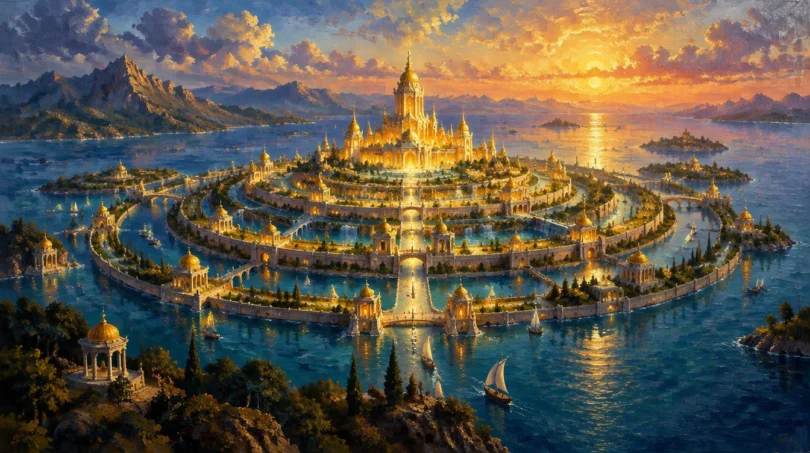
Critias begins with a mythic opening. In the earliest times, he says, the gods divided the whole earth among themselves by lot. Athena and Hephaestus received Attica. Poseidon received the island of Atlantis. There, on a low hill near the middle of a plain, lived a mortal girl named Cleito, whose parents had died. Poseidon fell in love with her. To protect her, he fashioned the hill into a stronghold, surrounding it with alternating rings of sea and land, two of land and three of water, so perfectly round that they looked turned on a lathe. No ship or person could reach the center.
Cleito bore Poseidon five sets of male twins. The god divided the island into ten kingdoms, one for each son. The firstborn of the eldest pair, Atlas, received the central palace and the largest share and gave his name to both the island and the surrounding sea. The ten kings were to rule together, bound by laws said to be inscribed by the first kings on a pillar of orichalcum in the temple of Poseidon.
A Capital Built in Circles
Over generations the kings turned the island into a wonder. They bridged the rings of water and cut a great canal from the outer sea to the innermost harbor, wide and deep enough for the biggest ships. Critias gives numbers: a central island of about five stadia across, rings of land and water widening outward, a canal roughly fifty stadia long, and a great plain of about 3,000 by 2,000 stadia ringed by mountains and cut by an enormous ditch. A stadion is roughly 185 meters, though ancient units varied.
The walls shone. The outermost was sheathed in brass, the next in tin, and the wall of the citadel gleamed with orichalcum, a metal Critias says was mined on the island and prized second only to gold. The temple of Poseidon was coated in silver, topped with gold, and roofed in ivory. Hot and cold springs fed baths and gardens. Docks teemed with traders. The plain was divided into thousands of lots, each owing soldiers, chariots and ships to the state, and Critias tallies a navy of twelve hundred vessels.
He also describes a ritual. Every fifth and sixth year, in alternation, the ten kings met in the temple of Poseidon, hunted bulls without iron weapons, caught one, and sacrificed it at the pillar, swearing to rule by the inscribed laws.
How the Golden Age Ended
Then comes the turn. For many generations, Critias says, the kings stayed faithful to their divine inheritance. They valued virtue above wealth and wore their gold lightly. But as the divine portion within them faded through repeated mixing with mortal nature, human greed took over. To anyone with eyes to see, Plato writes, they looked base, having lost the most precious of their possessions. To those without insight, they seemed at the height of their happiness and power.
Zeus, seeing this, calls the gods together to decide on a punishment. The manuscript breaks off there. We never read what he says, or what Hermocrates would have added in a third dialogue that Plato either never wrote or did not finish.
Was It History, Myth or Parable? How Readers Have Judged Plato
Plato’s first readers did not agree on what they were holding. The disagreement began almost immediately and has never fully stopped.
The Ancient Voices
Aristotle, Plato’s own student, is reported to have thought his teacher invented the whole thing. The geographer Strabo, writing centuries later, passes along the quip that the one who made Atlantis also made it disappear. Whether Aristotle said it exactly that way is uncertain, but the attitude is clear.
Others took it more seriously. Crantor, an early member of Plato’s Academy and the first known commentator on the Timaeus, is often cited as treating the story as history, although scholars debate what the surviving reports really say. The Greek biographer Plutarch, writing around 100 CE, tells in his life of Solon that the lawgiver began a poem on the Egyptian tale but, being old, never finished it, and that Plato later picked up the unused material like a fine plot of empty ground and built on it. In the fifth century CE, the Neoplatonist Proclus preserved Crantor’s views and called the account neither a mere myth nor unadorned history, a phrase that has stuck to Atlantis ever since.
What Mainstream Scholarship Holds
Most classicists today read Atlantis as Plato’s invention, a story crafted to illustrate his ideas about the ideal state. The pattern fits. In the Republic and the dialogues that follow, Plato describes a city that is rational, disciplined and orderly. Ancient Athens in the story fits that description. Atlantis is its mirror: wealthy, maritime, expansionist and ruled by appetite. Many scholars see in it a reflection of the real Athenian empire of Plato’s own lifetime, with its harbors and war fleets and its failed expedition against Sicily in 415 to 413 BCE. The philosopher Julia Annas has noted that insisting on a story’s truthfulness can itself be a signal, in Plato’s hands, that the story is a constructed fiction.
Plato also used myth openly elsewhere. The story of Er at the end of the Republic, which describes souls choosing their next lives, is a famous example. He seems to have believed myth could carry truths that argument alone could not reach. Read that way, Atlantis is not a lie. It is a teaching story.
The Esoteric Reading
Spiritual readers of Plato take a different path. The Neoplatonists, who were mystics as much as philosophers, read Plato’s tales on several levels at once: a literal level, a moral one and a cosmic one. For them, the ring-shaped island could stand for the structure of the cosmos or the layers of the human soul. Atlantis in decline became the soul that forgets its divine origin and mistakes wealth and power for the real prize.
That layered habit of reading never disappeared. Seekers across the centuries have asked the same question in new language. What if Plato was passing on a real memory, wrapped in the language of philosophy? What if Egyptian temple records preserved something the Greeks had forgotten? There is no document that proves it. But the question itself has kept Atlantis alive in the esoteric imagination.
A Fair Place to Stand
Here is where we land, and you are free to land elsewhere. As a matter of documented history, Plato wrote the story, and no earlier source for it exists. As a matter of speculation, some people suspect it distorts an older memory. As a matter of belief, many treat it as a true account of a real civilization. A grown-up spirituality can keep all three on the table without needing to collapse them. The story works on you whether or not it happened. Ask what it is asking of you.
A History of the Idea: From Bacon to Blavatsky
After Plato, Atlantis went quiet. Ancient writers mention it now and then, and medieval scholars knew it mostly through the Latin Timaeus. It was Europe’s voyages across the Atlantic, beginning in the late fifteenth century, that brought the island back.
Atlantis Meets the New World
When explorers reached the Americas, European thinkers asked where these lands and peoples fit into the old stories. Some suggested the new continent was Plato’s Atlantis. The Flemish mapmaker Abraham Ortelius, in 1596, speculated that the Americas had been torn away from Europe and Africa by earthquakes and floods. Francis Bacon wrote a utopian fable, New Atlantis, published in 1627 after his death, imagining a hidden island society devoted to knowledge. His Atlantis was invented, not argued for, but it set the name firmly in the imagination of the modern world. In 1665 the Jesuit polymath Athanasius Kircher published a map of Atlantis in the middle of the ocean. In the late 1600s the Swedish scholar Olof Rudbeck went furthest, arguing that Atlantis was in fact Sweden.
Ignatius Donnelly and the Father of Modern Atlantis
The modern Atlantis movement begins with an American, Ignatius Donnelly. A former congressman from Minnesota, he published Atlantis: The Antediluvian World in 1882. It was a sensation. Donnelly argued that Plato’s account was literal history, that Atlantis had lain in the Atlantic, and that it was the original cradle of human civilization. In his view, the gods and heroes of many mythologies were memories of Atlantean kings, and the similarities between Old World and New World cultures, such as pyramids, flood stories and calendars, came from Atlantean colonists who scattered when their land sank.
Donnelly drew on the science and the scholarship of his day, but his central method was to collect parallels and treat them as proof. Modern archaeologists reject this approach. Cultures can reach similar solutions independently, and the diffusionist claim carries a troubling assumption: that Indigenous peoples of the Americas, Africa and the Pacific could not have built their own monuments. That is a serious problem with Atlantis writing from this period, and it is part of why many scholars have been wary of the subject ever since.
The Occult Turn
Six years after Donnelly, in 1888, Helena Petrovna Blavatsky published The Secret Doctrine, which transformed Atlantis from a lost land into a chapter of spiritual evolution. William Scott-Elliot followed in 1896 with The Story of Atlantis, complete with maps, drawn from what he described as clairvoyant reading of the Akashic Records. Rudolf Steiner gave his own account between 1904 and 1908. Edgar Cayce, from the 1920s onward, added hundreds of trance readings that mention Atlantis. We take each in turn below.
A Timeline at a Glance
| When | Who | What changed |
|---|---|---|
| c. 360 BCE | Plato | Tells the story in the Timaeus and Critias |
| 1627 | Francis Bacon | New Atlantis makes the name a symbol of ideal knowledge |
| 1665 | Athanasius Kircher | Publishes a map placing Atlantis in the Atlantic |
| 1882 | Ignatius Donnelly | Argues Atlantis was the mother of all civilizations |
| 1888 | Helena Blavatsky | Makes Atlanteans the fourth “root race” of humanity |
| 1904 to 1908 | Rudolf Steiner | Describes Atlantis from the “Akasha Chronicle” |
| 1930s to 1940s | Edgar Cayce | Trance readings on Atlantis, crystals and a Hall of Records |
| 1995 | Graham Hancock | Popularizes the lost ice age civilization idea in Fingerprints of the Gods |
Where Was Atlantis? The Geography Debate
If there is one question people ask about Atlantis, it is this. Where?
Plato gives a clue. The island lay in front of the Pillars of Heracles, which Greeks understood to mean the Strait of Gibraltar. That points to the Atlantic Ocean, and it is the reason the ocean carries the island’s name in the first place. But searchers have proposed dozens of locations, some of them far from the Atlantic, and the debate shows how elastic the story is.
The Mid-Atlantic Idea
Donnelly and many after him placed Atlantis somewhere around the Azores, the Canaries or the Madeira islands, imagining a sunken continent whose mountaintops still poke above the water. Modern oceanography has not been kind to this view. Since the 1960s the theory of plate tectonics has explained how the Atlantic basin opened slowly over well over a hundred million years. The seafloor there is made of young, dense oceanic crust. Continents do not sink into it, geologists point out, because continental rock is lighter and floats higher. There is no sunken continent in the Atlantic to find.
Antarctica and Crust Shift
In 1958 Charles Hapgood proposed in Earth’s Shifting Crust that the outer shell of the Earth can slip as a whole, carrying continents to new latitudes. Later writers, including Rand and Rose Flem-Ath in their 1995 book When the Sky Fell, applied the idea to Atlantis and placed it in Antarctica, claiming the continent was once ice-free and temperate. Geophysicists reject the mechanism, and geologists note that Antarctica has been glaciated for tens of millions of years, long before any human beings existed.
Sundaland, Doggerland and the Drowned Shelves
One piece of this is solid science. At the end of the last glacial period, roughly 20,000 years ago, sea levels began to rise, ultimately by around 120 meters. Vast coastal plains vanished. Doggerland, between Britain and the continent, was once dry land with people living on it. Sundaland, the shelf that once joined Southeast Asia’s islands to the mainland, drowned as well. The British scientist Stephen Oppenheimer, in his 1998 book Eden in the East, argued that the flooding of Sundaland may have prompted migrations and left deep memories in flood myths. Others, including Arysio Santos, made the bolder claim that Atlantis itself was in Indonesia. Mainstream scholars see the sea-level rise as real and see the Atlantis link as unproven.
Bimini and the Caribbean
Edgar Cayce’s readings spoke of Atlantean remnants near Bimini in the Bahamas. In 1968, a naturalist named J. Manson Valentine reported a long line of large rectangular stones in shallow water off North Bimini, soon called the Bimini Road. Some believers see a harbor wall or paved street. Geologists, including a USGS researcher who studied the site, have concluded it is natural beachrock that fractured in rectangular blocks. The question has not ended the debate for those who find the formations too regular to be accidental.
Other Candidates at a Glance
| Candidate | Who proposed it | What supports it | What critics say |
|---|---|---|---|
| Mid-Atlantic (Azores) | Donnelly and many others | Plato’s “beyond the Pillars” | Seafloor geology shows no sunken continent |
| Santorini (Thera) | Marinatos, Galanopoulos and others | Real Bronze Age catastrophe | Wrong date, wrong place, wrong scale |
| Southern Spain (Doñana) | Richard Freund and Rainer Kühne | Tsunami-scarred wetlands near the Atlantic | Few archaeologists find the evidence convincing |
| Antarctica | Hapgood, Flem-Ath | Earth crust displacement idea | Not supported by geophysics |
| Sundaland | Oppenheimer, Santos | Real flooding after the Ice Age | No link to Plato’s text or date |
| Bimini | Followers of Cayce | Stone formations underwater | Geologists read them as natural beachrock |
| Sweden, Troy, Malta, Cyprus and more | Rudbeck, Zangger and others | Selected parallels to Plato’s details | Each match requires reshaping the text |
The honest summary is this: no proposed location has won over the professional community. For many seekers, that is not the point. The longing for Atlantis may be less about a coordinate on a map and more about a remembered state of being, which brings us to the esoteric traditions below.
The Minoan Santorini Theory
Among all the proposed locations, one has real archaeology behind it. Santorini, also called Thera, is a ring of volcanic islands in the Aegean Sea. Sometime in the Bronze Age, its volcano erupted in one of the largest explosions in human history, throwing ash across the eastern Mediterranean and collapsing the center of the island into a vast flooded caldera.
What We Know About the Eruption
The Minoan eruption buried a prosperous town now called Akrotiri under pumice and ash. The excavated buildings still hold painted walls, storage jars and furniture. Strikingly, no bodies have been found, which suggests the inhabitants fled after warning tremors. Tsunami deposits and ash layers have been found on Crete and other islands, and the blast would have devastated the coast of the Minoan civilization, the sophisticated sea-trading culture centered on Crete.
The exact date is still argued over. Radiocarbon work places the eruption in the 17th or 16th century BCE, with recent studies leaning toward the 16th. Archaeological evidence from Egyptian and Aegean pottery suggests a somewhat later date, around 1550 to 1480 BCE. Scholars have not settled the question.
How Santorini Became Atlantis
In 1939 the Greek archaeologist Spyridon Marinatos proposed that the eruption had destroyed Minoan civilization and that this event, remembered and retold over centuries, was the source of Plato’s Atlantis. Marinatos later excavated Akrotiri himself, beginning in 1967. In the late 1960s, the geologist Angelos Galanopoulos and the classicist J. V. Luce developed the idea further. Galanopoulos suggested that Plato’s “9,000 years” was a scribal exaggeration of 900, which would place the Egyptian source roughly in the right range, and that the stated dimensions of Atlantis were inflated by a factor of ten in transmission.
There are real attractions here. The Thera caldera is circular. The Minoans were a maritime power with a sophisticated culture, and their world did suffer a real natural catastrophe. If a story of that disaster reached Egypt and was retold over a thousand years, it might have supplied Plato with a kernel.
Why Most Scholars Remain Unconvinced
The problems are significant. Plato says Atlantis lay beyond the Pillars of Heracles, outside the Mediterranean entirely. The Minoans were a peaceful trading culture, so far as the evidence shows, and there is no sign they tried to conquer Athens or Egypt. The Minoan world did not vanish in a day and a night. Crete continued, and the Mycenaean Greeks later took it over. And the fix of changing 9,000 to 900 is something you do to a text only if you have already decided where the answer lies. Finally, Plato’s text says Athens fought and won a war against Atlantis, which has no archaeological counterpart anywhere.
The current mainstream view is that Santorini is not Atlantis, but that the memory of great Aegean disasters may have formed part of the cultural background that Plato drew on. That is a modest claim, and probably the safest. If you stand at the rim of the Santorini caldera today and look out over that ring of water, however, you will understand why the idea has never gone away. The place feels like a story.
The Younger Dryas, Gobekli Tepe and the Lost Civilization Question
Over the past three decades, a new version of the Atlantis question has taken shape. It does not rely on Plato’s details. It asks a larger question: could a sophisticated human culture have existed before the dates that archaeology currently gives us, and could a global catastrophe have erased it?
The Younger Dryas
About 12,900 years ago, as the last Ice Age was loosening its grip, the climate suddenly turned cold again for roughly twelve centuries. This period is called the Younger Dryas, and it ended about 11,700 years ago. Temperatures dropped sharply across much of the Northern Hemisphere, and many large animals went extinct around the same time. What caused the cold snap is a live scientific topic. In 2007 a team led by Richard Firestone proposed that a comet or asteroid fragment broke up and struck the planet. This Younger Dryas impact hypothesis has attracted both defenders and strong critics, and it remains debated, not settled.
Notice something in the numbers. Plato placed the fall of Atlantis 9,000 years before Solon’s visit to Egypt, around 600 BCE. Do the arithmetic and you land near 9600 BCE, which falls close to the end of the Younger Dryas. Cayce’s readings, as we will see, dated Atlantis’s final destruction to roughly the same era. Skeptics counter that Plato’s “9,000” is likely a round, symbolic figure, and that a coincidence of dates is thin ground for a theory.
Gobekli Tepe
In southeastern Turkey, near the city of Sanliurfa, stands a hilltop site called Gobekli Tepe. The German archaeologist Klaus Schmidt began excavating there in the mid-1990s, and what he found astonished the field. Ring-shaped enclosures of massive T-shaped limestone pillars, some carved with foxes, snakes, boars and birds, built around 9500 BCE or earlier. That is thousands of years before pottery, metal tools, cities or farming were thought to have appeared in the region.
Mainstream archaeology holds that Gobekli Tepe was built by hunter-gatherers, probably in a seasonal ritual setting, and that its builders organized large gatherings well before settled agriculture. It has rewritten some textbooks, because it shows that monumental building and shared ritual may have come first, and may even have helped pull people into settled life. Schmidt himself called it a sanctuary. Nearby sites like Karahan Tepe suggest it was part of a wider culture.
The Lost Civilization Argument
The British writer Graham Hancock reads the site differently. In Fingerprints of the Gods (1995) and later Magicians of the Gods (2015), he proposes that Gobekli Tepe may be a legacy of a more advanced Ice Age culture whose heartland was drowned by rising seas or destroyed by the Younger Dryas catastrophe, and whose survivors seeded later civilizations. His Netflix series Ancient Apocalypse brought the argument to a very wide audience in 2022. Other voices on Next Level Soul approach the same territory from their own angles, among them Matt LaCroix and Luke Caverns.
Professional archaeologists have pushed back strongly. They note that no tools, settlements, genetic traces or technologies of such a culture have been found. They see Gobekli Tepe as the product of known, local people who were more capable than we assumed. The Society for American Archaeology publicly criticized the Netflix series. It is also fair to say that Hancock and his supporters point to genuine gaps in the record and genuine surprises, such as the rapid revision of Gobekli Tepe’s importance, and they argue that the field has been slow to revise its assumptions.
Holding the Question Open
We try to stay clear-eyed here. What is documented: sea levels rose by about 120 meters after the Ice Age, burying huge coastal areas where early humans lived, and Gobekli Tepe is real and old. What is speculative: that those facts add up to a lost advanced civilization. What is believed: that this civilization was Atlantis. A fair mind can find the question exciting without treating the answer as known. Archaeology has surprised us before. It may again.
Atlantis in Myth Around the World: Dwarka and the Flood Stories
Almost every culture remembers a time when the water rose. These stories give Atlantis its emotional company, and they raise a good question. Is the Atlantis story one of a kind, or is it one voice in a worldwide chorus?
The Great Flood Stories
The Mesopotamian Epic of Gilgamesh includes a flood hero, Utnapishtim, who builds a boat at a god’s warning and survives. The Hebrew Bible tells of Noah. In Hindu tradition, the sage Manu is warned of a flood by a fish, an incarnation of Vishnu. In Greek myth, Deucalion and Pyrrha survive the waters sent by Zeus and repopulate the earth. The Maya Popol Vuh describes earlier worlds destroyed by flood. Many North American peoples, among them the Hopi, speak of previous worlds that ended in catastrophe.
These tales do not agree on details, and scholars debate whether they point to a single event, many local ones, or a deeper human instinct to explain cycles of creation and destruction. In Plato’s Egyptian priest, we hear a version of the same theme: periodic catastrophes wipe the slate and the survivors begin again with no memory.
Drowned Lands Everywhere
The motif of the sunken land turns up widely. Cornish tradition speaks of Lyonesse. Breton legend tells of the city of Ys swallowed by the sea. Welsh tradition remembers Cantre’r Gwaelod. Tamil literature refers to Kumari Kandam, a lost southern land. The Aztecs remembered Aztlan as their homeland, which our conversation with Luke Caverns on Atlantis and Aztec lost cities touches on. And the Greeks themselves told of Hyperborea, a blessed northern land beyond the winds.
There is also a scientific side. The geographer Patrick Nunn and colleagues have studied Aboriginal Australian oral traditions of coastlines that flooded after the Ice Age and argue that some stories may preserve memory of events 7,000 years old or more. If that is right, oral cultures can carry memory across enormous spans of time, and it is not absurd to ask what else might be held in old stories.
Dwarka: The Atlantis of the East
The closest parallel to Atlantis in the Indian tradition is Dwarka. According to the Mahabharata and the Puranas, Dwarka was the city that Krishna built on the western coast, in what is now Gujarat. After his departure from this world, the texts say, the sea rose and swallowed the city. Tradition links Krishna’s passing to the beginning of the Kali Yuga, the present age of the Hindu cosmic cycle, which tradition dates to 3102 BCE.
Since the 1980s, marine archaeologists from India’s National Institute of Oceanography, working with S. R. Rao and others, have explored the waters near Dwarka and nearby Bet Dwarka and reported submerged walls, anchors and structures. Dating remains contested, with estimates ranging over thousands of years, and some researchers argue the formations are natural or much later. The debate is open. Our conversation The Untold Story of Dwarka with Amish Shah follows the story from a seeker’s point of view, and our Spiritual Cinema feature Dwarka: Atlantis of the East reflects on the film, which you can find available on Next Level Soul. The film’s own description speaks of a 2012 expedition and of artifacts and ruins beneath the Arabian Sea.
What the Chorus Teaches
Taken together, these stories ask something of us. They suggest that people everywhere have felt that the world is fragile, that civilizations can end, and that memory is the thing worth preserving. Whether Atlantis was a place, a myth or a metaphor, it joins a very old human conversation, and our own guide to the lost years of Jesus and the mystery schools explores another thread of that conversation, the idea that ancient temples guarded teachings that the wider world forgot.
If the story of Dwarka draws you in, the film Dwarka: Atlantis of the East explores the submerged ruins off the coast of India and a 2012 expedition to study them. It is available on Next Level Soul TV. Watch the trailer:
What the Skeptics Say
Skepticism is not the enemy of spirituality. It is discernment. Any seeker who has been sold a bill of goods by a confident teacher knows that the question “how do you know?” is a kind of protection. So let us give the skeptics their full voice.
No Physical Evidence
The first and most basic objection is the simplest. After more than a century of searching with sonar, submarines, satellite imaging and deep drilling, nobody has found an island or sunken city that matches Plato’s description. No ring-shaped harbor, no orichalcum, no wrecked fleet. Archaeologists note that real lost cities, such as Troy or Akrotiri, left clear material traces that were found by excavation. Extraordinary claims, in the old saying, call for extraordinary evidence.
The Ocean Floor Disagrees
The seabed of the Atlantic has been mapped in detail, and the geology tells a coherent story: spreading ridges, young oceanic crust, no continental fragments in the wrong places. A landmass the size Plato describes could not have sunk without leaving a trace in the rocks. The 2009 episode in which Google’s ocean mapping seemed to show a grid like a city street plan was explained by Google as an artifact of how ship sonar tracks were collected.
It Reads Like Philosophy
Classicists point out that the story’s details line up with Plato’s philosophical purpose. Atlantis is rich, imperial and corrupt. Ancient Athens is austere, disciplined and just. The war shows virtue beating vice. The story is delivered in dialogues about the ideal state, introduced by Socrates’ request to see his ideal society in action. Scholars such as Christopher Gill, who produced a well-known edition of the Atlantis story, and Julia Annas have argued that this is the literary frame of a thought experiment, not a news report. Aristotle, who knew Plato best, evidently thought so.
The Number Problem
Plato’s dates are tough to square with archaeology. At 9,000 years before Solon, Athens would have been a thriving, organized city around 9600 BCE. Archaeology shows people in Greece at that time living as hunter-gatherers. There were no cities, no organized armies and no Atlantean empire in the Mediterranean to fight them. Believers often respond that the chronology could be garbled or symbolic. Skeptics respond that if you loosen the text to fit the evidence, you are no longer testing it.
The Shadow Side of Atlantis
There is also an ethical concern. Many writers on Atlantis, starting with Donnelly, argued that advanced cultures everywhere must have come from one white, European-style source. This treated Indigenous achievements as impossible. In the early twentieth century, völkisch and occult writers in Germany, among them Karl Georg Zschaetzsch and Herman Wirth, fused Atlantis with a myth of a Nordic master race, and the idea found its way into Nazi circles, including interest from Heinrich Himmler. Responsible writers on Atlantis today make a point of naming this history, and so do we. Any version of the story that ranks human beings by race is a distortion, whatever tradition it claims to speak for.
What a Fair Seeker Can Take from This
You do not have to choose between wonder and rigor. You can enjoy the story, honor the esoteric traditions that grew from it, and still say plainly that there is no proof Atlantis was a real place as Plato describes it. If someone tells you they know where it is and what happened, ask what their evidence is. That question will serve you in every corner of your spiritual life. The power to weigh a claim has always lived within you.
Theosophy: Blavatsky, the Root Races and the Masters
If Plato wrote the script and Donnelly made Atlantis popular, it was Helena Petrovna Blavatsky who made it sacred. Born in Russia in 1831, she co-founded the Theosophical Society in New York in 1875 with Henry Steel Olcott and a small circle of fellow seekers. Her aim was to bring Eastern and Western esoteric wisdom into a single stream. Her two great books, Isis Unveiled (1877) and The Secret Doctrine (1888), shaped almost everything that followed in modern Western spirituality, from New Age thought to channeling.
The Source She Claimed
Blavatsky said The Secret Doctrine was based on a very old text called the Stanzas of Dzyan, which she said she had been shown by adepts in Tibet, and which scholars have never located. She also said she was guided by the Masters, advanced beings she called Mahatmas, who watched over human evolution. That belief in hidden spiritual teachers was later developed into the Ascended Masters tradition, which we map in our complete guide to the Ascended Masters. Critics in her lifetime and since have argued that she drew heavily on existing books and that her sources cannot be verified. Her admirers answer that her real contribution was a spiritual vision and not a bibliography. Both things can be said.
Root Races and the Atlantean Chapter
In Blavatsky’s scheme, humanity unfolds through a sequence of seven “root races,” each tied to a different age and continent. The first were ethereal beings. The third were the Lemurians, who lived on a vanished southern continent. The fourth were the Atlanteans, who in her telling developed formidable psychic gifts and technologies and eventually misused them. The fifth, the so-called Aryan root race, is the one that supposedly follows the fall of Atlantis and includes humanity today. Theosophical chronologies stretched Atlantean history over hundreds of thousands of years and more, far beyond Plato’s 9,000. Atlantis, in this reading, did not sink in a single day. It broke apart over ages, with the last remnant island, which Plato’s Atlantis was understood to be, going under much later.
William Scott-Elliot’s The Story of Atlantis (1896) built on this with detailed maps and descriptions that he said came from clairvoyant study of the Akashic Records. Later Theosophical writers, among them C. W. Leadbeater and Annie Besant, added more, including the 1913 book Man: Whence, How and Whither.
A Necessary Caution
Here we have to be honest. The root-race scheme in its original form arranged peoples of the world in a hierarchy, and some versions treated certain races as more spiritually advanced than others. That is not a teaching we share, and it is not one most Theosophists hold today. Many modern readers prefer to understand the root races as stages of consciousness, not as divisions of human beings. The scheme was also taken up and twisted by Aryan-supremacist writers in the early twentieth century, which we mentioned above. Any honest engagement with this tradition has to hold both its imaginative richness and its history of misuse.
Why Theosophy Still Matters Here
Strip away the dated language and something durable remains. Blavatsky taught that history has an inner dimension, that consciousness evolves over ages, and that civilizations carry spiritual lessons. She also planted the idea that records of all this exist in a non-physical memory of nature. That leads straight into the next tradition. If you are curious how these ideas developed into practices you can do today, our audio course The Hidden Science of the Soul draws on the esoteric teachings of Yogi Ramacharaka and covers the sevenfold anatomy of the soul, prana, the aura and karma across 13 chapters. It is included with Next Level Soul membership.
Rudolf Steiner and the Akashic Records
Rudolf Steiner was an Austrian philosopher born in 1861 who became the leading figure of the German Theosophical Society before breaking away to found Anthroposophy in 1912 and 1913. He is also the founder of the Waldorf education movement and a pioneer of biodynamic farming. Between 1904 and 1908 he published a series of essays in the journal Lucifer-Gnosis that described the ancient past of the Earth, including Lemuria and Atlantis. They were later gathered into the book known in English as Cosmic Memory.
Reading the Akasha Chronicle
Steiner did not claim to be remembering. He claimed to be reading. The source, he said, was the Akasha Chronicle, a subtle record impressed on the spiritual substance of the world, accessible to a trained perception that he called spiritual science. The term akasha comes from Sanskrit and means space or ether. It entered Western occult writing through Theosophy. A. P. Sinnett’s Esoteric Buddhism (1883) helped popularize the idea of a record, and C. W. Leadbeater’s Clairvoyance (1899) tied it directly to clairvoyant reading.
Steiner’s Atlantis
Steiner’s Atlantis is very different from Plato’s. As he described it, the Atlanteans lived in a world of dense, watery mist in which the rainbow had not yet appeared. They did not think in the logical, abstract way we do. Instead they had extraordinary memory, strong will and a dreamlike sensitivity to the life forces in nature, which they could draw on to power their vehicles and tools. Over time, he said, some of them turned these capacities toward selfish ends, and the result was the catastrophe that closed the age. In his scheme, the survivors carried the seeds of a new stage of human consciousness, in which logical thinking and a strong sense of an individual “I” emerged.
You can see why this has appealed to so many seekers. It is not a story about technology as we know it. It is a story about the evolution of awareness. Steiner’s Atlantis is a chapter in how consciousness developed, not a prehistoric Las Vegas.
What Are the Akashic Records Today?
Practitioners today describe the Akashic Records as a kind of library of the soul, holding the imprint of every thought, word and deed. Many people now work with them through guided prayers and meditation, asking questions about their soul’s history and lessons. Our full guide What Are the Akashic Records? A Complete Guide to Your Soul’s Archive explains the concept and how people approach it. On the podcast, Laura Coe, a practitioner of the Akashic Records, shared how she sees Atlantis’s origins, and Danielle Hoffman channeled Thoth to decode Atlantean teachings.
An Honest Note on Evidence
No scientific study has demonstrated that an Akashic Record exists as a literal archive. The evidence is anecdotal and personal. Different readers report different Atlantises. Steiner’s misty, life-force world does not match Cayce’s crystal power plants, which does not match Scott-Elliot’s maps. Practitioners tend to answer that each reader receives the record through their own mind, culture and symbols, which is why accounts vary. Skeptics answer that the variation is exactly what you would expect from imagination. Both explanations are available to you.
Our suggestion is simple. Treat what you receive as a mirror and not as a proof. Ask what it shows you about your present life. If a reading helps you act with more compassion and clarity, it has done real work. If it makes you anxious, grandiose or dependent on a reader, step back. The Atlantean theme is not a test of how much you can remember. It is an invitation to ask who you are becoming. For a grounded reflection on that deeper question, our guide to non-duality offers a useful counterweight to all the storytelling.
Edgar Cayce and the Atlantis Readings
No one did more to make Atlantis a personal matter for ordinary Americans than Edgar Cayce. Born in Kentucky in 1877, Cayce spent his life giving what he called readings while lying in a self-induced trance. A stenographer wrote down his words. He died in 1945, and the Association for Research and Enlightenment, founded in 1931 in Virginia Beach, still preserves the transcripts. Admirers called him the Sleeping Prophet. Skeptics have called him an intuitive with a gift for suggestion. His readings are the source of much of what the public believes about Atlantis today.
Life Readings and Atlantis
Cayce’s early readings were medical. In the 1920s he began giving what he called life readings, which described the past lives of the person asking. Many of these placed the individual in ancient Egypt, in Persia or, remarkably often, in Atlantis. The records hold hundreds of readings that mention Atlantis. In the world of Cayce’s readings, Atlantis was not a distant myth. It was the place certain living people had come from.
What the Readings Claimed
Attributing every claim to the readings themselves, Cayce described Atlantis as an advanced civilization that went through several periods of destruction, the last of which, in his chronology, fell around 10,000 BCE, in rough agreement with Plato’s dates. He gave the land the name Poseidia. Its people, the readings said, divided into groups, one called the Law of One or the Sons of the Law of One, devoted to service and spiritual growth, and another, called the Children of Belial, devoted to power and appetite.
The readings spoke of a great crystal, sometimes called the firestone, which gathered energy from the sun and stars and was used for power, healing and rejuvenation. When the crystal was tuned too high or misused for domination, the readings said, it triggered upheavals that began the destruction. Critics have noted that the crystal story resembles the science fiction of the 1930s. Believers see it as a symbol of how any great power, used without love, harms the user first. These crystal claims also seeded much of the modern New Age interest in stones, which we cover in our guide Crystals for Healing: Meanings, Uses, History and What Research Says.
The readings also told of three repositories of Atlantean records, one in the sunken land itself, one in the Yucatan, and one in Egypt near the Sphinx, which later writers called the Hall of Records. Nobody has found such a chamber, and Egyptologists dismiss the idea.
The Bimini Prediction
In 1940, one reading said part of Atlantis would begin to rise again, with signs in the Bahamas around 1968 or 1969. In 1968 the Bimini Road was reported. For believers that was a remarkable match. For skeptics, geologists who studied the formation found natural beachrock, and the time window was wide enough to catch many coincidences. Cayce’s broader predictions of massive earth changes, which included shifting poles and the destruction of coastal cities, have not occurred on the schedules the readings suggested.
How to Hold Cayce
There is a wise middle path. Cayce’s medical and spiritual advice helped many people, and his Atlantis material has inspired generations to ask big questions about technology, power and compassion. At the same time, the readings are a claim and not a demonstration. A reading is only as dependable as the process behind it, and that process cannot be independently checked. Ask yourself what message in the Atlantis readings rings true in your own life, and let the rest remain an open question.
If the idea of a spiritual lineage connecting ancient mystery schools to the present speaks to you, the audio course Mystery Schools of the Ancients takes up the guarded teachings of Egypt, Atlantis and Greece across 22 chapters on universal laws. It is included with Next Level Soul membership.
The Law of One, Channeled Accounts, and a Word on Lemuria and Mu
Since Cayce, Atlantis has been a favorite subject of channeled material. Different voices tell different stories, and the contrasts are worth noticing.
The Ra Material and the Law of One
Between 1981 and 1984, a researcher named Don Elkins, his colleague Jim McCarty and a channel named Carla Rueckert held more than a hundred sessions at their home in Kentucky in which a source calling itself Ra spoke. The transcripts were published as The Law of One and related books. According to the material, Ra is a collective consciousness that once walked among early Egyptians. It describes Atlantis as a civilization whose people divided into those who followed the Law of One, that all things are one, and those who chased power. The language echoes Cayce’s “Sons of the Law of One,” which readers have long noted. The Law of One has since built a devoted following of its own and is discussed widely in spiritual communities. As with all channeled material, it can be valued for its teaching without being treated as historical proof.
Voices on Next Level Soul
The channeled and intuitive accounts that come through our guests vary widely. Matias De Stefano spoke about the prophecy of Atlantis’ fall, drawing on what he describes as memories of his own past lives. Michael Le Flem has explored the lost civilization from the perspective of a historian and researcher, and returned to share an ancient Atlantean prophecy. Matt LaCroix presents what he calls evidence of a global civilization spanning Egypt, Sumer, Turkey and South America. Belinda Womack channels ascended masters and archangels, Darryl Anka channels the extraterrestrial consciousness Bashar, and Sonja Grace speaks of time and the future from an Indigenous psychic perspective. Many of our guests refer to Atlantis, and none of them offer the same map.
That difference is itself a teaching. You can read the variety as a sign of imagination at work, or as different seers touching different facets of something real. We do not ask you to settle it. We ask you to listen with an open heart and a discerning mind, and to notice what stirs.
A Word on Lemuria and Mu
Atlantis has a companion, Lemuria. The idea began as science. In 1864 the zoologist Philip Sclater proposed that a land once stretched across the Indian Ocean to explain why lemur fossils appeared in Madagascar and India but not Africa. The theory faded once continental drift and plate tectonics explained the distribution of species. Blavatsky took the name for her third root race. Later, a writer named James Churchward claimed in The Lost Continent of Mu (1926) that a vast Pacific land had been the oldest civilization, based on tablets he said he had read in India, which have never been verified. In modern New Age lore, Lemurians are gentle, heart-centered beings, sometimes said to live on in places like Mount Shasta in California. No geological or archaeological evidence supports a sunken Lemuria or Mu. Many people, however, work with the symbols as a picture of an earlier stage of consciousness, softer and more intuitive than Atlantis’ intellect and power.
For Deeper Study
If you want a structured way to explore these threads, our audio course Echoes of Atlantis offers retellings, guided practices and sacred reflections on the rise and fall of Atlantis across 11 chapters. It is included with Next Level Soul membership. You can also watch the series When Atlantis Ruled the World, eight episodes of conversations with teachers and researchers, available on Next Level Soul.
How Atlantean Past Life Memories Are Described
For many people, Atlantis is not a topic. It is a feeling. They hear the word and something in the chest tightens or opens. Others discover it later, through a dream, a meditation, a regression session or a reading. What follows is a description of how people report these experiences, offered with care and with caution.
What People Commonly Describe
Accounts of Atlantean memories share certain recurring images. People speak of temples of white stone and gold. Of crystal chambers that hum. Of water, canals, harbors and the smell of salt air. Of sound used to heal, through tones and chanting. Of a life as a healer, a priestess or priest, an engineer or a keeper of records. Some describe the final days: the sense of warning, the scramble, the water rising.
The emotional notes are often more important to the people involved than the pictures. Recurring ones include a deep grief over something lost, a quiet guilt about the misuse of power or knowledge, a fear of water or of floods, an instinct to hide one’s gifts, or a vow made in that life never to repeat a mistake. People also describe being drawn, without knowing why, to Egypt, to pyramids, to the sea or to crystals.
How These Memories Arrive
They come in many ways. Spontaneous dreams are common. So are meditative states, regressions led by a hypnotherapist, readings from intuitives and encounters with places. On the podcast, Connie H. Deutsch shared a past life in Atlantis she remembered, and in a separate conversation she explored past lives and mankind’s future with her spirit guide. The hypnotist Sarah Breskman Cosme describes Atlantis history revealed through hypnosis. Matias De Stefano, who describes remembering his past lives, speaks about humanity’s chaotic future and rebirth in light of such memories.
A Gentle, Grounded Caution
This is the part we most want you to hear, so we will say it plainly.
Memory is not a recording. Psychologists, including the researcher Elizabeth Loftus, have shown that memories can be shaped by suggestion, and that vivid, emotional images are not the same thing as accurate ones. Hypnosis tends to increase confidence in what is recalled without necessarily increasing accuracy. There is also the phenomenon of cryptomnesia, in which something you read or saw long ago resurfaces and feels new. Atlantis is, in addition, one of the most culturally saturated stories there is. It is in films, books, cartoons and countless meditations. A mind seeking a story for a feeling may reach for the nearest ready-made one.
None of this proves your experience is false. It does suggest holding it lightly. A few guidelines may help.
- Hold the story loosely. You can value an image without insisting that it happened.
- Ask what it is showing you now. A fear of misusing your gifts, a grief about loss, a pull toward service: these live in your present life.
- Watch for grandiosity and for shame. “I was a great priestess” and “I caused the fall” are both ego stories. Neither is required.
- Be wary of anyone who profits from your fear. A reader who tells you that you are cursed, or that only they can help, is not a safe guide.
- Look after your body and mind. If images or feelings are distressing, disrupt your sleep or your daily life, talk to a licensed mental health professional. That is wise, not a failure of faith.
Where Karma and Non-Duality Fit
Many traditions teach that past experience shapes present patterns. Our guide to karma and how it really works explores that link. A nondual view adds a further question: if memories rise and fall in awareness, who is the one who watches? You can explore that in our introduction to non-duality. The audio course The Hidden Science of the Soul also covers the astral life between lives and karma in its 13 chapters, and is included with Next Level Soul membership.
A Practice: Working with Atlantis Themes
You do not have to believe in Atlantis to use it. Whatever the history, the themes it carries are alive in your own life: power and humility, knowledge and wisdom, technology and heart. The practices below treat Atlantis as a mirror. Use all three or only one.
Practice One: Seven Days of Journaling
Set aside ten minutes a day for a week. Write by hand if you can. Use one prompt each day.
- Day 1, Pull. What first drew me to Atlantis? What do I feel in my body when I hear the word?
- Day 2, Splendor. Where in my life do I feel brilliant, capable and alive?
- Day 3, Shadow. Where do I use cleverness, speed or control when what is needed is patience and care?
- Day 4, Balance. What would balance look like this week between head and heart, work and rest, giving and receiving?
- Day 5, Water. What am I afraid of losing? What would I save first?
- Day 6, Seeds. What wisdom do I want to carry forward and pass on? What can I let go of?
- Day 7, Vow. What one small commitment would honor everything I have written?
Practice Two: A Fifteen-Minute Meditation by the Water Temple
Sit comfortably. Let your breath slow. Read each step, then close your eyes and follow it in your own time.
- Feel your weight in the chair or on the floor. Take five slow breaths.
- Imagine standing at the edge of calm water at dusk. The sky is gold and deep blue. You are safe.
- Ahead, a circular temple rises from the water. Notice it without forcing detail. Whatever you see is welcome.
- Walk across a bridge. At each step, let go of one worry or demand.
- Reach the center. Sit. Place a hand on your heart and ask, “What do I most need to remember?”
- Wait. Do not chase an answer. A word, an image, a feeling or only quiet may come.
- Thank whatever came. Return across the bridge. Breathe. Open your eyes slowly.
- Write down one line. Then close the notebook and go about your day.
If nothing came, that is a perfectly good session. Presence is the practice. Imagery is a bonus.
Practice Three: Seeds, Not Towers
At the end of each day for a week, ask two questions. What did I build today that served only my image, my speed or my control? What did I plant today that could grow quietly into something that helps others? Write one line for each. The phrase “carrying seeds, not towers” is one of the themes of our audio course Echoes of Atlantis, which weaves guided practices through 11 chapters and is included with Next Level Soul membership.
If You Want to Go Further
For a gentle start, our free masterclasses introduce teachers and practices without cost. For a deeper commitment, Next Level Soul Mastery offers full courses from leading teachers. Whatever you choose, keep the focus where it belongs. The point of remembering the past is to live more wisely now.
Atlantis in Popular Culture
Few ideas have traveled as far as Atlantis. A short tour shows how the story has been retold, and how much of what we believe about it comes from entertainment and not from Plato.
- Jules Verne, 1870. In Twenty Thousand Leagues Under the Sea, Captain Nemo takes a guest on a walk through submerged ruins he calls Atlantis.
- Comics. Marvel’s Namor first appeared in 1939 as ruler of an undersea kingdom, and DC’s Aquaman is king of Atlantis. The Atlantean hero of the comics has since reached the movies.
- Film. The 1961 movie Atlantis, the Lost Continent set the mold for sword-and-sandal Atlantis. Disney released Atlantis: The Lost Empire in 2001, for which the linguist Marc Okrand, creator of the Klingon language, designed an Atlantean tongue. Aquaman followed in 2018.
- Television. Stargate Atlantis ran from 2004 to 2009, a BBC series called Atlantis aired from 2013 to 2015, and Graham Hancock’s Ancient Apocalypse reached Netflix viewers in 2022.
- Everyday life. A US Space Shuttle was named Atlantis and first flew in 1985. A large resort on Paradise Island in the Bahamas bears the name too.
Notice what the stories do with it. They treat Atlantis as a place of technological marvels and a cautionary tale about ambition. That is a modern spin. Plato’s Atlantis was not mainly about gadgets. It was about the character of a people and what happens when appetite replaces wisdom.
Atlantis on Next Level Soul
If you want to explore on screen, the documentary The Atlantis Puzzle reexamines the legend, according to its description, through new translations and research into Plato’s writings. Our own Spiritual Cinema review of The Atlantis Puzzle is coming soon. The series When Atlantis Ruled the World gathers eight episodes of conversations with teachers and researchers. The film Dwarka: Atlantis of the East follows the Indian story, and the interview The Lost Knowledge of Atlantis Returns with Matt LaCroix is available as well. All are available on Next Level Soul.
A little pop culture can be a doorway. It can also bury the deeper questions under special effects. As you watch, ask yourself which parts of the Atlantis you picture came from a text, which from a film, and which from somewhere you cannot name.
Books and Further Reading
A reading list in four groups: the source, the believers, the skeptics and the bridge-builders. Read across them and you will see the whole conversation.
The Source
- Timaeus and Critias by Plato, in the Penguin Classics translation by Desmond Lee with an introduction by Thomas Kjeller Johansen. Short, and the place to start. Read what Plato actually wrote before anyone tells you what he meant.
The Classic Believers
- Atlantis: The Antediluvian World by Ignatius Donnelly (1882). The book that started the modern movement. Read it for history, not for science.
- Edgar Cayce on Atlantis by Edgar Evans Cayce. Drawn from the readings by Cayce’s son, with attention to the crystal and Hall of Records material.
- Cosmic Memory by Rudolf Steiner. His Akasha Chronicle accounts of Atlantis and Lemuria.
- The Secret Doctrine by Helena Blavatsky (1888). Dense and demanding, and the root of the whole esoteric tradition.
The Skeptics and the Historians
- Lost Continents by L. Sprague de Camp (1954). A witty and thorough history of the Atlantis idea.
- Frauds, Myths, and Mysteries by Kenneth L. Feder. An archaeologist’s guide to evaluating claims about the past, with attention to Atlantis.
The Bridge-Builders
- Atlantis and the Cycles of Time by Joscelyn Godwin. A scholar’s sympathetic look at the esoteric traditions of Atlantis and the cycles of ages.
- Fingerprints of the Gods by Graham Hancock (1995). The best-known case for a lost ice age civilization. Read it alongside a critic.
If you buy through our Amazon links, it supports our work at no extra cost to you.
Who Will Connect with Atlantis, and Where to Go Next
Atlantis may speak to you if you love big questions and are comfortable leaving some of them open. If you are drawn to the idea that human history is deeper and stranger than the textbooks suggest. If you feel a pull toward Egypt, the sea, crystals or sacred geometry. If you like to think of civilizations as living things that can learn and forget. Or if you simply enjoy a good mystery that points back toward your own heart.
It may be less useful if you need firm proof before anything is worth your attention, or if you find that speculation about the past leaves you anxious or ungrounded. That is fine. There is plenty of spiritual practice that does not require a lost continent. What matters is the quality of your attention today.
Keep Exploring
Start where your curiosity is strongest. For the lost-knowledge side, listen to Matt LaCroix, Michael Le Flem or Randall Carlson. For the inner side, try Connie H. Deutsch on a remembered Atlantean life or our guide to the Akashic Records. For the Indian thread, there is Amish Shah on Dwarka. For the teachers behind the traditions, see our guide to the Ascended Masters.
Four audio courses sit close to this topic, each included with Next Level Soul membership. Echoes of Atlantis has 11 chapters of retellings and guided practice. Mystery Schools of the Ancients has 22 chapters on the guarded teachings and universal laws. The Hidden Science of the Soul has 13 chapters on the soul, karma and the aura. Alchemy of the Soul has 17 chapters on the Emerald Tablet and Hermes Trismegistus.
If you would like a guided path beyond this page, browse the free masterclasses or explore Next Level Soul Mastery. Whatever you choose, take your time. Atlantis has waited a very long while.
Frequently Asked Questions
Was Atlantis real?
There is no archaeological or geological evidence that Atlantis existed as Plato described it, and most classicists regard the story as Plato’s invention to illustrate his philosophy. Some researchers suggest it may distort an older memory, such as the Santorini eruption or a flooded Ice Age coastline, and many spiritual traditions treat it as real. Documented history supports the text. The rest is speculation or belief.
Who first wrote about Atlantis?
The Greek philosopher Plato, in two dialogues called the Timaeus and the Critias, written around 360 BCE. No earlier source for the story is known. Plato said it came from the Athenian lawgiver Solon, who heard it from Egyptian priests.
Where was Atlantis supposed to be?
Plato placed it beyond the Pillars of Heracles, usually understood as the Strait of Gibraltar, which suggests the Atlantic Ocean. Others have proposed Santorini, Antarctica, Sundaland, southern Spain, Bimini and many more. No location has been accepted by professional archaeologists.
What did Plato say happened to Atlantis?
In the Timaeus, Plato writes that after a failed war against Athens, earthquakes and floods struck, and in a single day and night the island vanished beneath the sea. The Critias adds that the Atlanteans had grown greedy and lost their virtue, and then the manuscript breaks off.
What did Edgar Cayce say about Atlantis?
Cayce’s trance readings claimed Atlantis was an advanced civilization, destroyed in stages, with a final fall around 10,000 BCE. They described a great crystal that powered the land and three repositories of records. One reading said part of Atlantis would rise near Bimini around 1968 or 1969. These are claims from the readings and have not been verified.
What is the Theosophical view of Atlantis?
Helena Blavatsky’s The Secret Doctrine (1888) described the Atlanteans as the fourth of seven root races, following the Lemurians. Later Theosophists added maps and detailed histories. The original root-race scheme included hierarchical ideas about human groups that many modern readers reject, preferring to treat the stages as phases of consciousness.
What do the Akashic Records say about Atlantis?
Different readers report different things. Rudolf Steiner, who said he read the Akasha Chronicle, described an Atlantis of mist, strong memory and life-force technology. Other practitioners describe other versions. There is no scientific verification of the Records, so accounts are best treated as personal or symbolic. Our guide to the Akashic Records explains how people work with them.
Is Gobekli Tepe connected to Atlantis?
Mainstream archaeology holds that Gobekli Tepe in Turkey, dated to about 9500 BCE or earlier, was built by hunter-gatherers. Writers such as Graham Hancock suggest it may reflect a lost Ice Age civilization. No direct evidence of such a civilization has been found, and the link to Atlantis is speculative.
Could I have lived in Atlantis in a past life?
Some people feel they have, and several traditions teach that souls reincarnate through many ages. Memory can be shaped by suggestion, imagination and stories we have absorbed, so it helps to hold such impressions lightly and ask what they show you about your present life. If they cause distress, talk with a licensed mental health professional. Our guide to karma may also help.
How can I explore Atlantis on Next Level Soul?
You can listen to conversations such as Matt LaCroix on Atlantis, watch The Atlantis Puzzle and When Atlantis Ruled the World, which are available on Next Level Soul, and try the audio course Echoes of Atlantis, included with membership.