The Emerald Tablet is a very short text, traditionally attributed to the legendary Hermes Trismegistus, that became a cornerstone of alchemy and Western esoteric thought. Its few lines speak of unity, correspondence between heaven and earth, and the making of a wiser self. This study guide walks through all 8 teachings in plain language, then hands you a workbook to try the ideas on your own life.
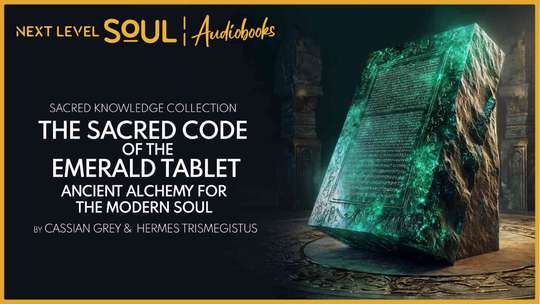
Listen While You Study
The audiobook is available on Next Level Soul TV. Play a teaching, then come back here for the notes and the workbook prompt.
Key Takeaways
- The text is old, brief, and mysterious. It is only a handful of lines, yet readers have studied it for over a thousand years.
- Its origins are legendary, not proven. Tradition credits Hermes Trismegistus, but scholars treat that attribution as a legend, and the earliest known versions are in Arabic.
- Its best-known idea is correspondence. The text teaches that what is above mirrors what is below, so the inner and outer worlds reflect each other.
- Alchemists read it as a map of transformation. Many taught that the same steps that refine a substance can refine the soul.
- You can use it as a practice, not only a puzzle. Each teaching in this guide comes with one small exercise you can try in a few minutes.
The Book at a Glance
| Detail | What to Know |
|---|---|
| Author | Attributed to Hermes Trismegistus (legendary; true author unknown) |
| First known form | Arabic, around the 8th or 9th century; Latin from the 12th century |
| Teachings | 8 |
| Tradition | Hermeticism and Western alchemy |
| Audiobook | Available on Next Level Soul TV |
What Is The Emerald Tablet About?
The Emerald Tablet is a short text that claims to hold the root secret of nature and of the Great Work of alchemy. In the old story, it was found carved on a slab of green emerald, held by Hermes Trismegistus. That tale is legend. The oldest versions we can actually trace are in Arabic, from around the 8th or 9th century.
The text speaks in riddles. It talks about one source behind all things, about the Sun and Moon as parent figures, about wind and earth, and about separating the fine from the coarse. Alchemists read this as a recipe for turning matter into gold. Later spiritual readers see a guide to inner change. This guide follows the text step by step and lets you choose how to read it.
The Board: 8 Teachings
Each square is a teaching. Tap one to jump to its study notes.
Teaching-by-Teaching Study Notes
These notes are our own summary, written to help you follow the book. Each one ends with a small practice you can try this week.
The declaration of truth
The text opens by insisting that what follows is true, certain, and free from deceit. This is a bold start for a riddle. It tells the reader to approach the words as a serious teaching, not a game. In the Hermetic tradition, truth is something you test by living with it. The opening asks for honesty first: with the text, and with yourself, before any deeper work begins.
As above, so below
This is the most famous teaching. What is below is like what is above, and what is above is like what is below, and together they work the wonders of one thing. Readers have taken this to mean that heaven and earth, mind and matter, and the large and small all echo each other. The idea invites you to look for patterns that repeat at every scale of life.
All things come from one
The text says that all things come from one source, through the thought of one, and so all things are born from this single thing by adaptation. Here the tablet states its view of unity. Many forms, one root. Hermetic thinkers saw the world as a single living whole rather than a heap of separate parts. This teaching asks you to notice what connects things instead of what divides them.
Sun and Moon, wind and earth
Next come strange images. The one thing has the Sun as its father and the Moon as its mother. The wind carries it in its belly, and the earth nurses it. Alchemists read these as symbols of fire and water, active and receptive, spirit and body. The picture is of a being that is born, carried, and fed by the natural world. Growth needs both force and care.
The father of every marvel
The text calls this one thing the source of every wonder in the world and says its power is complete when it is turned into earth. Hermetic writers often meant that spiritual power must become grounded and practical. An idea that stays in the clouds is not whole. The teaching points toward bringing insight down into daily life, where it can actually be tested and used.
Separate the fine from the coarse
Here the instruction is practical. Gently, and with great skill, you separate earth from fire and the subtle from the thick. Alchemists described this as refining a substance in stages. Spiritual readers take it as sorting your inner life: what is light and clear from what is heavy and clouded. The key words are gently and skillfully. Forcing the process is not the way.
Rise to heaven and return to earth
The one thing is said to climb from earth to heaven, then come back down, gathering the power of both the higher and the lower. The text then promises the glory of the whole world and says that darkness will flee. Readers see a cycle of ascent and return. You go up in insight, then bring it back into life. The gain comes from doing both.
The seal of Hermes Trismegistus
The closing lines say this power overcomes what is subtle and enters what is solid, and that the world was shaped in this pattern. The speaker then names himself as Hermes Trismegistus, whose name means thrice great, and says the teaching about the work of the Sun is complete. Scholars see this as a signature added by the tradition. It places the text inside the Hermetic world.
Key Ideas in Plain Language
| Idea | What It Means | Teaching |
|---|---|---|
| Correspondence | The idea that patterns repeat across levels, so the small world mirrors the large one. It is the heart of “as above, so below.” | 2 |
| Unity | All things share one source. The many forms are expressions of a single whole. | 3 |
| Polarity | Pairs like Sun and Moon, fire and earth, or active and receptive work together instead of fighting. | 4 |
| Grounding | Spiritual power becomes real when it is brought into practical, earthly form. | 5 |
| Refinement | Separating the subtle from the coarse, gradually and with care. Alchemists used this for substances, and many readers use it for the self. | 6 |
| Ascent and return | Insight rises, then comes back to enrich daily life. Both movements matter. | 7 |
| The Great Work | The alchemical aim of transformation, read either as turning matter into gold or as perfecting the soul. | 1, 6, 7 |
| Hermetic tradition | A stream of philosophy and spiritual teaching traditionally linked to Hermes Trismegistus, a legendary figure blending Hermes and Thoth. | 8 |
Who This Book Is For
This guide is for anyone curious about alchemy, Hermetic wisdom, or the roots of Western spiritual thought. You do not need any background. If you have met the phrase “as above, so below” and wondered where it comes from, this is a good place to start. It also suits readers who like short, dense texts that reward slow, repeated study.
An 8-Day Way to Use It
- On days 1 and 2, listen to the audiobook once through without stopping. Then read Teachings 1 and 2 in this guide and do the two practices.
- On days 3 to 5, take one teaching a day from 3 to 5, ending each day by writing one sentence about what you noticed.
- On days 6 and 7, work through Teachings 6 and 7. Look for moments when you rise in insight, then bring it back down into action.
- On day 8, read Teaching 8 and the full tablet again, then choose your favorite practice. On day 9, reread your notes and decide which one to keep.
Your Workbook
Your answers save on this device as you type. They are not sent anywhere. Use the copy button to move them into your own notes.
Watch More on Next Level Soul TV
Next Level Soul TV brings together full episodes, courses, movies, series and audiobooks, ad-free. Join Next Level Soul TV and keep exploring.
Keep Going
- Alchemy of the Soul audio course, which explores the Emerald Tablet teachings
- Saint Germain: The Violet Flame Master, His History and Teachings
- Best Spiritual Audiobooks: 10 Essential Listens (Plus 2 Bonus)
Sources and Further Reading
Go Deeper with NLS Mastery: The Spiritual Alchemy of St. Germain
The Emerald Tablet is the root text of Western alchemy, which holds that inner change is the source of outer change. If you want to take that idea further, David Christopher Lewis teaches it in The Spiritual Alchemy of St. Germain, part of NLS Mastery. Watch the course preview below.
Frequently Asked Questions
What is the Emerald Tablet about?
It is a short, riddling text about the unity of all things, the link between heaven and earth, and a process of refinement. Alchemists read it as a guide to transmutation, while spiritual readers see a path of inner change.
Who wrote the Emerald Tablet and when?
The text is traditionally attributed to Hermes Trismegistus, a legendary figure, so the true author is unknown. The earliest known versions are in Arabic, from about the 8th or 9th century, and Latin translations followed in the 12th century.
What kind of book is the Emerald Tablet?
It belongs to the Hermetic and alchemical tradition. It is a very short esoteric text rather than a full book, and later writers wrote long commentaries to explain it.
How many teachings does this guide cover, and what are they?
This guide groups the tablet into 8 teachings: truth, as above so below, the One, Sun and Moon, the father of marvels, separating fine from coarse, rising and returning, and the seal of Hermes.
What does “as above, so below” mean?
It means that the higher and lower levels of reality mirror each other. Readers apply it to heaven and earth, mind and body, or inner and outer life. It is a lens for finding patterns, not a proof of any claim.
What is the “one thing” in the Emerald Tablet?
The text never names it plainly. Alchemists took it as the first matter of their work, while spiritual readers take it as the single source or life force behind everything. Its meaning remains open.
Why are the Sun and Moon mentioned in the text?
They stand as father and mother of the one thing. In alchemy they often symbolize gold and silver, or fire and water. Spiritual readers see active and receptive forces working together.
How should a beginner study the Emerald Tablet?
Go slowly. Read or listen once for the overall feeling, then take one teaching at a time. Write down what each line stirs in you, and treat the images as symbols to explore.
Is the Emerald Tablet hard to read?
The text is very short but dense and symbolic, so it can feel puzzling at first. That is normal. Many readers find it easier with a guide that explains the images in plain language.
How long does it take to study?
The text itself takes only a few minutes. Working through this guide and workbook over 8 days, with a small daily practice, is a gentle pace for most people.
How does this study guide and workbook help?
It breaks the tablet into 8 clear teachings, explains each in simple words, and gives one small practice per teaching. You get a way to test the ideas in daily life, not only think about them.
Where can I listen to the audiobook, and what next?
The audiobook is available on Next Level Soul TV. After it, you might explore other Hermetic writings, books on alchemy, or classic works on the laws of the mind and spirit.
Spirituality for the Rest of Us™
Movies, teachings and community on Next Level Soul TV.