The Great Pyramid of Giza is the largest Egyptian pyramid and the oldest of the Seven Wonders of the Ancient World. Built around 2600 to 2560 BCE as the tomb of the pharaoh Khufu, it is a monument of about 2.3 million stone blocks that stood as the tallest human-made structure on Earth for nearly 3,800 years. Egyptologists see a royal tomb, while many seekers see sacred geometry, cosmic alignment and spiritual purpose.
This guide covers the history of the Great Pyramid, what is inside it, how it was built, and the debates about its mathematics, alignment and age. It also looks at what it meant to the ancient Egyptians, what NLS guests say about it, and a simple meditation inspired by its shape. We keep it grounded, with the facts first and the mystery honored.
Key Takeaways
- What it is. The Great Pyramid of Khufu on the Giza plateau, built around 2600 to 2560 BCE and still largely intact.
- Who built it. Evidence from a workers’ town, tombs and the Merer papyri points to a large organized workforce of paid and fed laborers, not slaves.
- What is inside. Three main chambers, the Grand Gallery and narrow shafts, plus hidden voids found by the ScanPyramids project.
- The mystery. Its precision, alignments and geometry inspire debates about sacred design, with Egyptologists and alternative researchers holding very different views.
- Spiritual meaning. For the Egyptians it was a stairway to the sky and a vehicle for rebirth. Today seekers read it as a symbol of ascent, order and living with mystery.
- A way to engage. Try the ten-minute Rising Light meditation and the journal prompts in this guide.
What Is the Great Pyramid of Giza?
The Great Pyramid of Giza is the largest of the Egyptian pyramids and the oldest of the Seven Wonders of the Ancient World, and it is the only one still largely standing. Built around 2600 to 2560 BCE as the tomb of the pharaoh Khufu (Cheops in Greek), it is a vast limestone monument on the Giza plateau, near Cairo. For nearly 3,800 years it was the tallest human-made structure on Earth.
It is also the most debated building in history. Egyptologists see a royal tomb and a triumph of ancient engineering and organized labor. Many seekers, researchers and guests on our show see something more: a structure of sacred geometry, cosmic alignment and spiritual purpose. This guide lays out both views, with the facts first, so you can explore the mystery with a clear head and an open heart.

| Quick Fact | What We Know |
|---|---|
| Location | Giza plateau, on the west bank of the Nile near Cairo, Egypt |
| Built For | Pharaoh Khufu, Fourth Dynasty of the Old Kingdom |
| Date | About 2600 to 2560 BCE, over roughly 26 years |
| Original Height | About 146.6 meters (481 feet); about 138.5 meters (454 feet) today |
| Base | About 230 meters (756 feet) on each side |
| Blocks | Roughly 2.3 million stone blocks |
| Main Materials | Local limestone, with granite from Aswan for the King’s Chamber |
| Status | Part of the Memphis and its Necropolis UNESCO World Heritage Site |
The History of the Great Pyramid
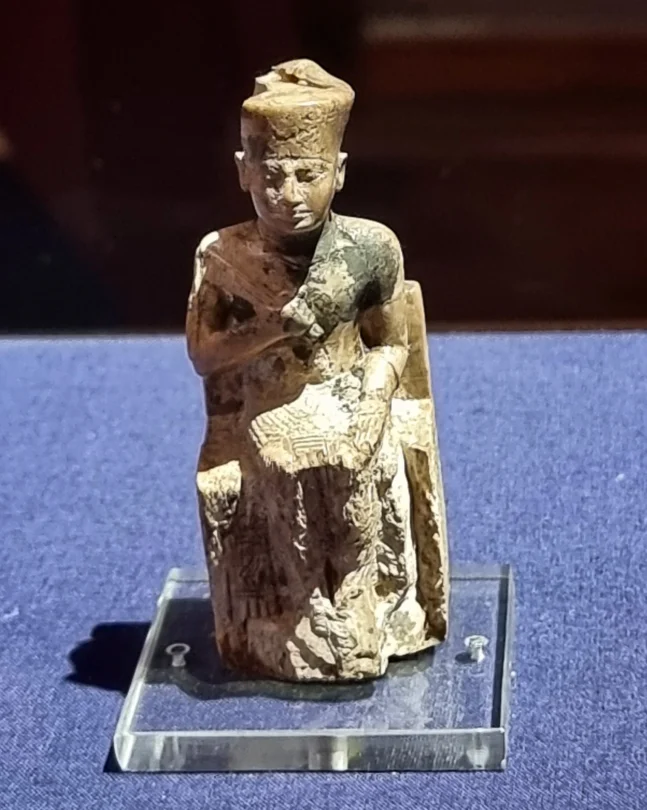
Khufu’s pyramid was the high point of a pyramid-building era that began with the Step Pyramid of Djoser, around 2670 BCE, and developed rapidly through the early Fourth Dynasty. Khufu’s father, Sneferu, built several pyramids, and the lessons from them, including the famous Bent Pyramid, made the Great Pyramid possible.
Khufu’s pyramid stood at the center of a complex that included a mortuary temple, a causeway to the Nile, smaller pyramids for queens, boat pits and rows of tombs for officials. Two later pharaohs, Khafre and Menkaure, built the other two large pyramids at Giza. The Great Sphinx stands nearby, and is usually attributed by Egyptologists to Khafre.
| Ruler | Monument | Approximate Date |
|---|---|---|
| Djoser | Step Pyramid at Saqqara | About 2670 BCE |
| Sneferu | Meidum, Bent and Red Pyramids | About 2600 BCE |
| Khufu | Great Pyramid of Giza | About 2600 to 2560 BCE |
| Khafre | Second pyramid and probably the Sphinx | About 2550 to 2500 BCE |
| Menkaure | Third pyramid of Giza | About 2500 BCE |
In the centuries after the Old Kingdom, the pyramids were visited, studied and looted. The Greek historian Herodotus wrote about them about 2,000 years after they were built, and the early Arab caliph al-Ma’mun is said to have forced a tunnel into the Great Pyramid in the ninth century. His men found the empty sarcophagus in the King’s Chamber, with no mummy and no treasure.
Inside the Great Pyramid: Chambers, Passages and Shafts
Unlike many pyramids, the Great Pyramid has chambers high inside the structure, and they are connected by a system of sloping passages.
| Feature | What It Is |
|---|---|
| Entrance | On the north face, about 17 meters above the ground |
| Subterranean Chamber | An unfinished room cut into the bedrock below the pyramid |
| Queen’s Chamber | A mid-level chamber with a corbelled ceiling; the name is a later nickname |
| Grand Gallery | A stepped, corbelled passage about 47 meters long and 8.6 meters high |
| King’s Chamber | A granite room with an empty, lidless sarcophagus |
| Relieving Chambers | Five stacked spaces above the King’s Chamber that spread the weight of the stone |
| Narrow Shafts | Small channels leading from the King’s and Queen’s Chambers |
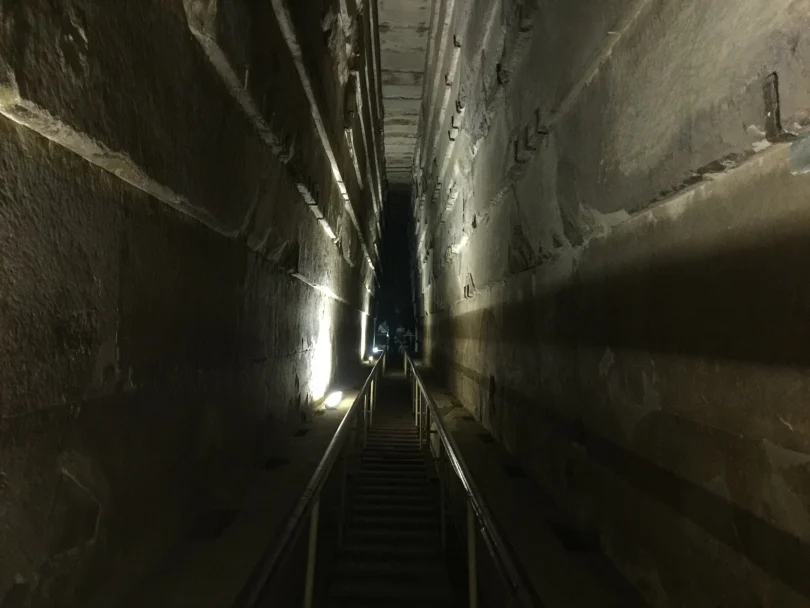
The King’s Chamber is built of red granite brought from Aswan, about 800 kilometers away, and some of its roof beams weigh dozens of tons. In 1837 the explorer Howard Vyse found work-gang graffiti in the relieving chambers above it, including the name of Khufu. Egyptologists treat this as strong evidence that the pyramid was built in his reign.
The narrow shafts are among its most intriguing features. Some traditions link their angles to stars such as Orion and Sirius, an idea popularized by the writer Robert Bauval as the Orion correlation theory. Most Egyptologists interpret them as ritual channels connected to the king’s journey to the sky, and they are still debated.
The ScanPyramids Discoveries
The Great Pyramid is still revealing secrets. In 2017 the ScanPyramids project used cosmic-ray muon imaging to detect a large hidden void above the Grand Gallery, at least 30 meters long, which scientists called the “Big Void.” In 2023 the team reported a smaller corridor behind the pyramid’s north-face entrance. What these spaces were for is an open question.
How Was the Great Pyramid Built?
Few questions in archaeology are asked as often. Here is what we know, and the main ideas about how it was done.
In the last decades, archaeologists have found a great deal of direct evidence from the time of Khufu. A workers’ town at the foot of the plateau, with bakeries, breweries and sleeping quarters, shows that a large, well-fed workforce lived there. Nearby cemeteries held the tombs of the builders. In 2013, in the Red Sea harbor of Wadi al-Jarf, archaeologists led by Pierre Tallet found papyri that include the logbook of an official named Merer, recording trips to transport limestone blocks by boat from the Tura quarries to Giza in the later years of Khufu’s reign.
| Idea | What It Proposes |
|---|---|
| Straight ramp | A long ramp of mud brick and rubble rising with the structure |
| Spiral or wrap-around ramp | A ramp winding around the outside of the pyramid |
| Internal ramp | An outer ramp for the lower levels and an internal ramp for the upper levels, proposed by architect Jean-Pierre Houdin |
| Levers and sledges | Wooden sledges dragged over wetted sand and moved with levers |
| Water transport | Blocks floated on the Nile and on canals brought close to the site |
The builders were not slaves in the way popular imagination often pictures them. The evidence points to a large organized workforce of skilled workers and rotating labor crews who were fed and housed. The remarkable precision of the work, including a base that is almost perfectly level and aligned to the cardinal directions, tells of expertise accumulated over generations.
Sacred Geometry and the Math of the Great Pyramid
Few buildings inspire as many numbers. Here are some of the best-known relationships, together with a grounded note on each.
| Claim | What Is Said | A Grounded Note |
|---|---|---|
| Pi in the proportions | The perimeter of the base divided by the height is very close to 2 times pi | This follows from the slope the builders chose, based on a measure called the seked. Some see deliberate design, while others see a natural result of the measuring system. |
| The golden ratio | The slant height compared with half the base is close to the golden ratio | The match is approximate, and scholars disagree on whether it was intended. |
| Cardinal alignment | The sides are aligned to true north, south, east and west within a tiny fraction of a degree | This is well documented and shows remarkable surveying skill. |
| Location on Earth | The pyramid sits near the center of the Earth’s land mass | This is a popular statement, and its accuracy depends on how the center is defined. |
| Level base | The base is level to within a very small tolerance across 13 acres | Engineer Christopher Dunn highlights this on our show as evidence of precision. |
The honest summary is that the pyramid shows extraordinary geometric care. Whether the builders were encoding deeper mathematical truths on purpose is a matter of interpretation. If sacred geometry interests you, our guides to the merkaba, the Seed of Life and Metatron’s Cube explore related ideas.
What the Pyramid Meant to the Ancient Egyptians
For the Egyptians, a pyramid was a machine for rebirth. The earliest religious writings we have, the Pyramid Texts, were carved on the walls of the pyramids of the late Fifth and Sixth Dynasties, around 2350 BCE. They are not inside the Great Pyramid, which has no inscriptions in its chambers, but they describe the thinking behind the whole tradition. They speak of the dead king rising to the sky, climbing a ladder or stairway of light, and joining the sun god Ra and the imperishable stars of the northern sky.

The shape itself carried meaning. It is often connected to the benben, the sacred mound that rose from the waters of chaos at the beginning of creation, and to the rays of the sun spreading down to Earth. A pyramid was a petrified sunbeam and a stairway to heaven. The king’s ka, his life force, was believed to travel from the burial chamber through the structure and out into the sky.
The Book of the Dead and the later funerary texts continue these themes, with the soul’s passage through judgment and into the afterlife. For a deeper look, see our Egyptian Book of the Dead study guide.
The Great Pyramid in Esoteric Tradition
Since antiquity, writers have wondered whether the Great Pyramid held secrets beyond a tomb. Over the centuries, a rich set of esoteric ideas grew up around it.
- A temple of initiation. Some Rosicrucian, Theosophical and Masonic writers described the King’s Chamber as a place of ritual initiation, a symbolic death and rebirth for those seeking higher knowledge. There is no archaeological evidence for this, but it has inspired a long tradition of symbolism.
- A record in stone. In the nineteenth century, writers such as Charles Piazzi Smyth proposed that the pyramid encoded measurements and prophecies. Mainstream scholars reject this, but the idea fed a whole genre of “pyramidology.”
- The Hall of Records. The American psychic Edgar Cayce said that a hall holding the records of an earlier civilization lay beneath the Sphinx. Nothing like this has been found.
- Pyramid power. Some people believe that a pyramid shape concentrates energy. There is no scientific support for the popular claims, but many people enjoy meditating inside pyramid-shaped spaces.
As always, we encourage you to enjoy the symbolism while keeping a clear view of what is documented and what is interpretation.
The Pyramids and the Stars
The Egyptians looked to the sky for the home of the gods and the dead. Orion, associated with the god Osiris, and Sirius, associated with Isis, were especially important. In 1994 Robert Bauval and Adrian Gilbert proposed in The Orion Mystery that the three pyramids of Giza mirror the three stars of Orion’s belt. The idea became widely known and is much loved by seekers, while many archaeologists and astronomers question the precision of the match and the dating.
Whatever the final verdict, the sky was central to Egyptian religion. A pyramid’s job was to help the king join the stars, and the builders’ skill at aligning it to the cardinal points shows how seriously they took the heavens.
The Sphinx Debate and the Question of Age
Next to the Great Pyramid sits the Great Sphinx, and the age of the Sphinx is one of the liveliest arguments in alternative archaeology. Egyptologists date it to the reign of Khafre, around 2500 BCE, based on its context in his pyramid complex. In the 1990s geologist Robert Schoch proposed that the weathering of the enclosure suggests an older age, from water erosion thousands of years earlier, an idea that has been popularized by Graham Hancock and others. Most Egyptologists disagree.

Gregg Braden has also spoken on our show about the Sphinx’s erosion and its possible age, which he places at 12,000 to 13,000 years or more, and about a cycle of civilization he proposes. These are his views, which we present as part of the larger conversation. If lost civilizations interest you, read our guides to Atlantis and to Göbekli Tepe, the oldest known stone temple complex.
What Next Level Soul Guests Say About the Great Pyramid
The Great Pyramid has been a recurring subject on the podcast. Here are three guests with three very different takes. They are the guests’ own perspectives, offered for you to consider.
- Christopher Dunn. An engineer and the author of The Giza Power Plant, he points to the precision of the base, the acoustic properties of the interior, and a theory that the pyramid functioned as a machine that interacted with energy from the earth. Watch the full conversation.
- Gregg Braden. The author describes massive polished granite blocks fitted with extreme tolerance, shares his view that the casing stones may have been poured and not carved, and proposes that civilization moves in cycles. Watch the full conversation.
- Robert Edward Grant. The polymath talks about musical ratios, geometry and his nights inside the Great Pyramid, and offers his opinion that the pyramids were designed as a device for spiritual ascension. Watch the full conversation.
Egyptologists do not accept the power-plant or ascension-device theories, and they see the pyramid as a royal tomb built by the Egyptians. We invite you to listen to all sides and see where your own sense of the mystery lands.
The Spiritual Meaning of the Great Pyramid
Whether you see it as a tomb, a temple or a machine, the Great Pyramid keeps drawing people who sense that it points to something beyond stone. Here are five meanings seekers find in it.
1. The Path Upward
A pyramid rises from a wide base to a single point. Many traditions read it as the soul’s path: a broad foundation of daily life that narrows toward one-pointed focus and unity. It is a picture of ascent that makes sense to the body as well as the mind.
2. Death and Rebirth
For the Egyptians, the pyramid was a vehicle for rebirth. That theme speaks to anyone who has been through loss or change. Our guests who have had near-death experiences describe something similar: that the end of one form is the start of another.
3. Order and Intention
The precision of the Great Pyramid suggests that its builders believed in cosmic order, known in Egyptian thought as ma’at. Aligning a monument to the cardinal points was a way of harmonizing earth with sky. In our own lives, order and intention can be quiet spiritual practices.
4. Sound and Resonance
Several guests and researchers point to the acoustic qualities of the interior, especially the King’s Chamber. Chanting or toning in resonant spaces is an ancient practice around the world, and visitors to the pyramid often describe the sensation of a deep hum.
5. Living With Mystery
Perhaps the greatest gift of the Great Pyramid is that it is still unsolved. It invites us to stay curious and humble, and to hold knowledge and wonder side by side. The power to wonder is within each of us.
If this resonates, you may also enjoy our guides on the third eye and pineal gland, remote viewing, and the ascended master Serapis Bey, who is associated with the Ascension Temple of Luxor in esoteric teaching.
A Ten-Minute Practice: The Rising Light Meditation
You do not need to travel to Egypt to feel the symbolism. Try this simple visualization.
- Settle. Sit comfortably and take slow breaths for two minutes.
- Picture the base. Imagine a wide, solid square of golden stone beneath you, steady and supported.
- Feel the four sides. Sense your body, your heart, your mind and your spirit as the four faces of the pyramid, each rising toward a shared point.
- Follow the line upward. With each inhale, let your attention rise along the faces toward the apex above your head.
- Rest at the point. Pause there for two minutes in quiet awareness, as if the whole pyramid were resting on a single point of light.
- Return slowly. Let the light flow back down into your body, and write down one word that came to you.
Journal Prompts
- What is the broad foundation in my life that supports me?
- Where am I being called to focus more clearly?
- What old form of myself am I ready to let go of so something new can rise?
- Which mysteries am I willing to live with, without needing an answer?
Common Misconceptions About the Great Pyramid
| You May Have Heard | What Is Actually the Case |
|---|---|
| “Slaves built the pyramids.” | The evidence points to organized, fed and housed workers, including skilled crews and rotating laborers. |
| “It is the oldest pyramid.” | The Step Pyramid of Djoser is older, and Sneferu built several before Khufu. |
| “Nobody knows how it was built.” | Archaeologists have strong evidence of the workforce, tools, quarries and logistics. The exact lifting methods are still debated. |
| “There is no evidence it was built for Khufu.” | Work-gang graffiti in the relieving chambers, the papyri of Merer, and the surrounding complex all link it to Khufu. |
| “Aliens built it.” | There is no evidence for this, and it undersells the skill of the Egyptians. |
| “It is a power plant.” | This is an interesting hypothesis from some engineers. Egyptologists consider the pyramid a tomb, and the power-plant idea is not accepted by mainstream science. |
Visiting the Great Pyramid
The Great Pyramid can be visited at the Giza plateau, on the edge of Cairo. Many visitors walk around the base and see the Sphinx and the neighboring pyramids, and some go inside. Access to the interior is limited and ticketed, and the passages are narrow, steep and can be warm and crowded. Chambers sometimes close for conservation, so check current rules with official Egyptian sources or a licensed guide before you go. Early morning is cooler and quieter, and many visitors say it is the best time to feel the place.
Bringing It All Together
The Great Pyramid is both the best-documented and the most mysterious monument on Earth. We know who it was built for, when, and a great deal about the people who built it. We do not know every detail of how they did it, why some of its spaces exist, or what meanings they intended. In that open space, seekers find room for wonder.
You can hold the archaeology and the mystery together. The deepest message may be the simplest: people long ago reached for the sky with all their skill, and that longing lives on in us. If this guide opened something in you, take the next step. Watch the conversations below, follow the links in the Go Deeper section, and let your curiosity lead. We rise together.
Watch: Real Conversations on the Great Pyramid
These NLS guests share very different views on the precision, purpose and meaning of the Great Pyramid.
Christopher Dunn: Did NASA Physicists Prove the Great Pyramid’s Purpose?
Engineer Christopher Dunn shares his research into the precision of the Great Pyramid and his theory of its purpose. Watch the full episode and read the show notes.

Gregg Braden: How the Pyramids Were Built
Gregg Braden asks where the first advanced civilizations came from and shares what he says the evidence points to about the pyramids. Watch the full episode and read the show notes.

Robert Edward Grant: Mysterious Pyramid Inscriptions
Researcher Robert Edward Grant shares what he believes the pyramids of Giza are really for, from musical ratios to his nights inside the Great Pyramid. Watch the full episode and read the show notes.

Watch More on Next Level Soul TV
Next Level Soul TV brings together full episodes, courses, movies, series and audiobooks, ad-free. Join Next Level Soul TV and keep exploring.
Go Deeper with Next Level Soul
- Atlantis: The Complete Guide to the Lost Civilization
- Göbekli Tepe: The World’s Oldest Temple
- Merkaba Meaning: Star Tetrahedron, Symbol and Meditation
- Seed of Life: Meaning, Sacred Geometry and a Simple Meditation
- Metatron’s Cube: Meaning, Sacred Geometry and Symbolism
- The Egyptian Book of the Dead: Study Guide and Workbook
- The Third Eye and Pineal Gland
- Serapis Bey: Master of the White Flame
- Remote Viewing: History, Method and How to Learn It
- The full spiritual glossary
Sources and Further Reading
- Great Pyramid of Giza (Wikipedia)
- Khufu (Wikipedia)
- Giza pyramid complex (Wikipedia)
- ScanPyramids (Wikipedia)
- Pyramid Texts (Wikipedia)
- Orion correlation theory (Wikipedia)
- Great Sphinx of Giza (Wikipedia)
- Pyramid power (Wikipedia)
- Edgar Cayce (Wikipedia)
Images courtesy of Wikimedia Commons under their stated licenses, credited in each caption.
Spirituality for the Rest of Us™
Movies, teachings and community on Next Level Soul TV.
Go Deeper with NLS Mastery: Your Soul’s Blueprint
If the mysteries of the ancient world call to you, this course helps you explore your own soul’s origins and purpose. Karen Bell teaches it in Your Soul’s Blueprint, part of NLS Mastery. Watch the course preview below.

Not Ready Yet? Explore all free masterclasses.
Frequently Asked Questions
What is the Great Pyramid of Giza?
The Great Pyramid is the largest Egyptian pyramid, built around 2600 to 2560 BCE as the tomb of the pharaoh Khufu. It is the oldest of the Seven Wonders of the Ancient World and the only one still largely intact.
How old is the Great Pyramid?
It is about 4,600 years old, built during the Fourth Dynasty of the Old Kingdom over roughly 26 years.
How tall is the Great Pyramid?
It originally stood about 146.6 meters (481 feet) tall. Because the capstone and some outer stone are gone, it is about 138.5 meters (454 feet) tall today.
Who built the Great Pyramid?
Evidence points to a large, organized workforce of skilled workers and rotating labor crews who were fed and housed. A workers’ town, nearby tombs and the Merer papyri support this.
Were the pyramids built by slaves?
Most archaeologists do not think so. The evidence shows paid and provisioned laborers, with their own tombs near the pyramids.
How was the Great Pyramid built?
Archaeologists propose ramps, sledges, levers and boat transport along the Nile, and the exact lifting methods are still debated. The logbook of an official named Merer records stone being shipped to Giza.
What is inside the Great Pyramid?
It has three main chambers, the Subterranean Chamber, the Queen’s Chamber and the King’s Chamber, along with the Grand Gallery and narrow shafts. The ScanPyramids project has also detected hidden voids.
Was Khufu buried in the Great Pyramid?
It was built as his tomb, but no mummy was found. By the time it was opened in the Middle Ages, the sarcophagus in the King’s Chamber was empty.
What is the spiritual meaning of the Great Pyramid?
For the ancient Egyptians it was a stairway to the sky and a vehicle for the king’s rebirth. Seekers today read it as a symbol of ascent, order, sacred geometry and living with mystery.
Did aliens build the pyramids?
There is no evidence for this. Archaeologists attribute the pyramids to the Egyptians and have found their tools, workers’ town and written records.
Is the Great Pyramid a power plant?
Engineer Christopher Dunn has proposed this idea, based on its precision and acoustics. Egyptologists do not accept it and consider the pyramid a royal tomb.
What did the ScanPyramids project find?
Using cosmic-ray muon imaging, the project found a large hidden void above the Grand Gallery in 2017, at least 30 meters long, and a smaller corridor behind the north entrance in 2023.
Can you go inside the Great Pyramid?
Yes, but access is limited and ticketed, and the passages are narrow and steep. Check current rules with official Egyptian sources or a licensed guide before you go.