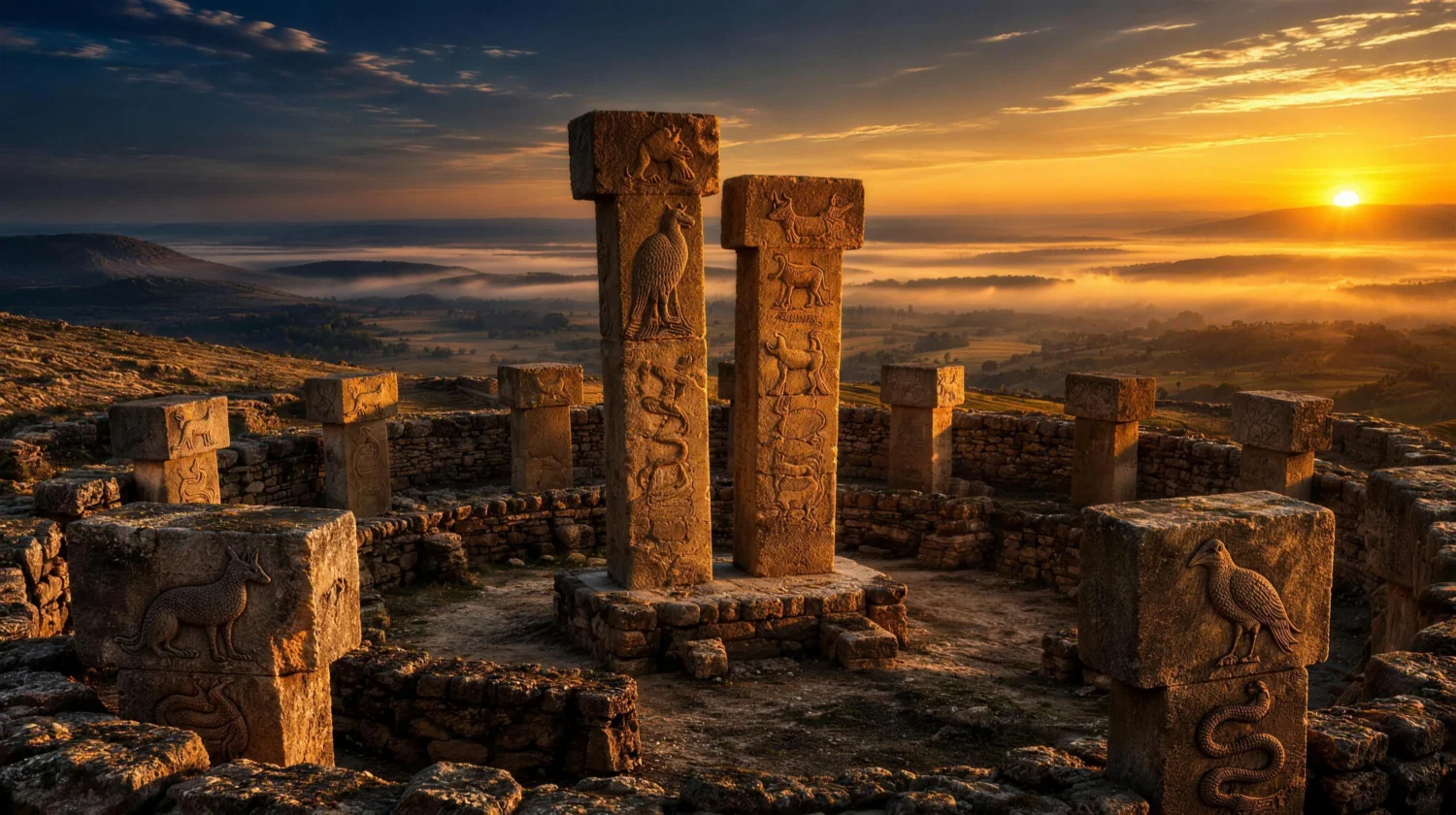
Göbekli Tepe is the oldest known monumental stone site on Earth: a hilltop in southeastern Türkiye where hunter-gatherers raised circles of carved T-shaped pillars more than 11,000 years ago. That is thousands of years before Stonehenge, the pyramids or the first cities. Archaeologists still debate what it was for, and that open question is exactly what makes it so compelling.
This guide walks through what Göbekli Tepe is, how old it is, how it was found, what the carvings show, and why it forces us to rethink the story of human origins. We look at the Younger Dryas debate, what Next Level Soul guests say about it, and a simple practice to bring its lesson into your own life. We keep it grounded, because the real invitation of a place this old is to wonder well.
Key Takeaways
- What it is. The oldest known monumental stone architecture in the world, built from about 9500 BCE by hunter-gatherers in what is now southeastern Türkiye.
- Why it matters. The monuments came before farming and cities, which challenges the standard story of how civilization began.
- What it was for. Nobody knows for certain. Ideas include a temple, ancestor rites, a gathering and feasting center, and sky watching.
- Mostly unexplored. Only about 10 percent has been excavated, and surveys show at least 20 large enclosures.
- The Younger Dryas link. The site’s earliest enclosures appear as the Younger Dryas ends. The comet impact idea is contested, while guests like Randall Carlson and Gregg Braden describe larger earth cycles.
- A way to engage. Try the ten-minute Standing in Deep Time practice and the journal prompts in this guide.
What Is Göbekli Tepe?
Göbekli Tepe (pronounced roughly “guh-BECK-lee TEH-peh,” Turkish for “Potbelly Hill”) is an archaeological site in southeastern Türkiye that holds the oldest known monumental stone architecture on Earth. Its builders raised circles of giant T-shaped limestone pillars, carved with foxes, snakes, boars, vultures and scorpions, around 11,500 years ago. That is more than 6,000 years before Stonehenge and roughly 7,000 years before the Great Pyramid of Giza.
What makes the site so astonishing is who built it. The people of Göbekli Tepe had no pottery, no metal tools, no writing, no wheel and, as far as the evidence shows, no farming yet. They were hunter-gatherers, and they quarried, carved, carried and stood up pillars that weigh many tons. The site does not fit the old story that monuments came after cities and farms. It suggests something closer to the opposite: that the pull toward something sacred, shared and larger than daily survival may have come first.
That is why Göbekli Tepe sits at the center of so many conversations, from mainstream archaeology to the questions that Next Level Soul guests keep returning to: how old is human culture, how much have we forgotten, and what does it mean that people were already looking up at the sky and building for the unseen so long ago?
| Quick Fact | What We Know |
|---|---|
| Location | Şanlıurfa Province, southeastern Türkiye, near the village of Örencik, overlooking the Harran plain |
| Age | Inhabited from about 9500 BCE to at least 8000 BCE (Pre-Pottery Neolithic) |
| What It Is | A complex of stone enclosures with carved T-shaped pillars, built on a natural hilltop |
| Rediscovered | First noted in a 1963 survey; its importance was recognized by Klaus Schmidt in 1994 |
| Excavation Began | 1995, led by Klaus Schmidt until 2014, and continued by an international team afterward |
| Recognition | UNESCO World Heritage Site since 2018 |
| Still Underground | About 90 percent, with geophysical surveys showing at least 20 large enclosures |
Where Is Göbekli Tepe, and How Old Is It?
Göbekli Tepe stands on a limestone ridge about 15 kilometers from the city of Şanlıurfa, in the region sometimes called Upper Mesopotamia. From the hilltop you look out over the broad Harran plain, one of the lands that later fed the first farming villages and the first cities. The mound itself rises roughly 15 meters above the surrounding ground and spreads across a few hundred meters. Most of that mound is not a natural hill. It is built-up layers of the site’s own history.
Archaeologists place the main building phases between about 9500 BCE and 8000 BCE, in a period called the Pre-Pottery Neolithic. Radiocarbon dating from the site points to the earliest monumental enclosures being raised near the start of that window, which means the oldest circles are more than 11,000 years old. Later, the enclosures were deliberately buried and the site slowly fell out of use. A revised chronology of the site now describes eight phases across more than 1,500 years.
To feel how long ago that is, put it on a line with other famous places.
| Site or Milestone | Approximate Date | Gap From Göbekli Tepe |
|---|---|---|
| Göbekli Tepe, first monumental enclosures | About 9500 BCE | Starting point |
| First walled settlement at Jericho | About 8000 BCE | About 1,500 years later |
| Çatalhöyük, large Anatolian town | About 7100 BCE | About 2,400 years later |
| Earliest writing in Sumer | About 3300 BCE | About 6,200 years later |
| Stonehenge, first earthwork phase | About 3000 BCE | About 6,500 years later |
| Great Pyramid of Giza | About 2560 BCE | About 6,900 years later |
One of the most striking facts in that table is this: the Great Pyramid is closer in time to us than it is to Göbekli Tepe. The pyramid builders stood almost as far from the people of Göbekli Tepe as we stand from the pyramid builders.
How Göbekli Tepe Was Found
For thousands of years, local people knew the hill as a place with strange stones and a few scattered flint pieces. A 1963 survey by researchers from Istanbul University and the University of Chicago noted the site, but the broken limestone slabs on the surface were taken for old gravestones from a medieval cemetery. The hill was left alone, and farmers kept plowing across it.
That changed in 1994, when the German archaeologist Klaus Schmidt, working for the German Archaeological Institute, visited the hill after reading the old survey. He saw the flint and the carved stone fragments and understood almost at once that the pieces did not belong to a medieval graveyard. He began excavating in 1995 and kept leading the work until his death in 2014. After him, the project continued under the Turkish archaeologist Necmi Karul together with Istanbul University, the Şanlıurfa Museum and the German Archaeological Institute.
It is a good story to hold in mind. Something this important sat in plain sight for millennia. It took a person willing to look again, and to ask whether the accepted explanation was actually true. That is a thread we pull on throughout this guide.
The T-Shaped Pillars and the Stone Enclosures
The heart of Göbekli Tepe is its enclosures: round or oval rooms between about 10 and 30 meters across, built into the hillside. Each one is ringed by a stone wall with T-shaped pillars set into it, and at the center of each stand two much taller pillars facing one another. The central pair can reach around five or six meters in height. Archaeologists have uncovered four of the main enclosures and refer to them as A, B, C and D. Geophysical surveys suggest there are at least twenty, and the number of pillars across the whole site is commonly estimated at around two hundred.
The pillars are the oldest known megaliths in the world. Here is what stands out:
- They are shaped, not just stacked. Each pillar was carved to a deliberate T-profile, a tall shaft with a crosspiece on top.
- They look like people. Some of the central pillars have arms that wrap around the sides of the shaft, hands that meet over the belly, a belt and what looks like a loincloth. Many researchers read the T-shape as a stylized human body, with the crosspiece as the head.
- The stone was quarried nearby. The limestone came from bedrock quarries about 100 meters from the enclosures and was cut with flint tools. One unfinished pillar still lies in the quarry. It is about 7 meters long and would have weighed around 50 tons.
- The rooms were built for a reason. The enclosures show planning, repeated design and, in the later phases, rebuilding and renewal.
Standing at one of the enclosures, you are looking at a deliberately designed sacred-feeling space, made by people who left no written word about it. Everything we know comes from the stone, the soil and the carvings.
The Carvings: Animals, Symbols and Very Few Faces
The pillars are covered in reliefs. The imagery is wild, dense and mostly animal. Foxes, wild boars, wild bulls and gazelles appear, along with snakes, insects, spiders and scorpions, and an abundance of birds, especially vultures. Human figures are rare. When people do appear, they are mostly implied by the arms, hands and belts carved on the T-pillars themselves.
| What Is Carved | Where It Shows Up | What Researchers Suggest |
|---|---|---|
| Snakes | Running down the shafts of many pillars | Protection, water, danger or a sacred power |
| Foxes and boars | Reliefs in several enclosures, and a fox pelt on a belt | Clan or totem identity |
| Vultures and other birds | The “Vulture Stone” and other pillars | Death rites, the sky, the passage of souls |
| Scorpions and spiders | Pillars and carved slabs | Guardians, thresholds, hidden forces |
| Abstract symbols | Crescents, discs, H-shapes and lines | An early symbol system, still not decoded |
Because there is no writing at Göbekli Tepe, nobody can say for certain what the images meant to the people who made them. That mystery is part of why the site stays so alive in the imagination. These are the symbols of a worldview, shared and understood by the community, and now only partly legible to us.
If you enjoy decoding symbols and how they carry meaning across time, our spiritual glossary is a good companion to this guide.
Inside Enclosure D: The Most Famous Room
Of the four main enclosures, Enclosure D is the one most often shown in photographs, and it is a good place to see how the design works. Two tall central pillars, often listed as Pillar 18 and Pillar 31, stand facing one another in the middle of the room, and a ring of smaller pillars surrounds them, set into a curved wall with a stone bench running along the inside.
The central pillars are described by excavators as stylized figures. Their shafts carry carved arms and hands, a belt and what appears to be a fox-pelt loincloth, and one of them shows a necklace-like symbol on its upper front. Looking at them, many visitors say it feels as if two large beings stand in the room, watching over whoever enters. Whatever they represent, ancestors, spirits or something we have no word for, they are the focal point of the whole space.
The Vulture Stone
One of the best-known carved pillars in the enclosure is Pillar 43, often called the Vulture Stone. It shows a large vulture with a raised wing, a disc, a scorpion and other creatures, in a carefully composed scene. Some researchers read it as an image about death and the passage of souls, since vultures are tied to funeral customs in many ancient cultures. Others have proposed that the symbols are an astronomical record. A 2017 paper by Martin Sweatman and Dimitrios Tsikritsis argued that the carvings may encode a date in the sky tied to a comet strike. Many archaeologists disagree with that reading, and the debate continues.
What both groups agree on is the artistry. The relief work is confident and sophisticated, and it was done at the dawn of settled life, with tools made of flint and bone.
Who Built Göbekli Tepe, and How?
The builders were people of the Pre-Pottery Neolithic, a time when communities in the region still lived mostly by hunting wild game and gathering wild plants. They had stone tools, fire, rope and, above all, one another. The archaeological record shows no sign of metal, no wheel, no beasts of burden and no pottery at the earliest levels.
How many people did it take? Estimates vary. The original excavator, Klaus Schmidt, thought that raising and finishing the larger pillars would have called for hundreds of people working together. Other researchers have argued that smaller crews could have done it over time, and one analysis suggested that 12 to 24 people might raise a pillar in under four months. Even at the low end, the project required planning, shared knowledge, food to feed the workers and a reason strong enough to hold a community together for years.
That last part may be the most interesting. Building something like this is not about survival. It is about meaning. Something drew these people together and kept them working.
Why Göbekli Tepe Rewrites the Story of Civilization
For much of the twentieth century, the standard story of human progress went like this: people learned to farm, farming produced surplus food, surplus food allowed villages, villages grew into cities, cities developed organized religion and monumental buildings. In that story, big temples were a result of settled, agricultural life. This idea is often called the Neolithic Revolution.
Göbekli Tepe turns the sequence on its head. The monuments are older than the farming. Klaus Schmidt put forward the bold idea that the need to gather for sacred purposes may have come first, and that the effort to feed large gatherings may have pushed people toward cultivating wild grains and herding animals. In other words, the temple may have helped create the village and not the other way around. The phrase that went around the world was that Göbekli Tepe was the “first temple.”
What the Settlement Evidence Shows
The picture has become more nuanced. Newer work, including findings published in 2019, points to people actually living at or near Göbekli Tepe. Excavators found tools for processing wild cereals and large cisterns carved into the rock that could hold at least 150 cubic meters of water. There is also evidence of a long, steady supply of game. That has led some scholars to describe the site not only as a ritual center but also as a place where people stayed for long periods, and not just an empty temple visited on special days.
Both views have strengths. The important point for the curious reader is that the site is still being understood. Only about a tenth of it has been uncovered, and every season of digging adds something new.
Was Göbekli Tepe a Temple? What Was It For?
No one can say for certain, because there are no texts and no direct explanations. Here are the main ideas researchers and teachers have put forward.
| Idea | What It Proposes | What Supports It |
|---|---|---|
| A temple or sanctuary | A sacred gathering place for ritual and ceremony | Carefully planned enclosures, carved symbolism, no signs of ordinary houses in the main rooms |
| An ancestor or skull cult | Rituals honoring the dead and the ancestors | Skull fragments with deliberate incisions found in 2017, and the arms and hands on the T-pillars |
| A feasting and gathering center | Large seasonal gatherings of scattered hunter-gatherer groups | Animal bones in large quantities, tools for processing food, water storage |
| A site of sky watching | Alignments and symbols linked to the stars and heavens | Vulture and sky imagery, and interpretations of the carved symbols as star and calendar markers (contested) |
| A memorial to a catastrophe | A response to a cosmic or climatic upheaval | A 2017 proposal that carved symbols record a comet strike near the start of the Younger Dryas (disputed by many archaeologists) |
These ideas are not necessarily in conflict. A site that lasted for more than a thousand years could easily have served more than one purpose, and the meaning of the place could have changed across the centuries. Seen from a spiritual perspective, a space like this could have been where a community expressed its relationship with death, the animals, the land and the sky, all at once.
Notice what is missing from this table: any claim that we know the full answer. The honest and more exciting position is that Göbekli Tepe is still asking us questions.
Karahan Tepe and the Stone Hills Around Göbekli Tepe
Göbekli Tepe is not alone. It sits in a landscape that archaeologists now call the Taş Tepeler, meaning “Stone Hills,” a cluster of Pre-Pottery Neolithic sites across the same region. Excavations at these neighboring sites are changing the picture.
- Karahan Tepe. A site about 35 kilometers away with its own T-shaped pillars, carved figures and a rock-cut hall. It may hold some of the earliest known village-style life in the region, dated roughly between 10,000 and 9500 BCE.
- Körtik Tepe. A settlement with rich burials and carved stone vessels dated around 10,700 to 9250 BCE, showing that complex symbolic life already existed here.
- Other Taş Tepeler sites. Several more hilltop locations show T-shaped pillars and similar designs, which suggests a shared culture and a regional tradition instead of a one-time miracle.
This matters because it turns Göbekli Tepe from a single puzzle into the best-known example of a whole civilization of builders that we are only beginning to meet. For more on Karahan Tepe, see the Wikipedia overview of Karahan Tepe.
Göbekli Tepe and the Younger Dryas
Almost every deeper conversation about Göbekli Tepe eventually arrives at the Younger Dryas, so it is worth understanding what that is and why it matters.
The Younger Dryas was a sudden return to cold, dry conditions that began roughly 12,900 years ago and lasted about 1,200 years, ending around 11,700 years ago. It interrupted the warming that followed the last Ice Age. Mainstream scientists generally explain it through changes in ocean circulation, caused by a large release of glacial meltwater into the North Atlantic. Göbekli Tepe’s first monumental enclosures appear right at the close of this period, as the climate warmed and the world changed quickly.
A group of researchers has proposed something more dramatic. The Younger Dryas impact hypothesis suggests that fragments of a comet struck the Earth around 12,900 years ago and triggered the cooling, wildfires and the loss of large animals. This is a contested idea, and many scientists reject it. Still, it has become influential outside academia, and it appears again and again in the work of authors and speakers who study lost civilizations.
| View | What It Says About the Younger Dryas | What It Says About Göbekli Tepe |
|---|---|---|
| Mainstream climate science | Ocean circulation changes from glacial meltwater, with possible volcanic contributions | A community of hunter-gatherers building during a period of rapid climate recovery |
| Impact hypothesis | A comet fragmented and struck the Earth about 12,900 years ago | Carvings may record the event, and the site may be a response to it |
| Cycle-based teaching | One event in a recurring pattern of cataclysm across thousands of years | Part of a memory passed down by an earlier culture |
You do not have to pick a side to appreciate the pattern. A world in upheaval, a community choosing to build something extraordinary, and a legacy that sat buried for ten thousand years is a powerful story whichever way the final science lands.
What Next Level Soul Guests Say About Göbekli Tepe
On the Next Level Soul podcast, Göbekli Tepe comes up when guests talk about lost history, earth cycles and the memory of ancient cultures. Here is how a few of them frame it, in their own territory and from their own research. These are the guests’ views, offered as perspectives to consider.
- Randall Carlson. The geomorphologist and builder studies cycles of cataclysm in the Earth’s history, which he describes as a repeating pattern, a “sawtooth” of rise and fall over thousands of years. In his conversation with us, he connects those cycles to Atlantis and to Göbekli Tepe.
- Gregg Braden. The author and speaker describes a roughly 12,500-year cycle of change and links it to the Younger Dryas period, then asks what ancient cultures may have recorded about it and what it means for our own time. His NLS episode on ancient prophecies carries that thread.
- Ben Van Kerkwyk. The researcher talks about the Younger Dryas as a cataclysm and the human story that follows it, and how that framing changes the way we read sites like Göbekli Tepe.
You will find three of these episodes embedded further down this page. The details vary from guest to guest, and that is useful: it shows you that Göbekli Tepe works like a mirror. The more you know about the ancient world, the more the site seems to reflect back.
Göbekli Tepe, Atlantis and the Idea of a Lost Civilization
When people learn that a sophisticated stone-building culture existed more than 11,000 years ago, one question comes up almost immediately: what else did they have that we have not found yet?
The author Graham Hancock has made this question his life’s work. He has argued that Göbekli Tepe may be the work of survivors of an older, advanced culture lost to the end of the last Ice Age, and he points to the Younger Dryas as the likely turning point. Most archaeologists do not agree. They see the site as the achievement of hunter-gatherers who were more capable than we had assumed, and they see no need to invent an unknown civilization to explain it.
| Perspective | How It Reads Göbekli Tepe |
|---|---|
| Mainstream archaeology | A remarkable product of Pre-Pottery Neolithic hunter-gatherers, proof that complex symbolic life came before farming |
| Lost civilization view | The surviving echo of an older, advanced culture whose story was wiped from memory by a global catastrophe |
| Spiritual and metaphysical view | A living reminder that humanity’s relationship with the sacred is far older than our written history |
It is worth noticing that the first view is already a revolution. Even if you never step into the idea of an earlier civilization, the mainstream conclusion changes everything: ordinary people, with stone tools and no state to compel them, built a monument to the unseen. If you would like to explore the Atlantis side of the conversation, our complete guide to Atlantis and the lost civilization goes further. For another angle on ancient origins, read about the Anunnaki and the Sumerian story of human beginnings.
A quick, helpful note: Göbekli Tepe is not the Sumerian world. It is about 6,000 years older than the first Sumerian writing, and it comes from a different culture and a different time. The two are often mentioned together because both are windows into our deepest past, but they should not be mixed up.
The Spiritual Meaning of Göbekli Tepe
Archaeology tells us what was built. Spirituality asks what it was built for, and what it still says to the person standing in front of it today. Here are five ways seekers find meaning in Göbekli Tepe.
1. The Sacred Came First
If the monuments really came before the farms, then reverence was not a luxury added to civilization. It was one of its foundations. People gathered for something they could not name, and that gathering shaped the world that followed. For a seeker, this is a gentle reminder that the longing for meaning is not a modern invention or a symptom of confusion. It is old, and it is ours.
2. The Power Is Within Us
There was no empire at Göbekli Tepe, no ruler with an army, no written law. A community decided together to build something that reached upward. That is a quiet picture of the idea we return to again and again at Next Level Soul: the power is within you, and within us when we choose to gather around it.
3. Nature Is a Teacher
The pillars are crowded with animals. Foxes, snakes, birds and boars are not decoration. They show a people who read the natural world as a source of wisdom, who saw intelligence in the living world and made it part of the sacred space. Many traditions still teach this, and it is a practice you can begin today with a walk and a little attention.
4. Death Is Part of the Story
Vultures, skulls and ancestor figures suggest that the builders were reflecting on mortality and what continues beyond it. This resonates with what many of our guests describe about consciousness continuing after the body, and with the stories in our guide to spiritual terms. Grief, memory and reverence for those who came before us are as old as stone.
5. We Are Part of a Very Long Story
Perhaps the most grounding gift of the site is perspective. Standing in front of a pillar that has been waiting 11,000 years makes our worries feel smaller and our lives feel more connected. It is a lesson that many people describe in meditation as well: the sense of being one small part of something vast.
A Ten-Minute Practice: Standing in Deep Time
You do not have to travel to Türkiye to take something from Göbekli Tepe. Try this simple practice.
- Find a quiet spot outdoors. A park bench, a backyard or a doorstep is enough. If you cannot go outside, sit near a window.
- Place one hand on something old. A stone, a tree trunk or a wall works well. Feel its weight and temperature.
- Breathe slowly for two minutes. Let your attention settle on the sensation of your hand.
- Remember the builders. Picture a community, thousands of years ago, gathering to stand a stone upright. Imagine their hands, their voices, their reasons.
- Ask one question. What is the thing I would gather my community around today?
- Sit with the answer. Do not force it. Notice what comes up in the next few minutes, and write it down.
People often find this simple exercise opens a feeling of belonging and calm. It pairs well with a guided meditation or an astral journey practice if you want to go further.
Journal Prompts
- What would I build, together with others, if survival were already taken care of?
- Which animals show up in my life, and what do I feel they are teaching me?
- Where do I feel most connected to something larger than myself?
- What do I want to leave standing for the people who come after me?
Göbekli Tepe Compared With Stonehenge and the Great Pyramid
People often compare Göbekli Tepe to the world’s other great ancient monuments. The comparison is useful because it shows how different the builders’ worlds were.
| Göbekli Tepe | Stonehenge | Great Pyramid of Giza | |
|---|---|---|---|
| Approximate date | 9500 BCE onward | Earthwork about 3000 BCE, stones about 2500 BCE | About 2560 BCE |
| Builders | Pre-Pottery Neolithic hunter-gatherers | Neolithic farming communities | Egyptian state with organized labor |
| Main material | Local limestone, carved with flint | Sarsen and bluestone | Limestone and granite blocks |
| Written records | None | None | Some inscriptions and later texts about the era |
| Purpose | Debated: ritual, gathering, memory | Debated: ceremony, burial, sky watching | Royal tomb and monument, with continuing spiritual interpretations |
The pattern is that the earlier the monument, the fewer the answers. At Göbekli Tepe, we have the stones and almost nothing else, and that is what makes the questions feel so large.
The Big Open Questions
For all that has been learned, the most important questions are still open. Archaeologists, geologists and spiritual teachers all keep returning to the same handful.
- Why were the enclosures buried? Around 8000 BCE the enclosures were filled in with rubble, animal bones and tools, and the site stopped being used. Was it a ritual closing, a response to change, or a slow shift in how people lived?
- Who were the builders? We know where they lived and what they ate, but we do not know what they called themselves, what language they spoke or what stories they told.
- What do the symbols say? The abstract signs on the pillars may be an early system of communication. They have not been decoded.
- What is still underground? With roughly 90 percent unexcavated, every season may add a surprise, and the sister sites around Şanlıurfa promise even more.
- How did the idea spread? Similar pillars at other Taş Tepeler sites suggest a shared tradition. How far did it reach, and where did it begin?
Holding open questions with curiosity instead of rushing to an answer is a spiritual skill in itself. Göbekli Tepe is a good teacher for that.
Common Misconceptions About Göbekli Tepe
| You May Have Heard | What Is Actually Known |
|---|---|
| “It is the oldest temple in the world.” | It is the oldest known monumental stone complex. Whether every part of it was a temple is still debated. |
| “It has been fully excavated.” | Only about 10 percent has been uncovered, so the picture is still developing. |
| “The Sumerians built it.” | No. It is roughly 6,000 years older than Sumerian writing and belongs to a different culture. |
| “It proves a lost advanced civilization.” | There is no consensus. Mainstream archaeologists read it as the work of capable hunter-gatherers, while some authors propose an earlier culture. |
| “It was built to record a comet.” | That is one proposed reading of some carvings. It is disputed, and other explanations are widely held. |
| “There was no one living there.” | Recent findings point to long-term habitation, with cisterns, food processing and daily activity. |
Visiting Göbekli Tepe
If the story calls to you, Göbekli Tepe can be visited. The site lies a short drive from the city of Şanlıurfa, which is also known as the city of the prophets and has its own ancient treasures. Visitors walk on raised boardwalks beneath a large protective canopy, so you can look down into the enclosures without disturbing them. The Şanlıurfa Museum holds important finds from the region, including carved figures from the Taş Tepeler.
A few simple tips for planning:
- Choose spring or autumn. The region can be extremely hot in summer.
- Combine it with the wider area. Karahan Tepe and the Şanlıurfa Museum add depth to the visit.
- Check official sources before you go. Opening hours, ticketing and access to neighboring sites change, so confirm on the Turkish Ministry of Culture and Tourism pages or with a licensed local guide.
- Bring a little silence. Many visitors describe the feeling of the place as quiet, vast and humbling. Leave time to simply stand there.
Bringing It All Together
Göbekli Tepe asks us to hold two things at the same time. The first is humility: the story of human history we were taught is incomplete, and it will keep being revised. The second is wonder: a community with stone tools and no written word built something so deliberate and so beautiful that it is still teaching us eleven thousand years later.
You do not need to settle the debates about comets, cycles or lost civilizations to take something real from this place. You can take the reminder that gathering around something sacred is one of the oldest human instincts. You can take the encouragement to stay curious. And you can take the quiet confidence that the questions you carry about where we come from, why we are here and what we are part of belong to a very long lineage of seekers.
If this guide opened something in you, there is more to explore. Watch the conversations below, follow the links in the Go Deeper section, and consider where your own curiosity wants to go next. We rise together.
Watch: Real Conversations on Cataclysms, Cycles and Ancient History
These NLS guests explore the Younger Dryas, earth cycles and what ancient sites may be telling us about our past.
Randall Carlson: Cataclysms, Atlantis and Gobekli Tepe
Randall Carlson shares his research on cycles of cataclysm in the Earth’s history and how they connect to Atlantis and Göbekli Tepe. Watch the full episode and read the show notes.

Gregg Braden: Ancient Prophecies and a 12,500-Year Cycle
Gregg Braden describes a roughly 12,500-year cycle of change, links it to the Younger Dryas and asks what ancient cultures recorded about it. Watch the full episode and read the show notes.

Ben Van Kerkwyk: The Younger Dryas Cataclysm
Ben Van Kerkwyk talks about the Younger Dryas as a cataclysm and how that framing changes the way we read ancient sites. Watch the full episode and read the show notes.

Watch More on Next Level Soul TV
Next Level Soul TV brings together full episodes, courses, movies, series and audiobooks, ad-free. Join Next Level Soul TV and keep exploring.
Go Deeper with Next Level Soul
- Atlantis: The Complete Guide to the Lost Civilization
- The Anunnaki: Who They Were and What the Sumerians Said
- The Yugas: The Four Ages of Time
- Astral Journey: How to Explore Beyond the Body
- Remote Viewing: Seeing Beyond Space and Time
- Spiritual Awakening: Meaning, Traditions and How to Integrate It
- What Is Synchronicity?
- Your Soul’s Blueprint with Karen Bell (NLS Mastery)
- The full spiritual glossary
Sources and Further Reading
Spirituality for the Rest of Us™
Movies, teachings and community on Next Level Soul TV.
Go Deeper with NLS Mastery: Your Soul’s Blueprint
If the questions Göbekli Tepe raises about where we come from call to you, this course helps you map your own soul’s origins and purpose. Karen Bell teaches it in Your Soul’s Blueprint, part of NLS Mastery. Watch the course preview below.

Not Ready Yet? Explore all free masterclasses.
Frequently Asked Questions
What is Göbekli Tepe?
Göbekli Tepe is an archaeological site in southeastern Türkiye with the oldest known monumental stone architecture in the world. It consists of enclosures ringed by carved T-shaped limestone pillars, built by hunter-gatherers.
What does Göbekli Tepe mean?
The name is Turkish for “Potbelly Hill,” a reference to the rounded shape of the mound the site sits on.
How old is Göbekli Tepe?
The site was in use from about 9500 BCE to at least 8000 BCE, which makes the oldest enclosures more than 11,000 years old. It is roughly 6,000 years older than Stonehenge and about 7,000 years older than the Great Pyramid.
Where is Göbekli Tepe located?
It is in Şanlıurfa Province in southeastern Türkiye, near the village of Örencik, on a ridge overlooking the Harran plain. It is a short drive from the city of Şanlıurfa.
Who built Göbekli Tepe?
Pre-Pottery Neolithic hunter-gatherers built it. They had stone tools but no metal, pottery, wheel or writing, and no clear evidence of farming at the earliest levels.
Is Göbekli Tepe the oldest temple in the world?
It is the oldest known monumental complex, and many people call it the first temple. Archaeologists still debate its exact purpose, and recent finds suggest people also lived and worked there.
What were the carvings at Göbekli Tepe for?
No one knows for certain, since there is no writing. Researchers connect the animals and symbols to ritual, clan identity, death and the sky, and the abstract signs may be an early symbol system.
Why was Göbekli Tepe buried?
Around 8000 BCE the enclosures were filled in with rubble, tools and animal bones, and the site went out of use. It may have been a deliberate ritual closing, but the reason is still unknown.
How much of Göbekli Tepe has been excavated?
Only about 10 percent. Geophysical surveys show at least 20 large enclosures, so most of the site is still underground.
What is the connection between Göbekli Tepe and the Younger Dryas?
The Younger Dryas was a cold snap that lasted from about 12,900 to 11,700 years ago, and Göbekli Tepe’s first enclosures appear as it ended. Some researchers propose a comet impact behind it, an idea many scientists reject, while others describe it as part of recurring earth cycles.
Is Göbekli Tepe connected to Atlantis or a lost civilization?
Authors such as Graham Hancock propose that the site reflects an older, advanced culture lost at the end of the Ice Age. Most archaeologists see it as the work of capable hunter-gatherers, so there is no consensus.
Did the Sumerians build Göbekli Tepe?
No. Göbekli Tepe is about 6,000 years older than the first Sumerian writing and comes from a different culture.
Can you visit Göbekli Tepe?
Yes. Visitors walk on raised boardwalks under a protective canopy. Check official sources for current hours and ticketing before you go, and consider visiting in spring or autumn.