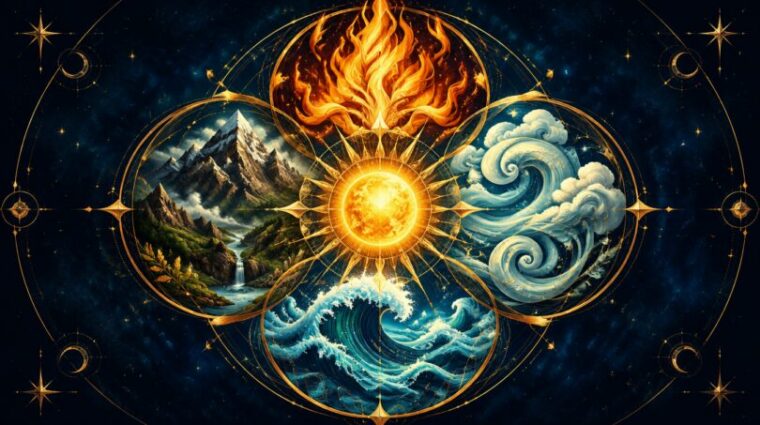
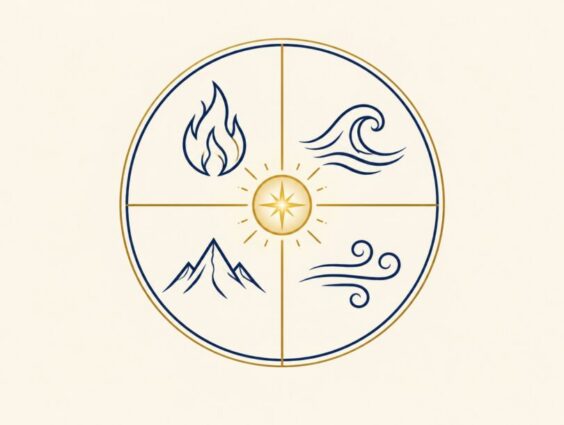
The four elements are Earth, Air, Fire and Water, the four basic substances that ancient Greek thinkers believed everything in the world is made of. Over thousands of years the idea grew into far more than early science. It became a shared language for temperament, the seasons, the zodiac, the tarot, the body and the inner life.
In spiritual practice, each element describes a quality you can feel. Earth is steady and practical. Air is curious and quick. Fire is passionate and bold. Water is deep and intuitive. Most of us carry all four, and one usually speaks louder than the others.
This guide covers where the four elements come from, what each one means, how they appear in astrology, tarot, the chakras and ritual, how to sense your own dominant element, and simple practices to bring each one back into balance. Looking for the Chinese system of five elements? That is a separate and equally rich tradition, and we cover it in our guide to Chinese zodiac elements. The idea we return to at Next Level Soul runs through all of it. The power is within you, and the elements are a map for remembering that.
Key Takeaways
- The four elements are Earth, Air, Fire and Water, the basic substances ancient Greek thinkers believed everything is made of.
- Empedocles named them in the fifth century BCE. Plato and Aristotle shaped them, and Aristotle added a fifth element, aether, for the heavens.
- Each element carries a quality: Earth is steady, Air is curious, Fire is passionate and Water is intuitive.
- In astrology, the 12 signs divide into four elements of three signs each. In tarot, the four suits map to them too.
- Vedic and Ayurvedic tradition teaches five great elements. Chinese tradition has its own five-element system.
- You can work with the elements through simple, safe practices. No claim here is medical, and the power to choose is yours.
What Are the Four Elements of Nature?
The four elements of nature are Earth, Air, Fire and Water. In the classical Western tradition they are the building blocks of the physical world: the solid ground, the breath of the sky, the heat of the flame and the flow of the sea. Nothing in the world is purely one of them. Everything is a mixture, and the proportions are what make a stone different from a cloud.
Today the four elements are less a physics lesson than a symbolic system. Spiritual teachers, astrologers, tarot readers and ritual practitioners use them to describe types of energy, stages of life and parts of ourselves. You do not need to believe the Greeks were right about matter to find it useful.
A fifth element, aether (also called quintessence or spirit), appears in several traditions as the finer substance that holds the other four together. We come to it below.
Where Did the Four Elements Come From?
Empedocles and the Four Roots
The Greek philosopher Empedocles, who lived in the fifth century BCE, is usually credited with putting the four together. He called them the “roots” of all things and taught that they join and separate through two forces he called Love and Strife. Earlier thinkers had each favored a single source. Thales pointed to water, Anaximenes to air and Heraclitus to fire. Empedocles brought them into one picture.
Plato, Aristotle and the Fifth Element
Plato, in the Timaeus, is thought to be the first to use the word we translate as “element.” He linked each one to a geometric solid: fire to the tetrahedron, earth to the cube, air to the octahedron and water to the icosahedron. Aristotle then described the elements through paired qualities. Fire is hot and dry, air is hot and wet, water is cold and wet, and earth is cold and dry. He also proposed aether, a fifth, unchanging element that fills the heavens beyond the earthly sphere.
Alchemy and the Hermetic Tradition
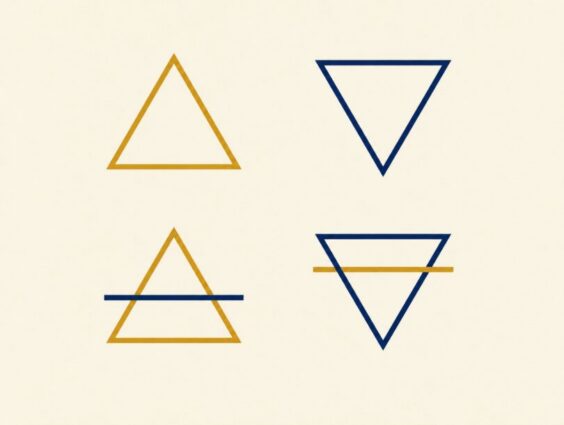
Medieval and Renaissance alchemists took the four elements as their working vocabulary. They drew them as triangles: fire as an upward triangle, water as a downward one, and air and earth as the same triangles crossed by a horizontal line.
The Hermetic tradition, rooted in the writings attributed to Hermes Trismegistus, treats the elements as stages of inner work as well as outer substances. Its best-known text, the Emerald Tablet, is the source of the line “as above, so below.” If that thread calls to you, our Emerald Tablet study guide walks through it step by step.
What Does Each Element Mean?
Traditions differ in detail, but the core qualities are consistent.
Earth: Stability, Body and Patience
Earth is the element of ground, form and the senses. It stands for security, steady effort, practicality and the physical body. When Earth is strong, you are reliable and good at building things that last. When it is overdone, it can show up as stubbornness or resistance to change.
Air: Mind, Breath and Communication
Air is the element of thought, language and connection. It stands for curiosity, ideas, perspective and the breath that moves through us all day. A strong Air nature is quick, social and open-minded. Too much can mean a busy mind that struggles to land.
Fire: Passion, Will and Transformation
Fire is the element of energy, courage and change. It stands for inspiration, drive, warmth and the spark that gets us moving. A strong Fire nature is bold and generous. Left unchecked, it can burn hot and burn out, or flare into impatience.
Water: Emotion, Intuition and Flow
Water is the element of feeling, memory and the unseen. It stands for empathy, intuition, healing and the ability to adapt. A strong Water nature is tender and perceptive. Without balance, it can become overwhelmed by emotion or lose its edges.
The Four Elements at a Glance
This table gathers the most common correspondences in one place. Mappings vary between traditions, so treat it as one widely used set, not a rulebook. The directions follow Western ceremonial practice, and the seasons follow an older classical pattern.
| Element | Core qualities | Direction | Season | Zodiac signs | Tarot suit | Chakra | Body and emotion |
|---|---|---|---|---|---|---|---|
| Earth | Stable, practical, sensual | North | Autumn | Taurus, Virgo, Capricorn | Pentacles (Coins) | Root | Body, bones, security |
| Air | Curious, social, mental | East | Spring | Gemini, Libra, Aquarius | Swords | Heart | Breath, thought, connection |
| Fire | Passionate, bold, creative | South | Summer | Aries, Leo, Sagittarius | Wands | Solar plexus | Warmth, drive, courage |
| Water | Intuitive, tender, adaptive | West | Winter | Cancer, Scorpio, Pisces | Cups | Sacral | Fluids, feelings, flow |
The Four Elements in Astrology
In astrology, the 12 zodiac signs are divided into four groups of three, one group for each element. Within each group, the signs share a temperament, even though each expresses it differently. You can read much more about signs and birth charts in our complete astrology guide.
| Element | Signs | Often described as |
|---|---|---|
| Fire | Aries, Leo, Sagittarius | Inspired, energetic, direct |
| Earth | Taurus, Virgo, Capricorn | Grounded, dependable, practical |
| Air | Gemini, Libra, Aquarius | Thoughtful, sociable, idea-driven |
| Water | Cancer, Scorpio, Pisces | Sensitive, intuitive, deep |
Astrology also sorts signs into three modalities. Cardinal signs (Aries, Cancer, Libra, Capricorn) begin things. Fixed signs (Taurus, Leo, Scorpio, Aquarius) sustain them. Mutable signs (Gemini, Virgo, Sagittarius, Pisces) adapt and carry them to the next stage. Every sign is one element plus one modality, which is why Aries is “cardinal fire” and Scorpio is “fixed water.”
The Four Elements in Tarot
The minor arcana of the tarot has four suits, and each one is tied to an element. Wands are Fire: ambition, creativity and action. Cups are Water: emotion, intuition and relationships. Swords are Air: thought, truth and communication. Pentacles, also called Coins, are Earth: work, money, the body and home. Our guide to tarot cards goes deeper into every card.
The Elements in the Chakras and the Body
Yogic and tantric teachings connect the lower chakras to the elements. The root chakra is linked to Earth, the sacral to Water, the solar plexus to Fire, the heart to Air and the throat to space, or ether. The brow and crown go beyond the elements into pure awareness. If you are exploring this system, start with our chakras guide.
The elements are also tied to the hands. In many yoga traditions, the thumb is linked to Fire, the index finger to Air, the middle finger to space, the ring finger to Earth and the little finger to Water. Mudras use finger positions to bring those qualities into meditation. You can see 22 of them in our mudra meanings guide.
In everyday language, the elements also map loosely onto how we experience ourselves. Earth feels like the body and its need for rest and food. Water feels like emotion. Fire feels like motivation. Air feels like thought and breath. This is symbolic, not diagnostic. If you have a health concern, please talk with a qualified professional.
The Five Great Elements in Vedic and Ayurvedic Thought
Indian philosophy teaches pancha mahabhuta, the “five great elements”: prithvi (earth), jala (water), agni (fire), vayu (air) and akasha (space or ether). They are close cousins of the Greek four, with space added as the fifth.
In Ayurveda, a traditional system of wellness from India, the elements combine into three constitutional types called doshas. Vata is described as space and air, pitta as fire and water, and kapha as water and earth. For anything health-related, work with a trained practitioner.
The Elements, the Four Directions and Ritual
Many people open a ritual or meditation by calling the four elements and the four directions. In Western ceremonial practice and modern Wicca, a common pattern is Air in the east, Fire in the south, Water in the west and Earth in the north. A candle, a bowl of water, a stone and a feather often stand in for them on an altar.
A note of respect. Many Indigenous nations hold their own teachings about land, water, fire, air and the directions, and these differ from nation to nation. The “medicine wheel,” for example, comes from specific Plains traditions and has been widely borrowed. We do not claim those teachings here. If you feel called to them, learn from teachers and communities who carry them, and credit the source. The Western four-element practices in this guide are your own to explore freely.
How Do You Know Your Dominant Element?
This is a reflection, not a test. There is no scientific measure for it. Read each line and notice which one makes you nod.
- Earth: I feel best with routine, good food, nature and things I can touch. I dislike being rushed.
- Air: I live in my thoughts. I love learning, talking things through and changing my mind.
- Fire: I need to be doing something that matters. I am quick to act and quick to feel fired up.
- Water: I pick up on moods and feel things deeply. I need quiet, solitude and time near water.
Your sun sign is another clue. If you are an Aries, Leo or Sagittarius, you may feel Fire strongly. You can also look at where the planets sit in your birth chart, which an astrologer or an online chart can show you. Then ask which element you have the least of right now. That is the one to invite in.
How to Balance Each Element
These practices are gentle and free. Choose the one that matches what feels missing, and stop if anything feels off in your body.
Balance Earth: A Grounding Walk
Walk slowly for 10 to 15 minutes, outside if you can. Feel your feet meet the ground. Name five things you can see and four you can touch. You can hold a smooth stone in your hand as a focus, and if you like working with stones, our crystals for healing guide is a good place to start.
Balance Air: Gentle Breath
Sit comfortably and breathe in through the nose for a count of four, hold for four, breathe out for four and hold for four. Repeat for two minutes. Keep it easy and never strain. Do not practice while driving or near water. Stop if you feel dizzy, and skip breath holds if you are pregnant or have heart, blood pressure or breathing conditions unless your doctor says it is fine. More ideas are in our guide to how to meditate.
Balance Fire: Candle and Movement
Light a candle on a safe, stable surface and gaze at the flame for a few minutes while you set one clear intention for the day. Then move: dance, stretch or take a brisk walk until you feel warm. Never leave a flame unattended.
Balance Water: A Bath or Water Ritual
Take a warm bath or shower with no phone and no rush, and picture the day washing away. If you prefer something simpler, sit by a lake, river or the sea, or drink a glass of water slowly and with thanks. Keep the water comfortably warm, never hot, and check with your doctor first if you have a condition that affects baths or hydration.
If big emotions come up and feel like too much, reach out to a counselor or someone you trust. In the United States, you can call or text 988 at any time for the Suicide and Crisis Lifeline.
Four Elements vs. Chinese Five Elements
The Western four elements describe types of energy and temperament. The Chinese five elements, Wood, Fire, Earth, Metal and Water, describe cycles of change. It has Wood and Metal but no Air, and it is tied to birth years, feng shui and Bazi. Use our Chinese zodiac elements guide to find your element by birth year.
Hear It From the Guests
These Next Level Soul Podcast conversations pair well with this guide, from water and shamanic healing to the breath.

Liquid Portals: Unlocking the Water Codes to Spirit Communication with Veda Austin
Water researcher Veda Austin explores water and consciousness through crystallography. She shares how an accident led her to ask what water is, and what she says water has shown her since. Watch the full episode and read the show notes.

The Ancient Path to Healing Your Body with Alberto Villoldo
Medical anthropologist Alberto Villoldo spent decades studying healing with shamans in the Amazon, the Andes and the Himalayas. He talks about what he says ancient wisdom and modern science share about the body. Watch the full episode and read the show notes.

The Mystical Power of the Breath with Wim Hof
Wim Hof talks about the power of the breath and why he calls the cold a noble force. A conversation for anyone curious about Air and Water as teachers. Watch the full episode and read the show notes.
Sources and Further Reading
Spirituality for the Rest of Us™
Films, teachings and community on Next Level Soul TV.
Go Deeper with NLS Mastery: The Spiritual Alchemy of St. Germain
Explore the old art of alchemy as a path of inner transformation, from the four elements to the violet flame. David Christopher Lewis teaches it in The Spiritual Alchemy of St. Germain, part of NLS Mastery. Watch the course preview below.
Frequently Asked Questions
What are the four elements?
The four elements are Earth, Air, Fire and Water. In the classical Western tradition they are the basic substances everything is made of, and in spiritual use they describe four types of energy.
What is the fifth element?
The fifth element is aether, also called quintessence or spirit. Aristotle described it as the unchanging substance of the heavens, and many traditions treat it as the spirit that connects the other four.
What do the four elements mean spiritually?
Earth stands for stability and the body, Air for mind and communication, Fire for passion and transformation, and Water for emotion and intuition. They are used as a map for understanding yourself.
What are the four elements in astrology?
Fire signs are Aries, Leo and Sagittarius. Earth signs are Taurus, Virgo and Capricorn. Air signs are Gemini, Libra and Aquarius. Water signs are Cancer, Scorpio and Pisces.
Which element is each tarot suit?
Wands are Fire, Cups are Water, Swords are Air and Pentacles are Earth. This is the standard mapping in most modern tarot decks.
Which of the four elements am I?
There is no scientific test, but your sun sign, your birth chart and a simple self-reflection can all point to a dominant element. Most people carry all four.
What are the four elements in the chakras?
In yogic teaching, the root chakra is linked to Earth, the sacral to Water, the solar plexus to Fire and the heart to Air. The throat chakra is linked to space, or ether.
What are the five elements in Ayurveda?
They are earth (prithvi), water (jala), fire (agni), air (vayu) and space (akasha). Together they form the three doshas, vata, pitta and kapha.
How are the four elements different from the Chinese five elements?
The Chinese system uses Wood, Fire, Earth, Metal and Water, and describes a cycle in which elements create and control one another. The Western four are about types of energy and temperament.
How can I balance the elements in daily life?
Match a simple practice to what feels missing: a slow walk for Earth, gentle breathing for Air, a candle and movement for Fire, or a bath or time by water for Water. Stop if anything feels uncomfortable, and speak with a doctor about any health concern.