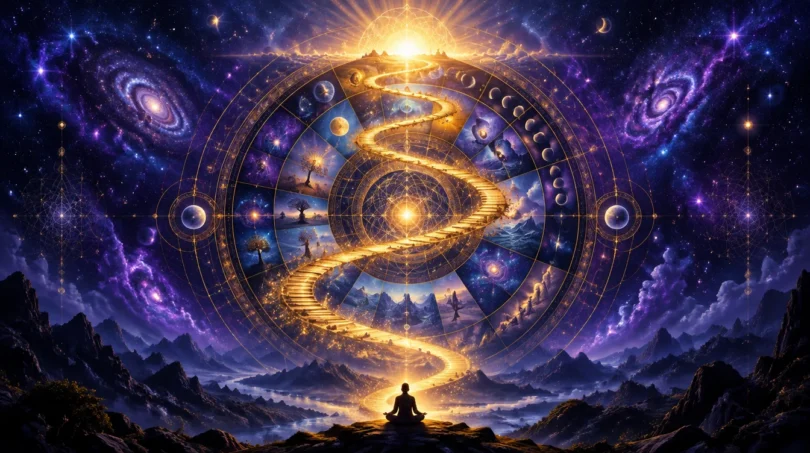
Ancient India taught that time is not a straight line. It is a wheel. Ages rise and fall in great cycles called yugas, and every soul on Earth moves through the turning of that wheel together. Some ages are dark and heavy. Some are bright and open. The question that has fascinated seekers for thousands of years is simple: where are we on the wheel right now?
The popular answer says we are deep inside the Kali Yuga, the darkest age, with hundreds of thousands of years still to go. But one of the most respected Kriya Yoga masters of the modern era, Sri Yukteswar Giri, taught something very different. In his 1894 book The Holy Science, he said the real cycle lasts about 24,000 years, that the darkest point has already passed, and that humanity has been climbing back toward the light for well over a thousand years.
His student Paramahansa Yogananda carried the teaching to the West. Their message was one of hope: the age is rising, and your own awakening is part of the rise.
This guide is the complete map. You will find the traditional yuga system, Sri Yukteswar’s 24,000-year cycle, every date and duration in one place, what each age is like, the signs of the current age, and what it all means for your life and your practice.
Key Takeaways
- The four yugas are Satya (Golden), Treta (Silver), Dwapara (Bronze) and Kali (Iron). Each is an age of consciousness, not only a span of years.
- Traditional Indian reckoning puts a full cycle at 4.32 million years, with Kali Yuga lasting 432,000 years.
- Sri Yukteswar taught a 24,000-year cycle, matching the precession of the equinoxes, with a 12,000-year descent and a 12,000-year ascent.
- In his chronology the low point came around 499 CE. The ascent began there, and Dwapara Yuga began around 1699 CE.
- Dwapara is the age of energy and subtle forces. Electricity, radio, quantum physics and global connection are its signature.
- The next major threshold in his scheme, the shift into Treta Yuga, comes around 4099 CE.
- You do not wait for the age to lift you. Your own meditation and Kriya Yoga practice is how you rise ahead of it.
What Are the Yugas?
The word yuga means “age” or “epoch” in Sanskrit. In the Vedic and Puranic traditions, time moves through four ages that repeat in a fixed order. The four ages are named after throws of an ancient dice game, with Satya as the perfect throw and Kali as the lowest.
| Yuga | Also called | Quality of consciousness | Symbol |
|---|---|---|---|
| Satya Yuga | Golden Age, Krita Yuga | Truth, divine awareness, direct knowing of Spirit | Dharma stands on four legs |
| Treta Yuga | Silver Age | Mind and thought reach their power, telepathy and divine magnetism | Dharma stands on three legs |
| Dwapara Yuga | Bronze Age | Energy, electricity and the subtle forces behind matter | Dharma stands on two legs |
| Kali Yuga | Iron Age, Dark Age | Matter is mistaken for the whole of reality | Dharma stands on one leg |
The image of dharma, or righteousness, standing on four legs and slowly losing them is a favorite of the scriptures. In the Golden Age the bull of dharma stands steady. By the Iron Age it hobbles on a single leg. The cycle then turns, and the legs return one by one.
Yugas as States of Mind
The teaching is not only about the calendar. In the yogic view, the age of the world and the state of the human mind move together. When the collective mind sees only matter, we live in an age of matter. When it opens to energy, then to mind, then to Spirit, the age opens with it. This is why the yugas matter to a spiritual seeker. They describe the sky of consciousness you are living under.
The Traditional Reckoning: 4.32 Million Years
The Puranas, including the Vishnu Purana and the Bhagavata Purana, give very long durations. A set of four yugas forms a Mahayuga, or great age. In this classical view, the ages are counted in years of the gods, where one divine year equals 360 human years.
| Yuga | Duration (human years) | Share of the Mahayuga |
|---|---|---|
| Satya Yuga | 1,728,000 | 40% |
| Treta Yuga | 1,296,000 | 30% |
| Dwapara Yuga | 864,000 | 20% |
| Kali Yuga | 432,000 | 10% |
| Full Mahayuga | 4,320,000 | 100% |
The classical date for the start of Kali Yuga is 3102 BCE, tied to the time of Lord Krishna and the end of the Mahabharata war. By this count, Kali Yuga has roughly 427,000 years left, and a golden age is almost unthinkably far away.
Many Hindu teachers still hold this view, and it carries deep meaning in temple rites and sacred astronomy. It is also the view Sri Yukteswar set out to correct.
Sri Yukteswar and the Holy Science
Sri Yukteswar Giri (1855 to 1936) was a Kriya Yoga master, an astronomer and astrologer by training, and the guru of Paramahansa Yogananda. He was a disciple of Lahiri Mahasaya and part of the lineage that traces back to Mahavatar Babaji.
In 1894, at a Kumbh Mela gathering in Allahabad, Sri Yukteswar met Babaji, who asked him to write a short book showing the harmony between the Eastern and Western scriptures. The result was Kaivalya Darsanam, published in English as The Holy Science. It has four short sections: The Gospel, The Goal, The Procedure and The Revelation.
The first section carries the astronomical teaching that made the book famous. In it, Sri Yukteswar lays out a cycle of the heavens that he said governs the rise and fall of human awareness.
The 24,000-Year Cycle
Sri Yukteswar taught that the Sun, with its family of planets, moves in a vast orbit around another body. As the Sun travels this path, the equinoxes drift backward through the zodiac. That drift is the precession of the equinoxes, which modern astronomy places at roughly 26,000 years. He gave the cycle as about 24,000 years and said it is the master clock of human consciousness.
- One full cycle is about 24,000 years. Think of it as a great circle with a bottom and a top.
- The descent takes about 12,000 years. Awareness narrows from the divine toward matter.
- The ascent takes about 12,000 years. Awareness expands from matter back toward the divine.
- Each half passes through all four yugas in opposite order, with lengths in a ratio of 1 to 2 to 3 to 4.
He measured the half-cycle as follows: Kali 1,200 years, Dwapara 2,400 years, Treta 3,600 years and Satya 4,800 years. Add them up and you reach 12,000.
| Yuga | Length in Yukteswar’s cycle | Share of one 12,000-year half |
|---|---|---|
| Kali Yuga | 1,200 years | 10% |
| Dwapara Yuga | 2,400 years | 20% |
| Treta Yuga | 3,600 years | 30% |
| Satya Yuga | 4,800 years | 40% |
The proportions of 10, 20, 30 and 40 percent match the traditional system exactly. What changed is the unit. Where the classical count multiplies by 360, Sri Yukteswar kept the years as plain solar years. His 12,000-year half-cycle is the classical 12,000 “divine years” with the multiplier removed.
Why He Said the Old Count Was Wrong
Sri Yukteswar taught that the long figures were a later error, not the original teaching. According to him, the old calculation was distorted during the dark centuries of the descent, when the understanding of the cycle faded and scholars could no longer read the sky for themselves. Once the multiplier crept in, the age of the world was stretched to 432,000 years, and people concluded that a golden age lay a half-million years away.
His correction restored the original scale, and the message of the ancient seers came back with it: the wheel is turning, and it is turning now.
The Companion Star Idea
The physical mechanism he proposed was a companion to our Sun, a binary partner that the Sun orbits. He called its influence the pull that moves the equinoxes. This idea has been explored by researchers such as the Binary Research Institute, and the book The Yugas by David Steinmetz and Joseph Selbie presents the case for a modern audience. Astronomers have not detected such a companion, and mainstream science explains precession through the Earth’s axial wobble. Many students of the teaching treat the cycle as a map of consciousness first, and a map of the sky second.
The Complete Timeline of One 24,000-Year Cycle
Here is the whole wheel in Sri Yukteswar’s chronology, with the dates drawn from the 499 CE low point. Each yuga includes short junction periods, called sandhis, where one age blends into the next.
| Phase | Yuga | Approximate dates | Years |
|---|---|---|---|
| Descending consciousness narrows | Satya Yuga | 11501 BCE to 6701 BCE | 4,800 |
| Treta Yuga | 6701 BCE to 3101 BCE | 3,600 | |
| Dwapara Yuga | 3101 BCE to 701 BCE | 2,400 | |
| Kali Yuga | 701 BCE to 499 CE | 1,200 | |
| Ascending consciousness widens | Kali Yuga | 499 CE to 1699 CE | 1,200 |
| Dwapara Yuga (we are here) | 1699 CE to 4099 CE | 2,400 | |
| Treta Yuga | 4099 CE to 7699 CE | 3,600 | |
| Satya Yuga | 7699 CE to 12499 CE | 4,800 |
Read the middle of that table and the story becomes clear. The lowest point of the whole wheel, the heart of the Dark Age, sits at about 499 CE. From there, the climb begins. The 1,200 years of the ascending Kali Yuga run to about 1699 CE, and the ascending Dwapara Yuga opens at that point. The commonly cited date for the transition is 1699, with the final century before it, from about 1599, serving as the junction.
Sri Yukteswar wrote in 1894. By his reckoning, that was already about 195 years into Dwapara Yuga. He pointed to the world around him as evidence, and we will see what he saw in a moment.
And After Satya Yuga?
At about 12499 CE the ascent reaches its summit, the center of the Golden Age, and the wheel begins to turn downward again. The entire pattern then repeats. The cycle has no beginning and no end in the human sense. Ages rise, ages fall, and souls pass through them again and again, which is one reason the yugas pair so naturally with the teaching of reincarnation.
The Four Ages Up Close
Each yuga has its own character. The descriptions below follow the yogic tradition, and they work in both directions. The same qualities appear on the way down and on the way up.
Satya Yuga: The Golden Age
This is the age of Spirit. Human awareness rests in the divine, and the understanding that all of creation is one consciousness is simply known, not taught. In the yogic view, humanity in this age perceives Spirit directly, and life flows in harmony with it. In the traditional symbolism, dharma stands on four legs, and the world is unified, luminous and at peace.
Many mystical traditions remember a golden age like this: the Garden of Eden, the Age of Gold of the Greeks, the Time before Time. The yugas place it on the great wheel instead of in a lost and unreachable past.
Treta Yuga: The Silver Age
In Treta, the understanding of mind opens. Sri Yukteswar taught that in this age, people know the nature of divine magnetism and the subtle powers of thought. Distance dissolves, and what we would call telepathy becomes ordinary. Knowledge of the inner worlds is widespread.
The Rama of the epic Ramayana is placed in this age by tradition, a ruler whose very presence ordered the kingdom around him.
Dwapara Yuga: The Bronze Age
In Dwapara, humanity learns about energy and the subtle forces that sit behind solid matter. People begin to see that what looks like dense substance is a play of fine vibration. They learn to command electricity and the elements of nature through technology.
This is the age we have been living in since about 1699. The earlier, descending Dwapara in his chronology is the age of the great epic heroes, when the era of Krishna is remembered in scripture. Read more in our guide to Lord Krishna.
Kali Yuga: The Iron Age
Kali is the age of matter. The world is thought to be only what the senses report. Spirit is forgotten, knowledge of the subtle realms fades, and life becomes a struggle for survival and possession. It is the narrowest point of the wheel, and it lasts only 1,200 years in each half in Sri Yukteswar’s scheme.
The darkest part of the Western Middle Ages falls near the bottom of this valley. Yet even in the Iron Age, the light does not go out. Saints, mystics and the first seeds of the ascent are always present. In the ascending Kali Yuga, the long climb back begins.
Living in Dwapara Yuga: The Age of Energy
If Sri Yukteswar is right, we are about 330 years into an age whose signature is the discovery of subtle energy. Look at what has unfolded since the late 1600s, and the pattern is striking.
| Period | Breakthrough | What it revealed |
|---|---|---|
| 1600s to 1700s | Newton’s physics, the first studies of static electricity and magnetism | Invisible forces govern the visible world |
| 1800s | Electric current, the telegraph, electromagnetism | Energy can be harnessed and sent across distance |
| Late 1800s | Maxwell’s equations, the electric light, the telephone, radio waves | Light, electricity and magnetism are one family |
| Early 1900s | Relativity, quantum physics, E = mc² | Matter and energy are interchangeable |
| Mid to late 1900s | Television, nuclear energy, computers, satellites | The world becomes one connected field |
| 2000s and beyond | The internet, mobile networks, global instant communication | Thought and information move at the speed of light |
The age of matter said that solid things are all there is. The age of energy says that solid things are a dance of vibration. The shift in the scientific picture of reality, from billiard balls to fields and waves, is the Dwapara awakening in plain view.
The Spiritual Signs of Dwapara
Alongside the technology, the inner life of the world has been changing too.
- Yoga, meditation and Eastern wisdom came West. What was once locked inside Indian ashrams now fills studios and phones. Yogananda arrived in America in 1920, and his book Autobiography of a Yogi reached millions.
- Energy medicine and subtle anatomy entered the mainstream. Chakras, prana, kundalini and the energy body are now everyday vocabulary.
- Near-death research. Thousands of people have returned from the edge of death with stories of light and a larger reality, and the subject is studied at universities.
- Psychic and intuitive abilities are being talked about openly. See our guides to clairvoyance and telepathy.
- Old walls are coming down. Faith traditions, cultures and nations are in contact as never before, and the idea that all paths lead to one summit is widespread.
Dwapara is not a golden age. It is an age of power and exploration that can be used for good or harm. The same energy that heals can also be turned toward destruction, and every great step forward shows its shadow. Sri Yukteswar made clear that this is a time of mixed gifts, rising overall, with the full flowering still ahead.
What Yogananda Taught About the Yugas
In Autobiography of a Yogi, Paramahansa Yogananda wrote about his guru’s revelation with real enthusiasm. He described Sri Yukteswar’s insight that the world had left the Dark Age, and that humanity was gradually coming into a better understanding of the finer forces of nature. He often reminded students that the end of the world was not near, and that the great story is one of ascent.
The teaching gave him a reason for urgency and for optimism. The age was opening, and the science of Kriya Yoga, long hidden, was being released to the world for exactly this moment. See our complete guide to Kriya Yoga meditation.
Why the Yugas Matter for Your Life
The yugas are not only an ancient clock. They give you a way to read your own times with calm and with purpose.
- They replace fear with perspective. If the age is rising, the troubles of our time look less like the end of everything and more like the growing pains of a wider awareness.
- They explain why spiritual practice is so available now. Teachings that once took a lifetime to reach you can be found in a single search.
- They place your effort inside a larger current. Meditation in the age of energy is meditation with the tide.
- They remind you that the mind sets the age. The ages are moved by consciousness, and consciousness is made of individual people.
How to Practice in the Age of Energy
- Sit daily. Even ten minutes of meditation turns your attention from the surface to the subtle. Start with our Kriya Yoga meditation guide.
- Work with energy, not only ideas. Breath, sound, light and the chakras are the tools of this age.
- Keep good company. Spend time with teachers and communities that raise your awareness.
- Use technology with intention. Let the tools of the age serve your inner life instead of crowding it out.
- Study the lineage. Read the lives of Babaji, Lahiri Mahasaya, Sri Yukteswar and Yogananda, and see what a life that rises ahead of its age looks like.
How the Yugas Compare to Other Cycle Teachings
The idea that time moves in great cycles is not unique to India. Many traditions describe the same wheel in their own language.
| Tradition | Cycle teaching | How it connects |
|---|---|---|
| Greek (Hesiod) | Ages of Gold, Silver, Bronze and Iron, with an Age of Heroes between Bronze and Iron | The same metals as the yugas, in the same order |
| Western astrology | The Great Year and the Ages of Pisces and Aquarius | Both tie the ages to the precession of the equinoxes. See our astrology guide |
| Maya and Aztec | The Five Suns and the Long Count | World ages that end and begin again |
| Hopi | Successive worlds, with humanity moving toward a Fifth World | Humanity passes through worlds of rising awareness |
| Theosophy | Root races and rounds | Consciousness evolves across vast stages. See Theosophy |
The cycle of Greek ages Hesiod described, Gold, Silver, Bronze and Iron, matches the yugas so closely that scholars have long wondered about a common source. Other lost-civilization teachings, such as the story of Atlantis, also place a high civilization in the deep past, which fits a cycle whose summit lies far behind us and far ahead.
Questions and Critiques
An honest guide shows both sides. Sri Yukteswar’s chronology is not the mainstream Indian view, and it raises questions that thoughtful students ask.
- Most traditional scholars hold the long count. Pandits and Sanskrit astronomers generally keep the 4.32 million year framework, and many accept 3102 BCE as the start of Kali.
- No companion star has been found. Astronomers explain precession through the Earth’s own wobble, and they have not confirmed a binary partner for the Sun.
- The 24,000-year figure differs slightly from modern precession. The measured period is about 25,800 years. Students of the teaching often read the number as a symbolic measure of the cycle.
- Dates are a guide, not a switch. Even in his own writing, the yugas blend through junction periods, and nobody wakes up to a new age on a single day.
These points do not erase the teaching’s value. Many seekers hold the yugas as a living map of consciousness. The deeper question is the one the map points to: what does it mean to wake up inside an age that is rising?
The Yugas, Timelines and the Mandela Effect
If the age of the world is a state of collective awareness, then shifts in awareness should have visible effects. Some teachers connect the rise of Dwapara energy with phenomena like timeline shifts and the Mandela effect, where memory and reality seem to diverge. Others see the opening of our collective senses to subtle realities, from ascension to the Akashic Records, as signs of the same turning. These links are part of the ongoing conversation, and they show how the yugas fit into the wider picture of an awakening world.
Watch: The Yugas Explained
These conversations on the Next Level Soul Podcast bring the teaching to life.
Joseph Selbie: The 24,000-Year Prophecy
Joseph Selbie, co-author of The Yugas, walks through Sri Yukteswar’s cycle and the evidence for it. This is the best single place to start. Watch the full episode and read the show notes.

Keshava Swami: Ancient Wisdom for Humanity’s Great Awakening
Keshava Swami speaks on the Vedic view of time and the awakening that is already under way. Watch the full episode and read the show notes.
Dr. Theresa Bullard: Humanity’s Future Cycles of Evolution
Dr. Theresa Bullard looks at where the great cycles are taking us next. Watch the full episode and read the show notes.

Go Deeper with Next Level Soul
- Sri Yukteswar Giri: The Complete Guide to His Life, Teachings and Legacy
- Paramahansa Yogananda: The Complete Guide
- Lahiri Mahasaya and Mahavatar Babaji
- Kriya Yoga Meditation: The Ancient Science of the Soul
- Dr. Katy Jane on Vedic astrology and humanity’s near future
- Michael Le Flem on Atlantean prophecy for humanity
- Astrology: Signs, Birth Charts and Cosmic Cycles
- The Mandela Effect: Examples, Theories and Meaning
- The full spiritual glossary
Read the Source: The Holy Science
The Holy Science by Swami Sri Yukteswar is the short, powerful 1894 book where the yuga teaching began. It is a quick read and the best way to meet Sri Yukteswar in his own words.
Get The Holy Science on Amazon
As an Amazon Associate, Next Level Soul earns from qualifying purchases.
Also worth reading: Yogananda’s Autobiography of a Yogi and The Yugas by David Steinmetz and Joseph Selbie.
Sources and Further Reading
Spirituality for the Rest of Us™
Films, teachings and community on Next Level Soul TV.
Frequently Asked Questions
What are the four yugas?
The four yugas are Satya (Golden), Treta (Silver), Dwapara (Bronze) and Kali (Iron). They are ages of consciousness that repeat in a fixed order, from the brightest to the darkest, and then rise again.
What yuga are we in now?
In the traditional view, we are in Kali Yuga, which began in 3102 BCE. According to Sri Yukteswar, the darkest age has passed, and we have been in the ascending Dwapara Yuga since about 1699 CE.
How long is each yuga?
Traditionally, Satya is 1,728,000 years, Treta 1,296,000, Dwapara 864,000 and Kali 432,000. In Sri Yukteswar’s cycle, Satya is 4,800 years, Treta 3,600, Dwapara 2,400 and Kali 1,200.
What is the 24,000-year cycle?
It is Sri Yukteswar’s teaching that the heavens turn through a great cycle of about 24,000 years, tied to the precession of the equinoxes. It has a 12,000-year descent into matter and a 12,000-year ascent back to Spirit.
When did Dwapara Yuga begin?
In Sri Yukteswar’s chronology, the ascending Dwapara Yuga began around 1699 CE and continues until about 4099 CE, with the lowest point of the whole cycle having come around 499 CE.
Who was Sri Yukteswar?
Sri Yukteswar Giri (1855 to 1936) was a Kriya Yoga master, the disciple of Lahiri Mahasaya and the guru of Paramahansa Yogananda. He wrote The Holy Science in 1894.
What is The Holy Science?
The Holy Science is Sri Yukteswar’s 1894 book, written at the request of Mahavatar Babaji, showing the unity of the Eastern and Western scriptures. It also presents his teaching on the yuga cycle.
What is special about Dwapara Yuga?
Dwapara is the age of energy. Humanity learns the subtle forces behind matter, such as electricity, electromagnetism and quantum physics, and begins to look beyond the purely material world.
Is the Kali Yuga really 432,000 years long?
That is the traditional Puranic figure. Sri Yukteswar taught that the long count came from a later error and that the true length of Kali is 1,200 years in each half of the cycle. Many traditional scholars still hold the long count.
When does the next age begin?
In Sri Yukteswar’s chronology, the transition into Treta Yuga comes around 4099 CE, and Satya Yuga, the Golden Age, reaches its center around 12499 CE.