
Mystics of the Renaissance is Rudolf Steiner’s study of the Western mystics who stood at the doorway of the modern age. He follows thinkers such as Meister Eckhart, Paracelsus, Jacob Boehme and Giordano Bruno, and asks what they can still say to us. This study guide walks through all 9 sections in plain language, then hands you a workbook to try the ideas on your own life.
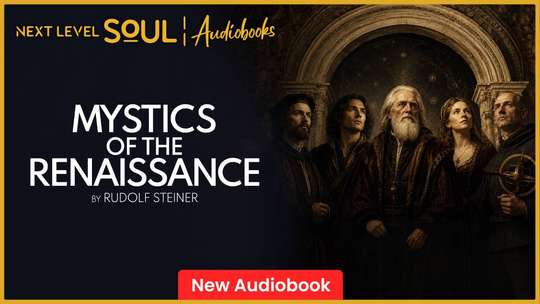
Listen While You Study
The audiobook is available on Next Level Soul TV. Play a section, then come back here for the notes and the workbook prompt.
Key Takeaways
- The inner life is a doorway to truth, and the mystics in this book walk through it.
- Steiner argues that mysticism and clear thinking belong together, not opposed to each other.
- Meister Eckhart points to something divine inside the soul, a place where God and the person meet.
- Paracelsus and Agrippa look at nature as alive and full of meaning, so knowing nature and knowing yourself go hand in hand.
- Boehme and Bruno show two sides of one search, a deep inner vision and a boundless sense of the universe.
The Book at a Glance
| Detail | What to Know |
|---|---|
| Author | Rudolf Steiner |
| English edition | Translated by Bertram Keightley, published by G. P. Putnam’s Sons, 1911 |
| Sections | 9 |
| Tradition | Western mysticism and esoteric philosophy |
| Audiobook | Available on Next Level Soul TV |
What Is Mystics of the Renaissance About?
This book is a series of portraits. Rudolf Steiner takes a group of European mystics and thinkers and shows how each one searched for truth by looking inward as well as outward. He treats them as serious seekers, not as curiosities from the past.
Steiner’s bigger question is how these older, spiritual ways of knowing relate to the modern world of science and reason. He argues that the mystics were not enemies of clear thought. He presents them as people who helped open the way to the modern mind.
The Board: 9 Sections
Each square is a section. Tap one to jump to its study notes.
- 1Foreword
- 2Introduction
- 3Eckhart
- 4Friends of God
- 5Nicholas of Cusa
- 6Nature Seers
- 7Weigel, Boehme
- 8Bruno, Silesius
- 9Afterword
Section-by-Section Study Notes
These notes are our own summary, written to help you follow the book. Each one ends with a small practice you can try this week.
Foreword
The Foreword sets the stage for the whole book. Here the author explains what he is trying to do and why he gathers these mystics together. Read it as a short map of the road ahead. It tells you the spirit in which Steiner approaches the subject: with respect for the inner life, and with a wish to link it to the thinking of our own age. It is a good place to slow down and set your own questions before you begin.
Introduction
The Introduction is the longest opening piece. Steiner describes how thinking changed as the modern age arrived, and where the mystics fit into that change. He argues that the spiritual search and the scientific search are not as far apart as they look. This section gives you the main frame for everything that follows. Expect big ideas about knowledge, nature, and the human spirit, and take your time with them, because later sections keep returning to these themes.
Meister Eckhart
Here Steiner turns to Meister Eckhart, a German preacher and mystic. The author teaches that, for Eckhart, the divine is not far away. It can be found in the depths of the human soul, in a place where the person and God meet. Eckhart’s language is bold and simple at once. This section invites you to see inner stillness as a path to knowing something real, and to ask what the soul’s deepest layer might be.
The Friendship of God
This section looks at a circle of devoted seekers who followed the inner path in the generations after Eckhart. Steiner describes how they lived their faith through direct experience rather than outer rules alone. The title points to a closeness with the divine that feels personal, like friendship. You will meet ideas about humility, trust, and turning inward in daily life. It shows that mysticism can be practical and warm, not only lofty.
Cardinal Nicholas of Cusa
Steiner now presents Cardinal Nicholas of Cusa, a thinker who combined deep faith with bold questioning. The author describes how Nicholas saw the limits of ordinary knowing and pointed beyond them. This section explores the idea that human understanding is always reaching toward something larger than itself. It is a good place to practice humble curiosity, holding your own views firmly enough to act, and loosely enough to keep learning.
Agrippa Von Nettesheim and Theophrastus Paracelsus
In this section Steiner looks at two Renaissance figures who studied nature as something living and meaningful. The author teaches that they tried to read the world as a book, with the human being as a small mirror of the whole. Paracelsus, known as a physician, comes into focus here. This section links knowing nature with knowing yourself, and may change how you look at your own body and the natural world.
Valentin Weigel and Jacob Boehme
Steiner now describes Valentin Weigel and Jacob Boehme, two seekers who looked for truth through inner vision. The author presents Boehme in particular as a thinker of striking depth who tried to put his experience into words. This section deals with the struggle between light and darkness in the world and in the soul. It is a rich, imaginative part of the book, and it rewards slow reading and repeated visits.
Giordano Bruno and Angelus Silesius
The last portrait pairs Giordano Bruno and Angelus Silesius. Steiner describes Bruno as a thinker who sensed an infinite, living universe. Silesius is shown as a voice of quiet, poetic mystical devotion. Together they show two moods of the same search: one wide and bold, the other close and tender. This section widens your sense of space and then brings you home to the heart, which makes it a fitting close to the main journey.
Afterword
The Afterword gathers the threads. Steiner steps back to reflect on what these mystics share and how their search connects with the modern outlook. Read it as a summary of the book’s deeper aim. It helps you see the whole pattern: thinkers from different places and times, each reaching toward the same inner source. After this section, you can return to any earlier portrait and see it with fresh eyes.
Key Ideas in Plain Language
| Idea | What It Means | Section |
|---|---|---|
| Inner knowing | The sense that truth can be found by looking within, not only by studying the outer world. | 2, 3 |
| The divine in the soul | Meister Eckhart’s teaching that God and the soul meet in a deep inner place. | 3 |
| Friendship with the divine | A close, personal bond with the spiritual, lived through trust and humility. | 4 |
| Limits of knowing | The idea that human understanding always points toward something larger than itself. | 5 |
| Nature as a living book | The view that nature has meaning and can be read, and that the human being mirrors the whole. | 6 |
| Light and darkness | Boehme’s picture of opposing forces at work in the world and in the soul. | 7 |
| The living universe | Bruno’s sense of a boundless world full of life and spirit. | 8 |
| Mysticism and modern thought | Steiner’s argument that spiritual seeking and clear thinking can support each other. | 2, 9 |
Who This Book Is For
This guide is for curious beginners who want to meet the great Western mystics without wading through dense pages alone. It suits readers of spiritual history, seekers who enjoy philosophy, and anyone who wonders how the inner life and modern thinking can fit together. You do not need any background. If you can follow a good lecture, you can follow this book with the help of a plain-language guide.
A 9-Day Way to Use It
- Days 1 and 2: Read or listen to the Foreword and Introduction. Write your own question and list what you already believe about mysticism.
- Days 3 to 5: Take one section a day, covering Eckhart, the Friends of God, and Nicholas of Cusa. Do the practice for each one.
- Days 6 to 8: Move through the portraits of Agrippa, Paracelsus, Weigel, Boehme, Bruno and Silesius at a gentle pace.
- Day 9: Read the Afterword, review your notes, and choose the one practice that helped you most.
Your Workbook
Your answers save on this device as you type. They are not sent anywhere. Use the copy button to move them into your own notes.
Watch More on Next Level Soul TV
Next Level Soul TV brings together full episodes, courses, movies, series and audiobooks, ad-free. Join Next Level Soul TV and keep exploring.
Keep Going
- Theosophy: Study Guide and Workbook
- The Rosicrucian Mysteries: Study Guide and Workbook
- Best Spiritual Audiobooks: 10 Essential Listens (Plus 2 Bonus)
Sources and Further Reading
Go Deeper with NLS Mastery: The Spiritual Alchemy of St. Germain
The alchemical and Hermetic thread running through Paracelsus and Agrippa points to a much older path of inner transformation. If you want to take that further, David Christopher Lewis teaches it in The Spiritual Alchemy of St. Germain, part of NLS Mastery. Watch the course preview below.
Frequently Asked Questions
What is Mystics of the Renaissance about?
It is Rudolf Steiner’s study of Western mystics and thinkers, including Meister Eckhart, Paracelsus, Jacob Boehme and Giordano Bruno. He explores how their inner search relates to the modern way of thinking and what they can still teach us.
Who wrote Mystics of the Renaissance and when?
Rudolf Steiner wrote it. He was an Austrian philosopher and esoteric teacher who lived from 1861 to 1925. The English edition used for this guide was translated by Bertram Keightley and published by G. P. Putnam’s Sons in 1911.
What kind of book is it?
It is an esoteric and philosophical work that belongs to the Western mystical tradition. It reads as a series of portraits of different thinkers, held together by one question about the inner life and modern thought.
How many sections are in the book and what are they?
This guide covers 9 sections: Foreword, Introduction, Meister Eckhart, The Friendship of God, Cardinal Nicholas of Cusa, Agrippa and Paracelsus, Weigel and Boehme, Bruno and Silesius, and the Afterword.
Who was Meister Eckhart in this book?
Meister Eckhart was a German preacher and mystic. Steiner presents him as a teacher of the divine within the soul, where the person and God meet. His section is the first full portrait after the Introduction.
What does Steiner say about Paracelsus and Agrippa?
The author describes them as Renaissance figures who saw nature as living and full of meaning. They tried to read the world like a book, with the human being as a small mirror of the whole.
What is the main idea about mysticism and modern thought?
Steiner argues that the mystics and modern clear thinking are not enemies. He presents the mystics as people whose inner search helped open the way to the modern mind, and he asks how the two can meet.
How should a beginner read this book?
Go one section at a time and read slowly. Start with the Foreword and Introduction for the frame, then enjoy each portrait on its own. Use this guide’s plain summaries and small practices to keep the ideas clear.
Is Mystics of the Renaissance hard to read?
It can be dense in places, because Steiner uses careful philosophical language and long sentences. That is why a study guide helps. Taking one section at a time and returning to key ideas makes it much easier to follow.
How does this study guide help?
It gives you a plain summary of each section, a short list of key ideas, and a small practice for every part. The workbook then helps you test the ideas on your own life instead of only reading about them.
Where can I listen to the audiobook?
The audiobook is available on Next Level Soul TV. You can listen while you follow this guide, section by section, and pause whenever you want to try a practice or write in your workbook.
What should I read or listen to next?
If you enjoyed this book, try other works on Western mysticism, alchemy and Hermetic wisdom, or the writings of the mystics themselves, such as Meister Eckhart’s sermons. Choose whatever matches your curiosity.
Spirituality for the Rest of Us™
Movies, teachings and community on Next Level Soul TV.