
Remote viewing is the practice of trying to describe a distant or hidden person, place, object or event using only your mind, with no clues from your senses. It was studied in a real research lab at Stanford Research Institute and, for about two decades, by U.S. government programs later known as the Stargate Project. Mainstream science has not accepted it, and the government’s own 1995 review ended the program. Both parts of that story are true, and this guide tells them side by side.
You will find the history here, with the names and dates checked against reliable sources. You will also find the scientific criticism, a plain look at how a session is structured, an original beginner exercise you can try at home, and where remote viewing sits next to intuition, the akashic records and astral projection.
No gatekeeping. You do not need to be gifted or certified to be curious. You only need to keep your discernment switched on while you explore.
Key Takeaways
- Remote viewing means describing a hidden or distant target with no ordinary information, often by sketching and noting impressions.
- The term came out of Stanford Research Institute in the early 1970s, through the work of Russell Targ, Harold Puthoff and Ingo Swann.
- The U.S. government funded related programs for roughly twenty years. The 1995 AIR evaluation ended them, concluding the results were not useful for intelligence work.
- Statistician Jessica Utts saw a real effect in the data. Psychologist Ray Hyman disagreed. The scientific consensus is that remote viewing is not demonstrated.
- A structured session uses blind targets, quick sketches and staged notes so imagination stays separate from impression.
- You can practice at home with envelopes, a partner and an honest scorecard. Treat it as a curious experiment, not a guarantee.
What Is Remote Viewing?
Remote viewing is a structured attempt to perceive information about a target you cannot see, hear or reach in the normal way. The target might be a photograph sealed in an envelope, a building across the country, or an object in another room. The person doing the attempt is called the viewer. The person guiding the session is often called the monitor or tasker.
The name was chosen on purpose. Researchers wanted a plain label for what they were testing, without the baggage of older words like clairvoyance. The idea was simple: if a viewer can describe a target they have no normal way of knowing, that is worth measuring.
In practice, a viewer rarely says “I see the Eiffel Tower.” Instead they report fragments. Something tall. Metal. Wind. A sense of height and lines crossing. A sketch with a tapering shape. The fragments are then compared to the real target by a judge who does not know what the viewer wrote beforehand.
That last part matters. A big reason remote viewing became a subject of experiments, and not only a party trick, is that the method tried to build in checks. Whether those checks were strong enough is the heart of the debate, and we will get to it.
Remote Viewing Compared With Related Practices
People often blur remote viewing together with several other ideas. They overlap, but they are not the same thing. Here is a simple side by side.
| Practice | What the person does | How it is usually approached |
|---|---|---|
| Remote viewing | Describes a hidden or distant target | Structured, often blind, with sketches, notes and a later comparison to the real target |
| Intuition | Notices a hunch or gut feeling in daily life | Informal and personal, checked by how things turn out |
| Clairvoyance | Reports seeing information beyond ordinary senses | Traditional word for the same family of claims, usually without a set protocol |
| Astral projection | Feels awareness leave the body and travel | An experience practiced through relaxation and meditation; see the astral projection guide |
| Akashic records work | Seeks insight through a symbolic record of the soul | Guided by prayer, meditation and intention; see the akashic records overview |
The difference that stands out is the structure. Remote viewing, at least as taught by its original researchers, is a disciplined method with paperwork. Most other practices on this list are lived experiences. Neither is better. They simply ask different things of you.

The History of Remote Viewing
The story begins in the early 1970s, in Menlo Park, California. Two physicists, Russell Targ and Harold Puthoff, were working at Stanford Research Institute (SRI), a research organization connected to Stanford University. They began testing people who said they had unusual perceptual abilities. Remote viewing research at SRI is generally dated to 1972.
According to Targ, the artist and psychic Ingo Swann suggested the name “remote viewing” in December 1971. Whatever its exact birthday, the phrase stuck, and it is the term still used today.
In 1974, Targ and Puthoff published a paper in the journal Nature titled “Information transmission under conditions of sensory shielding.” It is the best known formal report of their early experiments, and critics have been debating its methods ever since.
The interest was not purely scientific. In the Cold War, U.S. intelligence officials had heard reports that the Soviet Union was funding research into what they called psychotronic abilities. If there was even a small chance that something was happening, they wanted to know. The CIA funded early work, including a program called SCANATE, short for “scan by coordinate.”
Ingo Swann, Pat Price and Joseph McMoneagle
Three names come up again and again.
Ingo Swann (1933 to 2013) was an artist who became one of the best known subjects at SRI. He is commonly credited with helping shape the coordinate approach, in which a viewer is given only a set of map coordinates as the target. His 1973 session describing the planet Jupiter is often cited by supporters, since he described features of the planet years before spacecraft reached it. Skeptics point out that some details were later judged hits and some were not, and that his later retelling differs from the recorded transcript. Both readings are in the record.
Pat Price was a former police officer from Burbank, California, who worked with the SRI team in the mid 1970s. He is best remembered for sketches of cranes and gantries at a distant facility, which supporters say matched intelligence photographs. Many of the specific stories about him are told by people who believed in the work, so it is wise to hold them as accounts, not proven facts.
Joseph McMoneagle (born 1946) served in the U.S. Army for twenty years. He was among the first recruits to the Army unit and became known as Remote Viewer 001. He received the Legion of Merit on retirement, and he has written several books about his experience, including Mind Trek (1993) and The Stargate Chronicles (2002). He remains one of the most visible voices who say the work was real.
The Stargate Project Timeline
The Stargate Project was not one program. It was a chain of related efforts that changed names as funding moved between agencies. This table shows the main steps.
| Years | Name or event | What happened |
|---|---|---|
| Early 1970s | SCANATE | CIA-funded research on viewing by coordinate begins |
| 1972 | SRI research | Targ and Puthoff start remote viewing experiments in Menlo Park |
| 1977 to 1978 | Gondola Wish, then Grill Flame | The U.S. Army sets up an operational unit at Fort Meade, Maryland |
| 1983 | Center Lane | The unit is renamed under Army intelligence command |
| 1985 | Sun Streak | Funding moves to the Defense Intelligence Agency |
| 1991 | Stargate | The program takes its best known name and moves its contract work to a private research firm |
| 1995 | AIR evaluation | The CIA commissions a review, receives the report and ends the program |
Over its life, sources put the total spending at roughly twenty million dollars. At its busiest the unit had only a handful of full-time viewers, and by the end just three were still working. That is a small program for something that later captured so much imagination.
After the program ended in 1995, the AIR report was released to the public, and the CIA later made large batches of program records available in its online reading room. If you enjoy primary sources, those documents are where the real texture lives. They are dry, careful and sometimes surprising.
What Did the 1995 AIR Evaluation Find?
By the early 1990s, Congress and the intelligence community wanted a clear answer. The CIA hired the American Institutes for Research (AIR) to review the program. The report is dated September 29, 1995. Two experts on opposite sides gave their own assessments inside it.
Jessica Utts, a statistics professor at the University of California, Davis, looked at the laboratory data from SRI and its successor contractor. She concluded the results were beyond what chance would produce and had been seen in other labs too. Her recommendation was to stop arguing about whether the effect exists and start studying how it works.
Ray Hyman, a psychologist at the University of Oregon, took the skeptic’s seat. He argued that the case had not been proven, especially for any claim about seeing the future, and that the results had not been independently replicated under strict controls.
The AIR authors then looked at the practical question: was remote viewing useful for intelligence? Their answer was no. Laboratory conditions did not match real operations. Viewer reports were often vague, general or inconsistent. And none of the reports had ever been used to guide an actual intelligence operation. The CIA ended the program that year.
Notice how narrow that conclusion is. It says the practice was not operationally useful. It does not settle the larger question of whether anything unusual was happening in the lab, which is why both camps still cite the same report.
Scientific Criticism, Presented Fairly
Most scientists classify remote viewing as pseudoscience, and the reasons are specific. It helps to know them, because a thoughtful seeker deserves the strongest version of every side.
- Cueing and leakage. Psychologists David Marks and Richard Kammann reviewed some of the SRI judging transcripts and found clues in them, such as references to earlier sites or dates. They reported that when the clues were removed, results fell to chance.
- Weak controls. Critics argued that early experiments did not rule out ordinary explanations, and that the results were difficult to reproduce.
- Selective reporting. Accounts of some famous sessions rely on the hits and skip the misses. Swann himself said most of his work on criminal cases from 1972 to 1979 did not succeed.
- Vague descriptions. A transcript full of general words like “water” or “tall structure” can be matched to many targets after the fact. Hindsight and confirmation bias do a lot of quiet work.
- No agreed mechanism. Hyman pointed out that parapsychology lacks a positive theory that tells you what to control for.
Supporters answer that the strongest results were collected under tighter conditions than critics admit, that statistical effects in the SRI and contractor data were modest but consistent, and that Utts’s independent analysis found them significant. They also note that the intelligence use was never the same question as the laboratory question.
Where does that leave an honest reader? With a genuine open dispute, but not an even one. The mainstream scientific position remains that remote viewing has not been demonstrated. You can hold personal curiosity and that fact at the same time. Many people do.
How a Remote Viewing Session Is Structured
Different schools teach different versions, and details vary from teacher to teacher. What follows is a general overview of the structure often called coordinate remote viewing (CRV), the method associated with Ingo Swann and developed at SRI. It is an outline, not a training manual.
Blind Targets and Why They Matter
A blind target is one the viewer knows nothing about. Typically the target is a photograph or location chosen by someone else and labeled only with a random number or set of coordinates. The viewer works from that label. In a stricter setup, the monitor does not know the target either, so they cannot nudge the viewer, even by accident.
After the session, the target is revealed and the notes are compared. This step is called feedback. Without a blind target, there is nothing to measure, and any hit could simply be a good guess or a lucky memory.
The Stages in Plain Language
CRV is usually taught as a sequence of stages. Each one asks the viewer to collect a different kind of impression, moving from the simplest to the most detailed.
| Stage | What the viewer records | Example |
|---|---|---|
| Stage 1 | An ideogram, then a first basic impression of the target | A quick scribble, then a word such as “land,” “water” or “structure” |
| Stage 2 | Sensory impressions | Colors, textures, temperatures, sounds, smells, tastes |
| Stage 3 | Dimensions and spatial layout | A rough sketch showing height, width and how parts relate |
| Stage 4 | Feelings, ideas and concepts | “A sense of busyness,” “something old,” “a gathering place” |
| Later stages | Added detail and a modeled version of the target | Sketches of specific parts, or answers to specific questions |
What Is an Ideogram?
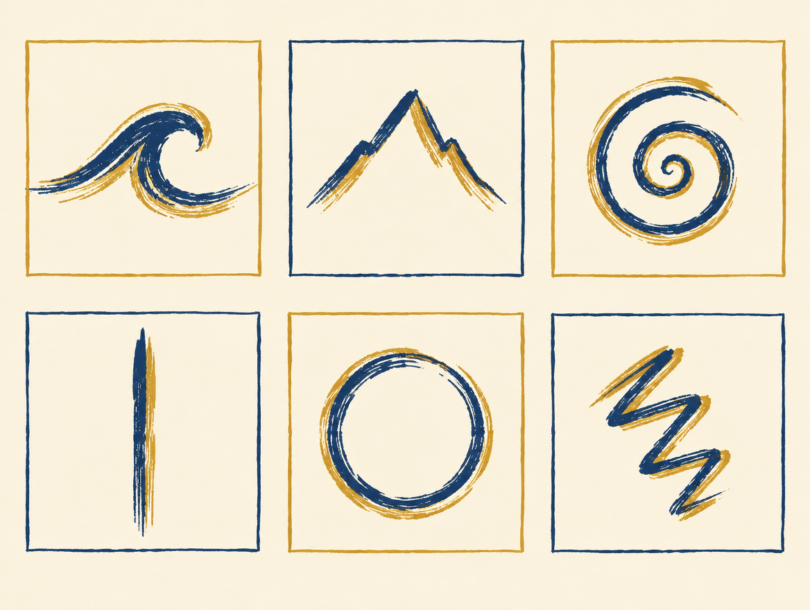
An ideogram is a quick, loose mark made at the very start of a session, usually in a second or two, without thinking. The idea is that the hand moves before the analytical mind can step in. After drawing it, the viewer says what the mark seems to mean, often a single word about the basic nature of the target, such as land, water, mountain or built structure.
Critics note that ideograms are interpretations of scribbles, which makes them easy to overread. Practitioners say the point is to bypass overthinking and to begin the session with something simple and honest.
Analytical Overlay: The Mind’s Helpful Guess
Remote viewers use a term called analytical overlay (AOL) for the moment the thinking mind jumps in with a label. “Oh, that must be a lighthouse.” The advice is to write the guess down, mark it as a guess, and set it aside so it does not steer the rest of the session. That is a surprisingly useful habit anywhere, not only in remote viewing. Notice the story, then separate it from the raw impression.
How to Practice Remote Viewing at Home: A Beginner Exercise
This is an original practice built for curiosity and honesty, not a replica of any government protocol. Treat it as a gentle experiment. The goal is not to prove anything. It is to see what happens when you take your own impressions seriously and then check them fairly.
What You Need
- A partner, friend or family member who is willing to be the target keeper
- Twelve to twenty photographs cut from magazines or printed, each very different (a beach, a market, a forest, a kitchen, a bridge, a crowd, and so on)
- Plain envelopes, one per photo, sealed, each with a random number on the outside
- A notebook, a pen, a timer and a quiet corner

The Envelope Sketch Exercise
- Set the stage. Your partner shuffles the envelopes, picks one and puts it on the table without telling you anything. Neither of you should know which photo is inside if you can manage it, so have your partner pick from the pile without looking.
- Settle. Sit quietly for three minutes. Breathe slowly. Let the shoulders drop. If you like, review our guide to meditation first.
- Write the header. Date, time and the number on the envelope. State your intention in one line: “I will describe what is inside this envelope.”
- Make an ideogram. Draw one quick mark. Then write one word about what it feels like: land, water, building, people, object.
- List impressions in three columns. Senses (colors, textures, sounds, temperature), shapes (round, tall, jagged, flat) and feelings (calm, busy, old, bright). Write short fragments, not sentences.
- Sketch. Draw what you sense in a rough form. It can be ugly. Ugly is fine.
- Mark your guesses. Anything that arrives as a named thing (“a church”) gets circled and labeled AOL. It does not count as a raw impression.
- Stop at ten minutes. Put the pen down. Do not edit.
- Open the envelope. Compare honestly with your partner. Which fragments truly fit? Which were off? Score them.
Scoring Yourself Honestly
Give one point for every fragment that clearly matches the photo, and subtract one for every fragment that clearly does not. Vague words such as “water” or “outdoors” only count if they are specific enough to separate this photo from the others in the pile. Keep a running log of every session, including the misses, for at least twenty attempts.
A fair test is a meaningful one. A friend can also take your notes and see whether they can match them to the right photo from a lineup of several. If the matches are no better than chance, that is useful information too, and it is not a failure of character.
Tips for Beginners
- Practice short. Ten minutes is plenty.
- Keep sessions light. Tension works against you.
- Write the impression before the interpretation.
- Rest between sessions. Do no more than two in a day.
- Do not use remote viewing to make medical, financial or legal decisions, or to check on other people’s private lives.
Remote Viewing and Intuition
Intuition is the everyday cousin of remote viewing. You think of a friend a moment before they call. You feel uneasy about a decision, and later learn why. Most of us have a handful of stories like that, and most of us never test them.
Remote viewing, at its best, is a way of taking that quiet faculty seriously enough to practice it with some discipline. The habits that help are the same ones you will find in any good intuition practice: a calm body, a clear intention, notes written before the answer arrives, and an honest look at the results. That last habit is the one that keeps us grounded.
If you are curious about how intuition shows up in the body and the energy centers, our guide to third eye opening symptoms is a gentle place to continue. And if the sense of knowing something about another person at a distance is what drew you here, you may enjoy our look at twin flame telepathy.
Remote Viewing and the Akashic Records
The akashic records are described in many spiritual traditions as a kind of energetic library holding the memory of every soul and every event. People approach them through prayer, meditation and a clear intention, and they often report symbols, feelings and inner images, much like the fragments a remote viewer writes down.
There is a real overlap in the experience. Both ask you to quiet the mind, receive impressions, and write them down without forcing them into a story. There is also a real difference. Remote viewing, as designed by its researchers, tries to check impressions against an external target. Akashic work usually looks for meaning and guidance, not verification. One asks “was I right?” The other asks “what is this showing me?”
Both questions are worth asking, in the right place. If you want to explore the second one, start with our akashic records overview and read what happens when you access your akashic records.
Remote Viewing and Astral Projection
Astral projection is the experience of feeling your awareness travel outside your body. Remote viewing, by contrast, is usually done fully awake, at a desk, with a pen. A viewer does not claim to go anywhere. They claim to perceive information about a place.
That said, the two ideas often show up in the same conversations. Some practitioners describe remote viewing as a “mental” cousin of out-of-body travel, and many people explore both because they share the same foundation: relaxation, focus and a willingness to observe without judging. If the out-of-body side calls to you, read our complete astral projection guide.
Tom Campbell and the Bigger Picture of Consciousness
Why would remote viewing work at all, if it does? Physicist Tom Campbell offers one thought-provoking frame. He describes our physical world as something like a virtual reality running inside a larger consciousness system, and he suggests that, in such a model, information may be reachable in ways our ordinary senses do not expect. It is an idea, not an established finding, and it is best held as a question to explore.
If that framing appeals to you, hear Campbell speak for himself in Full Disclosure Will Trigger a Global Awakening with Tom Campbell on the Next Level Soul Podcast.
Next Level Soul Podcast Episodes on Remote Viewing and Beyond
Three conversations on the Next Level Soul Podcast speak directly to the themes in this guide.

Sean McNamara: The Natural Abilities Everyone Has
Author and teacher Sean McNamara talks with Alex about telekinesis, remote viewing and the abilities he believes every person already has. He puts patience and relaxation ahead of power, and sees these practices as doorways to connection. Watch the full episode and read the show notes.

Terry Yoder: A Psychic Medium on Two Near-Death Experiences and Discernment
Psychic medium Terry Yoder on two near-death experiences, how his gifts opened, discernment, and humanity’s greatest struggles today. Watch the full episode and read the show notes.

Nikki Dutta: Remote Viewing the Future
Psychic medium Nikki Dutta shares her 2026 predictions in a conversation about remote viewing the future. A fitting listen if you want to hear how a working intuitive describes the process. Watch the full episode and read the show notes.
Care, Grounding and Healthy Expectations
Exploring unusual perception is safe for most people when it is approached lightly. A few reminders help.
- Keep it playful. Frustration and strain make the practice worse and the experience unpleasant.
- Stay grounded. After a session, have a glass of water, stretch and do something ordinary.
- Respect privacy. Never use impressions to spy on, judge or make claims about other people.
- Stay discerning. Treat results as interesting data, not as proof of anything, and avoid anyone who sells certainty or charges you fear.
- Get real support when needed. This practice is not a replacement for medical or mental health care. If you are in distress or having thoughts of harming yourself, please contact a doctor or call or text 988 in the United States.
The power is within you. Not in a gadget, a guru or a technique, but in your willingness to pay attention and tell the truth about what you notice.
Sources and Further Reading
- Remote viewing (Wikipedia)
- Stargate Project, U.S. Army unit (Wikipedia)
- Ingo Swann (Wikipedia)
- Joseph McMoneagle (Wikipedia)
- An Evaluation of Remote Viewing: Research and Applications, AIR, 1995 (National Security Archive)
- STAR GATE [Controlled Remote Viewing] (Federation of American Scientists)
- CIA Freedom of Information Act Electronic Reading Room
Spirituality for the Rest of Us™
Films, teachings and community on Next Level Soul TV.
Go Deeper with NLS Mastery: Awaken Your Psychic Abilities
Curious about developing your own intuition with guidance and care? Nikki Dutta teaches it in Awaken Your Psychic Abilities, part of NLS Mastery. Watch the course preview below.

Frequently Asked Questions About Remote Viewing
What is remote viewing?
Remote viewing is the practice of trying to describe a hidden or distant target using only the mind, with no ordinary clues. Viewers usually record sketches and impressions, which are later compared with the real target.
Is remote viewing real?
The mainstream scientific position is that remote viewing has not been demonstrated, and most scientists classify it as pseudoscience. A small group of researchers, including statistician Jessica Utts, have argued the laboratory data show a real effect.
What was the Stargate Project?
Stargate was the final name of a U.S. government program that studied and used remote viewing from the 1970s until 1995. It ran under several names, including Grill Flame, Center Lane and Sun Streak.
Who invented remote viewing?
Physicists Russell Targ and Harold Puthoff at Stanford Research Institute are generally credited with developing and naming it in the early 1970s. Artist Ingo Swann worked with them and helped shape the coordinate method.
Why did the CIA end the Stargate Project?
In 1995 an evaluation by the American Institutes for Research concluded remote viewing was not useful for intelligence work. Reports were often vague, and none had ever guided an operation.
Who was Joseph McMoneagle?
Joseph McMoneagle is a retired U.S. Army chief warrant officer who was known as Remote Viewer 001 in the Army unit. He later wrote several books about the experience.
What is coordinate remote viewing?
Coordinate remote viewing (CRV) is a structured method in which the viewer is given only a number or map coordinates as the target. The session moves through stages, from a first ideogram to sensory impressions, sketches and concepts.
What is an ideogram in remote viewing?
An ideogram is a quick, spontaneous mark made at the start of a session. The viewer then says what it seems to represent, often a simple word such as land, water or structure.
How can I practice remote viewing at home?
Ask a partner to seal a random photograph in a numbered envelope, then spend about ten minutes noting impressions and a sketch before opening it. Score the matches honestly and keep a log of every attempt, including the misses.
Is remote viewing the same as astral projection?
No. Remote viewing is done awake and aims to describe a target, while astral projection is the experience of feeling your awareness leave the body. They share relaxation and focus as a foundation.
How is remote viewing connected to the akashic records?
Both involve receiving impressions in a quiet state, but the aim differs. Remote viewing tries to check impressions against a real target, while akashic work usually looks for meaning and guidance.
Is remote viewing safe?
For most people a light, short practice is safe. Keep sessions brief, stay grounded afterward, respect other people’s privacy and seek medical or mental health care for any distress.