Go Deeper with NLS Mastery: The True Teachings of Jesus
A fresh look at the teachings of Jesus and what they offer a seeker today. John Davis teaches it in The True Teachings of Jesus, part of NLS Mastery. Watch the course preview below.
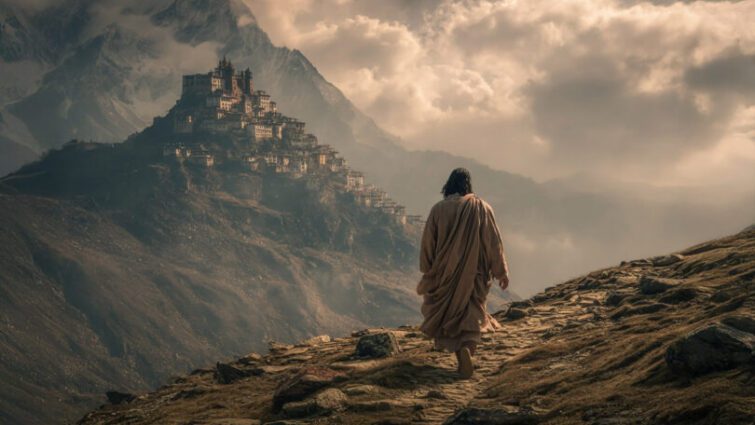
The lost years of Jesus are the roughly 18 years between his visit to the Temple at age twelve and the start of his ministry around thirty, a gap the Gospels never fill. For more than a century, mystics, yogis and channelers have said he traveled to Egypt, India, Tibet and Persia, studied in the mystery schools and returned a master. This guide follows every major trail, names who said what and when, and marks honestly where each story stands.
Key Takeaways
- Mystics say the silence hides a journey: Egypt, Persia, India and Tibet.
- The Gospels are silent from age 12 to about 30 (Luke 2:52 to 3:23).
- The India theory began in 1894 with Nicolas Notovitch, and it is widely seen as a hoax by scholars.
- The one documented link is Egypt: Matthew says the family fled there during Jesus’s childhood.
- Other theories include the Essenes, Buddhist contact, Kashmir and Britain, all unproven.
- Most agree on the teachings: love, forgiveness and the kingdom within.
In This Guide
- What Are the Lost Years of Jesus?
- What the Gospels Do and Do Not Say
- Why Mystics Read the Silence as a Doorway
- Timeline of the Theories
- Egypt and the Mystery Schools: The Initiation of Jesus
- Persia: The Magi, the Light and the Savior to Come
- Nicolas Notovitch and the Hemis Manuscript
- Abhedananda, Roerich and the Issa Traditions
- India: Yogis, Gurus and the Eastern Masters Who Claim Jesus
- Tibet and Ladakh: The Monastery Where the Scroll Was Said to Rest
- Kashmir, the Rozabal Tomb and the Survival Theory
- The Kashmir Mystery: Yuz Asaf and a Buddha Legend
- The Essenes and the Dead Sea Scrolls
- Buddhist Connections and the Tibet Theory
- Channeled Texts and Visionary Accounts
- The Master Jesus: Ascended Masters and the Great White Brotherhood
- Lost Teachings: Gnostic Gospels, Aramaic Words and the Christ Within
- The Glastonbury Legend and Britain
- What Historians Say
- A Carpenter in Galilee: Daily Life in the Lost Years
- How Strong Is the Evidence? A Fair Scorecard
- Why the Lost Years Matter
- Go Deeper: The True Teachings of Jesus
- Watch and Listen on Next Level Soul
- Books for the Lost Years of Jesus
- Sources and Further Research
- Watch and Listen on Next Level Soul TV
- Where to Go Next
- Frequently Asked Questions
What Are the Lost Years of Jesus?
The four Gospels tell us a great deal about Jesus’s birth and his final three years or so, and almost nothing between. Luke records him in the Temple at age twelve (Luke 2:41 to 52), then says only that he “increased in wisdom and stature, and in favour with God and man” (Luke 2:52, KJV). Luke 3:23 picks up the story when Jesus begins his ministry, “about thirty years of age.” That leaves roughly 18 years with no direct account. These are the lost years, sometimes called the silent years or missing years.
Where was he? What did he study? Who taught him? Mainstream scholars say the Gospels are silent because nothing remarkable was recorded: he grew up in Galilee. A long line of writers, mystics and researchers say the silence hides a journey. This guide sets out both sides, names the sources, and shows how strong the evidence is for each claim.
What the Gospels Do and Do Not Say
- Matthew 2:13 to 23: The family flees to Egypt to escape Herod, then settles in Nazareth.
- Luke 2:41 to 52: At twelve, Jesus astonishes teachers in the Temple.
- Mark 6:3: Neighbors call him “the carpenter,” from the Greek tekton.
- Luke 3:23: He begins his ministry at about thirty.
The Gospels never say he traveled east. They also never say he stayed in Nazareth the entire time. The record is simply silent, and that silence is where every theory begins.
Why Mystics Read the Silence as a Doorway
For historians, the missing years are a gap in the record. For mystics, they are a doorway. Across the last 150 years, yogis, Theosophists, Rosicrucians, channelers and seekers have all arrived at the same intuition: that a teacher who could say “the kingdom of God is within you” must have been trained somewhere, by someone, in an inner science. The silence, they say, is the point. Initiation traditions have always been secret. The Greek word mysterion means “something closed” and the mystery schools of Egypt, Greece and Persia were sworn to silence about what happened inside. A Gospel that says nothing about eighteen years is, to the esoteric mind, exactly what you would expect.
This section of the guide leans into that tradition. We tell the stories as their believers tell them, name who said what and when, and mark each claim honestly so you can weigh it yourself.
Timeline of the Theories
| Year | Source | Claim |
|---|---|---|
| c. 248 | Origen, Against Celsus | Records the critic Celsus claiming Jesus learned magic in Egypt |
| 1883 | A. P. Sinnett, Esoteric Buddhism | Brings “Akashic Records” into Western spirituality |
| 1894 | Nicolas Notovitch, The Unknown Life of Jesus Christ | Claims a scroll at Hemis, Ladakh, describes Jesus (Issa) in India |
| 1894 to 1896 | Max Müller and J. Archibald Douglas | Reject Notovitch’s claim after inquiry |
| 1899 | Mirza Ghulam Ahmad, Jesus in India | Argues Jesus survived the cross and died in Kashmir |
| 1908 | Levi Dowling, The Aquarian Gospel | Channeled text describing travels in India, Tibet, Persia, Egypt and Greece |
| 1920s | Swami Abhedananda; Nicholas Roerich | Report hearing of Issa traditions in Ladakh |
| 1930s to 1944 | Edgar Cayce readings | Describe Jesus studying with the Essenes and traveling to Egypt, India and Persia |
| 1976 to 1983 | Andreas Faber-Kaiser; Holger Kersten | Popularize the Kashmir and India theory |
| 1984 | Elizabeth Clare Prophet, The Lost Years of Jesus | Compiles the testimonies and documents |
Egypt and the Mystery Schools: The Initiation of Jesus
Egypt is the one place the Gospels do connect to Jesus. Matthew 2:13 to 15 says Joseph took the child there to escape Herod, and Matthew applies the old words, “Out of Egypt have I called my son.” Coptic tradition honors a long route of the Holy Family through the land, from the Nile Delta to Upper Egypt. For mystics, the child in Egypt is only the first chapter.
The Esoteric Story
A long line of esoteric writers say the adult Jesus returned to Egypt to be trained. Edouard Schúré’s The Great Initiates (1889), Rudolf Steiner’s lectures, Manly P. Hall’s The Secret Teachings of All Ages (1928), H. Spencer Lewis’s The Mystical Life of Jesus (1929, from the Rosicrucian tradition) and the trance readings of Edgar Cayce all describe him passing through the Egyptian mysteries. Cayce said he was taught in the temples of Egypt and by the Essene community at Mount Carmel, and that he walked the path of initiation to its final stage.
In these accounts, the great sites play a part:
- The Great Pyramid. Esoteric writers say its King’s Chamber was a place of initiation, where the candidate faced death symbolically and was “reborn.”
- Heliopolis (On). The ancient city of the sun, where priests taught cosmology and sacred science. Moses was said to have been trained in Egyptian learning.
- Alexandria. The Library and the Jewish philosopher Philo, who wrote of a contemplative community, the Therapeutae.
- The temples of Isis and Osiris. The god Osiris dies, is dismembered and restored, a pattern of death and resurrection that mystics compare to the story of Jesus.
| Mystery Tradition | Place | What Mystics Say Jesus Learned |
|---|---|---|
| Egyptian mysteries | Heliopolis, Memphis, Giza | Death and rebirth of the soul; sacred sound and light |
| Essenes | Mount Carmel, Qumran | Healing, purity, meditation and prophecy |
| Therapeutae | Lake Mareotis, near Alexandria | Contemplation and healing |
| Pythagorean and Orphic schools | Greece | Inner purification and the soul’s ascent |
| Mithraic mysteries | Roman world, Persia | Light, initiation and sacred meals |
How to weigh it. No Egyptian or Jewish text of the first century says Jesus was initiated in Egypt. The earliest hostile mention is from the critic Celsus (reported by Origen, about 248), who said Jesus hired himself out in Egypt and came back with magical powers. Some readers also link a Talmudic story about a figure who “brought sorcery from Egypt” to Jesus. These are old sources, but they are polemic, not biography. Our Mystery Schools of the Ancients audio course explores the traditions behind these claims.
Persia: The Magi, the Light and the Savior to Come
Persia gives the mystical case some of its strongest threads. Matthew 2 opens with the Magi, a word for the priestly class of the Zoroastrian faith. In Persian tradition they were stargazers and keepers of sacred fire. Marco Polo wrote in the 1270s that he was shown the tombs of the three Magi at Saveh, in what is now Iran. Whatever you make of the tombs, the story shows how deeply the Magi are woven into Persian memory.
Zoroastrian teaching held that a final savior, the Saoshyant, would come to renew the world and bring a last judgment. Mystics argue that this vision of a world-redeeming figure, and the contest of light and darkness, flowed into the Judaism of Jesus’s time. Scholars agree that Persian ideas shaped Second Temple Judaism, especially after the Babylonian exile ended under the Persian king Cyrus in 539 BCE.
Esoteric authors go further. Levi Dowling’s The Aquarian Gospel and Edgar Cayce’s readings place Jesus in Persia for a time of study, and some writers describe him learning from Magi-priests in the great temples. The Manichaeans, a Persian-born faith founded by Mani in the 3rd century, honored Jesus as a luminous savior. The Church of the East planted Christianity in Persia very early, reaching China by the 7th century. Persia, in other words, was an old and sacred crossroads between India and the Mediterranean.
Nicolas Notovitch and the Hemis Manuscript
The modern story starts with Nicolas Notovitch, a Russian journalist. In 1894 he published La vie inconnue de Jésus-Christ (The Unknown Life of Jesus Christ). He said that while traveling in Ladakh in 1887 he injured his leg and was treated at Hemis Monastery, where a lama showed him a Tibetan scroll translated from Pali, the Life of Saint Issa, Best of the Sons of Men. According to his translation, Issa traveled to India as a teenager, studied in places such as Puri and Benares, criticized the caste system, spent time with Buddhists in the Himalayas, then returned to Palestine around age 29.
The book was a sensation, but it was challenged quickly. The Oxford scholar Max Müller wrote a skeptical response in 1894. In 1895 J. Archibald Douglas, a professor from Agra, visited Hemis, and his account, published in 1896, said the lama there denied that any such scroll existed. Later scholars, including Edgar Goodspeed, concluded the work was a fabrication. Most academics still regard it as a hoax. Supporters reply that a monastery might not share sacred texts with outsiders and that Notovitch’s account should not be dismissed without a search of the collection.
Abhedananda, Roerich and the Issa Traditions
In 1922 Swami Abhedananda, a disciple of Ramakrishna, visited Hemis. He published his account in Bengali in 1929 (Kashmiri O Tibbeti), saying that monks showed him the manuscript Notovitch described. Supporters treat this as independent confirmation, though critics say he may have been influenced by Notovitch’s book, which he knew.
The Russian painter and explorer Nicholas Roerich traveled through Ladakh in the 1920s. In Altai-Himalaya (1929) he recorded that local people spoke of a saint named Issa who had visited the region. Because these are oral traditions recorded in the 20th century, historians say it is difficult to know whether they preserve ancient memory or reflect the spread of the Notovitch story. The American author Elizabeth Clare Prophet gathered these accounts, along with affidavits from monks and travelers, in The Lost Years of Jesus (1984), which remains the best-known English compilation.
India: Yogis, Gurus and the Eastern Masters Who Claim Jesus
India is where the mystical case becomes personal, because several of the great modern teachers speak about Jesus as someone they know. Here is what they said.
| Teacher | Tradition | What They Said About Jesus |
|---|---|---|
| Ramakrishna (1836 to 1886) | Bengal, devotional Vedanta | Practiced Christian devotion in 1874 and had a vision of Christ entering him. Taught that Christ was an incarnation of God. |
| Swami Vivekananda (1863 to 1902) | Vedanta | Honored Christ as a great soul and brought Vedanta to the West in 1893. |
| Swami Abhedananda (1866 to 1939) | Ramakrishna Mission | Visited Hemis in 1922 and published his account in 1929. |
| Swami Sri Yukteswar (1855 to 1936) | Kriya Yoga lineage | Wrote The Holy Science (1894), showing the harmony of the Bible and the Vedas. |
| Paramahansa Yogananda (1893 to 1952) | Kriya Yoga | Taught that the teachings of Jesus and Krishna are one, in The Second Coming of Christ (2004). |
| Mahavatar Babaji | Himalayan master | In Autobiography of a Yogi, said to be in constant communion with Christ. |
Yogananda and the Christ. In Autobiography of a Yogi (1946), Yogananda wrote that the deathless master Mahavatar Babaji is “in constant communion with Christ.” He taught that Jesus and the line of Indian masters work together for the salvation of the world, and he read the Gospels through the lens of yoga. His commentary on the four Gospels, The Second Coming of Christ, presents Jesus as a yogi-christ who attained union with God. He also taught that the meditation techniques of Kriya Yoga were part of the knowledge of the true Christ. Read his story in our guide to Paramahansa Yogananda.
The Indian places. Notovitch and later writers say Issa studied at Jagannath (Puri) on the Bay of Bengal, at Rajagriha, and at Benares (Varanasi), the oldest holy city of the Hindus. The story says he lived among Brahmins and Buddhists, taught that all people are equal, and so angered the high castes that he fled north. Mystics like this narrative because it shows a Jesus who is a friend of the lowly, which matches the Gospels. Historians point out that the evidence is a nineteenth-century story, not a first-century record.
Tibet and Ladakh: The Monastery Where the Scroll Was Said to Rest
High in the Himalaya lies Hemis Monastery, in Ladakh, a land often called Little Tibet. Its Buddhist monks have kept manuscripts for centuries. This is where Nicolas Notovitch (1894), Swami Abhedananda (1922) and Nicholas Roerich (1920s) each said they heard of Saint Issa. Roerich, the painter and mystic, wrote that local people held a memory of a saint from the West who had taught compassion. Elizabeth Clare Prophet (1984) gathered testimonies from monks and travelers in The Lost Years of Jesus.
In the Tibetan imagination the Himalaya is the home of hidden masters, and of Shambhala, a secret kingdom of wisdom. Theosophy and its successors taught that Himalayan Mahatmas guide humanity from behind the scenes, and some say Jesus was one of their students. Our guest Robert Thurman, the first American to become a Tibetan Buddhist monk, offers his thoughts on this in Jesus’ Lost Years and His Mystical Ties to Buddha. The filmmaker Paul J. Davids shares what he found in Catholic Church Deleted Jesus’ Teachings.
Kashmir, the Rozabal Tomb and the Survival Theory
A second strand claims Jesus not only traveled east but returned after the crucifixion. Mirza Ghulam Ahmad, founder of the Ahmadiyya movement, argued in Masih Hindustan Mein (Jesus in India, 1899) that Jesus survived the cross and eventually died in Kashmir at about age 120. His case draws on the Quran’s wording about the crucifixion and on local legends.
In Srinagar, the Roza Bal shrine is traditionally the tomb of a saint called Yuz Asaf. Some writers, including Andreas Faber-Kaiser (Jesus Died in Kashmir, 1976) and Holger Kersten (Jesus Lived in India, 1983), identify Yuz Asaf with Jesus. Fida Hassnain, a Kashmiri historian, wrote in the same vein. Others cite a passage in the Bhavishya Purana describing a king who meets a figure called Isha Masih, though scholars note that the text was revised over many centuries, so the passage’s date is disputed. Muslim custodians of the shrine and most historians identify Yuz Asaf with a different figure, and no archaeological study has supported the claim.
The Kashmir Mystery: Yuz Asaf and a Buddha Legend
One more curious thread: the Muslim and Sufi tradition of a prophet named Yuz Asaf who came to Kashmir. A 10th-century Persian-language text, the Kamal-ud-Din by Shaykh Saduq, tells of a saintly prince-teacher called Yuzasaf. The Ahmadiyya movement and later writers say this is Jesus. Scholars of religion note that the Yuzasaf story is a retelling of the life of the Buddha that traveled west through Persian and Arabic literature and became the Christian legend of Barlaam and Josaphat. Yuzasaf, in other words, is likely a form of “Bodhisattva.” The Roza Bal shrine in Srinagar continues to draw pilgrims and curious visitors, and the debate is still alive.
The Essenes and the Dead Sea Scrolls
The Essenes were a Jewish movement described by Josephus, Philo and Pliny the Elder. They lived communally, prized purity, studied scripture and practiced shared property. When the Dead Sea Scrolls were found at Qumran beginning in 1947, many scholars linked them to an Essene-like community. Writers such as Edgar Cayce, Edmond Bordeaux Székely and Barbara Thiering have argued that Jesus studied with the Essenes.
Most scholars see important differences between Jesus and the Qumran community, including his open table fellowship, his engagement with ordinary people and his view of purity. Still, both movements shared themes such as apocalyptic expectation, ethical rigor and criticism of the Temple establishment. The honest summary is that Jesus lived in a time of rich Jewish spiritual movements, and contact with one of them is plausible, but none is documented.
Buddhist Connections and the Tibet Theory
The India and Tibet theories raise a fair question: could Buddhist teaching have reached the Mediterranean world in Jesus’s time? There is real history here. Around 250 BCE, the emperor Ashoka recorded in Rock Edict XIII that he sent envoys promoting dhamma to Greek-ruled kingdoms, naming several Hellenistic rulers. Trade routes by land and sea linked India with Alexandria and the Roman Empire, and some Indian visitors reached Egypt and the Mediterranean.
Writers such as Elmar Gruber and Holger Kersten (The Original Jesus, 1995) point to parallels between the Gospels and Buddhist literature, such as compassion for enemies, the Golden Rule and stories of renunciation. The scholar Robert Thurman has argued for deep resonances between Jesus and Buddha, which he discusses in our episode, Jesus’ Lost Years and His Mystical Ties to Buddha. Academic critics respond that similar moral teachings appear in many cultures and are not evidence of contact. The strongest honest claim is that the two traditions share an ethic of compassion, and any historical link is unproven.
A related tradition holds that the apostle Thomas brought Christianity to southern India in 52 CE. The Saint Thomas Christians of Kerala preserve this memory, and it is evidence for early Christian-Indian contact after Jesus, not before.
Channeled Texts and Visionary Accounts
Some of the richest lost-years stories come from people who say they received them by vision, trance or inner dictation. These are not historical sources, but they have shaped what millions believe. Here are the best known.
| Text | Year | Source | What It Says About the Lost Years |
|---|---|---|---|
| The Aquarian Gospel of Jesus the Christ | 1908 | Levi Dowling, said to read the Akashic Records | Jesus travels to India, Tibet, Persia, Assyria, Greece and Egypt; is initiated in Egypt |
| Edgar Cayce Readings | 1920s to 1945 | Trance readings | Jesus studies with the Essenes and in Egypt, India and Persia |
| The Fifth Gospel lectures | 1913 to 1914 | Rudolf Steiner, spiritual research | Two Jesus children; a deep inner development; Lazarus’s initiation |
| The Urantia Book | 1955 | Said to be revealed by celestial beings | Describes Jesus’s travels around the Mediterranean world |
| The Essene Gospel of Peace | 1937 onward | Edmond Bordeaux Székely, from claimed Aramaic manuscripts | Presents an Essene Jesus; the manuscripts have never been verified |
| The Great Gospel of John | 1851 onward | Jakob Lorber, inner voice | Expanded accounts of Jesus’s childhood and ministry |
| The Poem of the Man-God | 1940s | Maria Valtorta, visions | Detailed visionary retelling of Jesus’s life |
| Seth material | 1970s | Jane Roberts, channeled | A view of the true Jesus; see our episode with David Cielak |
| A Course in Miracles | 1976 | Helen Schucman, inner voice identified as Jesus | A path of forgiveness; not a lost-years narrative |
Hear how the Seth material describes Jesus in our episode, What Channeled Master Seth Said About the True Jesus. For how channeling works, see our guide to channelers and mediums.
A word on the texts. The accounts disagree with each other about where Jesus went and when. That is typical of visionary material: it carries a meaning more than a map. Scholars point out that The Aquarian Gospel borrows heavily from nineteenth-century spiritual ideas and the King James Bible. Readers who value inner experience treat them as sources of inspiration rather than as historical proof.
The Master Jesus: Ascended Masters and the Great White Brotherhood
In Theosophy and the traditions that grew from it, Jesus is one of the Ascended Masters, a being who has completed the human journey and now guides others. Helena Blavatsky, Annie Besant, Alice Bailey and Elizabeth Clare Prophet’s Summit Lighthouse taught versions of this idea. In these teachings, Jesus is part of a spiritual hierarchy that includes Saint Germain, Kuthumi, Morya and others, many of them linked to the Himalaya. The lost years, in this telling, were a period of preparation under Eastern masters. Our guide to ascended masters explains who they are and how people say they guide us.
Lost Teachings: Gnostic Gospels, Aramaic Words and the Christ Within
Even without a journey, there is a different sense of “lost” that deserves attention: teachings that were set aside. In December 1945, a farmer found a jar of ancient codices near Nag Hammadi, Egypt. The library included the Gospel of Thomas, a collection of sayings attributed to Jesus, and other texts that did not enter the New Testament. Elaine Pagels’s The Gnostic Gospels (1979) brought them to a wide audience. Many of these texts emphasize inner knowledge, or gnosis, over external authority.
Scholars of Aramaic, such as Neil Douglas-Klotz, have retranslated the Lord’s Prayer and other sayings, finding meanings in the original language that are lost in Greek and English. He joined us to discuss the Aramaic Jesus.
The central theme across these threads is an interior path. The Gospel of Luke records Jesus saying “the kingdom of God is within you” (Luke 17:21, KJV), and the Gospel of Thomas voices a similar idea. This is the heart of what many call the Christ within, the teaching that the divine is found in the heart rather than at a distance. Our audio course, The Christ Within, explores this teaching in depth.
The Glastonbury Legend and Britain
A British legend says Jesus visited England as a youth with Joseph of Arimathea, a tin trader. William Blake’s poem, later set to music as Jerusalem, begins by asking whether those feet “in ancient time” walked on England’s mountains green. There is no historical evidence for the visit, and the story first appears in medieval sources. It is best seen as folklore, but it shows how widely the lost years have inspired imagination.
What Historians Say
Most historians of early Christianity, including Bart Ehrman, John Dominic Crossan and E. P. Sanders, hold that Jesus spent his early life in Galilee and that nothing about the lost years needs special explanation. Ancient biographies of ordinary people rarely cover childhood. Nazareth was a small village, and Sepphoris, a large Hellenized city, stood only a few miles away, offering work and exposure to Greek culture for a tradesman. Jesus speaks Aramaic, knows Hebrew scripture and uses farming and village imagery throughout his parables. To these scholars, the evidence fits a Galilean Jew who never left the region.
They also point out that no ancient source before the 19th century says Jesus went to India. That is the main reason they are skeptical. The counter-argument from supporters is that the Gospels were edited, many texts were lost or suppressed, and oral traditions in the East may have preserved what the West did not.
A Carpenter in Galilee: Daily Life in the Lost Years
Historians who stay with the Galilean view paint a vivid picture. Jesus likely learned a trade from Joseph, worked with wood and stone, attended synagogue, observed Jewish festivals and traveled to Jerusalem for pilgrimage. Villages shared a rhythm of farming, fishing and feasts, and Jesus’s parables are full of seeds, sheep, wineskins and day laborers. Archaeology at Nazareth and the discovery of Galilean synagogues and ritual baths offer glimpses of the world he knew. For many readers, this ordinary life is not a disappointment. It suggests that spiritual depth grows in common places.
How Strong Is the Evidence? A Fair Scorecard
| Claim | Main Sources | What Supports It | Main Objection | Verdict |
|---|---|---|---|---|
| Jesus lived in Galilee throughout | Gospels, mainstream historians | Consistent Gospel setting; no contrary ancient record | Silence is not proof | Strongest by documents |
| Holy Family fled to Egypt | Matthew 2; Coptic tradition | Gospel account; strong local tradition | Only Matthew records it | Reasonable tradition |
| Jesus studied with the Essenes | Cayce, Székely, Thiering | Shared themes; Qumran discoveries | No text links him to them | Possible, undocumented |
| Jesus traveled to India (Notovitch) | Notovitch; Abhedananda | Local Issa traditions | Lama denied; widely seen as fabricated | Weak |
| Jesus survived and died in Kashmir | Ahmadiyya; Kersten; Faber-Kaiser | Roza Bal shrine; local legend | No archaeological or early textual support | Weak |
| Buddhist influence on Jesus | Gruber and Kersten; Thurman | Ashoka’s envoys; shared ethics | Parallels can arise independently | Speculative |
| Jesus visited Britain | Glastonbury legend | Folklore | First appears centuries later | Legend |
This scorecard is our reading of the sources, offered to help you weigh them. Reasonable people differ.
Why the Lost Years Matter
Whether or not Jesus left Galilee, the lost years endure because they ask a bigger question: what shaped the teacher? For many seekers, the story that Jesus drew on wisdom from across the ancient world supports the idea that spiritual truth is universal, not owned by one religion. For others, the Galilean Jesus is more powerful because his wisdom grew from his own people and land. Both views point to the same teachings: love your enemies, forgive, serve the poor and look inward. The lost years invite us to read those teachings with fresh eyes.
Go Deeper: The True Teachings of Jesus with John Davis
The lost years invite a bigger question: what did Jesus actually teach? John Davis explores the answer as a direct path of inner awakening in his Next Level Soul Mastery course.
Join John as he guides you through the true teachings of Jesus, not as religion, but as a direct path of inner awakening. You will find practical insights into love, forgiveness, presence, and the Kingdom of Heaven within that you can embody in everyday life.

What you will walk away with
- Live from love
- Find the Kingdom within
- Release fear and judgment
- Live your awakening
14 lessons, part of Next Level Soul Mastery, our collection of in-depth courses.
Watch and Listen on Next Level Soul
On Next Level Soul TV
- Jesus in India: a film exploring the case for Jesus’s journey to the East. Watch on NLS TV
- Jesus in Egypt: a film exploring Egypt’s role in the story. Watch on NLS TV
- The Forgotten Christ: a show on the overlooked side of Christ’s teachings. Watch on NLS TV
Podcast Conversations
- The Lost Years of Jesus: Egypt, India, and Tibet with John Davis. A walk through the journeys attributed to Jesus. Listen to the episode
- Catholic Church Deleted Jesus’ Teachings with Paul J. Davids. The filmmaker behind Jesus in India on what he found. Listen to the episode
- Jesus’ Lost Years and His Mystical Ties to Buddha with Robert Thurman. A Buddhist scholar on Jesus and the Buddha. Listen to the episode
- The Lost Teachings of Jesus Christ with Paul Wallis. Rediscovering Jesus’s teachings. Listen to the episode
- The True Teachings of the Aramaic Jesus Christ with Neil Douglas-Klotz. The Aramaic roots of the sayings. Listen to the episode
- The Love, Light and True Teaching of Jesus Christ with John Davis. A live conversation on his teachings. Listen to the episode
- The Mystical Christ Revealed with Fr. Seán ÓLaoire. A priest on the mystical Christ. Listen to the episode
- The True Mary Magdalene with William Henry. Mary Magdalene and hidden history. Listen to the episode
- Ancient Watchers and the Bloodline of Jesus with Freddy Silva. Another view of Jesus’s lineage. Listen to the episode
- What Channeled Master Seth Said About the True Jesus with David Cielak. The Seth material on the true Jesus. Listen to the episode
- Ascended Masters: The Complete Guide. Who the masters are and how they guide us. Read the guide
Audio Courses and Mastery
- The Christ Within Audio Course. Teachings on the inner Christ. Explore the course
- Mystery Schools of the Ancients Audio Course. Initiation traditions of Egypt and beyond. Explore the course
- NLS Mastery: The True Teachings of Jesus with John Davis. A deeper course with John Davis. View the course
Books for the Lost Years of Jesus
If you want to read the sources yourself, these are the key titles for and against, from the original claims to the mystic visionaries.
- The Unknown Life of Jesus Christ by Nicolas Notovitch. The 1894 book that started the modern debate.
- The Lost Years of Jesus by Elizabeth Clare Prophet. The best-known compilation of testimonies and documents.
- Jesus Lived in India by Holger Kersten. The case for the India and Kashmir theory.
- The Original Jesus by Elmar Gruber and Holger Kersten. The Buddhist sources of Christianity.
- Autobiography of a Yogi by Paramahansa Yogananda. Babaji, Christ and the line of Indian masters.
- The Second Coming of Christ by Paramahansa Yogananda. A yogi’s commentary on the Gospels.
- The Holy Science by Swami Sri Yukteswar. The harmony of the Bible and the Vedas.
- The Aquarian Gospel of Jesus the Christ by Levi Dowling. The best-known channeled lost-years narrative.
- Edgar Cayce’s Story of Jesus by Jeffrey Furst. Cayce’s readings on Jesus.
- The Great Initiates by Edouard Schuré. Jesus among the great initiates.
- The Secret Teachings of All Ages by Manly P. Hall. The mystery schools and Jesus.
- The Mystical Life of Jesus by H. Spencer Lewis. The Rosicrucian account.
- The Fifth Gospel by Rudolf Steiner. Steiner’s spiritual research on Jesus.
- The Gnostic Gospels by Elaine Pagels. The Nag Hammadi library for general readers.
- Prayers of the Cosmos by Neil Douglas-Klotz. Meditations on the Aramaic words of Jesus.
- Did Jesus Exist? by Bart Ehrman. The mainstream scholarly view.
As an Amazon Associate, Next Level Soul earns from qualifying purchases.
Sources and Further Research
These are the works referenced above, so you can check them yourself.
- Notovitch, N. La vie inconnue de Jésus-Christ, Paris, 1894.
- Müller, F. Max. “The Alleged Sojourn of Christ in India,” The Nineteenth Century, October 1894.
- Douglas, J. Archibald. “The Chief Lama of Himis on the Alleged ‘Unknown Life of Christ,'” The Nineteenth Century, 1896.
- Abhedananda, Swami. Kashmiri O Tibbeti, 1929.
- Roerich, N. Altai-Himalaya, 1929.
- Ahmad, Mirza Ghulam. Masih Hindustan Mein (Jesus in India), 1899.
- Dowling, L. The Aquarian Gospel of Jesus the Christ, 1908.
- Faber-Kaiser, A. Jesus Died in Kashmir, 1976.
- Kersten, H. Jesus Lived in India, 1983 (German edition), English 1986.
- Prophet, E. C. The Lost Years of Jesus, 1984.
- Pagels, E. The Gnostic Gospels, 1979.
- Gruber, E. and Kersten, H. The Original Jesus, 1995.
- Ehrman, B. Did Jesus Exist?, 2012.
- Origen. Contra Celsum, Book 1.
- Josephus. Antiquities 18 and Jewish War 2, on the Essenes.
Watch and Listen on Next Level Soul TV
These titles from the Next Level Soul TV catalog go deeper into this topic.
- Jesus in India. Film on NLS TV.
- Jesus in Egypt: The Missing Childhood Years. Film on NLS TV.
- The Forgotten Christ. Film on NLS TV.
- The Lost Years of Jesus. Audiobook on NLS TV.
- The Aquarian Age Gospel of Jesus, the Christ. Audiobook on NLS TV.
- Jesus, The Last Great Initiate. Audiobook on NLS TV.
- Mystic Christianity. Audiobook on NLS TV.
- The Hidden Teachings of Jesus Christ. Audio course.
- Former Catholic Priest Reveals Jesus’ Mystical Lost Years with Fr. Sean O’Laoire. Episode.
Where to Go Next
- Ascended masters: a complete guide
- Near-death experiences: the complete guide
- Top 20 spiritual books
- Top 10 spiritual audiobooks
- What Seth said about the true Jesus
- The Gnostic Gospels explained
- Who was Mary Magdalene?
- Go deeper with Next Level Soul Mastery, our collection of in-depth courses.
Frequently Asked Questions
What Are the Lost Years of Jesus?
The period of roughly 18 years between Jesus at age twelve in the Temple (Luke 2) and the start of his ministry at about thirty (Luke 3:23), on which the Gospels are silent.
Where Was Jesus Between Ages 12 and 30?
Mainstream scholars say Galilee, working as a tradesman near Nazareth. Others claim he traveled to Egypt, India, Tibet or Persia. No ancient document confirms any journey.
Did Jesus Go to India?
There is no ancient record of it. The claim began in 1894 with Nicolas Notovitch and was developed by Swami Abhedananda, Elizabeth Clare Prophet and Holger Kersten. Most scholars reject it, and supporters believe the evidence is suppressed or lost.
Who Was Nicolas Notovitch?
A Russian journalist who published The Unknown Life of Jesus Christ in 1894, saying he saw a scroll about Jesus (Issa) at Hemis Monastery in Ladakh. Investigators reported that the monastery denied it existed.
What Is the Roza Bal Shrine?
A shrine in Srinagar, Kashmir, traditionally holding the tomb of Yuz Asaf. Some writers identify him with Jesus, a view not accepted by most historians or the shrine’s custodians.
Did Jesus Study in Egypt?
The Gospel of Matthew says the family fled to Egypt when Jesus was a child. Claims of adult study in Egypt come from later critics and esoteric writers, not from Gospel sources.
Was Jesus an Essene?
Some authors, including Edgar Cayce, say he studied with them. Most scholars see important differences and no direct evidence.
What Are the Lost Teachings of Jesus?
Teachings found in texts outside the New Testament, such as the Gospel of Thomas from the Nag Hammadi library, and meanings recovered by studying Aramaic.
What Does the Christ Within Mean?
The idea that the divine is found inside each person, which draws on Luke 17:21: “the kingdom of God is within you.” See our Christ Within audio course.
What Do Yogis Say About Jesus?
Ramakrishna had a vision of Christ in 1874, and Yogananda taught that Jesus and Krishna share one truth and that Babaji is in communion with Christ. These are spiritual teachings, not historical records.
What Is the Aquarian Gospel?
A 1908 book by Levi Dowling, said to be drawn from the Akashic Records, that describes Jesus traveling to India, Tibet, Persia, Egypt and Greece. It is a channeled text, not a historical source.
Did Jesus Study in the Mystery Schools?
Esoteric writers such as Edouard Schuré, Manly P. Hall, Rudolf Steiner and Edgar Cayce say so. No first-century source confirms it, and it remains a mystical tradition.
Where Can I Watch and Listen to More?
Next Level Soul TV has films including Jesus in India and Jesus in Egypt, plus the show The Forgotten Christ. Our podcast episodes with John Davis, Paul J. Davids and Robert Thurman go deeper.