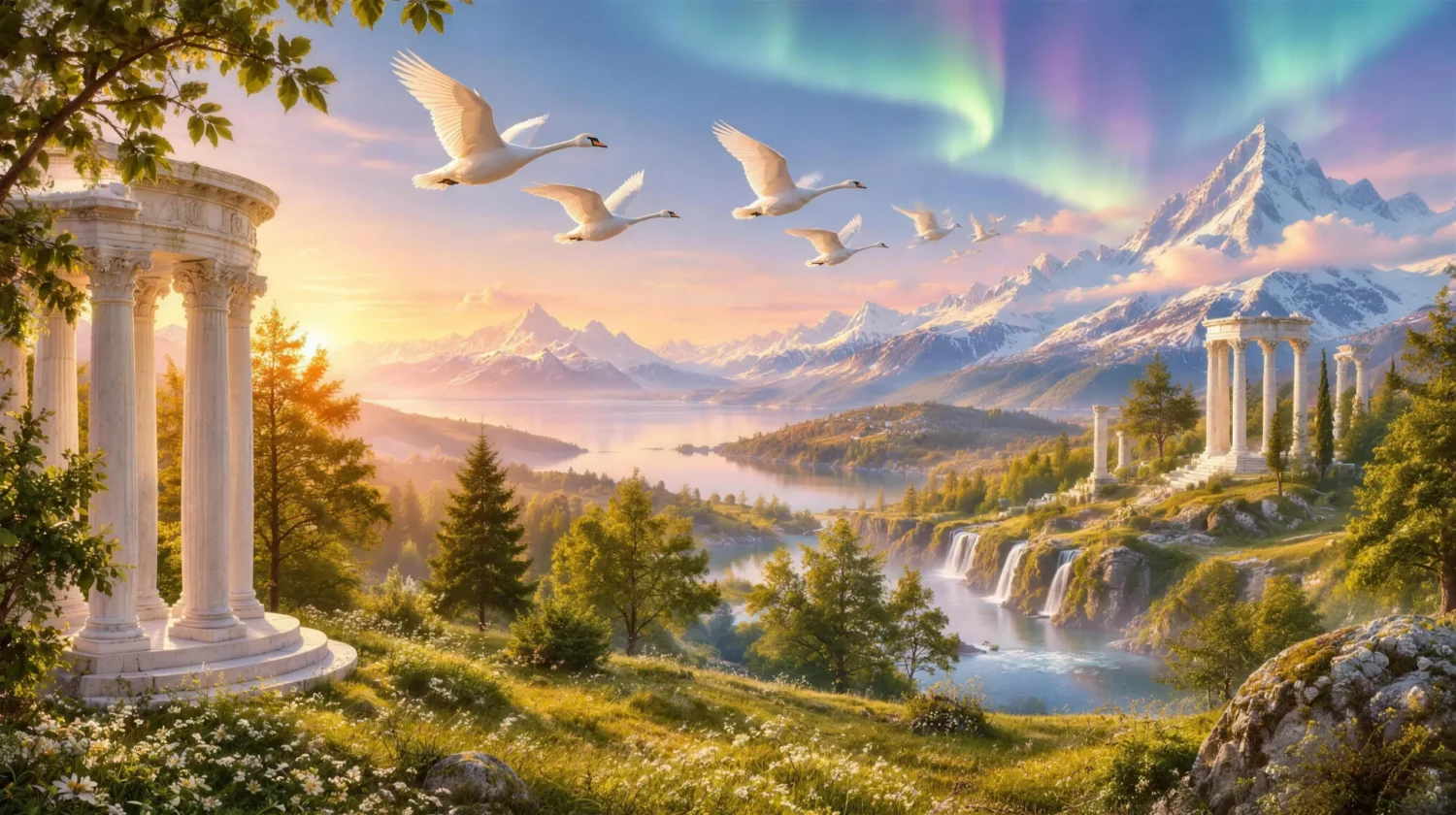
Hyperborea is a legendary land at the far north of the world, imagined by the ancient Greeks as a sunny, peaceful country beloved by the god Apollo. The name means “beyond the north wind,” and the people who lived there, the Hyperboreans, were said to know neither war nor hard labor nor harsh old age. Greek writers such as Pindar and Herodotus described them more than 2,400 years ago, and in the nineteenth century Helena Blavatsky made Hyperborea the home of the second root race in Theosophy.
This guide walks through who said what about Hyperborea, from the Greek poets and Apollo’s winters, through Theosophy and the polar-origin theories, to what archaeology can and cannot tell us. It also states plainly why the twentieth-century political misuse of Hyperborea was a distortion. Every claim is credited to the person who made it, so you can see the sources for yourself and decide what rings true. If you enjoy lost-world lore, pair this guide with our companions on Atlantis, the lost civilization and Lemuria and Mu.
Key Takeaways
- Hyperborea means “beyond Boreas,” the north wind. The earliest detailed account is in Herodotus (about 450 BC), and Pindar’s Tenth Pythian Ode pictures the Hyperboreans feasting in a blessed land.
- Apollo was thought to spend his winters among the Hyperboreans, and Herodotus says their gifts, wrapped in straw, were passed from people to people until they reached his shrine on Delos.
- Helena Blavatsky taught in The Secret Doctrine (1888) that the Hyperboreans were the second root race, ethereal beings of a polar homeland, before the Lemurians and Atlanteans.
- Polar-origin theories from writers such as Karl Penka (1883) and Bal Gangadhar Tilak (1903) placed a human or Indo-European homeland in the Arctic, a view most scientists do not support.
- The Nazi-era use of Hyperborea, including by the SS Ahnenerbe founded in 1935, twisted a Greek myth and a Theosophical teaching into racial pseudoscience. It is a distortion and is rejected here.
- Archaeology has found no Hyperborean city, but it has found Bronze Age tombs on Delos linked to the Hyperborean maidens and Baltic amber in Greek sanctuaries, real traces of ancient northern contact.
What Is Hyperborea?
Hyperborea is a mythical country said to lie beyond the northern edge of the Greek world. In the oldest stories it is a gentle, golden place: warm light, music, dancing and worship of Apollo, protected from the cold by distance and by the Riphean Mountains. Its inhabitants, the Hyperboreans, appear in Greek poetry, history and geography for roughly a thousand years, and every writer seems to place them somewhere a little different.
The word “Hyperborean” has since grown into a second meaning. In modern esoteric writing it names a primordial, polar humanity, a first golden age at the top of the world. In everyday English it can simply mean someone from a far northern region. Keeping these meanings apart is the key to reading anything about Hyperborea: the Greek myth, the esoteric teaching and the scientific record are three different conversations.
Hyperborea at a Glance
| Idea | Put forward by | When | Where it places Hyperborea | Kind of source |
|---|---|---|---|---|
| The blessed Hyperboreans | Pindar and Herodotus, citing earlier poets | 5th century BC | Far north, beyond the north wind | Poetry and early history |
| An island with a round temple of Apollo | Hecataeus of Abdera, preserved by Diodorus Siculus | 4th century BC | A northern island beyond the Celts | Greek ethnography |
| A memory of Bronze Age trade | Kristiansen, Larsson and Bridgman | Modern scholarship | Northern Europe along the amber routes | Archaeology |
| The second root race | Helena Blavatsky | 1888 | A polar continent | Theosophical teaching |
| An Arctic homeland | Karl Penka, Bal Gangadhar Tilak | 1883 and 1903 | The Arctic | Scholarship, now disputed |
| A racial homeland | Nazi-era writers and the Ahnenerbe | 1930s | The far north | Pseudoscience, rejected |
What Did the Ancient Greeks Say About Hyperborea?
The Greek tradition is the root of everything else, so it is worth reading slowly. The surviving sources are fragments, a few odes and one famous passage in the Histories of Herodotus. They agree on the mood of the place and disagree on almost everything else.
A Name That Means “Beyond the North Wind”
In Greek myth, Boreas is the god of the cold north wind. “Hyperboreans” appears to mean “those beyond Boreas,” the people who live where his winter blast no longer reaches. Some scholars prefer another root, the Greek verb hyperpherein, “to carry over,” which would make them the “carriers,” a name that suits the legend of sacred gifts passed along from the north. Either way, the idea is a land of shelter beyond the cold.
Pindar and the Tenth Pythian Ode
Pindar, the lyric poet of Thebes, was a contemporary of Herodotus. In his Tenth Pythian Ode he tells how the hero Perseus visited the Hyperboreans, and the poem is usually read as picturing a people of feasts, dancing, lyres and flutes, for whom sickness and harsh old age have no place. Pindar also says, in his Third Olympian Ode, that Heracles brought the olive tree to Olympia from the land of the Hyperboreans. In his telling, Perseus meets Medusa among them, a story other Greeks had placed in Libya.
Pindar is also one of the sources who locate the Hyperboreans in a very specific way. He sets the home of Boreas, the Riphean Mountains and Hyperborea all near the Danube, far from the Arctic. That detail matters later, because the polar version of the story is a modern development, not a Greek one.
Herodotus and the Gifts Wrapped in Straw
The earliest surviving detailed account of Hyperborea is in Book IV of Herodotus (chapters 32 to 36), written about 450 BC. Herodotus is a careful reporter here. He names Hesiod and the lost epic Epigoni, which was attributed to Homer, as earlier sources, though he doubts the Homer attribution. He also cites the seventh-century BC poet Aristeas, whose lost poem Arimaspea described a journey north past the one-eyed Arimaspians and the gold-guarding griffins to the Hyperboreans. Herodotus himself assumed Hyperborea lay somewhere in northeast Asia, and he notes that the Scythians had nothing to say about them, while the people of Delos told him a great deal.
What the Delians told him is the heart of the story. Offerings from the Hyperboreans, wrapped in wheat straw, traveled from people to people, through Scythia, then on to Dodona, and from there across the Greek world until they reached the temple of Apollo on Delos. The Hyperboreans, Herodotus says, used this relay after two maidens, Hyperoche and Laodice, who first carried the gifts with an escort of five men, never returned home. He adds that two earlier maidens, Arge and Opis, had come to Delos with the gods themselves, and that Delian women gathered gifts for them and sang hymns in their honor. Young people on Delos offered locks of their hair at the tombs of the Hyperborean maidens.
Apollo’s Winters Among the Hyperboreans
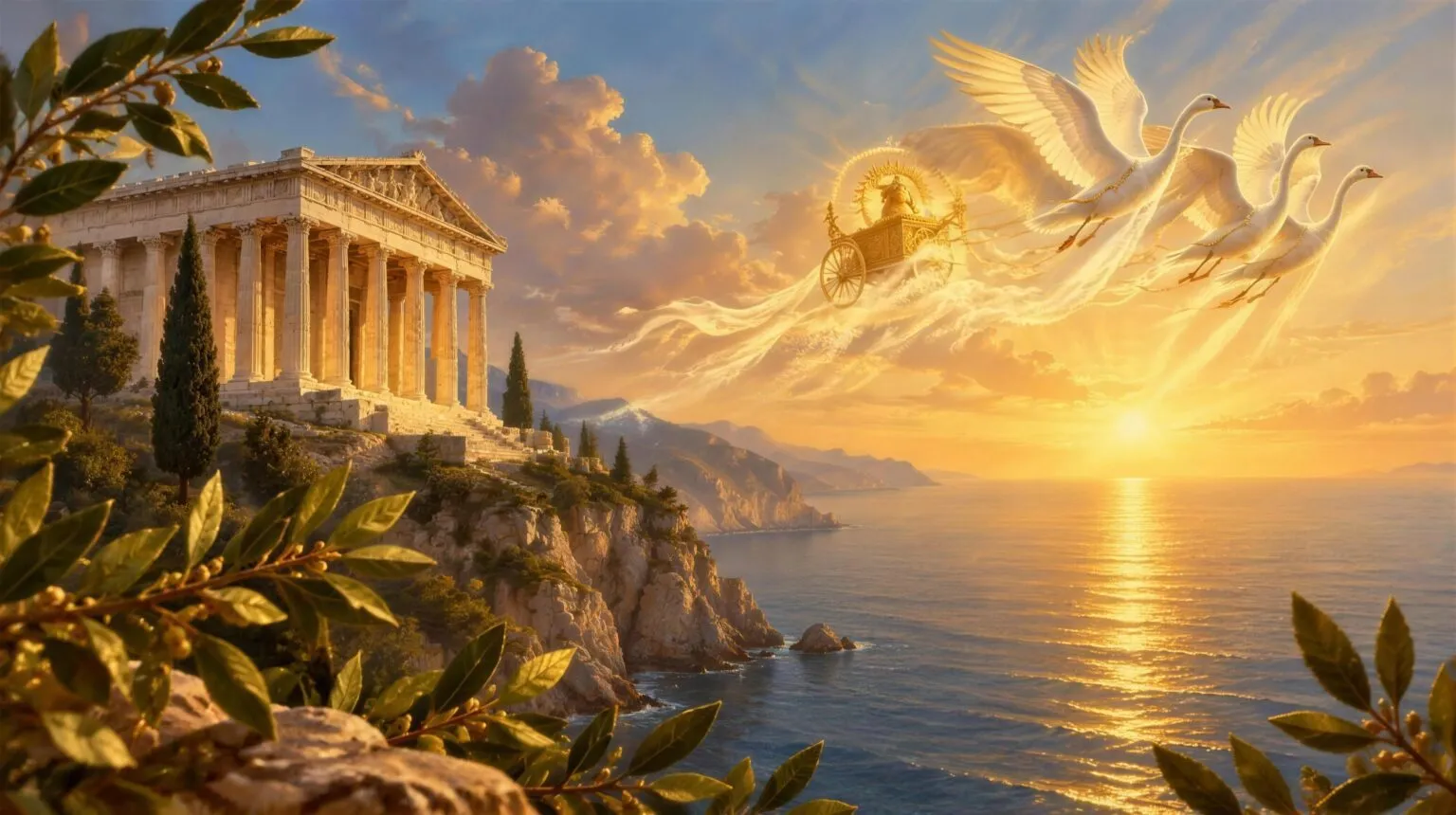
Among the twelve Olympian gods, Apollo alone was honored as a guest of the Hyperboreans, and the Greeks believed he spent his winters in their land. In many accounts the Hyperboreans were the founders of his shrines at Delos and Delphi. The god was pictured traveling north in a chariot drawn by white swans, an image that survives on Greek vases and in poetry, and the swan became one of his birds.
Diodorus Siculus preserves a fuller version from Hecataeus of Abdera, who gathered the Hyperborean stories current in the fourth century BC in a treatise that is now lost. According to that account, Apollo visited his island once every nineteen years and played the lyre and danced there, and the Hyperboreans kept a magnificent sacred precinct of Apollo with a round temple. The nineteen-year count matches a known cycle that brings the sun and moon back into the same alignment, which is why many readers see calendar wisdom hidden in the legend.
Abaris, the Boreades and Other Hyperboreans
A few Hyperboreans step out of the mist as individuals. Abaris was a legendary sage, healer and priest of Apollo who was said to have learned his skills in Hyperborea and left during a plague. Herodotus mentions him as the man who carried an arrow around the world without eating. Plato’s Charmides speaks of him as a physician from the far north, and Strabo calls him a Scythian, like the philosopher Anacharsis.
The Boreades, descendants of Boreas and Chione, were said to be the priests and kings of the land. The Roman writer Aelian describes three brothers, sons of Boreas, who served Apollo and stood six cubits tall, about 2.7 meters, and Diodorus says the rulers of the Hyperborean city and the keepers of its sacred precinct were called Boreadae. Beyond these few details the ancient sources give no description of the Hyperboreans at all, which leaves a great deal of room for later imagination.
Where Did the Ancients Place Hyperborea?
The ancient writers never agreed on a location. As Greek geography widened, Hyperborea kept moving north, always just beyond whatever the writer knew. The table shows how far the answers range.
| Writer | Where Hyperborea was placed |
|---|---|
| Herodotus, following Aristeas | Beyond the Issedones, the Arimaspians and the griffins, which he took to mean northeast Asia |
| Pindar | Near the Danube, with the Riphean Mountains and the home of Boreas |
| Hecataeus of Miletus | Beyond Riphean Mountains next to the Black Sea |
| Heraclides Ponticus and Antimachus | Beyond the Alps, as a Celtic tribe |
| Aristotle | North of the Riphean Mountains on the borders of Scythia |
| Hecataeus of Abdera | An island in the northern ocean beyond the Celts, with a round temple of Apollo |
| Pomponius Mela | Close to the Arctic |
| Ptolemy | In the North Sea, which he called the Hyperborean Ocean |
Some writers added that the sun rose and set only once a year in Hyperborea, a detail that would place it on or above the Arctic Circle. The Greek explorer Pytheas of Massalia sailed to northern Europe around 325 BC and reported on a far northern land called Thule, the most northerly place in ancient Greek and Roman literature. Reports like his, relayed by later writers, may be one reason the legend drifted toward the pole.
Hear It From a Guest: Matt LaCroix on Atlantis in the Ancient Record

Historian and author Matt LaCroix says Atlantis appears in the historical record through writers like Plato and Plutarch, and that Egyptian priests spoke of a great island beyond the Pillars of Hercules, destroyed in a sudden cataclysm. It is a good companion to the Greek sources discussed here, which also come to us through fragments and retellings. Watch The Lost Knowledge of Atlantis Returns with Matt LaCroix and read the show notes.
How Did Hyperborea Travel From Myth to Modern Imagination?
Once the classical world faded, Hyperborea survived as a symbol. In medieval and Renaissance writing, the Hyperboreans came to stand for remoteness and the exotic. Modern scholars read the original myth as a blend of four ingredients: ancient utopian dreaming, “edge of the earth” stories, the cult of Apollo, and exaggerated travelers’ reports of northern phenomena such as the Arctic midnight sun.
Northern Europeans then began to claim the name for themselves. In seventeenth-century Sweden, the movement known as Gothicism declared Scandinavia both the lost Atlantis and the land of the Hyperboreans, and the physician and scholar Olof Rudbeck is its best-known voice. In 1824 a group of northern European scholars studying classical ruins in Rome called themselves the Hyperborean-Roman Society. The philosopher Friedrich Nietzsche, in The Antichrist (written in 1888), called his sympathetic readers Hyperboreans, using the word for people living at a great distance from ordinary opinion. Writers of fantasy fiction followed, and in the 1930s Clark Ashton Smith set a cycle of stories in an imagined Hyperborea.
The Hyperborea Timeline
| Date | Event |
|---|---|
| 7th century BC | Aristeas writes the lost Arimaspea, known today through Herodotus |
| Early 5th century BC | Pindar describes the Hyperboreans in his odes |
| About 450 BC | Herodotus records the straw-wrapped gifts and the Hyperborean maidens |
| 4th century BC | Hecataeus of Abdera collects the Hyperborean stories in a lost treatise |
| About 325 BC | Pytheas of Massalia sails north and reports on Thule |
| 17th century | Swedish Gothicism claims Scandinavia as Atlantis and Hyperborea |
| 1883 | Karl Penka publishes Origins of the Aryans, placing an Indo-European homeland in the north |
| 1888 | Blavatsky’s The Secret Doctrine names the Hyperboreans the second root race |
| 1903 | Bal Gangadhar Tilak publishes The Arctic Home in the Vedas |
| 1935 | The SS founds the Ahnenerbe, which exploits northern-origin myths for racial pseudoscience |
| 1963 and 1974 | John G. Bennett links Indo-European origins to Hyperborea, and Robert Charroux links the Hyperboreans to an ancient astronaut race |
Helena Blavatsky, Theosophy and the Second Root Race
The modern esoteric life of Hyperborea begins with Theosophy. Helena Blavatsky, the Russian-born mystic who co-founded the Theosophical Society in 1875, set out a grand story of human evolution in The Secret Doctrine (1888). In it, humanity passes through seven “root races,” each living mainly on a continent that later vanished. Hyperborea became the home of the second.
Blavatsky did not invent the idea of successive prehistoric races from nothing. Historian James Webb traces the occult concept to the French author Antoine Fabre d’Olivet in 1824, and the English Theosophist Alfred Percy Sinnett described root races in Esoteric Buddhism in 1883, five years before her book. If you would like to read the movement in its own words, our Theosophy study guide and Ocean of Theosophy study guide are plain-language companions.
What Blavatsky Said About the Hyperboreans
According to reference summaries of her teaching, Blavatsky described the Hyperboreans as the origin of the second root race, ethereal beings who were not yet fully physical and who reproduced by budding. Later Theosophical accounts add that their continent had the esoteric name Plaksha, that they called themselves the Kimpurshas, and that their land included what is now northern Canada, Greenland, Iceland, Scandinavia, northern Russia and Kamchatka. In those accounts the climate was mild or even tropical because the Earth had not yet developed its tilt.
The place of the Hyperboreans in the larger scheme is easiest to see side by side.
| Root race | Theosophical name | Home | Character in Theosophical accounts |
|---|---|---|---|
| First | Polarian | The first land to rise from the primeval ocean | Ethereal beings who reproduced by dividing |
| Second | Hyperborean | Hyperborea, a northern polar continent | Ethereal beings who reproduced by budding |
| Third | Lemurian | Lemuria, in the Indian and Pacific oceans | Early physical humanity, explored in our Lemuria and Mu guide |
| Fourth | Atlantean | Atlantis, in the Atlantic | A mind-centered civilization, explored in our Atlantis guide |
| Fifth | Called “Aryan” in Theosophical vocabulary | Present humanity | The current stage; a sixth is expected in the future |
How Later Theosophists Expanded the Scheme
Other Theosophists filled in the map. William Scott-Elliot wrote The Story of Atlantis (1896) and The Lost Lemuria (1904), and Annie Besant added Man: Whence, How and Whither (1913). Both Besant and Scott-Elliot drew on information from Charles Webster Leadbeater, who said he obtained it by “astral clairvoyance.” The anthroposophist Rudolf Steiner offered his own version in Atlantis and Lemuria (1904), and he felt the word “race” no longer suited modern humanity, preferring the word “epochs” for the ages involved. Seekers who work with the Akashic Records will recognize this style of source: the claim is that these histories were read directly from a subtle record of the past, not dug up from the ground.
A Fair Word on the Root Race Scheme
The language of “races” in nineteenth-century Theosophy belongs to its time, and it is easy to misread today. In the Theosophical scheme the root races are successive stages of the evolution of consciousness through which all of humanity passes, not separate nations competing for rank. The Theosophical Society itself was founded with the aim of forming a universal brotherhood of humanity without distinction of race, creed, sex, caste or color. Many modern readers therefore treat the root-race story as a symbol of unfolding awareness, with the Hyperboreans standing for the earliest, most subtle layer of being.
René Guénon, Julius Evola and the Primordial North
In the twentieth century, two European writers carried the Hyperborean idea into a different current of esotericism known as Traditionalism. René Guénon, the French-Egyptian author on symbolism and initiation, and Julius Evola, an Italian philosopher, both wrote of a primordial, polar origin of humanity followed by a gradual descent away from a spiritual homeland in the far north. Evola was a far-right thinker with ties to Fascist Italy and Nazi Germany, and that political background is part of why Hyperborea attracts caution in some circles today.
What Are the Polar-Origin Theories?
Alongside the esoteric story ran a scholarly one. In the nineteenth and early twentieth centuries, several writers argued that human civilization, or at least the Indo-European peoples, began at the top of the world. These “polar-origin” theories are the bridge between the Greek legend and the Theosophical one, and they deserve to be laid out carefully, because many of them were sincere attempts to answer real questions with the tools of their day.
Bailly, Penka and the Northern Cradle
Jean Sylvain Bailly, the French astronomer who later presided over the Tennis Court Oath and served as mayor of Paris, argued in his late eighteenth-century writings on ancient astronomy and Atlantis that a lost, advanced people had lived far in the north. The Austro-Hungarian ethnologist Karl Penka published Origins of the Aryans in 1883, placing the Indo-European homeland in northern Europe. William Fairfield Warren, the first president of Boston University, argued in Paradise Found (1885) that the cradle of the human race lay at the North Pole. A common thread in this tradition is the idea that the early Arctic was mild and that a cooling climate later drove people south.
Bal Gangadhar Tilak and the Arctic Home in the Vedas
The best-known scholarly version came from Bal Gangadhar Tilak, an Indian nationalist and teacher of the early twentieth century, who published The Arctic Home in the Vedas in 1903. Tilak read passages of the ancient Vedic hymns as memories of an Arctic homeland and the long northern dawns and nights, and he credited the ideas of Penka. His book is a landmark in the history of the Hyperborean theory, even though most historians of the Vedas have not accepted his conclusion.
In 1963, John G. Bennett wrote a paper titled “The Hyperborean Origin of the Indo-European Culture,” claiming that the Indo-European homeland lay in the far north and that this was the Hyperborea of antiquity. Soviet scholars such as Natalia Guseva and S. V. Zharnikova, influenced by Tilak, argued for an Arctic Urals homeland, and their ideas were later popularized by Russian nationalists. In 1974 the French writer Robert Charroux proposed that the Hyperboreans were an ancient astronaut race. Each of these authors reshaped the same old name for a new purpose, which tells you how flexible a symbol Hyperborea has become.
Hear It From a Guest: Matias De Stefano on Antarctica and the Poles

Matias De Stefano discusses Antarctica and the poles with Alex. He calls Antarctica the mind of the planet and a record of memory, and on the idea of a pole shift he separates magnetic pole shifts from physical ones. It is a thoughtful modern voice on the poles, shared as his perspective. Watch Humanity’s Chaotic Future and Rebirth with Matias De Stefano and read the show notes.
Why the Nazi-Era Use of Hyperborea Was a Distortion
Any honest guide to Hyperborea has to deal directly with its twentieth-century political misuse. In Germany after the First World War, an occultist and ethnic-nationalist group called the Thule Society took its name from the mythical northern country of Greek legend, and it sponsored the small party that Adolf Hitler would later reorganize as the Nazi Party. In 1935 Heinrich Himmler founded the Ahnenerbe, an SS research body devoted to the idea that Germans descended from a racially superior Aryan people. Herman Wirth, a Dutch-German scholar of ancient symbols, helped found it, though Himmler later pushed him out.
The Ahnenerbe is described by historians as a pseudoscientific organization. Its scholars interpreted evidence to fit Hitler’s beliefs, and many consciously fabricated evidence to do so. Nazi propaganda then used its claims to justify German expansion, and the government used its research to justify many policies, including the Holocaust.
This was a distortion of everything Hyperborea had meant before. It is worth saying why, clearly and without hedging.
- The Greek sources contain no master race. Pindar and Herodotus describe a pious, peaceful people devoted to Apollo, known for music, dance and gifts. Nothing in the ancient texts ranks peoples or calls the Hyperboreans rulers of the world.
- Blavatsky’s Hyperboreans were not a nation. They were ethereal beings in a vision of consciousness evolving, and Theosophy’s first stated aim was a universal brotherhood without distinction of race.
- The “Aryan race” is a discredited idea. Reference works call it a pseudoscientific concept, and anthropological, historical and archaeological evidence does not support it. The Sanskrit word arya was an ethnocultural self-description used by Indo-Iranian peoples, not a biological category.
- The scholarship was fabricated. The Ahnenerbe’s own researchers manipulated evidence to produce the conclusions the regime wanted.
The misuse did not end with the war. A 2021 report by the Institute for Strategic Dialogue noted growing Hyperborean imagery on the social platform TikTok being used by neo-Nazi accounts as a form of esoteric Nazism, and political writers in Russia such as Aleksandr Dugin have also invoked Hyperborea in nationalist arguments. If you ever meet Hyperborea used to rank groups of people, or to claim that one people is the pure descendant of a vanished northern race, that is the sign to close the book. The legend belongs to everyone who finds wonder in it, and the people who have used it to justify hatred have taken nothing true from it.
What Does Archaeology Say About Hyperborea?
The short answer is that no one has found a Hyperborean city, a Hyperborean inscription or a Hyperborean burial ground that matches the myth. The longer answer is more interesting, because archaeology has found real traces of the contacts that may have inspired the legend. Modern scholars generally read the myth as a blend of utopian ideas, edge-of-the-world stories and travelers’ reports, with a core of genuine northern trade and religion inside it.
The Tombs of the Hyperborean Maidens on Delos
Herodotus said the Delians honored the tombs of the Hyperborean maidens, and in 1924 the French archaeologists Charles Picard and Joseph Replat identified tombs in the very places he described on the island of Delos. Both pairs of tombs turned out to date from the Bronze Age, and they held Cycladic, Minoan and Mycenaean pottery from roughly 1875 to 1420 BC, centuries before Herodotus wrote. A simple early cult appears to have been attached to them. In other words, the Delians really did honor ancient graves as the resting places of northern maidens, and the tradition is far older than the Greek classical age.
Amber, Swans and the Northern Routes
The archaeological record shows the Greek world was connected to the north in the Bronze Age. Baltic amber, amber necklaces from Britain and chariot equipment from the steppe or the Carpathian Basin have been found in the elite Shaft Graves at Mycenae, and Baltic amber has been found in the sanctuaries at Delphi and Delos. The archaeologists Kristian Kristiansen and Thomas B. Larsson have argued that the Hyperborean stories are “a mythological relict” of that northern economy. In their reading, Apollo’s journeys north on white swans echo the solar religion of the Baltic, where amber came from, and swans carry the sun on many northern metal objects. The historian Timothy P. Bridgman similarly suggests that the Hyperborean gift route may preserve a hazy memory of Mycenaean trade routes and dealings with northern peoples.
The Trundholm sun chariot from Denmark, a Nordic Bronze Age bronze horse pulling a large sun disc on spoked wheels, shows how deeply the image of a traveling sun belonged to the north. It is a good reminder that Apollo, a god of light, was never only a Mediterranean figure.
A Round Temple and Stonehenge
Hecataeus of Abdera described a spherical temple of Apollo on the northern island. Some scholars have identified that temple with Stonehenge, and in 1726 John Toland suggested the Callanish Stones on the Isle of Lewis. Diodorus Siculus, who preserves the passage, does not himself identify Hyperborea with Britain, and his own description of Britain never mentions the Hyperboreans, so the link remains a suggestion and not a settled fact.
Deep Time and the Tropical Arctic
The esoteric claim of a warm, tilt-free polar homeland meets the geological record head on. Geologists do find that the Arctic was once much warmer, with forests growing far north, but that was tens of millions of years ago. The oldest fossils of anatomically modern humans are only about 300,000 years old, and they come from Africa, where the fossil and genetic evidence places the origin of our species. Human beings have lived across the far north for many thousands of years, which is part of why a northern homeland can feel plausible, but no evidence places the origin of humanity at the pole.
The Evidence at a Glance
| Claim | What the sources and evidence say | Status |
|---|---|---|
| Hyperborea was a real nation in one place | Ancient writers placed it in a dozen different regions, and no site has been found | Not supported |
| The Hyperborean maidens were honored on Delos | Bronze Age tombs found on Delos in 1924 match Herodotus’s description | Supported |
| The gift route reflects real northern contact | Baltic amber is found in Mycenae, Delphi and Delos | Plausible, and discussed by scholars |
| The round temple was Stonehenge | Suggested by some scholars, though Diodorus does not equate Hyperborea with Britain | Debated |
| Humanity began at the North Pole | Fossil and genetic evidence points to Africa for the origin of modern humans | Not supported |
| An Aryan master race came from Hyperborea | Described as pseudoscience by historians and anthropologists | Rejected |
Hear It From a Guest: Randall Carlson on Ancient Cataclysms

Researcher Randall Carlson explores ancient cataclysms, Atlantis, Gobekli Tepe and cyclical civilizations. He says the end of the last Ice Age brought sea levels about 400 feet lower than today, so many early coastal settlements may now lie underwater, and he points out that the Egyptian priests in Plato’s account described a sinking about 9,000 years before Solon’s visit. Watch Cataclysms, Atlantis and Gobekli Tepe with Randall Carlson and read the show notes.
Why Does Hyperborea Still Matter to Seekers?
If the evidence for a literal polar civilization is thin, why does Hyperborea keep calling people? The answer has less to do with maps than with the human heart. The legend offers something very old: the memory, or the hope, of a place where life is gentle, music is everywhere and the gods walk close.
A Golden Age at the Top of the World
Greek and Roman writers pictured the Hyperboreans as living extraordinarily long, happy lives. Almost every culture keeps a story like this, an early age of ease before things grew heavy. In Hindu thought it appears as the first and highest of the ages in the cycle of the yugas, and in the Theosophical scheme it appears as the subtle, luminous second root race. Hyperborea belongs to the same family of memories, and many seekers say it names a longing for wholeness that no history book can quite explain.
The North as an Inner Direction
The north has always been the direction of the still point. The pole star holds the sky in place, and in Hindu, Jain and Buddhist cosmologies the sacred Mount Meru stands at the center of the universe. Blavatsky and later esoteric writers linked Meru and the north pole, so that Hyperborea becomes a picture of the axis of the world, the place where spirit and matter meet. Nietzsche used the word the same way, as a name for remoteness from the crowd. Read this way, Hyperborea is less a destination than a direction of attention, inward and upward.
Apollo, Light and Healing
The Hyperboreans were the people of Apollo, the god of light, music, healing and prophecy. Abaris the healer came from there, and Apollo himself was said to spend his winters among them. For many spiritual readers, that pattern speaks to the way rest and retreat renew the creative life: the god withdraws to a northern country of light and returns in spring. It is a gentle teaching about seasons of the soul.
Memory and the Soul
Some seekers feel a pull toward these ancient places that they cannot explain. Those who explore reincarnation or past-life regression sometimes read that pull as a memory of an earlier life or an earlier world. Others see it as an archetype, a symbol the soul uses to speak about its origins. Our guides to starseeds and starseed types explore the related idea that the soul has come from somewhere far away, and our piece on the yugas looks at the cycles of time behind it.
A Gentle Practice: Visiting Your Own Hyperborea
- Sit comfortably and take five slow breaths. Imagine the cold north wind of everyday worry at your back, growing quieter with each breath.
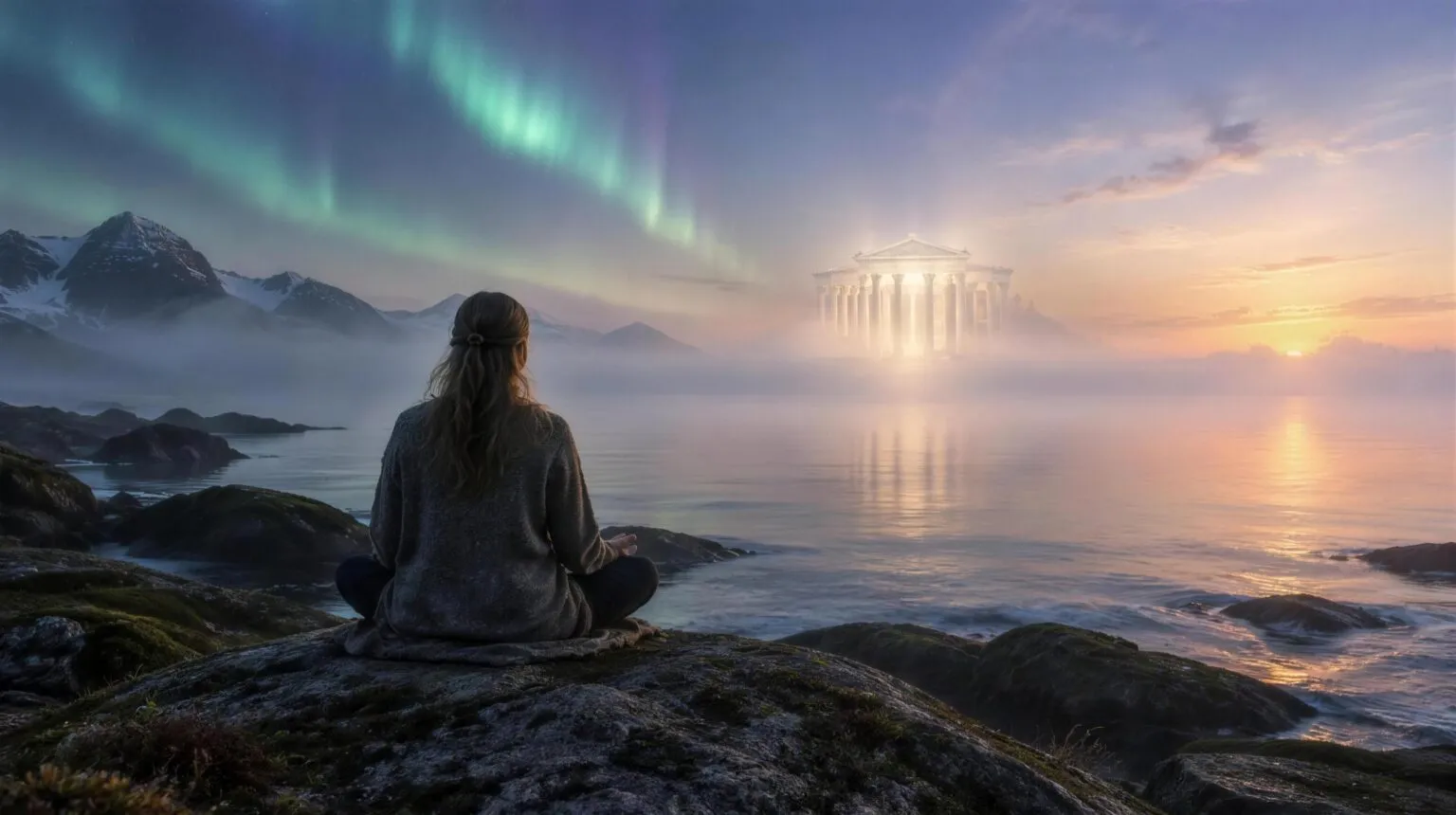
- Picture a northern shore at dawn, with soft light on the water and a faint white temple in the mist ahead of you. Notice how your body feels in that light.
- Ask quietly: where in my life is the “far place” where I feel most free, gentle and alive?
- Write three lines about what you find, and choose one small thing you can bring from that place into your week.
This is an imaginative exercise, not a historical claim. For more guided stillness, explore the meditations for spiritual awakening collection and the NLS meditations library.
Hear It From a Guest: Matias De Stefano on Ancient Civilizations

Matias De Stefano returns to the show to talk about ancient civilizations, Atlantis and Lemuria. He says that instead of asking how to handle reality, ancient civilizations asked how to become that reality, a thought worth holding beside any story of a lost northern or ancient world. Watch Prophecy of Atlantis’ Fall with Matias De Stefano and read the show notes.
Want the Atlantis story as narrated listening? The NLS TV audiobooks The Chronicles of Atlantis, Book 1: The Fall of the First Age, Book 2: In the Shadows of the Pyramids and Book 3: Atlantis Reborn in America, by Phylos the Thibetan and Lucien Ardan, follow it from the fall to rebirth.
Go Deeper: Explore Hyperborea and Ancient Mysteries on Next Level Soul
Here is where to continue, from audio to film to conversation.
Audio Courses, Audiobooks and Study Guides
- Echoes of Atlantis, an 11-chapter audio course of retellings, guided practices and sacred reflections on the rise and fall of Atlantis
- Mystery Schools of the Ancients, a 22-chapter audio course on the guarded teachings of Egypt, Atlantis and Greece
- The NLS TV audiobooks The Chronicles of Atlantis, Book 1, Book 2 and Book 3, a spiritual epic of Atlantis from its fall to its rebirth
- Browse the full audio course library, the audiobook library and the meditations library, all on Next Level Soul TV
- The study guides for Theosophy, The Ocean of Theosophy, The Emerald Tablet, The Rosicrucian Mysteries and Mystics of the Renaissance
Movies and Series on NLS TV
- The Atlantis Puzzle, with our Spiritual Cinema review
- When Atlantis Ruled the World
- Dwarka: Atlantis of the East, a 2012 expedition into the legend of a drowned city beneath the Arabian Sea, with our Spiritual Cinema review
- More in the movies library and series library
Next Level Soul TV brings movies, series, audiobooks, meditations and audio courses together in one place, and you can learn more on our Join Us page. If you know a seeker who would love it, a Next Level Soul TV gift membership is a thoughtful way to share the journey.
Podcast Episodes to Listen To
- Cataclysms, Atlantis and Gobekli Tepe with Randall Carlson, on ancient cataclysms and cyclical civilizations
- Ancient Prophecies for a New Earth with Gregg Braden, on humanity’s ancient past and civilization moving in cycles
- Ancient Mysteries and Relics Reveal Humanity’s Deep Past with Ben Van Kerkwyk, on megalithic building and ancient civilizations
- Discovering Humanity’s Mysterious Past and True Origins with Tok Thompson PhD, an anthropologist on flood stories and Egyptian beliefs
- Emerald Tablets and Humanity’s Origins with Billy Carson
- Ascended Master’s 24,000-Year Prophecy with Joseph Selbie, on the yugas and cycles of consciousness
- Lost History of Atlantis and Lemuria with Belinda Womack
Browse every conversation on the Next Level Soul Podcast page.
Glossary Terms Worth Knowing
Theosophy, Lemuria, Atlantis, esotericism, Akashic Records, Ascended Masters, channeling, sacred geometry and reincarnation. The full spiritual glossary has hundreds more.
Related Reading
- Lemuria and Mu: The Lost Continents, Their Legends and Their Meaning
- Atlantis: The Complete Guide to the Lost Civilization
- List of Ascended Masters: Names, Meaning and Traditions
- Saint Germain: The Violet Flame Master
- Darryl Anka and Bashar: The Complete Guide
- Anunnaki: Who They Were and What the Sumerian Texts Say
- The Yugas: Sri Yukteswar’s 24,000-Year Map of Consciousness
- Starseeds: Signs, Types and Your Origin
Sources and Further Reading
Spirituality for the Rest of Us™
Movies, teachings and community on Next Level Soul TV.
Episodes to Watch Next
The Next Level Soul Podcast has no episode on Hyperborea by name, but these four conversations touch the surrounding themes of ancient records, the poles, cataclysm and lost civilizations. Each guest speaks from their own research or perspective.
- The Lost Knowledge of Atlantis Returns with Matt LaCroix with Matt LaCroix: Atlantis in the ancient record and cosmic cycles
- Humanity’s Chaotic Future and Rebirth with Matias De Stefano with Matias De Stefano: Antarctica, the poles and pole shifts
- Cataclysms, Atlantis and Gobekli Tepe with Randall Carlson with Randall Carlson: ancient cataclysms and cyclical civilizations
- Prophecy of Atlantis’ Fall with Matias De Stefano with Matias De Stefano: ancient civilizations and the fall of Atlantis
Frequently Asked Questions
What is Hyperborea?
Hyperborea is a legendary land in the far north, described by ancient Greek writers as a sunny, peaceful country favored by Apollo. Its name means “beyond the north wind,” and its people are called the Hyperboreans.
What does the word Hyperborea mean?
It appears to come from the Greek words for “beyond Boreas,” the god of the north wind. Some scholars prefer a root meaning “to carry over,” which would make the Hyperboreans the “carriers” of sacred gifts.
Who were the Hyperboreans?
In Greek myth they were a blessed, pious people who lived beyond the cold north wind and worshipped Apollo with music and dance. Pindar pictures them feasting without sickness or harsh old age, and Herodotus records their gifts traveling to Delos.
What did Pindar and Herodotus say about Hyperborea?
Pindar, in his Tenth Pythian Ode, tells of Perseus visiting the Hyperboreans, and Herodotus, about 450 BC, records the straw-wrapped offerings and the Hyperborean maidens of Delos. Herodotus names Hesiod and the poet Aristeas as earlier sources.
What is the story of Apollo and the Hyperboreans?
The Greeks believed that Apollo spent his winters among the Hyperboreans, traveling north in a chariot drawn by swans. Many ancient writers said the Hyperboreans founded his shrines at Delos and Delphi.
Where was Hyperborea supposed to be located?
The ancient writers disagreed. Pindar placed it near the Danube, Hecataeus of Abdera on an island beyond the Celts, Herodotus in northeast Asia, and Pomponius Mela near the Arctic, and modern esoteric writers place it at the North Pole.
What did Helena Blavatsky teach about Hyperborea?
In The Secret Doctrine (1888), Blavatsky described the Hyperboreans as the origin of the second root race, ethereal beings of a polar homeland who reproduced by budding. They come before the Lemurians and the Atlanteans.
Was Hyperborea real, and what does archaeology say?
No Hyperborean city has been found. Archaeologists have found Bronze Age tombs on Delos linked to the Hyperborean maidens and Baltic amber in Greek sanctuaries, which suggest real contact with the north that the myth may remember.
What are the polar-origin theories?
These are nineteenth and early twentieth century ideas that humanity or the Indo-European peoples began in the Arctic, argued by writers such as Karl Penka and Bal Gangadhar Tilak. Fossil and genetic evidence places the origin of modern humans in Africa.
How is Hyperborea connected to Atlantis and Lemuria?
Why is Hyperborea linked to Nazi ideas, and is that link legitimate?
The Thule Society and the SS Ahnenerbe borrowed northern myths to promote a racial pseudoscience. The link is not legitimate: the Greek sources contain no master race, Theosophy taught universal brotherhood, and the Aryan race concept is discredited.
Why does Hyperborea matter to spiritual seekers?
It stands for a golden age, a still point at the top of the world and a longing for wholeness. Many seekers use it as a symbol for the inward, upward direction of the soul, and some read their pull toward it as a memory of origins.
Go Deeper with NLS Mastery: The Spiritual Alchemy of St. Germain
If the ancient mysteries and the Ascended Masters call to you, this course turns that curiosity into practice. David Christopher Lewis teaches it in The Spiritual Alchemy of St. Germain, part of NLS Mastery. Watch the course preview below.