The Secret Doctrine of the Rosicrucians is an esoteric classic published in 1918 under the name Magus Incognito and widely attributed to William Walker Atkinson. It presents a Rosicrucian view of creation, consciousness, the soul and its long journey. This study guide walks through all 13 parts in plain language, then hands you a workbook to try the ideas on your own life.
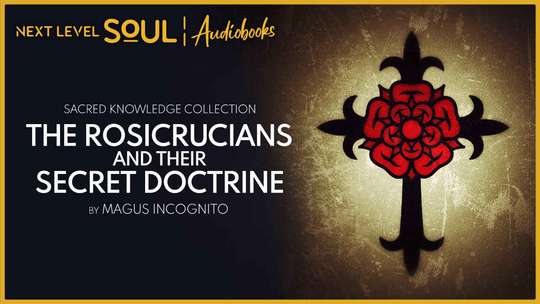
Listen While You Study
The audiobook is available on Next Level Soul TV. Play a part, then come back here for the notes and the workbook prompt.
Key Takeaways
- The book teaches that all life shares one source, pictured as a single flame with countless sparks.
- Consciousness is described as a ladder of seven planes, running from the elements up through minerals, plants, animals and humans.
- You are presented as a sevenfold being, with layers of body, feeling, mind and spirit.
- The soul is said to grow over many lives, through rebirth and a very long journey.
- The deepest work is inner, a spiritual alchemy of changing yourself, not metals.
The Book at a Glance
| Detail | What to Know |
|---|---|
| Author | Published as Magus Incognito, widely attributed to William Walker Atkinson |
| First published | 1918, Yogi Publication Society, Chicago |
| Parts | 13 |
| Tradition | Rosicrucian and Western esoteric teaching |
| Audiobook | Available on Next Level Soul TV |
What Is The Secret Doctrine of the Rosicrucians About?
The book sets out what its author calls the secret doctrine of the Rosicrucians. It begins with the history and legend of the order, then moves into a layered view of how the universe came to be. The author describes an Infinite Unmanifest, a World Soul, and a single living flame behind all things.
From there the book turns toward the human being. It describes planes of consciousness, a sevenfold soul, rebirth, the aura and the soul’s long progress. The author presents these as ancient teachings. This guide reports them as his claims and tradition, so you can weigh them yourself.
The Board: 13 Parts
Each square is a part. Tap one to jump to its study notes.
- 1Rosicrucians
- 2Eternal Parent
- 3Soul of World
- 4Androgyne
- 5One and Many
- 6Flame of Life
- 7Planes
- 8Higher Planes
- 9Sevenfold Soul
- 10Rebirth
- 11Soul’s Progress
- 12Aura
- 13Cosmic Principles
Part-by-Part Study Notes
These notes are our own summary, written to help you follow the book. Each one ends with a small practice you can try this week.
The Rosicrucians and Their Secret Doctrine
The author opens by sorting legend from history. He describes the Rosicrucian name, the story of Christian Rosenkreutz and the rumors that spread around 1610. He teaches that the order is an unorganized circle joined by shared study, not a club with dues. The secret doctrine is presented as ancient wisdom, kept hidden for good reasons and linked to older traditions. The focus is inner, mental and spiritual alchemy, with the Rosy Cross as a symbol of struggle and reward.
The Eternal Parent
This part gives the first creation teaching. The author describes the Infinite Unmanifest as resting in a cosmic night, with no light, time, things or opposites. Because no finite picture can hold the infinite, the Rosicrucians use an empty circle and endless space as symbols. Existence is said to move between cosmic days of manifestation and cosmic nights of rest. The Eternal Parent is placed beyond thought and words, approached only through silence.
The Soul of the World
Here the author moves from the unmanifest to the first stirring of creation. He teaches that the Eternal Parent shows itself as a World Soul, a living presence within all that exists. The idea is that creation is not dead matter made by a distant maker but something alive from the start. This chapter prepares the ground for the later teaching that every form shares one source of life.
The Universal Androgyne
This part presents the idea of a creative principle that holds two poles together, often described as masculine and feminine, active and receptive. The author teaches that these opposites do not fight at the root of things but work as a pair. The same pattern is said to appear in nature and in the human being. The symbol is the union of the two in a single whole.
The One and the Many
The author teaches that the One becomes the Many, yet the Many stays One. He pictures this as a small circle of points inside a larger circle, many centers of life within one whole. Separateness is called a working fiction, while oneness is the deeper fact. He also describes involution before evolution: life first descends into dense matter, then slowly rises through minerals, plants, animals and humans.
The Universal Flame of Life
Fire becomes the picture of life in this part. The author describes one living Flame, with every being a spark of it. Once lit, the Flame reaches everywhere, so no place is truly lifeless. Its nature never changes or shrinks, even as individual sparks appear and vanish. He notes that many traditions use flame as a symbol of life and spirit, and the Rosicrucians show it as a circle filled with fire.
The Planes of Consciousness
The author teaches that consciousness shows up on seven linked planes, and that everything is alive in some way. The first four are named as the elements, minerals, plants and animals. He gives examples such as crystals forming by inner pattern and plants sensing light and water. The part ends by pointing ahead to human self-consciousness as the next plane in the climb.
The Three Higher Planes of Consciousness
Having covered the four lower planes, the author turns to the three above them. He treats human self-consciousness as the doorway and describes higher spiritual levels beyond it as goals of growth. The teaching is that awareness is not fixed, and that a person can expand it step by step. This chapter marks the shift from the world around us to the possibilities inside us.
The Sevenfold Soul of Man
This part describes the human being as made of seven layers or principles, from the physical body up to the highest spiritual self. The author teaches that people live mostly in the lower layers without knowing the higher ones are there. Knowing the whole map is presented as the first step toward working with it. The idea ties the cosmic planes to the person reading the book.
Metempsychosis
The author takes up rebirth, the idea that the soul returns to live again. He presents it as part of the Rosicrucian teaching on how the soul grows over time. Rebirth is shown as a path of learning, not a punishment. The chapter links the single life we know to a much longer story. Readers are invited to weigh the idea against their own beliefs.
The Soul’s Progress
Here the author describes the soul’s long journey beyond Earth. He teaches that humanity moves through seven great rounds on a chain of seven worlds, with root races in each round, and that souls climb in a spiral. He speaks of Lemuria and Atlantis as earlier civilizations and says nations rise and fall by law. These are claims of his tradition, offered as a vision of purpose in a very long timeline.
The Aura and Auric Colors
The author describes the aura as an egg-shaped field around the body, seen by clairvoyants. He says its colors reflect thoughts, feelings and character, with habitual colors showing temperament and passing ones showing mood. Blue is tied to spiritual feeling, yellow to intellect and red to passion, with shades changing the meaning. He also offers a visualization of white light for protection. These are the author’s claims.
The Seven Cosmic Principles
The closing part gathers the teaching into seven cosmic principles. They are offered as a short frame for the whole system, linking the creation story, the planes of consciousness and the nature of the soul. The author presents them as keys to understanding how things work and how a person can work with them. It is a good chapter to reread after finishing the book.
Key Ideas in Plain Language
| Idea | What It Means | Part |
|---|---|---|
| The Eternal Parent | The unmanifest source beyond thought and words, which the author says can only be approached through silence. | 2 |
| The World Soul | A living presence the author says shows itself within all creation. | 3, 5 |
| One and Many | The teaching that all beings are centers of one whole, and separateness is only a working view. | 5 |
| The Universal Flame | A symbol of life, with one flame and many sparks. | 6 |
| Planes of Consciousness | Seven linked levels of awareness, from the elements up to higher spiritual states. | 7, 8 |
| Sevenfold Soul | The idea that a person has seven layers, from body to highest spirit. | 9 |
| Rebirth | The author’s teaching that the soul returns to learn over many lives. | 10, 11 |
| The Aura | A field of color around the body that the author says reflects mood and character. | 12 |
| Spiritual Alchemy | Inner change of mind and spirit, which the book treats as the true alchemy. | 1, 13 |
Who This Book Is For
This guide is for curious beginners who want to read an old esoteric text without getting lost. It is also useful if you already know some Western mysticism and want a clear map of the book. You do not need any background in Rosicrucian history. If you like asking big questions about life, consciousness and the soul, you will find plenty to think about here.
A 13-Day Way to Use It
- Days 1 to 4: Take one part a day, read or listen, then read its board entry here and try the practice.
- Days 5 to 9: Keep the same pace, and write a few lines each night about what stood out or what you doubt.
- Days 10 to 12: Finish the last parts. Then reread the key ideas table and mark what felt true for you.
- Day 13: Review your notes, pick the practices that helped most, and write your plan for keeping them.
Your Workbook
Your answers save on this device as you type. They are not sent anywhere. Use the copy button to move them into your own notes.
Watch More on Next Level Soul TV
Next Level Soul TV brings together full episodes, courses, movies, series and audiobooks, ad-free. Join Next Level Soul TV and keep exploring.
Keep Going
- The Rosicrucian Mysteries: Study Guide and Workbook
- Theosophy: Study Guide and Workbook
- Best Spiritual Audiobooks: 10 Essential Listens (Plus 2 Bonus)
Sources and Further Reading
Go Deeper with NLS Mastery: The Spiritual Alchemy of St. Germain
The book treats alchemy as the inner work of changing yourself, not turning metal into gold. If you want to take that idea further, David Christopher Lewis teaches it in The Spiritual Alchemy of St. Germain, part of NLS Mastery. Watch the course preview below.
Frequently Asked Questions
What is The Secret Doctrine of the Rosicrucians about?
It lays out a Rosicrucian view of creation, consciousness and the soul. The author describes an unmanifest source, a World Soul, planes of awareness, a sevenfold human being, rebirth and the aura. He presents all of it as ancient wisdom.
Who wrote The Secret Doctrine of the Rosicrucians?
It was published under the name Magus Incognito in 1918 and is widely attributed to William Walker Atkinson. Atkinson was an American New Thought writer who used many pen names. The attribution is common, though the book itself names only Magus Incognito.
What kind of book is it?
It is an esoteric classic in the Western occult and Rosicrucian tradition. It is a teaching text, not a story or a history. Its claims are offered as spiritual doctrine, so this guide treats them as the author’s teachings rather than proven fact.
How many parts does the book have and what are they?
It has 13 parts. They run from the Rosicrucians and their secret doctrine, through the Eternal Parent, World Soul, planes of consciousness and the sevenfold soul, to rebirth, the aura and the seven cosmic principles.
What is the Eternal Parent in this book?
The author uses it for the Infinite Unmanifest, the source before creation. He describes it as beyond thought, words, time and opposites. Because it cannot be pictured, the Rosicrucians use an empty circle and infinite space as symbols.
What does the book mean by the universal flame?
The flame is a symbol of life. The author pictures one living flame, with every being a spark of it. The flame lights everything and never shrinks, while individual sparks come and go.
What are the planes of consciousness?
The author describes seven linked planes of awareness. The first four are the elements, minerals, plants and animals. Human self-consciousness comes next, followed by three higher spiritual planes in his teaching.
What does the book teach about rebirth?
The author teaches that the soul returns to live again as part of a long path of growth. He treats this as learning, not punishment. This is a claim of his tradition, and readers can weigh it against their own beliefs.
How should a beginner read or study it?
Go one part at a time. Read or listen, then read the matching board entry in this guide and try the small practice. Keep a notebook for questions. Treat the ideas as lenses to test, not rules to accept.
Is The Secret Doctrine of the Rosicrucians hard to read?
It is shorter and clearer than many occult texts, but its language is from 1918 and some terms are unfamiliar. The ideas build on one another, so the early parts matter. This guide explains each term in plain words.
How long does it take to read or listen to?
Most readers can finish it in a few sittings. This guide suggests a 13-day plan with one part per day, which leaves time for notes and practice. You can go faster or slower to suit your pace.
Where can I listen to it, and what should I explore next?
The audiobook is available on Next Level Soul TV. After it, you might explore other Rosicrucian writings, Hermetic teachings, or books on spiritual alchemy and the nature of consciousness.
Spirituality for the Rest of Us™
Movies, teachings and community on Next Level Soul TV.