He appears at the court of Louis XV in a plain black coat, covered in diamonds, talking through dinner without eating a bite. Two centuries later, a mining engineer on Mount Shasta says the same man handed him a cup of liquid light. Between those scenes lies one of the strangest reputations in Western spirituality. This guide separates the documented Count of Saint-Germain from the Ascended Master Saint Germain of the Theosophical, I AM and Summit Lighthouse traditions. It explains the violet flame and the Seventh Ray, and says plainly what is history, what is belief and what is legend. For the wider picture, start with our complete guide to the Ascended Masters.
Key Takeaways
- Two figures, one name: a real 18th century courtier, musician and alchemist who died in 1784, and a spiritual Master whom several traditions say never really died.
- What is documented: his presence at the courts of Europe, his chemistry and dye work, his friendship with Prince Charles of Hesse-Kassel and his burial record at Eckernförde. His birth and background remain unknown.
- What is belief: that he is a Master of the Great White Brotherhood, Chohan of the Seventh Ray of freedom, mercy and transmutation, and sponsor of the Age of Aquarius.
- Who built the modern picture: H. P. Blavatsky and Henry Olcott (Theosophy), Guy and Edna Ballard (the I AM Activity, from 1930), and Mark and Elizabeth Clare Prophet (the Summit Lighthouse, from 1958).
- The violet flame: a visualization and prayer practice for releasing the past and transmuting heaviness into light. It is a devotional tool, not a medical or scientific one.
- Our stance: reverent, not credulous. You can love the teaching and still ask for evidence.
In This Guide
- Who Is Saint Germain?
- The Historical Count of Saint-Germain
- The Mystery of His Origins
- Legends That Grew Around Him
- The Death at Eckernförde and the Question of Ascension
- Saint Germain in the Theosophical Tradition
- The Lives Attributed to Him
- Guy Ballard, Mount Shasta and the I AM Activity
- United States v. Ballard: When a Religion Went to Court
- The Prophets and the Summit Lighthouse
- The Great White Brotherhood Explained
- The Seven Rays and the Seventh Ray of Freedom
- The Violet Flame: What It Is and How People Use It
- Alchemy as Inner Transformation
- Retreats: Royal Teton, the Cave of Symbols and Transylvania
- Saint Germain and the Age of Aquarius
- Channeled Voices Today
- How Saint Germain Compares with Other Masters
- Honest Questions and Cautions
- A Mystic’s Reading: Why Saint Germain Endures
- A Practice: Seven Days with the Violet Light
- Books and Further Reading
- Who Will Connect with This Master
- Keep Exploring
- Frequently Asked Questions
Who Is Saint Germain?
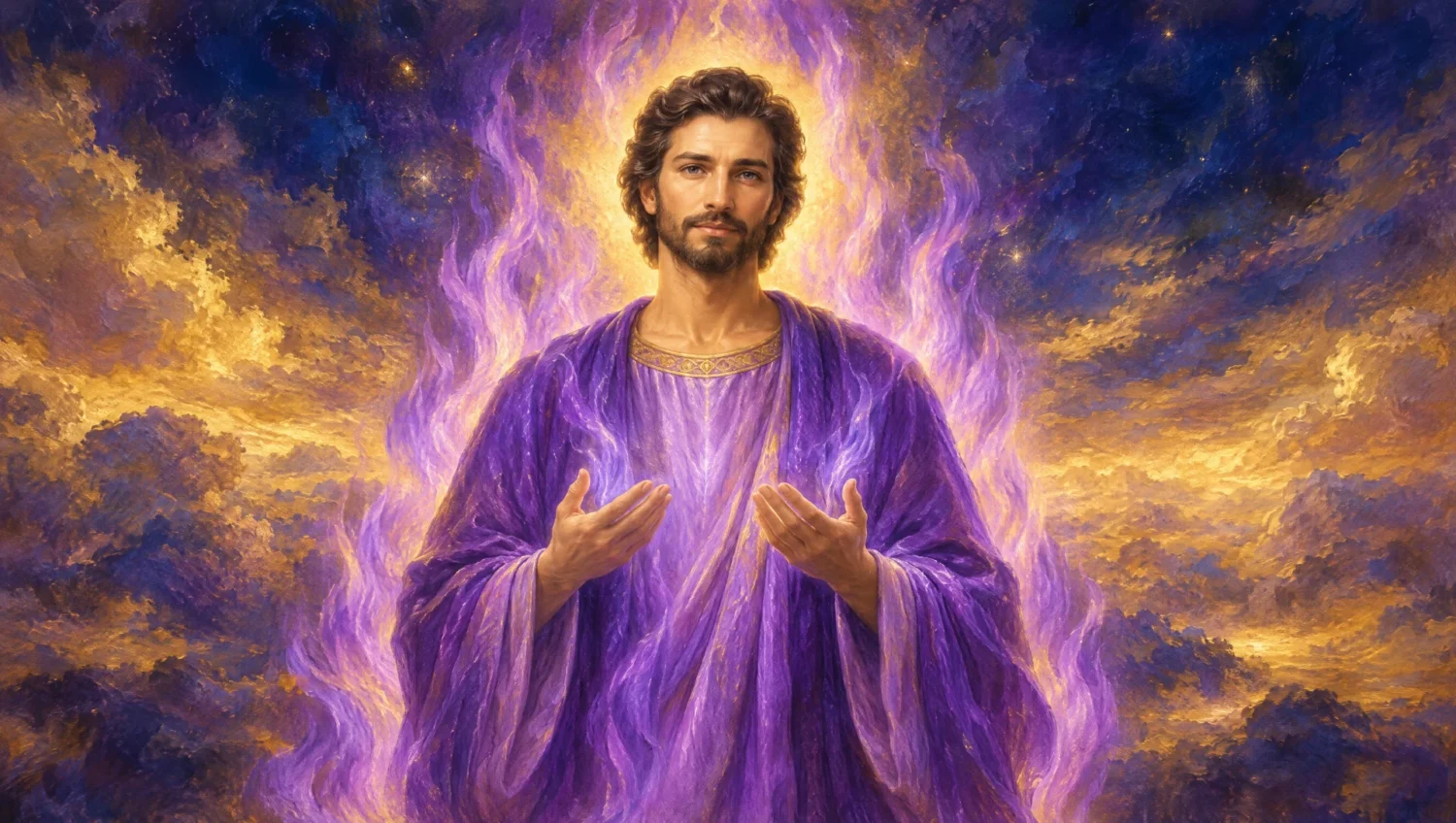
Ask ten people who Saint Germain is and you may get ten answers. A historian will describe an eighteenth century European nobleman of mysterious origin, a gifted violinist and a talented chemist. A Theosophist will describe a Master of the Wisdom who guided the political currents of Europe from behind the scenes. A student of the I AM Activity will describe a radiant, deathless being who appeared on a mountain in California and brought a message of freedom. A student of the Summit Lighthouse will describe the Lord of the Seventh Ray and the Chohan of the Violet Flame.
All of them are talking about something real. The question is which part of the story rests on records and which part rests on faith.
In this guide we follow a clear rule. When we say the Count, we mean the historical man. When we say Saint Germain or the Master, we mean the figure of esoteric belief. When a claim comes from a tradition, we say so, the way a good teacher would. We are not here to debunk. We are not here to convert. We are here to help you understand a presence that has fascinated seekers for nearly three hundred years.
If you are new to the whole subject of Masters, rays and retreats, our Ascended Masters guide is the best place to begin. It sets the stage for everything below.
The Historical Count of Saint-Germain
The first firm trace of the Count appears in London in the mid 1740s. He seems to have contributed songs to an opera staged at the Haymarket Theatre in early 1745. That December, Horace Walpole wrote in a letter that a man calling himself Count St. Germain had been arrested on suspicion of spying during the Jacobite rising. He was released without charge. Walpole described him as pale, with black hair and a beard, fluent in Italian and French, and apparently Spanish or Portuguese by birth.
By around 1748 he was in Paris and moving in the highest circles. He won the favor of Louis XV and of Madame de Pompadour. According to accounts that historians generally accept, the king gave him rooms at the Château de Chambord and funds for a laboratory, where the two experimented with dyes and textiles. The Count was also used as an informal envoy. In 1760, during the Seven Years War, he traveled to The Hague on a sensitive financial and peace mission. The king’s minister, the Duc de Choiseul, opposed him, and Louis XV disavowed him. The Count slipped away to England.
Giacomo Casanova met him in Paris in 1757 and left a vivid portrait. He thought the man a brilliant impostor, yet he could not stop watching him. The Count talked through an entire dinner while the others ate. He claimed to know a universal medicine and to be able to improve the flaws in diamonds. Voltaire, in a letter to Frederick the Great, summed up the legend with a joke: here is a man who never dies and who knows everything.
Later travels took him through the Netherlands, Italy, Germany and Russia, under a changing set of aliases. Around 1779 he settled in northern Germany as the guest of Prince Charles of Hesse-Kassel, a Freemason and a sincere student of the occult sciences. They worked together on dyes and on chemical experiments. Charles later said the Count was one of the few people in whom he truly confided.
The Mystery of His Origins
Nobody knows who he was born as. The date is usually given as 1691 or 1712. The earlier date comes from his own claim, late in life, that he was eighty eight. The later date is the one most historians prefer.
He sometimes said he was the son of Francis II Rákóczi, Prince of Transylvania, a Hungarian national hero who led a rebellion against the Habsburgs. There is no hard evidence for this. It would explain the education, the money and the manner. It would also explain why he used the name Prince Rákóczi at times. Other theories name an Alsatian Jewish merchant, a Spanish Jesuit, a Portuguese nobleman, or the illegitimate child of an Italian princess born at San Germano in Savoy. None can be proved.
The Count also went by many names. The surviving list includes the Marquis de Montferrat, Count Bellamarre, Chevalier Schoening, Count Weldon, Count Soltikoff and Prince Ragoczy. Some historians read this as the habit of a man with something to hide. Others see a career diplomat and adventurer using covers. In either case, the lack of a clean origin story is what turned him into a blank screen onto which later generations projected their longings.
That is worth remembering. A great deal of what people say about Saint Germain tells us more about the people than about the man.
Legends That Grew Around Him
Once an enigma attracts attention, stories multiply. Some of the best known are:
- He never ate or drank in public.
- He was hundreds, or thousands, of years old and remembered Cleopatra, the Queen of Sheba and Christ.
- He warned Marie Antoinette of the coming Revolution.
- He predicted the rise of Napoleon.
- He appeared after his death in 1784, at gatherings in Paris and Vienna.
Look at where these stories come from. The warnings to Marie Antoinette are told in memoirs attributed to the Countess d’Adhémar, which appeared long after the events and which historians generally regard as unreliable. The claim that he lived for centuries comes largely from his own boasting and from the gossip of salons. The later sightings come from the nineteenth century and from the occult revival, not from contemporary records.
None of this makes the stories worthless. Legends are a form of testimony. They tell us what people wished to be true: that there was a hidden wisdom behind the age of kings, and that someone wise was watching. But a careful reader should hold them loosely. In this guide we mark them as legend.
The Death at Eckernförde and the Question of Ascension
Here the record is surprisingly clear. The Count died on 27 February 1784 in Eckernförde, in the duchy of Schleswig, then under the Danish crown. The death was entered in the register of St. Nicolai Church. He was buried on 2 March. The local authorities later announced an auction of his effects, in case no relative came forward. Historian Jean Overton Fuller, who studied the surviving papers, found no hidden treasure, only clothing, linen, a few debts paid and a small sum of money.
This is exactly where the tradition steps in. H. P. Blavatsky argued that his death was doubtful, citing the lack of a proper funeral record in her sources and later alleged sightings. Followers in the I AM and Summit traditions go further. They say that the Master had already completed his ascension, a conscious return to spirit in the physical body, and that the grave is a cover. The Summit Lighthouse teaches that he ascended on 1 May 1684, long before the grave in Eckernförde, and that the Count of the 1700s was a later embodiment of an already ascended being who chose to return for a mission.
We should be honest about what this means. A burial record and an ascension story do not contradict each other if you believe in the second. They do contradict each other if you read the burial record as the final word. The document is real. The ascension is a matter of faith. Both can be held with respect.
Saint Germain in the Theosophical Tradition
The modern spiritual Saint Germain begins with Theosophy. Helena Petrovna Blavatsky and Henry Steel Olcott founded the Theosophical Society in New York in 1875. In Theosophical writing, Saint Germain is counted among the Adepts, or Masters of the Wisdom, the elder brothers of humanity who guard and teach the ancient wisdom. Blavatsky wrote of him with great admiration. A passage attributed to her in the Theosophical Glossary calls him the greatest Oriental Adept Europe had seen in recent centuries. Olcott later wrote that Saint Germain and Blavatsky were both messengers of the White Lodge, sent to influence the karmic currents of their times.
Blavatsky’s remarks about the Count are cautious. She doubted his death in 1784. She credited him with a role in the ferment before the French Revolution. But she did not build an elaborate system around him. That came later, with the writers who followed her.
Annie Besant claimed to have met the Master in 1896. Charles Webster Leadbeater, her colleague, described a Master called Rakoczi, or simply the Master R., with olive skin, dark eyes and a gentle, powerful presence. In the Leadbeater and later Alice Bailey scheme, this Master heads the Seventh Ray, the ray of ceremonial order and of the creative use of ritual, and he is understood to be preparing the cultural forms of the coming age. Bailey’s writing treats the Master R. as a high Chohan and as a Hungarian by birth.
If you want to read this material at the source, our readers can find Annie Besant’s Theosophy and William Q. Judge’s The Ocean of Theosophy as audiobooks, The Mahatma Letters to A. P. Sinnett for the wider Master tradition, and for a thoughtful modern biography of the founder, Gary Lachman’s Madame Blavatsky: The Mother of Modern Spirituality.
The Lives Attributed to Him
Most traditions agree that the Count was not his first or only life. The list varies by group, but some names appear again and again:
- Saint Alban, the first recorded martyr of Britain, in the third or fourth century.
- Proclus (c. 410 to 485), the Neoplatonist philosopher.
- Roger Bacon (c. 1220 to 1292), the Franciscan friar and experimental scientist.
- Christian Rosenkreutz, the legendary founder of the Rosicrucians.
- Francis Bacon (1561 to 1626), the statesman and philosopher of science.
Some groups add Merlin, Christopher Columbus, and even Joseph, the earthly father of Jesus. These lists come from the visionary statements of teachers within the tradition. They are not historical findings. Note also that the figures are strikingly similar in type: scholars, sages and advisers to rulers, people who stood between the world of ideas and the world of power. That matches how the tradition sees Saint Germain’s mission.
The Summit Lighthouse adds a particular story. Francis Bacon, it teaches, faked his death in 1626, went to a mansion in Transylvania belonging to the Rákóczi family, and ascended in 1684, afterward appearing in the world as the Count. From a historian’s point of view, this has no support. From a devotional point of view, it explains why the Master is associated at once with science, with the Rosicrucian current, with Hungary and with freedom.
Guy Ballard, Mount Shasta and the I AM Activity
The next chapter is American. In August 1930, a Chicago mining engineer named Guy Warren Ballard was hiking on Mount Shasta in northern California. According to his own account, published in 1934 as Unveiled Mysteries under the pen name Godfré Ray King, he met a stranger by a spring. The man offered him a cup of a sparkling liquid that, Ballard said, filled him with energy. The stranger revealed himself as Saint Germain, and he led Ballard through a series of experiences that included visions of ancient Egypt and Atlantis and a journey to the Royal Teton Retreat.
From this seed came the I AM Activity, founded by Ballard and his wife Edna in the early 1930s. Its central teaching is the Mighty I AM Presence, the God within each person, a higher self that is the true source of life. Its practices include decrees, spoken affirmations that call on the Presence and on the Masters, and the use of the violet consuming flame, a purifying light of divine love. Saint Germain is understood as the Master who sponsors the new age of freedom, and also as a patron of the United States. Ballard’s teaching carried a strong American patriotism, a feature that critics often mention.
The movement grew very quickly. The first large gathering was held in Philadelphia in October 1934. In 1935, a crowd of about six thousand filled the Shrine Auditorium in Los Angeles. By the late 1930s, followers numbered in the hundreds of thousands by most accounts, with some estimates reaching a million. Guy Ballard died in December 1939. Edna said he had completed his ascension. She led the movement until her death in 1971, and the Saint Germain Foundation still operates today, with a famous annual pageant at Mount Shasta each August.
If you want to read the founding text, it is Unveiled Mysteries. Read it as what it is: a devotional account of a private experience.
United States V. Ballard: When a Religion Went to Court
The I AM Activity is also famous in law. In 1942 Edna Ballard and her son Donald were convicted of mail fraud, accused of soliciting money on the basis of claims they knew to be false, including claims about spiritual healing. The case reached the Supreme Court. In United States v. Ballard (1944), the Court ruled five to four that a jury could not be asked to decide whether religious beliefs were true. A jury could decide only whether the defendants sincerely held them. The case is still taught in American law schools as a cornerstone of religious freedom.
The legal story is complicated. The conviction was later set aside on other grounds. But the case reminds us of two things at once. First, the state should not play judge of heaven. Second, spiritual groups can and do make claims about money and healing that call for real scrutiny. Both of these lessons will matter again when we reach the cautions section.
The Prophets and the Summit Lighthouse
The third great builder of the modern Saint Germain is the Summit Lighthouse. Mark L. Prophet, born in 1918, had been connected to a splinter of the Ballard-era I AM movement. In 1958, in Washington, D.C., he founded the Summit Lighthouse to publish what he called the Pearls of Wisdom, weekly messages he said were dictated by the Ascended Masters. He considered himself a Messenger. After he met Elizabeth Clare Wulf in 1960, the two married and worked together. Mark died in 1973. Elizabeth Clare Prophet led the organization, renamed the Church Universal and Triumphant in 1975, until she stepped back in the late 1990s. She died in 2009.
The Prophets developed the richest and most detailed version of the Master tradition. Their books include The Masters and Their Retreats, Lords of the Seven Rays and Saint Germain on Alchemy. They gave Saint Germain a clear office: Chohan, or lord, of the Seventh Ray. They taught that he became Hierarch of the Age of Aquarius in 1956. And they gave the violet flame its fullest practical form, with long rhythmic decrees recited aloud.
The Church Universal and Triumphant grew into an international movement and settled in Montana, at the Royal Teton Ranch near Yellowstone, in the early 1980s. In the late 1980s and 1990, Elizabeth Clare Prophet warned of a possible nuclear war. Thousands of members prepared for it, and the church built fallout shelters. The predicted catastrophe did not occur, and the group’s reputation never fully recovered. We will return to this in the cautions section, because it is exactly the kind of fact a thoughtful reader should know.
For the primary teaching, many readers begin with Saint Germain on Alchemy.
The Great White Brotherhood Explained
Saint Germain belongs to what the traditions call the Great White Brotherhood. It helps to understand what this means, and what it does not.
The “white” in the name refers to light and purity of intention. It has nothing to do with race, and many people find the wording unfortunate today. The idea is older than the phrase. Blavatsky wrote of a Brotherhood of Adepts who preserve the wisdom of the ages. Later writers such as Leadbeater and Alice Bailey described a Spiritual Hierarchy: a structured community of illumined souls who have completed the cycle of earthly lessons and who stay close to human life in order to guide it. At the head, in Bailey’s picture, stands Sanat Kumara, the Lord of the World, at the spiritual center called Shamballa. Beneath him are the World Teacher, the Manu, the Mahachohan and the seven Chohans, one for each ray. Below these are the Masters, including Saint Germain, El Morya, Kuthumi and others.
In the I AM and Summit traditions, these beings are called Ascended Masters. They are understood as souls who completed their earthly work, transcended the cycle of karma and rebirth, and “ascended” back into the light, while remaining active teachers.
This is a vision, not a documented organization. K. Paul Johnson, who has written two books on the subject, argues that Blavatsky’s Masters were idealized portraits of real people she knew, including Indian teachers and political figures. His work is debated, and some Theosophists strongly reject it. Whatever the truth, the concept of a hidden lineage of wisdom has proved remarkably durable. For a full tour of the idea, see our Ascended Masters guide.
The Seven Rays and the Seventh Ray of Freedom
In the Theosophical, I AM and Summit traditions, creation flows through seven rays: seven qualities of divine light, each with its own color, character and Master. Alice Bailey wrote at length about them in her Treatise on the Seven Rays. The Summit Lighthouse mapped them to colors and Chohans. Here is the version most familiar to students of the Ascended Master Teachings.
| Ray | Color | Quality | Chohan in the Summit tradition |
|---|---|---|---|
| First | Blue | Will, power, faith | El Morya |
| Second | Yellow | Wisdom, illumination | Lord Lanto |
| Third | Pink | Love, beauty, creativity | Paul the Venetian |
| Fourth | White | Purity, discipline, ascension | Serapis Bey |
| Fifth | Green | Truth, healing, science | Hilarion |
| Sixth | Ruby and gold | Service, peace, ministration | Lady Master Nada |
| Seventh | Violet | Freedom, mercy, transmutation, ceremonial order | Saint Germain |
Bailey uses different names for the same seven: Will or Power, Love-Wisdom, Active Intelligence, Harmony through Conflict, Concrete Knowledge, Devotion, and Ceremonial Order or Magic. The groups do not always agree on who holds which office, and the Summit Lighthouse says some offices changed hands during the twentieth century. Treat the table as the Summit Lighthouse version.
Saint Germain’s Seventh Ray is the ray of the new age. Its work is to bring spirit into form: ritual, law, art, institutions and the daily patterns of life. In the language of the tradition, it brings freedom through transmutation, which means changing something heavy into something light, rather than escaping it. The color is violet, the color of the crown center, the meeting place of the personal and the universal. If you want to see how the colors map to the body, our guide to the seven chakras is a good companion.
The Violet Flame: What It Is and How People Use It
The violet flame is the signature practice of Saint Germain. The I AM Activity called it the violet consuming flame. The Summit Lighthouse made it famous as the violet flame, and it is still the reason many people first hear his name.
The idea is simple. Light has frequencies. The violet frequency, they say, has the specific power to dissolve the residue of past mistakes: guilt, resentment, habit patterns, even what some call karmic debt. You do not push the heaviness away. You invite it into the flame and let it be transformed. Students learn to imagine violet fire passing through the body, the home, a relationship, or a painful memory, while repeating a spoken or silent affirmation. Many use the short rhythmic prayers called decrees.
Compare this with other traditions. A Tibetan practitioner of Vajrasattva visualizes a white purifying light descending through the body, while reciting a hundred syllable mantra to release karmic stains. A Catholic who goes to confession names an error and receives forgiveness. A therapist might ask you to picture a difficult scene and change its colors until it loses its charge. These are different frameworks for a similar human need: a way to let the past loosen its grip. For a clear account of karma as the tradition understands it, see our guide to what karma really is.
What does the research say? No study has tested the violet flame as such. There is research suggesting that guided imagery, rhythmic repetition and meditation can lower stress and help sleep. It is reasonable to think a violet flame practice could work through similar pathways. But the tradition itself claims more, and those claims cannot be verified. Use the practice as a devotional and contemplative tool. Never use it in place of medical or mental health care.
Alchemy as Inner Transformation
The historical Count was a working alchemist in the broad eighteenth century sense. He made dyes, studied minerals, and claimed to improve gemstones. His chemistry may have been real and useful. The craft of dyeing was an advanced science in his day, and a new color could be worth a fortune.
The spiritual Saint Germain takes this further. In the tradition, alchemy is not about turning lead into gold. It is about turning the lead of ordinary consciousness into the gold of awakened awareness. This reading has deep roots. Carl Jung spent years studying alchemical texts and concluded that the old alchemists were projecting an inner process onto matter. The stages of the Great Work, from the dark, dissolving nigredo through the purifying albedo to the golden rubedo, look remarkably like the stages of a psychological and spiritual transformation.
The Rosicrucian manifestos of the early seventeenth century, which circulated in Germany and shaped the Western esoteric current, speak the same language. Saint Germain is linked to the Rosicrucians in the tradition, though the historical Count’s own connection to any Rosicrucian body is undocumented. The book Saint Germain on Alchemy brings these themes into the violet flame practice. It treats the daily decree as a small act of alchemy: you stand in the middle of your life and ask what in it can be transformed.
Retreats: Royal Teton, the Cave of Symbols and Transylvania
The Masters are said to maintain retreats, centers of light on the etheric plane, usually located above physical places. Students are invited to visit them in meditation or in sleep to receive teaching and healing.
Saint Germain is connected to several. The Royal Teton Retreat, in the Teton Range of Wyoming, is described in the I AM tradition as a gathering place of the Brotherhood. Guy Ballard’s book describes it, and Edna said Guy returned there. In the Summit tradition, Saint Germain’s focus includes the Cave of Symbols, associated with Table Mountain in Wyoming, where the cosmic patterns of each soul are said to be kept. The tradition also names his connection to a Rákóczi mansion in the Carpathian mountains of Transylvania, which ties the story back to Hungary. Mount Shasta, where Ballard met him, remains a pilgrimage site for the I AM community.
These retreats are articles of faith. They are not physical buildings that you can visit with a map. If you travel to Wyoming or Shasta hoping to find an entrance to a hidden temple, you will find mountains. That can be a wonderful thing. Many seekers report feeling something on these peaks. But keep the poetry and the geography distinct.
Saint Germain and the Age of Aquarius
In astrology, the precession of the equinoxes moves the spring point backward through the zodiac, spending about 2,160 years in each sign. The era we call the Age of Aquarius is said to be arriving. When it begins is a matter of real dispute, with proposed dates ranging across several centuries. The Summit tradition holds that Saint Germain took up the role of hierarch, or sponsor, of the age in 1956.
What does that mean in practice? Aquarian themes are freedom, community, invention and universal brotherhood. Saint Germain’s message is mercy as the engine of freedom: that no one changes through shame, and that a free society depends on free inner lives. Ballard added the idea of the United States as a vessel for this freedom, a claim that deserves honest scrutiny. Spiritual teaching can slide into nationalism, and we will name that in the cautions below.
Even so, the vision is moving. It says the future is not fixed. It says the world can be made lighter by individuals who learn to transform their own heaviness. You do not have to accept the astrology or the dates to find that worth carrying.
Channeled Voices Today
Saint Germain is among the most frequently channeled beings in the modern spiritual world. At Next Level Soul we have spoken with several people who say they bring through his voice. You can listen to St. Germain Speaks with David Christopher Lewis, his earlier channeled message of love and hope, Geoffrey Hoppe on St. Germain’s message about war, AI and humanity’s evolution, and Saint Germain’s channeled message with Tara Arnold. David Christopher Lewis also teaches in the Next Level Soul Mastery course on the spiritual alchemy of St. Germain.
You can also meet him in a wider circle. Genevieve Taeger’s live channeling of the Ascended Masters and the series Ascended Masters Channeled on Next Level Soul bring several voices together, and Anjie Hipple’s interview covers a great many Masters in one conversation.
A word on discernment. Different channelers present Saint Germain with different emphases, and they do not always agree with each other or with the older Theosophical and I AM sources. That is normal. Treat each message as one person’s experience. Ask whether it makes you kinder, steadier and freer. Ask whether it respects your own judgment. A message that increases fear, urgency or dependence is not carrying the violet ray, whoever signs it.
How Saint Germain Compares with Other Masters
Each Master brings a different gift, and it helps to compare. In the Summit view, El Morya is the Chohan of the First Ray: the will to act, discipline, and devotion to the larger good. Kuthumi brings gentleness and the wisdom of the heart. Serapis Bey trains the aspirant in purity and discipline. Hilarion serves truth and healing. Lady Master Nada serves love in the form of ministry. Saint Germain sits at the point where all of these come into practice: he asks what you will do with what you have learned, and he offers a flame for the mistakes you make along the way.
Historically, the Count belongs to a cluster of eighteenth century figures who claimed secret wisdom and moved through courts. Another was Alessandro di Cagliostro, who sold Egyptian Freemasonry across Europe, was arrested by the Roman Inquisition in 1789 and died in prison in 1795. Next to him, Saint Germain seems more restrained, more musical and more credible. He was never convicted of fraud, although many suspected him of it.
In myth, he resembles a Merlin figure: the adviser behind the throne, the magician who is in truth a teacher. In the tradition, Merlin is one of his past lives. Whether you see this as fact or as archetype, the pattern is old and powerful.
You can read the same pattern in the wider mystery school tradition, from Egypt through Greece to the Renaissance. Our guide on the lost years of Jesus and the mystery schools and the audio course Mystery Schools of the Ancients explore that lineage.
Honest Questions and Cautions
A guide that tells only the glowing side does a disservice to the reader and to the Master. Here are the questions worth asking.
Is the Count of Saint-Germain Really the Ascended Master?
This is a belief, not a finding. History gives us a remarkable man with an obscure origin. The tradition says that man was an embodiment of a much older being. You can respect the possibility, and you can also say that no independent evidence supports it.
Where Do the Stories of Immortality Come From?
Mostly from the Count’s own talk, from salon gossip and from writers who came long after his death. Casanova doubted him. Many contemporaries thought him an adventurer. The Theosophical and I AM sources are devotional, not documentary.
Do the Traditions Agree with Each Other?
No. The I AM movement treats Master Rakoczi as a separate being from Saint Germain, while Theosophists often treat them as one. Lists of past lives differ. Even the word ascended is disputed, since many Theosophists feel it distorts their older idea of a Master of the Wisdom. Where groups differ, we have named the group.
Is the Violet Flame Safe?
As a visualization and prayer practice, it carries the same low risks as other meditations. The danger lies in how it is used. Long, intense sessions of decrees can leave some people agitated or exhausted. And no spiritual practice replaces medical care, therapy or time with trusted friends. If a group claims the flame will cure illness or erase the need for treatment, step back.
What About the Money, the Loyalty and the Predictions?
The two largest organizations in this story each faced serious public scrutiny. The I AM Activity was prosecuted for mail fraud in the 1940s. The Church Universal and Triumphant prepared its members for a predicted nuclear war in 1990 that did not come. Courts and critics have raised questions about pressure on members and about financial claims. This does not make every follower dishonest, and many students speak warmly of what they received. It does mean you should keep your own judgment. Be wary of any group that asks for large sums, discourages questions, or isolates you from family and friends.
Can Saint Germain Be Used for Political Ends?
Yes, and it has happened. The idea of a chosen nation or a special destiny is easy to attach to a Master of freedom. If a message uses his name to demand obedience or to condemn others, it is not carrying mercy.
A Mystic’s Reading: Why Saint Germain Endures
Set aside the courts, the books and the charts for a moment. Why does this figure still pull at people?
Perhaps because he stands for a promise that is hard to believe: that you can change. Not by erasing your past, but by letting it burn into something useful. Most of us carry things we cannot undo. A word we cannot take back. A year we spent in the wrong place. A habit that keeps returning. The violet flame is a picture of mercy that has nothing to do with excuses. It says the weight is real, and it says the weight can be transformed.
The mystic hears a second message. The Count in the records was a man who moved between worlds, who served kings and kept his own counsel, who was loved and doubted in equal measure. He did not insist on being believed. In a time of loud certainty, there is something refreshing about a teacher who comes with questions attached.
Whatever he was, the invitation is the same: become an alchemist of your own life. Take the lead of this day and look for the gold in it.
A Practice: Seven Days with the Violet Light
You can taste the spirit of this tradition in a week. This is a gentle contemplative exercise inspired by the violet flame practice. It does not require any belief in Masters.
- Day one: Settle. Sit comfortably for five minutes. Breathe slowly. Imagine a soft violet light resting around your body like a shawl.
- Day two: Name one weight. Write down a single worry, regret or resentment. Just one. Read it once and breathe.
- Day three: Offer it to the light. Close your eyes. Picture the weight as a small dark stone. See it placed in a violet flame that does not harm, only softens. Watch it become lighter.
- Day four: Speak a simple phrase. Repeat quietly: I release what no longer serves me, and I welcome what is true. Say it slowly nine times.
- Day five: Practice mercy. Think of someone who disappointed you. Silently wish them freedom. You do not have to forgive in full. You only have to loosen your grip.
- Day six: One act of order. The Seventh Ray loves form. Tidy one drawer, finish one small task, or set one clear boundary.
- Day seven: Reflect. Write what shifted, however small.
Skip any step that feels heavy. If memories become distressing, stop and speak with a counselor. Gentle is the point.
Books and Further Reading
- Saint Germain on Alchemy: Formulas for Self-Transformation, by Mark and Elizabeth Clare Prophet. The central text of the violet flame tradition.
- Unveiled Mysteries, by Godfré Ray King (Guy Ballard). The founding account of the I AM Activity.
- The Comte de St. Germain: Last Scion of the House of Rakoczy, by Jean Overton Fuller. A biographical study of the historical man.
- The Masters and Their Retreats, by Mark and Elizabeth Clare Prophet. A reference to the Masters and their etheric retreats.
- Lords of the Seven Rays, by Mark and Elizabeth Clare Prophet. The seven rays and their Chohans in the Summit tradition.
- The Mahatma Letters to A. P. Sinnett. The core Theosophical source on the Masters, for context.
- The Masters Revealed, by K. Paul Johnson. A critical, historical argument about Blavatsky’s Masters.
- Madame Blavatsky: The Mother of Modern Spirituality, by Gary Lachman. A readable biography.
If you buy through these Amazon links, it supports our work at no extra cost to you.
Who Will Connect with This Master
Saint Germain may speak to you if you are drawn to transformation, to ritual and beauty, to history with a shimmer of mystery on it. He may suit you if you carry regret and want a gentle, imaginative practice for letting it go. He may also suit the creative seeker who likes the idea of spirituality as craft: something you do with your hands and your days.
If you prefer a more straightforward ethical teaching, or if the elaborate cosmology feels like too much, you may find more ease with a quieter path. Our guide to Kriya Yoga meditation and our library of Akashic Records practice offer other ways in.
Keep Exploring
To read the older Theosophical sources behind the Master tradition, listen to Theosophy and The Ocean of Theosophy, both available on Next Level Soul. For the Alice Bailey material on the rays, try Initiation, Human and Solar.
For quiet companions to this study, the audio course Mystery Schools of the Ancients offers 22 chapters on the universal laws taught by the ancient schools. The Hidden Science of the Soul offers 13 chapters, and Echoes of Atlantis offers 11. All are included with Next Level Soul membership. You can also explore NLS Mastery and the free masterclasses.
Watch Ascended Masters, Channeled on Next Level Soul TV
An eight-episode series in which renowned channeler Genevieve Taeger brings through Buddha, Mary Magdalene, Athena, Mother Mary, Jesus, Saint Germain, Yogananda and Kuan Yin. Each episode is a channeled message, offered as spiritual guidance and not as historical record.
Episodes that connect with this guide: Ascended Master Saint Germain.
Frequently Asked Questions
Who is Saint Germain?
Saint Germain is two figures. The first is the Count of Saint-Germain, a mysterious eighteenth century courtier, musician and alchemist who died in 1784. The second is the Ascended Master of Theosophy, the I AM Activity and the Summit Lighthouse, who is said to be Chohan of the Seventh Ray and a teacher of freedom and transmutation.
Was the Count of Saint-Germain a real person?
Yes. He appears in letters by Horace Walpole, in Casanova’s memoirs, in the correspondence of Voltaire and in court records. He died at Eckernförde in 1784 and the death was recorded in the church register. His birth and background are unknown.
What is the violet flame?
The violet flame is a visualization and prayer practice associated with Saint Germain. Students imagine violet light passing through the body, the mind or a situation to dissolve heaviness and bring about transmutation. It is a devotional practice, not a medical treatment.
What is the Seventh Ray?
In the Theosophical and Ascended Master traditions, the Seventh Ray is the ray of ceremonial order, freedom, mercy and transmutation. Its color is violet and its Chohan is Saint Germain. It is associated with the Age of Aquarius.
Did Guy Ballard really meet Saint Germain?
Ballard said so, in his 1934 book Unveiled Mysteries, describing an encounter on Mount Shasta in August 1930. There is no outside verification. It is a personal claim and the foundation of the I AM Activity. In 1944 the Supreme Court held that a jury could not decide whether such beliefs were true.
Is Saint Germain the same as Master Rakoczi?
Theosophical writers often treat them as one. The I AM Activity treats them as separate beings. The name Rákóczi connects to the Hungarian princely family that the Count sometimes claimed as his own.
Is the violet flame dangerous?
As a meditation, it carries low risk. Problems arise when it is used in place of medical or mental health care, or when a group uses it to pressure members. If long periods of decrees leave you anxious or exhausted, scale back and seek support.
What are the seven rays?
The seven rays are seven qualities of divine light, each with its own color and Master. In one common version they are Will, Wisdom, Love, Purity, Truth and Healing, Service, and Freedom. See the table in this guide for the Summit Lighthouse version, and our Ascended Masters guide for the larger picture.
Where can I hear channeled messages from Saint Germain?
On Next Level Soul you can listen to David Christopher Lewis, Geoffrey Hoppe and Tara Arnold, among others. Treat each message as one person’s experience and use your own discernment.
Do I have to believe in Ascended Masters to use these practices?
No. You can use the violet light exercise as a contemplative tool for letting go. Many people do, whatever they think about the cosmology.