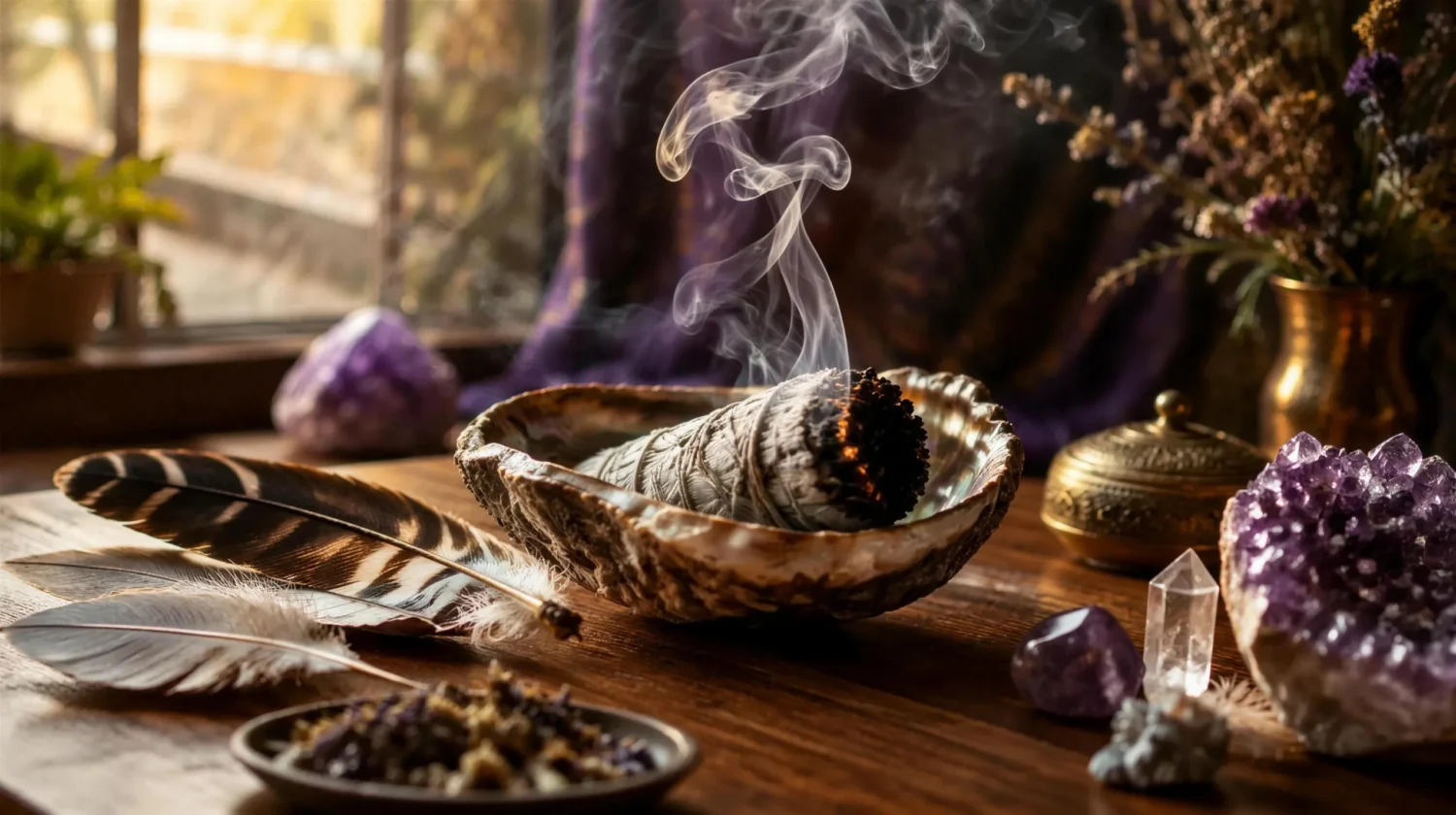
Smudging is the practice of burning sacred herbs, most often sage, cedar or sweetgrass, and moving the smoke around a person, object or space to cleanse and bless it. It is rooted in the ceremonies of many Indigenous nations in North America, and today many people use the word more broadly for any smoke cleansing of a home or energy field. To smudge respectfully, learn where the practice comes from, choose sustainable materials, keep the intention clear and loving, and stay safe with fire and smoke.
This guide explains what smudging is, its cultural roots, how to do it step by step, which herbs to use, alternatives, safety, and what Next Level Soul guests say about ceremony and cleansing. It pairs well with our guides to Samhain, creating a sacred space and building an ancestor altar.
Key Takeaways
- What it is. The burning of sacred plants, with the smoke used to cleanse and bless a person, object or space.
- Where it comes from. Ceremonial practice among many Indigenous nations. Practices differ from nation to nation, and the word “smudging” is associated with North American Indigenous traditions.
- What people use. White sage, garden sage, cedar, sweetgrass, lavender, rosemary and other herbs. Palo santo and incense are used in related practices.
- Respect matters. White sage is overharvested and is sacred to many nations. Buy from Indigenous-owned sources, grow your own or choose alternatives.
- Keep it safe. Use a fireproof bowl, open a window, never leave a flame unattended, and avoid smoke around people with breathing conditions.
- It is a tool. Smoke is a ritual that supports your intention. Calm, clear intention is the real cleansing.
Ghost and Spirit Audiobooks on Next Level Soul TV
Clearing a space often brings up questions about spirits and unseen energy. These audiobooks are available to members on Next Level Soul TV.


What Is Smudging?
To smudge is to burn dried herbs or resin until they smolder, then waft the smoke with a hand, a feather or a fan over a person, an object or a room. In its original context, smudging is a ceremony that purifies, prepares and blesses. People may smudge before a gathering, a prayer, a healing session or a reading, and a smudge may be offered to those who enter a ceremonial space.
In everyday modern use, many people smudge a new home, after an argument, after an illness, at a season change or as part of a quiet ritual to reset. The aim is the same across both uses: to release what is heavy and invite clarity, calm and goodwill.
The Cultural Roots of Smudging
Smudging is a sacred practice in many First Nations and Native American communities, where it is part of ceremony, prayer and healing. The plants used, the prayers spoken and the protocols followed vary widely between nations, and some ceremonies are not for outsiders to copy. The word itself is closely tied to these traditions.
Smoke cleansing in a wider sense appears across the world: incense in churches and temples, juniper smoke in the Himalayas, frankincense and myrrh in the Middle East, and herbal bundles burned in Europe and Asia. Each has its own history and meaning. When we borrow from any of them, it helps to learn the story and say thanks.
Shawn Leonard, an Indigenous psychic medium who has appeared twice on Next Level Soul, says that ceremony and connecting to ancestors and culture are part of who he is as an Indigenous person. In our Spiritual Cinema review of the series Spirit Talker, we note that he smudges before a reading to help the flow of spirit communication. Listen to his conversations on Indigenous insights on spirit and totem animals and the spirit realm.
How to Practice With Respect
- Learn first. Read from Indigenous authors and teachers about the meaning and protocols.
- Use the right name. Where you can, call a general home cleansing “smoke cleansing” and reserve “smudging” for its ceremonial context.
- Source with care. Buy from Indigenous-owned businesses, or grow your own herbs.
- Take only what you need. Do not overbuy, and do not hoard.
- Keep your intention humble. Treat the practice as prayer, not performance.
- Honor invitations. If you are invited to take part in a ceremony led by an Indigenous elder, follow their guidance.
What to Burn: Herbs and Resins
| Material | Traditional or common use | Notes |
|---|---|---|
| White sage | Purification and clearing, sacred to many nations | Native to the southwestern United States and northern Mexico, and heavily overharvested. Buy from Indigenous-owned or ethical growers, or choose another herb. |
| Garden sage | Cleansing and protection | Easy to grow and dry at home. A kind, accessible choice. |
| Cedar | Protection and prayer, sacred to many nations | Burned alone or with other herbs. Smells warm and woody. |
| Sweetgrass | Invitation of goodness and blessing, often burned after cleansing | Sacred to many nations. Traditionally braided. Buy ethically. |
| Lavender | Calm and rest | Gentle and fragrant. Good for bedrooms. |
| Rosemary | Clearing and remembrance | Easy to grow, long associated with remembrance. |
| Mugwort | Dreams and intuition | Has a long history in European folk practice. |
| Juniper | Purification | Used in many cultures. Smells crisp and clean. |
| Palo santo | Used in South American traditions | Choose sustainably sourced, naturally fallen wood. |
| Frankincense and myrrh | Sacred offerings in many religions | Resins that burn on charcoal. |
How to Smudge Your Home: Step by Step
- Set your intention. Decide what you wish to clear and what you wish to welcome. For example: “I release what is heavy and welcome peace.”
- Prepare your tools. You will need your herb bundle or loose herbs, a fireproof bowl or shell, matches or a lighter, a feather or fan if you like, and a small dish of sand or water to extinguish the herbs.
- Open a window. Smoke needs a way out, and it carries the energy with it.
- Quiet yourself. Take a few slow breaths and ground your feet on the floor.
- Light the herbs. Hold the tip in the flame until it catches, then blow it out gently so it smolders and produces smoke.
- Cleanse yourself first. Waft the smoke over your body, from head to feet, with a calm mind.
- Walk the space. Move slowly through the room, often clockwise, wafting smoke into corners, doorways and windows. Say your prayer or intention aloud as you go.
- Cover the whole home. Include closets and basements if you can. Work from the back of the house toward the front door.
- Let the smoke exit. Finish at an open door or window, and direct the smoke outside with thanks.
- Extinguish the herbs. Press the tip into sand or a small dish of water until it is completely out. Never leave smoldering herbs unattended.
- Close with gratitude. Thank the plants, the space and the helpers you invoked. Sit quietly for a minute.
When to Smudge
- When moving into a new home or office
- After an argument, illness or a heavy visit
- At seasonal turning points, such as the equinoxes or Samhain
- Before meditation, ritual, prayer or a reading
- When a room feels stuffy or low in energy
Smudging Safety
- Fire safety. Use a heat-safe bowl or shell, keep flammable items away, and never leave burning herbs unattended.
- Ventilation. Keep a window open. Smoke can irritate eyes and lungs.
- Health. People with asthma, allergies, COPD or other breathing conditions, and anyone sensitive to smoke, may want to avoid it or choose a smoke-free alternative. Take care around babies and pets.
- Smoke detectors. Light smoke may set one off. Open a window and fan the area rather than disabling the detector.
- Extinguish fully. Smoldering bundles can reignite. Press them out completely.
Studies of the physical effects of medicinal smoke are limited. One small study reported a reduction in airborne bacteria after burning certain herbs, but the evidence is early and the practice should not replace ventilation, cleaning or medical care. Smudging is best understood as a spiritual and psychological ritual.
Smoke-Free Alternatives to Smudging
If you cannot burn herbs, or prefer not to, a cleansing ritual can be just as meaningful.
- Sound. Ring a bell, a chime or a singing bowl, or clap in corners.
- Salt. Place small bowls of salt in corners, or sprinkle salt water, with care for your floors.
- Fresh air and light. Open every window, let in sunlight and tidy your space.
- Water and spray. Mist the room with a blend of water and a few drops of lavender or rosemary oil.
- Sacred song or prayer. Speak a blessing or sing.
- Intention and presence. Walk through the home with a candle and quietly bless each room.
Common Misconceptions About Smudging
- “It removes ghosts for good.” It is a ritual of cleansing and intention. If you are troubled by repeated experiences, check for physical causes and consider support. See our guide to ghosts.
- “White sage is the only option.” It is not. Many herbs serve, and white sage is overharvested.
- “The smoke does all the work.” Your intention and presence matter most.
- “It is the same as incense.” The materials and meanings differ. Smudging is rooted in Indigenous ceremony.
- “More smoke is better.” A small, steady amount is enough.
After You Smudge: Keeping a Space Clear
A cleansed space stays fresh with ordinary care: tidy rooms, clean air, daily light, kind speech and regular quiet. Psychic and author Dougall Fraser says he grew up seeing colors around people, and he shares what he says auras and colors reveal about your vibrational energy. Noticing your own energy is a good place to start. Watch his episode on auras and colors.
Shawn Leonard talks about totem animals and ceremony, and why he says pets are part of our soul curriculum. His conversation is a reminder that how you approach a practice matters as much as what you clear. Watch his full episode.
Smudging in the Season of the Thin Veil
Many people reach for smoke cleansing in the weeks around Samhain, when the days darken and the sense of presence grows stronger. If you choose to do so, pair it with remembrance, not fear. Cleanse the home, set out a candle and a photograph, and say the names of your loved ones. Our guides to the ancestor altar and the thin veil show how to put a ritual together, and our guide to the Ouija board explains why provocative tools do not belong in a loving ritual.
Whatever you burn, finish by thanking the plants and the space. Gratitude is the cleanest smoke of all.
Watch: Conversations on Ceremony, Spirit and Energy
These Next Level Soul guests speak to ceremony, the spirit realm and the energy around us.
Shawn Leonard: Insights from an Indigenous Psychic Medium
Shawn Leonard shares how spirits visited him as a child and what the seven generations perspective means to him. Watch the full episode and read the show notes.

Shawn Leonard: Totem Animals and the Spirit Realm
Shawn Leonard talks about totem animals, ceremony and why he says pets are part of our soul curriculum. Watch the full episode and read the show notes.

Dougall Fraser: Auras and Colors, the Key to Your Vibrational Energy
Psychic and author Dougall Fraser shares how he grew up seeing colors around people, and what he says auras and colors reveal about your vibrational energy. Watch the full episode and read the show notes.

Watch More on Next Level Soul TV
Next Level Soul TV has movies and episodes on witchcraft history and the unseen world, including The Souls of the Salem Witches with Marie Manuchehri and Ghosts and the Afterlife. Join Next Level Soul TV and keep exploring.
Go Deeper with Next Level Soul
- Creating a Sacred Space at Home
- Samhain and Ancestor Altar and the Dumb Supper
- Are Ghosts Real? and Ghost Signs
- Spirit Communication
- The Wheel of the Year and Pagan Holidays
- Meditation, Aura and Shamanism in the glossary
- The full spiritual glossary
- Audiobooks on Next Level Soul TV: listen to The Human Aura and Psychic Self-Defense.
- Audio course: The Alchemy of Healing, a narrated course on self-restoration and wholeness.
- Guided meditations: finish your cleansing in stillness with The Inner Sanctuary and Sacred Pause.
- In the glossary: Smudging, Aura, Psychic Protection, Ancestor Veneration, Paganism and Wicca.
- Related guides: Spiritual Cleansing Bath, The Wheel of the Year, Ghost Signs and Are Ghosts Real?.
- Know someone who would love this? You can gift a Next Level Soul TV membership.
Sources and Further Reading
Spirituality for the Rest of Us™
Movies, teachings and community on Next Level Soul TV.
Go Deeper with NLS Mastery: Connecting to Your Higher Self
If crystals are helping you tune in and you are ready to listen more deeply to your own guidance, this course is a direct path. Genevieve, a non-trance channeler, guides you toward your higher self at your own pace. Genevieve Taeger teaches it in Connecting to Your Higher Self, part of NLS Mastery. Watch the course preview below.

Not Ready Yet? Explore the Free Masterclasses, or explore all free masterclasses.
Frequently Asked Questions
What is smudging?
Smudging is the practice of burning sacred herbs such as sage, cedar or sweetgrass and moving the smoke around a person, object or space to cleanse and bless it. It is rooted in the ceremonies of many Indigenous nations in North America.
What is the difference between smudging and smoke cleansing?
Smudging usually refers to the ceremonial practice of Indigenous nations. Smoke cleansing is a broader term for burning herbs or resins to cleanse a space, found in many cultures. Many people use “smoke cleansing” for general home use out of respect.
How do you smudge a house?
Set an intention, open a window, light your herbs in a fireproof bowl, let them smolder, and carry the smoke slowly through each room, wafting it into corners and doorways while you speak your intention. Finish at an open door or window, extinguish the herbs fully and give thanks.
What can I burn for smudging?
Common choices are white sage, garden sage, cedar, sweetgrass, lavender, rosemary, mugwort and juniper. Palo santo and resins such as frankincense are used in related practices.
Is white sage okay to use?
White sage is sacred to many nations and has been heavily overharvested. If you use it, buy from Indigenous-owned or ethical growers, or choose another herb such as garden sage, cedar or rosemary.
Is smudging cultural appropriation?
Smudging is a sacred Indigenous practice, and many people ask that others approach it with respect. Learn the history, source materials ethically, use humble intention and consider smoke-free or other cleansing options if you are uncertain.
Is smudging safe?
It can be, with care. Use a fireproof bowl, keep a window open, extinguish the herbs completely and avoid smoke around anyone with asthma, allergies or other breathing conditions, and around babies and pets.
What are alternatives to smudging?
You can use sound with a bell or singing bowl, salt, fresh air and sunlight, a water and essential oil mist, prayer or song, or a simple walk through the home with a candle and a blessing.
How often should I smudge?
There is no required schedule. Many people do so when moving into a new home, after conflict or illness, at seasonal changes or before meditation. Once a month or at the turning of the seasons is common.
Does smudging remove ghosts or negative energy?
Smudging is a ritual of cleansing and intention that many people find calming and clarifying. If you are troubled by repeated unexplained experiences, check for physical causes and seek support. Read our guide to ghosts.
Can I smudge myself?
Yes. Many people waft the smoke from head to feet, with an intention of calm and clarity. Take care with the burning herbs, keep your hair and clothing away from the flame and stop if the smoke bothers your breathing.