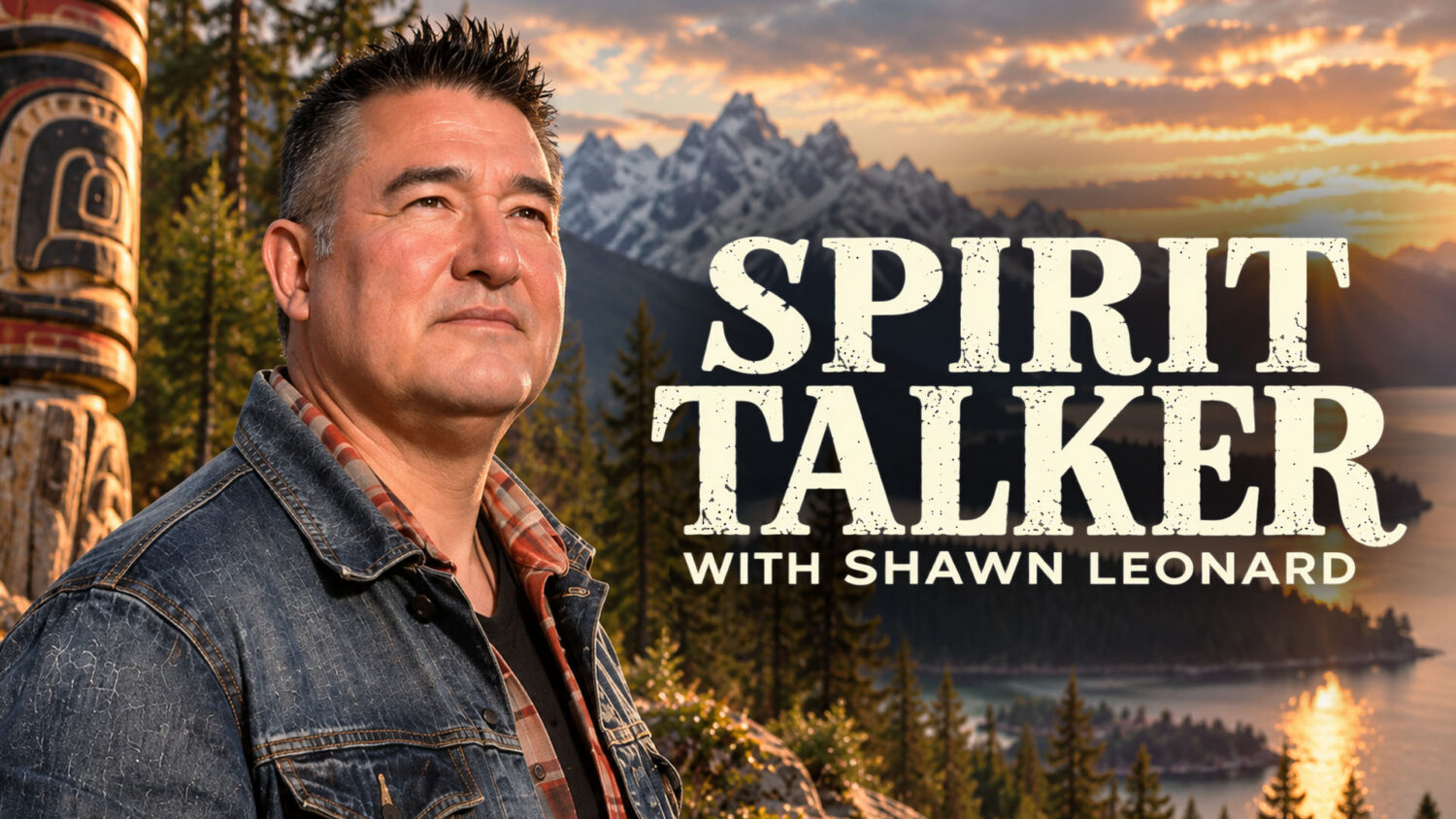
Most television about mediumship happens in a theater or a living room. Spirit Talker happens on a riverbank, in a canoe, at a sweat lodge, in a community hall after a feast. Shawn Leonard, a Mi’kmaw psychic medium from Nova Scotia, travels to First Nations communities across Atlantic Canada and Quebec, learns something of the culture in each place, and then sits with local families who hope to hear from someone they have lost. This review covers both seasons, walks through all thirteen Season 2 communities, looks at what repeats across the readings, and gives a fair view of how a skeptic and a believer might each watch it.
Key Takeaways
- What it is: a two season documentary series, thirteen episodes each, following Mi’kmaw medium Shawn Leonard as he reconnects with his culture and gives readings in First Nations communities.
- The format: every episode pairs a cultural experience (canoe building, moose hunting, eel spearing, a quilling lesson) with two or three readings for local families.
- The heart of it: forgiveness, released guilt, reassurance that loved ones are near, and a sense of belonging to a people and a place.
- Honest note: the series presents the readings as they happened and leaves the judgment to you. It is not a laboratory test of mediumship.
- Content note: some episodes deal with sudden death, addiction and suicide loss, told with care and no graphic detail.
- Where to watch: both seasons are available on Next Level Soul TV.
In This Guide
- What Is Spirit Talker?
- Meet Shawn Leonard
- How an Episode Works
- Season 1: A Journey Back to Culture
- Season 2: Episode by Episode
- The Culture on Screen
- What Repeats Across the Readings
- An Honest Look: Believers, Skeptics and the Edit
- A Note Before You Watch
- A Simple Practice After You Watch
- Who Will Connect with Spirit Talker
- Keep Exploring
- Frequently Asked Questions
What Is Spirit Talker?
Spirit Talker is a documentary series built on a plain idea. A man with a gift goes to the people who need to hear from someone they have lost, and he meets them where they live. Across two seasons and twenty six episodes, Shawn Leonard visits Mi’kmaw, Maliseet and Mi’gmaw communities from Newfoundland to Quebec, from Prince Edward Island to the shores of the Bay of Fundy.
Each episode opens with Shawn naming his purpose out loud. He calls himself a spirit talker, also known as a psychic medium. During a reading, he says, spirits communicate with him and he passes along their messages. Then the episode shows you what that looks like: the nerves in the room, the first small detail that lands, the pause, the tears, the laugh.
What sets it apart from other mediumship programs is where it puts its attention. The reading is one half of the story. The other half is the land, the language, the food, the crafts and the elders who keep them alive. Shawn is learning too. Many of the communities are new to him, and he says so.
Watch the season trailer:

Both seasons are available on Next Level Soul TV.
Meet Shawn Leonard
Shawn Leonard grew up on the Shubenacadie River in Nova Scotia and describes himself in the series as someone reconnecting with his Mi’kmaw roots as an adult. That is the emotional spine of the show. In Season 1 the synopsis frames the whole run as Shawn beginning his journey into reconnecting with his Mi’kmaw culture. By Season 2 he is still learning, still asking how to say a word, still being corrected with a smile.
He is easy company. He jokes with the families, admits when a symbol makes no sense to him, and tells people to say only yes or no while he works. He smudges before a reading to help the flow of spirit communication, and he talks about the creator and the ancestors without ceremony or fuss.
To hear him outside the series, listen to our conversation Spirit Talker: Insights from an Indigenous Psychic Medium with Shawn Leonard, and his later talk on totem animals and the spirit realm.
How an Episode Works
The structure is steady, and that steadiness is part of the comfort.
- The cold open. A short teaser of what is coming: a mother, a brother, a grandmother, and the community Shawn is visiting.
- The culture. Shawn spends time with an elder or craftsperson and learns something specific to that place.
- The readings. Two or three groups, usually family members who requested a session, sit down with Shawn for the first time.
- The return. Over the break, a thread from the first reading comes back, often with the sharpest message.
- The recap. Shawn names what each family received and what he took from the visit.
Many participants say, on camera, that they are skeptics or only half believers. A good number say they came because someone else in the family wanted to. The series lets them stay skeptical for a while. Then it lets you watch what happens.
Season 1: A Journey Back to Culture
The Season 1 synopsis lays out the route. It begins at Miawpukek First Nation, also called Conne River, in Newfoundland, Shawn’s ancestral home, where he watches a mother and daughter reunite and a grandmother’s message of hope reach a granddaughter.
The thirteen episodes then travel through:
- Episode 1: Miawpukek First Nation, Newfoundland
- Episode 2: Qalipu First Nation, Newfoundland, with a community drum circle
- Episode 3: Eskasoni First Nation, Cape Breton, Nova Scotia
- Episode 4: Membertou First Nation, Nova Scotia, and a sad chapter of the community’s history
- Episode 5: Elsipogtog First Nation, New Brunswick, and a sunrise ceremony on the ocean floor of the Bay of Fundy
- Episode 6: Listuguj Mi’gmaw First Nation, Quebec, and a community feast
- Episode 7: Halifax, Nova Scotia, and the Mi’kmaw settlement lost to the Halifax Explosion
- Episode 8: Tobique First Nation, New Brunswick, and the story of Malabeam
- Episode 9: Saint Mary’s First Nation, New Brunswick, and a medicine walk
- Episode 10: Acadia First Nation, Nova Scotia, on National Indigenous Peoples Day
- Episode 11: Bear River First Nation, Nova Scotia, harvesting sweetgrass on the Bay of Fundy
- Episode 12: Sipekne’katik First Nation, Nova Scotia, near the site of a former residential school
- Episode 13: Millbrook First Nation, Nova Scotia, with the Mi’kmaq Warriors lacrosse team
Season 1 sets the pattern. It also carries the series’ quiet weight: histories of loss that belong to whole communities, not only to families. The residential school episode and the Halifax Explosion episode ask you to hold personal grief and collective memory in the same room.
Season 2: Episode by Episode
Season 2 follows the same format and deepens it. These are the thirteen communities, with what each episode gives you. We name only the hosts, craftspeople and elders who appear on screen in a public role, and we leave the families’ private stories in their own hands.
Episode 1: Acadia First Nation, Wildcat, Nova Scotia
Shawn meets Todd and Melissa Labrador, a father and daughter who build birch bark canoes the traditional way. They are making a twenty one foot canoe from spruce root and bark. He paddles one, then visits petroglyphs in Kejimkujik National Park, where canoes, stars and a whale are carved in stone. The reading follows a family still carrying anger after a loss ten years earlier. The message that lands is about setting down resentment, in an image about poison and who it really harms.
Episode 2: Woodstock First Nation, New Brunswick
An elder shows Shawn the Meductic site, the old end of the portage path on the river, and he pauses to honor the spirits along the water. A sweat lodge keeper shows him arrowheads he has found along the riverbank. In the readings, a father reaches his daughter with a message of pride, and a grandmother who has always feared spirit learns she can let that fear go. A young spirit speaks to a brother he never knew in life.
Episode 3: Kingsclear First Nation, New Brunswick
A softball game opens the visit, then a basket maker teaches Shawn how to pound ash into splints. The central reading is the hardest in the season: a family still tormented by the night a loved one died and by what they believe they should have done. Shawn’s message to them is about release, and about the truth that nobody knew the whole story. In a second reading, a father tells his daughter that a recent visit was a real visit and no dream.
Episode 4: Metepenagiag First Nation, New Brunswick
Elder Betty Ward takes Shawn to the Augustine Mound, an ancient burial site, with tobacco and offerings. Later he fulfills a dream by fly fishing for salmon on the Miramichi. In the final reading, a grandmother from Maine tells her granddaughter, who is facing serious health challenges, that she is watching over her. Shawn’s closing note is practical: your words have power, and spirit may guide you to the right person or circumstance instead of fixing things directly.
Episode 5: Esgenoopetitj First Nation, New Brunswick
A coastal community, a young guide named Kyana, and a day of clam digging. A self described skeptic gets a reading she did not expect. A pregnant young woman hears about a baby with a strong spirit, which Shawn says is unlike anything he has felt before in a reading. It is an episode for anyone who thinks the other side cannot surprise Shawn.
Episode 6: Lennox Island First Nation, Prince Edward Island
Shawn crews on a lobster boat in the community food fishery, then shares the catch. An unplanned reading in an office catches him off guard, and he feels dizzy and off balance as a spirit gets his attention. A father and son connection is the emotional peak.
Episode 7: Eel Ground First Nation, New Brunswick
The Natoaganeg community lies on the Miramichi River, famous for salmon and good hunting grounds. Shawn gets up at four thirty to hunt moose with veteran hunters, does not catch one, and is cheerful about it. He learns to cook wild game at a community kitchen reclaiming food traditions. A family that waited thirty two years for a message finally gets one. A brother’s spirit also intervenes in a young woman’s story.
Episode 8: Potlotek First Nation, Nova Scotia
Potlotek is tied to the Mi’kmaw Grand Council and to Chapel Island nearby. Shawn goes back to school, in the form of a Mi’kmaq language lesson. A father tells his daughter to let go of guilt, and a respected chief praises his daughters for keeping his legacy. Shawn passes along the chief’s point that actions speak louder than words.
Episode 9: Wagmatcook First Nation, Cape Breton, Nova Scotia
Fiddler Morgan Toney and his band play for Shawn. Culture here comes through music and play. In the readings, a mother reaches out to her family, two brothers are reunited, and a mother’s message about the letters she left is handled with great sensitivity. Shawn says plainly that finding your spirit through culture is a powerful thing.
Episode 10: Waycobah First Nation, Nova Scotia
Shawn learns the many steps of quilling, a traditional art of decorating with porcupine quills. A mother’s spirit gives him an odd image of cloves, a first for him in a reading. A brother’s spirit revisits the accident that took his life, and a woman is told to stop worrying about being judged for what she has been through.
Episode 11: Paq’tnkek First Nation, Nova Scotia
Paq’tnkek means by the bay. Shawn goes eel fishing and learns to spear them, then tastes eel at a community feast with jingle dress dancers. A son tells his mother that being angry will not help him, and sisters find comfort in a group reading where a lost sister is laughing about a tattoo.
Episode 12: Pictou Landing First Nation, Nova Scotia
Michelle Francis-Denny leads a water healing ceremony at Boat Harbour, where people are working to heal waters damaged by decades of pulp mill pollution. The mill closed in early 2020. In the readings, a mother warns her daughter about repeating her mistakes, and the spirit of a gentle teenage son tells his mother that it was his time to go.
Episode 13: Glooscap First Nation, Nova Scotia
The season finale visits Blomidon and the landscape tied to the legend of Glooscap, said to rest and smoke his pipe in the clouds. A young woman learns that the pain passed through her family stops with her. A man who came as a last minute companion leaves with things he had not thought about in years.
The Culture on Screen
If you watch Spirit Talker only for the readings, you will miss half the work. The cultural scenes are not filler. They are how Shawn prepares and how the series explains why mediumship, for many Indigenous people, is an extension of ordinary relationship with ancestors.
- Birch bark canoes in Kejimkujik, and petroglyphs that carry stories carved in stone.
- Sweat lodges, smudging and tobacco offerings as ways of beginning in a good way.
- Basketry and quilling as living arts passed hand to hand.
- Eel spearing, moose hunting, clam digging and the lobster fishery as food, family and sovereignty.
- Music and play in the fiddle scenes at Wagmatcook, jingle dress dancing and softball.
- The Mi’kmaq language, heard in every opening and taught in a classroom scene.
The series also touches harder history: pollution that took a community’s waters, burial sites, the shadow of a residential school. These scenes are brief but real, and they give the readings their weight.
What Repeats Across the Readings
Watch enough episodes and patterns appear. They are worth noticing because they say something about what the series is really about.
Release from Guilt
Again and again, the loved one in spirit tells the living person that it was not their fault. Many of the families in Spirit Talker have carried a private question for years: could I have done something? The messages answer, over and over, with some version of: no, let that go.
Anger as a Weight
Several readings address resentment in families. In Season 2, Episode 1, the message uses a vivid image: holding anger is like taking poison and hoping someone else suffers. Whatever you believe about where the message comes from, it is sound human advice.
Small, Odd Details
Canned milk. A poodle. A fold up patio chair. Peanut butter cookies. A tooth that needs looking at. Shawn says he feels silly relaying them, and the families light up because the detail was private. Those moments are what make believers of some skeptics, and they are the strongest argument the series makes.
Signs That Someone Is Near
Feathers found by a child. The smell of a mother. A new bike showing up right after a reading mentions a bike. The series treats these as the quiet way the people we love remain present, and leaves the proof to you.
A Sense of Belonging
Shawn comes into each community as a Mi’kmaw man who is also an outsider. He says it feels good to be welcomed somewhere that is not his own. The message under the readings is that you belong to something larger than your own grief: a family line, a people, a place.
An Honest Look: Believers, Skeptics and the Edit
Spirit Talker is not a controlled experiment. It is a television series with an edit. Readings are cut for time. We see the moments that land and rarely the misses. If you are a skeptic, you will notice that, and you will also notice that Shawn asks leading yes or no questions. A fair viewer can hold both thoughts.
What the series does well is document what people say happened. Participants speak plainly about their doubt before and after. Some changed their mind. Others stayed on the fence. The program does not pressure you to join either camp, which is a rare courtesy in this genre.
Here is a simple frame we like for any reading, on screen or in life.
- Does the message bring comfort and clarity rather than fear?
- Does it respect your free will?
- Does it leave you more able to live your own life?
- Would you be comfortable if a trusted friend heard it too?
Real healing points you back to your own strength. The power to stay connected to the people you love was always within you. A medium, a series or a book can only remind you.
A Note Before You Watch
Several episodes deal with sudden death, addiction and the loss of someone to suicide. The series handles these with care and without graphic detail, but they can be heavy. Watch when you have room to feel something, and stop if you need to. If you are struggling or thinking about harming yourself, please reach out to a crisis line or a trusted person in your area right away.
A Simple Practice After You Watch
Pick one small thing, not all of them.
- Say a name. Sit for five minutes and say the name of someone you miss.
- Write the letter. Write to them what you wish you had said. You do not need to send it anywhere.
- Ask for a story. Call an older relative and ask about a person who has passed.
- Notice a sign. For one week, notice small things that remind you of them without forcing a meaning.
- Put down one weight. If a reading in the series spoke to your own guilt or anger, name it once, out loud, and let it go a little.
Who Will Connect with Spirit Talker
Seekers who are grieving and wondering about what comes next. Anyone drawn to how Indigenous traditions and mediumship meet, when the approach is respectful and led by someone from the culture. Viewers who like spiritual stories grounded in real people, real communities and real landscapes. And anyone who has ever wished for one more conversation.
If you prefer fast, flashy television, this will feel slow. That slowness is the point.
Hear Shawn Leonard in Conversation
Shawn has also sat down with Alex Ferrari on the Next Level Soul Podcast. In the first conversation he talks about what he sees coming for humanity. In the second he explains totem animals and clans.

Prefer to read or listen? Here are the full episode pages: Spirit Talker with Shawn Leonard and Totem Animals with Shawn Leonard.
Keep Exploring
If this series spoke to you, our guide to communicating with your spirit guides is a gentle next step. For another view of working with the other side, listen to Speaking and Releasing Stranded Spirits to the Other Side with Laura Warren.
For a structured path, the audio courses Mediumship Mastery, The Between and Becoming Clairvoyant are included with Next Level Soul membership. You can also join a free session with Nikki Dutta, a masterclass on mediumship.
Frequently Asked Questions
What is Spirit Talker?
Spirit Talker is a documentary series that follows Mi’kmaw psychic medium Shawn Leonard as he travels to First Nations communities, learns about their culture and gives readings for local families. It has two seasons of thirteen episodes each.
Who is Shawn Leonard?
Shawn Leonard is a Mi’kmaw psychic medium from Nova Scotia and the host of Spirit Talker. He describes himself as a spirit talker and says he is reconnecting with his Indigenous heritage through the series.
How many episodes and seasons are there?
There are two seasons with thirteen episodes each, twenty six in total. Season 1 begins in Newfoundland and Season 2 begins at Acadia First Nation in Nova Scotia.
Which communities does the series visit?
Season 1 visits Miawpukek, Qalipu, Eskasoni, Membertou, Elsipogtog, Listuguj, Halifax, Tobique, Saint Mary’s, Acadia, Bear River, Sipekne’katik and Millbrook. Season 2 visits Acadia, Woodstock, Kingsclear, Metepenagiag, Esgenoopetitj, Lennox Island, Eel Ground, Potlotek, Wagmatcook, Waycobah, Paq’tnkek, Pictou Landing and Glooscap.
Is Spirit Talker only about grief?
Grief is central, but the series is as much about culture, forgiveness and belonging. Each episode pairs the readings with a cultural experience such as canoe building, eel spearing or quilling.
Is the series real or staged?
The series presents the readings as they took place and shows participants speaking about their own doubts. As with any television edit, it shows selected moments. We suggest watching with an open mind and your own discernment.
Is it suitable for skeptics?
Yes. Many participants describe themselves as skeptics or fence sitters, and the series lets them voice that before and after the reading. You do not need to believe to appreciate the culture and the human stories.
Does Spirit Talker contain difficult subject matter?
Some episodes deal with sudden death, addiction and suicide loss. They are handled with care and no graphic detail. If you are struggling, please contact a crisis line or someone you trust.
Where can I watch Spirit Talker?
Spirit Talker is available on Next Level Soul TV. Watch Spirit Talker on Next Level Soul TV.