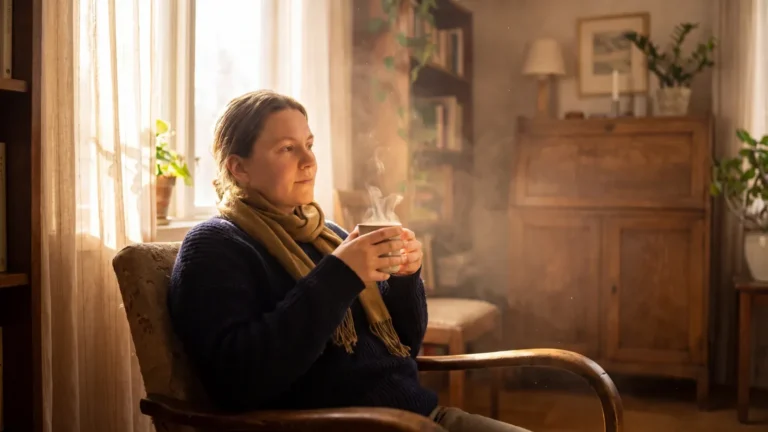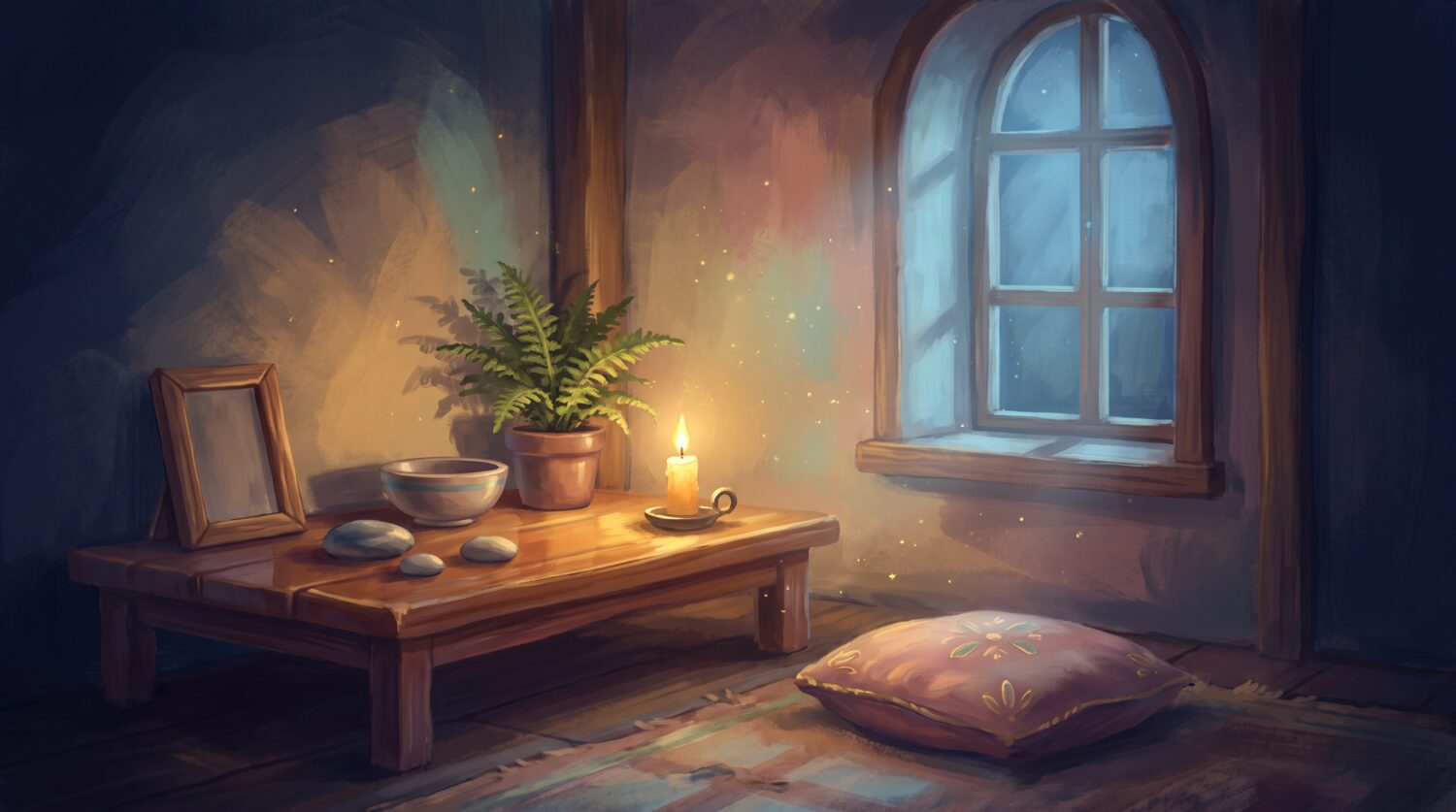
Maybe there is a chair in your home you keep walking past. Or a corner where the light lands just right in the late afternoon. You have never done anything with it, but you have noticed it. That noticing is the beginning of a sacred space.
A sacred space is a place you set aside, on purpose, to come back to yourself. It can be a whole room or a single shelf. It can hold a candle and a plant, or nothing but a cushion. This guide walks through what makes a space sacred, how to choose the spot, how to build a small altar, how to work with light, sound and scent safely, and how to keep it alive with simple daily and weekly rituals. We also cover small apartments, shared homes, travel altars, and the cleansing traditions people have used for centuries, described as traditions and nothing more. You do not need to buy a thing.
Key Takeaways
- A space becomes sacred through intention and repetition, not through expensive objects.
- Start with one small surface and a few things that mean something to you.
- Use light, sound and scent gently and safely. Never leave a flame unattended.
- A five-minute daily visit matters more than a perfect setup.
- Small homes, shared homes and travel all work. Portable is fine.
What Makes a Space Sacred
Walk into a church, a temple, or an old forest and your body often changes before your mind catches up. Your shoulders drop. Your voice softens. Nothing in the building told you to do that. The place was set apart, and people have gone there with reverence for a very long time.
You can bring that quality home. Almost every tradition agrees on the ingredients, even when the details differ: a place set apart, an intention behind it, and a habit of returning. Practitioners often say it is the returning that does the work. A corner you visit every morning begins to hold the feeling of those visits. Think of a path through a field. Nobody built it. It formed because people kept walking the same way.
Here is the grounding truth. The sacred does not live in the candle or the cushion. The power is within you, and the space simply gives it a place to be remembered. That means you cannot do this wrong. A kitchen windowsill with a stone and a cup of tea can be more sacred than an elaborate shrine nobody sits at.
Try this: Stand in each main room of your home for one slow breath. Notice where your body relaxes a little. Write down that spot. You are already learning where your space wants to be.
Choosing the Spot
You do not need a spare room. You need a place that is yours for ten minutes at a time. A few simple questions help you choose.
- Is it quiet enough? Look for a spot away from the television, the kitchen bustle and the front door.
- Does it have some natural light? A window nearby is lovely, because morning and evening light change the mood of the place without any effort from you.
- Can you sit comfortably? Room for a chair, a cushion or a yoga mat matters more than people expect.
- Can you leave it set up? A space you have to build from scratch each time is a space you will stop visiting.
- Does it feel right? Trust that. Your body knows things before your reasoning does.
Some people like to use feng shui ideas at this point. The tradition suggests placing a seat where you can see the door, with a solid wall behind you. Many people find that sitting with a view of the room feels settled. Others do not care. Treat these as ideas to try, not rules to obey. If you are curious, our conversation with Marie Diamond on feng shui is a good place to listen.
Do not let the search for the perfect spot become a way of not starting. Pick a good one. You can always move it. Plenty of people move their space two or three times before it settles, and each move teaches them something.
Try this: Choose your spot today. Put one object there that matters to you. That is a sacred space, already begun.
Building a Small Altar or Table
The word altar sounds heavy. In practice it means a surface where the things that matter to you are kept in view. A small table, a shelf, the top of a dresser, a tray you can carry from room to room. That is all.
What goes on it is yours to decide. Some common choices, and what people tend to love about them:
- A candle. A flame gives the eye something to rest on. Lighting it can become the signal that says, now I am here. (More on candle safety below.)
- A plant or fresh flowers. Something alive reminds you of growth and of the seasons. A cutting in a glass of water counts.
- Photographs. People often place pictures of loved ones, including ones who have passed, along with teachers and places that shaped them. Many traditions honor ancestors this way.
- Objects with meaning. A stone from a beach you loved, a feather, a shell, a child’s drawing, a ring, a note someone wrote you, a piece of cloth from your grandmother’s kitchen.
- A bowl or dish. For water, for salt, or simply to hold small things.
- Words. A line from a book, a prayer, a verse, or a few sentences you wrote yourself.
- A symbol of your path. A statue, a cross, a mala, a mandala, a sacred text, if that is your tradition. Or none of the above.
There is no pressure to buy anything. The best altars are mostly made of what you already own, which is exactly why they feel like yours. If you love crystals, wonderful. If you do not, nothing is missing. A sacred object is any object that opens your heart when you look at it. A chipped mug can qualify.
Keep it simple at first. Three to five items is plenty. A crowded altar can start to feel like another cluttered shelf. Leave some empty space, because the space itself says something too. Then let it change with the seasons, and keep what still works.
Try this: Gather five things from around your home that make you feel something. Place them on your surface and step back. Move one. Remove one. Stop when it feels quietly right.
Light, Sound and Scent
Your senses tell your body where it is. A few gentle choices can help your whole system understand that this corner is different from the rest of the house.
Light
Natural light is the gift to use first. Sit near a window at sunrise or at dusk and notice how different the room feels. For evenings, soft and warm beats bright and white. A small lamp, a string of warm lights, or candles do the job.
If you use real candles, set them on a steady, heat-safe surface, away from curtains, paper and anything that could catch. Keep them out of reach of children and pets, and never leave a flame unattended. If you share a home with small children, cats, or anyone who forgets, battery-operated candles are a perfectly good choice. The glow does the same thing for your eyes.
Sound
Silence is sound too, and many people find it the most powerful. If your home is noisy, a small fan, a soft recording of rain, or a simple piece of instrumental music can help soften the edges. Chimes, singing bowls, a small bell, or your own voice humming all work. Chanting and singing have a long history in nearly every spiritual tradition.
If you use sound to begin and end your sittings, one clear tone is enough. Many people strike a small bell once at the start and once at the end. It becomes a doorway in and a doorway out.
Scent and Safety
Scent can be a beautiful anchor, because smell connects strongly with memory. The same scent, used again and again in the same place, can become a cue that tells your body to settle. Common choices include incense, essential oil diffusers, simmer pots with herbs, or simply a sprig of rosemary or lavender.
A few safety notes, because they matter:
- Ventilate. Crack a window whenever you burn incense, herbs or resin. Smoke of any kind can irritate the lungs.
- Know who lives with you. People with asthma, allergies or sensitivities, people who are pregnant, babies, and pets can react to smoke and strong scents. Birds are especially sensitive. Essential oils can be harmful to cats and dogs. If you are unsure, skip scent or ask a doctor or vet.
- Keep it mild. A little goes a long way. If the scent gives you a headache, it is too much.
- Handle fire with care. Use a heat-safe holder, keep ash and embers contained, and make sure everything is fully out before you leave the room.
- Do not rely on scent for healing. It can support a mood. It is not a treatment.
Fresh air, a bowl of citrus peel, or a pot of tea on the altar makes a lovely scent-free option.
Try this: Pick one sense and add one gentle thing this week. A warm lamp, a single bell tone, or an open window at dawn. Notice how your body responds.
Clearing the Clutter
Clutter is rarely just objects. A pile of unopened mail carries a quiet message: you have things to do. A heap of clothes on the chair says the same. You do not have to turn your home into a showroom. You only need the area around your space to stop shouting.
- Clear the surface first. Remove everything from the spot you chose. Wipe it down. Begin with a clean slate.
- Clear a few feet around it. Move the laundry basket, the bills and the charging cords out of sight.
- Return only what belongs. Put back what serves the space. Everything else finds another home.
- Do one drawer or shelf a week. Slow clearing sticks. A weekend purge often returns in a month.
As you go, hold each item for a moment and ask whether it supports the life you want. You can thank an object for what it gave you and let it go. Plenty of people find that clearing a room clears something inside, too. If tears come, let them. If you enjoy books on this topic, the books section below lists two well-loved places to start.
Try this: Set a timer for ten minutes. Clear one surface near your space. Stop when the timer rings, even if you want to keep going.
Cleansing Traditions Around the World
People have been refreshing their living spaces for as long as there have been homes. Here are some of the best-known traditions. We describe them as traditions, not as proven techniques. Whether you find them meaningful is up to you.
- Smoke cleansing. Burning herbs or resins and moving the smoke through a room appears in many cultures. Smudging with sacred plants is a ceremonial practice among a number of Indigenous nations, and white sage in particular has been heavily overharvested. If you want to respect that, learn where your materials come from, buy from Indigenous-owned sources, or choose a different practice. Frankincense and myrrh are used in church and temple settings, and incense is part of many Buddhist and Hindu homes.
- Salt. Salt has been used across many cultures as a symbol of purity and protection. People sprinkle it in corners, set a bowl of it out, or use it in a floor wash.
- Sound. Bells, bowls, clapping and chanting are used in various traditions to mark a space or to bring a gathering together.
- Water. Sprinkling or washing with water, sometimes blessed or scented with herbs, is found in many religious traditions.
- Fresh air and open windows. Perhaps the oldest one of all. Spring cleaning with the windows thrown open is a practice found in households around the world.
- Prayer and blessing. Many families walk through a new home speaking a blessing. It costs nothing, and it works wherever you are.
What do these have in common? Attention. Someone slowed down, walked through the rooms, and meant it. Say out loud what you are doing and why. “I am clearing the stress of this week from this room and making space for rest.” Plain words are enough.
Take what resonates. Leave what does not. If a practice belongs to a culture that is not yours, learn about it with respect before you borrow it. A window, a broom and a sincere intention are available to everyone.
Try this: This weekend, open every window for ten minutes. Walk through your home slowly and state one intention for the coming week.
Daily and Weekly Rituals
A space only becomes sacred if you use it. The good news is that a ritual does not need to be long. It needs to be repeatable.
A Five-Minute Daily Visit
- Arrive. Pause at the edge of your space and take one slow breath.
- Light the candle or the lamp. Let that be the signal.
- Sit. Breathe naturally. Feel your feet and your seat.
- Offer something. A line of thanks, a prayer, a simple “help me with today,” or one thing you are grateful for. Our guide to the power of gratitude has simple ways to start.
- Close. Say thank you, put out the flame, and carry the stillness into your morning.
Some people prefer evenings. Others split it, with a quick hello in the morning and a longer visit at night. Choose the moment you will actually keep. If you are new to sitting in silence, a guided meditation can help. Acharya Shunya, one of our Mastery teachers, shares ancient meditation for inner stillness in her Mastery session.
A Weekly Reset
Once a week, give the space a little more attention. Dust it. Replace the flowers. Wash the dish. Read something that lifts you, or write in a journal for fifteen minutes. Look at the objects and ask whether each still belongs. Many people choose a Sunday evening to set the tone for the week ahead. When the seasons turn, rearrange the space too, so it never becomes wallpaper.
When You Miss a Day
You will. Everyone does. Come back without commentary. There is no scorecard in a sacred space.
Try this: Put a reminder on your phone for the same time every day this week. When it rings, give yourself five minutes. Notice what changes by Friday.
Small Apartments and Shared Homes
Not everyone has a quiet room to claim. If you live in a studio, with roommates, with a partner, or with children, you can still have a sacred space. It simply looks different.
If You Live in a Small Space
- Use vertical space. A floating shelf or the top of a bookcase works as an altar.
- Use a tray. Keep your items on a tray and carry it to a table or the floor when you want to sit. Put it away afterward.
- Use a corner. A cushion, a small lamp and a plant can quietly claim a few square feet.
- Use a box. A closed box with your candle, a stone and a notebook inside is a portable sanctuary.
- Use the windowsill. Light, air and a small view of the sky.
If You Share Your Home
Talk about it. A short, friendly conversation avoids a lot of confusion. Explain that you are setting up a small spot for rest and quiet, and ask for a few minutes of privacy. You do not need to defend your beliefs or convince anyone. If your household does not share your path, a simple, neutral setup, such as a lamp, a plant and a few pictures, keeps the peace.
Some families make a shared sacred space, where everyone adds something. A jar of gratitude notes, a bowl for family photos, a small table for holidays. Children often take to this naturally, and it gives them a place to bring big feelings. Keep flames safely out of reach.
If privacy is hard to come by, a sacred space can be a time, not a place. Take a walk each morning. Sit in your parked car for five minutes. Our guide to earthing and grounding explores another simple practice you can do just outside your door. The sacred travels with you.
Try this: Decide on a small portable altar today. A tray, a box or a scarf spread on a shelf. Gather three items and set it up.
Travel Altars
Travel pulls us out of our routines. A tiny traveling altar keeps one thread of the practice intact when everything else is unfamiliar. It also makes hotel rooms and guest rooms feel a little more like home.
Here is what many people pack:
- A small cloth or scarf to lay down as the base
- One photograph, printed small
- A stone or a shell that fits in a pocket
- A battery-operated tea light (open flames are often not allowed in hotels or on planes)
- A small notebook and pen
- A mala, a rosary, a prayer card or a token from your tradition
When you arrive, spread the cloth on the dresser or desk and set out your items. It takes under two minutes. Sit for your usual five. No supplies at all? Use what is there. A glass of water, a window with a view, a leaf you picked up outside. Open your eyes to what is in front of you.
Try this: Before your next trip, put your travel kit together in a small pouch. Keep it packed so it is always ready.
Books for Your Shelf
If you would like to read more, these are widely loved places to begin. Borrow them from the library if you like. None of them is required.
- Sacred Space by Denise Linn, on clearing and enhancing the energy of your home.
- The Life-Changing Magic of Tidying Up by Marie Kondo, a gentle approach to letting go.
- The Power of Ritual by Casper ter Kuile, on turning everyday habits into meaningful practice.
Looking for more reading? Our list of essential spiritual books is a good next stop, and our guide to spiritual enlightenment shows how a daily practice fits into a longer path.
Begin Where You Are
You do not need the right candle, the right corner or the right amount of time. You need a place, a few minutes and a willingness to show up. A sacred space is built one visit at a time, and it grows with you.
So start this week. Choose the spot. Clear the surface. Place one thing that matters. Sit for five minutes. Then do it again tomorrow. The quiet you are looking for has been waiting for you, and it does not need to be earned. When you want company on the path, Next Level Soul is a spiritual ecosystem of movies, teachings, meditations and community, with new content every week.
Frequently Asked Questions
What Is a Sacred Space?
A sacred space is a place you set aside on purpose for rest, reflection, prayer or meditation. It can be a corner, a shelf, a whole room, or even a tray you carry from place to place. What makes it sacred is your intention and the habit of returning.
Do I Need an Altar?
No. An altar is just a surface where meaningful things are kept in view. Many people use a windowsill, a shelf or a small table. If you prefer an empty corner with a cushion, that works too.
Where Is the Best Place for a Sacred Space at Home?
Choose a quiet spot with some natural light where you can sit comfortably and leave your things set up. The best place is the one that feels peaceful to you. You can move it later if it does not suit you.
What Should I Put on a Home Altar?
Common items include a candle, a plant or flowers, photographs of loved ones, a stone or shell, a meaningful keepsake, and a line of text or prayer. Start with three to five things and add or remove them as it feels right. You do not need to buy anything.
Is It Safe to Burn Candles, Incense or Sage?
It can be if you take care. Use a heat-safe holder, keep flames away from anything flammable, never leave them unattended, and ventilate the room. People with asthma or allergies, pregnant people, babies and pets may react to smoke and scent, so battery candles and fresh air are good alternatives.
How Do I Create a Sacred Space in a Small Apartment?
Use a shelf, a windowsill or a tray that you can set out and put away. A corner with a cushion, a lamp and a plant is enough. A box holding a few meaningful objects also works well as a portable sanctuary.
How Often Should I Cleanse or Reset My Space?
Many people do a light reset weekly by dusting, refreshing flowers and opening windows, and a bigger refresh when the seasons change. There is no set schedule. Reset it whenever the space starts to feel stale or cluttered.
Can I Share a Sacred Space With Family or Roommates?
Yes. You can set up a neutral spot, such as a lamp, a plant and some photographs, or create a shared family altar where everyone adds something. A short, friendly talk about privacy and quiet time helps everyone feel comfortable.
Do I Have to Follow a Particular Religion or Tradition?
No. A sacred space can reflect any faith or no faith at all. If you borrow from a tradition that is not yours, learn about it first and treat it with respect.
How Long Should I Sit in My Sacred Space Each Day?
Five minutes is a good start. A short visit you keep is worth more than a long one you skip. You can lengthen your time as the habit settles in.