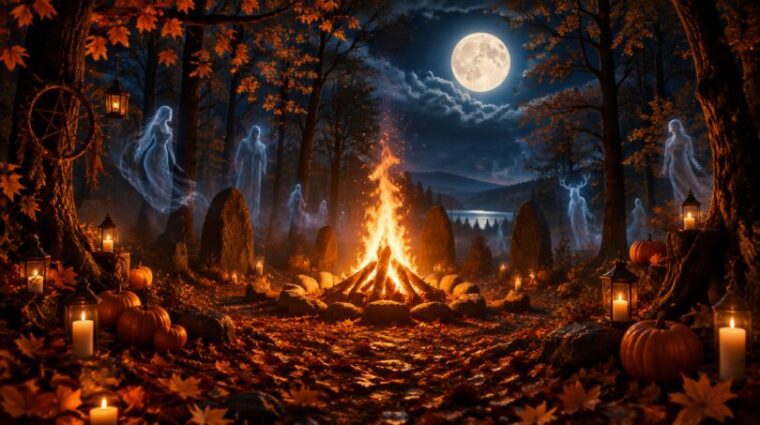
Samhain (pronounced SOW-in) is the ancient Gaelic festival that marks the end of the harvest and the beginning of the dark half of the year. It is celebrated from the evening of October 31 to November 1, and for thousands of years it has been remembered as the time when the veil between the living and the dead grows thin. People honor their ancestors, light fires and candles, and make space for rest, release and remembrance.
This guide explains what Samhain means, where it came from, how it differs from Halloween, the Day of the Dead and All Souls Day, and how to keep it in a simple, grounded way at home. It also shares what Next Level Soul guests say about the thin veil, contact with loved ones and staying protected. If you would like to go deeper on each thread, the links throughout lead to our companion guides on the thin veil, the ancestor altar, the Wheel of the Year and more.
Key Takeaways
- What it is. The Gaelic festival of the end of harvest and the start of winter, kept from sunset on October 31 through November 1.
- What it means. A sacred threshold. Summer ends, the light shortens, and many traditions say the boundary between this world and the next becomes easier to cross.
- Where it came from. Early Irish literature describes Samhain as one of four great seasonal festivals, with bonfires, feasting and offerings to the dead. Many Halloween customs trace back to it.
- How people keep it. Ancestor altars, candles, a dumb supper, journaling, meditation, gentle divination and a calm cleansing of the home.
- Stay grounded. Samhain is about honoring and releasing, not summoning. Protection begins with a clear, steady, loving intention.
- Samhain 2026. It begins at sunset on Saturday, October 31, 2026. In the Southern Hemisphere it is kept around April 30 to May 1.
What Is Samhain?
Samhain is a Gaelic festival that marks the end of the harvest season and the start of winter. The name comes from the Old Irish Samain, and it is usually linked to words meaning “summer’s end.” In Irish the name is pronounced roughly “SOW-in,” with the first syllable rhyming with “cow.”
It is one of four seasonal festivals in the old Gaelic year. The others are Imbolc in early February, Beltane in early May and Lughnasadh in early August. Of the four, Samhain was the great turning point. The cattle came down from summer pasture, the last crops were gathered, and the community faced the long dark together. Early Irish stories describe it as a time of feasting, assembly, fire and wonder, when the ordinary rules of the world loosened.
In the Celtic understanding of time, the day often began at sunset rather than at dawn. That is why Samhain is kept on the evening of October 31, and why the night comes first and the day follows. Darkness is where the new cycle begins, the way a seed rests in the soil before it grows.
How Do You Pronounce Samhain?
The most common pronunciation in English is “SAH-win” or “SOW-in.” In modern Irish it is closer to “SOW-in” with a soft, rounded ending, and in Scottish Gaelic the festival is called Samhuinn. Any of these is fine. What matters more than the sound is the intention behind it.
When Is Samhain?
Samhain is traditionally kept from sunset on October 31 through November 1 in the Northern Hemisphere. Some modern practitioners follow the astronomical midpoint between the autumn equinox and the winter solstice, which falls in early November. In the Southern Hemisphere, where the seasons are reversed, Samhain is kept around April 30 to May 1.
| Year | Samhain begins (Northern Hemisphere) | Day of the week |
|---|---|---|
| 2026 | Sunset, October 31 | Saturday |
| 2027 | Sunset, October 31 | Sunday |
| 2028 | Sunset, October 31 | Tuesday |
What Does Samhain Mean Spiritually?
Spiritually, Samhain is the festival of thresholds. It sits between light and dark, summer and winter, the living and the dead, what has finished and what has not yet begun. Many people experience it as a natural moment to pause and ask three questions: what am I ready to release, who am I ready to remember, and what do I want to plant in the quiet of winter?
In this view, endings are not failures. They are part of the rhythm that keeps life moving. The harvest is brought in so that rest can come. The leaves fall so that roots can deepen. The same law runs through the soul’s own story, and it is why Samhain feels so natural to people who are already walking a path of rebirth and return.
It is also a festival of love. The ancestors are not feared in the older traditions. They are welcomed, fed and thanked. A place is set for them at the table, a candle is lit in the window, and their names are spoken aloud. Remembering the dead is one of the oldest ways people have kept the human family whole.
The Three Gifts of Samhain
- Remembrance. Honoring the ancestors and loved ones who have crossed over.
- Release. Letting go of habits, grudges and stories that no longer serve your growth.
- Rest. Turning inward as the year darkens, trusting that stillness is productive.
The History of Samhain
The earliest written descriptions of Samhain come from medieval Irish manuscripts, which preserve much older oral tradition. They portray it as a major gathering time, tied to the royal assemblies at sites such as Tara and Tlachtga, with bonfires on the hills, feasting, and the sense that otherworld doors stood open. Scholars note that the manuscripts were written by Christian monks, so the picture we have is filtered through later eyes, but the central themes of fire, feast, boundary and the dead are consistent.
Folk customs recorded in Ireland, Scotland, Wales and the Isle of Man into the nineteenth and twentieth centuries preserve echoes of the old festival. Households let their hearth fires die and relit them from a communal bonfire. People left food and drink out for visiting spirits. Young people dressed in disguise, a practice known as guising, and went from house to house. Divination games, especially around love and marriage, were popular on the night.
How Samhain Met the Christian Calendar
The Christian church honors the saints on November 1 (All Saints’ Day) and the faithful departed on November 2 (All Souls’ Day). The evening before All Saints, All Hallows’ Eve, became Hallowe’en. Historians debate how directly the Christian dates were shaped by Samhain, but the overlap in timing, in themes of remembrance, and in customs such as soul cakes and lighted candles is hard to miss. Our guide to All Souls Day follows that thread in full.
The Modern Revival
In the twentieth century, Neopagan and Wiccan communities adopted Samhain as one of eight festivals in what is now called the Wheel of the Year. Many people today keep Samhain as a personal spiritual practice without belonging to any one tradition. They light a candle, write to a loved one, set a place at the table, or sit quietly and listen. That is enough. The festival works through sincerity, not through perfect form.
Samhain vs Halloween vs Day of the Dead vs All Souls Day
These four observances fall at the same time of year and share the theme of honoring the dead, but they have different roots and feel quite different in practice.
| Observance | Origin | Dates | Spirit of the day |
|---|---|---|---|
| Samhain | Gaelic, pre-Christian seasonal festival | Oct 31 sunset to Nov 1 | Threshold, ancestors, release, rest |
| Halloween | Christian eve of All Saints, with Gaelic folk customs | Oct 31 | Costumes, play, candy, playful fear |
| Day of the Dead (Día de Muertos) | Mexican tradition blending Indigenous and Catholic roots | Nov 1 to 2 | Joyful reunion with the departed, ofrendas, marigolds |
| All Souls Day | Catholic day of prayer for the faithful departed | Nov 2 | Prayer, remembrance, cemetery visits |
If you are drawn to the Mexican celebration, read our guide to the meaning of the Day of the Dead, which treats the tradition with the respect it deserves. It is a living cultural and family practice, not a costume theme, and it is different from Samhain even though both honor those who have gone before.
Why Is the Veil Said to Be Thin at Samhain?
Across cultures, people have described a sense that the border between the seen and unseen worlds is not fixed. It moves. It thins in certain places, at certain hours and in certain seasons. Samhain is the season most famous for it, which is why so many people report vivid dreams, a feeling of presence, or sudden memories of loved ones at the end of October. Our full guide to what “the veil is thin” means explores the idea in depth.
There are a few ways to understand why this might be so. None needs to be treated as the only answer, and they can sit together.
The Season Itself Is a Teacher
Nature is visibly dying back at Samhain. The days shorten, the leaves fall and the land goes quiet. Our own attention turns inward, and when attention turns inward, intuition tends to grow louder. People who are paying close attention to endings are more likely to notice the subtle signs that love continues.
Collective Remembrance Builds a Field
Millions of people turn their thoughts to the dead at the same time of year. In the spiritual view, shared intention is a force. When a whole culture lights candles and speaks names aloud, the atmosphere changes. Many mediums say the work feels different in late October and early November, as if the doorway had been propped open by the sheer weight of remembrance.
What Next Level Soul Guests Say
Our guests describe the other side as close, not far. Hospice nurse Julie McFadden says that dying people often see loved ones, pets or spiritual figures, sometimes weeks before death and with a clear mind. Dr. Spirit Sunshine Frost says that when she nearly died at 17 she was shown two timelines and told she had a gift to give the world. Watch the full episodes with Julie McFadden and Dr. Spirit Sunshine Frost.
Scholar Dr. Greg Shushan offers a wider lens on how ancient peoples saw death. In his NLS conversation he says that, as an Egyptologist, he noticed that texts such as the Pyramid Texts echo near-death accounts: leaving the body, passing through darkness, meeting light and reviewing a life. He says afterlife traditions around the world share a common core, with each culture shaping the details. His account is his own, shared in his own words, and it sits well beside the old Celtic view that death is a passage and not an ending. Watch the full episode and read the show notes.
Samhain and the Wheel of the Year
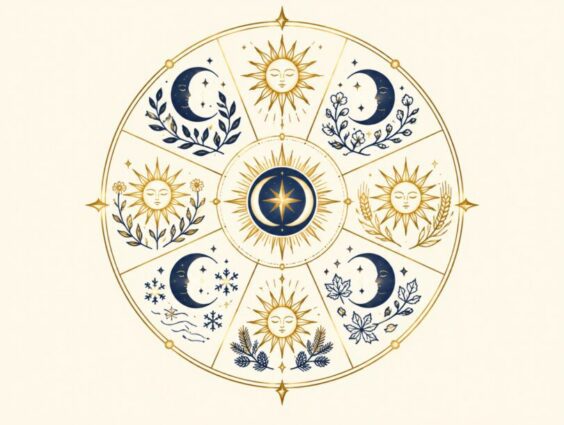
In modern Pagan and Wiccan practice, Samhain is one of eight festivals that make up the Wheel of the Year. Four are solar (the solstices and equinoxes) and four are the older Gaelic cross-quarter fires. Samhain is often called the Witches’ New Year because it opens the dark half of the cycle.
| Festival | Approximate date (Northern Hemisphere) | Season and theme |
|---|---|---|
| Samhain | Oct 31 to Nov 1 | Endings, ancestors, the thin veil |
| Yule (Winter Solstice) | Dec 21 | Rebirth of the light |
| Imbolc | Feb 1 to 2 | First stirrings, purification |
| Ostara (Spring Equinox) | Mar 20 | Balance, new growth |
| Beltane | Apr 30 to May 1 | Fertility, fire, joy |
| Litha (Summer Solstice) | Jun 21 | Peak of the light |
| Lughnasadh | Aug 1 | First harvest, gratitude |
| Mabon (Autumn Equinox) | Sep 22 to 23 | Second harvest, balance |
Seeing Samhain inside the whole wheel helps it make sense. It is not a stand-alone spooky night. It is the doorway between the gathered light of the year and the deep winter work of the soul. Our guide to the Wheel of the Year and the pagan holidays walks through each festival and how to keep it.
How to Celebrate Samhain: 12 Simple Practices
You do not need special tools, a coven or a perfect setup. Choose the practices that feel true to you, and begin small. A single candle and a few honest minutes can carry real power.
1. Build an Ancestor Altar
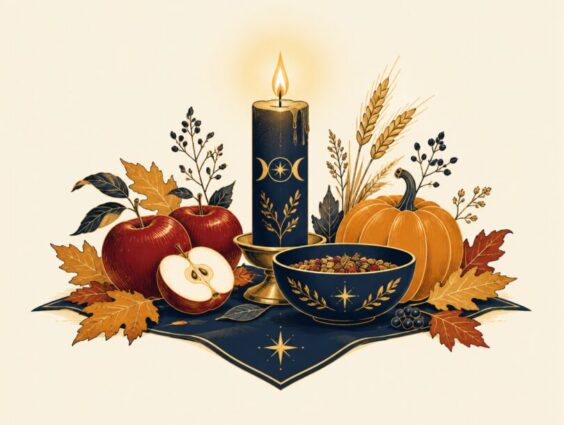
Place photographs, keepsakes and symbols of those you wish to remember on a shelf, table or windowsill. Add a candle, a glass of water, a small plate of food they loved and something from the season, such as apples or fallen leaves. Speak each name aloud. Our guide to the ancestor altar and the dumb supper includes a full layout and a gentle script.
2. Hold a Dumb Supper
The dumb supper is a quiet meal, eaten in silence or near-silence, with a place set for the departed. Plates are served to the living and the dead, and the meal ends with thanks. It is a simple way to make the invisible guests welcome.
3. Light a Fire or a Candle
Fire sits at the heart of Samhain. If you have a safe outdoor fire pit, gather there. If not, a single candle in a window works beautifully. Let the flame stand for the light that does not go out, and sit with it for a few minutes while you remember.
4. Write a Letter to a Loved One
Write what you wish you had said, what you are grateful for and what you want them to know about your life now. Read it aloud, then keep it on your altar or burn it safely in a fireproof dish as a symbol of release.
5. Release What You Are Ready to Release
Write on small slips of paper the habits, fears or old stories you are ready to let go of. Place them in a bowl and burn or bury them with thanks for what they taught you. This is the “Release” in the Three Gifts, and it pairs well with the quiet of the season.
6. Practice Forgiveness
Animal communicator Karen Anderson says that holding on to guilt over a loved one’s final moments is unnecessary, because in her experience animals simply do not see it that way. Dr. Spirit Sunshine Frost says her message from her near-death experience is to love yourself, love others and find purpose by serving. Samhain is a fitting time to forgive a person, a situation or yourself. Forgiveness does not excuse harm. It frees you from carrying it.
7. Sit in Meditation
Choose a quiet corner and set a timer for ten to twenty minutes. Breathe slowly and let your attention rest on your heart. Ask silently, “Is there anything I am meant to know?” and let whatever arises come without forcing it. If you are new to the practice, our glossary entry on meditation is a good place to begin.
8. Cleanse and Bless Your Space
Open a window, tidy the room, and use smoke, sound or simple intention to clear the air. Many people use sage, cedar or palo santo, and others use a bell or a bowl of salted water. Our guide to smudging explains how to do it respectfully and safely, and our piece on creating a sacred space at home offers a calm setup.
9. Walk in Nature
Go outside at dusk. Notice the cold, the stillness, the bare branches and the way the light changes. Bring home a leaf, acorn or stone for your altar. Walking slowly in the season is itself a ritual, a way of letting the year teach you.
10. Pay Attention to Dreams
Keep a notebook by your bed in the week around Samhain. Many people report vivid dreams of loved ones during this window. Write them down without analyzing them, then look back after a few days for patterns. Our guide to lucid dreaming offers ways to work with the dream state.
11. Try Gentle Divination
Samhain has long been a night for asking questions. Pull a single card from a tarot or oracle deck, or open a favorite book at random and read the first line you see. Treat the answer as a conversation starter with your own intuition, not a command. For our guidance on spirit boards, read the safety notes in our guide to the Ouija board first.
12. Honor the Living and the Dying
Samhain is also about those still here. Call an elder. Visit someone who is ill. Hospice nurse Julie McFadden says that years at the bedside showed her how death denying our culture is, and that doing less at the very end often looks more peaceful. Her NLS episode on what happens moments before we die is a tender listen for anyone who has lost someone or supports someone who is dying.
What to Put on a Samhain Altar
A Samhain altar is a small, tended place of remembrance. There is no required list. Choose items that carry meaning for you, and keep the arrangement simple enough that you can tend it each day through the season.
| Item | What it represents | Easy substitute |
|---|---|---|
| Photographs of loved ones | The people you are honoring | A handwritten name on a card |
| White or black candle | The light that continues through the dark | Any candle or a safe LED light |
| Water | Purity, memory and a welcome drink for visitors | A small glass of clean water |
| Apples, pumpkins, nuts, grain | The final harvest and the cycle of life | Any seasonal fruit or bread |
| Favorite food or drink of the departed | A gesture of love and hospitality | A cookie, a coffee, a sweet |
| Fallen leaves, acorns, bones of the season | Nature’s letting go | Leaves from your yard or a walk |
| Marigolds or chrysanthemums | Remembrance and the path home | Any fresh flowers |
| Journal or paper and pen | A place to write letters and intentions | Your phone’s notes app |
Clear space around the altar, add something that smells of the season if you like, and give it a quiet corner where you will see it often. When Samhain ends, thank the ancestors for visiting, blow out the candle, and return the food to the earth.
A Simple 20-Minute Samhain Ritual
If you would like a gentle structure, here is a short ritual you can do alone, with a partner or with your family. Read it through once before you begin.
- Prepare. Tidy the space, silence your phone and set out your candle, a bowl or dish, paper and a pen.
- Ground. Sit comfortably. Take five slow breaths. Feel your feet on the floor and your weight in the chair.
- Light the candle. Say aloud, “I light this flame for love that does not end.”
- Call the names. Speak the names of those you are honoring. Pause after each one and let a memory rise.
- Offer thanks. Say what you are grateful to each person for. Keep it simple and sincere.
- Release. Write one thing you are ready to let go of. Burn it safely or tear it up and place it in the bowl.
- Listen. Sit in silence for five minutes. Notice thoughts, feelings, images or sensations without chasing them.
- Close. Say, “Thank you for being with me. Go in peace, and may we meet again in love.” Blow out the candle.
- Ground again. Drink a glass of water, eat something warm and write down anything you noticed.
Staying Protected and Grounded at Samhain
Because Samhain is linked with the thin veil, many people wonder about protection. The most important point is that Samhain is about honoring and releasing, not about summoning or provoking anything. The tone you set at the start shapes the whole experience.
Terry Yoder, who shared his near-death story on Next Level Soul, says that after his experience a guide told him to resist a negative force. He describes a simple routine for moments of heaviness: stop, speak a firm prayer, then meditate on white and golden light. You can hear him explain it in his episode on leaving his body at 14. His approach fits the heart of Samhain well: come with love, clear intention and a calm mind, and you set the terms.
Practical Grounding Tips
- Set an intention aloud. For example, “I welcome only loving presence, and I close this space when I am finished.”
- Keep your body steady. Eat, drink water and sleep. Fatigue and hunger blur discernment.
- Avoid alcohol and drugs during spiritual work. A clear mind is your best protection.
- Choose sacred over sensational. A candle and a quiet heart are better than provoking tools. See our notes on the Ouija board and on safe spirit communication.
- Close the ritual. Always say thank you and farewell, then ground with water, food and fresh air.
- Know when to ask for help. If you feel distressed, frightened or unwell, reach out to a trusted friend, a counselor or a healthcare provider. Spiritual practice is a complement to care, not a replacement for it.
Can You Feel Loved Ones Near You at Samhain?
Many people say yes. They describe a familiar scent, a warmth in the room, a song that arrives at exactly the right moment, a dream that feels more real than a dream, or an unmistakable sense of presence. Whether you hold these as messages, memories or both, they are meaningful. Our guide to the signs from deceased loved ones lists the most commonly reported ones, and our piece on signs of a ghost or lingering presence helps tell comfort from concern.
Psychic medium Nicky Alan describes a family line of mediums and a childhood of seeing white light. Medium Jennifer Rose explains how she says spirit blends with her awareness and how to trust what you receive. Listen to Nicky Alan and Jennifer Rose to hear how two mediums describe the experience in their own words.
What About a Seance?
A seance done with care is not about summoning spirits but about making a steady, loving place. Medium Isabeau Maxwell says she uses a practice called ground, clear, protect to stay steady when she works with spirit. That fits the spirit of Samhain: you are not dragging anyone anywhere, you are making a lit place where connection may arise if it is meant to. If you are curious, begin with a simple remembrance circle at home before considering anything more formal, and work with an ethical, experienced medium if you want a reading.
Samhain for Every Path
If You Are Christian or Come From a Church Background
You can honor the day without leaving your faith. All Saints’ Day and All Souls’ Day carry the same themes of remembrance and prayer. Lighting a candle for the departed, visiting a grave and saying their names are all fitting. Many people find that Samhain deepens, rather than competes with, their own tradition.
If You Have Children
Keep it warm and simple. Share stories about grandparents, bake a favorite recipe, light a candle at dinner and let children draw pictures for the altar. Explain that remembering someone is a way of keeping them near. Dressing up and trick-or-treating can sit happily alongside it.
If You Practice Alone
Solitary practice is very much in the spirit of the season. Pick one or two practices from the list above and make them yours. A walk, a candle and a letter are enough.
If You Are Grieving
Be gentle with yourself. Samhain can bring grief closer to the surface, which is natural. Light a candle, say their name, and let the tears come if they need to. If grief feels too heavy to carry alone, speak with a counselor, a grief support group or a trusted friend. Amber Kasic says that in the hours before her father’s last breath in a hospice bed she felt a force move through her chest, down her arm and into his hand, and she describes it as a sign that love never dies. Her story may bring comfort to those who fear a loved one went without company. Hear her story.
Common Misconceptions About Samhain
- “Samhain is the Celtic god of death.” This is a modern myth. Samhain is the name of a festival and a season, not a deity.
- “Samhain is satanic.” Samhain has no connection to Satan. It is a seasonal festival of harvest, ancestors and the turning of the year.
- “It is the same as Halloween.” The two overlap in date and share customs, but Halloween grew through Christian and folk traditions and has a playful, popular character of its own.
- “You must be Pagan to celebrate.” Anyone can honor their ancestors and the turning of the season with respect.
- “It is only about fear.” The older customs center on love, hospitality and remembrance. The fear is mostly a modern costume.
Samhain Journal Prompts
- Who am I remembering this year, and what did they teach me?
- What is ending in my life that I have been resisting?
- What am I ready to forgive, in myself or someone else?
- What do I want to carry into the winter, and what do I want to leave at the door?
- If a loved one could speak to me now, what would I hope they would say?
- What small seed do I want to plant for the coming year?
Watch: Conversations on the Veil, Ancient Beliefs and Protection
These Next Level Soul guests speak to the heart of Samhain: how ancient cultures saw death, journeys to the edge of the veil, and staying protected.
Dr. Greg Shushan: The Origins of Afterlife Beliefs
Scholar Dr. Greg Shushan compares afterlife beliefs and near-death accounts across ancient Egypt, India, China, Mesopotamia and indigenous societies, and shares what repeats and what changes with culture. Watch the full episode and read the show notes.

Dr. Spirit Sunshine Frost: One Month Beyond the Veil
Dr. Spirit Sunshine Frost shares what she says happened when she collapsed at 17: a luminous guide, two timelines and a message that she had a gift to give the world. Watch the full episode and read the show notes.

Terry Yoder: He Left His Body at 14 and Heard a Voice Say Let Go
Terry Yoder says he left his body at 14 and heard a voice urging him to let go. He also shares a simple routine for moments of heaviness: a firm prayer, then white and golden light. Watch the full episode and read the show notes.

Watch More on Next Level Soul TV
Next Level Soul TV has films and episodes on witchcraft history and the afterlife, including The Souls of the Salem Witches with Marie Manuchehri and Ghosts and the Afterlife. Join Next Level Soul TV and keep exploring through the long nights of winter.
Go Deeper with Next Level Soul
- What “The Veil Is Thin” Means
- Ancestor Altar and the Dumb Supper
- The Wheel of the Year and Pagan Holidays
- Day of the Dead Meaning and All Souls Day
- Are Ghosts Real?, Ghost Signs and Spirit Communication
- Smudging: How to Cleanse a Space and The Ouija Board
- Near-Death Experiences: The Complete Guide
- Mediumship, Afterlife and Reincarnation in the glossary
- The full spiritual glossary
Sources and Further Reading
Spirituality for the Rest of Us™
Films, teachings and community on Next Level Soul TV.
Go Deeper with NLS Mastery: Beyond the Veil
A grounded exploration of what lies beyond death and how that understanding changes how we live. Julie Ryan teaches it in Beyond the Veil, part of NLS Mastery. Watch the course preview below.
Frequently Asked Questions
What is Samhain in simple terms?
Samhain is the ancient Gaelic festival that marks the end of the harvest and the start of winter. It is kept from sunset on October 31 through November 1, and it is traditionally a time to honor ancestors, light fires and candles, and reflect on endings and new beginnings.
How do you pronounce Samhain?
The most common pronunciations are “SOW-in” (the first syllable rhymes with “cow”) and “SAH-win.” In Scottish Gaelic the festival is called Samhuinn. Any of these is acceptable when the intention is respectful.
When is Samhain in 2026?
Samhain begins at sunset on Saturday, October 31, 2026, and runs through November 1. Some practitioners keep the astronomical midpoint between the autumn equinox and the winter solstice, which falls in early November. In the Southern Hemisphere it is kept around April 30 to May 1.
What does Samhain mean spiritually?
Spiritually, Samhain is a festival of thresholds. It honors endings, the ancestors and the thin boundary between the living and the dead, and it invites remembrance, release and rest as the year darkens.
Is Samhain the same as Halloween?
No. They share a date and many customs, but Samhain is a pre-Christian Gaelic seasonal festival, while Halloween grew from the Christian eve of All Saints with Gaelic folk traditions mixed in. Halloween today is playful and popular, and Samhain is quieter and more reflective.
Is Samhain the same as the Day of the Dead?
No. The Day of the Dead (Día de Muertos) is a Mexican tradition with Indigenous and Catholic roots, celebrated November 1 to 2 with ofrendas and marigolds. Both honor the dead, but they come from different cultures. Read our guide to the meaning of the Day of the Dead.
Why is the veil said to be thin at Samhain?
Many traditions teach that the boundary between worlds is easiest to cross when the year turns from light to dark. Others point to the inward mood of the season and the collective remembrance of the dead. See our guide to what “the veil is thin” means.
How do I celebrate Samhain at home?
Light a candle, build a small ancestor altar, speak the names of loved ones, write a letter or a release list, and sit in quiet meditation. A dumb supper, a walk at dusk and a gentle cleansing of your space are other simple options. Our ancestor altar guide shows one way to begin.
What should I put on a Samhain altar?
Photographs of loved ones, a candle, a glass of water, seasonal fruit or grain, a favorite food of the departed, fallen leaves and flowers such as marigolds or chrysanthemums. Keep it simple and personal.
Is it safe to contact spirits at Samhain?
Samhain is best approached as a time of honoring, not summoning. Come with a calm mind and loving intention, avoid provoking tools, and close your practice with thanks. Terry Yoder describes a simple routine for moments of heaviness: stop, speak a firm prayer, then meditate on white and golden light. If you feel distressed, reach out to a trusted person or a healthcare provider. See our guide to spirit communication.
Do you have to be Pagan to celebrate Samhain?
No. Anyone can honor their ancestors and the turning of the season with respect. People of many faiths and of no formal tradition light candles, share stories and remember the departed at this time of year.
What does the Celtic tradition say about death?
Early Gaelic traditions treated death as a passage, with the otherworld close at hand. Scholar Dr. Greg Shushan compares afterlife beliefs across ancient cultures and finds shared themes of leaving the body, light and a review of life. Watch his NLS episode on the origins of afterlife beliefs.