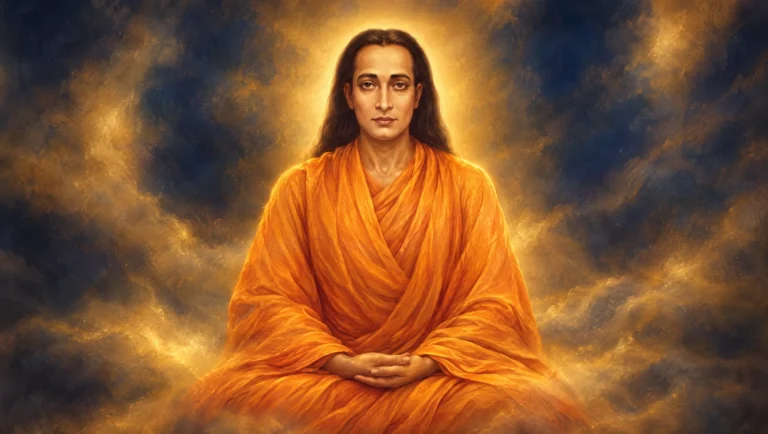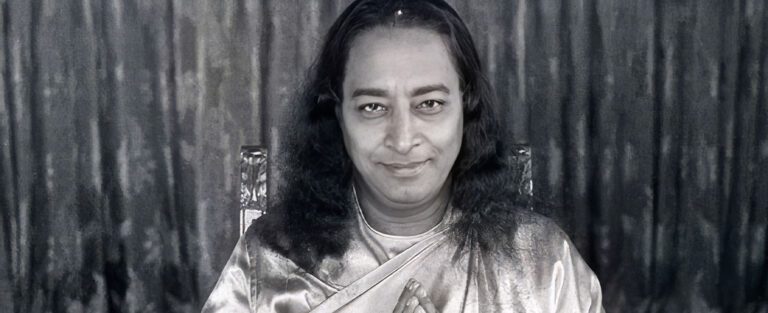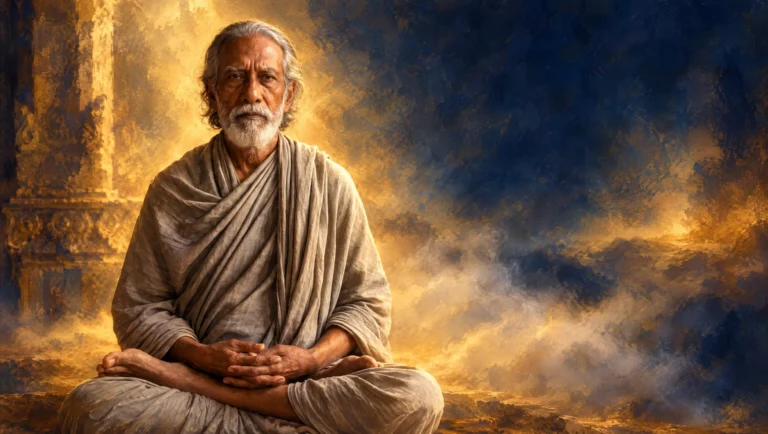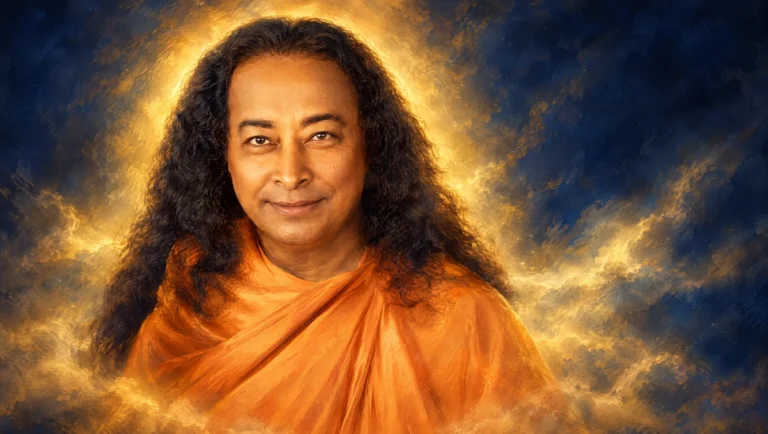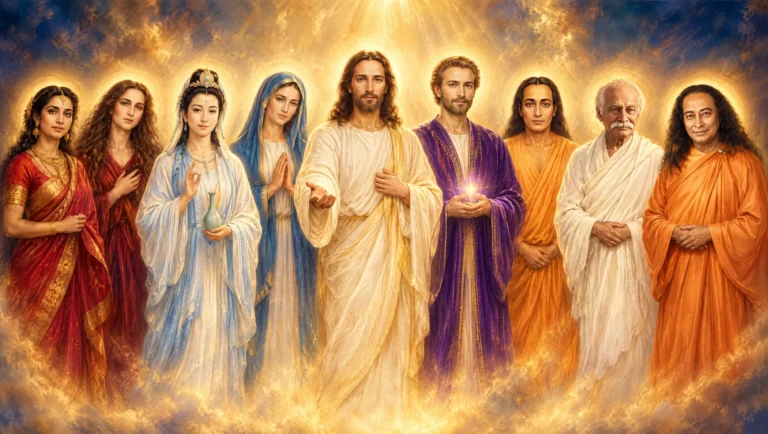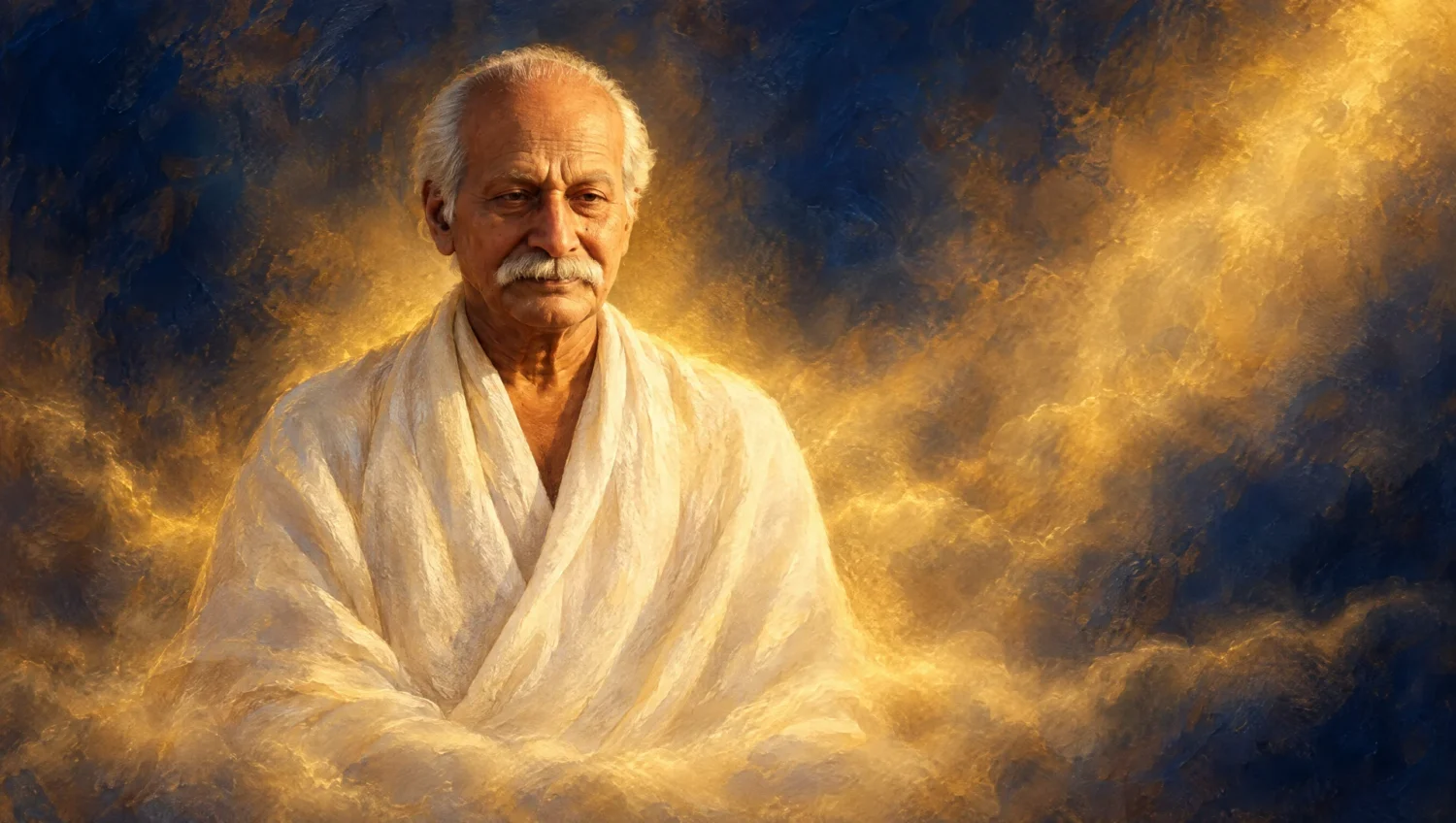
He wore no orange robe. He did not leave his family, and he did not retreat to a cave. He went to the office, came home to his wife and children, and sat in meditation at night. Lahiri Mahasaya is remembered as the householder yogi who proved that deep spiritual realization does not require walking away from ordinary life. This is the full story of the man who brought Kriya Yoga out of the Himalayas and into the homes of everyday people, with the legends marked as legends.
If you came to him through Autobiography of a Yogi, you know him as the gentle master of Benares who looked like a calm, plump, smiling man in a simple cloth. If you came through the film Awake: The Life of Yogananda, you met him as the teacher who foresaw Yogananda’s birth. That film is available on Next Level Soul, and the trailer above gives you a first look. This guide gives you the rest of his story.
Who Was Lahiri Mahasaya?
Lahiri Mahasaya was born Shyama Charan Lahiri on September 30, 1828, in the village of Ghurni in Bengal. He died on September 26, 1895, in Varanasi, the ancient city on the Ganges that the British called Benares. He lived most of his adult life in that city, worked for the British administration as an accountant and raised a family there.
The name Mahasaya is a respectful Sanskrit term that is often translated as great-minded. The tradition also calls him Yogiraj, king of yogis. But notice what he never became. He was not a monk. He did not take a new name. He kept his family name, his job and his household for most of his life, and he taught from that position.
That choice is the center of his story. In India’s long history, many great teachers were renunciates. Lahiri Mahasaya stands for another possibility: that a person can live fully in the world and still be fully awake. For readers who have been told that serious spiritual life is for someone else, someone with more free time, fewer bills and no children, he is an encouraging figure.
A word on sources. Most of what we know about his life comes from his students’ accounts, collected in biographies and, most famously, in Yogananda’s Autobiography. These are warm, devotional sources, and we will say so when we rely on them.
A Bengal Boyhood
Shyama Charan was born into a respected Brahmin family. According to accounts, the family’s ancestral home in Ghurni was destroyed when a nearby river changed course, and the family eventually moved to Benares when he was still a child. It is a small detail, but it explains a great deal. The boy who would become a master of the old tradition grew up in the oldest living city in India.
In Benares he studied Sanskrit, Hindi, Urdu, Bengali and English, and he took an interest in scripture. He had a quiet temperament. Accounts describe a thoughtful, kind and reserved boy who listened more than he spoke.
He was also, by the accounts, drawn to the quiet corners of the city. Benares is a place where the sacred is part of the everyday scenery: the river at dawn, the bathing steps, the bells and the pilgrims. A child who grew up there absorbed the idea that the spiritual life was not something distant.
A Young Man in Benares
As a young man, Lahiri Mahasaya married and began a family. He and his wife, Kashi Moni, had children, and by every account they lived a modest and happy home life. He took a position as an accountant in the Military Engineering Department of the British government, a steady job that would carry him through his working life.
Think of how ordinary this picture is. A clerk, a husband, a father, a man who paid bills and came home at the end of the day. It is the most unromantic background imaginable for a spiritual master, and that is exactly the point. The tradition stresses that nothing in his outward life suggested what was about to happen.
He was also, according to his students, a good colleague. Accounts describe a man who was courteous at work, honest with money and attentive to the people around him. That reputation mattered later, because it made his teaching credible. He was not asking others to do something he had not done under the same pressures.
The Transfer to Ranikhet
In 1861, when he was about thirty-three, Lahiri Mahasaya received a transfer from his office in the plains to the hill town of Ranikhet, in the foothills of the Himalayas. It looked like a routine posting. According to the tradition, it was the hinge of his life.
Ranikhet sits in a landscape of forested ridges and clear light, and the nearby hills were known to pilgrims. According to the accounts, Lahiri Mahasaya spent his free time walking in the hills. He had no special plan. He was a man out for a walk.
It is worth pausing on that. Many life-changing events begin as errands. A person goes to a new town, takes a walk and meets someone. The tradition says that nothing in Lahiri Mahasaya’s schedule marked that afternoon as unusual.
The Meeting with Babaji
The central story of his life is a meeting in the hills near Ranikhet. As he walked on a hillside, according to Yogananda’s account, he heard a voice calling his name. He followed it up the slope and found a young-looking man who greeted him as an old friend. The man was Mahavatar Babaji, the deathless master said to have revived Kriya Yoga for this age.
In the account, Babaji touched him on the forehead, and the memory of an earlier life came flooding back. Lahiri Mahasaya realized that he had been a disciple of Babaji in a past life and that he had been drawn to this hillside by a thread that had never been cut. Babaji then initiated him into Kriya Yoga, and Lahiri Mahasaya spent a number of days in his company before returning to his duties.
Here we need to be fair. This is a spiritual account, passed down by devotees. There were no outside witnesses, and Babaji, by tradition, does not leave a paper trail. People of faith take the story as true. Others treat it as devotional lore. What can be said without argument is that Lahiri Mahasaya returned from that posting as a man who taught Kriya Yoga, and that a lineage grew from him.
According to the tradition, Babaji gave him a task. He was to go back into the world, live as a householder and teach Kriya Yoga to sincere people. He was not to retreat. The instruction suited him, and it set the pattern for everything that followed.
The Golden Palace
One of the best-known stories from that visit is the tale of the golden palace. In the account, Lahiri Mahasaya found himself with a lingering personal desire, a wish for a beautiful home, and Babaji is said to have brought a shimmering palace into being so that the desire could be lived through and dissolved. After the vision, the story says, the palace vanished and the desire was gone.
Whether you read it as a literal event or as a teaching story, the lesson is clear. Desire is not defeated by force. It is fulfilled, seen through and released. The tradition used the story to teach that spiritual life does not ask us to pretend we have no wants. It asks us to look at them honestly.
For readers who feel guilty about wanting comfort, beauty or security, this is a welcome idea. The tradition does not scold. It suggests that the way through is clarity, not shame.
Returning to Benares and Teaching Quietly
After his transfer ended, Lahiri Mahasaya returned to Benares and began to teach. He did it quietly. He did not advertise, hold public events or seek followers. According to the accounts, students came to him by word of mouth, and he initiated them in small groups, often in the evening after his office work was done.
The simplicity of this is striking. There was no organization, no fees and no brand. A man with a day job sat with sincere people in a plain room and taught them a method.
Over the years the circle grew. Students came from Benares, from Bengal and from farther away. Some were scholars, some were officials and some were simple householders. Later in life he retired from government service and had more time for teaching, but he never changed the basic pattern. He remained a family man, he remained approachable and he remained unshowy.
Kriya Yoga: What He Taught
Kriya is a Sanskrit word meaning action or practice. In the lineage, Kriya Yoga is a method of working with breath and attention to quiet the mind and turn awareness toward the Self. The tradition holds that it is very ancient, and that Babaji revived it for this age. For a gentle introduction, see our guide to Kriya Yoga meditation.
What did Lahiri Mahasaya add? According to his students, he made it accessible. In earlier eras, the tradition says, such methods were reserved for monks. He offered them to householders, who had the least time and the most responsibilities. That decision changed the practical reach of the tradition.
His teaching, as it comes to us, had a few clear features:
- It was a practice, not a belief. He did not ask for faith. He asked for effort and honest observation.
- It was taught in stages. Students prepared before moving on, because the breath techniques are powerful.
- It was meant for daily life. He encouraged students to keep their jobs and families and to meditate morning and evening.
- It went hand in hand with study. He encouraged students to read the Bhagavad Gita and other scriptures, and he is said to have written commentaries himself.
One saying attributed to him, in the sense of “by doing, doing, one day it is done,” captures his tone. He was not impressed by dramatic effort. He believed in steady practice, and he trusted that the doing would eventually become being.
A Teacher Open to All
One striking feature of his teaching is who he accepted. In nineteenth-century India, caste and religious boundaries shaped almost every part of life, and many teachers kept strict limits on who could learn. Lahiri Mahasaya, by the accounts, did not. He is said to have initiated students from different castes, and Hindus, Muslims and Christians alike.
According to the tradition, his own wife was among his students. And he welcomed people from the whole range of society: officials and laborers, scholars and ordinary families. The practice, he held, was for anyone who would do it.
That openness fits his own background. He was not a hermit with a closed circle. He was a man of the city, and he taught as a man of the city. For modern seekers who feel excluded by rigid religious structures, it is a model of generosity that still feels fresh.
His Circle of Disciples
Lahiri Mahasaya taught many students, and a few are known by name from the Autobiography and other sources.
- Sri Yukteswar, the author of The Holy Science and the guru of Yogananda. Read his story in our guide to Sri Yukteswar Giri.
- Panchanan Bhattacharya, a devoted disciple who is said to have helped spread the teaching in Calcutta.
- Swami Kebalananda, who later tutored the young Yogananda in Sanskrit.
- Swami Pranabananda, a disciple whom Yogananda met and described in the Autobiography.
- Bhupendranath Sanyal, who is remembered as a close disciple and an early chronicler of the master’s teachings.
The list is not complete, and it does not need to be. The point is that the teaching moved through an ordinary web of relationships. Each student practiced, taught and passed it on, and a few of them became teachers of note.
A Day in the House at Benares
What was it like to visit him? From the accounts, his house in Benares was modest and calm. He often sat in a meditation posture in a small room, and visitors came and went with little ceremony. He spoke softly and usually briefly. He answered questions with patience, and he often replied by pointing the questioner back to his or her own practice.
The tradition describes him as a quiet presence. People who sat near him reported a sense of peace that stayed with them after they left. He did not perform wonders on demand, and he discouraged his students from chasing them.
Evenings were often given to scripture and conversation, and he is said to have read and explained the Gita to his students. The house, according to accounts, became a place where people felt welcome, not impressed.
That image is worth keeping. In an age of loud spiritual marketing, the picture of a quiet room, a plain cloth and a patient teacher is its own kind of correction.
Stories Told About Him
Like many revered teachers, Lahiri Mahasaya is the subject of stories that go beyond ordinary experience. The Autobiography relates accounts of healing, of knowing a student’s thoughts and of appearing in more than one place. His devotees treasure these stories.
We think it is wise to hold them as they are offered, which is as the testimony of devoted students. They are not verified history, and they should not be presented as such. But they tell us what his students experienced in his presence: a sense of being seen, of being known and of being loved without condition.
If you are drawn to the miracle stories, enjoy them. If you are skeptical, you lose nothing by setting them aside and looking at what he actually taught. Both responses are respectful, and both leave the practice intact.
The Famous Photograph
Almost every image of Lahiri Mahasaya traces back to a single photograph, which shows him seated in a meditation posture, calm and composed, with a gentle face. According to the tradition, he was reluctant to be photographed, and only one image of him is widely known.
The photograph has become an object of devotion in many homes. In Yogananda’s family, it held a place of honor, and in the Autobiography it is part of the story of a child’s recovery from illness through faith. You may recognize the image from books, from temple walls or from the cover of biographies.
It is a good reminder that images carry meaning. A simple photograph of a seated man became, for generations of seekers, a doorway into stillness.
The Prediction of a Yoga Renaissance
One of the most famous parts of his story is a series of predictions attributed to him. According to the Autobiography, Lahiri Mahasaya said that some decades after his death, interest in yoga would rise in the West, and that a biography of him would be written because of that interest. He is said to have added that the message of yoga would encircle the globe and help build understanding among people of different nations.
The film Awake repeats a related account. According to the film, he foretold the birth of Yogananda decades in advance, saying that through this person many would receive the spiritual teaching of India. When Yogananda was an infant, according to the Autobiography, his parents carried him to Lahiri Mahasaya, who blessed him and said that the child would carry many souls toward God.
Take these as the tradition tells them. What is beyond dispute is that interest in yoga did rise dramatically in the West in the following century, and that Yogananda was one of its main carriers. Whether you read the predictions as foresight, as devotional memory or as a way of giving a life meaning, they give the story a sense of design.
Mahasamadhi in 1895
Lahiri Mahasaya died in September 1895 in Benares. In his tradition, a master’s death is called mahasamadhi, a conscious departure from the body. Accounts describe a calm farewell, with students gathered around him, and a funeral on the banks of the Ganges, where the Hindu rites for the dead are carried out in Benares.
The Autobiography adds a remarkable story. Several disciples in different places are said to have reported seeing him in a radiant form shortly after his death, and some described a conversation. Believers accept these accounts as evidence of his continued presence. Others read them as expressions of grief and love.
The simplest way to hold the story is to notice how it fits the rest of his life. He taught that the Self is not born and does not die. His students, according to their own accounts, experienced his teaching confirmed at the end.
How His Message Traveled West
Lahiri Mahasaya never left India, but his teaching crossed oceans. The chain is simple. He taught Sri Yukteswar. Sri Yukteswar trained Yogananda. Yogananda went to Boston in 1920 and founded Self-Realization Fellowship, and in 1946 he published Autobiography of a Yogi, which introduced Lahiri Mahasaya to millions of readers.
It is a very human story. One person taught another, who taught another, and each took the teaching on faith, tested it and passed it on. No single step was spectacular. The cumulative effect was a tradition that reached across the world.
You can read more about the next links in the chain in our guides to Sri Yukteswar and Paramahansa Yogananda.
His Teachings, Simply Put
- Live in the world and practice. You do not have to leave your family or job to find God. Try this: Build your practice into the schedule you already have.
- Practice beats belief. Kriya is a method you can test, not a doctrine to accept. Try this: Choose a simple practice and keep it for ninety days.
- Steady effort works. By doing, doing, it gets done. Dramatic effort is less important than daily effort. Try this: Aim for ten faithful minutes over an hour once a month.
- The practice is for everyone. People of every background can take it up. Try this: Share what helps you without making it exclusive.
- Study supports practice. Read scripture to understand what you experience. Try this: Read a page of the Gita or another text after you sit.
- Be humble about wonders. Inner peace matters more than dramatic experiences. Try this: When something unusual happens, notice it and keep going.
- Desire is seen through, not suppressed. Honest awareness loosens the grip of wanting. Try this: When a wish arises, name it kindly and watch it.
The Kriya Lineage at a Glance
- Mahavatar Babaji (Unknown; a deathless figure in tradition). Revived Kriya Yoga; initiated Lahiri Mahasaya.
- Lahiri Mahasaya (1828 to 1895). Householder yogi of Benares; taught Kriya to ordinary families.
- Sri Yukteswar (1855 to 1936). Author of The Holy Science; teacher of Yogananda.
- Paramahansa Yogananda (1893 to 1952). Brought Kriya Yoga to the West; wrote Autobiography of a Yogi.
On Screen: Awake

Awake: The Life of Yogananda is the film where Lahiri Mahasaya’s influence is easiest to see. It traces Kriya Yoga back to Babaji, shows how Babaji instructed Lahiri Mahasaya to teach, and includes the account of Lahiri Mahasaya foretelling that the message of yoga would circle the globe.
It is a visually rich film, with archival footage, interviews and dreamlike sequences that attempt to show inner experience rather than only describe it. It is a good way to feel the lineage as a living stream. You can read our full film guide to Awake: The Life of Yogananda and then watch the film on Next Level Soul.
Where the Word Kriya Comes From
The word kriya is much older than Lahiri Mahasaya. In the Yoga Sutras of Patanjali, a classic text on yoga usually dated to the early centuries of the common era, the term kriya yoga appears for a short list of practices: self-discipline, self-study and surrender to the Divine. That ancient meaning is gentle and practical. It describes a way of living with intention.
The lineage that runs through Lahiri Mahasaya uses the term for a specific method of breath and attention, which the tradition says was revived by Babaji. The two meanings are not at odds. Both stress effort, honest self-observation and devotion. If you are new to the idea, think of Kriya as practice in its fullest sense: not a one-time insight, but a daily way of turning toward the Self.
That framing may help if you feel intimidated by the word. At its root, Kriya Yoga means little more than yoga that is practiced, and Lahiri Mahasaya’s teaching was always about practice.
Householder and Renunciate: Two Paths
India has long honored two broad ways of life. The renunciate leaves family and property and devotes full time to spiritual practice. The householder stays, raises children, earns a living and carries the responsibilities of ordinary life. Both are old, and both are respected.
For centuries the cultural assumption was that the renunciate had the better chance at liberation. Lahiri Mahasaya challenged that assumption by example. His students saw a man with a job and a family who radiated calm, and they concluded that the inner life could be built inside a busy schedule.
The tradition does not say that the householder’s path is easier. It says that it is possible, and that it has its own strengths. A householder learns patience, service and balance in a way that a hermit might not. He practices where the practice is tested.
Lahiri Mahasaya and the Bhagavad Gita
The Bhagavad Gita is a conversation on a battlefield between Prince Arjuna and Krishna, and its central question is how to act well in the middle of life’s demands. It was a natural text for a householder yogi, and Lahiri Mahasaya is said to have loved it. Accounts say he studied it closely, explained it to his students and wrote commentaries in his own style.
The Gita fits his message because it does not tell Arjuna to leave the battlefield. It tells him to act without clinging to the results. That is the householder’s creed, and it echoes through Yogananda’s own later commentary, God Talks with Arjuna.
If you would like to read the Gita alongside the story of Lahiri Mahasaya, start with a clear modern translation and read a few verses after you sit. Let them work on you slowly.
Varanasi Today
Varanasi is still one of the great pilgrimage cities of the world. Pilgrims bathe in the Ganges at dawn, and the riverfront steps, called ghats, fill with people at prayer. Devotees of Lahiri Mahasaya visit the city to see places connected with his life, including the area where he lived and taught.
If you ever go, it is worth knowing that the city is intense. It is crowded, loud and full of life and death in close quarters. Many travelers say that it is hard to describe and impossible to forget. It is a fitting home for a teacher who insisted that the sacred lives in the middle of ordinary things.
If travel is not possible, the same attention can be practiced at home. A quiet corner, a regular time and a few minutes of silence do most of the work.
Honest Questions and Cautions
How Reliable Are the Stories?
They come mostly from devoted students, and some were written down decades after the events. The broad outlines of his life, including his job, his family, his teaching in Benares and his dates, are well supported. The miracle stories are testimony and should be understood that way.
Is the Babaji Meeting Historical?
It is a spiritual account. No outside witness recorded it. Believers accept it, and others treat it as tradition. The lineage that followed is a matter of record.
Is There Only One Photograph?
The tradition says so, and the widely circulated image is the one most people know. We mention it as the tradition’s own account.
Can I Learn Kriya Yoga from a Book?
Traditionally, Kriya Yoga is taught through initiation by a qualified teacher, because the breath techniques are best learned with guidance. A book can introduce the ideas.
Are the Predictions Verified?
They are recorded in devotional sources. The rise of global interest in yoga is easy to see. How much of it should be credited to a prediction is a matter of belief.
A Mystic’s Reading: Why He Matters Now
Why does a clerk from nineteenth-century Benares still matter? Because most of us live his life. We have jobs, families and bills. We have little spare time and a lot of noise. And somewhere inside, we suspect that there is more.
Lahiri Mahasaya’s answer is that the more is not far away, and that you do not have to burn your life down to find it. You have to sit down, regularly, and look. That is a humble, practical message, and it fits ordinary people very well.
It also speaks to the exhaustion many of us feel with performative spirituality. His picture of the spiritual life is a quiet room, a steady habit and a teacher who does not need your applause. In that picture, the power does not come from outside. It comes from within, and the teacher is a guide who helps you remember.
That is exactly the spirit of Next Level Soul. The power is within you, and every teacher, book and film is only a guide to help you remember who you already are.
A Practice: One Week of Steady Doing
You can try his spirit this week. It takes about ten to fifteen minutes a day, and it fits inside a working life.
- Day 1, Pick a time. Choose a time you can keep, such as before breakfast or just before bed. Write it down.
- Day 2, Sit. Sit for five minutes in a quiet spot. Watch the breath without trying to change it.
- Day 3, Do it again. Same time, same place. Do not judge how it went.
- Day 4, Read. After sitting, read one page of a text that moves you.
- Day 5, Notice a wish. When a want arises, name it kindly and let it pass.
- Day 6, Serve. Do one small kindness at home or at work, quietly.
- Day 7, Review. Ask what changed. Keep whatever helped, and keep the time.
If you want to go deeper, start with our guide to Kriya Yoga meditation.
Books and Further Reading
If you want to read Lahiri Mahasaya and the tradition around him, start here. We use affiliate links, which means Next Level Soul may earn a small commission at no cost to you.
- Autobiography of a Yogi, which gives Lahiri Mahasaya a memorable chapter and a presence throughout.
- The Holy Science by his disciple Sri Yukteswar.
- Lahiri Mahasaya biographies, a selection of lives of the master.
- Lahiri Mahasaya’s Gita commentary, for readers who want his own words on scripture.
- Yogananda: The Man Who Brought Yoga to the West by Philip Goldberg, which tells the story of the lineage in context.
Who Will Connect with His Story
It suits busy householders, readers of Autobiography of a Yogi, seekers who want a method they can test, anyone who has been told that spiritual life is for someone else, and anyone who feels the pull of something quiet.
Keep Exploring
Keep exploring with spiritual enlightenment, ascended masters and the Spiritual Cinema collection.
Go Deeper: Watch Awake: The Life of Yogananda
Watch Awake on Next Level Soul TV Not Ready Yet? Read Our Awake Review
Frequently Asked Questions
Who was Lahiri Mahasaya?
Lahiri Mahasaya (Shyama Charan Lahiri, 1828 to 1895) was a married householder and government accountant in Varanasi who became a revered yogi and teacher of Kriya Yoga. He was initiated by Mahavatar Babaji and taught Sri Yukteswar, who trained Yogananda.
What does Mahasaya mean?
It is a respectful Sanskrit term often translated as great-minded. The tradition also calls him Yogiraj, king of yogis.
When and where was Lahiri Mahasaya born?
He was born on September 30, 1828, in the village of Ghurni in Bengal, and he spent most of his life in Varanasi, then called Benares.
How did Lahiri Mahasaya meet Babaji?
According to Autobiography of a Yogi, while posted to Ranikhet in 1861 he heard a voice calling his name while walking in the hills and found Mahavatar Babaji, who initiated him into Kriya Yoga. It is a spiritual account rather than a documented historical record. Read more in our guide to Mahavatar Babaji.
Why is Lahiri Mahasaya called the householder yogi?
Because he kept his job, his marriage and his family throughout most of his life while teaching Kriya Yoga. He showed that deep practice is possible inside ordinary responsibilities.
What did Lahiri Mahasaya teach?
He taught Kriya Yoga as a practical method of breath and attention, encouraged steady daily effort, valued the study of scripture such as the Bhagavad Gita and welcomed students from many backgrounds.
Who were Lahiri Mahasaya’s disciples?
Among them were Sri Yukteswar, Panchanan Bhattacharya, Swami Kebalananda, Swami Pranabananda and Bhupendranath Sanyal. Read about Sri Yukteswar, the best-known link in the chain.
How is Lahiri Mahasaya connected to Yogananda?
Lahiri Mahasaya taught Sri Yukteswar, who trained Paramahansa Yogananda. According to the tradition, he also blessed Yogananda as an infant and foretold his mission. See our guide to Paramahansa Yogananda.
Is there really only one photograph of Lahiri Mahasaya?
According to tradition, he was reluctant to be photographed, and one image is widely known and reproduced.
When did Lahiri Mahasaya die?
He died on September 26, 1895, in Varanasi. His tradition calls this mahasamadhi, a master’s conscious exit from the body.
What did Lahiri Mahasaya predict?
According to the Autobiography, he said that interest in yoga would rise in the West after his death and that the message of yoga would circle the globe. The film Awake also relates his foretelling of Yogananda’s birth.
Where can I watch a film that tells his story?
Watch Awake: The Life of Yogananda on Next Level Soul. The film traces Kriya Yoga from Babaji through Lahiri Mahasaya to Yogananda.
Can I learn Kriya Yoga from a book?
Traditionally, Kriya Yoga is taught through initiation by a qualified teacher, because the breath techniques are best learned with guidance. A book can introduce the ideas. See our guide to Kriya Yoga meditation.