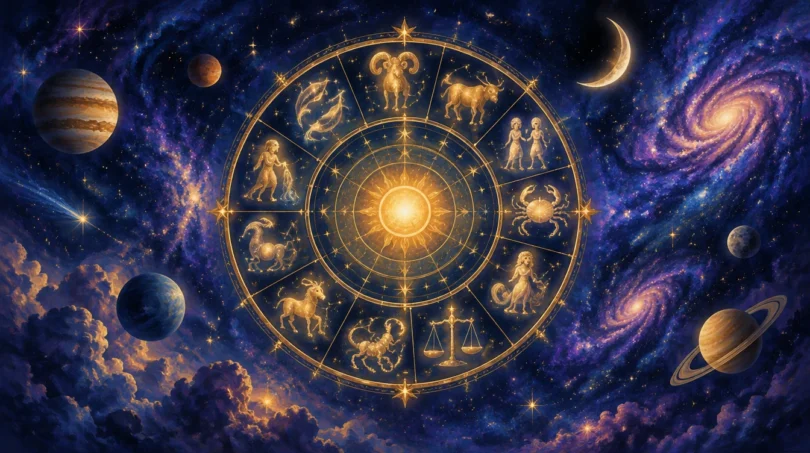
Look up on a clear night and something old stirs in you. People have felt it for as long as there have been people. The sky moves in patterns, and somewhere in the back of the mind a question rises: what if those patterns are speaking to me?
That question is the root of astrology. It is one of the oldest human traditions still alive today, and it is also one of the most misunderstood. Some people wave it off as entertainment. Others hold it so tightly that every Mercury retrograde becomes a crisis. Most seekers sit somewhere in between, curious, a little guarded, and hungry for something real.
This guide is for you. It is a full, plain-language walk through astrology, from where it came from to how a birth chart is built to what the signs, houses, planets and cycles actually mean. You do not need any background. By the end you will be able to look at a chart and read its basic language, and you will know where to go next.
One idea runs through everything here, and it is the same idea we keep returning to at Next Level Soul. The power is within you. Astrology is not a verdict handed down from the heavens. It is a mirror, a map, and a calendar, and you are the one who decides what to do with it.
Key Takeaways
- Astrology reads the positions of the Sun, Moon and planets at your birth as a map of your nature and the timing of your life.
- Your big three are the Sun sign (core self), Moon sign (inner world) and Rising Sign (how you meet the world).
- A chart combines planets, twelve signs and twelve houses, with aspects showing how the planets relate.
- There are many traditions: Western, Hellenistic, Vedic, Chinese, Tibetan, Mayan and evolutionary, each with its own lens.
- Cycles such as the Saturn return and Mercury retrograde give life a rhythm you can work with.
- A chart describes tendencies, not fate. You still choose. The power is within you.
What Astrology Is
Astrology is the study of the relationship between the sky and life on Earth. Its core principle comes down to a single ancient line, often credited to the Hermetic tradition: as above, so below. The heavens and the human world move in correspondence. When you understand the pattern overhead, you gain a language for the pattern within.
In practice, an astrologer works with three things. The first is the planets, which are the actors. The second is the signs, which describe how each actor behaves. The third is the houses, which show the stage, the area of life where the action unfolds. Put together, they form a birth chart, a snapshot of the sky at the moment and place you were born.
That chart is not a prediction of one fixed future. Think of it as a portrait of your nature and a map of the seasons you are likely to move through. Two people can have the same difficult placement and live it completely differently, because awareness changes the experience. A chart describes the weather. You are still the one who steers the ship.
Astrology Is Not Astronomy, and It Is Not a Horoscope Column
Astronomy measures the physical sky. Astrology interprets it. They were once a single discipline, and the great astronomers of history, including Ptolemy and Kepler, practiced both. Today they have separated, and astrology works as a symbolic and spiritual art rather than a physical science.
It also helps to know what a newspaper horoscope really is. When a column says something about your sun sign, it is speaking to one twelfth of the population with a single sentence. That can be fun, but it is the shallow end of a very deep pool. A real chart uses the exact date, time and place of your birth, and it is as individual as a fingerprint.
Why Seekers Are Drawn to It
People come to astrology for different reasons, and most of them are good ones.
- Self-understanding. A chart gives you words for patterns you have always felt but could not name.
- Timing. Astrology tracks cycles, so it can tell you when a season of growth, rest or change is likely to arrive.
- Compassion. Once you see how differently people are wired, it gets easier to stop taking things personally.
- Meaning. For many, a chart is a quiet reminder that a life has a shape and a purpose.
None of that requires you to believe anything on faith. You can simply try it. Read your chart, watch your life for a season, and see what rings true.
Where Astrology Came From
To understand astrology, it helps to know it was never invented in a single place. It grew slowly, in many cultures, out of one shared act: people watching the sky with great patience.
Mesopotamia: The First Sky Watchers
The oldest roots reach back more than 4,000 years to Mesopotamia. Babylonian priests recorded the movements of the planets and the Moon on clay tablets and linked what they saw to events on Earth. Their early work was mostly about omens for kings and kingdoms. Around the fifth century BCE, the Babylonians divided the sky into twelve equal sections along the path of the Sun. That was the birth of the zodiac as we know it.
Egypt and Greece: The Personal Chart Is Born
When Alexander the Great carried Greek culture into Egypt and the East, Babylonian sky-lore met Egyptian timekeeping and Greek philosophy. Out of that meeting came Hellenistic astrology, which took shape in Alexandria around the second century BCE. This was the great turning point. Astrology stopped being only about kings and began to describe the individual. The rising sign, the houses and the planetary aspects all come from this period.
The tradition has remarkable written sources. Ptolemy’s Tetrabiblos in the second century CE gave astrology a philosophical foundation, and Vettius Valens, writing in the same era, left behind an anthology filled with real example charts. Much of what modern Western astrologers practice grows from these texts.
India, Persia and the Islamic World
Greek astrology traveled east and merged with older Indian wisdom to form Vedic astrology, or Jyotish, which remains a living practice with its own tools and its own way of measuring the sky. In the medieval Islamic world, scholars translated, preserved and expanded the Greek texts, and they passed that learning on to Europe.
China: A Separate and Ancient Stream
Alongside all of this, China developed its own sky tradition, built on cycles of time, the five elements and the balance of yin and yang. Chinese astrology grew from a different root, and it shows how a very different culture arrived at the same instinct: that time has quality, and that timing matters.
The Modern Revival
Western astrology faded in the age of the telescope, then came back in the twentieth century, shaped by the work of Carl Jung, who saw in the signs a map of the archetypes living in the human psyche. Psychological astrology followed, then the soul-centered approach of evolutionary astrology. Today there is also a strong movement back to the ancient sources, as astrologers rediscover Hellenistic techniques and bring them into modern practice.
That long arc matters. Astrology has lasted because it keeps answering a need: to feel that our lives are part of something larger and that the larger thing is paying attention.
How a Chart Is Built
A birth chart looks like a wheel, and that is exactly what it is. To draw yours, an astrologer needs three pieces of information: the date you were born, the exact time, and the place. From those, software or a careful calculation reveals where every planet stood in the sky at that moment, as seen from where you were.
The Circle and Its Layers
The wheel has three layers working at once.
- The outer ring holds the twelve signs. Each sign takes up thirty degrees of the 360-degree circle.
- The planets sit inside the ring. Each one lands in a specific sign and at a specific degree.
- The inner spokes mark the twelve houses. They divide the wheel by the rotation of the Earth, which is why your birth time and location matter so much.
Read the three together and a sentence appears. For example: Venus (the planet) in Taurus (the sign) in the seventh house (the area of life). Translate that and you get something like: the way you love and value others is steady, sensual and loyal, and it plays out most strongly in your closest partnerships. Every placement in a chart is a sentence like that, and the whole chart is a story.
Why the Birth Time Matters
If you do not know your birth time, you can still learn a great deal from the chart, but a few things shift. Your rising sign changes roughly every two hours, so it depends on the exact minute. The houses depend on it too. The Moon moves about thirteen degrees a day, so even your moon sign can occasionally be uncertain on the day it changes signs. If you can, find your birth certificate or ask a parent. Many hospitals record the time to the minute.
Tropical and Sidereal: Two Ways of Measuring the Sky
You may run into these two words, so here is the simple version. The tropical zodiac, used in most Western astrology, anchors the signs to the seasons. Aries begins at the spring equinox. The sidereal zodiac, used in Vedic astrology, anchors the signs to the fixed stars. Over thousands of years the two have drifted apart by about twenty-four degrees, which is why your sign can differ between a Western and a Vedic chart. Neither is wrong. They are two lenses, and each has a long and careful tradition behind it.
Your Big Three: Sun, Moon and Rising
If a chart is a story, the big three are its main characters. If you learn only these three, you will already know more about yourself than a thousand horoscope columns could tell you.
The Sun Sign: Your Core
Your sun sign is the sign the Sun occupied on the day you were born. It describes your essential identity, your vitality and the self you are growing into. Think of it as your center of gravity. When you are living in alignment, this is the part of you that feels lit from within.
The Sun is also a long-term project. Many people feel their sun sign more strongly as they get older, because it describes who you are becoming rather than who you already are.
The Moon Sign: Your Inner World
Your moon sign is where the Moon stood at your birth. It speaks to your emotions, your instincts, your habits and the way you comfort yourself. It describes what you need in order to feel safe. Many astrologers say the Moon is the key to the private you, the one your closest people know.
If the Sun is who you are becoming, the Moon is who you are when no one is watching. When your Sun and Moon are in different elements, you may feel pulled in two directions, and learning to honor both is a lifelong dance.
The Rising Sign: Your Doorway
Your rising sign, also called the ascendant, is the sign rising over the eastern horizon at your birth. It shapes your first impression, your style and the way you approach new situations. Think of it as the doorway through which the world meets you.
The rising sign also sets the entire house structure of your chart, which is why astrologers consider it one of the most important points. Many people find that others describe them in rising-sign language long before they notice it themselves.
How the Three Work Together
A person with a Leo Sun, Pisces Moon and Capricorn rising might come across as reserved and capable at first (Capricorn), feel everything deeply and quietly (Pisces), and glow with real warmth and creative fire once they trust you (Leo). No single sign tells that story. The combination does. This is why two people with the same sun sign can be so different, and why the work of reading a chart is really the work of listening to the blend.
The Planets and What They Mean
In astrology, the word “planet” includes the Sun and the Moon, even though astronomers classify them differently. Each planet represents a function in your psyche, a part of you that wants something. The sign it sits in shows how it goes about it.
The Personal Planets
These move quickly and shape your day-to-day personality.
- The Sun is your identity, will and life force.
- The Moon is your emotions, needs and instinctive responses.
- Mercury is your mind, your speech and how you learn and communicate.
- Venus is love, beauty, values and what you find pleasing.
- Mars is drive, desire, courage and how you take action.
The Social Planets
These two connect you to the wider world.
- Jupiter is growth, faith, generosity and the search for meaning. It expands whatever it touches.
- Saturn is structure, responsibility, time and mastery. It is the great teacher, and its lessons often come through patience.
The Generational Planets
These move slowly, spending years in a single sign, so they shape whole generations as much as individuals.
- Uranus is awakening, rebellion and sudden change.
- Neptune is dreams, imagination, spirituality and dissolving boundaries.
- Pluto is deep transformation, power and rebirth.
Chiron, the Nodes and Other Points
A chart also includes sensitive points that are not planets in the strict sense, and some of the most soulful meaning lives here.
Chiron orbits between Saturn and Uranus and is called the wounded healer. It marks the place of a deep, often early hurt, and the compassion and skill that grow from healing it. Many astrologers find that people become teachers and guides in exactly the area where Chiron sits in their chart.
The North Node and South Node are not bodies at all. They are two points where the Moon’s path crosses the Sun’s path, and they sit directly opposite each other. The South Node points to gifts and habits you carry from the past, the place of comfort. The North Node points to where your soul is stretching toward, which often feels unfamiliar and a little uncomfortable, and is where the growth is. We will come back to this when we talk about the soul.
The Classical Seven
Older traditions, including Hellenistic and Vedic astrology, work mainly with the seven visible bodies you can see with the naked eye: the Sun, Moon, Mercury, Venus, Mars, Jupiter and Saturn. Many astrologers feel that this smaller set reveals a great deal and keeps a reading focused. Modern Western astrology adds Uranus, Neptune and Pluto, which were discovered after the telescope arrived. Both approaches are valid. They simply use different sets of colors.
The Twelve Signs
Each sign is a way of being alive. None is better than another. Every sign carries a gift and a growing edge, and each one is a chapter in a larger story that begins with Aries and ends with Pisces. The dates below are approximate, since the Sun changes signs at a slightly different moment each year.
Think of the zodiac as one long arc of human development. It starts with the raw spark of “I am” and travels all the way to “we are all one.”
The Twelve Signs at a Glance
| Sign | Dates | Element | Modality | Ruling Planet |
|---|---|---|---|---|
| Aries | March 21 to April 19 | fire | Cardinal | Mars |
| Taurus | April 20 to May 20 | earth | Fixed | Venus |
| Gemini | May 21 to June 20 | air | Mutable | Mercury |
| Cancer | June 21 to July 22 | water | Cardinal | the Moon |
| Leo | July 23 to August 22 | fire | Fixed | the Sun |
| Virgo | August 23 to September 22 | earth | Mutable | Mercury |
| Libra | September 23 to October 22 | air | Cardinal | Venus |
| Scorpio | October 23 to November 21 | water | Fixed | Pluto (and traditionally Mars) |
| Sagittarius | November 22 to December 21 | fire | Mutable | Jupiter |
| Capricorn | December 22 to January 19 | earth | Cardinal | Saturn |
| Aquarius | January 20 to February 18 | air | Fixed | Uranus (and traditionally Saturn) |
| Pisces | February 19 to March 20 | water | Mutable | Neptune (and traditionally Jupiter) |
Aries (March 21 to April 19)
Cardinal fire, ruled by Mars
Aries is the spark. As the first sign, it carries the courage of beginnings, the instinct to move before the path is clear. Aries people tend to be direct, brave and quick to act, and they are often the first to say yes to a new adventure. The growing edge is patience and listening. When Aries learns to pair its fire with awareness of others, it becomes a true leader.
Taurus (April 20 to May 20)
Fixed earth, ruled by Venus
Taurus is the one who stays. It loves beauty, food, nature, music and the pleasure of a life well built. This is the sign of steadiness and loyalty, and its patience can move mountains. The growing edge is change. Taurus learns that real security is not found in possessions but in a deep trust in itself.
Gemini (May 21 to June 20)
Mutable air, ruled by Mercury
Gemini is curiosity in motion. Quick, witty and endlessly interested, Gemini collects ideas and connects people. Its gift is communication, the ability to translate between worlds. The growing edge is depth and focus. When Gemini slows down enough to follow one thread all the way in, its scattered brilliance becomes wisdom.
Cancer (June 21 to July 22)
Cardinal water, ruled by the Moon
Cancer is the heart that holds. Deeply intuitive and protective, it creates home wherever it goes. Cancer feels everything, including what others leave unsaid. The growing edge is learning to build safety within, so that its shell becomes a choice instead of a defense.
Leo (July 23 to August 22)
Fixed fire, ruled by the Sun
Leo is the heart in full expression. Warm, generous and creative, Leo lights up a room and gives others permission to shine. Its deepest need is to be seen for who it truly is. The growing edge is to shine from the heart rather than for applause, and to let love be the source of its confidence.
Virgo (August 23 to September 22)
Mutable earth, ruled by Mercury
Virgo is devotion through detail. Thoughtful, practical and service-minded, Virgo notices what needs fixing and quietly makes the world work better. Its gift is discernment. The growing edge is self-kindness. When Virgo trades perfectionism for grace, its care becomes healing.
Libra (September 23 to October 22)
Cardinal air, ruled by Venus
Libra seeks harmony. Charming, fair-minded and gifted at relationship, Libra can see all sides of a situation. It teaches us the art of balance and beauty. The growing edge is decision and honesty. A mature Libra learns that peace sometimes requires saying the hard thing, and that their own needs belong in the balance too.
Scorpio (October 23 to November 21)
Fixed water, ruled by Pluto (and traditionally Mars)
Scorpio goes deep. Intense, perceptive and fiercely loyal, it is drawn to the hidden, to mystery and to truth. This is the sign of transformation, and Scorpios often live several lives in one lifetime. The growing edge is trust and release. When Scorpio lets go of control, it rises like the phoenix.
Sagittarius (November 22 to December 21)
Mutable fire, ruled by Jupiter
Sagittarius is the seeker. Optimistic, adventurous and philosophical, it is always reaching for the horizon and for the meaning of it all. It brings laughter and big-picture vision. The growing edge is commitment and follow-through. Sagittarius learns that wisdom is not only collected, it is lived.
Capricorn (December 22 to January 19)
Cardinal earth, ruled by Saturn
Capricorn climbs. Disciplined, responsible and quietly ambitious, it builds things that last. Capricorn often seems older when young and younger when old, as the weight of responsibility lifts with time. The growing edge is allowing softness and rest. When success serves the soul, Capricorn becomes a true master.
Aquarius (January 20 to February 18)
Fixed air, ruled by Uranus (and traditionally Saturn)
Aquarius sees the future. Original, independent and humanitarian, it thinks in terms of the whole. It is the friend, the rebel and the visionary. The growing edge is intimacy. Aquarius learns that connection is not a threat to freedom, and that bringing the future to everyone starts with one honest relationship.
Pisces (February 19 to March 20)
Mutable water, ruled by Neptune (and traditionally Jupiter)
Pisces dissolves the boundary between self and other. Compassionate, imaginative and deeply spiritual, it feels the whole ocean in a single drop. Artists, healers and mystics often carry strong Pisces. The growing edge is grounding and boundaries. When Pisces learns where it ends and others begin, its compassion flows freely instead of draining it.
A Note on the Thirteenth Sign
Every few years a headline announces that astrology got it wrong and there is a thirteenth sign, Ophiuchus. The truth is simpler. The astrological zodiac is not the same thing as the constellations. It is a twelve-part measuring system built on the Sun’s yearly path and the seasons, and the signs are named for constellations they once roughly aligned with. The constellation of Ophiuchus does overlap the Sun’s path, but it has never been part of the zodiac, any more than a ruler is wrong for having twelve inches instead of thirteen.
Elements and Modalities
Twelve signs can feel like a lot. The good news is that they sort themselves in two simple ways, and once you see the pattern, the whole zodiac clicks into place.
The Four Elements
The four elements describe temperament, the basic kind of energy a sign expresses. Each element holds three signs.
- Fire (Aries, Leo, Sagittarius). is spirit. Fire signs are inspired, bold and full of life. They lead with enthusiasm. When out of balance, they can burn out or burn others.
- Earth (Taurus, Virgo, Capricorn). is matter. Earth signs are practical, patient and devoted to what is real. They build and sustain. When out of balance, they can become rigid or stuck.
- Air (Gemini, Libra, Aquarius). is mind. Air signs are thoughtful, social and curious. They connect and communicate. When out of balance, they can float away from feeling.
- Water (Cancer, Scorpio, Pisces). is feeling. Water signs are intuitive, empathic and deep. They sense what is beneath the surface. When out of balance, they can be overwhelmed by emotion.
A helpful exercise is to look at your chart and see which element is strongest and which is missing. If you have a lot of fire and no water, you may need to practice slowing down and feeling. If you have a lot of earth and no air, you may need more conversation and fresh ideas. The missing element is not a flaw. It shows where to nurture yourself.
The Three Modalities
The second way to sort the signs is by modality, which describes how a sign moves through time.
- Cardinal (Aries, Cancer, Libra, Capricorn). signs begin things. They arrive at the start of each season and carry the energy of initiation.
- Fixed (Taurus, Leo, Scorpio, Aquarius). signs sustain things. They arrive in the middle of each season and carry the energy of persistence.
- Mutable (Gemini, Virgo, Sagittarius, Pisces). signs adapt things. They arrive at the end of each season and carry the energy of change and transition.
Combine one element with one modality and you get exactly one sign. Aries is cardinal fire, the beginner of the fire family. Leo is fixed fire, the one who holds the flame. Sagittarius is mutable fire, the one who spreads it. The pattern is elegant, and it is a quick way to remember what each sign is about.
Polarity: Masculine and Feminine, Yang and Yin
One more layer: fire and air signs are called active or yang, while earth and water signs are called receptive or yin. These words describe styles of energy and not gender. Every person carries both, and a healthy chart, like a healthy life, finds a way to honor each.
The Twelve Houses
If the planets are the actors and the signs are their styles, the houses are the stage. Each house governs an area of life. The house a planet falls in tells you where its energy shows up most strongly.
Here is a quick tour, in order around the wheel.
| House | Area of Life | What It Shows |
|---|---|---|
| 1 | Self | Your body, appearance and the way you begin. This is the house of the rising sign and your approach to life. |
| 2 | Resources | Money, possessions, values and your sense of self-worth. It asks what you truly value. |
| 3 | Communication | Everyday mind, siblings, neighbors, short trips and learning. It shows how you think and speak. |
| 4 | Roots | Home, family, ancestry and your inner foundation. It marks the deepest private part of your life. |
| 5 | Creativity | Joy, romance, children, play and self-expression. It shows what makes you feel alive. |
| 6 | Service | Daily routine, work, health and the habits that shape your days. It is the house of devotion through craft. |
| 7 | Partnership | Marriage, close partners and your mirrors. It shows what you seek in others and what you learn from them. |
| 8 | Transformation | Shared resources, intimacy, death and rebirth. It is the house of the deep and the hidden. |
| 9 | Meaning | Higher learning, travel, philosophy and faith. It reveals your search for truth. |
| 10 | Calling | Career, reputation and your public path. It shows what you are building in the world. |
| 11 | Community | Friends, groups, hopes and the future you wish to create. It shows your people and your vision. |
| 12 | Spirit | The unconscious, solitude, dreams and surrender. It is the house of the hidden and the sacred. |
Angular, Succedent and Cadent
The houses also sort into three groups. The angular houses (first, fourth, seventh and tenth) sit at the four corners of the chart and carry the most visible energy. The succedent houses (second, fifth, eighth and eleventh) follow them and deal with resources and stability. The cadent houses (third, sixth, ninth and twelfth) come before the next corner and deal with learning, adjustment and preparation. A planet in an angular house tends to be strong and obvious in a life. A planet in a cadent house often works more quietly behind the scenes.
Reading a House in Practice
Say you have Mars in your sixth house. Mars is drive, and the sixth is daily work and health. You might pour a great deal of energy into your routine, thrive on physical activity, and become restless if your work lacks challenge. Now say you have Venus in your twelfth house. Venus is love, and the twelfth is the hidden. You might love quietly, find beauty in solitude, or feel a spiritual kind of love before a personal one. The same planet means something completely different depending on where it lives.
Aspects: How the Planets Talk
Planets in a chart do not sit in isolation. They make angles to one another, and those angles are called aspects. An aspect describes how two parts of you relate, whether they cooperate, push each other or merge.
The Major Aspects
- Conjunction (0 degrees). Two planets sit together and blend into one force. It is powerful, concentrated and sometimes hard to see around.
- Sextile (60 degrees). A gentle, supportive link. It offers opportunity and rewards the effort to use it.
- Square (90 degrees). Friction. The two planets pull in different directions, and this tension is often what drives growth and action.
- Trine (120 degrees). Natural flow. The planets sit in the same element and support each other with ease. Trines are gifts, though they can make us comfortable enough to ignore them.
- Opposition (180 degrees). Two planets face each other across the wheel. It is a call for balance, often experienced through other people.
Hard Does Not Mean Bad
A common mistake is to label squares and oppositions as “bad” and trines and sextiles as “good.” In reality, the aspects that stretch us are often the source of our greatest strength. A chart full of trines can mean a life with little push to grow. A chart with several squares can mean a person who is driven, resilient and fascinating. What matters is what you do with the energy.
Orbs and Patterns
Aspects do not need to be exact to work. Astrologers allow a small margin, called an orb, usually a few degrees on either side. The tighter the aspect, the louder it speaks. When several aspects connect, they form patterns such as the T-square or the grand trine, which describe themes that run through a whole life.
Timing and Cycles
Here is where astrology becomes especially useful. The planets keep moving after you are born, and as they travel they form new angles to the planets in your birth chart. These are called transits, and they are how astrologers read the timing of a life.
Your birth chart is the permanent weather of your nature. Transits are the passing seasons. Some pass in a day. Some take years. Together they give a life its rhythm.
The Saturn Return
Around the age of 27 to 30, Saturn comes back to the exact sign and degree it held when you were born. This is the Saturn return, and it is one of the most talked-about passages in astrology. It marks the end of one chapter of adulthood and the real start of another.
People often describe it as a time of reckoning. Relationships that were built on habit may end, careers that no longer fit may fall away, and a deeper question rises: what is truly mine to build? The experience can be hard, but it is also clarifying. Saturn clears away what is not real so that you can build with integrity. The second Saturn return arrives near 58 to 60 and opens the door to the later years, often with a similar call to simplify and to stand in your wisdom.
Mercury Retrograde
Several times a year, Mercury appears to move backward in the sky for about three weeks. This is an optical effect, similar to how a slower car seems to drift backward when you pass it on the highway. In astrology, Mercury retrograde is a time to review, repair and reconsider, especially in matters of communication, travel and technology.
The popular version of the idea is that everything goes wrong. A more useful version says this is a season to slow down, double-check details, finish unfinished business and reconnect with people from the past. Many people find that it is a gift when used for rest and review, and a headache only when used for rushing.
Jupiter Return and Other Rhythms
Jupiter returns to its birth position about every twelve years, bringing a spirit of growth and opportunity. The lunar nodes return about every 18.6 years, and the halfway points of that cycle often mark times when life asks you to turn toward your soul’s direction. Chiron returns around age 50, often bringing a deep healing and a sense of taking up your role as a guide. Uranus reaches its opposition in your early forties, a time many people call a midlife awakening.
You can see why astrologers feel that time has a shape. The cycles give you language for moments that otherwise feel random, and they remind you that every season passes.
Eclipses and New Moons
Eclipses occur in pairs along the lunar nodes roughly twice a year, and astrologers regard them as powerful times of change and revelation. New moons are traditionally times for planting intentions, and full moons for harvest and release. Many seekers build a gentle monthly rhythm around the moon cycle, using it for reflection, journaling and meditation.
Every Kind of Astrology
When people say “astrology,” they usually mean the sun-sign version they know from magazines. In truth, astrology is a family of traditions, each with its own history, tools and questions. Some are thousands of years old. Some are barely a century old. Some come from entirely different cultures, and some are different ways of asking what a chart is for.
The easiest way to hold it all is to look at astrology in three ways: by culture (where it came from), by approach (what question it asks) and by branch (what it is used for). Here is the whole map.
At a Glance: The Major Traditions
| Tradition | Origin | Zodiac | Signature tool | Best for |
|---|---|---|---|---|
| Modern Western | Europe and the Americas, 20th century | Tropical | Sun, Moon and rising; psychological reading | Self-understanding |
| Hellenistic | Greek and Egyptian world, c. 2nd century BCE | Tropical | Whole-sign houses, planetary condition, timing techniques | Precision and timing |
| Vedic (Jyotish) | India | Sidereal | Moon sign, nakshatras, dashas | Karma, dharma and life timing |
| Chinese | China | Not a sign wheel; cycles of time | Twelve animals, five elements, Four Pillars | Cycles, balance and decisions |
| Evolutionary | Western, 20th century | Tropical | Pluto and the lunar nodes | Soul growth across lifetimes |
| Tibetan | Tibet | Blends Indian and Chinese systems | Elements, animals and the Kalachakra tradition | Practical guidance and ritual timing |
| Mayan | Mesoamerica | Not a zodiac; a sacred calendar | The 260-day Tzolk’in | Day signs and sacred timing |
By Culture: Where It Came From
Babylonian and Mesopotamian Astrology
The oldest roots of the Western tradition. Priests recorded planetary movements on clay tablets and read them as omens for kings and cities. Their twelve-part division of the sky gave us the zodiac itself. Personal charts came later.
Hellenistic Astrology
Born in Alexandria when Babylonian sky-lore met Egyptian timekeeping and Greek philosophy, Hellenistic astrology created the personal birth chart. It uses the rising sign, whole-sign houses, the strength or weakness of each planet and sharp timing methods. Most Western astrology descends from it. Hear it on the podcast in Hellenistic Astrologer Reveals Humanity’s Future 2026 to 2032 with Jorge Roque.
Persian and Arabic (Medieval) Astrology
Astrologers in the medieval Persian and Islamic world, such as Abu Ma’shar and Masha’allah, translated, preserved and extended the Greek texts. They refined predictive methods, developed the “Arabic Parts” (calculated sensitive points of a chart) and sharpened the art of answering specific questions. Without them, the tradition would not have reached Europe.
Vedic Astrology (Jyotish)
Jyotish, “the science of light,” is India’s living astrology. It uses the sidereal zodiac, so your sign can differ from your Western one. It emphasizes the Moon, 27 lunar mansions called nakshatras and a layered timing system of planetary periods called dashas, the best known being the 120-year Vimshottari cycle. It is bound up with karma and dharma, and many see the chart as a record of what the soul is working through. Listen to What Vedic Astrology Says About Humanity’s Near Future with Dr. Katy Jane.
Chinese Astrology
Chinese astrology reads life through time rather than through a wheel of signs. Its core pieces are the twelve-year animal cycle (Rat, Ox, Tiger, Rabbit, Dragon, Snake, Horse, Goat, Monkey, Rooster, Dog and Pig), the five elements (Wood, Fire, Earth, Metal and Water) and the balance of yin and yang. The deepest layer is the Four Pillars of Destiny (BaZi), a chart built from the year, month, day and hour of birth. Another system, Zi Wei Dou Shu, or Purple Star astrology, maps a life through star palaces. It is closely tied to feng shui. Hear Joey Yap in Chinese Astrology’s Predictions for the Coming Decade.
Tibetan Astrology
Tibetan astrology blends two streams: an Indian stream tied to the Kalachakra (“Wheel of Time”) teachings and a Chinese stream of elements and animals. It is practiced alongside Tibetan Buddhism and is often used to choose auspicious dates and to guide ritual and healing.
Mayan Astrology
The Maya tracked time with several interlocking calendars. The sacred 260-day Tzolk’in combines twenty day signs with thirteen numbers, and each person is said to carry the energy of the day they were born. It is a calendar of sacred time, not a zodiac of constellations.
Egyptian Astrology and the Decans
Ancient Egyptians divided the sky into 36 star groups called decans, each ruling about ten days. The decans traveled into Hellenistic astrology, where each sign was split into three parts of ten degrees. Many modern astrologers still use them to add fine detail to a sign.
Celtic Tree Astrology
Celtic tree astrology assigns trees to thirteen lunar periods of the year. It draws on Celtic and Druidic imagery, but the calendar in popular use is a twentieth-century creation. Many people love it for its closeness to nature, and it is best held as a modern symbolic system inspired by old lore.
By Approach: What Question It Asks
Psychological Astrology
Shaped by Carl Jung, who saw the signs and planets as expressions of the archetypes within us, this approach treats the chart as a map of the psyche. Dane Rudhyar and later Liz Greene brought it into modern practice. It asks: what patterns shape my inner world?
Evolutionary Astrology
Evolutionary astrology reads the chart as the story of the soul across lifetimes. It looks at Pluto and the lunar nodes for where the soul has been and where it is headed. Jeffrey Wolf Green, Steven Forrest and Ricky Williams are among its best-known voices. It asks: what is my soul here to learn? Listen to Evolutionary Astrology: Decoding Your Soul’s Journey with Ricky Williams.
Archetypal Astrology
Associated with Richard Tarnas and his book Cosmos and Psyche, archetypal astrology studies how planetary cycles line up with themes in history and culture. It asks: what is humanity going through together?
Karmic Astrology
This approach, common in Vedic circles and in many Western ones, focuses on the karma a chart reveals, including the nodes and difficult placements. It asks: what am I carrying, and what is mine to resolve? Hear Heather Ensworth in Astrology, Karma and the Path Ahead for Humanity.
Draconic Astrology
A draconic chart is built by setting your North Node at zero degrees of Aries and measuring the rest from there. Practitioners read it as a portrait of the soul beneath the personality. It is usually studied alongside the regular birth chart.
Sidereal Western Astrology
Some Western astrologers use the sidereal zodiac with Western interpretation, drawing on the logic of the fixed stars while keeping Western techniques. It is a smaller movement that sits between the two great systems.
By Branch: What It Is Used For
- Natal Astrology. The study of the birth chart. The foundation of everything else, and what most people mean by astrology.
- Relationship Astrology. Synastry compares two charts to see how people meet. A composite chart blends them into a single chart for the relationship itself.
- Predictive Astrology. Methods for timing, including transits, progressions, solar returns and, in Vedic astrology, dashas. This is where the Saturn return and other cycles live.
- Horary Astrology. A chart cast for the moment a sincere question is asked, used to answer that single question. It is a traditional art from the Hellenistic and medieval worlds.
- Electional Astrology. Choosing the best moment to begin something, such as a wedding, a launch or a journey, by timing it to a favorable sky.
- Mundane Astrology. Astrology of nations, cultures and world events, studying the great planetary cycles. Pam Gregory takes this view in The Great Alignment: Astrology and Humanity’s Future.
- Astrocartography. Maps where each planet’s lines cross the Earth, to explore how different places may feel for you. Also called relocation astrology.
- Medical Astrology. A historical branch that linked signs and planets to parts of the body and to temperament. It is studied today mainly as part of astrology’s history, and it is never a substitute for medical care.
Which One Should You Start With?
If you are brand new, begin with modern Western natal astrology. It is the easiest to learn and the easiest to find good resources for. If you feel drawn to questions of karma and life timing, explore Vedic. If you want a precise, classical approach, try Hellenistic. If your heart is in the soul’s journey, evolutionary astrology is a beautiful fit. And if you love cycles and balance, Chinese astrology offers a completely different lens. You do not have to pick only one. Many astrologers study several, and each one illuminates the others.
Astrology and the Soul
This is where astrology moves past personality and into meaning. Many seekers feel that a birth chart is not just a description of a temperament but an echo of something older: the soul’s intention for this life.
Choosing Your Chart
Some spiritual traditions hold that the soul selects the time and place of its birth, choosing the exact sky that holds the lessons it came to learn. If that is true, then a chart is less a cage than a blueprint. It is related to the idea of a soul contract, the set of lessons, relationships and experiences a soul agrees to before birth. Whether you take this literally or as a useful frame, it changes how you meet difficulty. A hard placement becomes a curriculum rather than a punishment.
The Nodes as a Soul Compass
The lunar nodes are the most direct soul pointers in a chart. The South Node describes what you already know how to do. It is familiar and comfortable, and it carries gifts you bring forward. The North Node describes what you are here to grow toward. It often feels strange at first, like learning a new language. People tend to feel most alive when they move toward the North Node with the South Node’s gifts in hand.
Karma, Reincarnation and the Chart
Evolutionary and Vedic astrologers read the chart through the lens of reincarnation and karma. In this view, the planets and houses show patterns carried through many lives, and the present life is one chapter in a longer story. Heather Ensworth explores these ideas in Astrology, Karma and the Path Ahead for Humanity.
Your Soul Purpose
Many people turn to astrology looking for their soul purpose. A chart cannot hand you a job title. What it can do is point to your natural gifts, your hardest lessons and the way the two connect. The Midheaven, the North Node, Chiron and the placement of Jupiter are four places astrologers look when exploring purpose. Read together, they describe what you came to give.
Collective Cycles
Astrology also looks at humanity as a whole. Slow-moving planets like Saturn, Uranus, Neptune and Pluto set the tone of entire eras. Astrologers watch their meetings for signs of shifts in culture, technology and consciousness. The popular idea of the Age of Aquarius comes from this way of thinking, as does the conversation with Pam Gregory in The Great Alignment: Astrology and Humanity’s Future. You can also hear Debra Silverman on astrology and the great shift and Molly McCord on astrology and feminine energy.
How to Read Your Own Chart
You do not need to become an astrologer to begin. Here is a simple path that works for almost everyone.
Step 1: Get Your Chart
Many free chart calculators online will produce your chart from your birth date, time and city. Save the picture and the list of placements. If you are unsure of your birth time, use noon as a placeholder and focus on the Sun, planets and signs. Leave aside the rising sign and houses until you can confirm the time.
Step 2: Start With the Big Three
Read about your Sun, Moon and rising signs. Notice which descriptions land, and which do not. Pay particular attention to the places where your three signs agree and where they argue.
Step 3: Find Your Elements
Count how many of your planets fall in fire, earth, air and water signs. Notice what is abundant and what is missing. Ask yourself one question: what could I do this week to give the missing element some attention?
Step 4: Look at the Houses
Find which houses hold the most planets. Those areas of life are where much of your story plays out. A chart with many planets in the fourth house may center on home and family. One with many planets in the tenth may center on public work and calling.
Step 5: Notice the Nodes and Chiron
Find your North Node, South Node and Chiron by sign and house. Spend time with them in a journal. These points ask the deepest questions, and they respond well to quiet reflection and meditation.
Step 6: Check Your Current Transits
Look at where Saturn, Jupiter and the outer planets are right now relative to your chart. This gives you a feel for the season you are in. A transit is not an order. It is an invitation, and you can answer it with awareness.
Step 7: Test It Against Your Life
This is the most important step. Astrology earns its place by being useful. Keep a simple journal for a month or two. Record events, moods and dreams alongside what the sky was doing. Keep what rings true. Let go of what does not. Your own experience is the final authority, and that is exactly how it should be.
When to Seek a Reading
If you want more depth, a skilled astrologer can bring a chart to life in a way no article can. Look for someone who speaks about choice and empowerment, who asks questions as well as giving answers, and who never uses fear to keep you coming back. A good reading should leave you feeling clearer and more capable, not more anxious.
Common Misconceptions
“Astrology Says My Life Is Fixed”
The chart describes tendencies and timing. You still choose. A skilled astrologer will speak of potentials, and two people with similar charts can live very different lives depending on awareness and effort.
“Only My Sun Sign Matters”
The sun sign is one of three main pillars and a small part of a full chart. If a description of your sun sign does not fit, check your Moon and rising signs. They may be speaking louder than you realized.
“Mercury Retrograde Ruins Everything”
Mercury retrograde is a rhythm, not a curse. It invites you to slow down and review. Many people find it one of the most productive times of the year for finishing projects, reconnecting and clearing clutter.
“Hard Placements Are Bad Luck”
No placement is bad. Difficult ones are where you find your power. The very planets that frustrate us often become the source of our deepest skill and compassion.
“You Have to Believe in It for It to Work”
Astrology is a language, and a language does not require belief. It requires attention. You can approach it with open curiosity and let your own experience be the test.
“It Replaces Your Own Inner Guidance”
This is the most important one. A healthy relationship with astrology strengthens your trust in yourself. If you find yourself unable to make a decision without checking the sky, it is time to return to your own intuition. The stars can illuminate the path. The walking is yours.
Watch Astrologers Explain the Sky
Reading gives you the map. Listening to an experienced astrologer gives you the feel of the territory. These conversations on the Next Level Soul Podcast are a good place to start. They cover Western, evolutionary, Vedic and Chinese astrology.
Ricky Williams: Evolutionary Astrology and Your Soul’s Journey

Ricky Williams joins Alex Ferrari to talk about evolutionary astrology, the approach that reads a birth chart as the story of the soul across lifetimes. If the sections on the lunar nodes and soul purpose in this guide spoke to you, this is the conversation to watch next. Watch the full episode and read the show notes.
Debra Silverman: Astrology and Humanity’s Great Shift

Debra Silverman, one of the most recognized astrologers working today, returns to the podcast to look at the larger cycles moving through the sky and what they may mean for humanity in the years ahead. It pairs well with the sections on timing and cycles above. Watch the full episode and read the show notes. You can also hear her earlier conversation, Humanity’s Astrological Chart Decoded with Debra Silverman.
Vish Chatterji: Inside Ancient Vedic Astrology

Vish Chatterji takes you inside Vedic astrology, known in Sanskrit as Jyotish, the sidereal system that grew out of India’s Vedic tradition. It is the best companion to the Vedic section of this guide. Watch the full episode and read the show notes.
Dr. Katy Jane: What Vedic Astrology Says About Humanity’s Near Future

Dr. Katy Jane applies Vedic astrology to the big cycles ahead and what they may mean for humanity. Watch the full episode and read the show notes.
Joey Yap: Chinese Astrology and the Coming Decade

Joey Yap, a well-known teacher of Chinese metaphysics, explains how Chinese astrology reads the years ahead. Pair it with the Chinese astrology section above. Watch the full episode and read the show notes. For the related art of space and energy, see our Feng Shui guide and the conversation with Marie Diamond.
More Astrology Conversations
Reading is one way to learn. Hearing an experienced astrologer talk through the ideas in their own voice is another. These conversations on the Next Level Soul Podcast each take a different angle on the sky.
- Astrology Predicts Humanity’s Great Shift in the Near Future with Debra Silverman
- Evolutionary Astrology: Decoding Your Soul’s Journey with Ricky Williams
- What Vedic Astrology Says About Humanity’s Near Future with Dr. Katy Jane
- Hellenistic Astrologer Reveals Humanity’s Future 2026 to 2032 with Jorge Roque
- Chinese Astrology’s Predictions for the Coming Decade with Joey Yap
- Astrology and Feminine Energy in the Stars with Molly McCord
- Astrology, Karma and the Path Ahead for Humanity with Heather Ensworth
- The Great Alignment: Astrology and Humanity’s Future with Pam Gregory
Where to Go Next
You do not have to learn everything at once. Start with your big three. Spend a month noticing how your Sun, Moon and rising signs show up in your days. Then pick one tradition that calls to you and follow it for a season.
When you are ready for more, browse the Spiritual Glossary for plain-language definitions of every term in this guide, from the birth chart and houses to the Saturn return and lunar nodes. Read our guides to tarot cards and soul purpose for other ways of listening to yourself, or revisit the Ascended Masters for the teachers who point back to the light within. You are already enough to begin.
Spirituality for the Rest of Us™
Films, teachings and community on Next Level Soul TV.
Frequently Asked Questions
What is astrology in simple terms?
Astrology is the study of how the positions of the Sun, Moon and planets relate to human life. Using the date, time and place of your birth, an astrologer builds a birth chart that describes your nature and the timing of your life seasons.
What are the big three in astrology?
The big three are your Sun sign, Moon sign and rising sign. The Sun describes your core identity, the Moon your emotional world, and the rising sign how you meet the world.
Do I need my exact birth time to read my chart?
Your birth time is needed for your rising sign and your houses. Without it you can still learn a great deal from your Sun, Moon and planets, but the Moon sign may be uncertain on days when it changes signs.
How many zodiac signs are there?
There are twelve zodiac signs: Aries, Taurus, Gemini, Cancer, Leo, Virgo, Libra, Scorpio, Sagittarius, Capricorn, Aquarius and Pisces. Each spans thirty degrees of the sky.
What is a Saturn return?
A Saturn return happens when Saturn comes back to the place it held at your birth, around ages 27 to 30 and again near 58 to 60. It is a time of maturing, release and building a life that is truly your own.
Does Mercury retrograde really affect us?
Mercury retrograde is an apparent backward movement of Mercury that happens a few times each year. Astrologers read it as a season for review, repair and slowing down, especially around communication and technology.
Is astrology the same as fate?
Astrology describes tendencies and timing, not a fixed outcome. Most modern astrologers see a chart as a map of potential, and your choices and awareness shape how its themes unfold.
What is the difference between Western and Vedic astrology?
Western astrology uses the tropical zodiac tied to the seasons, while Vedic astrology uses the sidereal zodiac tied to the fixed stars. Vedic astrology also emphasizes the Moon, lunar mansions and planetary periods called dashas.
What is evolutionary astrology?
Evolutionary astrology reads the birth chart as the story of the soul across lifetimes, using Pluto and the lunar nodes to show where the soul has been and where it is growing.