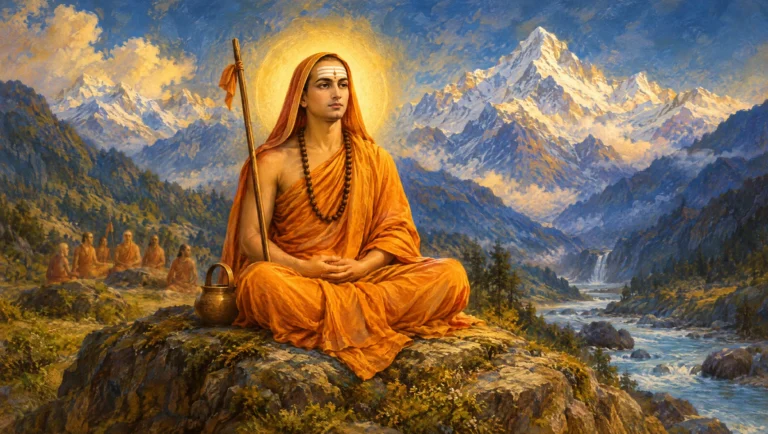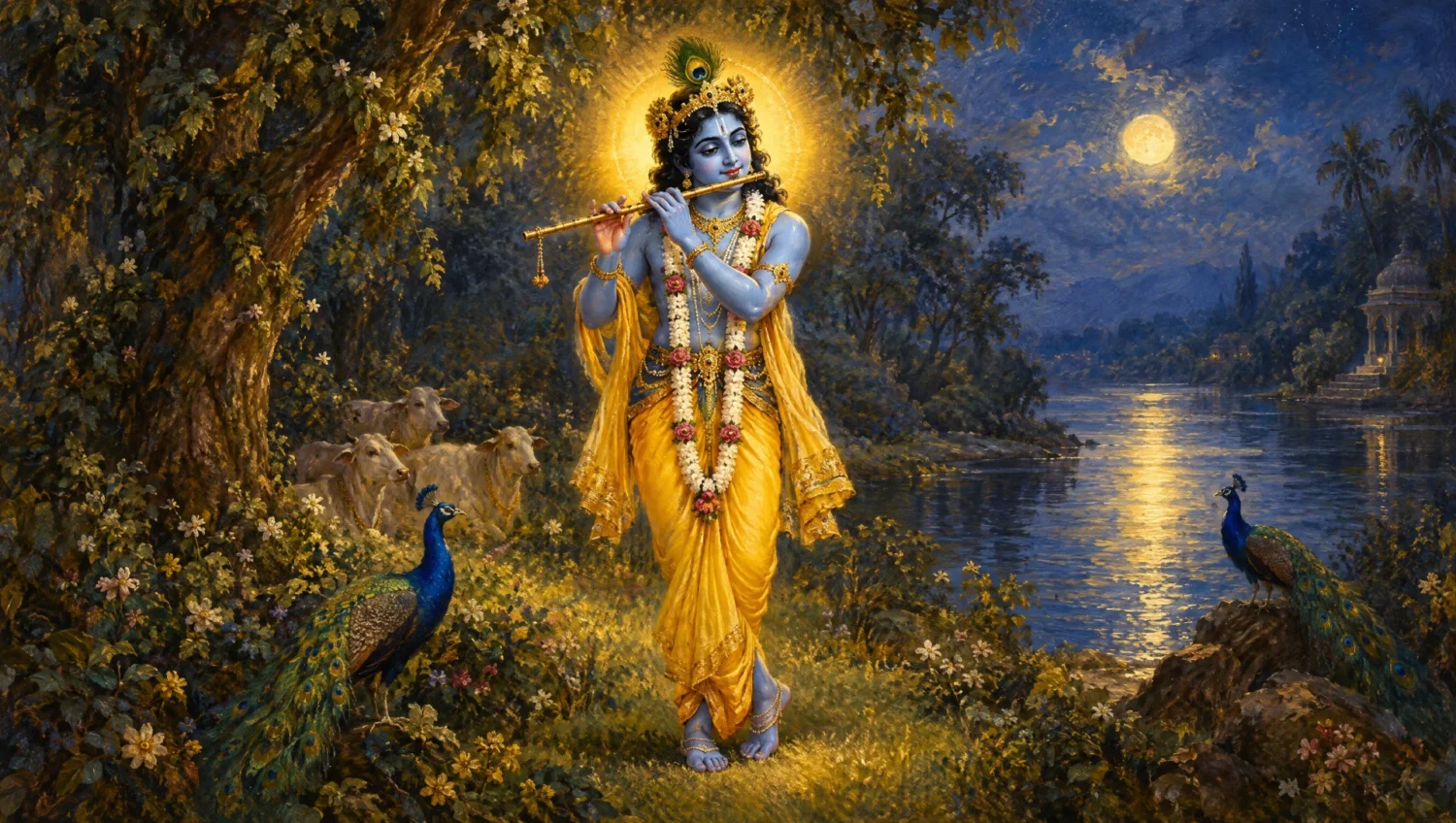
Blue-skinned, flute in hand, a peacock feather in his hair. A mischievous child who stole butter. A cowherd whose song drew everyone to the forest at midnight. A king, a statesman, and the charioteer who spoke the most famous dialogue in Indian spirituality on the eve of a war. Krishna is all of these, and more. For hundreds of millions of Hindus he is the Supreme Being himself, not a teacher or a master. This guide follows his story, explains the Bhagavad Gita, and looks at how different traditions understand him, including the esoteric view of him as a great teacher of humanity. We say plainly what is history, what is scripture and what is devotion.
Key Takeaways
- Who he is: Krishna is a central figure of the Hindu tradition, honored as an avatar of Vishnu and, in many devotional schools, as the Supreme Person.
- His story: Born in Mathura in a prison cell, raised among cowherds in Vrindavan, later a prince and statesman of Dwarka, and the guide of the Pandava prince Arjuna at Kurukshetra.
- His great teaching: The Bhagavad Gita, a 700-verse dialogue in the Mahabharata, on duty, the eternal Self, and the paths of action, knowledge and love.
- History and faith: Early evidence for Krishna worship goes back at least two thousand years. The traditional dates for his life, set thousands of years earlier, belong to belief rather than to records.
- How traditions differ: Advaita sees the Self as one. Devotional schools such as those of Ramanuja, Madhva and Chaitanya keep a lasting bond of love between soul and God.
- An ascended master? Theosophy and the Kriya Yoga lineages honor him as a great teacher. Vaishnavas hold him to be God himself. We keep these views separate and respectful.
In This Guide
- Who Is Krishna?
- What History Shows and What Faith Holds
- Born in a Prison Cell: The Birth Story
- Vrindavan: The Divine Child and Cowherd
- Radha, the Gopis and the Dance of Love
- Mathura and Dwarka: The Prince and Statesman
- Kurukshetra: The Chariot Between Two Armies
- The Bhagavad Gita: The Song of God
- Core Teachings of the Gita
- The Passing of Krishna
- How the Traditions Understand Krishna
- Legacy: Bhakti, Song and the West
- Krishna in the Kriya Yoga Lineage
- Krishna as an Avatar and a Master of Masters
- Honest Questions and Cautions
- A Practice: Seven Days with the Gita
- Books and Further Reading
- Keep Exploring
- Frequently Asked Questions
Who Is Krishna?
Krishna is one of the most beloved figures in all of spiritual history. His name comes from a Sanskrit word meaning “dark” or “dark blue,” and also, in some readings, “all-attractive.” Devotees call him by many names: Govinda, Gopala, Madhava, Hari, Vasudeva, Shyam, and Murari. Each one points to a different face of his story.
In the Hindu tradition he is an avatar, a descent of the divine, of the god Vishnu. For many devotees, especially in the Vaishnava schools, he is more than that. He is the source of all avatars, the Supreme Person, Svayam Bhagavan. He is worshipped in homes, in great temples at Vrindavan, Puri and Udupi, and in song across the world.
He is also the voice of the Bhagavad Gita, the “Song of God,” which Mahatma Gandhi, Western poets and countless modern seekers have called a companion for life.
Because Krishna is sacred to a living faith, we write about him as a guide, not as a skeptic or a missionary. We tell the story as the tradition tells it. When we step back to say what history does and does not show, we say so. And we explore his place among the great spiritual teachers of humanity, as our complete guide to the Ascended Masters does for others.
What History Shows and What Faith Holds
The story of Krishna lives in layers of texts. The main ones are the Mahabharata, the great epic of the Bharata dynasty. The Harivamsa, a later supplement to the epic, tells of his youth. And the Puranas, especially the Bhagavata Purana, which devotes its tenth book to his childhood and his love-play with the cowherd women.
Tradition credits Vyasa with composing the Mahabharata and the Bhagavata Purana. Scholars see the Mahabharata as growing over centuries, perhaps from about 400 BCE to 400 CE, with the Gita among its earlier insertions. The Bhagavata Purana is usually dated to the ninth or tenth century CE, although its devotees hold it to be far older.
Is there a historical Krishna? Some scholars think there may have been a chieftain behind the legend, and others see a figure shaped by merging several traditions. We have some real evidence of early worship. The Chandogya Upanishad mentions a Krishna, son of Devaki, as a student of a sage. A stone pillar at Besnagar in central India, raised around 110 BCE, was dedicated to Vasudeva by a Greek ambassador named Heliodorus, who called himself a devotee. This is strong evidence that Krishna devotion was already established over two thousand years ago.
The tradition itself places his life at the end of the Dvapara age, with his departure marking the start of the present Kali Yuga in 3102 BCE. These are the dates of sacred reckoning. No excavation has confirmed them. And claims about a drowned city near Dwarka are still debated by archaeologists. You can hear one researcher’s story in our conversation about the untold story of Dwarka with Amish Shah and in the film guide Dwarka: Atlantis of the East.
Born in a Prison Cell: The Birth Story
The story begins in Mathura, in the Yadava kingdom. The king, Kamsa, was a tyrant. At the wedding of his cousin Devaki to a nobleman named Vasudeva, a voice from the sky proclaimed that the eighth child of the couple would be the one to end Kamsa’s life.
Kamsa threw the couple in prison and killed their first six children as they were born. The seventh was transferred, by divine means, to the womb of another wife. The eighth was Krishna.
He was born at midnight, on the eighth day of the dark fortnight, in the rainy season. The tradition celebrates that night as Janmashtami, usually in August or September. The prison doors opened. The guards slept. Vasudeva carried the newborn in a basket across the flooded Yamuna River to Gokula, where the cowherd chieftain Nanda and his wife Yashoda lived. A serpent spread its hood to shelter the child from the rain.
In Gokula, Vasudeva exchanged his son for Yashoda’s newborn daughter and returned to the prison. When Kamsa dashed the baby girl against a stone, she rose into the sky as a goddess and warned that his destroyer lived elsewhere. In the Devi tradition she is honored as Yogamaya, the Mother’s own power.
This is sacred history, told with great tenderness. It does not need to be proven to be understood. It tells us that the divine can be born in the least expected place, hidden among simple people, in times of darkness.
Vrindavan: The Divine Child and Cowherd
Krishna grew up among the cowherds of Gokula and Vrindavan. The Bhagavata Purana and the folk tradition after it delight in these years.
He is the butter thief, who steals from the pots and smears his face. When Yashoda catches him and ties him to a mortar, he opens his mouth and she sees the whole universe inside. He is the toddler who uproots two great trees. He is the boy who dances on the head of the serpent Kaliya, to cleanse the Yamuna. He is the child who lifts Mount Govardhana on his little finger, to shelter the villagers from Indra’s storm.
Each of these stories has layers. To a child they are adventure. To a devotee they show the Lord’s accessibility: he comes as a baby to be loved, not as a king to be feared. To a philosopher they show that the divine plays within the world, not apart from it. The Sanskrit word for this is lila, divine play.
Vrindavan today is a living pilgrimage town, in the state of Uttar Pradesh. Pilgrims walk the forest paths, chant, and visit hundreds of temples. The place is, for many, as much a state of the heart as a location on the map.
Radha, the Gopis and the Dance of Love
The most intimate chapter of his story is the rasa lila. On an autumn night, Krishna plays his flute in the forest. The cowherd women hear it and leave everything: their homes, their families, their duties. They run to him. He dances with each of them at the same time, so that each feels he is dancing only with her.
This is not a love story in the usual sense. In the Bhagavata Purana and its commentaries, the gopis represent souls that have given up everything for the Divine. The dance shows God meeting each soul fully. The Sanskrit texts are careful to say that this love is utterly pure. In Vaishnava theology it is the highest example of bhakti, devotion that asks for nothing.
Radha, the beloved who stands above all the gopis, holds a special place. It is worth knowing that she does not appear in the Mahabharata or in the earliest Puranic accounts of Krishna’s life. She becomes central in later texts, such as the twelfth-century poem Gita Govinda by Jayadeva, and in the teachings of Chaitanya and others. In many Vaishnava schools, Radha is understood as the Divine Feminine in her own right, the power of divine love. If you wish to see a modern devotional movement built on this, our film guide on Hare Krishna tells that story.
Wise commentators have long cautioned against reading these scenes in a worldly way. The mystics of the tradition read them the way we read the Song of Songs: as the soul’s longing for union.
Mathura and Dwarka: The Prince and Statesman
Krishna’s childhood ends with his return to Mathura, where he and his brother Balarama overthrow Kamsa. He restores the rightful king, Ugrasena, and refuses the throne himself. He then studies under the sage Sandipani, and a famous story tells of his deep friendship with a poor classmate named Sudama. When Sudama arrives years later with a bag of flattened rice as his only gift, Krishna receives him as a brother and his poverty is quietly removed.
Facing repeated attacks from the king of Magadha, Krishna moves his people west to the coast and builds the city of Dwarka. He marries Rukmini, who writes to him begging to be rescued from an arranged marriage. In the tradition he has other wives, with elaborate theology around their number.
In this phase of his life he is a ruler, a tactician and a peacemaker. He is the cousin and advisor of the Pandava brothers, who are in conflict with their cousins the Kauravas over a throne. When war becomes unavoidable, he is the one who tries to stop it. He goes to the Kaurava court as an envoy, proposes that the Pandavas ask for only five villages, and is refused.
Then he does something remarkable. He offers both sides a choice. One may have his vast army. The other may have himself, unarmed. Arjuna, for the Pandavas, chooses Krishna. And Krishna agrees to be his charioteer.
Kurukshetra: The Chariot Between Two Armies
The two armies assemble on the plain of Kurukshetra. Arjuna, the greatest archer of his age, asks Krishna to drive his chariot between the lines so he can see his opponents. He sees teachers, cousins, uncles, friends. His courage collapses. His bow slips from his hand. He says he would rather live as a beggar than kill his own family.
And there, in the pause before the first arrow, Krishna begins to speak. That conversation is the Bhagavad Gita. It takes place in the middle of a battlefield, not in a temple or a cave. That is the point. The Gita was never meant for retreat. It was meant for the moment when you must act and do not know how.
The war lasts eighteen days and ends in great destruction. Krishna does not fight. He guides, and sometimes uses shrewd means. The epic does not hide the moral cost. It ends with grief on every side. The Gita’s call to action must be read in that light.
The Bhagavad Gita: The Song of God
The Gita is a dialogue in 700 verses and 18 chapters, set inside the Bhishma Parva of the Mahabharata. Its speaker is Krishna. Its listener is Arjuna. Its narrator is Sanjaya, who relays the scene to the blind king Dhritarashtra.
It is one of the three foundations of Vedanta, alongside the Upanishads and the Brahma Sutras. Great teachers of every school have written commentaries on it: Shankara, Ramanuja, Madhva, Abhinavagupta, Tilak, Gandhi, Aurobindo, Vivekananda and Yogananda.
The Gita does not offer a single path. It offers several, and shows that they converge. Here is a short map.
| Path | Sanskrit | What it asks |
|---|---|---|
| Action | Karma Yoga | Do your work fully, without clinging to the results. Offer it up. |
| Knowledge | Jnana Yoga | See through the body and mind to the eternal Self. |
| Devotion | Bhakti Yoga | Love the Divine with the whole heart. Surrender. |
| Meditation | Dhyana Yoga | Train the mind into stillness until it rests in the Self. |
The Gita’s voice is intimate and urgent. It says that you are not your body. It says that action is unavoidable, and that the question is how to act. And it says that the Divine is not far away but stands at the center of your own life, driving your chariot.
Core Teachings of the Gita
The Self Is Eternal
In the second chapter, Krishna begins with the deepest point. The Self was never born and never dies. Weapons cannot cut it, fire cannot burn it. The body is like a garment, worn and cast off. Grief for the body, he says, is grief for what was always passing. This is the first foundation of the teaching, and the root of its calm.
Act Without Clinging to the Fruit
The most quoted idea of the Gita is the call to nishkama karma, action without attachment to its results. You have a right to the work, Krishna says, but not to its fruits. This does not mean doing a poor job. It means giving your best and letting go of the anxious grasping after outcomes. It turns work into a form of prayer.
The Divine Descends When Needed
In the fourth chapter, he says that whenever dharma declines and unrighteousness rises, he comes forth. For the protection of the good and the restoration of dharma, he is born age after age. This is the source of the Hindu doctrine of avatars.
Offer Everything with Love
In the ninth chapter the tone softens. A leaf, a flower, a fruit, a little water, offered with love, he says, is accepted. It is not the size of the gift that matters but the heart in it. Devotion needs no wealth.
The Universal Form
In the eleventh chapter, Arjuna asks to see Krishna’s true nature. Krishna grants him divine sight, and Arjuna beholds the cosmos in a single body: all gods, all beings, creation and destruction. He is terrified and awestruck. He begs Krishna to return to his gentle form. This is one of the great mystical visions in world literature. It balances intimacy with infinity.
Surrender
The teaching reaches its summit in the final chapter. Krishna asks Arjuna to give up all other supports and take refuge in him alone, and promises freedom from fear. Just before this he says something worth noticing. “Reflect on all this fully,” he says, “then do as you choose.” Even God does not command Arjuna. He invites.
The Passing of Krishna
The epic and the Puranas tell of a sad ending. Thirty-six years after the war, the Yadava clan destroys itself in a drunken brawl. Krishna’s brother Balarama leaves his body in meditation. Krishna himself sits quietly in a forest. A hunter named Jara, mistaking his foot for a deer, shoots an arrow that wounds him. Jara realizes what he has done and weeps. Krishna forgives him and departs from the world.
The sea then rises and takes Dwarka. The tradition marks this moment as the beginning of the Kali Yuga.
How do devotees understand this? Krishna’s death is called a lila as well, the final act of a play. Having done his work, the Lord withdraws. His teaching and his name remain. Many Vaishnavas hold that Krishna never really leaves, and that he is eternally present in Vrindavan.
How the Traditions Understand Krishna
Hindu thought is wide, and Krishna means different things within it.
| Tradition | Teacher | How Krishna is seen |
|---|---|---|
| Advaita Vedanta | Adi Shankara (about 8th century) | Krishna speaks as the Absolute. The Gita’s goal is to know the Self as one with Brahman. Devotion purifies the mind for that knowing. |
| Vishishtadvaita | Ramanuja (11th to 12th century) | Krishna is Vishnu, the personal God. Souls are parts of God and remain forever his servants and lovers, even in liberation. |
| Dvaita | Madhva (13th century) | God and the soul are eternally distinct. Krishna is the Supreme, and liberation is nearness to him. |
| Gaudiya Vaishnavism | Chaitanya (1486 to 1534) | Krishna is the source of all avatars. Loving, joyful devotion, especially chanting his names, is the highest path. |
These are old, respectful debates. A good student reads the Gita with all of them in mind. You will notice that a single verse can be read as a call to knowledge, to love, or to service, depending on the teacher. That is one reason it has stayed alive for so many centuries. If the nondual reading draws you, our guide to what non-duality means gives a plain introduction.
Legacy: Bhakti, Song and the West
From the sixth century onward, a wave of devotional poetry swept India. Krishna was its beloved. Mirabai, a Rajput princess of the sixteenth century, sang to him as her husband and left her palace. Surdas, the blind poet, sang of his childhood. Jayadeva, Vidyapati and Chandidas wrote of Radha and Krishna. In the dance forms of Kathak, Odissi and Manipuri, the stories live on.
Chaitanya Mahaprabhu, born in Bengal in 1486, taught that the highest practice was the congregational chanting of God’s names. His movement spread across Bengal and Odisha and made Vrindavan a living center again.
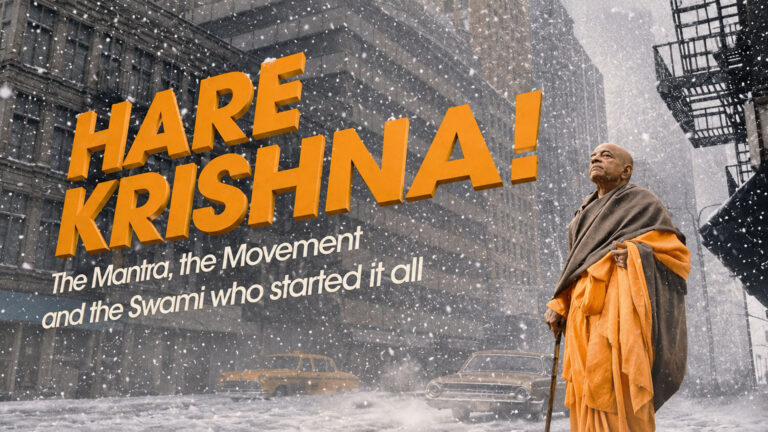
In 1965, A.C. Bhaktivedanta Swami Prabhupada, then in his late sixties, sailed to New York with almost nothing. In 1966 he founded the International Society for Krishna Consciousness, known as ISKCON. Within a few years its chanting was heard in city parks and on records, and George Harrison helped carry the mantra to a wide audience. The documentary on Next Level Soul, Hare Krishna! The Mantra, the Movement and the Swami Who Started It All, tells that story, and our film guide gives context.
The Gita traveled west far earlier. Emerson and Thoreau read it in the nineteenth century. J. Robert Oppenheimer studied it in Sanskrit. T.S. Eliot echoed it in the Four Quartets. Yogananda opened the book to whole generations of Americans, which we come to next. If you wish to hear a living teacher of the ancient path, listen to Keshava Swami on ancient spiritual wisdom for humanity’s great awakening.
Krishna in the Kriya Yoga Lineage
Yogananda placed Krishna, alongside Jesus Christ, at the heart of his teaching. He saw them as two great expressions of the one divine consciousness, one from the East and one from the West. His commentary on the Gita, God Talks with Arjuna, reads the battlefield as the inner field of the soul. Arjuna’s war against the Kauravas, in his reading, is the struggle of the discerning mind against the forces of the senses and the ego.
The Kriya lineage holds that Krishna taught a form of the breath-based yoga that later came through Babaji, Lahiri Mahasaya and Sri Yukteswar. The tradition points to a verse in the fourth chapter of the Gita about offering the incoming breath into the outgoing breath, and the outgoing breath into the incoming. Kriya teachers read this as a reference to the technique. Other commentators read it as describing ordinary breath-control practices. We report the lineage’s view as theirs.
Lahiri Mahasaya, the householder yogi, wrote commentaries on the Gita and is remembered for teaching it to ordinary working people. Sri Yukteswar, his student, wrote The Holy Science, which draws the Gita and the Bible together. If you want to meet this lineage, read our guides to Paramahansa Yogananda, Lahiri Mahasaya, Sri Yukteswar and Mahavatar Babaji, and our introduction to Kriya Yoga meditation. You can also watch Awake: The Life of Yogananda, available on Next Level Soul.
Krishna as an Avatar and a Master of Masters
The phrase “ascended master” does not come from Hindu thought. It comes from the Theosophical movement and the teachings that followed it. A Vaishnava devotee would likely say it falls short. In their view, Krishna is not a human who attained mastery. He is God, who chose to appear as a human.
The Theosophists took a wider view. They honored Krishna as one of the great Avatars, along with the Buddha and Jesus, a divine teacher who comes at the turn of the ages. Later esoteric writers placed him among the great Teachers who work for the spiritual growth of the world. In the Kriya tradition, as we saw, Krishna is a master of the highest science of the soul.
Where do these meet? Perhaps here. All of them agree that Krishna’s presence did not end at Dwarka. The devotee feels him in the heart, hears him in kirtan, finds him at a temple door. The mystic hears him in the Gita whenever it is read with sincerity. And the seeker who has never opened a scripture may feel his voice in the sudden quiet that follows the question, “What is my duty now?”
For the wider family of the masters, see our complete guide to the Ascended Masters.
Honest Questions and Cautions
Dates are sacred, not historical. The traditional dates for Krishna’s life cannot be confirmed by archaeology. Different parts of his story come from texts written over more than a thousand years.
The Gita and war. The Gita asks a warrior to fight, and has been used by some to justify violence. Many Indian thinkers, including Gandhi, read the battle as inward. Others, such as Tilak, read it as a call to action in the world. The text itself holds both layers. Read it slowly and ask what it asks of you.
The Gita and caste. The Gita speaks of the four varnas, social orders, and of duties that follow from one’s nature. Different teachers read these passages differently: as a description of temperament, or as a social order that has caused real harm. We think honesty requires naming that debate.
Many translations. The Gita changes with the translator. Some bring a particular lineage’s view, and some are mostly commentary. Try two or three versions, and notice what each emphasizes.
Respect for living faith. Krishna is not a symbol to millions, but a living presence. If you borrow his teaching, honor the people who hold it sacred.
A Practice: Seven Days with the Gita
This week is faith-neutral. You can use the name Krishna, another name of the Divine, or simply “the Self.”
- Day 1: Read. Read the opening of the second chapter, from Arjuna’s despair to Krishna’s first words. Sit with how real the confusion is.
- Day 2: Remember the Self. Sit for five minutes. Silently say: I am not this body, I am not these thoughts. Let the awareness behind them be your resting place.
- Day 3: Offer your work. Before one task, whisper: this is for the Divine. Do it with full care.
- Day 4: Let go of one outcome. Choose one thing you are anxious about. Do your best, then release the result in your heart.
- Day 5: Chant. For five minutes, repeat a name of God aloud or inwardly. Many people use the Hare Krishna mantra. Others use Om or a word that feels warm.
- Day 6: Make a small offering. Place a flower, a leaf or a glass of water on a table with love. This echoes the Gita’s teaching that a simple gift, given with love, is enough.
- Day 7: Surrender and write. Sit quietly and ask for guidance on one real question. Write down what arises, without editing.
The Gita says the fruit of practice ripens in its own time. Do not rush it.
Books and Further Reading
- The Bhagavad Gita, translated by Eknath Easwaran. A clear, warm and readable version with an excellent introduction.
- God Talks with Arjuna: The Bhagavad Gita, by Paramahansa Yogananda. A mystic’s verse-by-verse commentary from the Kriya Yoga tradition.
- Krishna: The Beautiful Legend of God, the tenth book of the Bhagavata Purana in a Penguin Classics translation. The best way to meet the child and the cowherd of Vrindavan.
- The audiobook The Eternal Self: The Wisdom of the Bhagavad Gita, available on Next Level Soul.
- Bhakti Yoga and Karma Yoga, by Swami Vivekananda, as audiobooks on Next Level Soul.
Book links are Amazon affiliate links. If you buy through them, it supports our work at no extra cost to you.
Keep Exploring
If the idea of cause and effect in the Gita interests you, read our guide to understanding karma. To see how a modern American seeker met this tradition, read about Self-Realization and the path within. And for the many other beings who guide the human family, return to our complete guide to the Ascended Masters.
Two audio courses sit close to Krishna’s path. Rumi’s Eternal Dance offers 27 lessons on love, presence and silence, in the spirit of devotion that Krishna’s lovers knew. The Yogi’s Guide to the Infinite gives 14 lessons of mystic wisdom from the East. Both are included with Next Level Soul membership. See the Next Level Soul Mastery overview for more, or begin with a free masterclass.
Watch Ascended Masters, Channeled on Next Level Soul TV
An eight-episode series in which renowned channeler Genevieve Taeger brings through Buddha, Mary Magdalene, Athena, Mother Mary, Jesus, Saint Germain, Yogananda and Kuan Yin. Each episode is a channeled message, offered as spiritual guidance and not as historical record.
Episodes that connect with this guide: Ascended Master Yogananda and Ascended Master Buddha.
Frequently Asked Questions
Who is Lord Krishna?
Krishna is a central figure in Hinduism, honored as an avatar of Vishnu and, in many devotional traditions, as the Supreme Being. He is the charioteer and teacher in the Bhagavad Gita, and the child and cowherd of Vrindavan.
When did Krishna live?
Tradition places his life at the end of the Dvapara age, with his departure in 3102 BCE. Historians cannot confirm these dates. Evidence of Krishna worship, such as the Heliodorus pillar at Besnagar, goes back to about 110 BCE.
What is the Bhagavad Gita?
It is a dialogue of 700 verses between Krishna and the warrior Arjuna, found in the Mahabharata. It teaches the eternal Self, selfless action, knowledge, devotion and surrender.
What is Janmashtami?
It is the festival of Krishna’s birth, held on the eighth day of the dark fortnight in the month of Bhadrapada, usually in August or September. Devotees fast, sing and wait for midnight, the hour of his birth.
Who is Radha?
Radha is Krishna’s beloved, honored in many Vaishnava traditions as the embodiment of divine love. She does not appear in the Mahabharata and becomes prominent in later devotional texts such as Jayadeva’s Gita Govinda.
What does the Hare Krishna mantra mean?
The mantra calls on the names Hare, Krishna and Rama. Devotees see it as a call to the Lord and to his energy of love, and chant it as the central practice of Gaudiya Vaishnavism.
Is Krishna an ascended master?
Devotees regard Krishna as God himself, not as a master. Theosophy and some Kriya Yoga teachings honor him as a great Avatar and teacher. Our guide to the Ascended Masters explores how these views relate.
Where can I learn more about Krishna on Next Level Soul?
Watch Hare Krishna! The Mantra, the Movement and the Swami Who Started It All or listen to The Eternal Self: The Wisdom of the Bhagavad Gita, both available on Next Level Soul.
Do I have to be Hindu to read the Gita?
No. People of every faith have found guidance in it. Gandhi, who was Hindu, loved the Sermon on the Mount. Readers of many backgrounds turn to the Gita for its practical advice on action and inner steadiness.
Which translation of the Gita should I start with?
Many readers begin with Eknath Easwaran’s clear and warm translation. If you love the mystical Kriya tradition, try Yogananda’s God Talks with Arjuna. Reading two versions side by side is often the best way.