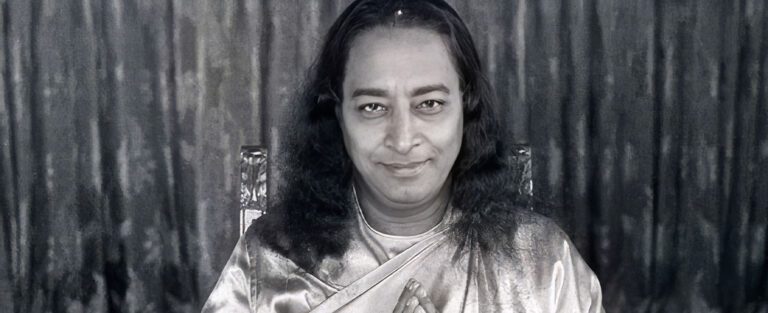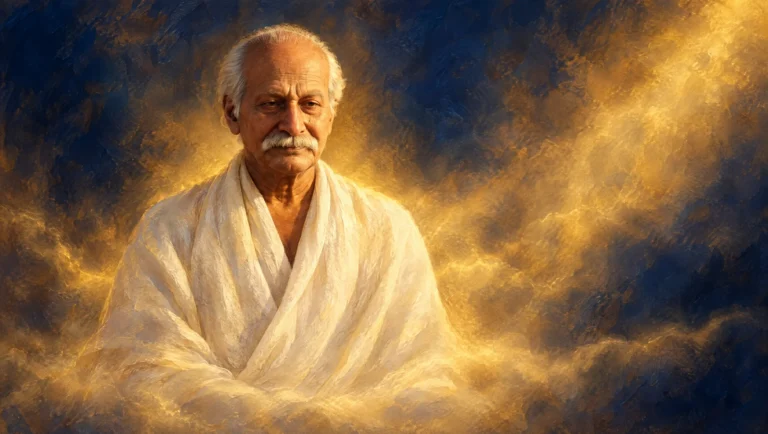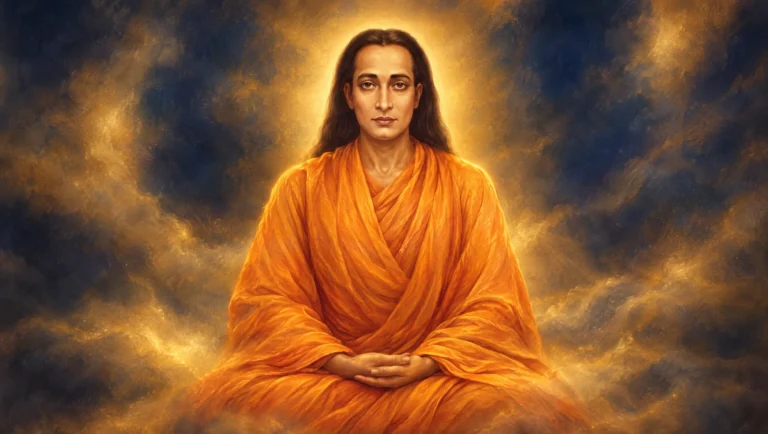
Some teachers are remembered for what they said. Sri Yukteswar is remembered for what he made possible. He was the guru of Paramahansa Yogananda, a trusted link in the Kriya Yoga lineage, and the author of one of the most unusual spiritual books of the nineteenth century. He did not chase attention. He trained a student, and that student carried the message across an ocean. This is his full story, told from the accounts we have, with the legends marked as legends.
If you have read Autobiography of a Yogi, you already know him as the stern, funny, deeply loving master of the Serampore hermitage. If you have only seen him as a photograph, a calm figure with a long white beard, this guide will fill in the man behind the picture. His story is also told on screen in Awake: The Life of Yogananda, which is available on Next Level Soul. The trailer above gives you a first look.
Who Was Sri Yukteswar?
Sri Yukteswar was born Priya Nath Karar on May 10, 1855, in Serampore, a river town in Bengal not far from Calcutta. He died on March 9, 1936, in Puri, on the eastern coast of India. In between, he lived three lives in one. He was a married householder with a family. He was a widely read student of science, scripture and astronomy. And in his later decades he was a swami and a teacher whose hermitages drew a small, devoted circle of students.
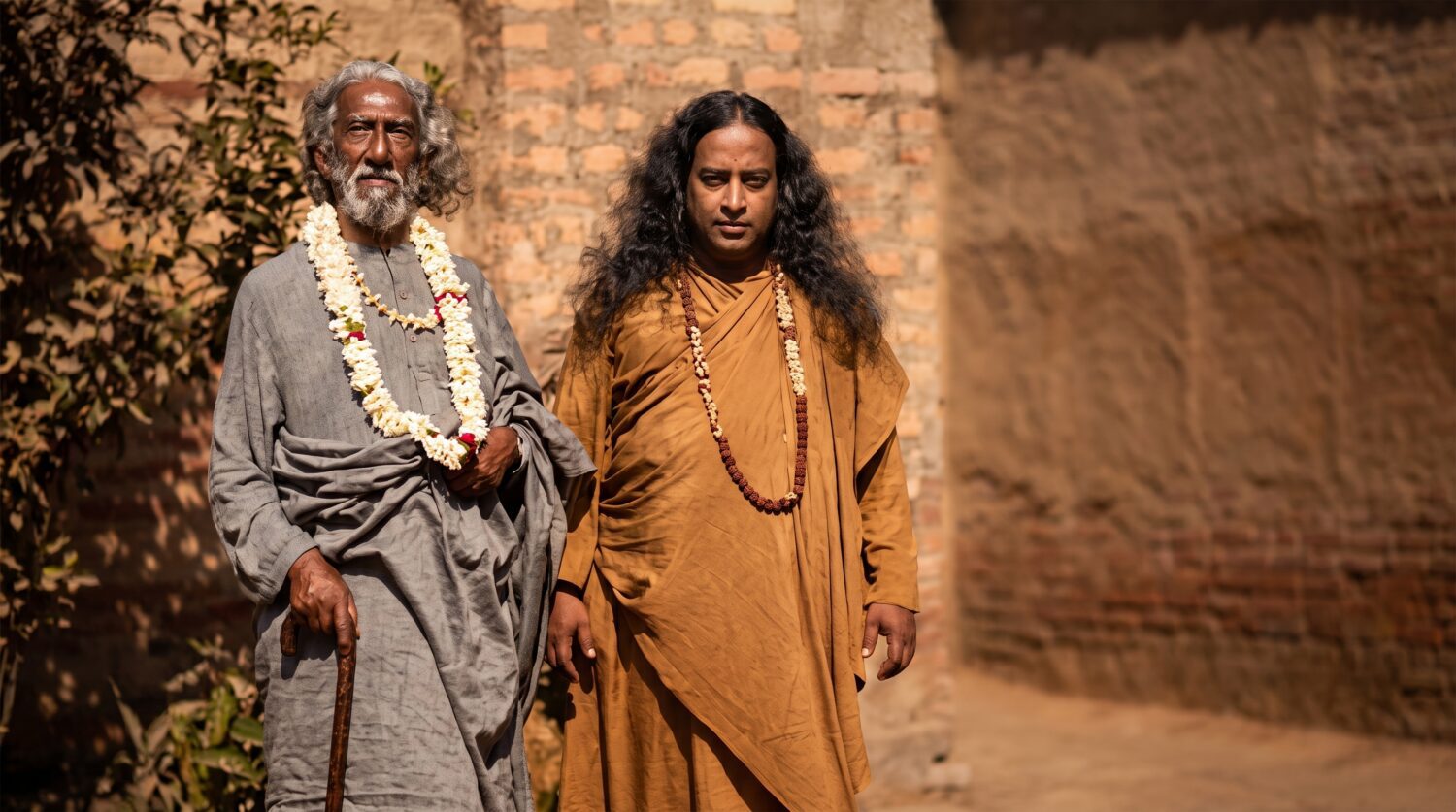
The name by which most of us know him is a monastic one. Swami is a title for a renunciate. Giri means mountain, and it is one of the ten traditional branches of the swami order. Yukteswar is usually explained as “one who is united with God,” and Sri is a respectful honorific. Put together, the name is a statement of purpose.
What makes him stand out is the combination. He was an intellectual who did not hide from hard questions. He was a mystic who distrusted spiritual showmanship. And he was a guru who believed that his job was to make himself unnecessary. Those three qualities run through every story told about him.
Most of what we know about his personality comes from his best-known student. Yogananda’s Autobiography of a Yogi gives him many chapters and runs him like a thread through the rest. That means the picture we carry is a devotee’s portrait, written with love. We will lean on it, and we will say so each time we do.
A Boy from Serampore
Priya Nath grew up in a comfortable Bengali family. Serampore, where he was born, had a long history as a Danish trading settlement and later became a center of printing, education and missionary activity. That mix of influences shaped the boy. He grew up around Hindu household practice, around the Bible and around the questions of an India that was changing quickly under British rule.
He studied at Serampore College, where he read the Bible closely and took an interest in science. This detail matters. Many people picture a swami as someone who came out of a cave. Sri Yukteswar came out of a classroom. He could argue a verse of Genesis in the morning and discuss the movements of the stars in the evening, and he felt no tension between the two.
As a young man he also showed the quality that his students later described as plain dealing. He said what he saw, whether or not it flattered. In a culture that prizes politeness, that was unusual. It also made him a trustworthy teacher, because a person who does not flatter you is a person you can believe.
Householder, Student and Seeker
Before he became a monk, Sri Yukteswar married and had a daughter. After his wife died, he took the next step on a path he had been preparing for. We do not have many details about these years, and it is better to say so than to invent them. What we can say is that he did not begin as a renunciate. He knew the work of supporting a household, and he knew what it was to love and to lose.
That background shaped his teaching. When he spoke to householders, he spoke as one of them. He never taught that you must abandon your life to find God. He taught that you must put God first inside the life you have. For the readers we serve at Next Level Soul, that is a welcome idea. You do not have to leave your family, your work or your city to take the path seriously.
During these years he was also a restless seeker. He had read widely and practiced sincerely, and he felt that something was missing. In the accounts handed down, the missing piece was not information. It was a living teacher who could show the practice and stand behind it.
Meeting Lahiri Mahasaya
The teacher he found was Lahiri Mahasaya of Benares, now called Varanasi. Lahiri Mahasaya was himself a householder, an accountant by profession, and he had received Kriya Yoga from Mahavatar Babaji in the Himalayan foothills in the 1860s. You can read the whole story in our guide to Lahiri Mahasaya.
In the account that comes to us through Yogananda, Sri Yukteswar met Lahiri Mahasaya and recognized in him the teacher he had been looking for. He became a close disciple and received initiation into Kriya Yoga. He later said that his years with Lahiri Mahasaya were the turning point of his life.
Think about what Lahiri Mahasaya offered. He did not offer a belief system. He offered a technique, a method of working with breath and attention to quiet the mind and turn it toward the Self, along with a living example of what a person looks like after years of that practice. That is a very different kind of authority from a book or a sermon. You can test it.
This is the heart of the Kriya tradition, and it is the reason the lineage matters. The practice does not float free of its teachers. It is passed from one person to another, and Sri Yukteswar is the third link in the chain that reaches Yogananda: Babaji, Lahiri Mahasaya, Sri Yukteswar, Yogananda.
Becoming a Swami
In the 1880s, Sri Yukteswar took formal monastic vows and received the name by which we know him. Yogananda’s account places this initiation in the Giri branch of the swami order, at the hands of a monk at Buddha Gaya, the place where the Buddha is said to have attained enlightenment. The location is a quiet statement all by itself: this was a Hindu monk taking his vows at a Buddhist holy site, and nobody in the story thought that was strange.
The swami vows meant leaving ordinary worldly ambitions behind. They did not mean leaving the world. Sri Yukteswar lived in the town of his birth, in his family house, and kept an open door. He is a good example of a type of renunciate that India has always produced, the monk who lives in the middle of things and keeps his inner life firm.
If you wonder what changes when someone takes vows like these, the accounts suggest that the change was mostly inward. His daily routine became simple. His attention turned toward teaching, writing and practice. And his sense of responsibility deepened, because a swami who takes a student takes on that student’s growth as well.
The Kumbh Mela and Babaji
The best-known event of his middle years is a meeting that, if the accounts are right, changed the course of his work. In January 1894, Sri Yukteswar attended the Kumbh Mela at Prayag, today called Prayagraj. The Kumbh Mela is the great Hindu pilgrimage, held in turn at four sacred river sites, and it draws millions of people who come to bathe, pray and listen to teachers.
According to Autobiography of a Yogi, he met Mahavatar Babaji there. Babaji is the deathless master said to have revived Kriya Yoga for this age, and he is reported to have stayed out of public view. In Yogananda’s telling, Babaji greeted Sri Yukteswar warmly, praised his devotion and then asked him to write a book showing the harmony between the Christian scriptures and the Hindu scriptures. He also asked him, in time, to train a disciple who could carry Kriya Yoga to the West.
Here we need to be careful and fair. This is a spiritual account, not a documented historical record. There are no outside witnesses, and Babaji, by the tradition’s own description, did not leave a paper trail. People of faith take the story as true. Skeptics treat it as devotional tradition. What can be said without argument is that the book Sri Yukteswar wrote next exists, and that his student did cross the ocean. The meeting, whatever one makes of it, sits at the hinge of both events.
For a fuller picture of the figure he is said to have met, read our guide to Mahavatar Babaji.
The Holy Science
The book that came out of that meeting is The Holy Science, also known by its Sanskrit title, Kaivalya Darshanam, which can be translated as the vision of the absolute. It was published in 1894 and is short, dense and unlike anything else on the shelf. Find The Holy Science on Amazon.
The book is organized in four parts, which Sri Yukteswar called the Gospel, the Goal, the Procedure and the Revelation. In the first part he lays out the basic truths he believes every religion points to. In the second he describes the aim of all spiritual effort, which is to know the Self and be free of the sense of separateness. In the third he describes the inner path, including the role of Kriya Yoga. In the fourth he turns to the Bible’s Book of Revelation and reads it as a map of inner experience rather than a prediction of outer disaster.
That last choice is worth pausing on. Many readers treat Revelation as a puzzle about the end of the world. Sri Yukteswar reads it as a description of the awakening of consciousness through the spine and the energy centers, a kind of symbolic autobiography of every seeker. Whether or not you agree, the reading shows how he approached all scripture: as a language of inner experience written by people who had actually had it.
Two features make the book distinctive. First, it uses the Hindu philosophy of Sankhya and the Christian Bible together, as if they were two dialects of one language. Second, it is unusually compact. He was not trying to impress. He was trying to pass something along.
Readers should know that The Holy Science is not an easy first read. Many people find it more rewarding after they have read Autobiography of a Yogi, which gives the emotional and human context for the ideas.
The Yugas: A Different Reading of Time
One of the most talked-about ideas in the book is his account of the yugas. In Hindu tradition, time moves through four great ages: Satya, Treta, Dvapara and Kali, from the most enlightened to the most clouded. The popular version says that we are living in the Kali Yuga, an age that lasts hundreds of thousands of years, and that humanity is in a long decline.
Sri Yukteswar disagreed. He argued that the traditional reckoning had been miscalculated over centuries of copying, and that the real cycle is far shorter, about 24,000 years, tied to the slow wobble of the Earth’s axis that astronomers call the precession of the equinoxes. In his scheme, the cycle has a descending half and an ascending half. The darkest point, he said, passed around 500 CE. Since then humanity has been rising, and the Dvapara Yuga, an age of growing understanding of subtle energies, began around 1699 CE.
You do not have to accept the details of his astronomy to feel the weight of the claim. His message is that we are not stuck at the bottom of a pit. We are in a period of rising awareness, and the developments of the last few centuries, from the discovery of electricity to the study of the mind, are signs of that climb.
Scholars of Indian astronomy and religion have debated his numbers, and many do not accept them. We mention that so you can hold the idea the way he offered it: as a visionary reading of time, put forward by a man who also had a science background, rather than as a settled fact. What we can say with confidence is that it is a hopeful reading, and that it fits his steady habit of looking at the world and finding reasons for courage.
The Bible and the Gita Side by Side
It was unusual in his day for a Hindu monk to read the Bible with such affection. Sri Yukteswar did it naturally, and he saw no conflict between Jesus and Krishna. He taught that the saints of every tradition had touched the same truth, and that the differences between religions came mostly from language, culture and later disputes among followers.
This stance became part of Yogananda’s own teaching. Years later, Yogananda wrote long commentaries on both the Bhagavad Gita and the Gospels, and in the second of those he treated Jesus as a master of the same inner science his own lineage taught. That approach started in the hermitage at Serampore. You can see a modern echo in our own film Marketing the Messiah, which asks what Jesus actually taught.
For the seeker who has left a rigid religious background and feels unsure what to keep, this is a generous model. You do not have to throw out the beauty of the tradition you grew up in. You can ask what it was pointing at. Sri Yukteswar did exactly that with the tradition he knew best.
The Hermitages at Serampore and Puri
Sri Yukteswar kept two main places of teaching. The first was his hermitage at Serampore, in the family house where he had grown up, close to the Ganges. The second was a seaside hermitage in Puri, which he established in the early twentieth century. In both places, the pattern was the same. A small number of students lived close by, studied scripture, practiced meditation and did the daily work of the household.
Life there was plain. According to Yogananda, the hermitage was clean but bare, the schedule was steady and nobody was pampered. Students swept, cooked, meditated and studied. In the accounts, visitors came and went, among them professors, officials and curious neighbors, and Sri Yukteswar treated them all with the same dry courtesy.
The Puri hermitage sat near the sea, and the sea shows up often in the stories. Some of the most tender moments in the Autobiography take place on its terraces. If you want a picture of how this lineage felt from the inside, those scenes are a good place to start.
Teaching Without Theatre
Accounts of Sri Yukteswar agree on one point: he disliked spiritual drama. He was reserved about miracles. He did not encourage students to chase visions. If a student arrived excited about a mystical experience, he was likely to ask how that student was treating their family.
His humor was dry and his honesty was complete. He would tell students plainly where they were falling short, and he did not repeat himself. Yogananda describes being scolded, sometimes sharply, and later realizing that every correction had been exact. The scolding came from love, and the love was steady.
His method contained several habits that any of us can borrow:
- Tell the truth kindly, and tell it once. Repeated nagging is a sign that you want control. A single clear statement is a sign that you trust the other person.
- Keep practice daily and ordinary. He did not ask for dramatic effort. He asked for faithful effort.
- Study with your mind and your heart. He asked for both, and he did not accept the idea that spirituality meant switching off your intelligence.
- Do not make a show of your inner life. What you are doing in meditation is between you and God.
This is the opposite of the loud, outward-pointing spirituality that many seekers have grown tired of. His authority came from steadiness. And he gave his students a way to find the same steadiness in themselves.
Meeting Yogananda
In 1910, a teenage boy named Mukunda Lal Ghosh, later known as Paramahansa Yogananda, met Sri Yukteswar in Benares. The boy had run away from home to search for a teacher, and had been disappointed more than once. According to his account, when he first saw Sri Yukteswar, he knew at once that this was the man he had been seeing in visions since childhood.
The account says that Sri Yukteswar greeted him as someone he had been waiting for, and that the two recognized each other immediately. The boy touched his feet and asked to be accepted as a disciple. The teacher agreed, and said that the boy would come to him fully only when he was ready.
Readers of the Autobiography will remember how affectionate and how severe the relationship was. The guru asked for obedience and gave in return a love so steady that Yogananda later wrote that nobody else had ever loved him in quite the same way. If you are curious about the student’s side of the story, our guide to Paramahansa Yogananda follows his life from Gorakhpur to Los Angeles.
The Serampore Years
After finishing his studies, Yogananda joined the hermitage in Serampore in 1915 and took monastic vows, receiving the name Yogananda, which can be translated as bliss through union. For about five years he lived there as a disciple, and the rest of the Autobiography’s early chapters are drawn from that time.
What did the training look like? Not what most people expect. There was meditation, but there was also study, housework, gardening, errands and long conversations. Sri Yukteswar corrected small things: how Yogananda held his body, how he spoke to visitors, how he handled his own temper. The accounts suggest that he believed spiritual realization was built from small habits repeated until they became second nature.
It was also a time of ordinary human friction. Yogananda was a lively, impulsive young man, and he did not always like what he heard. There are moments in the Autobiography when he rebels, and moments when he sulks. What stands out is how patient the teacher was. He allowed his student to be difficult, and he did not take it personally.
During these years Sri Yukteswar also guided his student toward the practical work that lay ahead. He wanted Yogananda to combine meditation with education, and to teach young people how to live well. That idea became Yogananda’s school for boys, founded in 1917, a forerunner of his later organizations.
Astrology and the Metal Bangle
One of the more surprising stories in the Autobiography concerns astrology. Sri Yukteswar was a student of the subject, and he taught that the positions of the planets reflect tendencies in a person’s life. He did not use astrology to predict doom. He treated it as a way to understand timing, and to prepare.
In Yogananda’s account, the guru had him wear a metal armlet designed to reduce the effect of certain difficult planetary influences, and a stretch of troubles passed more lightly than they otherwise might have. Whatever you think of the details, the principle he stated is worth keeping: the stars incline, they do not compel. A person who is anchored in the Divine, he taught, is not simply a plaything of planetary forces.
If you are curious about how astrology and spirituality meet today, you can hear a modern astrologer talk through the same questions in our conversation with Debra Silverman.
Sending a Student to the West
By 1920, Sri Yukteswar had made a decision. His student would leave India. The accounts say that the guru had been preparing for it for years, and that Babaji had given the same instruction. When an invitation arrived for Yogananda to speak at an international gathering of religious leaders in Boston, the guru’s answer was ready.
Yogananda did not want to go. He loved his homeland, his guru and the quiet life of the hermitage, and he was afraid. The guru told him, in effect, that the time had come, and that the teaching was needed. The film Awake treats this moment with tenderness. It notes that the instruction came right after the First World War, when Sri Yukteswar sensed that harder years lay ahead and that the world would need the practice of inner stillness more than ever.
Yogananda sailed for America and arrived in Boston in 1920. He went on to found Self-Realization Fellowship, to lecture across the United States and eventually to publish Autobiography of a Yogi in 1946. In a sense, every reader of that book is a reader of Sri Yukteswar too, because the guru’s voice and example are in nearly every chapter.
It is worth noting what Sri Yukteswar did and did not do. He did not go to the West himself. He did not build an organization. He trained one person well, gave him his blessing and let go. If you are a parent, a teacher or a mentor, that is a model worth thinking about.
The Final Years and Mahasamadhi
Yogananda returned to India in 1935 and spent about a year with his guru. By his own account, it was a tender and happy reunion. During this visit, Sri Yukteswar conferred on him the title Paramahansa, which means supreme swan, a Sanskrit term for a person of the highest realization. Yogananda used the title for the rest of his life.
Sri Yukteswar died in Puri on March 9, 1936. In the language of his tradition, he entered mahasamadhi, a term for a master’s conscious exit from the body. Yogananda was in India at the time and took part in the final rites.
The film Awake treats the moment of loss with great honesty. The narration notes that the “Lion of Bengal” was gone, and Yogananda’s own recorded grief is rendered simply and without ornament. That tenderness is part of why the film works. It lets us see that a man we call a master was also a student who missed his teacher.
The Return: Yogananda’s Account
The Autobiography contains one more chapter about Sri Yukteswar, and it is the most astonishing. Yogananda reports that, some months after his guru’s death, Sri Yukteswar appeared to him in a hotel room in Bombay in a body that looked solid and warm. According to the account, the two talked at length, and the guru described the subtle realm where he now worked and answered questions about life after death.
This is a story of faith, told by a disciple, and it should be understood that way. Some readers find it deeply consoling. Others treat it as a spiritual teaching in narrative form. We think the most useful way to hold it is to notice what the story says about love. In the tradition’s telling, the bond between teacher and student did not end at the grave. If you have lost someone close to you, you may find the idea comforting even if you hold it lightly.
For a wider look at how seekers understand contact with those who have passed, you may enjoy our guide to ascended masters and our Spiritual Cinema collection.
His Teachings, Simply Put
Sri Yukteswar left a small written legacy, but his main message can be gathered from his book and from the accounts of his students. Here are the central ideas, in plain language.
- All religions point to one truth. The saints of every faith touched the same reality. The differences are mostly about language and history. Try this: Read widely. Ask what each tradition is pointing at before you argue with its wording.
- Practice beats belief. You do not have to accept anything on faith. Kriya Yoga is a method you can test. Try this: Choose one practice and keep it for ninety days before you judge it.
- Put God first inside your life. You do not have to abandon your duties. You put the Divine at the center of them. Try this: Start your day with a short stillness before the phone, the news or the inbox.
- Honesty is a spiritual practice. Seeing yourself clearly is the start of growth. Flattery slows you down. Try this: Ask one trusted person for honest feedback and listen without defending.
- Time is a cycle, and we are rising. Humanity is moving toward greater understanding, not away from it. Try this: When the news is heavy, remember that the long arc is not the headline.
- Balance matters. Science and spirit, work and meditation, effort and surrender belong together. Try this: Pair every inner practice with an outer act of service.
- The stars incline, they do not compel. Influences are real, but your awareness gives you room to choose. Try this: Use any guide, including astrology, for timing and not for excuses.
The Kriya Lineage at a Glance
Sri Yukteswar belongs to a short and well-known chain. The dates below are the commonly cited ones, and Babaji’s are legendary and uncertain.
- Mahavatar Babaji (Unknown; a deathless figure in tradition). Revived Kriya Yoga for this age; initiated Lahiri Mahasaya.
- Lahiri Mahasaya (1828 to 1895). Householder yogi of Benares; brought Kriya Yoga to ordinary families.
- Sri Yukteswar (1855 to 1936). Author of The Holy Science; teacher of Yogananda.
- Paramahansa Yogananda (1893 to 1952). Brought Kriya Yoga to the West; wrote Autobiography of a Yogi.
On Screen: Awake
Awake: The Life of Yogananda is the film that brings this lineage to life, and it gives Sri Yukteswar a central place. It shows how the student’s path was shaped by the guru’s guidance, and it dwells on the reunion in India and the sorrow of parting. If you have read about him here, you will recognize the texture of the relationship on screen.

The film also traces the lineage back to Babaji and Lahiri Mahasaya, and it includes accounts of how Autobiography of a Yogi has touched lives, from musicians to technology pioneers. You can read our full film guide to Awake: The Life of Yogananda and then watch the film on Next Level Soul.
Honest Questions and Cautions
Every good guide should name the places where the story gets hard to verify. Here are the main ones.
How Much of the Story Comes from One Source?
A great deal of what we know about Sri Yukteswar’s personality comes from Yogananda’s Autobiography, written by a devoted student decades after many of the events. That does not make it false. It does mean it is a loving portrait. Where other sources exist, they tend to agree on the main outlines.
Is the Babaji Meeting Historical?
It is a spiritual account. No outside witness recorded it, and Babaji himself, in tradition, kept out of public record. Believers accept it. Others treat it as devotional lore. The book that followed and the mission that grew from it are matters of record.
Is His Yuga Chronology Accepted?
Not widely. Scholars of Indian astronomy have questioned the numbers, and mainstream Hindu tradition still teaches the longer cycles. Many readers value the idea for its message of hope rather than for its arithmetic.
Did He Approve of Miracles?
Accounts say he rarely displayed them and discouraged his students from seeking them. If you find yourself drawn to the dramatic stories, it is worth remembering that his own emphasis was on character and daily practice.
Can I Learn Kriya Yoga from a Book?
Traditionally, Kriya Yoga is taught through initiation by a qualified teacher, because the breath techniques are best learned with guidance. A book can introduce the ideas. For a practical starting point, see our guide to Kriya Yoga meditation.
A Mystic’s Reading: Why He Matters Now
Why does a teacher born in 1855 still speak to seekers today? Maybe because his central message is so plainly useful. You do not have to renounce your life. You do not have to believe anything blindly. You do not have to be impressed by miracles. You have to practice, be honest with yourself and put the highest thing first.
There is also the question of fear. Many of us feel as though the world is coming apart, and we are tired of being told that the worst is ahead. Sri Yukteswar’s reading of time gives a different frame. In his view, humanity is on the rise, and the turbulence we feel is part of a larger climb. You do not have to take his chronology literally to find that idea steadying.
And there is the quiet model of the teacher himself. He trained one student well and let him go. He did not build a brand. He did not ask for followers. He lived simply, taught honestly and trusted that what was true would travel. In an age of noise, that example is its own kind of teaching.
The power, in his view, was never in the guru. The guru is a mirror, and the work is yours. That fits the heart of Next Level Soul: every teacher, book and film is only a guide to help you remember what you already carry.
A Practice: One Week of Clear Priorities
You can try a simple version of his approach this week. It takes about fifteen minutes a day and asks nothing but honesty.
- Day 1, Sit. Before any screen, sit for five minutes in silence. Keep your attention on the breath.
- Day 2, Name the first thing. Write one sentence describing what you want to put first in your life. Keep it plain.
- Day 3, Tell one truth. Say one honest thing you have been avoiding saying, kindly and once.
- Day 4, Read. Spend ten minutes with a page of scripture you were raised on, and ask what it is pointing at.
- Day 5, Serve. Do one quiet act of help that nobody will thank you for.
- Day 6, Look at the long arc. Write down three ways the world has improved in your lifetime or your parents’. Let that sit.
- Day 7, Review. Ask what changed. Keep whatever helped.
If it helps, listen to a guided stillness practice from Next Level Soul, or explore our guide to Kriya Yoga meditation when you are ready to go deeper.
Books and Further Reading
If you want to read Sri Yukteswar and the tradition around him, these are good places to start. We use affiliate links, which means Next Level Soul may earn a small commission at no cost to you.
- The Holy Science, his own book, short and dense.
- Autobiography of a Yogi, the classic that gives him many chapters and a lasting presence.
- The Second Coming of Christ, Yogananda’s commentary on the Gospels, shaped by his guru’s approach.
- God Talks with Arjuna, his commentary on the Bhagavad Gita.
- Yogananda: The Man Who Brought Yoga to the West, a recent biography by Philip Goldberg, who has also joined us on the podcast.
Who Will Connect with This Teacher
This story suits readers of Autobiography of a Yogi, seekers who prefer practice to doctrine, anyone leaving rigid religion who still wants God, curious readers of both the Bible and the Gita, and anyone who wonders how a good teacher behaves.
Keep Exploring
Keep exploring with spiritual enlightenment, Yogananda quotes and the Spiritual Cinema collection.
Hear the Lineage in Their Own Words
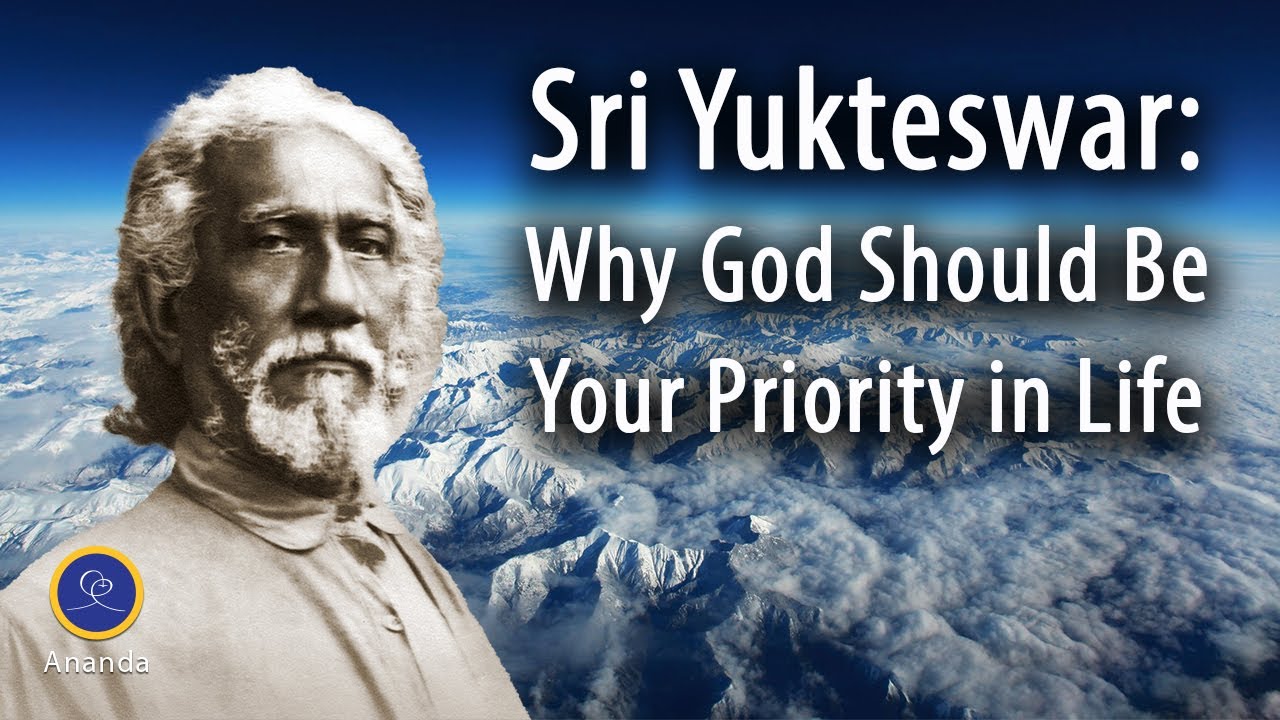
A short talk on one of Sri Yukteswar’s central ideas, putting God first in your life:
Philip Goldberg on Yogananda’s Life
The author and teacher Philip Goldberg walks us through Yogananda’s journey, and the guru who made it possible.
Yogiraj SatGurunath Siddhanath on the Kriya Path
A living Kriya Yoga master speaks about the lineage, the practice and awakening.
Want more? Read our notes on the Philip Goldberg episode and the Kriya path with Yogiraj SatGurunath Siddhanath.
Frequently Asked Questions
Who was Sri Yukteswar?
Sri Yukteswar (Swami Sri Yukteswar Giri, 1855 to 1936) was a Bengali householder who became a monk, a student of Lahiri Mahasaya and the guru of Paramahansa Yogananda. He is also the author of The Holy Science.
What does the name Yukteswar mean?
It is usually explained as “one who is united with God.” Swami marks a monk, Giri (mountain) is one of the ten traditional branches of the swami order, and Sri is an honorific.
What is The Holy Science about?
Published in 1894, it is a short book that shows the shared truth in the Bible and the Hindu scriptures. It has four parts: the Gospel, the Goal, the Procedure and the Revelation. Its final part reads the Book of Revelation as an account of inner awakening.
Who was Sri Yukteswar’s guru?
His guru was Lahiri Mahasaya of Benares, who had received Kriya Yoga from Mahavatar Babaji. Sri Yukteswar is the third link in the chain: Babaji, Lahiri Mahasaya, Sri Yukteswar, Yogananda.
Did Sri Yukteswar meet Babaji?
According to Autobiography of a Yogi, they met at the Kumbh Mela in Prayag in January 1894, and Babaji asked him to write a book on the harmony of the scriptures. It is a spiritual account rather than a documented historical record.
What did Sri Yukteswar teach about the yugas?
He argued that the traditional reckoning was miscalculated and that the real cycle lasts about 24,000 years, with a descending and an ascending half. In his scheme, humanity has been rising since about 500 CE. Many scholars do not accept his chronology, but the idea carries a message of hope.
Who were Sri Yukteswar’s disciples?
Paramahansa Yogananda is by far the best known. Sri Yukteswar kept a small circle of students at his hermitages in Serampore and Puri, and he chose to train one student for the work in the West.
When and where did Sri Yukteswar die?
He died on March 9, 1936, in Puri, on the eastern coast of India. His tradition calls this mahasamadhi, a master’s conscious exit from the body.
What role did he play in Kriya Yoga?
He received Kriya Yoga from Lahiri Mahasaya, taught it to his students and passed it to Yogananda, who spread it widely in the West. For an introduction to the practice, see our guide to Kriya Yoga meditation.
Where can I watch a film about Sri Yukteswar and his student?
Watch Awake: The Life of Yogananda on Next Level Soul. The film gives Sri Yukteswar a central place and traces the lineage back to Babaji and Lahiri Mahasaya.
Where should I begin reading him?
Start with Autobiography of a Yogi for the human story, then read The Holy Science for his own words. You can also read our guide to Paramahansa Yogananda.
Can I learn Kriya Yoga from a book?
Traditionally, Kriya Yoga is taught through initiation by a qualified teacher, because the breath techniques are best learned with guidance. A book can introduce the ideas and the lineage.