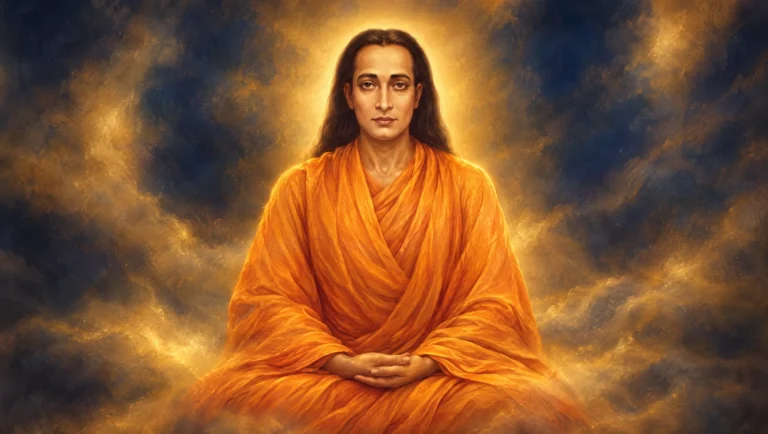
In 1920, a thin young monk from Bengal stepped off a ship in Boston with a handful of dollars and a mission his guru had given him. Thirty-two years later he left behind a movement, a library of writings and a book that millions of people still read as if it were written for them alone. This is the full story of Paramahansa Yogananda, told from the record as we have it, with the miracles marked as miracles and the history marked as history.
If Autobiography of a Yogi sits on your shelf, you know how personal it feels. If it does not, this guide is a good place to begin. His life is also told on screen in Awake: The Life of Yogananda, which is available on Next Level Soul, and his teachings are explored in the community film Finding Happiness, also available on Next Level Soul. The trailer above gives you a first look at the first of those.
Who Was Paramahansa Yogananda?
Paramahansa Yogananda was born Mukunda Lal Ghosh on January 5, 1893, in Gorakhpur, in northern India. He died on March 7, 1952, in Los Angeles. In the fifty-nine years between, he moved from a Bengali railway family to a hermitage in the Himalayan foothills, to a lecture hall in Boston, to the largest auditoriums on the American West Coast.
The name by which the world knows him is a monastic one. Yogananda means bliss through union, bliss through yoga. Paramahansa is a Sanskrit title for a person of the highest spiritual realization, and the word means supreme swan. His own guru gave him the title late in life.
What made him unusual was a simple move. In a culture that treated yoga as something foreign and a little suspect, he presented it as practical, scientific and compatible with every religion. He talked about meditation the way a good teacher talks about a skill: here is a technique, here is what it does, try it and see. For seekers who had been told to simply believe, that was a relief.
He was also a storyteller of rare warmth. His great book reads like a conversation with a friend who has seen remarkable things and is not trying to impress you. That tone, more than any single idea, is why his work has lasted.
Mukunda: A Childhood of Visions
Mukunda was the fourth of eight children in a devout, comfortable Bengali family. His father, Bhagavati Charan Ghosh, held a senior position with a railway company, and the family moved from town to town with his postings. His mother, Gyana Prabha, was a gentle woman of deep faith. Both parents were disciples of Lahiri Mahasaya, the householder yogi of Benares, and his photograph held a place of honor in the house.
From early childhood, according to the Autobiography, Mukunda had a strong inner life. He describes unusual states of awareness, including a clear sense of being conscious before his birth, a detail the film Awake uses to open the story. He also describes a serious childhood illness, from which he is said to have recovered after turning in faith to the photograph of Lahiri Mahasaya.
We should say plainly that these are his own recollections, offered with love and written decades later. They are what he felt his childhood meant. Some readers take them literally. Others read them as the way a spiritual teacher makes sense of a life. Either way, they show a boy for whom the question of God was not abstract. It was the main question.
The Loss of His Mother
When Mukunda was eleven, his mother died of cholera. The Autobiography describes how he was away from home at the time, and how he woke at night with a strong sense that she had appeared to him. A telegram arrived days later with the news. The film Awake lingers on this memory with great tenderness, and it is one of the places where Yogananda is most human.
The loss shaped him. He describes years of grief, and a hunger that could not be filled by ordinary things. Later in life he spoke often of the Divine as Mother, and in a vision, according to the film, a presence tells him that he had been watched over, life after life, in the tenderness of many mothers.
It is worth noticing how this fits the rest of his teaching. He did not preach from a place of detachment. He preached from the middle of human sorrow, and he taught that grief can become a doorway. If you are carrying a loss, his story may meet you where you are.
The Search for a Teacher
As a teenager, Mukunda was restless. He wanted a teacher, and he went looking in the old Indian way, visiting ashrams and holy men, reading scripture and trying to run away to the Himalayas more than once. The Autobiography is full of encounters from these years, with saints who seemed to know his thoughts, with ascetics of striking appearance and with a few teachers who left him unsatisfied.
It is a very recognizable picture. Many of us have walked into a bookstore, a workshop or a retreat hoping for the missing piece, and walked out unsure. The young Mukunda was no different. What sets his story apart is how it resolves.
In 1910, at the age of seventeen, he met a teacher in the city of Benares. According to his account, he recognized the man at once from visions he had seen since childhood. The teacher was Sri Yukteswar, and the meeting changed everything.
Sri Yukteswar and the Serampore Years
Sri Yukteswar was a disciplined, honest and very dry-humored monk who ran a small hermitage in Serampore. He was a student of Lahiri Mahasaya, and he had himself been asked by Mahavatar Babaji to prepare a disciple for the West. You can read his whole story in our guide to Sri Yukteswar Giri.
Mukunda graduated from Serampore College in 1915, after which he took monastic vows and received the name Yogananda. For about five years he lived in the hermitage as a disciple. The training, by his account, was not mystical theatre. It was meditation, study, chores and frank correction. His teacher believed that spiritual realization was built from small habits repeated until they became natural.
It was a loving and demanding relationship, and the Autobiography gives it a great deal of space. The guru was not interested in flattery. He was interested in the student’s growth. When Yogananda later wrote that nobody had ever loved him as his guru did, he was describing something plain: the love of a person who wants you to become what you are.
This relationship is also the emotional center of the film Awake, which shows the reunion in India years later and the quiet devastation of the guru’s death.
The School at Ranchi
Before he left for America, Yogananda did something practical. In 1917 he founded a school for boys, first at Dihika and then at Ranchi, in eastern India. The school combined ordinary academic studies with yoga training and meditation, and it was meant to show that spiritual life and education could belong together.
The school grew into what is now the Yogoda Satsanga Society of India, which still runs schools, centers and publications. It is easy to overlook this chapter, but it matters. Before he addressed audiences in the West, he had already tried to build something in India that served ordinary families.
It also shows one of his habits as a teacher. He liked to make spiritual ideas practical. He taught simple physical exercises meant to energize the body and to help young people sit still. Those exercises became part of his later teaching, along with simple techniques of concentration.
The Voyage to America
In 1920, Yogananda was invited to speak at an international congress of religious liberals in Boston. According to his account, he had been told by his guru and by a higher inner source that the time had come. He did not want to go. He was afraid, he loved his home and he did not know whether Westerners would listen.
The film Awake gives this reluctance its due. It notes that the guru sent his student west right after the First World War, with a feeling that a period of even greater trouble was ahead and that the world would need inner stillness. In the Autobiography, there is also a dramatic account of a meeting with Mahavatar Babaji in Calcutta shortly before his departure, in which the great master is said to have confirmed the mission and promised his help.
He sailed that summer and reached Boston in the fall of 1920. His talk, on the science of religion, was well received. It was the beginning of a new life, and he would never live in India again.
It is easy to underestimate how much courage this took. He arrived with limited money, in a country where Indians faced prejudice and where nobody knew his name. He had a technique, a message and the conviction that both were needed. That was all.
Building Self-Realization Fellowship
After the Boston congress, Yogananda stayed in the United States, lecturing and teaching. He founded Self-Realization Fellowship in 1920, and in 1925 he established its international headquarters on Mount Washington in Los Angeles, a building that still serves as the center of the organization.
The name is telling. Self-Realization means direct knowing of the soul as one with the Spirit. It is the same goal that Sri Yukteswar described in The Holy Science, translated into a phrase that Western audiences could grasp. The Fellowship offered lessons by mail, so that students anywhere could learn meditation techniques step by step. That system, a kind of correspondence course in meditation, reached people long before the internet did.
He taught several things at once. There were physical exercises to energize the body, techniques of concentration, devotional chanting and the more advanced Kriya Yoga for committed students. And behind it all was a single message: you are a soul, and God can be known directly.
The Fellowship remains active, with temples, retreat centers and a worldwide membership. We will say a word about its place in the larger world of Yogananda’s heirs in a later section.
Packed Halls and the White House
In the 1920s, Yogananda lectured to large audiences across the United States. Accounts from the period describe crowds of thousands in major halls in New York, Los Angeles and other cities, which is remarkable for a monk in orange robes speaking about meditation. The newspapers were curious. The audiences were hungry.
He was received by prominent people as well. The Fellowship reports that he met President Calvin Coolidge at the White House in 1927. He also formed a friendship with the plant scientist Luther Burbank, to whom he later dedicated the Autobiography as an American saint.
Why did he succeed? Part of the answer was timing. The 1920s, like our own time, was a period of great upheaval, and many people were looking for something steadier than the available answers. Part of it was his manner. He was cheerful, humorous and clear. And part of it was the teaching itself, which promised a way to experience what religion had only described.
He also spoke in language that his audience understood. He compared the mind to a lake that must be still to reflect the moon. He compared life to a film projected on a screen, a metaphor that the documentary uses to illustrate his sense that behind the changing images there is a steady beam of light. Those pictures made abstract ideas feel close at hand.
Saints and Scientists He Met
One of the pleasures of the Autobiography is its cast of characters. Yogananda had a gift for friendship, and he met an extraordinary range of people. A few are worth knowing by name.
- Luther Burbank, the American plant breeder in Santa Rosa, California, who became a close friend and received a dedication in the Autobiography.
- Jagadish Chandra Bose, the Indian physicist and plant scientist whose experiments suggested that plants respond to their surroundings in surprising ways.
- Anandamoyi Ma, the Bengali woman saint known as the joy-permeated mother, whom he visited during his return to India.
- Therese Neumann, the German Catholic mystic from Konnersreuth, whom he visited in 1935 and wrote about with great respect.
- Ramana Maharshi, the sage of Arunachala in south India, whom he visited during the same trip.
- Mahatma Gandhi, whom he visited in Wardha, as described above.
The list shows what he cared about. He moved easily between scientists and mystics, between Hindus and Christians, and between the famous and the unknown. He treated each as a possible window onto the same truth.
The Return to India
In 1935, after fifteen years in the West, Yogananda went home. He spent about a year in India, reuniting with his guru, visiting family and meeting the saints of his homeland. The Autobiography records a series of encounters from this trip, including a memorable visit to the woman saint Anandamoyi Ma, and an account of a woman said to have lived without ordinary food.
It was also the year his guru named him Paramahansa. The title was a recognition of what the teacher saw as his student’s realization, and Yogananda used it for the rest of his life.
The trip ended in sorrow. Sri Yukteswar died in March of 1936, and Yogananda, who had traveled to be with him, took part in the funeral rites. The film Awake treats this passage with great restraint, letting the grief speak for itself.
Meeting Gandhi
During his trip, Yogananda visited Mahatma Gandhi at his ashram in Wardha. By the Autobiography’s account, Gandhi received him warmly, asked to be initiated into Kriya Yoga, and the two discussed nonviolence and spiritual practice. Gandhi’s followers sometimes noted that the meeting took place on a day of silence, which Gandhi kept, and that he communicated by writing.
The meeting is notable for what it shows. Yogananda’s world was larger than a meditation hall. He moved among the great figures of his time, and he believed that inner stillness and outer service belong together. Gandhi’s own approach, that nonviolence begins in a disciplined inner life, is close to what Yogananda taught.
It is a small scene in a long life, but it captures something about him. He met power and fame with the same easy warmth he gave to everyone else.
Autobiography of a Yogi
His most famous achievement is a book. Autobiography of a Yogi was published in New York in 1946 after years of work, much of it written at his hermitage in Encinitas, California. It tells his story from childhood to his decades in America, and it introduces a gallery of saints, yogis and miracles. Find it on Amazon.
The book works on several levels at once. It is a memoir, a travel narrative, a spiritual primer and a portrait of a lineage. It speaks of reincarnation, of the astral world and of the possibility that a human being can move beyond ordinary limits. And it does so in a calm, friendly voice, without pressure.
It has been translated into dozens of languages and has remained in print for nearly eighty years. The film Awake follows the book’s ripple through culture, from the musician who was handed a copy by Ravi Shankar to the technology pioneer who, the film notes, kept it as the only book on his tablet and gave copies to guests at his memorial. The same book is said to have helped open the minds of many musicians in the 1960s, including George Harrison.
Why does it still work? Many readers say that it gave them permission. They had sensed that life held more than what they had been told, and here was a person who said so, calmly, from experience. If you have never read it, our guide to the best spiritual books will show you where it sits among other classics.
His Teachings, Simply Put
Yogananda wrote and lectured on a wide range of subjects, but a few ideas run through everything. Here they are in plain language.
- You are a soul. Your deepest identity is not your body, your mood or your job. It is consciousness itself. Try this: When you feel small, pause and ask who is watching the thought.
- God can be known directly. Religion is meant to be an experience, not a set of beliefs. Try this: Make a daily appointment with stillness and let experience teach you.
- Meditation is a science. Concentration and breath methods produce predictable results when practiced regularly. Try this: Keep a steady time and a steady place, and judge by results over weeks.
- All true religions point to one truth. The saints of every faith touched the same reality. Try this: Read widely and ask what each tradition is pointing at.
- Balance body, mind and spirit. Health, calm and devotion support each other. Try this: Pair meditation with movement, good food and rest.
- Happiness is a quality of the soul. Joy is not a prize at the end of success. It is already within and can be uncovered. Try this: Notice small moments of ease and practice staying with them.
- Serve while you seek. Inner growth and outer kindness belong together. Try this: Do one quiet act of service a day.
Kriya Yoga and Meditation
Kriya Yoga sits at the center of his work. It is an ancient method, in his account revived by Mahavatar Babaji and passed down through Lahiri Mahasaya and Sri Yukteswar, that uses breath and attention to quiet the mind. Yogananda described it as a scientific way of directing the life energy in the body toward higher awareness.
He taught it to committed students in stages, after preparation through simpler techniques. That is a practical decision. Breath techniques are powerful, and they are best learned with guidance. The simpler practices he offered openly include a method of watching the breath with a quiet mental sound, a concentration technique and a set of exercises to energize the body.
If you are new to meditation, you do not need to begin with anything advanced. A few minutes of sitting, a steady spine and an easy attention to the breath is enough. Our guide to Kriya Yoga meditation explains where to begin and what to expect.
Jesus and Krishna, Side by Side
One of Yogananda’s most striking choices was to treat Jesus and Krishna as members of the same spiritual family. He wrote long commentaries on the Gospels and the Bhagavad Gita, reading both as guides to the inner path. In his view, the two traditions described the same journey in different languages.
For seekers who grew up in a church and are unsure what to do with that heritage, this is a gentle model. You do not have to reject what you were given. You can ask what it was pointing at. The idea echoes his guru’s work in The Holy Science, which sets the Bible and the Hindu scriptures side by side.
It also resonates with our own film Marketing the Messiah, which asks what Jesus actually taught.
The Last Years
In 1936, Yogananda settled in a hermitage in Encinitas, California, a gift from a devoted disciple, Rajarsi Janakananda. It was a seaside retreat where he wrote, taught and finished the Autobiography. In 1950 he opened the Lake Shrine in Pacific Palisades, a garden sanctuary that remains open to visitors today.
He kept lecturing and writing, and in his last years he spent more time in seclusion, working on commentaries and guiding close students. By his own description, he knew that his time in the body was coming to an end.
On March 7, 1952, he attended a banquet in Los Angeles in honor of the Indian ambassador. After speaking, he is reported to have left the body in what his followers call mahasamadhi. The Fellowship reports that the director of the mortuary where his body was cared for described unusual signs of preservation, a claim that is widely repeated among devotees. We mention it as part of the tradition’s telling. The more lasting evidence of his life is what he built and wrote.
Legacy and Reach
Yogananda’s successors have carried the work forward. Self-Realization Fellowship continues under a line of presidents, beginning with Rajarsi Janakananda and, from 1955, Sri Daya Mata, who led the organization for decades. The Yogoda Satsanga Society of India continues in his homeland.
His influence reaches well beyond these organizations. Meditation centers, yoga studios and spiritual communities across the world cite him as an inspiration. His Autobiography has been a gateway for people who later explored many other traditions. And his central idea, that every person can have a direct experience of the sacred, has become so familiar that it is easy to forget how new it sounded in 1920.
Other communities have also grown from his teaching. One of them, Ananda, founded by his direct disciple Swami Kriyananda in 1968, is the setting of the film Finding Happiness.
A Timeline of His Life
- 1893: Born Mukunda Lal Ghosh in Gorakhpur, India
- 1904: His mother dies when he is about eleven
- 1910: Meets Sri Yukteswar in Benares
- 1915: Graduates and takes monastic vows as Yogananda
- 1917: Founds a school for boys, later based in Ranchi
- 1920: Speaks at a congress of religious liberals in Boston
- 1925: Opens the Self-Realization Fellowship headquarters on Mount Washington, Los Angeles
- 1927: Reported to meet President Calvin Coolidge at the White House
- 1935: Returns to India; meets Gandhi; receives the title Paramahansa
- 1936: Sri Yukteswar dies; Yogananda settles in Encinitas, California
- 1946: Publishes Autobiography of a Yogi
- 1950: Opens the Lake Shrine in Pacific Palisades
- 1952: Dies in Los Angeles on March 7
On Screen: Awake
Awake: The Life of Yogananda, directed by Paola di Florio and Lisa Leeman, is the most complete film portrait of his life. It opens with consciousness itself, with Yogananda’s own description of being aware in the womb, and it moves through his childhood, his search, his guru and his mission.

It is a film of unusual honesty. It gives space to grief, to doubt and to the reluctance he felt before leaving India. It uses archival footage, interviews with disciples and scholars, and dreamlike animation to evoke his inner experiences, and it traces the lineage back through Lahiri Mahasaya to Mahavatar Babaji.
Read our full film guide to Awake: The Life of Yogananda, then watch the film on Next Level Soul.
Honest Questions and Cautions
A good guide names the places where the story is hard to verify, or where people disagree. Here are the main ones.
How Much of the Story Comes from One Source?
Much of what we know about his early life comes from the Autobiography, which he wrote decades later and in a devotional spirit. It is a loving portrait, and it should be read as such. Where outside records exist, they generally match the main outline.
What About the Miracles?
The Autobiography contains many stories that go beyond ordinary experience. Believers accept them. Skeptics treat them as devotional narrative. You can benefit from the practices and ideas without settling that question. His own emphasis was on direct experience through practice, not on marvels.
Are There Disputes Among His Followers?
Yes. Different organizations carry his teaching, and over the years there have been disagreements, including legal disputes over how his materials may be used. If you are choosing a path, it is reasonable to look at more than one and to trust what works for you.
Is It Necessary to Join an Organization?
No. Many readers learn from his books and practice simple meditation on their own. If you want structured guidance, the lessons offered by the organizations he founded are one option.
Is Kriya Yoga Safe?
Gentle breath and meditation practices are widely used and are generally considered safe. Stronger breath techniques are best learned from a qualified teacher. If you have a health condition, speak with your doctor first.
A Mystic’s Reading: Why He Still Matters
What does a yogi born in 1893 have to say to someone reading this on a phone? Maybe more than we expect. His central point was that you do not need to take anyone’s word for the nature of reality. You can sit down, get quiet and look.
That is a very practical invitation, and it fits an age that is tired of being told what to think. He asked for patience and for honesty, and he offered a method rather than a creed. He also insisted that happiness is not a reward for later. It is closer than we think.
And there is the quiet shape of his life. He carried a message across an ocean at the request of a teacher he loved, and he built the work with joy. He wrote of the Divine as friend and mother as much as law and judge. He was not trying to frighten anyone toward God. He was trying to remind people of what they already carry.
The power, in his teaching, was never in the guru. The guru is a guide who helps you remember who you are. That is the spirit of Next Level Soul, and a good reason his story belongs here.
A Practice: One Week of Inner Stillness
You can try the spirit of his teaching this week with fifteen minutes a day. Nothing here requires any belief.
- Day 1, Sit. Before you touch your phone, sit for five minutes. Keep the spine easy and upright. Watch the breath.
- Day 2, Add a quiet word. On the inhale, think a soft sound. On the exhale, think another. Let the mind settle into the rhythm.
- Day 3, Move. Add a few minutes of gentle stretching or a walk, and notice how the body feels afterward.
- Day 4, Find joy. After sitting, notice any quiet sense of ease. Stay with it for a minute.
- Day 5, Serve. Do one small kindness that nobody will see.
- Day 6, Read. Read a page of a book that moves you. Let it sit.
- Day 7, Review. Ask what changed. Keep whatever helped.
If you want to go deeper, our guide to Kriya Yoga meditation is a good next step, and this collection of Yogananda quotes makes a lovely daily reading.
On Screen: Finding Happiness
Finding Happiness approaches the same teaching from a different angle. It is a one hour and thirty-five minute docu-drama set in Ananda, a spiritual community in Northern California built on Yogananda’s teachings. The actress Elisabeth Rohm plays a reporter who arrives to write about the community and finds herself asking harder questions about her own life. The film mixes actors with real residents, and it asks whether happiness is something we can learn.
It is a fitting companion to Awake. Where the first film tells the life, this one shows what happens when people try to live the teaching together, through meditation, service and community. You can watch Finding Happiness on Next Level Soul.

Books and Further Reading
If you want to read Yogananda and the tradition around him, start here. We use affiliate links, which means Next Level Soul may earn a small commission at no cost to you.
- Autobiography of a Yogi, his best-known work and the natural starting point.
- God Talks with Arjuna, his commentary on the Bhagavad Gita.
- The Second Coming of Christ, his reading of the Gospels as a path of inner awakening.
- Where There Is Light, a collection of his guidance for daily life.
- Whispers from Eternity, devotional poems and prayers.
- The Holy Science by his guru, Sri Yukteswar.
- Yogananda: The Man Who Brought Yoga to the West by Philip Goldberg, a recent biography.
Who Will Connect with His Story
It suits readers of Autobiography of a Yogi, seekers who want a method rather than a belief, anyone drawn to meditation, readers who love both the Bible and the Gita, and anyone who wants to feel that happiness is closer than it looks.
Keep Exploring
Keep exploring with spiritual enlightenment, ascended masters and the Spiritual Cinema collection.
Hear His Story in Their Own Words
Philip Goldberg on Yogananda’s Life
The author and teacher Philip Goldberg walks us through Yogananda’s journey from the banks of the Ganges to Boston.
Yogiraj SatGurunath Siddhanath on the Kriya Path
A living Kriya Yoga master speaks about the lineage Yogananda carried west.
Want more? Read our notes on the Philip Goldberg episode and the Kriya path with Yogiraj SatGurunath Siddhanath.
Go Deeper: Watch Awake: The Life of Yogananda
Watch Awake on Next Level Soul TV Not Ready Yet? Read Our Awake Review
Frequently Asked Questions
Who was Paramahansa Yogananda?
Paramahansa Yogananda (1893 to 1952) was an Indian yogi and teacher, born Mukunda Lal Ghosh, who brought meditation and Kriya Yoga to a wide Western audience. He founded Self-Realization Fellowship and wrote Autobiography of a Yogi.
What does Paramahansa Yogananda mean?
Yogananda means bliss through yoga. Paramahansa is a Sanskrit title for a person of the highest realization, meaning supreme swan. His guru, Sri Yukteswar, gave him the title in 1935.
Who was Yogananda’s guru?
His guru was Sri Yukteswar, a disciple of Lahiri Mahasaya, who had been initiated by Mahavatar Babaji. Read our guide to Sri Yukteswar.
What is Autobiography of a Yogi about?
It is Yogananda’s memoir, published in 1946. It tells his story from childhood in India to his years in America, and introduces saints, the Kriya Yoga lineage and the idea that direct experience of God is possible.
Why did Yogananda go to America?
According to his account, his guru and Mahavatar Babaji told him the time had come to bring Kriya Yoga to the West. He was invited to speak at a religious congress in Boston in 1920 and stayed to teach.
What is Self-Realization Fellowship?
It is the organization Yogananda founded in 1920. It offers lessons in meditation by mail, runs temples and retreats, and publishes his works from its headquarters in Los Angeles.
What is Kriya Yoga?
Kriya Yoga is a method of breath and attention used to quiet the mind and turn awareness inward. Yogananda taught it to committed students after preparation. See our guide to Kriya Yoga meditation.
Did Yogananda meet Gandhi?
Yes. According to the Autobiography, he visited Gandhi at Wardha in 1935 and initiated him into Kriya Yoga at Gandhi’s request.
When and how did Yogananda die?
He died on March 7, 1952, in Los Angeles, after speaking at a banquet for the Indian ambassador. His followers call this mahasamadhi, a master’s conscious exit from the body.
Where can I watch a film about Yogananda?
Watch Awake: The Life of Yogananda on Next Level Soul. The film tells his life story with archival footage, interviews and animation.
Where can I watch Finding Happiness?
Watch Finding Happiness on Next Level Soul. It is a one hour and thirty-five minute docu-drama set in Ananda, a community built on Yogananda’s teachings.
Which book should I read first?
Start with Autobiography of a Yogi. If you want his scripture commentaries, try God Talks with Arjuna and The Second Coming of Christ. Our list of the best spiritual books shows where it fits.
Do I need to join an organization to practice his teachings?
No. Many people learn from his books and practice simple meditation on their own. Structured lessons are available from the organizations he founded if you want them.
Is there a collection of Yogananda quotes?
Yes. See our collection of Yogananda quotes.