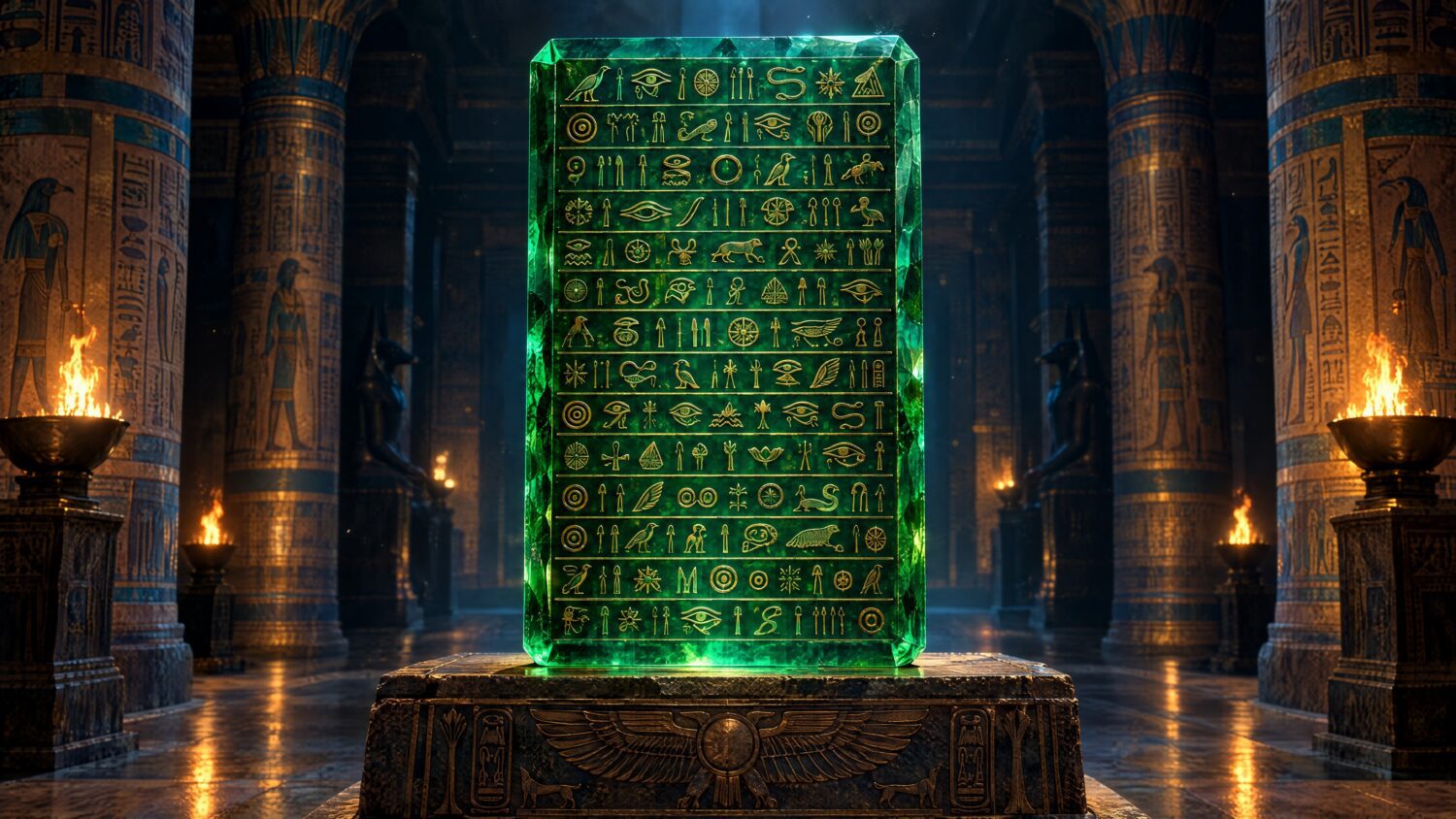
Two different works share the name Emerald Tablets. The first is the Hermetic Emerald Tablet, also called the Tabula Smaragdina, a short and cryptic text traditionally attributed to Hermes Trismegistus and the source of the maxim “as above, so below.” The second is the Emerald Tablets of Thoth the Atlantean, a twentieth century work that Maurice Doreal said he translated from tablets he found at the Great Pyramid in 1925. Anyone searching for the Emerald Tablets of Thoth may be looking for either one, so this guide explains both, side by side.
This is the explainer. If you want a line-by-line walk through the Hermetic text with a workbook, that lives in our Emerald Tablet study guide and workbook. Here we cover where each work came from, what each one says, how the famous phrase traveled, and why seekers still care. Every claim is credited to the person who made it, so you can see the sources and decide what rings true.
Key Takeaways
- Two works, one name. The medieval Hermetic Emerald Tablet and Doreal’s Emerald Tablets of Thoth the Atlantean are different texts with different histories.
- The Hermetic Emerald Tablet survives first in Arabic treatises from the 8th to 10th centuries, and reached Europe in Latin translations from the 12th century onward.
- “As above, so below” is a popular paraphrase of its second verse, spread by Helena Blavatsky and later by The Kybalion.
- Hermes Trismegistus is a legendary figure, a blend of the Greek god Hermes and the Egyptian god Thoth, which is why the two tablets are linked in the popular mind.
- Isaac Newton prepared an English translation of the Latin text, and Carl Jung called it a paramount alchemical text.
- Maurice Doreal (1898 to 1963) founded the Brotherhood of the White Temple and published the Atlantean version, which presents Thoth as a king of Atlantis.
What Are the Emerald Tablets?
The Emerald Tablets are best understood as a name that two separate traditions have used. In the older tradition, the Emerald Tablet is one compact piece of writing, said in legend to have been engraved on emerald and found in the tomb of Hermes. In the newer tradition, the Emerald Tablets of Thoth are a longer, numbered set of teachings presented as the words of Thoth, an Atlantean priest-king.
Because both are tied to Thoth and Hermes, and both carry a sense of ancient hidden wisdom, they are often blended together online. Keeping them apart makes each one easier to understand.
The Two Works at a Glance
| Question | Hermetic Emerald Tablet | Emerald Tablets of Thoth the Atlantean |
|---|---|---|
| Also called | Tabula Smaragdina, Smaragdine Table | Emerald Tablets of Thoth |
| Attributed to | Hermes Trismegistus (legendary) | Thoth the Atlantean, as presented by Maurice Doreal |
| Earliest known form | Arabic treatises, 8th to 10th centuries | Doreal’s twentieth century publication |
| Length and style | A very short, riddling text | A longer set of numbered tablets |
| Main themes | Unity, correspondence between above and below, transformation | Thoth’s story, Atlantis, the Halls of Amenti, cosmic law and initiation |
| Famous phrase | “As above, so below” | None that matches it |
| Tradition | Hermeticism and alchemy | Twentieth century occult and New Age writing |
The Hermetic Emerald Tablet (Tabula Smaragdina)
The Hermetic Emerald Tablet is a short text, only a few lines long in most versions. According to the scholarship summarized on Wikipedia, it is traditionally attributed to Hermes Trismegistus, and its earliest known versions are four Arabic recensions found in treatises between the 8th and 10th centuries CE. No Greek or Egyptian manuscript of it is known, so its true author remains unknown.
Where the Earliest Versions Appear
The oldest version appears as an appendix to an Arabic book titled the Book of the Secret of Creation (Sirr al-Khaliqa), believed to have been compiled in the late 8th or early 9th century. That book presents itself as a translation of a work by Apollonius of Tyana. Its frame story tells of a legendary figure called Balinus, the Master of Talismans, who finds a crypt beneath a statue of Hermes Trismegistus and discovers a tablet of emerald in the hands of a seated old man.
Other early Arabic versions appear in a work attributed to the alchemist Jabir ibn Hayyan, in the tenth century Secret of Secrets (a letter framed as written by Aristotle to Alexander the Great), and in a treatise by Ibn Umayl. In Ibn Umayl’s telling, a stone table is found on the knees of Hermes in the hidden chamber of a pyramid. The detail of a tablet found with Hermes, in a tomb, crypt or pyramid, is where the legend of the “emerald” slab comes from.

How It Reached Europe
The text entered Europe through Latin. The scholar Hugo of Santalla translated the Book of the Secret of Creation into Latin around 1145 to 1151, and a third, much more widely copied Latin version, called the vulgate, appears in an alchemical treatise likely from the twelfth century. The vulgate became the basis for later European translations. Its translator did not know the Arabic word tilasm (enigma or talisman) and simply wrote it as telesmus in Latin, a word that generations of commentators then tried to explain.
The first printed edition appeared in 1541 in Nuremberg, and from the late sixteenth century the tablet was often shown with a symbolic emblem of the sun, moon and planets that people came to treat as its picture.
What Does the Emerald Tablet Say?
Versions differ, so here is a plain-language summary of the widely copied Latin vulgate, in our own words rather than a quotation. For a slower, teaching-by-teaching reading, see our study guide and workbook.
| Theme | Plain-language summary |
|---|---|
| Truth | The text opens by insisting that what follows is true and certain. |
| Above and below | What is below is like what is above, and what is above is like what is below, so that the wonders of “the one thing” can be worked. |
| The One | All things came from one thing, and all things are born from it by adaptation. |
| Sun and Moon | Its father is the Sun, its mother the Moon, the wind carried it, and the Earth nursed it. |
| Refinement | Separate the earth from the fire, the subtle from the gross, gently and with great skill. |
| Ascent and return | It rises from earth to heaven and descends again, taking on the powers of both. |
| The seal | The speaker names himself Hermes Trismegistus, “thrice great,” holder of three parts of the wisdom of the whole world. |
Where Does “As Above, So Below” Come From?
The phrase is a popular paraphrase of the second verse. Per Wikipedia, Helena Blavatsky helped popularize it, and its use in The Kybalion (see our glossary entry on The Kybalion) made it an often-cited motto. Later in the twentieth century it became especially familiar in New Age circles.
In its plainest sense it says that the higher and lower levels of reality mirror each other. Readers apply it to heaven and earth, mind and body, or the inner and outer life. It is a lens for noticing patterns, and our glossary entry on the Hermetic principles shows how later writers turned it into the law of correspondence.

Who Are Hermes Trismegistus and Thoth?
Hermes Trismegistus, whose name means “thrice greatest,” is described by Wikipedia as a legendary Hellenistic figure who began as a blend of the Greek god Hermes and the Egyptian god Thoth. He is the purported author of the Hermetica, a diverse body of writings that laid the basis of Hermeticism. That blending is the reason the Emerald Tablet of Hermes and the Emerald Tablets of Thoth sound like cousins.
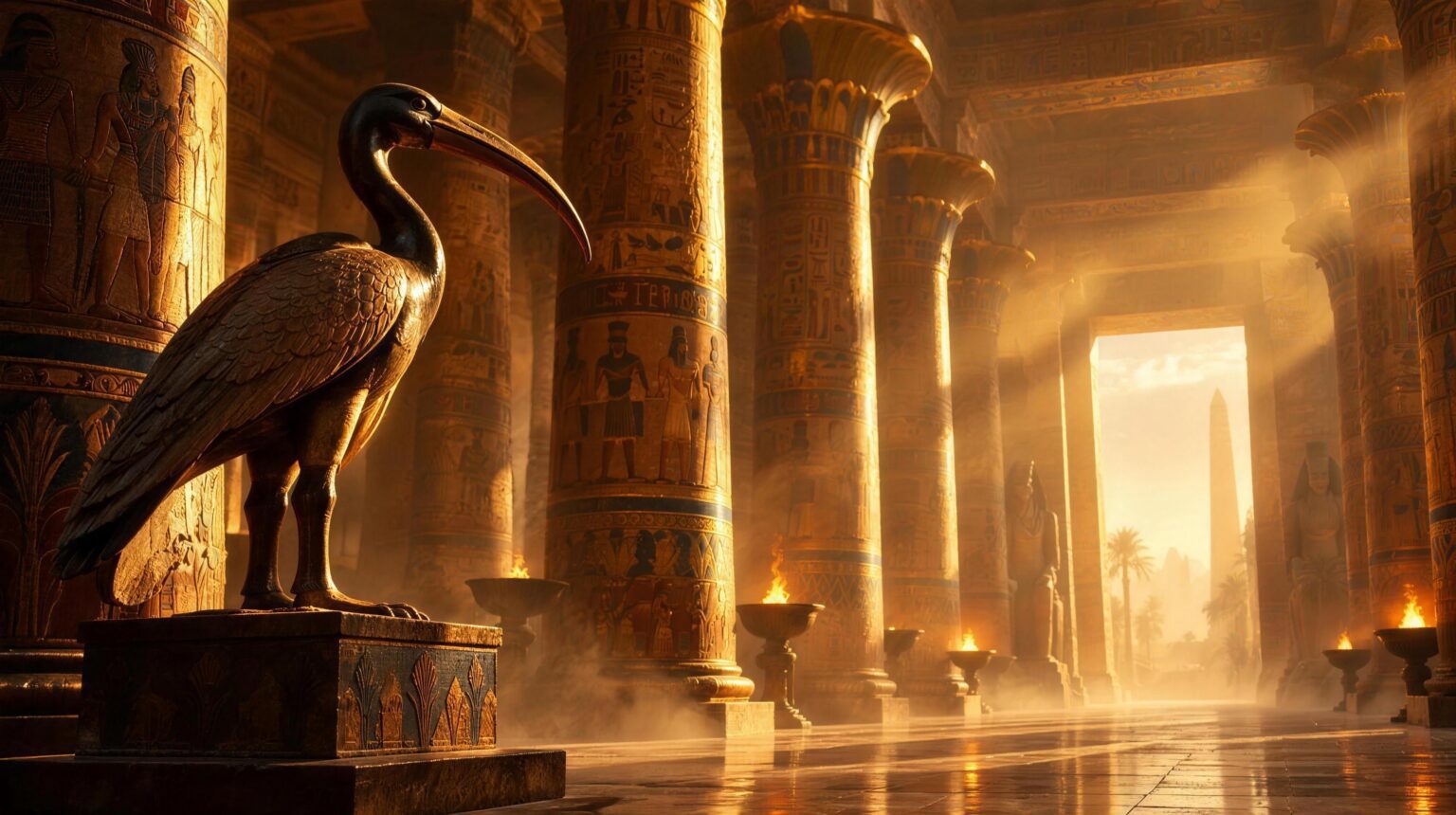
In Egyptian religion, Thoth is the god of the Moon, wisdom, writing, science, magic and judgment, often shown with the head of an ibis or a baboon. Spiritual writers across many traditions have since treated him as a keeper of sacred knowledge. Hermeticism, the tradition built on the Hermetic writings, is also the soil from which alchemy and much of Western esotericism grew.
Hear it from the guests: Thoth, Hermes and Metatron
Two guests on the Next Level Soul Podcast speak about Thoth and the Hermetic lineage from their own perspectives. For the classic Hermetic philosophy, listen to the The Kybalion audiobook.
Channeling Thoth to Decode Atlantean Teachings with Danielle Hoffman

Danielle Hoffman. Danielle Hoffman shares her partnership with Thoth and a channeled message that includes what she describes as one of the Emerald Tablets they are bringing forward. This is her own experience, offered as she describes it. Watch the full episode and read the show notes.
The True Story of St. Germain & Metatron with Robert Edward Grant

Robert Edward Grant. Robert Edward Grant says he believes Metatron has appeared in many forms, among them Thoth and Hermes Trismegistus. It is a modern reading that connects the figure behind the Emerald Tablet to other traditions. Watch the full episode and read the show notes.
How Did Alchemists Read the Emerald Tablet?
Medieval commentators such as Hortulanus read the tablet as a cryptic laboratory recipe. In that reading the Sun and Moon stood for gold and silver, and the text hid the secret of the philosopher’s stone. Albertus Magnus took a similar view. By the early sixteenth century, writers such as Johannes Trithemius moved toward a metaphysical reading, linking the “one thing” to the monad of Pythagorean thought and the world soul.
That shift is where spiritual alchemy begins: the idea that the real work is the refinement of the person. Carl Jung carried it into psychology. Per Wikipedia, he saw the Tablet as the paramount alchemical text and read its “operation of the sun” as a picture of consciousness separating from an archetypal source and returning as a transformed, individuated self. For a deeper look at the roots of this tradition, see our guides to the mystics of the Renaissance and the Rosicrucian mysteries.
Isaac Newton and the Emerald Tablet
Isaac Newton is best known for physics, but he also wrote extensively on alchemy. Wikipedia notes that he prepared an English translation of the Latin vulgate of the Emerald Tablet and rendered the puzzling word telesmus as “perfection.” Historians of science point to his alchemical papers as part of his lifelong search for the wisdom of the ancients.
Debates About Its Age and Author
The tablet has never been free of questions. From the seventeenth century, writers such as Nicolas Guibert and Athanasius Kircher challenged its attribution to Hermes, and Isaac Casaubon’s analysis questioned the authenticity of the wider Hermetic writings. Kircher pointed to its late, “barbaric” Latin and to the silence of ancient Greek philosophers about it. Ole Borch answered in 1668 by defending its Egyptian roots.
Modern scholars, summarized by Wikipedia, agree that the Arabic Secret of Creation is the earliest source and was likely compiled at least partly from earlier Greek or Syriac materials. Julius Ruska, who rediscovered the Arabic sources with Eric Holmyard, suggested influences from Chaldean, Harranian or gnostic ideas. No ancient emerald slab has ever been shown to exist, so the “tomb of Hermes” is best read as a legend about where wisdom is found.
The Emerald Tablets of Thoth the Atlantean
The second work is a different book entirely. According to Wikipedia, Maurice Doreal (1898 to 1963) was the religious name of Claude D. Dodgin, an American occultist who founded the Brotherhood of the White Temple, around 1930 in Denver, after an earlier involvement with Theosophy. Doreal claimed that during a 1925 visit to the pyramids of Giza he discovered a set of ancient emerald tablets belonging to Thoth, whom he re-imagined as a king of Atlantis. He said he translated them and published the result as the Emerald Tablets of Thoth the Atlantean.
What the Atlantean Tablets Present
As published, the text is written in the voice of Thoth, an Atlantean priest-king who tells of his life, of the Halls of Amenti, of cosmic law, and of keys to magic, time and wisdom. Readers often describe it as an initiation text about the soul’s ascent, the nature of space and time, and the unity of all life. Its Atlantis frame ties it to the broader lost-civilization lore we explore in our guide to Atlantis, the lost civilization and our glossary entry on Atlantis.
How Different Readers View It
Doreal’s account of how the tablets were found rests on his own word, and no physical emerald tablets have been presented for study. Scholars of esotericism treat the book as a twentieth century occult work, closer to Theosophy and later New Age writing than to the Hermetic Emerald Tablet of the Middle Ages. Many spiritual readers, though, value it as inspired teaching in its own right, and read it for its symbols and spiritual guidance rather than as a historical record.
What Guests on Our Podcast Say
On the Next Level Soul Podcast, researcher Billy Carson shares his reading of the tablets in Emerald Tablets & Humanity’s Origins with Billy Carson. He describes Thoth as an Atlantean priest-king who, he says, wrote the tablets himself and is credited in them with building the Great Pyramid, which Billy dates to about 36,000 years ago. These are his readings of ancient texts and oral history, and mainstream archaeology gives much later dates. You can also hear Billy in Ancient Tablets Reveal Mankind’s Divine Origins.
Channeler Danielle Hoffman speaks of a primary partnership with Thoth in Channeling Thoth to Decode Atlantean Teachings, describing the Egyptian pantheon as archetypal energies. For a different angle on the same hidden-knowledge theme, listen to Robert Edward Grant on pyramid inscriptions, and to his talk with Alex about St. Germain and Metatron.
Hear it from the guests: the Emerald Tablets of Thoth the Atlantean
These two conversations take up the Atlantean tablets directly. To pair these with the Hermetic text itself, try the The Sacred Code of the Emerald Tablet audiobook.
Emerald Tablets & Humanity’s Origins with Billy Carson

Billy Carson. Billy Carson shares his view of the Emerald Tablets of Thoth and cites Robert Schoch’s view that weathering suggests the Sphinx is at least 13,000 years old. These are his personal conclusions, and mainstream archaeology dates the monuments much later. Watch the full episode and read the show notes.
Mysterious Pyramid Inscriptions with Robert Edward Grant

Robert Edward Grant. Robert Edward Grant talks about the Giza plateau and says he believes, based on the erosion work he links to Robert Schoch, that the Sphinx is approximately 13,000 years old. The conversation also covers pyramid inscriptions and the Emerald Tablets of Thoth the Atlantean. Watch the full episode and read the show notes.
Hermetic Tablet vs. Atlantean Tablets: Key Differences
| Point | Hermetic Emerald Tablet | Atlantean Emerald Tablets |
|---|---|---|
| Voice | Hermes Trismegistus, in a few lines | Thoth the Atlantean, across many tablets |
| Source claim | Found in Hermes’ tomb, in legend | Found at Giza in 1925, per Doreal |
| Documented history | Arabic manuscripts, Latin translations, printed in 1541 | Doreal and the Brotherhood of the White Temple |
| Famous readers | Hortulanus, Albertus Magnus, Isaac Newton, Carl Jung | Modern New Age and Atlantis researchers |
| Best read as | A seed text of alchemy and Hermeticism | A modern spiritual and occult teaching |
Why Do Seekers Still Care About the Emerald Tablets?
The Hermetic tablet is short enough to carry in your head, and its central picture is simple: inner and outer worlds echo each other, and refinement is possible. That is why it has been used by alchemists, Rosicrucians, Theosophists and modern teachers alike. The Atlantean tablets speak to a different longing, the sense that humanity once knew more than it remembers, and that sacred teachings were set down to outlast the ages.
You do not have to settle every historical question to find meaning in either. A useful way to read them is as maps of human imagination, each one credited to the people who made the claim. If a line stirs something, try writing about it. Our workbook offers prompts for the Hermetic lines, and our glossary entries on mystery schools, the occult and ascended masters map the wider landscape.
Go Further on Next Level Soul
- The Emerald Tablet: Study Guide and Workbook, our line-by-line companion to the Hermetic text.
- The Sacred Code of the Emerald Tablet audiobook and Saint Germain Channeled on Advanced Alchemy, Vol. 1, listed in our audiobook catalog. Browse more on Next Level Soul TV audio.
- Alchemy of the Soul audio course and Mystery Schools of the Ancients, plus the full list of audio courses.
- Guided meditations for turning an idea like “as above, so below” into practice.
- The Atlantis Puzzle: A Spiritual Cinema Review and more spiritual awakening movies on Next Level Soul TV.
- The Egyptian Book of the Dead study guide, the four elements, the Anunnaki and Saint Germain and the violet flame.
- Spiritual Alchemy and the Kabbalah with Dr. Theresa Bullard, on the Next Level Soul Podcast.
- Know a seeker who would love this? Send them a Next Level Soul TV gift membership.
Sources and Further Reading
Episodes to Watch Next
These conversations on the Next Level Soul Podcast support the sections above. Four are embedded in the article, and one more is below. For the Egyptian side of the story, see the The Egyptian Book of the Dead audiobook.
- Channeling Thoth to Decode Atlantean Teachings with Danielle Hoffman, with Danielle Hoffman.
- The True Story of St. Germain & Metatron with Robert Edward Grant, with Robert Edward Grant.
- Emerald Tablets & Humanity’s Origins with Billy Carson, with Billy Carson.
- Mysterious Pyramid Inscriptions with Robert Edward Grant, with Robert Edward Grant.
- Ancient Tablets Reveal Mankind’s Divine Origins with Billy Carson, with Billy Carson.
Ancient Tablets Reveal Mankind’s Divine Origins with Billy Carson

Billy Carson. Billy Carson speaks about ancient tablets, advanced beings and lost cities, and places the Sphinx earlier than the textbooks do, near the time he says the Emerald Tablets were written. He presents these as his own views. Watch the full episode and read the show notes.
Spirituality for the Rest of Us™
Movies, teachings and community on Next Level Soul TV.
Frequently Asked Questions
What are the Emerald Tablets of Thoth?
The name is used for two works. The Hermetic Emerald Tablet is a short medieval text attributed to Hermes Trismegistus. The Emerald Tablets of Thoth the Atlantean is a twentieth century book that Maurice Doreal said he translated from tablets found at Giza in 1925.
Is the Emerald Tablet the same as the Emerald Tablets of Thoth the Atlantean?
No. They are different texts with different histories. The Hermetic tablet appears in Arabic manuscripts from the 8th to 10th centuries, while the Atlantean tablets were published by Maurice Doreal in the twentieth century.
Who wrote the Emerald Tablet?
Tradition attributes it to Hermes Trismegistus, a legendary figure, so the true author is unknown. Scholars see it as compiled in Arabic, likely partly from earlier Greek or Syriac materials.
What is the oldest version of the Emerald Tablet?
The oldest known version is an appendix to the Arabic Book of the Secret of Creation, believed to have been compiled in the late 8th or early 9th century. Other early Arabic versions appear in works tied to Jabir ibn Hayyan, the Secret of Secrets and Ibn Umayl.
What does “as above, so below” mean?
It means the higher and lower levels of reality mirror each other. It is a popular paraphrase of the Emerald Tablet’s second verse, popularized by Helena Blavatsky and later by The Kybalion.
Who was Maurice Doreal?
Maurice Doreal (1898 to 1963) was the religious name of Claude D. Dodgin, an American occultist who founded the Brotherhood of the White Temple. He published the Emerald Tablets of Thoth the Atlantean and said he found the tablets at the Great Pyramid in 1925.
Who is Thoth?
Thoth is an ancient Egyptian deity of the Moon, wisdom, knowledge, writing and magic, often shown with the head of an ibis or a baboon. In Doreal’s book, Thoth is re-imagined as a priest-king of Atlantis.
Who is Hermes Trismegistus?
Hermes Trismegistus, meaning “thrice greatest,” is a legendary Hellenistic figure who began as a blend of the Greek god Hermes and the Egyptian god Thoth. He is the purported author of the Hermetica, the writings behind Hermeticism.
Did Isaac Newton translate the Emerald Tablet?
Yes. Isaac Newton prepared an English translation of the Latin vulgate of the Emerald Tablet and rendered the word telesmus as “perfection.” He also wrote extensively on alchemy.
What does the Emerald Tablet have to do with alchemy?
Medieval alchemists read it as a coded recipe for the philosopher’s stone, with the Sun and Moon standing for gold and silver. Later readers, including Carl Jung, treated it as a picture of inner transformation, which is the root of spiritual alchemy.
Is there a real emerald tablet?
No ancient emerald slab has been shown to exist. The emerald tablet in Hermes’ tomb is part of the legend told in Arabic sources, and Doreal’s account of finding tablets at Giza rests on his own word.
Where should I start reading about the Emerald Tablets?
Start with our Emerald Tablet study guide and workbook for the Hermetic text, then explore the glossary entry, the podcast with Billy Carson, and the audiobook catalog for deeper listening.
Go Deeper with NLS Mastery: The Spiritual Alchemy of St. Germain
The Hermetic Emerald Tablet is the root text of Western alchemy, which holds that inner change is the source of outer change. If you want to take that idea further into spiritual alchemy, David Christopher Lewis teaches it in The Spiritual Alchemy of St. Germain, part of NLS Mastery. Watch the course preview below.