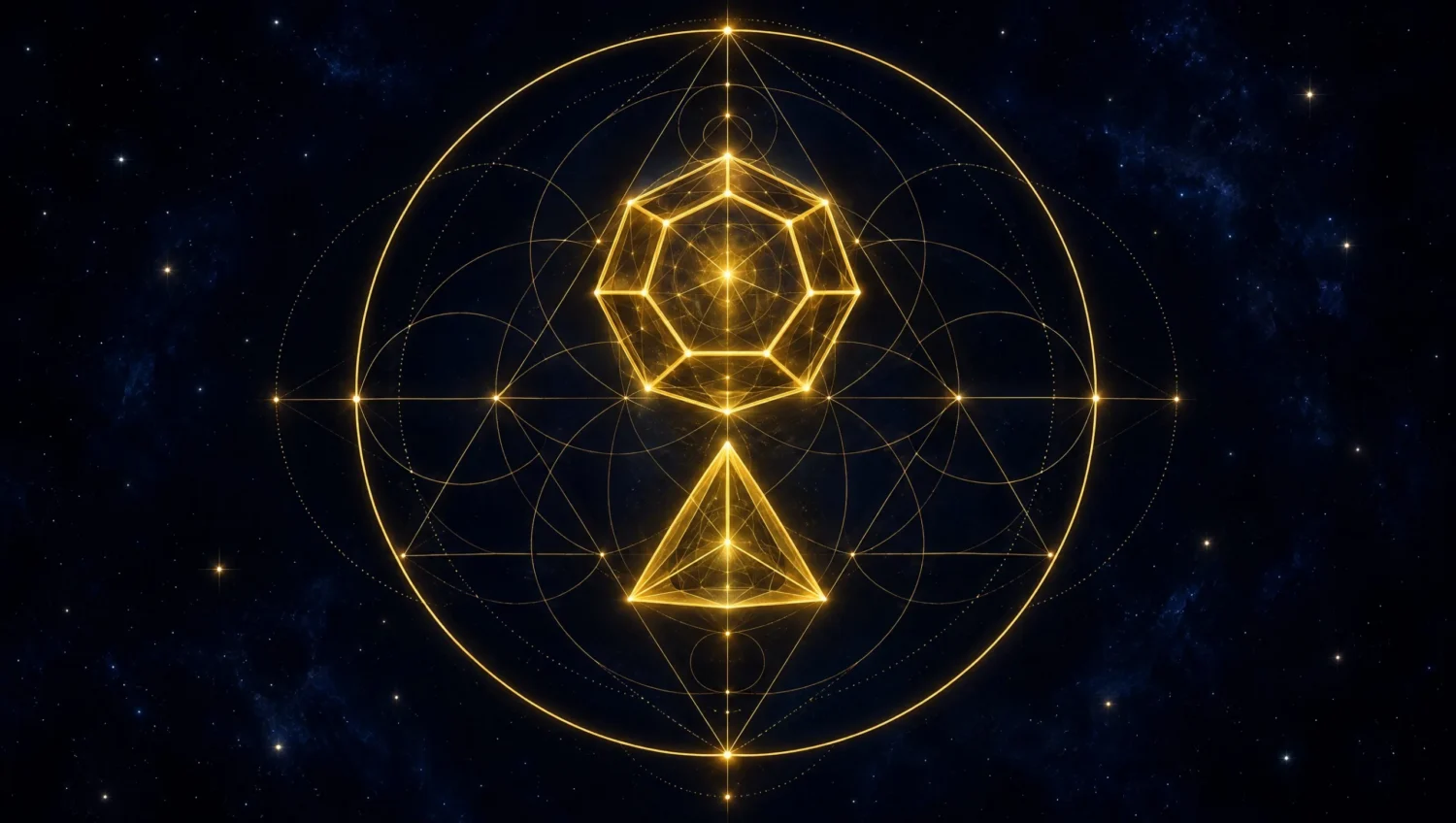
Sacred geometry is the idea that certain shapes and proportions carry spiritual meaning, and that the same patterns appear in the stars, in living things and in the temples people have built for thousands of years. A circle, a spiral, a triangle, a flower of overlapping circles: each one is read as a way the universe organizes itself.
You have already seen these patterns even if you never had a name for them. They are in a sunflower, a snail shell, a snowflake, a stained glass window and the floor plan of an ancient temple. Seekers return to them because they feel like a language beneath language.
This guide is a complete, plain-language map of the territory. You will learn where the idea came from, the basic shapes and the five Platonic solids, the famous symbols like the Seed of Life and Metatron’s Cube, where geometry shows up in nature and architecture, what is established and what is tradition, and how to draw and meditate with these forms yourself. As always, the power is within you. The shapes are a doorway, not a destination.
Key Takeaways
- Sacred geometry reads shapes and proportions as expressions of order, unity and creation.
- The idea runs from Pythagoras and Plato through Gothic cathedrals and Islamic art to the modern revival of symbols like the Flower of Life.
- The core building blocks are the circle, vesica piscis, triangle, square and spiral.
- The five Platonic solids were linked by Plato to fire, earth, air, water and the cosmos.
- Patterns like hexagons, spirals and six-fold symmetry really do appear throughout nature, which is part of why the subject feels so alive.
- You can work with these forms by drawing, gazing, breathing and noticing. No special training is needed.
What Is Sacred Geometry?
Sacred geometry assigns symbolic and spiritual meaning to geometric forms. In this view, geometry is not only mathematics. It is a way of seeing how unity becomes many: how a single point becomes a line, a circle, a form and a world. You can read the short definition in our sacred geometry glossary entry.
There are two ways to read the subject, and both are valid. The first is symbolic: each shape stands for an idea such as wholeness, balance or creation, and you use it as a focus for reflection. The second is structural: geometry shows up in how nature grows and how builders design, so studying it teaches you about the pattern of the world itself. Most people find that the two feed each other.
A Short History of Sacred Geometry
People have attached meaning to shape for as long as there has been art. The written record gives us a few clear landmarks:
| Period | Who or What | Contribution |
|---|---|---|
| c. 570 to 495 BC | Pythagoras and his followers | Treated number and proportion as the hidden order of the cosmos |
| c. 360 BC | Plato, in the dialogue Timaeus | Linked the five regular solids to the elements and the heavens |
| c. 300 BC | Euclid | Gathered the foundations of geometry in the Elements |
| 12th and 13th centuries | Gothic cathedral builders | Used circles, squares and triangles to plan sacred space |
| Medieval Islamic world | Artists and architects | Developed intricate geometric patterns for mosques, tiles and manuscripts |
| c. 1490 to 1509 | Leonardo da Vinci and Luca Pacioli | Studied proportion in the Vitruvian Man and in a book on the divine proportion |
| 1596 | Johannes Kepler | Proposed that nested Platonic solids shaped the planetary orbits |
| Late 20th century | Modern spiritual teachers | Popularized symbols like the Flower of Life and Metatron’s Cube |
The thread is steady. Philosophers, builders, astronomers and mystics all found that geometry gave them a way to speak about order and the sacred at the same time.
The Basic Shapes and What They Symbolize
Sacred geometry begins with a very simple story. A point becomes a line. A line becomes a circle. Two circles meet and a third form appears. From that small sequence, nearly every symbol in this guide can be drawn.
| Shape | Traditional Meaning | Where You See It |
|---|---|---|
| Point | The source, the beginning | The center of a mandala |
| Circle | Wholeness, unity, the infinite | Halos, mandalas, the sun and moon |
| Vesica piscis | Union, birth, the meeting of two worlds | Two overlapping circles, cathedral windows |
| Triangle | Trinity, balance, direction | Pyramids, the Sri Yantra |
| Square | Earth, stability, the material world | Temples, foundations, city plans |
| Hexagon | Harmony, the six-fold pattern | Honeycombs, snowflakes, the Seed of Life |
| Spiral | Growth, evolution, return | Shells, galaxies, ferns |
The vesica piscis is formed where two circles of equal size overlap, each passing through the center of the other. Many traditions treat that almond shape as a gateway, the place where two become a third.
The Five Platonic Solids
A Platonic solid is a three-dimensional shape made of identical faces with the same number of faces meeting at every corner. There are exactly five. In Timaeus, Plato linked four of them to the classical elements and the fifth to the heavens.
| Solid | Faces | Associated With | Feeling Tone |
|---|---|---|---|
| Tetrahedron | 4 triangles | Fire | Sharp, energetic, rising |
| Cube | 6 squares | Earth | Stable, grounded, still |
| Octahedron | 8 triangles | Air | Light, balanced, flowing |
| Icosahedron | 20 triangles | Water | Fluid, rounded, adaptable |
| Dodecahedron | 12 pentagons | The cosmos, ether | Whole, expansive, harmonious |
Centuries later, Kepler was so taken with these solids that he proposed nesting them inside one another to explain the spacing of the planets, an idea he published in Mysterium Cosmographicum. The model did not hold up, but it shows how deeply the solids captured the imagination of serious thinkers.
The star-shaped form built from two interlocking tetrahedra appears in the Merkaba, a symbol of light and ascension in many modern teachings.
The Famous Symbols of Sacred Geometry
Seed of Life
The Seed of Life is made of seven overlapping circles: one in the center and six around it. It is often read as the pattern of creation unfolding, sometimes linked to the seven days of creation in the book of Genesis. Learn more in our guide to the Seed of Life, with a simple meditation.
Flower of Life
The Flower of Life extends the Seed of Life into a larger lattice of overlapping circles in a hexagonal pattern, most often shown with 19 circles inside an enclosing circle. It appears in art and architecture across many cultures. See our Flower of Life guide and the glossary entry for the Flower of Life.
Fruit of Life
The Fruit of Life is a set of 13 circles drawn within the Flower of Life. It is the foundation from which Metatron’s Cube is drawn.
Metatron’s Cube
Metatron’s Cube is drawn from the centers of thirteen circles joined by straight lines. The lines can be traced to outline two-dimensional views of all five Platonic solids. It is named for the archangel Metatron, a figure associated with the divine blueprint of creation. Read the full story in our Metatron’s Cube guide, and meet the archangel in Archangel Metatron: Who He Is and How to Connect.
Merkaba
The Merkaba is a star tetrahedron, two interlocking pyramids pointing opposite ways. In teachings that use the word, it is a vehicle of light for the soul and body. Explore it in our Merkaba guide or the Merkaba glossary entry.
Tree of Life
In the Jewish mystical tradition of Kabbalah, the Tree of Life is a diagram of ten spheres joined by 22 paths. It maps the stages through which the divine becomes the world, and it is one of the best known geometric diagrams in Western esotericism.
Sri Yantra and Mandala
Not all sacred geometry comes from the West. The Sri Yantra is a diagram of nine interlocking triangles used in Hindu meditation as a map of creation. A mandala is a circular design used in Hindu, Buddhist and Jain practice as an aid to focus and wholeness. Tibetan monks make sand mandalas over days and sweep them away as a teaching on impermanence.
The Torus
A torus is a doughnut-shaped surface. Many modern teachers use it as a picture of energy that flows out from a center and returns to it. Treat this as a symbolic model, a useful image for how a living system circulates and renews itself.
The Golden Ratio and the Fibonacci Spiral
The golden ratio is a proportion of about 1.618, found by dividing a line so that the whole is to the longer part as the longer part is to the shorter. It is closely related to the Fibonacci sequence: 1, 1, 2, 3, 5, 8, 13, and on, where each number is the sum of the two before it. The ratio between neighboring numbers in the sequence gets closer and closer to 1.618.
Draw squares with those side lengths, connect their corners with a curve and you get the Fibonacci spiral. Spirals of this kind appear in sunflower heads, pinecones and pineapples, where the number of spirals is often a Fibonacci number. Many designers believe proportions near the golden ratio feel balanced and calm. It is worth saying plainly that not every spiral in nature is a perfect golden spiral. A nautilus shell, for example, is a lovely logarithmic spiral, but its growth ratio is not exactly 1.618. The beauty does not depend on the exact number.
Sacred Geometry in Nature
Part of the pull of this subject is that the patterns are real. A few of the clearest examples:
- Honeycomb: bees build cells in a tessellation of hexagons, which uses wax efficiently and packs tightly.
- Snowflakes: ice crystals grow with six-fold symmetry, so snowflakes have six arms.
- Sunflowers and pinecones: seeds and scales arrange in interlocking spirals.
- Ripples: a drop in still water makes widening circles, and two drops make overlapping ones, the same shape as the vesica piscis.
- Sound made visible: in the 1780s the physicist Ernst Chladni showed that sand scattered on a vibrating plate gathers into geometric patterns, a striking link between sound and form.
You do not have to believe anything to enjoy these. You only have to look. A walk with the intention of noticing shapes is one of the simplest sacred geometry practices there is.
Sacred Geometry in Temples, Cathedrals and Art
Builders have long used geometry to shape places of worship. The aim is a space that helps the visitor feel gathered and still.
- Gothic cathedrals: the early 13th century Chartres Cathedral holds a famous labyrinth set in the floor of the nave, a geometric path that pilgrims walk as a meditation. Rose windows use circles and polygons radiating from a center.
- Islamic art: mosques, palaces and manuscripts use star patterns and interlocking polygons built from circles and straight lines, a tradition that avoids figures and celebrates unity through pattern.
- Hindu temples: many temple plans follow strict proportions, and smaller towers echo the shape of the whole, a picture of the divine repeating at every scale.
- The human figure: Leonardo’s Vitruvian Man fits a body inside a circle and a square, joining the human and the cosmic.
- Ancient monuments: see our guide to the Great Pyramid of Giza for the geometry people have found in its design and the debates around it.
For a teaching from a lineage that takes this seriously, listen to our conversation on sacred geometry and the true teaching of the Rosicrucians. If you are curious about the lost-knowledge side of the story, try our conversation with Matt LaCroix in The Lost Knowledge of Atlantis Returns.
Sacred Geometry and the Energy Body
Geometry also appears in traditions that work with the subtle body. Each of the seven chakras is traditionally drawn as a lotus with a set number of petals, and the heart chakra includes two interlocking triangles. Many people pair visual focus on a geometric form with breath and attention at the matching center. If that interests you, try our chakra meditation for each energy center.
What Is Established and What Is Tradition
It helps to keep clear which claims belong in which box. Holding them separately makes you a more grounded student, and it does not take away any of the beauty.
| Idea | What we can say with confidence |
|---|---|
| Platonic solids | Exactly five exist, and ancient philosophers linked them to the elements |
| Golden ratio | A real mathematical constant of about 1.618, related to Fibonacci numbers |
| Patterns in nature | Hexagons, spirals and six-fold symmetry are real and well documented |
| Flower of Life in ancient sites | Overlapping circle patterns appear in many places. The age and method of specific carvings are debated |
| Metatron’s Cube holding the solids | True as a drawing exercise. The spiritual meaning is a tradition and a symbol |
| Energy or healing effects of shapes | A matter of personal experience and belief, not a settled finding |
How to Draw the Basic Forms
Drawing is the best way to understand these patterns. You need paper, a pencil and a compass. Keep the compass at the same width for every step.
Vesica Piscis
- Draw a circle. Mark its center.
- Place the compass point anywhere on the circle and draw a second circle of the same size.
- The almond shape where they overlap is the vesica piscis.
Seed of Life
- Draw the first circle.
- Place the point on its edge and draw a second circle.
- Place the point where the two circles cross and draw a third.
- Continue around the center until six circles surround the first. You now have seven circles.
Flower of Life
- Start from the Seed of Life.
- Place the compass point on each outer intersection and draw a new circle of the same size.
- Add one large circle around the whole figure to enclose it.
Go slowly. The act of drawing is itself a quiet meditation.
Five Ways to Work With Sacred Geometry
- Draw it by hand. Spend ten minutes drawing the Seed of Life. Notice how your breath changes as you work.
- Gaze at one shape. Look at it softly for five minutes. Let your breath slow. Notice what rises.
- Walk and notice. Look for spirals, hexagons and circles in the natural world. A pinecone, a honeycomb and a ripple all count.
- Pair it with breath. Inhale as your eyes trace outward along a pattern, exhale as they return to the center.
- Journal with it. Choose a symbol and write for five minutes on what it brings up: where in your life do you feel whole, balanced or in the process of becoming?
You can also place a simple print or drawing where you rest, as a quiet reminder to return to center. Choose a version that you find beautiful and let it support your own reflection.
Quick Glossary of Terms
| Term | Plain-Language Meaning |
|---|---|
| Vesica piscis | The almond shape formed by two overlapping circles of equal size |
| Platonic solid | One of five regular three-dimensional shapes with identical faces |
| Phi | The golden ratio, about 1.618 |
| Tessellation | A pattern of shapes that fit together with no gaps, such as hexagons |
| Yantra | A geometric diagram used in Hindu meditation |
| Mandala | A circular design used as a map of the cosmos and an aid to focus |
| Torus | A doughnut-shaped form, used symbolically for energy that circulates |
| Symmetry | Balance in a pattern, such as the same shape repeating around a center |
For a wider tour of images that carry meaning, see our guide to spiritual symbols and their meanings.
A Grounded Way to Hold It
It is easy to get lost in big claims about sacred geometry. A grounded approach keeps two things true at once. The patterns are beautiful and meaningful to millions of people, and they are tools for your own attention and reflection, not magic formulas. Use them to feel more present, more curious and more connected. That is already a lot, and it is yours to keep.
Frequently Asked Questions
What is sacred geometry in simple terms?
Sacred geometry is the practice of seeing spiritual meaning in geometric shapes and proportions, such as circles, triangles, spirals and the Flower of Life. It treats geometry as a language of how creation is organized.
Where did sacred geometry come from?
The idea has deep roots in ancient Greek philosophy, especially Pythagoras and Plato, and in the sacred architecture and art of many cultures, including Gothic Europe, the Islamic world and India. The modern popularity of symbols like the Flower of Life grew in the late twentieth century.
What are the main shapes in sacred geometry?
The core shapes are the point, circle, vesica piscis, triangle, square, hexagon and spiral. From them come larger patterns like the Seed of Life, Flower of Life, Metatron’s Cube and the Platonic solids.
What are the five Platonic solids?
They are the tetrahedron, cube, octahedron, dodecahedron and icosahedron. Each has identical faces and the same number of faces meeting at every corner. Plato linked them to fire, earth, air, the cosmos and water.
What is the Seed of Life?
The Seed of Life is a symbol of seven overlapping circles, one in the center and six around it. It is often read as the pattern of creation unfolding step by step.
What is the Flower of Life?
The Flower of Life is a larger pattern of overlapping circles in a hexagonal lattice, most often shown with 19 circles. It is one of the most widely used symbols in sacred geometry and appears in art and architecture across many cultures.
What is Metatron’s Cube?
Metatron’s Cube is a figure made from thirteen circles joined by straight lines. The lines can be traced to outline two-dimensional views of all five Platonic solids. It is named for the archangel Metatron.
What is the Merkaba?
The Merkaba is a star tetrahedron made of two interlocking pyramids. In many modern teachings it represents a vehicle of light for the soul and body.
What is the golden ratio?
The golden ratio is a proportion of about 1.618 found in mathematics and closely related to the Fibonacci sequence. Many people find designs based on it feel balanced and harmonious.
Does sacred geometry appear in nature?
Yes. Hexagons in honeycombs, six-fold symmetry in snowflakes and spirals in sunflowers and pinecones are well documented. Noticing them is a simple way to practice sacred geometry.
How do I start working with sacred geometry?
Begin by drawing a Seed of Life with a compass, then sit with it for five minutes of quiet breathing. Notice what you feel, and repeat daily for a week.
Is sacred geometry a religion?
No. It is a way of seeing that appears in many traditions, from Greek philosophy to Hindu yantras to Christian cathedrals. You can explore it without belonging to any one path.
Can sacred geometry heal you?
Many people find that drawing or gazing at these patterns calms the mind and brings a sense of focus. Claims about physical healing are a matter of personal belief, so treat the practice as support for well-being and speak with a doctor about health concerns.
Sources and Further Reading
Spirituality for the Rest of Us™
Movies, teachings and community on Next Level Soul TV.