
Paramahansa Yogananda wrote and spoke for more than three decades, and his words still travel. Some of that is the sheer plainness of them. He did not ask people to believe anything complicated. He asked them to be calm, to be kind, to practice, and to remember what they already are. That is a rare thing to hear from a spiritual teacher, and it is why so many seekers keep his book on the nightstand.
This page gathers twenty of his sayings, grouped by theme: calm and meditation, joy and simplicity, power and growth, the soul, and love. Under each one, you will find a short note in plain language and a small way to try it today. The quotes come from his published talks and writings, including Solving the Mystery of Life and the collection Where There Is Light.
If you would like to meet the man behind the words first, the film Awake: The Life of Yogananda is a good place to begin. Watch the trailer below, then read on.

Awake is a feature documentary about Yogananda’s life, directed by Paola di Florio and Lisa Leeman. It follows him from his childhood in India to his decades of teaching in America, and it is available on Next Level Soul. You can read our review of Awake before you watch.
Quotes on Calm and Meditation
Yogananda taught that stillness is not an absence of life. It is where the deepest part of life shows itself. These five lines are the heart of his advice on prayer and meditation.
“Calmness is the altar and sanctuary of the Father.”
Think of calmness as a room you can step into. You do not have to build it. Try one minute of slow breathing before your next meeting and treat that minute as a quiet room.
“Realization is found only in inner calmness.”
He is not asking you to feel calm all the time. He is pointing out where insight lives. Notice what you understand more clearly after you slow down.
“Meditation is the way.”
Short and direct. It is an invitation to make meditation the center of your spiritual life, not an extra. Start with ten minutes at the same time each morning.
“Real prayer is not intellectual; it is feeling what you say to God.”
Many of us were taught prayers as words to recite. He asks for the feeling behind them. Say a simple prayer slowly and wait for the feeling to arrive.
“Say the first word “Father,” that is enough; but say it until you feel it.”
This is one of his gentlest instructions. One word, repeated, until your heart joins in. It works with any name for the Divine that is meaningful to you.
Quotes on Joy and Simplicity
So much of modern life asks us to add. Yogananda keeps pointing the other way, toward less, and toward a happiness that does not depend on circumstances.
“Be as simple as you can be; you will be astonished to see how uncomplicated and happy your life can become.”
Pick one thing to simplify this week, such as a commitment, a pile of clutter or a habit of checking your phone. Notice what returns to you.
“Don’t seek little things; they will divert you from God.”
He is not scolding ordinary desires. He is asking what you are really after. When you feel a pull toward something small, ask what you hope it will give you.
“Learn to be happy at will and to hold on to that happiness within, no matter what happens.”
Happiness here is a skill, not a mood. Practice by calling up a moment of gratitude on purpose, and hold it for sixty seconds.
“No matter where I go, I keep my mind continuously on my soul peace.”
This is a picture of how a life of practice can feel. You can try it in miniature by returning to one slow breath whenever you notice stress.
“Start your experiment now: make life simple and be a king.”
He frames simplicity as an experiment, not a vow. Try it for one week and see whether your days feel lighter.
Quotes on Power and Growth
If you grew up hearing that spiritual life is about giving up, these lines may surprise you. Yogananda talks about willpower, courage and the usefulness of difficulty.
“Whatever you make up your mind to do, you can do.”
It is an invitation, not a guarantee. Choose one small thing you have been putting off and commit to doing it today.
“One who doesn’t have difficulties is one who doesn’t grow.”
This does not make hard times pleasant. It gives them a reason. Think of a challenge from five years ago and ask what it taught you.
“Use every trial that comes to you as an opportunity to improve yourself.”
The word that matters is use. When something goes wrong, ask what you can practice here: patience, honesty, courage or compassion.
“Those who are unconquered in spirit are the real successes in life.”
Success, in his view, is measured by inner freedom. Ask yourself what a successful day would look like if you measured it that way.
“When you say to me that you can’t do this or that, I don’t believe it.”
A warm kind of tough love. Catch yourself the next time you say I can’t, and replace it with I have not learned how yet.
“Who can stop you from thinking you are a god? No one. You are your only obstruction.”
In the Indian tradition, this speaks to the divine spark within each person, and not to the ego. The only real limit he names is the one inside you.
Quotes on the Soul
At the center of Yogananda’s teaching is a simple claim: you are more than your body, your mood or your history. These two lines say it plainly.
“Every human being is an expression of the great, vast Spirit.”
Try seeing the people around you this way for one day, especially the difficult ones. See what changes in how you speak to them.
“All great teachers declare that within this body is the immortal soul, a spark of That which sustains all.”
Notice how many traditions say something similar. If you like comparative reading, our guide to spiritual enlightenment is a good next step.
Quotes on Love and Kindness
Meditation was never meant to be a private escape. Yogananda connects inner peace to the way we treat each other.
“Making others happy, through kindness of speech and sincerity of right advice, is a sign of true greatness.”
Greatness is measured in small kindnesses. Send one honest, encouraging message to someone today.
“To send your thoughts to loved ones who have passed on, sit quietly in your room and meditate upon God.”
For anyone grieving, this is a tender instruction. Sit quietly, breathe, and let your love be the prayer.
A Short Life of Yogananda
Paramahansa Yogananda (1893 to 1952) was born Mukunda Lal Ghosh in Gorakhpur, India. As a young man he became the disciple of Sri Yukteswar in Serampore, and in 1920 he traveled to Boston to speak at an international congress of religious liberals. He stayed in the West, founded Self-Realization Fellowship that same year and taught Kriya Yoga meditation to thousands of students. For the full story, read our guide to Paramahansa Yogananda.
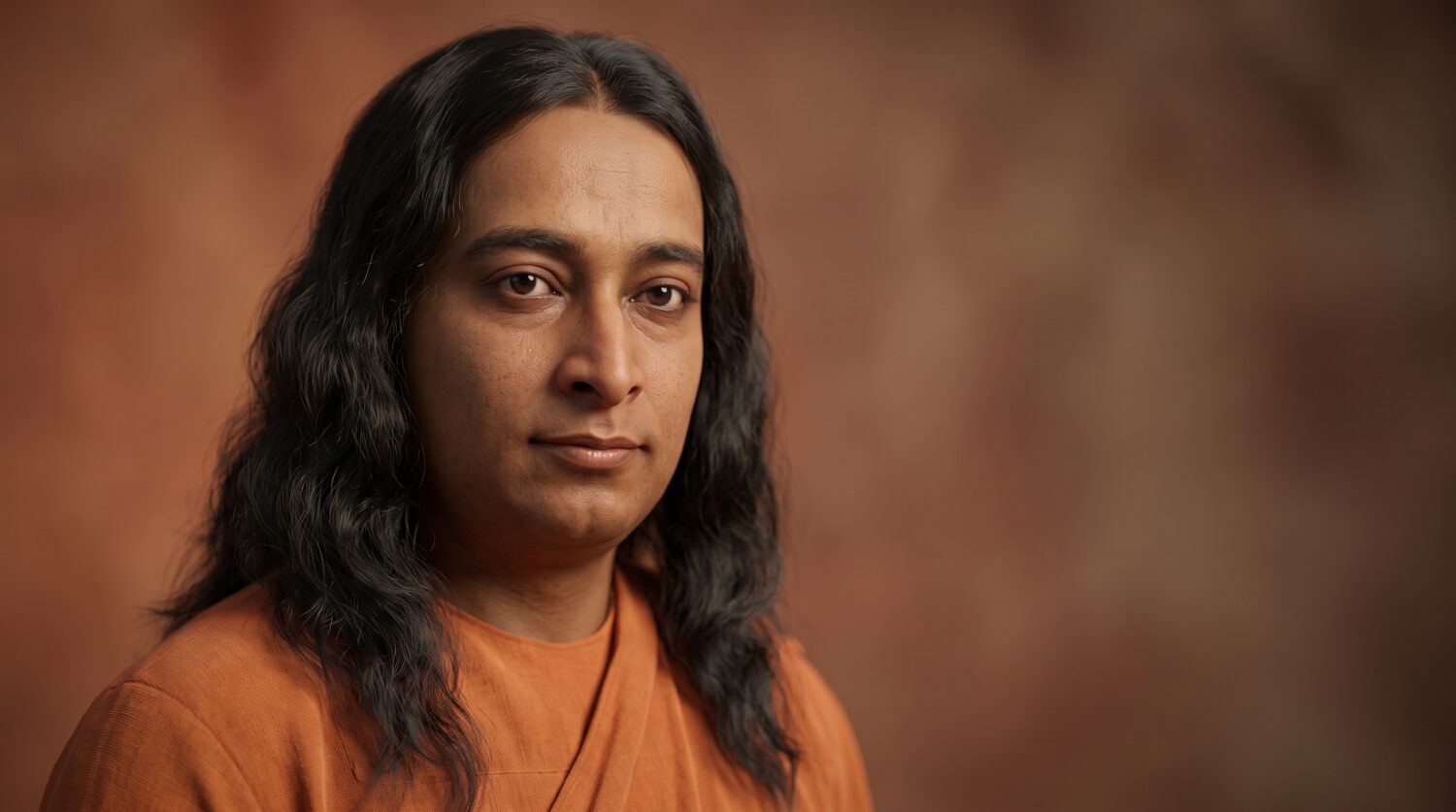
The Legacy of Autobiography of a Yogi
Autobiography of a Yogi, first published in 1946, is Yogananda’s memoir and the book that introduced meditation and the Kriya Yoga lineage to a global audience. It tells of his childhood in India, his years with his guru and his mission in America, and it has been translated into dozens of languages. If these quotes have moved you, it is the natural next read. For the techniques behind the quotes, see our guide to Kriya Yoga meditation.
How to Live With These Quotes
A quote is only words until you do something with it. Here are four simple ways to let these twenty lines work on you.
- Choose one a week. Write it where you will see it, on the bathroom mirror or the first page of your notebook.
- Read it before you meditate. Let it be the thought you carry into silence, and let it go once you begin.
- Ask a question of it. What would my day look like if this were true? Write down one line.
- Share it with someone. Send a favorite quote to a friend who could use a lift.
On Screen: Finding Happiness
Yogananda’s teaching on joy also comes to life in the film Finding Happiness. It is a docu-drama set in Ananda, a spiritual community in Northern California founded on his teachings, and it asks whether happiness is something we can learn. It makes a gentle companion to the quotes above, and you can watch it on Next Level Soul.

Keep Exploring
Continue with our guides to Paramahansa Yogananda’s life and teachings, Kriya Yoga meditation and Self-Realization teachings. When you are ready to go deeper, explore the free masterclasses or the Next Level Soul Mastery courses.
Go Deeper: Watch Awake: The Life of Yogananda
Watch Awake on Next Level Soul TV Not Ready Yet? Read Our Awake Review
Frequently Asked Questions
Who was Paramahansa Yogananda?
Paramahansa Yogananda (1893 to 1952) was an Indian yogi and teacher who brought meditation and Kriya Yoga to a wide Western audience. He founded Self-Realization Fellowship in 1920 and wrote Autobiography of a Yogi.
What is Yogananda’s most famous quote?
There is no single official answer, but lines about calmness, simplicity and learning to be happy at will are among the most widely shared. This page collects twenty from his published talks and writings.
Where do these Yogananda quotes come from?
They come from his published talks and writings, including Solving the Mystery of Life and the collection Where There Is Light. Many quotes online are misattributed, so we have included only lines we could trace to his published work.
What did Yogananda teach about meditation?
He taught that meditation is the direct way to experience the soul and God, and that calmness is where realization is found. He taught Kriya Yoga as a method for quieting the mind. See our guide to Kriya Yoga meditation.
What is the book Autobiography of a Yogi about?
It is Yogananda’s memoir, published in 1946. It tells his life story, introduces the Kriya Yoga lineage and explores the idea that direct experience of God is possible.
Where can I watch the film Awake?
Awake: The Life of Yogananda is available on Next Level Soul.
Where can I watch Finding Happiness?
Finding Happiness is available on Next Level Soul.
Go Deeper with NLS Mastery: Ancient Meditation for Inner Stillness
Time-tested meditation from the Vedic tradition, taught step by step for modern daily life. Acharya Shunya teaches it in Ancient Meditation for Inner Stillness, part of NLS Mastery. Watch the course preview below.