His name means cheerful. That is a small, true detail, and it is almost the only simple thing about him. Master Hilarion is the Cypriot Adept of Blavatsky’s circle, the green-robed Chohan of the Fifth Ray in the Ascended Master Teachings, a Master of truth and healing who is said to have walked the earth as the Apostle Paul and as Saint Hilarion of Gaza. He has also been linked to the Neoplatonist Iamblichus, which makes the lists of his lives interesting to compare. The historical material about him is thin, so this guide does what honest writing should: it separates the documented from the claimed, supplies the real history of the people named, and does not invent what the sources do not say. For the wider picture, begin with our complete guide to the Ascended Masters.
Key Takeaways
- Who he is: Master Hilarion (also Ilarion or Hillarion Smerdis), a Cypriot Adept in the Theosophical tradition and the Chohan of the Fifth Ray of truth, science and healing in the Ascended Master Teachings.
- What is documented: Blavatsky and Olcott mention him in the early 1880s, he appears in three letters to Olcott, and the writer Mabel Collins attributed Light on the Path (1885) to a teacher she called Hilarion.
- Claims about his lives: Paul of Tarsus and Iamblichus (Theosophical writers), and Paul and Saint Hilarion of Gaza (Summit Lighthouse). The lists overlap in time, which we explain.
- His ray and place: the green or emerald ray, with a retreat called the Temple of Truth, said to stand in the etheric octave over Crete.
- Where the material is thin: his life as a Theosophical Adept, his identity and the exact origin of many online details. We say so wherever it applies.
- Our stance: reverent, not credulous. We offer the teaching on truth and healing without claiming more than the sources do.
In This Guide
- Who Is Master Hilarion?
- A Name That Means Cheerful
- Hilarion in the Theosophical Record
- Mabel Collins, the White Lotus and Light on the Path
- Who Might He Have Been? A Cypriot, a Magician, or a Symbol
- Leadbeater and Besant: Hilarion as Paul and Iamblichus
- Paul of Tarsus: What History Records
- Iamblichus: The Philosopher Who Defended the Rites
- Saint Hilarion of Gaza: The Hermit in Jerome’s Life
- One Name, Three Lives: The Overlap Puzzle
- The Fifth Ray: Concrete Knowledge or Truth and Healing
- The Temple of Truth over Crete
- Healing in the Greek World: Asclepius and Hippocrates
- Truth, Science and the Skeptic
- The Emerald Tablet and the Alchemy of Green
- How Students Say They Work with Hilarion
- Channeled Voices on NLS
- How Hilarion Compares with Other Masters
- Honest Questions and Cautions
- A Mystic’s Reading: The Master of the Honest Question
- A Practice: Seven Days of the Green Flame
- Books and Further Reading
- Who Will Connect with This Master
- Keep Exploring
- Frequently Asked Questions
Who Is Master Hilarion?
Some Masters come with a thick biography. Hilarion arrives with a green robe, a few documented sightings, a mysterious book and a handful of claimed past lives. That is not a failure. It is a reminder that the Masters of the esoteric tradition are known mainly through testimony, and the amount of testimony varies a great deal.
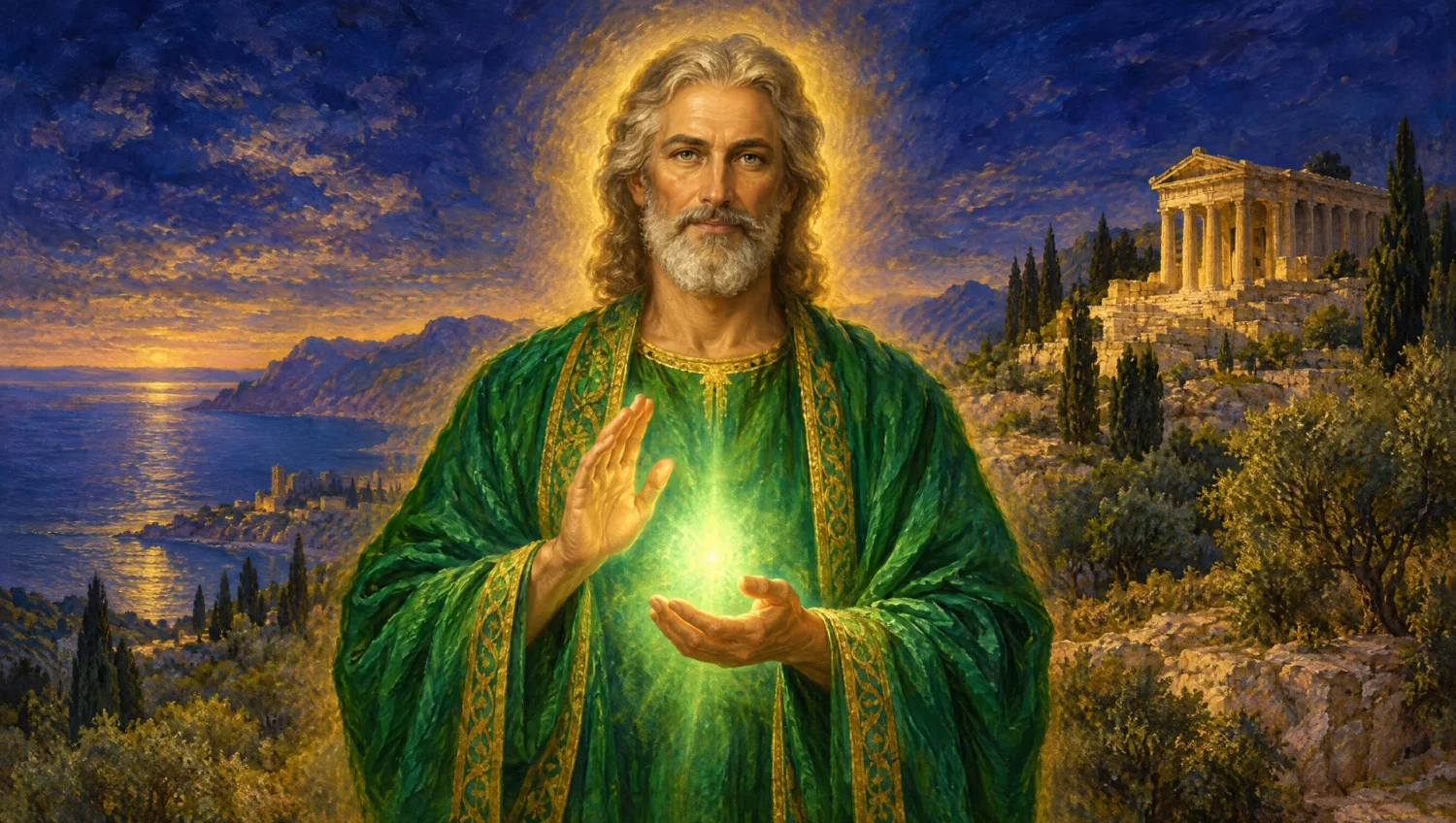
In the Theosophical tradition he is a Greek or Cypriot Adept who traveled between Egypt, Cyprus and India and who appears in the letters and diaries of Blavatsky and Olcott. In the later Ascended Master tradition he is the Chohan of the Fifth Ray, which is associated with truth, science, healing and the color green. In the stream of the Summit Lighthouse, he is also described as the hierarch of the Temple of Truth, a retreat said to exist above the island of Crete.
The word we keep using is tradition. Everything below comes with a source. When a claim rests on Blavatsky or Olcott, we say so. When it comes from Mabel Collins, we say so. When it comes from the Prophets of the Summit Lighthouse, we say so. We prefer a short guide with solid footing to a long one with invented detail.
A Name That Means Cheerful
Hilarion comes from the Greek hilaros, which means cheerful, joyful or merry. It is the same root that gives us the word hilarious. It was a common name among early Christians, and the name Hilarion is borne by several saints and bishops.
The spelling varies. In Theosophical sources you will see Hilarion, Ilarion and Hillarion, and with a surname, Hilarion Smerdis or Ilarion Smerdis. The Smerdis is an odd addition, and no one is sure of its meaning. It echoes the name of a figure in ancient Persian history, but there is no evidence that the Master’s name was meant to refer to him.
There is something gently surprising in the fact that the Master of truth and healing carries a name meaning cheerful. Medicine has long known that spirits matter to healing. The tradition seems to say that real truth is not grim. The one who loves the truth most can laugh the most easily.
Hilarion in the Theosophical Record
Let us start with what the early Theosophical sources say. They are few but specific.
- Blavatsky (1884): described him as a Greek gentleman, an Adept whom she had known since 1860, and said he had gone on to his final initiation.
- Olcott’s diary (February 1881): records a visit to Bombay by Hilarion, on his way to Tibet. A letter from Koot Hoomi to A. P. Sinnett independently mentions him passing through Bombay from Cyprus.
- Letters to Olcott: three letters attributed to him survive in Letters from the Masters of the Wisdom. One was written in French. One relays a message from the Master Serapis Bey. One asks Olcott to write to Sinnett on behalf of Koot Hoomi.
That is the core. There are also hints. Some Theosophical writers connect Hilarion with three early stories linked to Blavatsky, including An Unsolved Mystery and A Story of the Mystical, both from 1875, and The Ensouled Violin, published in 1892. The idea is that the Master collaborated with Blavatsky on fiction. That is a conjecture based on a hint in a letter from Koot Hoomi, and it is not certain.
For the wider background on these letters, including the debate over their authorship, see our guide to the Ascended Masters, and listen to Theosophy and The Ocean of Theosophy, both available on Next Level Soul.
Notice also how Hilarion functions in the story. He is a courier and a bridge: between Egypt and India, between Serapis and Koot Hoomi, between the earlier Egyptian circle and the Himalayan Masters. That is a fitting role for a Master who is later associated with truth, because truth often travels between different worlds.
Mabel Collins, the White Lotus and Light on the Path
The most influential text connected to Hilarion is a small book. Mabel Collins (1851 to 1927) was an English novelist and a member of Blavatsky’s circle. In 1884 she published The Idyll of the White Lotus, a novel set in an Egyptian temple of initiation, about a young neophyte who must face temptation and choose between the world and the path. In 1885 came Light on the Path, a short collection of aphorisms for the aspirant, with commentary.
Collins said she wrote Light on the Path under the inspiration of a teacher she called Hilarion, beginning in October 1884. Blavatsky, writing in 1888, described seeing the astral figure of a dark Greek urging Collins to write. Blavatsky also said that the finishing of the Idyll was the work of a Greek Adept. When another writer, Elliott Coues, claimed that Koot Hoomi had dictated the book, Blavatsky disputed it.
Collins’s own account was not without difficulty. She later broke with Blavatsky’s circle, and there was controversy over how much of the material came from her and how much from elsewhere. As always, the line between inspiration, authorship and testimony is blurry.
What matters for readers is the book itself. Light on the Path is a famous text in the Western esoteric tradition. It begins with rules for the seeker, such as the instruction that before the eyes can see they must be incapable of tears. The line is a call to a kind of strong tenderness, in which grief does not blind judgment. It is public domain, and the full text can be found easily. You can also search for editions on Amazon.
Who Might He Have Been? A Cypriot, a Magician, or a Symbol
If Hilarion lived as a person, he has not been identified. The historian K. Paul Johnson, who suggested real-world identities for several Masters, speculated that the Hilarion of Blavatsky’s circle might have been Ooton Liato, a Cypriot stage magician whom Blavatsky met in New York in 1873. The suggestion is not accepted by Theosophists and is, like Johnson’s other proposals, debated.
Another possibility is that Hilarion was a symbol that Blavatsky used for the Mediterranean or Greek strand in her story, as Morya stood for India and Serapis for Egypt. In this reading the three Masters represent three streams of ancient wisdom that she believed flowed together in Theosophy. That is a literary and religious reading, not a historical one.
A believer would add that the Masters naturally use different personas and that identity does not matter. The student of history will want to note that we do not know. Both can still agree that the figure has meant something to many readers.
Leadbeater and Besant: Hilarion as Paul and Iamblichus
The Theosophical Society did not stop at a Cypriot Adept in the 1880s. Later writers added a long past to him. Charles Webster Leadbeater and Annie Besant, who led the Society after Blavatsky died, wrote about the past lives of the Masters. In their accounts, Hilarion had once been Paul of Tarsus and, before that or after, the Neoplatonist Iamblichus.
Treat this as what it is. It is a claim made by two Theosophical leaders in the early twentieth century. It does not come from Hilarion himself. It does not appear in the first Mahatma Letters. Historians have no way to test it, and many Theosophists and later students of the tradition hold it loosely.
Still, the claim tells you something. Paul and Iamblichus are an odd pair. One was a Jewish tentmaker who became the great missionary of early Christianity. The other was a Syrian philosopher who defended the old Greek rites of the gods. A student who sees them as one soul must believe that truth can wear very different clothes. That is the green ray idea in a sentence.
If you want to read the Theosophical background for yourself, The Masters Revealed by K. Paul Johnson is the careful scholarly study. It treats the Masters as a historian would, and it is fair to believers and doubters alike.
Paul of Tarsus: What History Records
Here is the documented part. Paul was born in Tarsus, a city in what is now southern Turkey, probably in the first decade of the first century. He was a Pharisee, a tentmaker by trade, and at first a persecutor of the early followers of Jesus. His own letters describe a sudden turn, a vision on the road to Damascus, and a life of travel afterward.
Seven of the letters in the New Testament are accepted by nearly all scholars as his own. They are Romans, First and Second Corinthians, Galatians, Philippians, First Thessalonians and Philemon. Others are debated. He founded small communities across Asia Minor and Greece. Tradition says he died in Rome around 64 to 67 CE. The exact year is not known.
Why would Theosophists link him to a Master of truth and healing? Paul wrote often of knowledge, of a mystery revealed, of being “all things to all people.” He also wrote of gifts of healing in the communities he led. A reader looking for a thread can find one. A historian would say the thread is the reader’s own.
For the wider story of how early Christian ideas branched, see our guide to the Gnostic Gospels and the story of the lost years of Jesus. Both show how many voices stood at the start of that movement.
Iamblichus: The Philosopher Who Defended the Rites
Iamblichus lived from about 245 to about 325 CE. He was born in Chalcis in Syria and studied under Porphyry, the pupil of Plotinus. He founded a school of his own in Syria. He is counted among the great Neoplatonists.
His best-known defense of ritual is the work usually titled On the Mysteries. It is a reply to a letter that Porphyry had written to an Egyptian priest, questioning the old rites. Iamblichus argued that the gods are reached not by reasoning alone but by sacred acts, which he called theurgy. The soul, he said, needs help to rise, and ritual is part of that help.
The link to a Master of healing and truth is easy to see on the surface. Iamblichus took the inner life seriously and he defended a path that joined mind with devotion. Later Neoplatonists revered him. Some stories about miracles were told about him after his death. Those stories were written down by admirers, so read them as admiration and not as evidence.
If this period interests you, our audio course Mystery Schools of the Ancients covers 22 chapters on the old traditions of initiation. It is included with Next Level Soul membership.
Saint Hilarion of Gaza: The Hermit in Jerome’s Life
The third Hilarion is the best documented. Saint Hilarion of Gaza lived from about 291 to 371 CE. We know of him mainly because Jerome wrote a short Life of him around 390, not long after his death. It is available in English in Early Christian Lives from Penguin.
In Jerome’s account, Hilarion was born near Gaza, studied in Alexandria, and as a teenager visited the desert father Antony. He then lived for years as a hermit in the wilderness south of Gaza, in great simplicity. Disciples gathered around him. Many came for healing. Later he traveled to Sicily, Dalmatia and finally Cyprus, where he died, said Jerome, at about the age of eighty.
Jerome wrote as a churchman and a storyteller. His Life includes miracles of healing and the casting out of spirits. Scholars read it as hagiography, the genre of saints’ lives. That does not make it empty. It tells us what the early Church admired. It also tells us that the name Hilarion was linked to healing from very early on.
The Church keeps his feast on 21 October. A ruined fortress above Kyrenia in Northern Cyprus carries the name Saint Hilarion Castle. It is named for the hermit by long tradition, though the building itself is a medieval castle and not his dwelling.
One Name, Three Lives: The Overlap Puzzle
Here is a puzzle that careful readers notice. The Theosophical list of lives is Paul, then Iamblichus. The Summit Lighthouse teaching names the hermit, Saint Hilarion, as an earlier embodiment. The hermit lived from about 291 to 371. Iamblichus died around 325. The two lifespans overlap for several decades.
A single soul cannot easily live two lives at once. Believers answer in different ways. Some say the two traditions simply describe different Masters who share a name. Some say one tradition is mistaken. Some say the dates of the lists are teaching tools and not strict biography. The Theosophical and Summit accounts were also written by different people, decades apart, with different aims.
We name the puzzle here because honest sourcing means telling you where the stories do not fit. You do not have to solve it to work with the energy of the name. You only have to know which tradition is speaking when you read a claim.
The Fifth Ray: Concrete Knowledge or Truth and Healing
Hilarion is tied to the fifth of the seven rays. The traditions describe that ray differently. In Alice Bailey’s system the fifth ray is called Concrete Knowledge or Science. It is the ray of the investigating mind, of the lab and the classroom. In Summit Lighthouse teaching the fifth ray is green, and it carries truth, healing, science and music.
These are close cousins. Both put a clear mind at the center. The Summit version adds an emerald-green flame and links it to the work of doctors and scientists. The book Lords of the Seven Rays is a Summit Lighthouse volume on the rays, written from the Summit point of view. For Bailey’s own view, see her book Initiation, Human and Solar, which is also on NLS TV. If you want the wider system, see our guide to the Ascended Masters and the post on the seven chakras.
The Summit tradition associates green with the heart center. Many people also find green naturally calming. Our post on aura colors explains how color is used in energy traditions.
The Temple of Truth over Crete
In Summit Lighthouse teaching, each of the Masters keeps a retreat, a place on the etheric plane where students are said to be taught during sleep. Hilarion’s retreat is called the Temple of Truth. The tradition places it over the island of Crete.
The Summit Touring Heaven podcast describes the Temple of Truth this way. It sits over the north of Crete. An emerald flame is said to have burned there for about twelve thousand years. The story tells of an Atlantean priest who brought the flame to Greece, where it was kept at Delphi. The same teaching says Saint Hilarion trained at the Arabian Retreat and that Hilarion today works with doctors, scientists and skeptics.
These are the claims of one tradition, told in its own words. They cannot be checked by an archaeologist. They are best read as sacred story. For the Atlantis background that many of these retreat stories lean on, see our conversation with Matt LaCroix on Atlantis and the audio course Echoes of Atlantis, which runs 11 chapters and is included with Next Level Soul membership.
Crete is a fitting setting for a story about a flame. It was home to the Minoan civilization, one of the oldest in Europe, and later to many shrines of Greek religion. The island has long been a place where people looked for the sacred.
Healing in the Greek World: Asclepius and Hippocrates
To understand why a healer-Master is linked to Greece, look at what Greek healing was. The god Asclepius had temples called Asclepieia across the Greek world. The most famous stood at Epidaurus. Sick people came, bathed, fasted, slept in the sanctuary and told their dreams to the priests. The cures that followed were recorded on stone tablets.
At the same time, another path was growing. Hippocrates of Kos, who lived around 460 to 370 BCE, is the name linked to a body of medical writings built on careful observation. The Hippocratic collection looks for natural causes. It values diet, rest and watching the patient.
Both streams live inside the story of Hilarion. The first is devotional and dreamlike. The second is clear-eyed and practical. The green ray, as the Summit tradition tells it, joins them: healing through the heart and truth through the mind. For a modern look at how energy practices and medicine meet, read our post on energy healing, its history and what the research says.
Truth, Science and the Skeptic
It is unusual for a spiritual Master to be linked to science and skeptics. Most traditions put faith first. Hilarion is the odd one out. His ray stands for the honest question.
That fits the Theosophical motto often printed under the Society’s seal: there is no religion higher than truth. A student who takes that line seriously will test claims, including claims about Masters. Reading the Mahatma Letters, the Collins books and the history of the Society with open eyes is itself a form of work with the fifth ray.
So when you meet a bold claim about Hilarion, do what he is said to ask. Look for the source. Ask who wrote it and when. Keep what helps. Set the rest down gently.
The Emerald Tablet and the Alchemy of Green
The color green in this tradition meets an older green text, the Emerald Tablet. This short Hermetic writing, attributed to the legendary Hermes Trismegistus, is the source of the line “as above, so below.” The oldest known versions are in Arabic and date to around the eighth or ninth century. The tablet became a founding text of Western alchemy.
No source ties Hilarion to the Emerald Tablet. The link is a meeting of symbols, and we offer it as such. Both speak of the green, the living, the process of change in nature and in the soul.
If you want to explore inner alchemy, the audio course Alchemy of the Soul has 17 chapters on the subject and is included with Next Level Soul membership. Our guide to the Akashic Records pairs well with it for students interested in soul memory.
How Students Say They Work with Hilarion
People who feel drawn to Hilarion describe a few common themes. Some report a sense of clarity when they are confused. Some turn to him in times of illness, asking for support while they follow their doctor’s advice. Some say he helps them to see what is true in a hard situation. Some are healers, nurses or researchers who feel a quiet kinship with the ray.
These are personal accounts. We share them as accounts and not as proof. Many people find that an image of an emerald light, held for a few minutes with a calm mind, helps them breathe and think. That is a real benefit whatever you believe about the Master.
If you are working through grief or a tangled situation, it may also help to read about karma and reincarnation. They give a wider frame for why hard things happen.
Channeled Voices on NLS
Next Level Soul has hosted several guests who work with the Ascended Masters. Their conversations are personal testimony, not historical proof, and we invite you to listen with your own discernment.
A good place to start is Hope Messages for Humanity from the Ascended Masters with Chanel Lingenfelder. For a longer session, listen to Genevieve Taeger’s live channeling, and then watch the full series Ascended Masters Channeled on NLS TV. You can also hear Anjie Hipple’s interview on the topic.
How Hilarion Compares with Other Masters
Each Master in the Summit list holds a ray. El Morya carries the blue ray of will. Saint Germain carries the violet ray of freedom and transmutation. Serapis Bey carries the white ray of ascension. Lady Master Nada carries the ruby and gold ray. Hilarion holds the green ray of truth and healing.
In the Theosophical letters, Hilarion plays a smaller part than Morya or Koot Hoomi. He appears as a helper and a messenger more than as a teacher of a large system. He is the Master who is nearest to the working world of the sciences and the healing arts.
You can meet the others through our guide to the Ascended Masters, which links to each Master as the guides are published.
Honest Questions and Cautions
The Sources Are Thin
Hilarion’s documented trail is small. A few lines in Olcott’s diary, three letters to Olcott, a mention by Blavatsky, and the Collins books. Anything beyond that comes from later writers or from channeled material. Be gentle with the thin parts, and do not let a confident tone replace a source.
The Collins Question
Mabel Collins wrote that her books came from Hilarion. Some critics later doubted that. Others take her at her word. The honest position is that we have her claim, Blavatsky’s partial support, and a long-running dispute. Read the books on their merit.
Three Lives and a Timeline Problem
The lists of past lives come from later teachers and do not agree with each other. We explained the overlap above. It is a reason to hold such lists lightly.
Medical Care Still Matters
Some modern voices who speak for Hilarion make bold remarks about pharmaceutical companies, artificial intelligence and the failings of medicine. Those remarks are not supported by evidence, and we do not endorse them. A green flame is no replacement for a doctor. If you are ill, see a qualified professional. Use meditation as support and not as a substitute.
Respect for Believers and Doubters
People of deep faith and people of deep skepticism have both written about the Masters. You do not need to choose a side to learn from the story.
A Mystic’s Reading: The Master of the Honest Question
Read through a mystic’s eyes, Hilarion is a figure of cheerful honesty. His name means cheerful. His ray is truth. His work, in every telling, is to heal. The three belong together.
A cheerful truth is a kind truth. It does not use facts as weapons. It tells the truth so that a person can stand up. That is what a good doctor does. It is what a good friend does.
Perhaps that is the gift the figure of Hilarion offers, whoever he was. He asks you to be honest and warm at once. Then he asks you to look after the body and the mind that are carrying you.
A Practice: Seven Days of the Green Flame
This simple week uses an image of green light. It asks for ten minutes a day. You do not need to believe anything about Hilarion to try it.
- Day 1, Rest. Sit quietly. Breathe slowly. Picture a soft green light at the center of the chest. Do nothing else.
- Day 2, Body. Place a hand where your body feels tight. Breathe green light there and thank the body for carrying you.
- Day 3, Truth. Ask yourself one honest question you have been avoiding. Write the first plain answer on paper.
- Day 4, Kind words. Think of one hard thing you need to say to someone. Write it in a warm and clear way.
- Day 5, Mind. Pick one belief you hold strongly. List what you know, and how you know it.
- Day 6, Care. Book the check-up, call the doctor or take the walk you have been putting off.
- Day 7, Gratitude. Sit with the green light again. Name three things that were true and good this week.
For a deeper study of the soul and its subtle bodies, the audio course The Hidden Science of the Soul has 13 chapters and is included with Next Level Soul membership.
Books and Further Reading
- Early Christian Lives (Penguin) includes Jerome’s Life of Hilarion, the main source on the hermit.
- The Mahatma Letters to A. P. Sinnett has the K.H. letter that mentions Hilarion, and the wider world of the Masters.
- The Masters Revealed by K. Paul Johnson is a scholarly study of the Master figures, including his theory about the Cypriot Adept.
- Madame Blavatsky by Gary Lachman is a readable and fair biography.
- Madame Blavatsky’s Baboon by Peter Washington is a witty and critical history of the Theosophical movement.
- The Masters and Their Retreats by Mark and Elizabeth Clare Prophet gives the Summit Lighthouse view, including the Temple of Truth.
- Lords of the Seven Rays covers the rays from the Summit perspective.
- Light on the Path by Mabel Collins, a short book of aphorisms, is easy to find in many editions.
Who Will Connect with This Master
Hilarion may speak to you if you work in healing, medicine, research, teaching or any field where careful truth matters. He may also appeal if you are a skeptic who still wants a spiritual life, or if you are recovering from illness and want a gentle image to hold.
If you prefer will and leadership, you may feel closer to El Morya. If you want freedom and transformation, look to Saint Germain. The hub page lists all of them in one place.
Keep Exploring
- Watch Theosophy and The Ocean of Theosophy on NLS TV.
- Browse the full series Ascended Masters Channeled.
- Listen to The Christ Within, 18 chapters, included with Next Level Soul membership.
- Explore NLS Mastery for all of our audio courses.
- Try our free masterclasses.
- Return to the Ascended Masters hub.
Watch Ascended Masters, Channeled on Next Level Soul TV
An eight-episode series in which renowned channeler Genevieve Taeger brings through Buddha, Mary Magdalene, Athena, Mother Mary, Jesus, Saint Germain, Yogananda and Kuan Yin. Each episode is a channeled message, offered as spiritual guidance and not as historical record.
Episodes that connect with this guide: Ascended Master Saint Germain and Ascended Master Mary Magdalene.
Frequently Asked Questions
Who is Master Hilarion?
In Theosophy, Hilarion is an Adept from Cyprus who is said to have been a helper to Blavatsky and Olcott. In Summit Lighthouse teaching he is the Ascended Master of the green ray of truth, healing and science.
What does the name Hilarion mean?
It comes from the Greek word hilaros, which means cheerful.
Was Hilarion a real person?
The tradition says so. Historians have not confirmed the Cypriot Adept. The documentary trail is a few diary entries, letters and Blavatsky’s account. Saint Hilarion of Gaza, a different figure, is a well documented historical hermit.
Did Hilarion write Light on the Path?
Mabel Collins said that Light on the Path came to her from a teacher she linked with Hilarion. Blavatsky gave partial support to that account in 1888. Critics have raised doubts. The books stand on their merits.
Was Hilarion really Paul of Tarsus?
That claim comes from later Theosophical writers such as Leadbeater and Besant. It is not historically testable and it does not appear in the first Mahatma Letters.
What is the Temple of Truth?
In Summit Lighthouse teaching it is Hilarion’s etheric retreat over Crete, where an emerald flame is said to burn. It is a claim of the tradition and not a physical place.
What is the fifth ray?
Bailey calls it Concrete Knowledge or Science. The Summit Lighthouse calls it the green ray of truth, healing and science.
Which color is linked to Hilarion?
Green, in the Summit Lighthouse tradition. Some students picture it in the heart center.
Can I use this practice instead of medical care?
No. The practice is meant as a quiet support alongside proper medical care, never a replacement for it.
Where can I learn more on Next Level Soul?
Start with our Ascended Masters hub, then explore Theosophy on NLS TV and the audio courses in NLS Mastery. Courses are included with Next Level Soul membership.