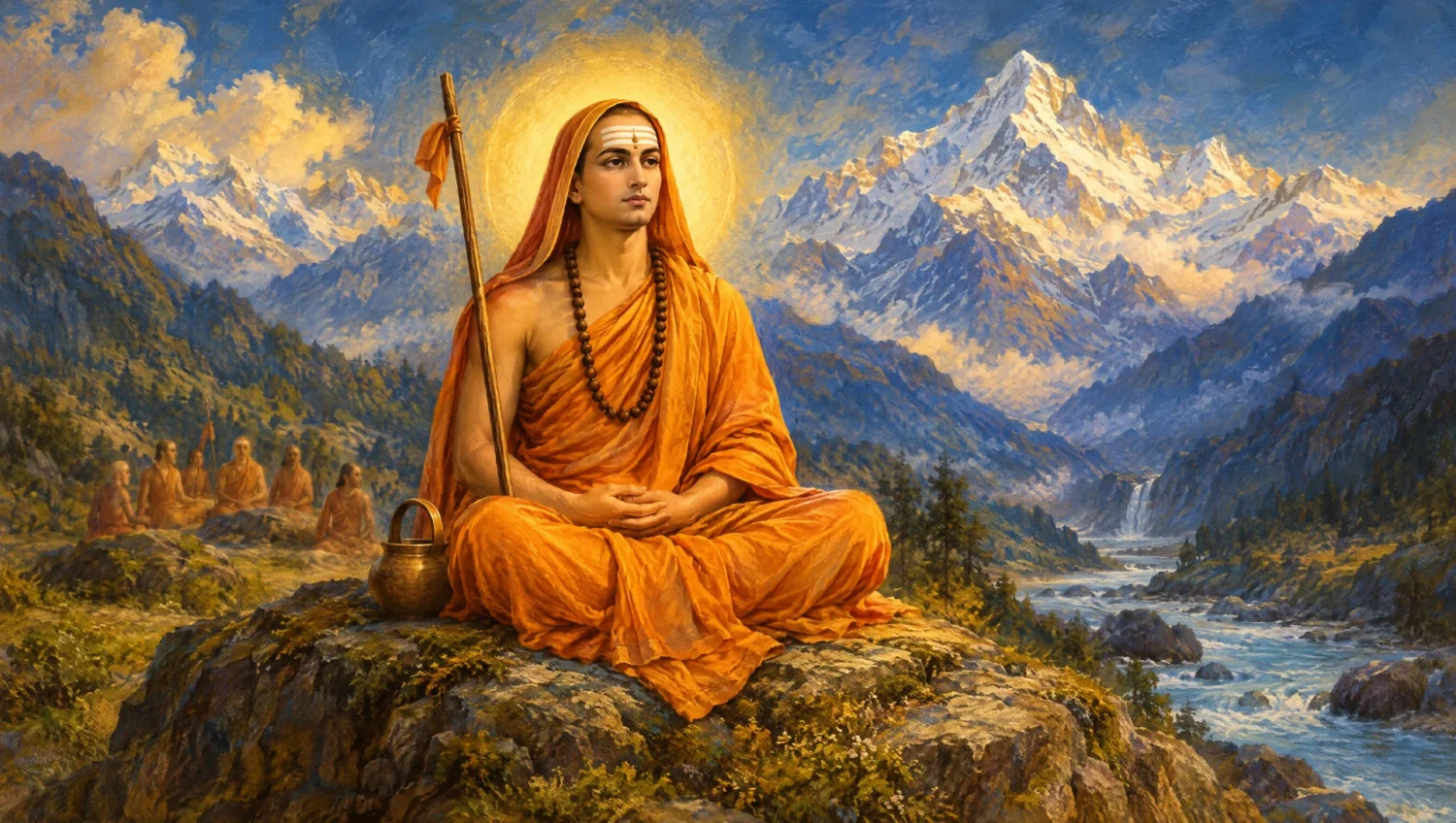
He is said to have lived only thirty-two years. In that short span, according to tradition, he walked the length of India on foot, debated the leading thinkers of his day, wrote commentaries on the great scriptures, composed hymns that are still sung, and founded monasteries that still stand. His central teaching can be said in a few words: you are not who you think you are. You are the Self, one with the Absolute, and nothing can be added to it. This guide follows Adi Shankara from his village in Kerala to the foot of the Himalayas. It explains Advaita Vedanta in plain language, introduces the texts, compares his teaching with those of other schools, and looks at how he is honored as an ascended master. We say plainly what is documented and what is devotional memory.
Key Takeaways
- Who he was: Adi Shankara, also called Shankaracharya, was a philosopher, monk and poet of the eighth century CE, born in Kaladi, Kerala. He is the best-known teacher of Advaita Vedanta.
- When he lived: Tradition says 788 to 820 CE. Some scholars prefer a date a few decades earlier. Either way, he died young.
- His core teaching: Brahman, the Absolute, is the only reality. The individual Self is not different from it. The sense of separation comes from ignorance, and knowledge frees us.
- His works: Commentaries on the Upanishads, the Brahma Sutras and the Bhagavad Gita are accepted as his. Many popular hymns and short texts are attributed to him by tradition, though scholars debate them.
- His legacy: Four monastic centers, the order of ten-named monks, and a tradition of teaching that shaped Hindu thought, Ramana Maharshi, Vivekananda and modern nondual teachers.
- An ascended master? Hindu tradition honors him as a world teacher, and many hold him to be a form of Shiva. Kriya Yoga lineages and esoteric traditions honor him as a great adept. We keep these views distinct.
In This Guide
- Who Was Adi Shankara?
- What Is Documented and What Is Remembered
- India in the Eighth Century
- Birth in Kaladi
- The Crocodile and the Promise: Renunciation
- The Teacher on the Narmada
- Varanasi, the Outcaste and the Debates
- The Four Monasteries and the Order of Ten Names
- The Core Teaching: Brahman Is All, the Self Is Brahman
- Maya: Is the World an Illusion?
- The Path: Qualities, Hearing and Reflection
- The Poet and the Devotee
- Keeping the Promise: His Mother’s Last Rites
- The Last Years and the Departure
- How Other Schools and Teachers Differ
- Shankara and the Bhagavad Gita
- Legacy: From Vidyaranya to Ramana Maharshi
- Shankara as an Ascended Master
- Honest Questions and Cautions
- A Practice: Seven Days of Self-Inquiry
- Books and Further Reading
- Keep Exploring
- Frequently Asked Questions
Who Was Adi Shankara?
Adi Shankara is among the most influential thinkers India has ever produced. The word adi means “first,” and acharya means teacher. He is the First Shankara, to distinguish him from the long line of heads of monasteries who have carried his title.
He taught Advaita Vedanta. Advaita means “not two.” Vedanta means “the end of the Vedas,” a name for the Upanishads and the philosophy that grows out of them. In its simplest form, the teaching says that the ultimate reality is one: pure, limitless awareness, called Brahman. The Self at the center of every person, the Atman, is not a part of Brahman or a spark from it. It is Brahman.
That is a bold claim. It means that the sense of being a small, separate person is the root problem, and that waking up from that sense is the goal. Shankara spent his short life showing how, using the words of the Upanishads, careful reasoning and the guidance of a teacher.
He is revered in Hinduism as a great saint and philosopher. Many devotees believe him to be an incarnation of Shiva. Beyond India, he is studied in universities, read by mystics of many traditions, and quoted by modern nondual teachers. You can place him among the other great beings in our complete guide to the Ascended Masters.
Because the tradition of Advaita is alive, we write about it as a guide, not a critic. We tell the story as the sources tell it, and we also say where scholars disagree.
What Is Documented and What Is Remembered
Our knowledge of Shankara comes from two kinds of source. The first is his own writings, which are the most reliable evidence of his thought. The second is a set of biographies, called Shankara Vijaya, “the conquest of Shankara.” The best known were written centuries after his death, mainly between the thirteenth and sixteenth centuries. They are full of miracles and legends. They preserve valuable memory, but they are not history in the modern sense.
Dates are debated. The traditional account, kept by the monasteries, gives 788 to 820 CE. Many modern scholars place him in the eighth century, with some arguing for an earlier range around 700 to 750. Everyone agrees he lived in the eighth century or close to it, and everyone agrees that he died young.
Which works are by him? Scholars generally accept his commentaries (bhashyas) on the Brahma Sutras, on the principal Upanishads, and on the Bhagavad Gita, along with a prose work called the Upadeshasahasri, “A Thousand Teachings.” Many famous short works are attributed to him by tradition, including the Vivekachudamani (“Crest-Jewel of Discrimination”), the Atmabodha (“Self-Knowledge”), the Bhaja Govindam, and the Saundarya Lahari. Scholars debate which of these were written by the commentator himself and which came from later authors in his name. They are still valuable. It is wise to say “attributed to Shankara.”
India in the Eighth Century
The India that Shankara knew was crowded with ideas. The great Buddhist universities, such as Nalanda, were still active, and Buddhist philosophers had produced some of the sharpest arguments in the world about the nature of mind and reality. The Mimamsa school, which defended Vedic ritual, was strong. Jain thinkers, Shaivas, Vaishnavas, Tantric practitioners and others were all debating in royal courts and village squares.
In this atmosphere, the Upanishads were respected but not dominant. Ritual was the main center of orthodox religion. Shankara’s achievement was to place the Upanishadic teaching of knowledge, jnana, at the center of the Vedic tradition. He argued that the earlier part of the Vedas, the ritual portion, served to prepare the mind, while the Upanishads taught the final truth. And he defended this against both ritualists and Buddhists.
This was not purely an intellectual contest. It was an effort to give a thinking, questioning person a path that was fully rational and fully spiritual.
Birth in Kaladi
The tradition says he was born in Kaladi, a village on the Periyar River in Kerala, to a Namboodiri Brahmin couple named Shivaguru and Aryamba. They had been childless for many years and prayed to Shiva at the temple in Thrissur. The story says Shiva appeared in a dream and offered them a choice: a hundred ordinary children or a single child of great wisdom who would live a short life. They chose the one.
The boy showed remarkable gifts. He is said to have learned to read Malayalam and Sanskrit before he was three, and to have mastered the Vedas and the scriptures in his earliest years. His father died when he was very young. His mother raised him alone.
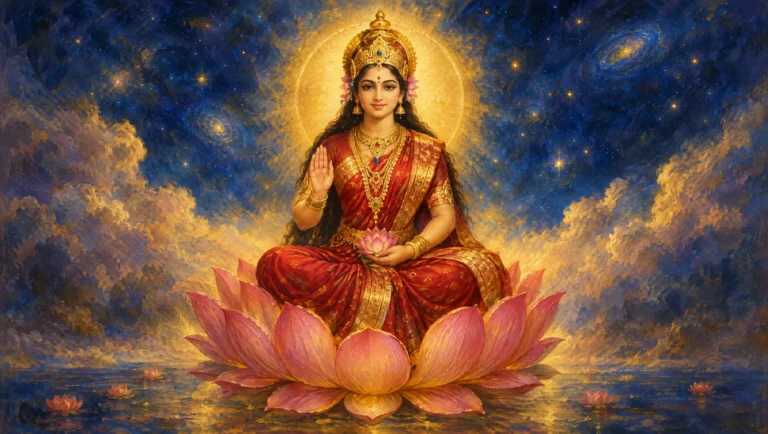
One of the tenderest tales concerns a poor woman who had no food to give him when he came begging. She offered a single dried amla fruit. Moved, the boy is said to have sung a hymn to the goddess Lakshmi, the Kanakadhara Stotram, and golden fruit rained down upon her house. Whether or not it happened, the story tells you who the tradition believes Shankara to have been: a man whose compassion matched his intellect.
The Crocodile and the Promise: Renunciation
From a young age he wished to renounce the world and become a monk, a sannyasi. His mother, a widow with one child, would not allow it. The tradition tells how, while bathing in the river with his mother, a crocodile seized his leg. He called out that he was dying and that she must let him take the vow of a renunciant at the last moment. Tradition holds that renouncing at the point of death was allowed. Aryamba gave permission. The crocodile released him.
He promised his mother that he would return to perform her last rites when she died, wherever he was. And he left home as a boy of about eight, according to the accounts.
It is a hard story, and another in the long line of saints who left families behind. It is also true that he kept his promise, as we will see.
The Teacher on the Narmada
Shankara traveled north on foot, over many weeks, and reached the banks of the Narmada River. There, in a cave near Omkareshwar, lived a renowned teacher named Govindapada, also called Govinda Bhagavatpada. Govindapada was himself a student of Gaudapada, the author of the Mandukya Karika, an early and deeply influential statement of nondual philosophy. Shankara asked to become his student. Govindapada asked: who are you? Shankara answered in verses that are now known as the Dashashloki, “ten verses,” each ending with the declaration that he was pure consciousness, the Self, Shiva.
Govindapada recognized the answer and initiated him. For some years he studied there. A tradition tells that one year the Narmada flooded and threatened the cave. Shankara placed his water pot at the entrance and the flood waters entered the pot and receded. It is the sort of story told of a master’s hidden power.
He was then sent to Varanasi, the city of Shiva, to teach.
Varanasi, the Outcaste and the Debates
In Varanasi, according to the tradition, he began to teach and to write. He gathered his first disciples, among them Padmapada, who would become a prominent teacher. He wrote his commentaries on the Brahma Sutras and the Upanishads. And he walked, and debated.
A famous story is told of a walk to the Ganges. A man of the lowest caste, an outcaste with four dogs, blocked his path. Shankara told him to move aside. The man asked a question: do you tell the Self to move, or the body? Is it the body that is pure or impure, or the awareness within? Shankara, shaken, understood that he had been tested. The man was Shiva in disguise, according to tradition. Shankara then composed the Manisha Panchakam, five verses declaring that anyone who has realized the Self, whether a brahmin or an outcaste, is his teacher.
We include this story with care. It is a tradition’s memory and it shows the ideal the tradition wished to praise. Later we will look at the harder questions about caste in Shankara’s own writings.
In the great debates, he is said to have defeated many opponents. The most famous was Mandana Mishra, a great Mimamsa scholar and ritualist, in the town of Mahishmati. Mandana’s wife, Ubhaya Bharati, served as judge. The accounts say that she was herself a brilliant scholar, who ruled in Shankara’s favor but then challenged him in the subject of married love, on which he, a celibate, had no experience. Tradition holds that Shankara took time to learn, by entering the body of a dead king, an act of yogic power. Whatever you make of this, the conclusion is that Mandana Mishra became his disciple, taking the monastic name Sureshvara.
The Four Monasteries and the Order of Ten Names
Shankara traveled across India on foot, from Kerala to Kashmir, and east to Puri, teaching, debating and visiting temples. Tradition credits him with establishing four mathas, monastic centers, one in each corner of the land.
| Direction | Place | Region | Associated scripture |
|---|---|---|---|
| South | Sringeri | Karnataka | Yajurveda |
| West | Dwarka | Gujarat | Samaveda |
| East | Puri (Govardhana) | Odisha | Rigveda |
| North | Jyotirmath (Joshimath) | Uttarakhand | Atharvaveda |
These monasteries still exist, and each is headed by a Shankaracharya, a leader who stands in the line of the first. A fifth center, at Kanchipuram, claims a connection to Shankara as well, and there is a long-standing debate about its status. Historians note that the earliest records of the four mathas as a system are later than Shankara, and they are cautious about attributing the whole structure to one person. The tradition holds firmly that he began it.
Shankara is also credited with organizing the wandering monks into an order, called the Dashanami Sampradaya, the order of the ten names. Monks take one of ten surnames, Giri, Puri, Bharati, Saraswati, Tirtha, Ashrama, Vana, Aranya, Parvata or Sagara. Great gatherings such as the Kumbh Mela still begin with the processions of monks of these orders. You may notice one of the names in the lineage of Kriya Yoga: Sri Yukteswar Giri and Swami Yogananda Giri belong to the Giri branch. Read their stories in our guides to Sri Yukteswar and Paramahansa Yogananda.
The Core Teaching: Brahman Is All, the Self Is Brahman
Everything in Shankara’s philosophy flows from one insight, which the Upanishads express in a handful of statements. There is one reality, the Absolute. It is pure being, pure consciousness, and limitless fullness. In Sanskrit this is called sat-chit-ananda, existence, awareness, bliss. It is Brahman. It has no parts, no beginning and no end.
The Self within each of us, the Atman, is the same as Brahman. Not similar, not a fragment, but identical. The Upanishads put it in four great sayings, called the mahavakyas.
| Statement | Meaning | Source |
|---|---|---|
| Prajnanam Brahma | Consciousness is Brahman | Aitareya Upanishad (Rigveda) |
| Aham Brahmasmi | I am Brahman | Brihadaranyaka Upanishad (Yajurveda) |
| Tat Tvam Asi | You are That | Chandogya Upanishad (Samaveda) |
| Ayam Atma Brahma | This Self is Brahman | Mandukya Upanishad (Atharvaveda) |
If this is so, why do we not feel it? Shankara’s answer is avidya, ignorance. We mistake the Self for the body, the mind, the personality. He called this adhyasa, superimposition: laying something that is not there over something that is. The most beloved example is a rope in dim light, mistaken for a snake. The fear is real, the heartbeat is real, but the snake is not. Once you see the rope, the snake is gone. No new reality has been created. The truth was always there.
In the same way, Shankara teaches, liberation, moksha, does not produce something new. It is not a place we travel to or a state we construct. It is the removal of a mistake. This is why he says the path is knowledge, and why no amount of ritual by itself can free a person. Action can purify the mind, but only knowledge removes ignorance, as only light removes darkness.
Maya: Is the World an Illusion?
The most misunderstood word in Advaita is maya. It is often translated as “illusion,” and many people take Shankara to mean that the world is a hallucination. That is not what the careful tradition says.
The Sanskrit term he used for the status of the world is mithya, usually translated “dependent” or “apparent.” The world, he said, is not absolutely real in the way Brahman is, since it changes and depends on something else. But it is not nothing either. It is not a hare’s horn or a barren woman’s son. It is like a dream that we cannot dismiss while we are in it, and like a wave on the ocean: real as a wave, but not other than water.
A saying summarizing his view is often quoted: Brahman is real, the world is apparent, the individual self is none other than Brahman. This verse is traditionally attributed to him, though it likely summarizes a longer teaching. The teaching holds that you can live fully in the world and also know its nature. In fact, knowing it is how you live without being dragged around by it.
There is an important further point. Shankara distinguishes Brahman without attributes, nirguna, from Brahman seen as God with attributes, saguna, whom he calls Ishvara, the Lord. Worship of God is valued, and it is part of the path.
The Path: Qualities, Hearing and Reflection
Shankara was a practical teacher. He knew that the highest truth cannot be understood by someone who is not ready. So he laid out a path.
The seeker is expected to develop four qualifications, known as the sadhana chatushtaya.
- Discrimination (viveka). The ability to tell the lasting from the passing, the real from the apparent.
- Dispassion (vairagya). Freedom from compulsive craving for the pleasures of this world and the next.
- The six treasures (shatsampat). Calm of mind, control of the senses, withdrawal, patience, faith in the teacher and teaching, and concentration.
- A longing for freedom (mumukshutva). A real burning wish to be free.
Then the seeker approaches a teacher and engages in three practices. Shravana is listening to the teaching from a qualified teacher. Manana is reflecting on it until doubts are resolved. Nididhyasana is deep contemplation, in which the truth is absorbed until it is no longer an idea but a fact of living.
A key method is neti neti, “not this, not this.” The seeker observes: I have a body, but I am not the body. I have thoughts, but I am not the thoughts. I have a mind, but I am not the mind. What remains, the awareness that sees them all, is the Self. This is not a technique of rejection. It is a way of finding what cannot be removed.
If this path draws you, our guide to what non-duality means offers a simple introduction, and our conversation with Rupert Spira on awareness, consciousness and the nature of the Self shows how a modern teacher speaks about the same discovery.
The Poet and the Devotee
It surprises many readers that the great philosopher of nonduality was also a poet of devotion. Tradition credits him with a great body of hymns to Shiva, Vishnu, Devi, Ganesha and many deities. They are tender, vivid and filled with love.
The Bhaja Govindam, “Worship Govinda,” is among the best loved. According to tradition, Shankara saw an old scholar in Varanasi repeating rules of grammar and burst into song. Worship God, you fool, he sings, since grammar will not save you when death comes. The verses are a plain warning that learning without devotion and realization is empty.
The Dakshinamurti Stotram praises Shiva as the silent teacher who teaches in silence, with the disciples around him confused and the guru saying nothing. The Saundarya Lahari, attributed to him, praises the Divine Mother. The Nirvana Shatakam, “Six Verses on Liberation,” is a chant that repeats: I am not the mind, not the intellect, not the ego. I am consciousness and bliss, I am Shiva. Scholars debate the attribution of some, but the hymns carry his spirit.
How do devotion and nonduality fit together? Shankara taught that devotion purifies the heart and prepares the ground. Many who follow his path find that the sense of love and the sense of unity grow together. Our own guide to connecting with your higher self touches the same meeting of heart and wisdom.
Keeping the Promise: His Mother’s Last Rites
Years after his departure, as the story goes, Shankara sensed that his mother was dying. By his yogic power he knew, and he returned to Kaladi. As a renunciant, it was forbidden for him to perform funeral rites. The relatives of the village refused to help. He cremated her body in the yard of their house, in a pyre he built himself, and the villagers, moved or ashamed, did not stop him.
It is a quiet story, but it carries weight. It shows a monk who held his vows lightly enough to keep a higher promise. For many it shows that realization does not cancel love.
The Last Years and the Departure
The final part of his life is, according to tradition, spent in the Himalayas, visiting Badrinath and Kedarnath and writing his last works. At Badrinath he is credited with finding the image of Vishnu in the Alaknanda River and installing it in a shrine. At Kedarnath, around the age of thirty-two, he is said to have entered a cave and not returned. A memorial stands behind the temple of Kedarnath at the place the tradition identifies as his samadhi.
Other traditions place his final days elsewhere, at Kanchipuram or in Kerala. The accounts disagree, which shows how thick the layers of memory are. What matters to most devotees is the vision of a teacher who accomplished an enormous work in thirty-two years and then left the world in peace.
How Other Schools and Teachers Differ
Shankara’s teaching was admired and also challenged. Later Vedanta teachers built rival systems.
| School | Teacher | On God, world and soul |
|---|---|---|
| Advaita (non-dual) | Shankara | Only Brahman is ultimately real. The soul is Brahman. The world is dependent and apparent. |
| Vishishtadvaita (qualified non-dual) | Ramanuja | God is real and personal. Souls and the world are real parts of God. Liberation is loving service in God’s presence. |
| Dvaita (dual) | Madhva | God, souls and matter are eternally distinct. Liberation is nearness to God. |
Ramanuja argued that the doctrine of maya was incoherent and left no room for love of God. Madhva was blunter still. Shankara’s side answered that real love is itself a pointer to oneness. These debates are not over, and they are conducted with great respect on all sides.
His teaching also differs from Buddhism in a way that matters. The Buddha taught that no permanent self can be found in the aggregates of experience. Shankara taught that the Self is the one unchanging reality. Some Vaishnava critics even called him a “crypto-Buddhist” for his use of Buddhist-looking arguments. Advaitins reply that he used logic common to the debates of his age and rejected the Buddhist denial of a Self. Others find the two closer than the schools admit. Both views have thoughtful defenders. For the Buddha’s teaching in its own words, listen to The Buddha’s Bible, available on Next Level Soul.
Within Hindu life, his school represents the path of knowledge, jnana yoga. You can hear Swami Vivekananda on that path in Gnani Yoga: The Path of Self-Knowledge and Liberation, an audiobook available on Next Level Soul. And you can hear the root texts’ spirit in The Spirit of the Upanishads.
Shankara and the Bhagavad Gita
Shankara wrote the oldest surviving commentary on the Bhagavad Gita. He read the text through the lens of Advaita. For him, its central message was that knowledge of the Self brings liberation, and that selfless action, done without attachment, purifies the mind for that knowledge.
Other teachers read the Gita differently, stressing devotion or action. That is part of why it is so alive. If you want to meet the text itself, begin with The Eternal Self: The Wisdom of the Bhagavad Gita, available on Next Level Soul, and the verse-by-verse commentary traditions linked in our books list below.
Legacy: From Vidyaranya to Ramana Maharshi
Shankara’s influence runs deep and wide. After his time, Advaita became the dominant philosophy of Brahmanical India. Great later teachers, such as Vidyaranya in the fourteenth century, who served the Vijayanagara empire, deepened its systems. Monks of the Dashanami order carried the teaching along the pilgrimage roads. His monasteries became centers of learning.
In the nineteenth and twentieth centuries, Advaita became a world voice. Swami Vivekananda introduced it to the West at the 1893 Parliament of the World’s Religions in Chicago. The Vedanta Societies took root in American cities. Translators such as Swami Prabhavananda and Christopher Isherwood brought the Crest-Jewel of Discrimination to English readers. Paul Deussen, a German philosopher, and Arthur Schopenhauer before him, praised the Upanishads and the tradition around them.
In India itself, Ramana Maharshi (1879 to 1950) gave a living demonstration of the Advaita path through the question “Who am I?” Though he came from no formal lineage, he praised Shankara’s works and translated some into Tamil. The nondual teachers who followed, from Nisargadatta Maharaj to modern speakers like Rupert Spira, carry the stream forward in new language. Our guide to Self-Realization and the teachings of Yogananda touches this same inner destination.
And Shankara’s direct influence on the yogic world is easy to see: the order of the Giri, Puri and other monks who still carry his structure, among them the line to which Yogananda’s own teachers belonged.
Shankara as an Ascended Master
In Hindu thought, Shankara is honored as the Jagadguru, the teacher of the world. Many devotees believe that Lord Shiva himself took birth as Shankara to revive the Vedic path. Others see him as a supreme sage. Neither view calls for a separate category of “ascended master,” a phrase borrowed from Theosophy and later esoteric teaching.
That said, the connection runs through several streams. Theosophical writers, beginning with Helena Blavatsky, spoke with respect of Shankara as a great adept and reformer. Some later esoteric writers have placed him among the great Masters of the Indian tradition, with details that vary widely.
The Kriya Yoga lineage offers a distinct claim. In his Autobiography of a Yogi, Paramahansa Yogananda recounts that the deathless master Babaji initiated Shankara into Kriya Yoga, as he did the poet Kabir. This is a statement made within that lineage, and scholars of Advaita do not corroborate it. It reflects how deeply these teachers revered him. You can read the story of that lineage in our guides to Mahavatar Babaji, Lahiri Mahasaya and Kriya Yoga meditation, and you can watch Awake: The Life of Yogananda on Next Level Soul.
How should a seeker hold all this? Honor the historical man as the great clarifier. Honor the devotee’s Shankara as a form of Shiva. Honor the esoteric Shankara as one of the guides of humanity. Then test what he taught in your own life. You will find the wider family of guides in our complete guide to the Ascended Masters and a channeled sampling in Ascended Masters Channeled, available on Next Level Soul.
Honest Questions and Cautions
Dates and works are uncertain. The biographies came centuries later. Scholars debate his dates and the authorship of many works. We have used “tradition holds” and “attributed” for a reason.
“The world is an illusion” is a shortcut. Advaita does not ask you to ignore the world or treat suffering as unreal. A careful reading speaks of the world as dependent, not as nothing. Taking the shortcut can turn into a way of avoiding feelings, which is sometimes called spiritual bypassing.
Caste and gender. In his commentary on the Brahma Sutras, Shankara accepts the orthodox view that people of the lowest social class, and women, may not formally study the Vedas. This is a real and uncomfortable part of the record. Many modern Advaitins reject the limitation and teach to everyone. The tradition also remembers him, in the outcaste story, as saying that realization matters more than birth. Both facts belong in an honest portrait.
Knowledge without preparation is shallow. Shankara insisted on ethical preparation, a teacher and long reflection. Reading a few slogans and announcing “I am Brahman” misses the point. The tradition warns about this again and again.
Teachers and institutions are human. Monasteries, then and now, have politics. Honor the teaching without idealizing every holder of the title.
A Practice: Seven Days of Self-Inquiry
This week is a taste of the Advaita method. Ten minutes a day is enough. No belief is required.
- Day 1: Who is aware? Sit quietly. Notice thoughts, sounds and sensations. Ask softly: who is noticing all this? Do not answer with words. Rest in the noticing.
- Day 2: Neti, neti. Say to yourself: I have a body, but I am not the body. I have thoughts, but I am not the thoughts. See what remains.
- Day 3: The witness. Through the day, pause three times and notice that you are aware of whatever is happening. Awareness is always here.
- Day 4: Contemplate one phrase. Take “Tat tvam asi,” you are That. Do not try to understand it. Let it sit in your mind.
- Day 5: Rope and snake. Choose a fear or a story that is troubling you. Ask: what am I adding to the plain facts? What would be left if I took away the story?
- Day 6: Discriminate and serve. Notice one thing you keep chasing that does not last. Let it go for the day. Then do one act of service with no wish for reward.
- Day 7: Rest as the Self. Sit without technique. At the end, give thanks to every teacher, living or gone, who has pointed you inward.
If doubts rise, that is fine. The tradition says to bring them to a qualified teacher.
Books and Further Reading
- Shankara’s Crest-Jewel of Discrimination, translated by Swami Prabhavananda and Christopher Isherwood. A classic text, attributed to Shankara, on the path of discernment.
- The Upanishads, translated by Eknath Easwaran. A readable version of the texts Shankara commented on.
- The Bhagavad Gita, translated by Eknath Easwaran. A warm introduction to the scripture Shankara wrote on.
- The audiobook The Spirit of the Upanishads, available on Next Level Soul.
- The audiobook Gnani Yoga, by Swami Vivekananda, on the path of knowledge, available on Next Level Soul.
Book links are Amazon affiliate links. If you buy through them, it supports our work at no extra cost to you.
Keep Exploring
For the Kriya Yoga story that connects with Shankara’s monastic order, read our guide to Paramahansa Yogananda and the life of Sri Yukteswar Giri. For the cause-and-effect side of the path, read understanding karma. And for the other beings who guide us, return to our complete guide to the Ascended Masters.
Two audio courses fit this path well. The Yogi’s Guide to the Infinite offers 14 lessons of mystic wisdom from the East. The Art of Self-Realization, with Michael J. Tamura, explores the discovery of who you truly are, in eight chapters. Both are included with Next Level Soul membership. See the Next Level Soul Mastery overview for more, or begin with a free masterclass.
Watch Ascended Masters, Channeled on Next Level Soul TV
An eight-episode series in which renowned channeler Genevieve Taeger brings through Buddha, Mary Magdalene, Athena, Mother Mary, Jesus, Saint Germain, Yogananda and Kuan Yin. Each episode is a channeled message, offered as spiritual guidance and not as historical record.
Episodes that connect with this guide: Ascended Master Yogananda and Ascended Master Buddha.
Frequently Asked Questions
Who was Adi Shankara?
Adi Shankara was an eighth-century philosopher, monk and poet from Kerala, India. He is the best-known teacher of Advaita Vedanta and is honored as a world teacher, or Jagadguru.
When did Adi Shankara live?
Tradition says 788 to 820 CE, and he is said to have died at thirty-two. Some scholars place him a little earlier. His life cannot be dated with certainty.
What is Advaita Vedanta?
Advaita means “not two.” The teaching holds that the only ultimate reality is Brahman, pure consciousness, and that the individual Self is not different from it. Liberation comes through knowledge of this truth.
Did Shankara say the world is an illusion?
Not in the crude sense. He called the world mithya, dependent or apparent. It is not absolutely real like Brahman, but it is not nothing. It is like a wave on the ocean.
What are the mahavakyas?
They are four great sayings of the Upanishads: Prajnanam Brahma, Aham Brahmasmi, Tat Tvam Asi and Ayam Atma Brahma. Advaita teachers treat them as the essence of the teaching.
What are the four mathas?
They are the monastic centers traditionally founded by Shankara at Sringeri, Dwarka, Puri and Jyotirmath. Each is headed by a Shankaracharya.
Which books did Shankara write?
His accepted works include commentaries on the Brahma Sutras, the main Upanishads and the Bhagavad Gita, and the Upadeshasahasri. Many famous texts, such as the Vivekachudamani and the Bhaja Govindam, are attributed to him by tradition.
Is Shankara an ascended master?
Hindu tradition honors him as a world teacher and a form of Shiva. Theosophy, Kriya Yoga and other esoteric traditions honor him as a great adept. See our guide to the Ascended Masters for how these views relate.
Where can I learn more on Next Level Soul?
Listen to Gnani Yoga or The Spirit of the Upanishads, both available on Next Level Soul. The audio course The Yogi’s Guide to the Infinite adds mystic lessons from the East.
How do I start practicing Advaita?
Begin with simple self-inquiry: ask who is aware, and rest in that awareness. The seven-day practice in this guide offers a gentle start. Over time, a qualified teacher is valuable.