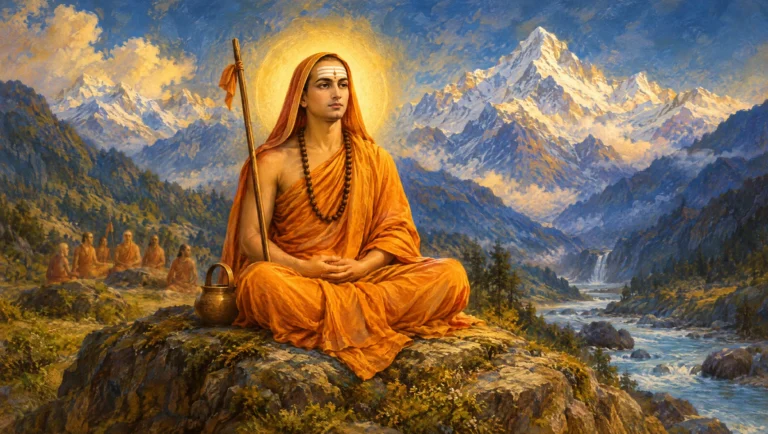
A young disciple copies out a Master’s letters in a Himalayan lodge while his teacher is in trance. Forty years later, an Englishwoman in California hears a voice asking whether she will write some books for the public. Over thirty years she writes twenty-four. Whether you read this as history, as inspiration or as one of the most remarkable literary projects in modern spirituality, the figure behind it is Djwal Khul, often called simply the Tibetan or D.K. This guide follows him from the Mahatma Letters to Alice Bailey’s study, explains the teachings credited to him, and says openly where the evidence runs out. For the wider picture, begin with our complete guide to the Ascended Masters.
Key Takeaways
- Who he is: Djwal Khul (also Djwhal Khul, Djual Khool, Master D.K. or the Tibetan), a Tibetan teacher in the Theosophical and Ascended Master traditions, said to be a disciple of Koot Hoomi who later became a Master.
- Where the story begins: a chela (disciple) in the Mahatma Letters of the early 1880s, and then Alice Bailey’s teacher from 1919.
- The books: about 24 volumes published by the Lucis Trust, including Initiation, Human and Solar, A Treatise on Cosmic Fire and the five-volume Treatise on the Seven Rays. Bailey said she received them by telepathic dictation.
- Core teachings: the seven rays, the Spiritual Hierarchy, the soul and its bridge to the personality (the antahkarana), group service and goodwill, and the expected return of the Christ.
- Real cautions: disputed authorship, hierarchical language, and statements about Jews and other groups that reflect early twentieth century prejudice and are rightly criticized.
- Our stance: reverent, not credulous. We take the best of the teaching and name the rest plainly.
In This Guide
- Who Is Djwal Khul?
- Names and Spellings
- The Chela in the Mahatma Letters
- Who Might He Have Been? Theories and Tibet
- Alice Bailey: The Woman Who Wrote the Books
- November 1919 and the Voice
- The Books at a Glance
- The Core Teaching in Plain Language
- The Seven Rays in Bailey’s System
- The Antahkarana: The Bridge of Light
- Group Work: Triangles, Goodwill and the Great Invocation
- Esoteric Healing and Esoteric Astrology
- Djwal Kul in the Summit Lighthouse
- Hearing the Tibetan Today
- How Djwal Khul Compares with Other Masters
- Honest Questions and Cautions
- A Mystic’s Reading: The Teacher Who Writes It Down
- A Practice: Seven Days of Building the Bridge
- Books and Further Reading
- Who Will Connect with This Master
- Keep Exploring
- Frequently Asked Questions
Who Is Djwal Khul?
There are Masters you meet in a vision and Masters you meet in a library. Djwal Khul is the second kind. His reputation rests less on stories of miracles than on a very large body of written teaching: thousands of pages on the soul, the rays, the path of discipleship and the work of serving the world.
In the older Theosophical story, he is a junior figure, a Tibetan disciple of the Master Koot Hoomi. In the later story, told by Alice Bailey, he is a Master in his own right who has taken a high initiation and who works in the ashram, or spiritual community, of Koot Hoomi. Followers of Elizabeth Clare Prophet and the Summit Lighthouse place him among the Ascended Masters, associated with the same current of wisdom and teaching as Kuthumi.
His signature is a tone of calm authority. The books attributed to him are written in a dense, formal style. They rarely sound warm. They contain few anecdotes. What they offer instead is a structure, a map of the inner and outer worlds that tens of thousands of readers have used for decades.
As with all the Masters, almost everything we know of him reaches us through other people. We will be careful to say which claim comes from whom.
Names and Spellings
The name has many forms. In the Mahatma Letters it appears as Djual Khool. Blavatsky wrote Djwal Kul. Bailey settled on Djwhal Khul, and her Lucis Trust still uses that form. Her readers often write Djwal Khul or the initials D.K. Followers of the Summit Lighthouse write Djwal Kul. They are all the same figure.
Bailey rarely used his name in her books, preferring to refer to him as the Tibetan. She wrote that he was uneasy with publicity. She also said that he was a disciple of a certain degree, a modest description that fits the way he speaks of himself.
There is a small puzzle about the name. Tibetan Buddhist scholars have not found a lama of this name in the historical records of Tibet. That fits a pattern across the Theosophical names, such as Koot Hoomi and Morya, which do not look like standard Tibetan names. Defenders reply that Masters may use private names. Critics reply that the names look like nineteenth century transliterations of what a European ear might make of Indian sounds. We do not know the answer.
The Chela in the Mahatma Letters
Our first historical trace of Djwal Khul is in the Mahatma Letters, the correspondence of 1880 to the mid 1880s between the Theosophists A. P. Sinnett and A. O. Hume and the Masters Koot Hoomi and Morya, published in 1923 as The Mahatma Letters to A. P. Sinnett.
In those letters, Djual Khool is a chela, a pupil of Koot Hoomi. He is described as a young Tibetan who is gifted and loyal, and who helps his teacher by preparing and copying letters. Early letters from Koot Hoomi were signed Koot Hoomi Lal Sing. The Master later explained that the Lal Sing was added by his disciple Djwal Khool, and he dropped it. When Koot Hoomi withdrew into a trance in 1881, the letters describe Djual Khool as the one who stayed on to handle some of the correspondence.
Blavatsky also mentions Djwal Kul in her writings. She refers to him as a Tibetan adept and a disciple of Koot Hoomi. C. W. Leadbeater later claimed to have seen him appear in a room where he and Blavatsky were sitting.
This is the whole documentary record. It is small, and it comes from the same disputed source as the other Master material. If you want to understand the debate over those letters, we explain it in our guides to Master Morya and Kuthumi, and in the Ascended Masters guide.
Who Might He Have Been? Theories and Tibet
If Djwal Khul was a historical person, who was he? The historian K. Paul Johnson, in his study of the Masters, proposed that the figure may be based on Dyal Singh Majithia (1848 to 1898), a wealthy Sikh reformer in Lahore who founded The Tribune newspaper and the Punjab National Bank and who was known to Theosophists. Johnson’s theory is one of several attempts to link the Masters with real people, and it is debated. Other scholars find the evidence slight.
The Tibetan setting deserves its own note. In the Theosophical account the Masters live in Tibet near Shigatse, close to the great Tashilhunpo monastery, the seat of the Panchen Lama, founded in 1447. Tashilhunpo belongs to the Gelug school of Tibetan Buddhism, whose tradition is built on teacher and student lineages. A reader familiar with Tibetan practice will recognize some echoes in the Master and disciple pattern, but also many differences. The Theosophical Masters teach reincarnation, karma and spiritual hierarchies in forms that differ from Tibetan doctrine.
The scholar Donald Lopez, in Prisoners of Shangri-La, argues that Westerners have long projected their own wishes onto Tibet, imagining it as a land of hidden wisdom. The Theosophical Masters are a key chapter in that story. This does not mean that Tibet has no wisdom to offer. It means that you should read about real Tibetan Buddhism in the voices of real Tibetan teachers. Our audio course The Between offers 19 chapters of Tibetan wisdom on death and awareness.
Alice Bailey: The Woman Who Wrote the Books
Alice La Trobe-Bateman was born in Manchester in 1880 and raised in a conventional, wealthy English family. As a teenager she was devoutly Christian, and she taught Sunday school and worked with soldiers’ welfare. In her early twenties she traveled to India and met a clergyman, Walter Evans. They married and moved to the United States, where Evans served in churches. The marriage was unhappy, and it ended in divorce. She was left to raise three daughters, and by her own account she worked in a sardine cannery in Pacific Grove, California.
There she encountered Theosophy. Around 1915 she joined the Theosophical Society, and she became active in its Esoteric Section. She married Foster Bailey, a Theosophist, in 1921. Together they built the Arcane School and a publishing house that became the Lucis Trust. Her life is told in The Unfinished Autobiography, published after her death in 1949.
She is a more complicated figure than the stern voice of the books suggests. She was a pioneering woman in an era of rigid roles. She was devout, earnest and sometimes severe. She spoke with great pride of her British upbringing, which shows in her prejudices. And she insisted, always, that she was not a medium and that she wrote with her full consciousness.
November 1919 and the Voice
In November 1919, Bailey tells us, she was sitting on a hill in Pacific Grove when a voice told her that books were wanted for the public. She was asked whether she would write them. She was offended. The Masters of Theosophy, she felt, did not speak to ordinary members, and she disliked the idea of being a medium. Her first impulse was to refuse.
She later identified the speaker as the Tibetan, Djwhal Khul. Over the next weeks she accepted a trial. She came to feel that the communication was telepathic rather than mediumistic: the Master impressed ideas and she wrote them down in her own words. She insisted that she always remained awake and in control.
She left the Theosophical Society around 1920, after disagreements with its leadership, and she began to write. The first book, Initiation, Human and Solar, was published in 1922. You can listen to it on Next Level Soul: Initiation, Human and Solar is presented there as a telepathically channeled transmission from the Tibetan teacher Djwhal Khul.
The Books at a Glance
Bailey wrote or compiled about twenty-four books over three decades. Here are the main ones.
| Book | Year | What it covers |
|---|---|---|
| Initiation, Human and Solar | 1922 | The stages of spiritual initiation |
| Letters on Occult Meditation | 1922 | Meditation and the inner life |
| A Treatise on Cosmic Fire | 1925 | A vast, abstract study of fire, matter and consciousness |
| A Treatise on White Magic | 1934 | The way of the disciple and the use of the mind |
| A Treatise on the Seven Rays (five volumes) | 1936 to 1960 | Esoteric Psychology, Esoteric Astrology, Esoteric Healing, Rays and Initiations |
| Discipleship in the New Age (two volumes) | 1944, 1955 | Instructions to disciples in her Arcane School |
| Glamour: A World Problem | 1950 | Illusion and the clearing of the mind |
For a first taste, many readers start with a compilation such as Ponder on This, which gathers short passages by theme, or with Glamour: A World Problem, which deals with the confusions of the emotional life in a way many find practical.
The style is demanding. Sentences are long and technical, and the books use their own vocabulary. Readers who persevere often say that they find rewards in short passages and that the books reward slow reading.
The Core Teaching in Plain Language
Bailey’s books are huge, but the central structure can be stated simply.
- You are a soul using a personality. The soul is the immortal center of awareness. The personality is the temporary vehicle of body, emotions and mind. Spiritual life is the process of bringing the personality into line with the soul.
- The soul has a purpose. It expresses through a ray, one of seven types of energy, and each person and nation has a ray tendency.
- A Hierarchy helps. A community of illumined souls, the Masters, work to guide humanity’s evolution. They do not command. They offer stimulus and teaching.
- Service is the path. A disciple advances by serving others, not by seeking personal salvation.
- Humanity is on the threshold of a new phase. The books speak of a coming age of group consciousness, goodwill and right human relations, and an expected return of the Christ, understood as a universal teacher.
Notice how modest and practical this is, under the esoteric vocabulary. It says: find your deeper self, practice meditation, serve, and do not lose your mind in dogma. Much of the later New Age movement took these ideas, and the phrase New Age itself owes a good deal to Bailey’s writings.
The Tibetan also insisted that his teaching should be tested, not simply believed. In the books he repeatedly asks readers to use their own minds and to treat the material as hypothesis. That is a refreshing attitude, and one worth keeping when you read.
The Seven Rays in Bailey’s System
The rays are the framework Bailey developed most fully, in the five volumes of A Treatise on the Seven Rays. In her teaching, the Divine Life expresses through seven great streams, which shape the soul, the personality, nations, cultures and ages. She also assigned Masters to them.
| Ray | Name in Bailey | Master or office in her scheme |
|---|---|---|
| First | Will or Power | Master Morya (M.) |
| Second | Love-Wisdom | Master Koot Hoomi (K.H.), with the Tibetan as a disciple in his ashram |
| Third | Active Intelligence | The Master called the Venetian |
| Fourth | Harmony through Conflict | Master Serapis |
| Fifth | Concrete Knowledge | Master Hilarion |
| Sixth | Devotion or Idealism | Master Jesus |
| Seventh | Ceremonial Order or Magic | Master Rakoczi (Saint Germain) |
The Tibetan himself belongs to the Second Ray of Love-Wisdom. That fits a teacher whose task is to explain. A person on the second ray combines understanding and care, and often finds fulfillment as a teacher, counselor or writer.
Bailey also used the rays to read history. She taught that the sixth ray of devotion had shaped the Piscean age and was passing out, while the seventh was entering with the Aquarian age. Whether or not you accept the framework, it offers an interesting way to think about why different eras prize different virtues. For the colors and body centers sometimes linked to the rays, see our guide to the seven chakras.
The Antahkarana: The Bridge of Light
One of the most distinctive teachings in the books is the antahkarana, a Sanskrit word that in Indian philosophy refers to the inner instrument of mind. Bailey used the word differently, for a bridge of light that a disciple builds between the personality and the soul, and then between the soul and the spiritual Triad above it.
How is the bridge built? Mainly by focused thought, meditation and service. The Tibetan describes it as made of the thread of consciousness spun by the mind and strengthened by good will. A practical version is simple: when you meditate, hold awareness of your higher self, bring that awareness into your daily life, and act from it, even in small decisions. Repeated, this creates a continuity of awareness that spans your day.
You do not have to accept the esoteric psychology to value the picture. Many contemplative traditions describe something similar, a thread that links ordinary mind to a deeper wisdom. In Vedanta it is the movement from the personal self to the Self. In Christian mysticism it is the ladder of ascent. In depth psychology, Carl Jung called the process individuation: bringing the conscious and unconscious into relationship.
If this idea interests you, our audio course The Hidden Science of the Soul offers 13 chapters that ground big questions about who you really are.
Group Work: Triangles, Goodwill and the Great Invocation
Bailey and the Tibetan stressed that spiritual work is not only private. They created several simple group practices, some of which are still used.
- Triangles (from 1937): three people link in thought each day and hold a vision of light and goodwill for the world. A person can belong to several triangles, forming a network.
- World Goodwill (from 1932): a program to encourage right human relations and cooperation, recognized in later years as a nongovernmental organization associated with the United Nations.
- The Great Invocation (released in 1945): a short world prayer. In plain terms, it asks that light stream into human minds, that love flow into human hearts, that the purpose guided by wisdom be carried out, and that the door where evil dwells be sealed. Millions of copies have been distributed in many languages.
These practices reflect a conviction that runs through Bailey’s work: that quiet, regular, shared intention matters. Whatever you believe about the Hierarchy, the practice of setting aside a few minutes a day to wish the world well is a kind and humane thing. It resembles the loving kindness meditation of Buddhism, the intercessory prayer of Christianity and the global prayer circles that many people join today.
Be aware that the Lucis Trust, which publishes these materials, and its association with the United Nations has become the target of conspiracy theories. The original company name, Lucifer Publishing Company, was chosen in 1922 for the Latin meaning of the word, light bearer, and changed in 1925 because of misunderstandings. The theories are not supported by evidence, but the name and the UN link have generated years of suspicion. It is worth knowing so that you can handle the rumors calmly if you meet them.
Esoteric Healing and Esoteric Astrology
Two of the seven rays volumes are widely cited outside Bailey circles.
Esoteric Astrology proposes that each zodiac sign is linked to rays and to a spiritual purpose. It treats the chart as a map of the soul’s task rather than of personality tendencies alone. Its influence can be seen in the soul-centered approaches to astrology that many astrologers use today, including the evolutionary school. For a modern conversation in this spirit, you may enjoy Evolutionary Astrology: Decoding Your Soul’s Journey with Ricky Williams.
Esoteric Healing offers a theory of illness in terms of energy, rays and the relation between soul and body. It says that disease can arise from blocked or distorted energy, from collective causes, or from the soul’s lessons. It also suggests ways of working with energy centers and with the mind.
Here, a caution is essential. These books were written in the first half of the twentieth century. They are not medical texts and they contain claims that are not supported by evidence. Do not use them as a substitute for medical care. If you are drawn to the idea of subtle energy, see our guide to energy healing, its history and what the research says, and use these ideas alongside, never in place of, qualified treatment.
Djwal Kul in the Summit Lighthouse
The Ascended Master Teachings give Djwal Kul a place beside Kuthumi. Elizabeth Clare Prophet taught that she channeled him, and the Summit Lighthouse has published many dictations credited to him, including teaching on the human aura, jointly with Kuthumi. In this tradition, the two work as a pair, with Kuthumi as the elder partner and Djwal Kul as the faithful disciple who became a Master.
The Prophets also added a past life. According to the Summit teaching, Djwal Kul was once Caspar, one of the three Magi who visited the infant Jesus. The Gospel of Matthew does not name the Magi or give their number, and the names Melchior, Caspar and Balthazar come from later Christian tradition. In the Summit scheme, the three Magi are El Morya, Kuthumi and Djwal Kul, which brings the three Masters of the Theosophical letters into a single story.
Compare this with Bailey. She did not give Djwal Khul a list of past lives, and her books do not link him to Caspar. The two traditions are related, but they are not the same. If you move from one to the other, expect a different tone, a different vocabulary and a different set of claims.
Hearing the Tibetan Today
Many modern channelers say they bring through Djwal Khul. On Next Level Soul, you can listen to Ascended Master Djwal Khul Channeled with Kathlyn Kingdon. For a wider circle of Masters, try Genevieve Taeger’s live channeling, the series Ascended Masters Channeled, Anjie Hipple’s interview and Hope Messages for Humanity from the Ascended Masters with Chanel Lingenfelder.
A reminder about discernment. A channeled message from a named Master is a claim that cannot be checked. Notice whether it matches the tone of the older teaching: calm, practical, oriented to service, and respectful of your freedom. Be cautious if it asks for loyalty to the messenger, predicts disaster or flatters you.
How Djwal Khul Compares with Other Masters
If El Morya is the commander and Kuthumi is the heart, Djwal Khul is the scribe and systematizer. His gift is to take large ideas and lay them out in order. Where Saint Germain offers a flame for the heart, the Tibetan offers a map for the mind.
He differs from the other Masters in another way: he is the only one whose main legacy is a body of written teaching delivered through a named human collaborator. Morya and Koot Hoomi gave letters. Saint Germain and the Summit Masters gave dictations. The Tibetan gave a library.
Compare him also with the great teacher-writers in other traditions. Shankara in India wrote commentaries that organized the Vedanta. Thomas Aquinas in Europe wrote a summa to order theology. The Tibetan’s work has a similar ambition: to build a coherent structure for a body of esoteric ideas. The difference is that he claims to be passing on teaching received from a spiritual community, not building a philosophy of his own.
Next to the personal warmth of the devotional Masters, he can feel cool. Some readers find that restful. Others look elsewhere for comfort. Both are fine.
Honest Questions and Cautions
Did Djwal Khul really dictate the books?
That cannot be shown. Bailey said she received them telepathically. Skeptics suggest she wrote them herself, drawing on Theosophical sources, as many Theosophical authors had. Defenders point to the scale, the consistency and the difference between the books and her own autobiography. The more helpful question is whether the ideas are useful and sound.
What about the prejudiced passages?
This is a serious matter. Some of Bailey’s writings, especially from the 1930s and 1940s, contain statements about Jews, about nations and about race that reflect the prejudices of her time and that critics rightly condemn. Scholars including Lee Penn and Victor Shnirelman have written about this. Some of her language about a spiritual elite and about the future of humanity can also sound hierarchical and uncomfortable today. A modern reader should name this plainly. You can find value in the teaching of service, goodwill and the soul, and still reject the parts that harm.
Are the Lucis Trust and the UN part of a conspiracy?
There is no evidence of that. The Lucis Trust is a publishing and educational organization. Its link to the UN is a consultative status common for nongovernmental organizations. Conspiracy theories about the Trust circulated for decades and are not supported by evidence.
Is the Hierarchy a good model?
Some find it inspiring. Others find the picture of a top down spiritual government unsettling, since it can encourage deference. The Tibetan himself said that the Masters do not give orders. Even so, treat any ladder language with care, and remember that your conscience is your first teacher.
Do the traditions agree on who he is?
No. The Theosophical letters describe a young disciple. Bailey describes a Master. The Summit Lighthouse describes an Ascended Master and links him to Caspar. These are different pictures in the same family. When you read about him, check which stream you are in.
Can esoteric healing replace medicine?
No. Use it, if at all, as a complement to qualified care.
A Mystic’s Reading: The Teacher Who Writes It Down
There is a quiet kind of devotion in the writer. Think of the scribes who copied the Bible by hand, the monks who illuminated manuscripts, the disciple who sat beside the Buddha and remembered what was said. Much of the world’s wisdom has survived because someone was willing to write it down.
Djwal Khul, whether as a historical person or as a symbol, stands for that service. He is the one who explains, patiently and at length, what the great ones feel in a flash. He accepts that his teaching will be misread. He keeps writing anyway.
There is also a lesson in the partnership. The Tibetan did not publish alone. He worked through a woman who doubted herself, who first said no, who wrote in a cannery town and then through decades of hard work. It suggests that the highest teaching needs a willing hand, and that each of us is a hand for something.
If you feel drawn to study, to organizing ideas, to teaching, to the long patient work of making things clear, this may be your Master. Take comfort in the thought that the unglamorous work of explaining has always been sacred.
A Practice: Seven Days of Building the Bridge
This is a contemplative exercise inspired by the antahkarana and Bailey’s emphasis on service. It requires no belief in Masters.
- Day one: Alignment. Sit for five minutes. Breathe slowly. Ask quietly: what in me is wise and calm? Rest in whatever answer arrives, even if it is only stillness.
- Day two: Pick a thread. Choose one phrase that reminds you of your deeper self, such as I am more than my worry. Repeat it silently several times during the day.
- Day three: Meditation on a seed thought. Choose one idea, such as service, and hold it gently in your mind for ten minutes. Notice what arises.
- Day four: Act from the higher view. Make one decision today by asking: what would my wisest self do?
- Day five: Join a triangle. Link with two friends. Each day, at the same time, spend one minute silently wishing the world well. Tell them you are doing it.
- Day six: Serve. Do one thing that helps a person or group beyond your usual circle.
- Day seven: Review. Write what you noticed about your inner continuity and your sense of purpose.
If strong feelings arise, slow down. Contemplative work should leave you steadier.
Books and Further Reading
- Initiation, Human and Solar, by Alice A. Bailey. Her first book from the Tibetan.
- Ponder on This, by Alice A. Bailey. A compilation of short passages by theme, ideal for beginners.
- Glamour: A World Problem, by Alice A. Bailey. On illusion and clarity of mind.
- The Unfinished Autobiography, by Alice A. Bailey. Her own account of her life and the 1919 events.
- The Mahatma Letters to A. P. Sinnett. The Theosophical source for Djual Khool the chela.
- The Masters Revealed, by K. Paul Johnson. A critical, contested attempt to name the historical figures behind the Masters.
- Madame Blavatsky: The Mother of Modern Spirituality, by Gary Lachman. A readable biography.
- Lords of the Seven Rays, by Mark and Elizabeth Clare Prophet. The rays in the Summit tradition.
If you buy through these Amazon links, it supports our work at no extra cost to you.
Who Will Connect with This Master
The Tibetan may speak to you if you are a thinker, a reader, a teacher or an organizer, if you like clear structures and long arguments, or if you want a spirituality that is oriented to service. He may be a good companion if you volunteer, work in a group or care about the world’s condition.
If you prefer something warmer or more devotional, you might find Kuthumi or Lady Master Nada more congenial. If you want a practical, bodily practice, a path like Kriya Yoga may suit you better. Our guide to Kriya Yoga meditation is a good place to start. For a gentle daily companion, our audio course The Inner Path offers ten lessons, each with a practical action item.
Keep Exploring
To read the Theosophical sources behind the Masters, listen to Theosophy and The Ocean of Theosophy, both available on Next Level Soul. For the Bailey material itself, listen to Initiation, Human and Solar.
Three Mastery audio courses fit this study. The Hidden Science of the Soul offers 13 chapters. The Between offers 19 chapters of Tibetan wisdom on death and awareness. Mystery Schools of the Ancients offers 22 chapters on the universal laws taught by the old schools. All are included with Next Level Soul membership. You can also explore NLS Mastery and our free masterclasses. For more on karma and rebirth, see our guides to karma and reincarnation.
Watch Ascended Masters, Channeled on Next Level Soul TV
An eight-episode series in which renowned channeler Genevieve Taeger brings through Buddha, Mary Magdalene, Athena, Mother Mary, Jesus, Saint Germain, Yogananda and Kuan Yin. Each episode is a channeled message, offered as spiritual guidance and not as historical record.
Episodes that connect with this guide: Ascended Master Saint Germain and Ascended Master Buddha.
Frequently Asked Questions
Who is Djwal Khul?
Djwal Khul, also called Djwhal Khul, Djual Khool, D.K. or the Tibetan, is a Tibetan teacher in the Theosophical and Ascended Master traditions. He appears as a disciple of Koot Hoomi in the Mahatma Letters and as the teacher behind Alice Bailey’s books.
How did Alice Bailey receive the books?
Bailey said she heard a voice in November 1919 and began to receive the books by telepathic dictation from the Tibetan. She insisted that she was not a medium and that she remained fully conscious.
What are the seven rays?
The seven rays are seven types of energy in Bailey’s teaching: Will or Power, Love-Wisdom, Active Intelligence, Harmony through Conflict, Concrete Knowledge, Devotion or Idealism, and Ceremonial Order or Magic. Each is linked to a Master and an area of life.
What is the antahkarana?
In Bailey’s usage, the antahkarana is a bridge of light between the personality and the soul, built through meditation, focused thought and service. In classical Indian thought, the word refers to the inner instrument of mind.
Which book should I read first?
Many readers begin with Ponder on This, a compilation of short passages, or with Glamour: A World Problem. Those who want the original starting point read Initiation, Human and Solar, which you can also listen to on Next Level Soul.
Is Djwal Khul the same as Kuthumi?
No. In the Theosophical and Bailey traditions, Djwal Khul is a disciple in the ashram of Koot Hoomi, also called Kuthumi. In the Summit Lighthouse tradition they work as a pair.
Were the Bailey books antisemitic?
Some passages contain statements about Jews and other groups that reflect early twentieth century prejudice and are widely criticized. Readers can value the teaching of service and goodwill while rejecting those statements.
What is the Great Invocation?
It is a short world prayer released through Alice Bailey in 1945, asking that light, love, purpose and the plan of wisdom be carried out on earth. It is freely distributed by the Lucis Trust and used in many languages.
Where can I hear Djwal Khul channeled?
On Next Level Soul you can listen to Ascended Master Djwal Khul Channeled with Kathlyn Kingdon. As with all channeled messages, use your own discernment.