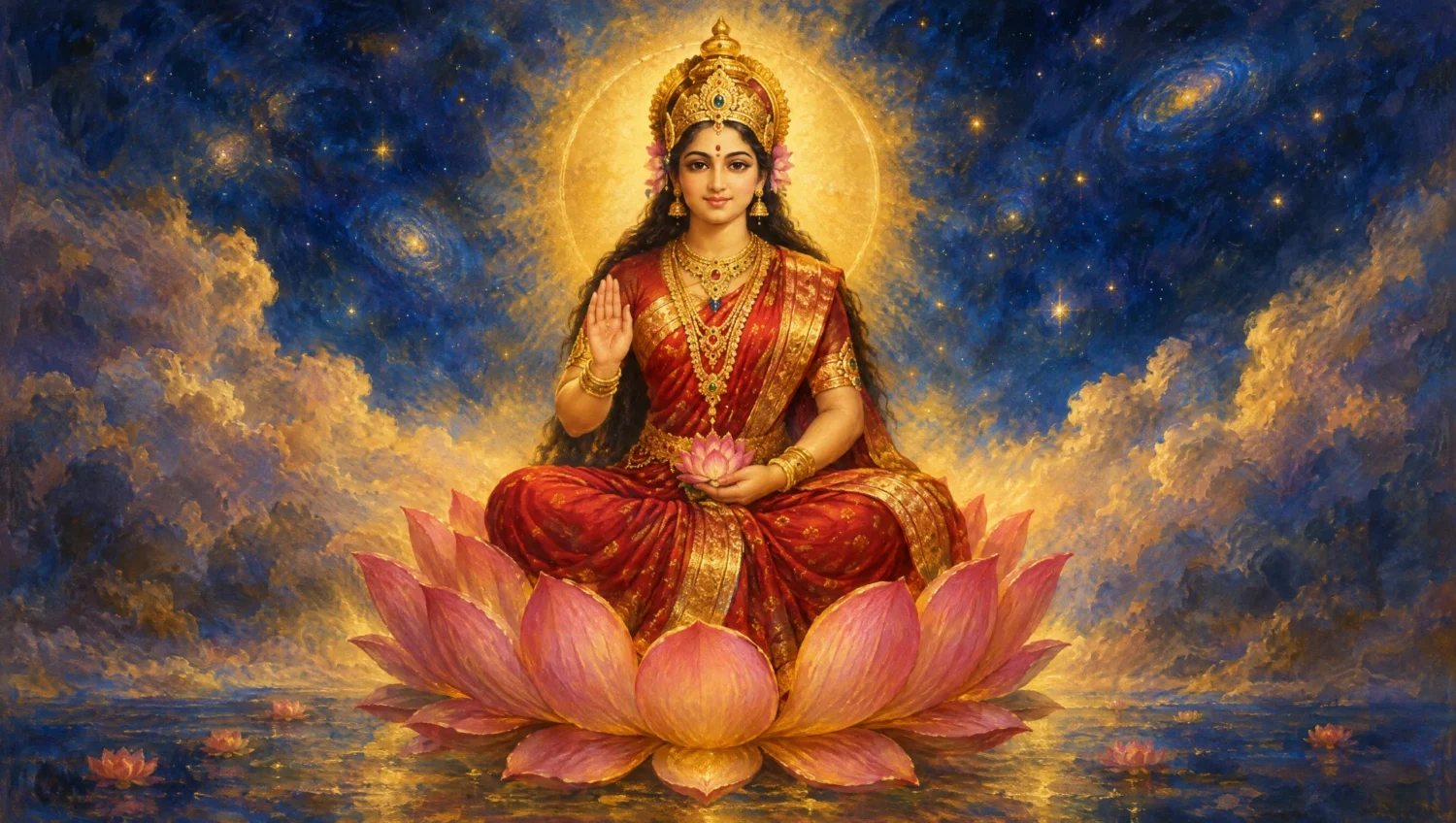
Long before anyone wrote a scripture, people looked at the earth and saw a mother. Fields grew, rivers ran, children were born, and life seemed to pour out of one source. In India that source has a name. She is Devi, the Goddess, the Divine Mother. She is Durga on her lion, Kali dancing in the dark, Lakshmi on her lotus, Sarasvati with her vina. Many Hindus say these are not separate goddesses at all, but faces of one Supreme Reality who is both the world and its mother. This guide follows Devi through scripture, devotion and mysticism. It explains Shakti, introduces the great saints who loved her, and looks at the Divine Mother as an ascended-master presence. We say what is text, what is history and what is devotion.
Key Takeaways
- Who she is: Devi means “goddess.” In the Shakta tradition she is the Supreme Reality herself, the Mahadevi, the Great Goddess, source of all gods and all worlds.
- Many faces: Durga, Kali, Lakshmi, Sarasvati, Parvati, Tara, Lalita and many others. Tradition holds that they are forms of one Divine Mother.
- Her great text: The Devi Mahatmya, a 700-verse scripture of about the fifth to sixth century CE, tells how the Goddess saves the world from demons and declares herself the only reality.
- Shakti: The word means power. It names the dynamic energy of the divine, felt as life, consciousness and creativity, and in yoga as kundalini.
- Living devotion: Navaratri, Durga Puja and the songs of saints such as Ramprasad, Sri Ramakrishna and Anandamayi Ma keep her presence alive today.
- An ascended-master presence: The Divine Mother also appears in Yogananda’s teaching, in Theosophy and in Ascended Master traditions as the feminine face of God. We keep these frames distinct.
In This Guide
- Who Is Devi?
- One Mother, Many Names
- Roots in the Veda and the Upanishads
- The Devi Mahatmya: Her Great Scripture
- Durga and Kali: Fierce Grace
- How Devotees Worship the Mother Today
- What the Mother Teaches
- Shakti and Shiva: The Dance of Power and Stillness
- The Ten Wisdom Goddesses and the Sacred Sites
- Shakti Within: Kundalini
- Saints and Mystics of the Mother
- The Universal Mother Across Cultures
- The Divine Mother in the Ascended Master Tradition
- Honest Questions and Cautions
- A Practice: Seven Days with the Mother
- Books and Further Reading
- Keep Exploring
- Frequently Asked Questions
Who Is Devi?
In Sanskrit, devi simply means goddess, the feminine of deva, a shining one. The word is used for any goddess. But when Hindus say Devi with a capital letter, or Mahadevi, the Great Goddess, they mean something more. They mean the Divine itself, understood as Mother.
This way of seeing God is called Shaktism, from shakti, power. It is one of the major streams of Hinduism, alongside the paths centered on Vishnu and Shiva. In the Shakta view the ultimate reality is not a distant male figure but a living, loving, fierce and tender Mother who creates, sustains and dissolves the universe, and who is also the awareness that sees it all.
It is easy to imagine this as a pantheon of separate goddesses. The tradition describes something else. A famous hymn in the Devi Mahatmya bows to the Goddess who dwells in all beings as consciousness, as intelligence, as hunger, as shadow, as compassion, as mother. Everything, in other words, is her.
Because Devi is sacred to millions of living worshippers, we write with respect. We tell her stories as the texts tell them, and we say clearly when something is history and when it is devotion. You can also see where the Mother fits among the other great beings who guide the human family in our complete guide to the Ascended Masters.
One Mother, Many Names
The Goddess has more names than any other figure in Indian religion. A short guide to a few of them follows.
| Name | Aspect | Symbols |
|---|---|---|
| Durga | Protective power that conquers evil and ignorance | A lion or tiger, ten arms, weapons given by the gods |
| Kali | Time, death and liberation. The Mother who cuts through illusion | Dark skin, garland of heads, dancing on Shiva |
| Lakshmi | Grace, abundance, fortune and beauty | Lotus, gold coins, elephants |
| Sarasvati | Knowledge, music, speech and the arts | White robes, vina, a swan |
| Parvati (Uma) | Devoted wife, mother, mountain daughter, Shiva’s power | Often seen with Ganesha and Kartikeya |
| Tara | The Mother who carries across the ocean of suffering | Blue or green skin, lotus |
| Tripura Sundari (Lalita) | Supreme beauty, the heart of the Sri Vidya tradition | Red, with sugarcane bow and flower arrows |
Other goddesses are village mothers, protectors of a river or a hill, and many of them were probably worshipped long before they were joined to the great tradition. Scholars see centuries of local goddesses merging into a few large figures. The tradition sees a single Mother wearing many costumes.
The two readings are not incompatible. A person can know the history of how a goddess was joined to another and still feel that she is truly present when the incense is lit.
Roots in the Veda and the Upanishads
The Goddess is old in India. We should be careful about how old. Some writers connect the female clay figurines of the Indus Valley, from about 2500 BCE, to a Mother Goddess cult. This is possible, but no one can read the Indus script, and the figurines might have had many purposes. It is honest to say that we do not know.
What we do have is literature. In the Rigveda, in a hymn called the Devi Sukta, a woman named Vak, the goddess of speech, declares herself the sovereign queen. She says she moves with the gods, sustains them, is the first of those who are worthy of worship, and that through her people see, breathe and hear. Scholars have long seen in it an early glimpse of the Supreme as feminine.
The Kena Upanishad tells a famous tale. The gods win a battle and celebrate as if the victory were their own. The Absolute appears to them as a mysterious spirit and asks Agni, Vayu and Indra to do small tasks, and each fails. Then a radiant woman appears, Uma, daughter of the Himalaya, and tells Indra that the spirit was Brahman, the Absolute, and that the victory was his. In the text she is the one who gives knowledge.
Over the centuries, the goddess gathered strength in the epics and the Puranas. By the early centuries of the common era she had become the center of her own literature.
The Devi Mahatmya: Her Great Scripture
The central text of Shaktism is the Devi Mahatmya, “The Greatness of the Goddess.” It is also called the Durga Saptashati, “Seven Hundred Verses,” because it has about seven hundred verses in thirteen chapters. It forms a section of the Markandeya Purana. Most scholars date it to around the fifth or sixth century CE. Devotees recite it, usually in Sanskrit, in what is called the Chandi Path, especially during Navaratri.
It contains three great stories.
- Madhu and Kaitabha. The god Vishnu sleeps on the cosmic ocean. Two demons arise from his ear and threaten Brahma. Brahma praises the Goddess as the power of illusion, Mahamaya, who holds Vishnu in sleep. She withdraws, Vishnu wakes, and the demons are killed. Even the great gods depend on her.
- Mahishasura. A buffalo demon defeats the gods and drives them from heaven. In their anger, the gods’ radiance streams out and gathers into a single blazing form: Devi. Each god gives her a weapon. She rides a lion into battle and defeats the demon after a mighty fight. This is the story of Durga.
- Shumbha and Nishumbha. Two brothers claim the universe. The Goddess is born from the body of Parvati, called Kaushiki. When two of the demon generals attack her, a dark and terrible form springs from her brow: Kali. The demon Raktabija can reproduce from every drop of his blood. Kali drinks it before it falls, and he is destroyed. At the end, other goddesses who had come to help merge back into the Goddess, who says: “I am alone here in the world. Who else is there besides me?”
These stories can be read at several levels. At the surface they are myth. For a mystic they are an inner drama: the demons are ignorance, ego, greed and delusion, and the Goddess is the awakening power that clears them away. For the devotee they are a promise that the Mother comes whenever she is called.
The Devi Mahatmya ends with a promise that those who hear it with devotion will be protected from fear and sorrow and will receive good fortune. It is among the most widely recited scriptures in India.
Durga and Kali: Fierce Grace
Western readers often meet the fierce goddesses first, and they can be startling. Durga, whose name means “the invincible” or “hard to reach,” stands with ten arms, each bearing a weapon, and calmly lifts a trident against a monster. Kali, whose name means “time” or “the dark one,” is dark-skinned, with a necklace of skulls and a tongue stuck out in a gesture of wild abandon.
These images are not meant to frighten the devotee. In the devotional poetry of Bengal, the worshipper sings to Kali as a child sings to a mother. The poet Ramprasad Sen, who lived in the eighteenth century, wrote songs that are still sung in Bengali homes. He scolds her, begs her, argues with her and weeps at her feet. She is terrifying and she is the one place a child can run to.
How do the traditions explain this? Kali is time that devours everything. She is also the one who removes the fear of death. She dances on Shiva, who lies still, to show that pure consciousness is inactive without her power. And the weapons of Durga are tools for cutting ignorance. The tradition teaches that the Mother’s severity is a form of mercy. She destroys only what keeps us bound.
Navaratri, “nine nights,” is celebrated in autumn in her honor. In Bengal and eastern India, the festival is called Durga Puja. Enormous images of Durga are made of clay, worshipped for days, and immersed in the river on the tenth day, Vijayadashami. UNESCO inscribed Durga Puja in Kolkata on its list of intangible cultural heritage in 2021.
How Devotees Worship the Mother Today
Devi is worshipped in great temples and in kitchens. In many Hindu homes a small shrine holds an image or a picture of the Goddess. A lamp is lit in the morning. A flower is offered, often a red hibiscus. A bell is rung and a short hymn, called an aarti, is sung. Red powder and red cloth are common, since red is the color of her power and her blessing.
The great temples draw crowds on festival days. Priests recite the Chandi Path from the Devi Mahatmya. During Navaratri, many families fast, or eat simply, for nine days. On the eighth or ninth day, some communities honor young girls as living forms of the Goddess, washing their feet, offering them food and gifts. It is a tender custom, and it speaks of seeing the Mother in the smallest and least powerful.
Devotees also use mantras, sacred sounds. A well-known verse for Durga and Kali and Sarasvati together, the Navarna mantra, begins with the seed syllables Aim, Hreem and Kleem. Seed syllables are not words in the usual sense. They are sounds that practitioners believe carry the essence of a divine power. Traditional teachers advise learning such mantras from a qualified teacher. For a simple beginning, the name “Ma” or “Durga,” spoken with feeling, is enough.
Pilgrimage is also a form of worship. Walking to a high temple, chanting along the way, is understood as offering the effort of the body to the Mother.
What the Mother Teaches
The Goddess traditions do not hand down a single list of rules. But they carry a recognizable view of life.
The world is sacred. If the Divine is Mother and the world is her body, then matter is not a trap. Soil, water, breath and the human body are all places where she can be met. This is a world-affirming mysticism.
Power and tenderness belong together. The Goddess is both lion-riding warrior and nursing mother. She teaches that real love is strong, and real strength is kind. Gentleness without courage cannot protect. Courage without tenderness becomes cruelty.
Surrender like a child. The saints of the Mother approach her as children approach a parent. They complain, plead and laugh. They do not try to master her. Many seekers find this a relief after years of trying to control their own growth.
Knowledge comes as grace. The Kena Upanishad shows Uma giving the gods the truth they could not find alone. The tradition teaches that the deepest understanding is received, not seized.
Face what you fear. Kali’s dark image invites us to look at death, change and loss with open eyes. In meeting what frightens us, we are freed from its grip.
Shakti and Shiva: The Dance of Power and Stillness
In the Tantric and Shakta traditions, the universe is a play of two aspects of one reality. Shiva is pure consciousness, still and unchanging. Shakti is the power that moves, creates, appears as the world and also dissolves it. They are not two separate beings. A saying from the tradition compares them to fire and its heat, or a word and its meaning. You cannot have one without the other.
This is a deeply nondual idea, and it softens a common misunderstanding. Some people think nondual teaching means the world is a dismissible illusion. In Shakta thought, the world is Shakti’s own expression: real, as the Mother’s body is real, and also not other than the Absolute. If this theme interests you, our guide to what non-duality is explains the wider landscape.
The tradition has produced rich systems of practice. Sri Vidya is a South Indian line of worship of the Goddess Lalita Tripura Sundari, using the Sri Yantra, a geometric diagram of interlocking triangles that represents the unfolding of the cosmos. The Lalita Sahasranama, “the thousand names of Lalita,” is a hymn chanted daily by many devotees. The Saundarya Lahari, “The Wave of Beauty,” a poem in praise of the Goddess, is attributed by tradition to Adi Shankara, though scholars debate its authorship.
Tantra is often misunderstood in the West as only a matter of sex. In its classical forms it is a very wide set of practices of ritual, mantra, visualization and meditation for realizing the divine within. The Shakta traditions are one of its homes. Some practices are initiatory and are best learned from a qualified teacher.
The Ten Wisdom Goddesses and the Sacred Sites
The Tantric tradition counts ten great forms of the Goddess, called the Mahavidyas, the “great wisdom ones.” They are Kali, Tara, Tripura Sundari, Bhuvaneshvari, Bhairavi, Chinnamasta, Dhumavati, Bagalamukhi, Matangi and Kamala. Some are lovely and some are alarming. Together they hold the whole range of the Mother’s wisdom: creation and destruction, beauty and decay, speech and silence, wealth and poverty.
The Mahavidyas are often understood as ten doors of insight. A seeker may be drawn to one more than the rest. The tradition says that the Goddess chooses the devotee, not the other way around.
The land of India is also seen as the Mother’s body. A well-known story tells of Sati, the first wife of Shiva, who died in grief and humiliation at her father’s sacrifice. Shiva wandered the world carrying her body. To end his sorrow, parts of her body fell to earth at many places, and these became the Shakti Pithas, sacred seats of the Goddess. Tradition names 51 of them, and some lists name 108. They include Kamakhya in Assam, Kalighat in Kolkata and Jwalamukhi in the Himalayas. Pilgrims have walked to them for centuries.
In this vision, the earth is not a backdrop. She is alive, and to walk her paths with reverence is a form of prayer.
Shakti Within: Kundalini
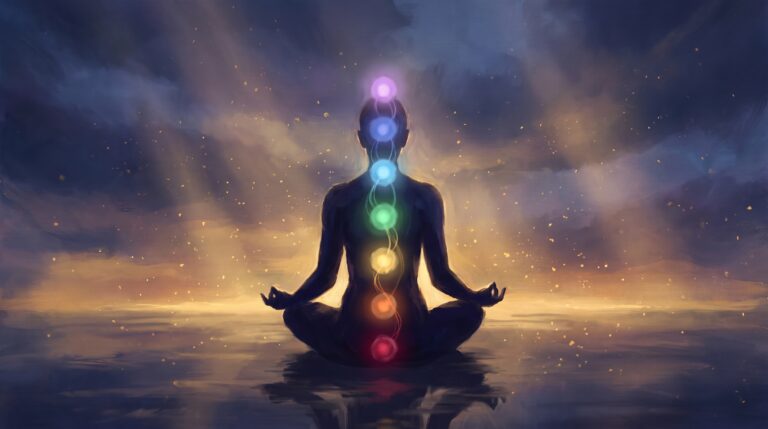
Yoga takes this teaching inward. The same cosmic power that creates the universe lies, in each person, coiled at the base of the spine. It is called kundalini, “the coiled one,” and is understood as Shakti herself. When it awakens and rises through the subtle centers, the chakras, the practitioner is said to join Shakti to Shiva in the crown of the head. The result is liberation.
Whether you take this literally or as a map of inner experience, it shows how thoroughly the tradition links the cosmic Mother with the personal journey. Your own vital energy and awareness are not separate from hers.
We have written separate guides on this. You can begin with kundalini energy: awakening, signs and safe practice and the chakras and the seven energy centers. Please note the cautions in those pages. Awakening practices can be intense, and they are best approached slowly and with a teacher.
Saints and Mystics of the Mother
Some of the best-known spiritual figures of the last three centuries were children of the Mother.
Ramprasad Sen (about 1718 to 1775). A Bengali poet-saint whose songs to Kali are tender, funny and fierce. Legend says he was a clerk who began writing songs to the Mother in the margins of his account books.
Sri Ramakrishna (1836 to 1886). A priest at the Kali temple of Dakshineswar near Calcutta. He lived for years in an intense longing for a direct vision of Kali, and he reported that she appeared to him as living consciousness. He later practiced many other paths and found each led to the same goal, but he never lost his sense of the Divine as Mother. His disciple Vivekananda carried his message abroad. You can hear Vivekananda tell the story of his teacher in the audiobook My Master, available on Next Level Soul.
Sarada Devi (1853 to 1920). Ramakrishna’s wife, called the Holy Mother. She was a quiet householder who gave spiritual guidance to thousands, and who treated all of them, strangers and the unworthy included, as her children.
Anandamayi Ma (1896 to 1982). The Bengali saint known as the Joy-Permeated Mother. Millions called her Ma, and she spoke of herself as “this body.” Whether her devotees saw her as the Goddess in human form or a great realized soul, they felt held by something larger than a person. You can watch Anandamayi Ma: Mother of the World on Next Level Soul.
Mirra Alfassa, “The Mother” (1878 to 1973). Born in Paris, she became the spiritual partner of Sri Aurobindo in Pondicherry and led the Sri Aurobindo Ashram and the founding of Auroville. Sri Aurobindo regarded her as an embodiment of the Divine Mother.
Mata Amritanandamayi, “Amma” (born 1953). A living teacher from Kerala known for embracing millions of people in public gatherings.
Notice a pattern. The Mother’s saints are often practical, tender and unpretentious. They tend to look like ordinary caretakers, and their teaching is mainly love.
The Universal Mother Across Cultures
Almost every culture has a story of a divine mother, and it is tempting to say they are all the same. Honest scholarship warns against lumping them together. Isis in Egypt, Demeter in Greece, Gaia, the Sumerian Inanna, Sophia in the Gnostic and Christian mystical traditions, Mary in Catholic and Orthodox devotion, Kuan Yin in East Asia, and Devi in India all arose in different worlds with different meanings.
Still, a family resemblance is clear. Each reaches for a Divine that nurtures, forgives, protects and also holds the world together. Many of them sit near human fears about birth and death. Seekers who love more than one of them are not confused. They have recognized the same kind of love speaking in different accents.
If this draws you, you might explore the figure of Mary Magdalene and the feminine wisdom of the early Christian world, or the East Asian bodhisattva of compassion in our guide to Kuan Yin. For the audio of the channeled messages of a Lady Master of mercy, see the audiobook Kuan Yin on Mercy, Forgiveness and the Bodhisattva Path, available on Next Level Soul.
The Divine Mother in the Ascended Master Tradition
The phrase “ascended master” does not come from Hindu thought, and no Shakta worshipper would say that Devi is an ascended master. She is not a person who rose from a human life. She is the Supreme herself. The esoteric traditions use the word in a different sense, and it is worth being clear about the difference.
In his teaching, Paramahansa Yogananda spoke of God as Divine Mother as well as Father, Friend and Beloved. He believed the Divine Mother was the aspect of God most near to the heart, and he prayed to her in chants and poems. He said that a devotee who calls on God as Mother finds a special kind of tenderness. You can read more about his life in our complete guide to Paramahansa Yogananda.
In Theosophy and the Ascended Master traditions, the feminine aspect of God is described in different ways. Some teachings speak of the Divine Mother as the feminine side of the Creator and of a “Mother Flame” held on behalf of the world. Others honor Lady Masters such as Mother Mary and Kuan Yin as emissaries of the Mother’s love. The details vary a great deal from source to source, and they are not a part of classical Hindu doctrine.
How should a seeker hold these layers? The Shakta devotee worships a Supreme Goddess and a living tradition. The mystic of any path may find a Mother in the heart. The esoteric student may find her through the figures who serve as her instruments. You can listen to several of these figures in Ascended Masters Channeled, available on Next Level Soul, and read our guide to the Ascended Masters for the larger picture.
Honest Questions and Cautions
The history is layered and uncertain. Beginnings of goddess worship in India are debated. The Devi Mahatmya’s date is a scholarly estimate. We have named what is guesswork.
The Goddess is not one single thing. Shakta traditions differ in their rituals, philosophies and even their views of whether the world is real. What a Bengali Kali devotee does is not what a Sri Vidya initiate does.
Some worship is not for beginners. Certain Tantric rites are initiatory and restricted. They should not be imitated from a book. Some regional traditions have included animal sacrifice, a practice that remains debated and has been reduced or replaced by symbolic offerings in many places.
Goddess worship and real women’s lives. Reverence for the Mother has existed alongside social inequality in India. Women’s lives have not always matched the exalted image. Many thoughtful voices, in India and beyond, point this out. Honoring the Divine Feminine means honoring actual women too.
Kali is not a symbol of chaos or evil. Western pop culture often reduces her to a monster or a fashion image. In her tradition she is liberating Mother. If you wish to honor her, please learn the context.
Be careful with energy practices. Kundalini and Tantric practices can be intense. Go gently, and if you feel unsettled, return to grounding and ordinary life.
A Practice: Seven Days with the Mother
You do not need to be Hindu to turn toward the Divine as Mother. This week is simple and open to anyone.
- Day 1: Thank the Earth. Stand barefoot for a few minutes on grass or soil. Say thank you to the ground that holds you.
- Day 2: Light a lamp. Light a candle or a small lamp. Sit with it. Say silently: Mother, be with me.
- Day 3: Chant a name. For five minutes, repeat a simple name, such as “Ma,” “Durga,” “Kali” or “Divine Mother.” Let the sound soften you.
- Day 4: Speak to her. Talk to the Mother as you would to a trusted parent. Tell her what you are afraid of. Listen for a feeling of reply.
- Day 5: Serve. Do one small act of care for someone: cook, carry, listen. Offer it to the Mother.
- Day 6: Look for her in people. In every encounter today, silently greet the Mother in the person in front of you.
- Day 7: Offer and rest. Place a flower or a glass of water before an image or a candle. Sit in silence and let yourself be held.
If you feel nothing, do not worry. The Mother, the tradition says, is patient.
Books and Further Reading
- Hindu Goddesses: Visions of the Divine Feminine in the Hindu Religious Tradition, by David Kinsley. A classic scholarly survey of the goddesses and their traditions.
- Encountering the Goddess, by Thomas Coburn. A translation of the Devi Mahatmya with a study of how it has been read.
- The Gospel of Sri Ramakrishna, translated by Swami Nikhilananda. Conversations with a saint of the Divine Mother.
- The audiobook My Master, by Swami Vivekananda, available on Next Level Soul.
- Bhakti Yoga, by Swami Vivekananda, an audiobook on the path of loving devotion.
Book links are Amazon affiliate links. If you buy through them, it supports our work at no extra cost to you.
Keep Exploring
To see how the Eastern wisdom of the Mother met a modern seeker, read our guide to Paramahansa Yogananda and our introduction to Self-Realization. For the cause-and-effect side of the path, read understanding karma. And for the other beings who guide us, return to our complete guide to the Ascended Masters.
Two audio courses fit this path well. Rumi’s Eternal Dance offers 27 lessons on love, presence and silence, in a spirit close to the Mother’s own. The Hidden Science of the Soul offers 12 lessons on prana, the subtle body and the hidden anatomy of the soul. Both are included with Next Level Soul membership. See the Next Level Soul Mastery overview for more, or begin with a free masterclass.
Watch Ascended Masters, Channeled on Next Level Soul TV
An eight-episode series in which renowned channeler Genevieve Taeger brings through Buddha, Mary Magdalene, Athena, Mother Mary, Jesus, Saint Germain, Yogananda and Kuan Yin. Each episode is a channeled message, offered as spiritual guidance and not as historical record.
Episodes that connect with this guide: Ascended Master Yogananda, Ascended Master Kuan Yin and Ascended Master Mary Magdalene.
Frequently Asked Questions
Who is Devi?
Devi means goddess. In the Shakta tradition she is the Supreme Reality herself, the Mahadevi, the Divine Mother, who creates, sustains and dissolves the universe. Durga, Kali, Lakshmi and Sarasvati are seen as her forms.
Are Durga, Kali and Lakshmi different goddesses?
Tradition treats them as different faces of one Divine Mother. Scholars also note that many were originally separate goddesses who were linked over time. Both views are held with respect.
What is Shakti?
Shakti means power. It is the dynamic energy of the divine, the force behind creation and life. In yoga it is also understood as kundalini, the energy that lies at the base of the spine.
What is the Devi Mahatmya?
It is the main scripture of Shaktism, a 700-verse text from the Markandeya Purana, dated by most scholars to about the fifth or sixth century CE. It tells three stories of the Goddess defeating demons and proclaims her supreme.
What is Navaratri?
Navaratri means nine nights. It is a festival in autumn dedicated to the Goddess, with fasting, worship and recitation, ending on the tenth day, Vijayadashami. In eastern India it is celebrated as Durga Puja.
Why is Kali so fierce?
Her fierce form represents time, death and the destruction of illusion. Devotees approach her as a loving Mother who removes fear and ignorance. Her severity is understood as a form of mercy.
Is Devi an ascended master?
Devotees regard Devi as the Supreme Reality, not an ascended master. The Divine Mother also appears in Yogananda’s teaching, in Theosophy and in the Ascended Master traditions as the feminine face of God. See our guide to the Ascended Masters for how these views relate.
Who was Anandamayi Ma?
Anandamayi Ma (1896 to 1982) was a Bengali mystic called the Joy-Permeated Mother. Many devotees saw her as a human form of the Divine Mother. You can watch Anandamayi Ma: Mother of the World on Next Level Soul.
Where can I learn more about Devi on Next Level Soul?
Listen to Vivekananda’s My Master, the story of Sri Ramakrishna, a devotee of Kali, or Bhakti Yoga, both available on Next Level Soul. You can also watch Anandamayi Ma: Mother of the World.
How can I begin to connect with the Divine Mother?
Light a candle, sit quietly, and speak to the Mother in your own words. Chant a simple name such as “Ma.” The seven-day practice in this guide offers a gentle way to begin, whatever your faith.