Maybe you have felt it. A pull of attention to the space between your eyebrows when you close your eyes. A hunch that turned out to be right. A stretch of quiet in meditation when something behind your forehead seemed to brighten. You wondered what it was, and whether it has a name.
It does. Traditions around the world call it the third eye. In the yogic system it is the ajna chakra, the center of perception, insight and inner guidance. This guide is a complete, grounded walk through it: where the idea comes from, what the pineal gland has (and has not) been shown to do, the signs people report, the meditations and mantras that have been used for centuries, how to practice safely, and how the third eye fits with the rest of your energy system.
One promise before we begin. We will tell you what is tradition, what is personal experience, and what is science. They are three different kinds of knowing, and each deserves honesty. The power is within you. Every teacher, book and practice here is only a guide to help you remember it.
Key Takeaways
- The third eye is the ajna chakra, the energy center between and just behind the eyebrows. Ajna means “command” or “perceive.”
- Traditions link it to intuition, insight and clear seeing, not to a literal third eye.
- The pineal gland is real and regulates sleep rhythms. Claims that it is a spiritual organ remain unproven.
- Gentle practice works best: breath, Om, brow-center awareness and a steady daily rhythm.
- Go slowly. Headaches, strain or overwhelm are signals to ease off, and persistent symptoms deserve a doctor.
- A healthy third eye works with all seven chakras, not above them.
What Is the Third Eye?
The third eye is an idea, a symbol and, for many practitioners, an experience. As an idea, it describes an inner faculty of perception that does not depend on the physical eyes. As a symbol, it appears in art, scripture and ritual from India to Tibet to ancient Egypt. As an experience, people describe it as pressure, warmth, light or simple clarity near the brow while they meditate.
What it is not is a hidden organ waiting to be switched on. You do not have a third eye in the way you have two eyes. Teachers who speak of it are pointing at something about attention: where it rests, how still it becomes, and what you notice when the noise inside you quiets down.
That is why this teaching has lasted. It asks nothing of you except attention. Attention, practiced kindly and daily, is available to everyone.
Try this now. Close your eyes. Let your breath settle. Rest your awareness at the point between your eyebrows for ten slow breaths. Do not push. Just notice what is there.
The Ajna Chakra in Yogic Tradition
In the yogic and tantric systems, the body holds a subtle map of energy centers called chakras (the Sanskrit word means “wheel”). The sixth of the seven main chakras is ajna. If you are new to the whole system, start with our guide to the seven chakras and how to balance them, then return here.
What the Name Means
Ajna is usually translated as “command.” Some teachers prefer “to perceive” or “to know.” Both meanings fit the tradition. The center is described as the place where the practitioner receives inner guidance, sometimes called the command of the inner teacher, and where the mind turns from outward looking to inward seeing.
Where It Is Said to Live
Texts place ajna between the eyebrows, a little above the root of the nose, and also deeper inside the head, behind the forehead. Many teachers point out that the physical spot on the brow is a doorway, and the center itself sits further in. When you rest your attention there, you are not looking at your forehead. You are looking from the inside.
Its Traditional Imagery
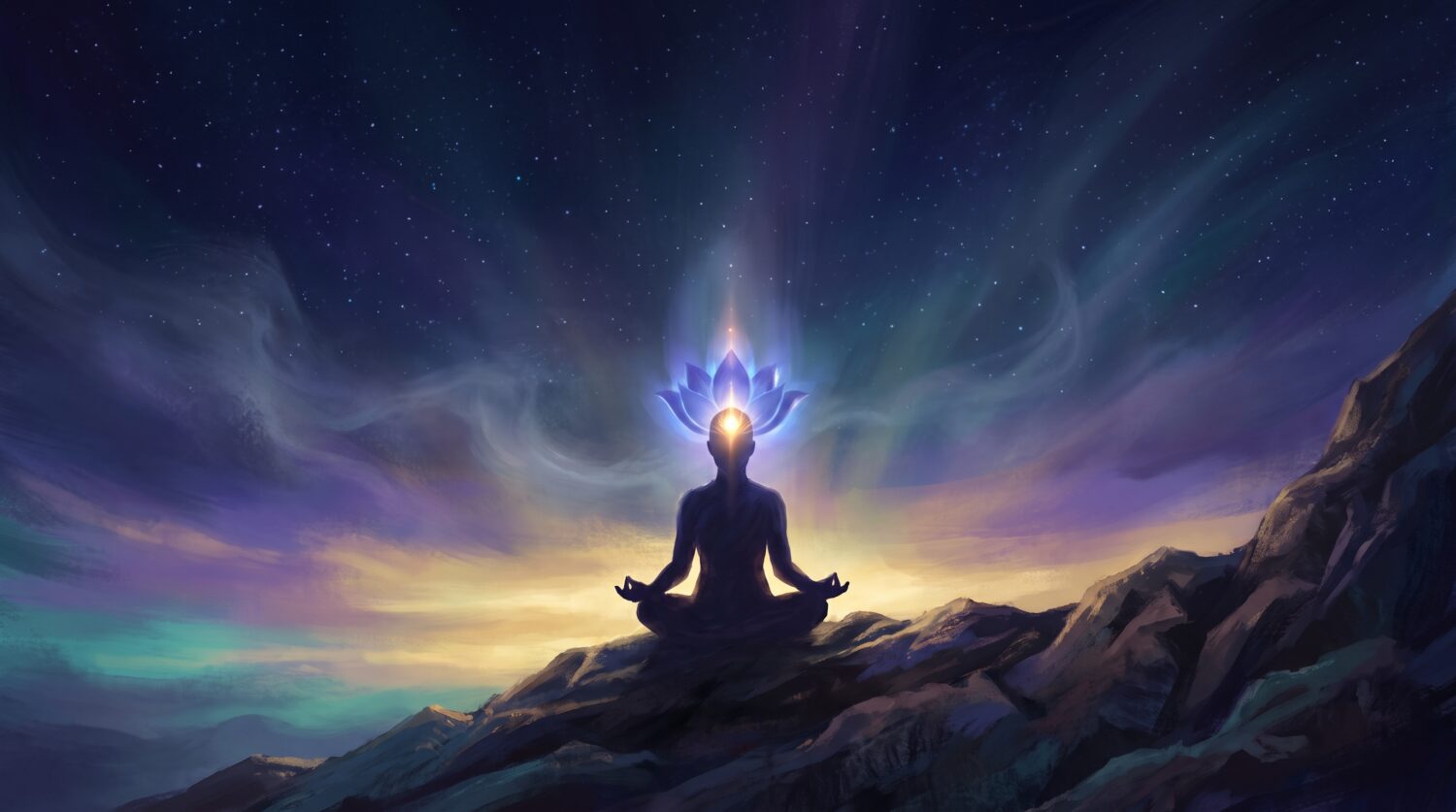
According to tradition, ajna is pictured as a lotus with two petals. Teachers read the two petals in different ways: the meeting of opposites, the merging of the solar and lunar energy channels, or the union of the personal self with something larger. In classical yoga, the three main channels (ida, pingala and sushumna) are said to meet at this point, which is one reason it is treated as a threshold.
The seed sound, or bija mantra, is Om. The color most often given today is indigo, a deep blue-violet. That color scheme is a relatively modern Western addition. Older sources describe the center differently, so treat indigo as a helpful visual, not a fixed rule.
What It Is Associated With
Practitioners and teachers associate a balanced ajna with these qualities:
- Intuition and inner knowing
- Clear thinking and good judgment
- Imagination and visualization
- Seeing patterns and the bigger picture
- Discernment about what is true for you
A center out of balance is said to show up as confusion, indecision, overthinking, difficulty trusting yourself, or the opposite: getting lost in fantasy and losing touch with everyday life. We will come back to balance later in this guide. For a closer look at how the system gets stuck and eases, see our article on chakra blockages, their causes and relief.
Try this now. Think of one decision you have been circling. Sit quietly, rest attention at the brow, and ask: what do I already know about this? Write down the first honest answer, even if it is small.
A Short History of the Third Eye
The third eye is older than the modern chakra chart. It shows up in many places, and it helps to see each one on its own terms.
In Hindu Imagery
The god Shiva is often shown with a third eye in the center of his forehead. In the stories, it opens to burn away illusion and ignorance. That is the same theme you will hear in the yoga teachings: the third eye sees what ordinary sight misses. Many Hindus wear a mark between the brows, a tilaka or bindi, to honor that point. The meaning differs by region and tradition, and it is also worn simply as cultural and devotional adornment.
The Bhagavad Gita includes a famous moment in which Krishna grants Arjuna a “divine eye” (divya chakshu) so that he can see a vision that ordinary sight cannot hold. Read that way, the idea of an inner eye is woven into the oldest devotional literature of India.
In Buddhism
Buddhist art often shows a small dot or curl between the Buddha’s brows, called the urna. It is counted among the traditional marks of a great being and is said to radiate light. Early Buddhist teachings also describe a “divine eye” (dibba-cakkhu) as one of the higher knowledges that advanced meditators may develop. The same teachings caution that these abilities are not the goal. Freedom and compassion are.
In the Yoga Texts
The detailed system of seven chakras, with ajna at the brow, comes largely from later tantric literature. A well-known source is a sixteenth-century Sanskrit work on the six centers, which John Woodroffe translated into English in 1919 as The Serpent Power. Classical hatha yoga texts also describe brow-center gazing and candle-gazing as ways to steady the mind.
In Christian and Western Mysticism
Many readers connect the third eye with a line in the Gospels about the “single eye” filling the body with light. Paramahansa Yogananda taught that this refers to the spiritual eye seen in deep meditation at the brow, and his Kriya Yoga tradition places great emphasis on that point. You can read more in our Kriya Yoga meditation guide and our guide to Sri Yukteswar Giri. Other Christian readers understand the verse more simply, as a call to a single-hearted, undivided vision. Both readings are part of the conversation.
In the West
The modern idea of the third eye as the pineal gland spread through the Theosophical movement. Helena Blavatsky wrote about the pineal as a vestige of a spiritual organ in her late nineteenth-century work, and later writers popularized the seven-chakra rainbow chart. Earlier, in the seventeenth century, the philosopher Rene Descartes had called the pineal gland the principal seat of the soul. These are interesting chapters in the history of ideas. They are not scientific findings, and we will keep that line clear in the next sections.
Third Eye Glossary
A few words come up again and again. Here is a plain-language list you can come back to.
- Ajna: the sixth chakra, the center of perception and inner guidance. Often translated “command.”
- Chakra: “wheel.” An energy center in the subtle body, according to yogic tradition.
- Bija mantra: a “seed sound” linked to a chakra. For ajna it is Om.
- Om (Aum): the sacred syllable of the Indian traditions, chanted at the start of many practices.
- Nadi: a channel through which subtle energy is said to flow. The main three are ida, pingala and sushumna.
- Prana: life force, closely tied to the breath in yogic teaching.
- Bindu: “point” or “drop.” A focus point used in meditation.
- Trataka: steady gazing, usually at a candle flame, to train concentration.
- Drishti: a focused gaze point used in yoga and meditation.
- Kutastha: in Kriya Yoga, the point at the brow where attention is held and the spiritual eye is said to be seen.
- Mudra: a seal or gesture, using the hands, eyes or body, to direct attention.
- Siddhi: a power or ability said to arise on the path. Teachers warn against chasing them.
- Sahasrara: the seventh chakra at the crown, the center of unity and spiritual connection.
- Pineal gland: a tiny gland deep in the brain that helps regulate the sleep and wake cycle through melatonin.
- Melatonin: a hormone that signals night to the body.
- Phosphenes: spots, swirls or flashes of light seen with closed eyes, caused by activity in the visual system.
The Pineal Gland: What Science Does and Does Not Say
Almost every modern article about the third eye mentions the pineal gland. Because this is where the most confusion lives, it deserves a careful look. We will separate what is established, what is a hypothesis, and what is claimed without evidence.
What Is Well Established
The pineal gland is a small, pinecone-shaped structure near the center of the brain. It is roughly the size of a grain of rice. Its best-understood job is producing melatonin. Light signals travel from the eyes to the brain’s internal clock, and in darkness the pineal releases melatonin, which helps tell your body that it is night. This is why sleep and light exposure are so closely connected.
It is also true that some animals have a light-sensing “parietal eye” on top of the head. Certain lizards and the tuatara are examples. It is a real structure connected to the pineal region in those species. Humans do not have it, but its existence is one reason the third eye idea feels so natural. The ancients and the biologists were both looking at the same small spot.
What Is a Hypothesis
You may have read that the pineal gland makes DMT, a powerful psychedelic compound, and that this explains mystical experience. The idea was popularized by psychiatrist Rick Strassman in his 2001 book DMT: The Spirit Molecule, following his clinical research on DMT. It is an interesting hypothesis. Researchers have detected DMT-related enzymes and the compound in animals, but it has not been shown that the human pineal gland produces meaningful amounts of DMT, or that this produces spiritual experiences during meditation. Treat it as an open question.
What Is Claimed Without Good Evidence
- “Fluoride calcifies your third eye.” The pineal gland does collect calcium deposits with age, and some studies have found fluoride in pineal tissue. There is no solid evidence that this blocks intuition or spiritual perception, or that any product can “decalcify” it for that purpose.
- “A pineal detox opens spiritual sight.” No research supports a link between detox products and spiritual experience.
- “Staring at the sun activates it.” Please do not do this. Looking at the sun can permanently damage your eyes.
- “Meditation has been proven to activate the pineal gland.” Studies on meditation commonly report benefits for stress, attention and sleep, and some find effects on melatonin. They do not show that meditation opens a spiritual organ.
A Grounded Way to Hold It
Here is a view many thoughtful teachers share. The pineal gland is a fascinating part of the body that governs your rhythm of light and dark. The ajna chakra is a spiritual map that points at inner perception. The two may overlap in the imagination, and they may even be related in ways we do not yet understand. But claiming one has proven the other goes beyond what we know.
The good news is that you do not need the science to settle for the practice to help. A regular sleep rhythm, morning light, dark nights and a quiet mind are good for your body and your inner life. That is where we will start.
Try this now. Tonight, dim the lights an hour before bed and put the phone in another room. Notice whether your mind feels quieter the next morning.
Signs People Report
People who practice brow-center meditation describe a range of experiences. These are reports, not a checklist, and not everyone has them. Absence of any sensation does not mean the practice is failing.
- Pressure or tingling between the eyebrows, or a feeling of warmth or fullness in the forehead
- Light behind closed eyelids: colors, soft glow, points or swirls (often phosphenes, a normal visual effect)
- Stronger intuition: hunches that arrive clearly and prove helpful
- Vivid dreams and better dream recall
- Clearer thinking: less mental fog, better focus, easier decisions
- A quieter inner voice: more space between a thought and your reaction to it
- Sensitivity to light, sound or crowds for a while
- Emotional release: tears or a wave of calm that arrives without a reason
Some people also report seeing lights or imagery that they interpret as visions, guides or messages. Those are personal experiences, and many traditions advise holding them lightly. A helpful test from the wisdom traditions: does the experience leave you kinder, steadier and more grounded? If so, it is serving you. If it leaves you anxious, inflated or cut off from daily life, slow down.
It also helps to know what the signs are not. A flash of light with closed eyes is common and usually harmless. Persistent visual disturbances, headaches that do not ease, or anything sudden and alarming are medical questions first. See a doctor, then come back to the practice.
If you are curious about the energy field around the body, our guide to aura colors and how to see them is a good companion read.
Preparing the Ground
The third eye does not open through effort. It opens through ease. A few simple foundations make every practice in this guide work better.
Set a Gentle Intention
Choose one honest reason for practicing. Not “I want visions.” Something like: I want to trust myself more. I want to hear my own wisdom. I want a quieter mind. An intention like that points you in a useful direction and keeps you from chasing special effects.
Take Care of the Body
Sleep, water, regular meals and movement matter more than any technique. A tired, dehydrated body will not meditate well, no matter how sacred the method. Walk outside. Stretch. Eat real food. This is not a detour from the path. It is the path.
Choose a Simple Space
You do not need an altar, crystals or incense. A chair, a cushion or the edge of your bed works. Some people like a candle or a few minutes of soft instrumental music. If you enjoy traditional associations, amethyst and lapis lazuli are often linked to the brow chakra, and our guide to chakra stones covers them. They are optional. The power is within you, not in the object.
Set a Time Limit
Start with five to ten minutes. Short, steady practice beats long, forced sessions. You can always add time later.
Try this now. Pick a daily time slot and put it on your calendar. Morning, before the day pulls at you, is a favorite for many people.
Third Eye Meditations
These three meditations move from simplest to deepest. Try the first for a week before you move on.
1. Brow-Center Breath Awareness
- Sit comfortably with your spine tall and your shoulders loose. Close your eyes.
- Breathe naturally through the nose for a minute. Let the breath slow down by itself.
- Rest your attention at the point between your eyebrows. Keep your eyes relaxed, not rolled upward.
- With each inhale, imagine a soft indigo light gathering at the brow. With each exhale, let it spread through the head.
- When your mind wanders, and it will, gently return to the brow. No scolding.
- After ten minutes, rest for a minute and notice how you feel before opening your eyes.
The key is softness. If you feel a tight squeeze or a headache, you are trying too hard. Soften the face, the jaw and the eyes, and begin again.
2. The Indigo Light Visualization
- Settle into stillness for a few breaths.
- Picture a small point of indigo light at the center of your forehead. It can be tiny, like a star at dusk.
- With each breath, let it grow a little brighter and a little wider, as though a lamp is slowly being turned up.
- Rest in the glow. Do not try to see anything. Let the image come or not come.
- When the time is up, imagine the light settling down into the heart. This helps anchor the practice in feeling, not only in thought.
Visualization comes easily to some people and not at all to others. Both are fine. Many people simply sense the light as a feeling instead of a picture. That counts.
3. Inner Questions at the Brow
- Begin with the brow-center breath awareness for five minutes.
- Ask one clear, kind question silently. For example: what is mine to do today?
- Do not chase an answer. Let the question sit in the quiet like a stone in a still pond.
- When you finish, write down anything that surfaced: a word, a feeling, an image, or nothing at all.
Over weeks, your journal becomes the real teacher. You will see patterns in what you receive and which insights prove true in your daily life. That is how intuition becomes trustworthy: by checking it against real experience.
If you like to be guided, our chakra meditation guide walks through the whole system, and the Next Level Soul library has many guided meditations you can use with your phone or TV.
Om and the Power of Sound
Sound is one of the oldest ways to gather attention, and Om is the sound most closely tied to the third eye.
What Om Means
Om (also written Aum) is regarded in the Indian traditions as the primordial sound. The Mandukya Upanishad describes it in four parts: the three sounds A, U and M, and the silence that follows. Teachers read those as waking, dreaming and deep sleep states, with the silence pointing to the awareness that underlies them all. In ajna practice, Om is the seed sound of the center.
How to Chant Om
- Sit tall. Take a slow breath in through the nose.
- On the exhale, let the sound begin as a rounded “ah,” roll into “oo,” and close into a humming “mm.”
- Feel the vibration in the lips, the face and the forehead on the “mm.”
- Pause in the silence after each round. This is part of the practice, not a gap.
- Repeat for five to eleven rounds, then sit in silence for a few minutes with attention at the brow.
Practitioners say the humming part of the chant makes it easy to feel the head and brow area. You do not need to believe anything for this to help. Chanting slows the breath and gives a busy mind something simple to do, and many people find that calming.
Other Sounds and Mantras
- So Hum: a breath mantra. Silently say “so” on the inhale and “hum” on the exhale. It is often taught as “I am that.”
- Silent Om: repeat Om mentally with the breath, with attention resting at the brow.
- Bhramari (bee breath): a humming exhale described in the next section.
- Your own sacred word: a word from your own tradition, such as a short prayer phrase, works as well. The sincerity matters more than the language.
Try this now. Chant Om seven times, slowly. Then sit in the silence for one minute. Notice what changes in your face, your shoulders and your breath.
More Practices for the Third Eye
Trataka (Candle Gazing)
Trataka is an old yoga method for training concentration. Sit about an arm’s length from a candle at eye level in a dim, draft-free room. Gaze softly at the flame without forcing your eyes. When your eyes tire or water, close them and hold the afterimage at the brow. Begin with two or three minutes. Stop if your eyes ache or strain.
Bhramari (Bee Breath)
Inhale through the nose. On a slow exhale, make a low humming sound like a bee, with lips closed and teeth slightly apart. Feel the vibration in the head. Five to ten rounds is plenty. Many people find it a quick way to calm the mind and bring awareness inward.
Alternate Nostril Breathing (Nadi Shodhana)
This breathing method is said to balance the solar and lunar channels that meet at ajna. Close the right nostril with your thumb and inhale through the left. Close both, pause briefly, then release the right and exhale through it. Inhale on the right, switch, and exhale on the left. That is one round. Keep the breath smooth and never strain. Start with five rounds.
Yoga Postures That Bring Attention to the Head
Child’s pose, with the forehead resting on the mat, is a gentle way to feel the brow center. Seated forward folds do something similar. See our chakra yoga guide for a sequence through all seven centers. Skip any inversions if you have high blood pressure, eye pressure problems or neck concerns, and check with a qualified teacher first.
Light and Dark Rhythm
This is the most down-to-earth practice in the guide. Get natural daylight in the morning. Keep your evenings dim. Sleep in a dark room. Because the pineal gland responds to light and dark, this supports the one thing science does tell us about it, and it often leads to better sleep and clearer mornings.
Dream Journaling
Keep a notebook by the bed. Write down whatever you remember the moment you wake. People who practice brow-center meditation often report more vivid dreams, and the journal helps you see patterns without over-reading them.
Creative Play
The ajna is tied to imagination. Draw, doodle, write, sing, rearrange a room. Imagination is the muscle the third eye uses, and playing with it keeps it strong.
Time in Nature
A slow walk with attention on the trees, the sky and the way light moves through leaves is a perfectly good third eye practice. If you want a related practice for the body, our earthing and grounding guide explores reconnecting with the earth.
Safety Notes: Go Gently
This is the most important section of the guide. Third eye practices are usually gentle, but they are not risk free. Awareness of a few points keeps the path safe and sweet.
Headaches and Eye Strain
Many beginners strain: they squeeze the forehead, roll the eyes upward and clench the jaw. This causes tension headaches that people sometimes mistake for “energy opening.” It is not a sign of progress. If your head hurts, ease off. Relax the face, look straight ahead in your mind, and shorten the session. If headaches are frequent, severe or unusual for you, see a doctor. A sudden, severe headache needs urgent medical care.
Overdoing It
More is not better. Hours of intense practice can leave people feeling spacey, wired, tearful, irritable or unable to sleep. If that happens, cut back to a few minutes, add grounding activities like walking, cooking or time with friends, and sleep well. Teachers say that integration matters as much as practice.
Difficult Experiences
Meditation research has documented that a minority of people have challenging experiences, including anxiety, strong emotions, feelings of detachment or disturbing imagery. Researchers at Brown University, among others, have studied these experiences, and the lesson is simple: take them seriously, tell someone, and get support. You are not failing.
Who Should Be Extra Careful
If you have a history of psychosis, bipolar disorder, seizures, severe anxiety, dissociation or trauma, talk with your doctor or therapist before starting intensive meditation, long breath holds or extended gazing practices. Gentle, short, grounded practice is usually the better path, and a skilled guide can help. This guide is spiritual education, not medical advice.
Skip the Shortcuts
You may see claims that psychedelics, extreme fasting, sun gazing or breath holds will force the third eye open. They carry real physical and psychological risks, can be illegal depending on where you live, and the tradition itself warns that forced experiences rarely leave lasting change. Slow, steady practice is the road teachers have trusted for centuries.
Hold Visions Lightly
If you see or sense something, you do not need to decide right away what it means. Note it, stay kind to yourself, and let time show whether it was useful. Be cautious with anyone who claims to read your third eye for a fee, tells you that you are blocked and must buy something, or makes you feel dependent on them. Discernment is part of the ajna itself.
Try this now. Write three guardrails for your practice. Example: I stop if my head hurts. I never practice longer than twenty minutes. I will talk to someone if something unsettles me.
Balance With the Other Chakras
The third eye does not float above the rest of you. In the yogic map, the chakras work as a system, and a bright brow center rests on a steady foundation. Many teachers say that people who focus only on the higher centers can feel ungrounded, and people who ignore them can feel flat or stuck. The goal is a whole, balanced person.
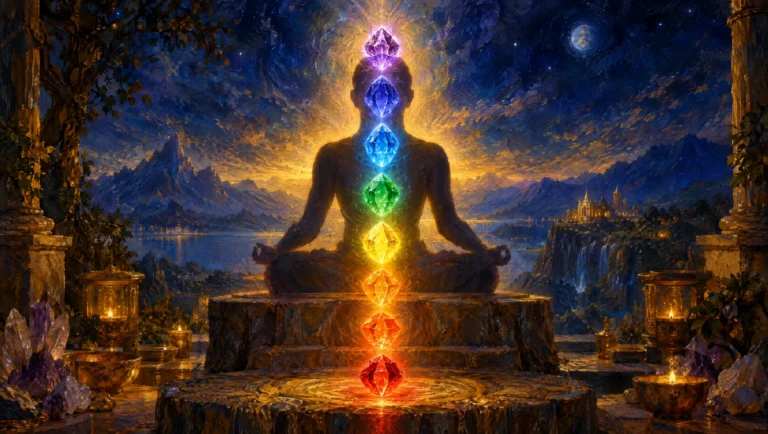
- Root (Muladhara): safety, stability, the body. Seed sound Lam. This is your foundation. If you feel spacey in third eye practice, start here with walking, stretching and eating well.
- Sacral (Svadhisthana): creativity, feeling, pleasure. Seed sound Vam. Imagination and emotion feed each other.
- Solar Plexus (Manipura): will, confidence, action. Seed sound Ram. Insight needs the courage to act on it.
- Heart (Anahata): love, compassion, connection. Seed sound Yam. Insight without a loving heart turns cold. This is the center that keeps the third eye kind.
- Throat (Vishuddha): truth and expression. Seed sound Ham. What you perceive becomes real when you say it honestly.
- Third Eye (Ajna): perception and insight. Seed sound Om.
- Crown (Sahasrara): unity and spiritual connection. Often practiced in silence.
A simple way to keep balance is to follow a short “ladder” at the end of a session. Spend one minute on each of the centers below ajna, from the root up, and finish at the brow. Or work the other direction: after brow-center practice, bring your attention down to the heart and the belly and rest there.
For deeper walkthroughs, explore our guides on chakra healing techniques for balance and energy, the chakra meditation practice for all seven centers, and the overview of the 7 chakras.
The crown chakra and the third eye are often paired. If you want to see where this path leads, read our guide to spiritual enlightenment across traditions and our guide to the ascended masters, who are said to have walked it fully.
A Simple Four-Week Plan
Here is a gentle way to begin. Adjust it to fit your life.
- Week 1, Settle: Five minutes a day of brow-center breath awareness. Establish the light and dark rhythm: morning daylight, dim evenings.
- Week 2, Sound: Add five rounds of Om before each sitting. Start a dream and insight journal.
- Week 3, Light: Try the indigo light visualization for ten minutes. Add bee breath or alternate nostril breathing.
- Week 4, Ask and Ground: Practice inner questions at the brow, then end every session with a minute at the heart. Review your journal and note what proved true.
After four weeks, look back. What changed? Sleep, focus, mood, decisions? Keep what helps and let go of the rest. That is how any path becomes yours.
Common Myths
- “Opening the third eye gives you psychic powers.” Some people report intuitive experiences. Traditions say these are side effects, not the goal, and not a promise.
- “You must feel something to be doing it right.” Many people feel nothing dramatic, and still gain calm and clarity.
- “It is dangerous and should be avoided.” Gentle practice is generally safe. Strain, extremes and ignoring warning signs are the risks.
- “It takes years of retreats.” A few mindful minutes a day count. Depth grows with time, but the doorway is always open.
- “A guru or a product must open it for you.” The power is within you. A good guide helps. Nobody can do the seeing for you.
Books on the Third Eye and the Chakras
These are good companions for the road. Each of them goes further than a single article can.
- Autobiography of a Yogi by Paramahansa Yogananda. The classic account of Kriya Yoga and the spiritual eye.
- The Holy Science by Sri Yukteswar. A short, dense text on the unity of the world religions and the inner path.
- Eastern Body, Western Mind by Anodea Judith. A thorough, psychologically minded guide to the chakra system.
- The Serpent Power by Sir John Woodroffe (Arthur Avalon). The classic translation of the traditional text on the six centers.
- Awakening the Third Eye by Samuel Sagan. A practical book on developing inner perception.
- Wherever You Go, There You Are by Jon Kabat-Zinn. A calm, grounded introduction to mindfulness.
As an Amazon Associate, Next Level Soul earns from qualifying purchases.
Go Deeper on Next Level Soul
These titles and conversations explore inner vision and intuition, and they are available on Next Level Soul.
- Mystic Vision An audio course on awakening the astral eye and seeing beyond the veil.
- Becoming Clairvoyant An audio course on developing clairvoyance.
- NLS Mastery: Awaken Your Psychic Abilities with Nikki Dutta.
- The Channeled Messages That Humanity Needs with intuitive teacher Sonia Choquette.
- Spiritual Cinema: Awake, The Life of Yogananda A look at the life of the master who brought Kriya Yoga to the West.
Where to Go Next
You do not have to do everything in this guide. Pick one thing. Maybe it is ten breaths at the brow tonight. Maybe it is an earlier bedtime, a journal by the bed, or a conversation with a friend about the hunches you have been quietly noticing. Start there. The third eye grows by attention, kindness and time.
When you want company on the path, explore our guide to spiritual enlightenment, return to the seven chakras overview, or step into the Mystic Vision audio course. You are already enough to begin.
Frequently Asked Questions
What Is the Third Eye?
The third eye is a symbol and an inner faculty of perception described in many spiritual traditions. In yoga it is the ajna chakra, located between and just behind the eyebrows, associated with intuition, insight and clear seeing. It is not a physical third eye.
What Is the Ajna Chakra?
Ajna is the sixth of the seven main chakras. The name means “command” or “perceive.” According to tradition it is pictured as a two-petaled lotus, its seed sound is Om, and it is linked to intuition, imagination and discernment.
Is the Pineal Gland the Third Eye?
Not in any proven sense. The pineal gland is a real structure that helps regulate sleep through melatonin. Some spiritual writers link it to the third eye, but science has not shown that it is a spiritual organ.
How Do I Know If My Third Eye Is Opening?
People report pressure or tingling at the brow, light behind closed eyelids, vivid dreams, stronger intuition and clearer thinking. These are personal reports, not a checklist, and many people feel nothing dramatic while still benefiting from the practice.
How Long Does It Take to Awaken the Third Eye?
There is no fixed timeline. Some people notice calmer focus within weeks of daily practice. Teachers describe it as a gradual path, and they advise valuing steady practice over dramatic experiences.
What Is the Best Mantra for the Third Eye?
Om is the traditional seed sound of the ajna chakra. Other options are So Hum, silent repetition of Om with the breath, or a sacred word from your own tradition. Sincerity matters more than the particular sound.
Can Third Eye Meditation Cause Headaches?
Yes, if you strain. Squeezing the forehead, rolling the eyes upward or clenching the jaw can cause tension headaches. Soften the face and shorten the session. If headaches are frequent, severe or unusual, see a doctor.
Is It Safe to Open the Third Eye?
Gentle practice such as breath awareness, Om chanting and short visualizations is generally considered safe for most people. Avoid forcing experiences, and speak with a doctor or therapist first if you have a history of psychosis, seizures, severe anxiety or trauma.
What Color Is the Third Eye Chakra?
Indigo, a deep blue-violet, is the color most often used today. That color scheme is a modern Western convention. Older sources describe the center differently, so use indigo as a helpful visual, not a rule.
Does Fluoride Calcify the Pineal Gland and Block the Third Eye?
The pineal gland does collect calcium deposits with age, and some studies have found fluoride in it. There is no solid evidence that this blocks intuition or spiritual perception, or that detox products reverse it.
What Should I Do If I Feel Overwhelmed During Practice?
Stop, open your eyes, feel your feet on the floor and breathe slowly. Walk, drink water and talk to someone you trust. Shorten future sessions and add grounding activities. If distress continues, speak with a mental health professional.