Maybe you have tried to meditate and your mind turned into a crowded kitchen. Maybe you have heard about chakras and wondered whether they are real, symbolic, or just a pretty diagram on a yoga studio wall. Either way, you are in the right place. You do not need to be sure about the metaphysics to try this. You only need a quiet corner and a few minutes.
Chakra meditation is a practice of resting your attention, one at a time, on seven points along the centerline of the body. According to yogic and tantric tradition, those points are energy centers. Practitioners say that giving each one gentle, steady attention brings calm, clarity and a feeling of being gathered back into yourself. This guide is the practical side: posture, timing, breath, bija mantras, a guided practice for each chakra, a full 10-minute sequence, and honest troubleshooting for the days it does not go to plan. For the meaning behind each center, our complete guide to the seven chakras goes chakra by chakra.
Key Takeaways
- Chakra meditation moves your attention through seven points along the spine, from the base to the crown.
- Start with five to ten minutes. Consistency matters more than length.
- Bija sounds such as LAM, VAM, RAM, YAM, HAM and OM are traditional tools, offered here as tradition, not as proof.
- A 10-minute full sequence below gives you a complete daily practice.
- Sleepy, restless or emotional sessions are normal. Go gently and adjust.
What Chakra Meditation Is (and Is Not)
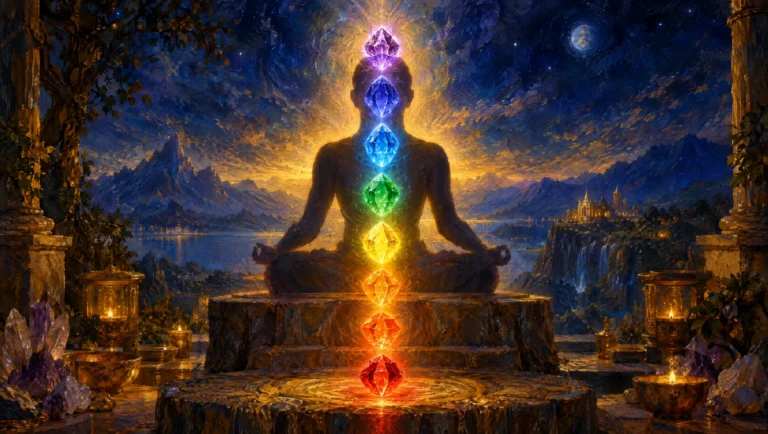
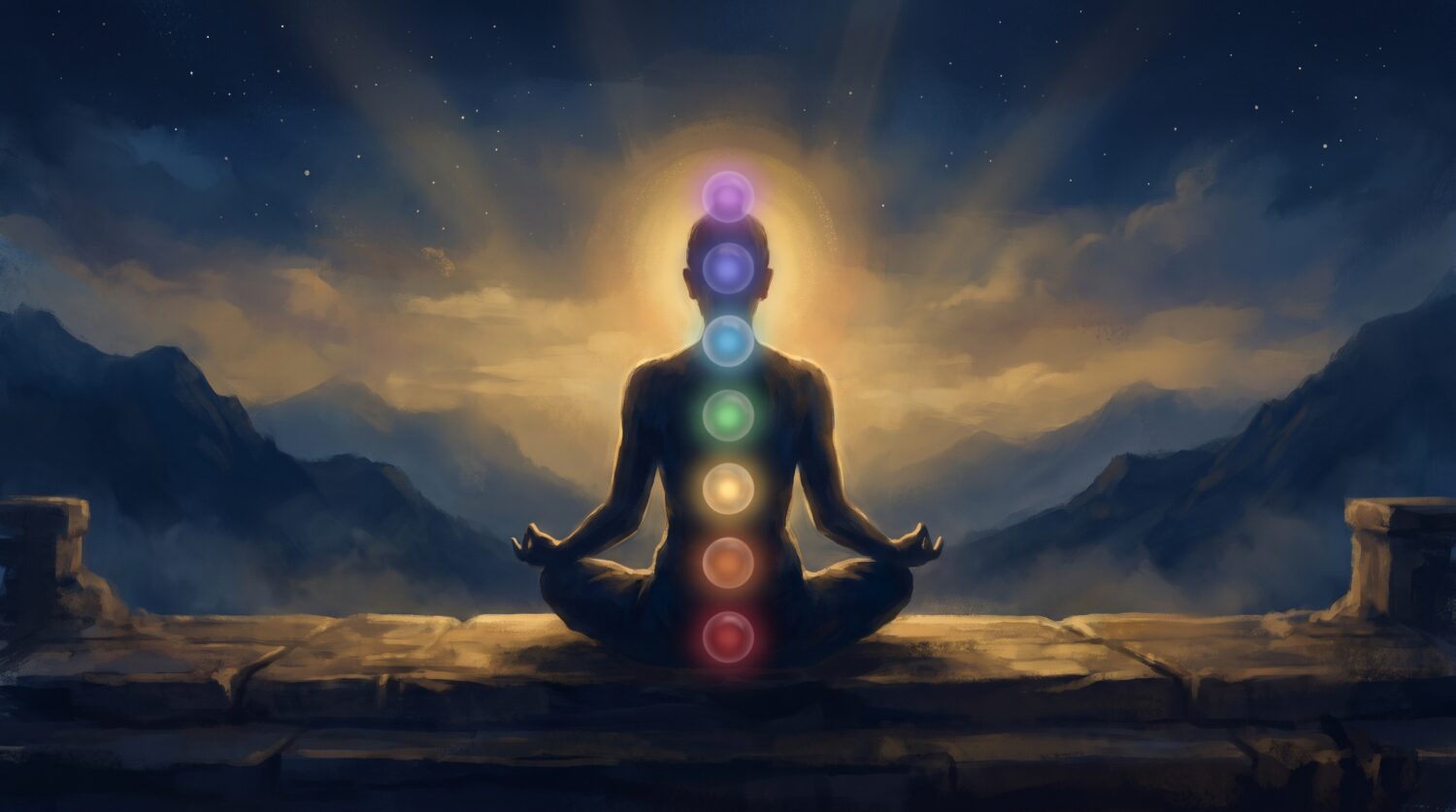
The word chakra comes from Sanskrit and is usually translated as wheel or disc. In the yogic and tantric traditions of India, chakras are described as centers where the subtle energy of the body gathers. The most familiar system names seven main centers, running from the base of the spine to the crown of the head. Other traditions count differently.
It helps to be honest about what this is. Chakras are a spiritual and symbolic map. They are not organs, and science has not measured them. A chakra meditation does not diagnose or treat anything, and it is not a replacement for medical care. What it can be is a structured way to pay attention to the body, to breathe slowly, and to notice how you feel from the ground up. Many people find that this alone is worth the time.
There is one more thing worth saying. You are not broken, and your chakras are not “blocked” in some way that makes you less than whole. The practice is not about fixing yourself. It is about visiting each part of your inner landscape, listening, and remembering that the power is within you. The colors, sounds and images are only doors.
Try this: Before you read further, close your eyes for one minute. Feel your feet, your seat, your hands. Notice that you can already do the first step of every practice below.
Posture, Space and Timing
You do not need incense, a cushion from a catalog, or an altar. You need a spot where you will not be interrupted and a position you can hold without strain.
Choose Your Posture
- Chair: Feet flat on the floor, hands on your thighs, spine tall but not stiff. This is a perfectly good posture, and often the best one.
- Floor or cushion: Cross-legged with hips slightly higher than your knees, so the spine can stack naturally. Support your knees with blankets if they float.
- Lying down: Fine for tired days or physical discomfort. You may drift off, which is covered in the troubleshooting section.
Whatever you choose, let the crown of your head lift gently toward the ceiling, soften your shoulders, and rest your tongue on the roof of your mouth or simply let it relax. Hands can rest palms up for receiving or palms down for steadiness. Neither is wrong.
Choose Your Timing
Traditions often favor early morning, before the day fills up, and many practitioners like the quiet right before sleep. The honest answer is that the best time is the one you will keep. A few guidelines tend to help:
- Meditate on a mostly empty stomach, or at least an hour after a large meal.
- Silence your phone and tell the people in your house you are taking ten minutes.
- Pair the practice with something you already do, such as the first coffee or brushing your teeth at night.
- Start with five to ten minutes. A short practice done daily beats an hour done once.
Try this: Pick your spot and your time today and write them on a sticky note. A decision made in advance is half of the practice.
The Basic Practice, Step by Step
Every chakra meditation, no matter how elaborate, follows the same bones. Learn these steps once and the rest of this guide will make sense.
- Arrive. Sit, close your eyes or soften your gaze, and take five slow breaths. Let the exhale be longer than the inhale.
- Find the place. Bring your attention to the location of the chakra. Feel the spot in the body, as sensation: warmth, pressure, tingling, or nothing at all.
- Breathe into it. Imagine each inhale flowing toward that spot and each exhale softening around it. Do not force anything.
- Add the color. If visualization works for you, picture a gentle light in the traditional color of that center. If you cannot see anything, that is fine. Thinking of the color is enough.
- Add the sound. Quietly chant the bija sound, aloud or silently, three to nine times. We cover this in the next section.
- Rest. Let the sound fade and stay with whatever you feel for a few breaths.
- Close. When you finish, take a deep breath, feel your body in the seat, wiggle your fingers and toes, and open your eyes slowly.
A quick note on what you will feel. Many people feel very little at first. Others notice warmth, tingling, a sense of expansion, a lump in the throat or sudden tears. All of that is ordinary. Do not chase sensation. Attention itself is the practice.
Try this: Do just steps 1, 2 and 3 on one spot, the center of your chest, for three minutes. That is a legitimate chakra meditation.
A Word About Bija Mantras
Bija means seed in Sanskrit. A bija mantra is a short, single-syllable sound that, according to tradition, carries the essence of a chakra the way a seed carries a tree. The classical sounds are LAM, VAM, RAM, YAM, HAM and OM, followed by a silent or very subtle sound at the crown. Different lineages assign them slightly differently, and spellings vary, so you may see them written a little differently in other books.
How to use them:
- Chant aloud in a low, comfortable voice and feel the vibration in the area of the body you are working with.
- Whisper if you share walls or a bed with someone.
- Chant silently by hearing the sound in your mind, which is quieter and just as valid.
Pronounce them as they look: LAM rhymes with “hum” with a clear “L”, so “lum.” VAM is “vum.” RAM is “rum.” YAM is “yum.” HAM is “hum” with an open “H.” OM is “ohm,” drawn out and ending in a gentle hum. Pronunciation is flexible, and no teacher worth following will tell you that you got it wrong. The point is steady sound and steady attention.
Practitioners say the sounds help the mind stay on one thing. That is an easily testable claim in your own experience. If the sounds feel awkward, leave them out and use breath and color only. The practice does not depend on any single tool.
Try this: Say each of the six sounds out loud once, slowly, and notice where in your body each one seems to land. Just notice.
Guided Practices for Each Chakra
Each practice below runs about five minutes. You can do one on its own, or work through them across a week. If you read the words to yourself, slow down. Pause at every full stop.
Root Chakra (Muladhara)
Location: base of the spine, the pelvic floor. Color: red. Bija: LAM. Themes in tradition: safety, stability, belonging.
Sit with your sitting bones firmly on the seat. Feel the weight of your body being held. Breathe in, and imagine the earth rising to meet you. Breathe out, and let your legs and hips grow heavy. Picture a warm, deep red glow at the very base of your spine, like embers in a hearth. Chant LAM slowly, three to nine times. After the last one, stay in the silence and repeat to yourself: I am here. I am supported.
Our guide to earthing and grounding pairs naturally with this practice.
Try this: Stand barefoot for two minutes on grass, tile or wood and feel the full contact of your feet.
Sacral Chakra (Svadhisthana)
Location: lower belly, a few inches below the navel. Color: orange. Bija: VAM. Themes in tradition: creativity, pleasure, emotion, flow.
Rest your hands in your lap, one in the other. Bring attention to your lower belly. Let your belly be soft. Do not hold it in. As you breathe, imagine the motion of water: a slow tide in, a slow tide out. Picture a soft orange light, like a sunset over a calm sea. Chant VAM, feeling the sound as a gentle wave. Then ask, with no pressure to answer: What would feel nourishing today? Let any answer arrive as a feeling, a memory or nothing at all.
Try this: Do one small thing today purely because it feels good. A warm bath, a song, a slow walk. No justification needed.
Solar Plexus Chakra (Manipura)
Location: upper abdomen, between the navel and the base of the ribcage. Color: yellow. Bija: RAM. Themes in tradition: will, confidence, personal power.
Sit a little taller. Place a hand over your upper belly if that helps you find the spot. Breathe in as if filling a lantern, and breathe out as if the lantern glows brighter. Picture a clear, warm yellow light, like the sun at midday, settling in your center. Chant RAM with a bit of energy, short and bright. Then rest and say quietly: I can trust my own voice.
Try this: Name one small decision you have been putting off and take the first step on it today.
Heart Chakra (Anahata)
Location: center of the chest. Color: green, sometimes soft pink. Bija: YAM. Themes in tradition: love, compassion, connection, grief and tenderness.
Place one hand on your heart and the other on top of it. Feel the warmth of your own hands. Breathe into the space beneath them and let the chest widen on the inhale, as if making room. Picture a soft green light, or pink if that feels truer, glowing outward in all directions. Chant YAM softly. Then bring to mind someone you love, or a place where you felt safe, or even a pet, and let the feeling grow for a few breaths. Offer it to yourself last: May I be held in kindness.
The heart practice can bring up tenderness, and sometimes tears. That is welcome. Let them come, breathe, and keep going if you can or stop if you need to. In the troubleshooting section we talk about what to do when emotion arrives in force.
Try this: Send one honest message of thanks to someone today, even just two lines.
Throat Chakra (Vishuddha)
Location: the throat, at the base of the neck. Color: blue. Bija: HAM. Themes in tradition: expression, truth, listening.
Lengthen the back of your neck and let your jaw unclench. Swallow once and notice the throat. Breathe in cool and out warm. Picture a clear blue light, like the sky just after sunrise, resting in your throat. Chant HAM, letting the sound come from the throat area and open as it goes. Between rounds, hum quietly on a single note. Then ask: What is true that I have not said? Listen without judging the answer.
Try this: Write down one sentence you have wanted to say to someone. You do not have to send it. Seeing it on paper often loosens the knot.
Third Eye Chakra (Ajna)
Location: between the eyebrows, slightly above. Color: indigo. Bija: OM. Themes in tradition: intuition, insight, inner sight.
Close your eyes and lightly turn your attention to the space between your brows, as if looking inward with the eyes closed. Do not strain or cross your eyes. Let your forehead stay smooth. Picture a deep indigo light, like the sky at dusk, a few moments before the stars appear. Chant OM slowly and let it end in a hum. Afterwards rest in the stillness, and watch your thoughts come and go like clouds, without following any of them.
If you get a headache, you are trying too hard. Relax the eyes, relax the brow, and bring your attention a little farther back inside the head, less like a point and more like a soft glow.
Try this: Before your next decision, however small, pause for three breaths and notice what your gut says first.
Crown Chakra (Sahasrara)
Location: the top of the head. Color: violet, white or gold. Sound: OM, or silence. Themes in tradition: spirit, unity, stillness.
Sit with a gently lifted spine. Imagine the crown of your head opening like a flower in morning light. You do not need to reach for anything. Picture violet or white light above and around you, and let the sense of the body grow soft at the edges. Chant OM once, then let the silence take over. Rest here. Thoughts will come. Let them be weather. When you are ready, rest your attention in the simple fact of being aware.
Try this: Spend two minutes looking at the sky, a tree, or a candle with no purpose at all.
The 10-Minute Full Chakra Sequence
When you want one complete practice that touches every center, use this. It moves from the ground up, with about 75 seconds at each chakra and a minute at either end. Set a quiet timer if you like, or simply count breaths: about eight slow breaths per center.
- 0:00 to 1:00, Arrive. Sit comfortably. Take five slow breaths, exhaling longer than you inhale. Feel your body being supported.
- 1:00 to 2:15, Root. Attention at the base of the spine. Red glow. Chant LAM three times, then breathe quietly.
- 2:15 to 3:30, Sacral. Attention in the lower belly. Orange glow. Chant VAM three times, then breathe.
- 3:30 to 4:45, Solar plexus. Attention in the upper belly. Yellow glow. Chant RAM three times, then breathe.
- 4:45 to 6:00, Heart. Attention at the center of the chest. Green glow. Chant YAM three times, then breathe.
- 6:00 to 7:15, Throat. Attention at the throat. Blue glow. Chant HAM three times, then breathe.
- 7:15 to 8:30, Third eye. Attention between the brows. Indigo glow. Chant OM three times, then breathe.
- 8:30 to 9:15, Crown. Attention at the top of the head. Violet or white light. Chant OM once, then rest in silence.
- 9:15 to 10:00, Return. Let the colors fade. Feel the whole column of your body as one. Place your hands on your belly or heart, take a deep breath, and open your eyes.
Short on time? A five-minute version works too. Skip the chanting and spend about 40 seconds at each center with breath and color alone.
Try this: Run this sequence tomorrow morning. Afterwards, write one line about how you feel. Do the same the next day and see what you notice after a week.
Building a Rhythm That Lasts
Seven chakras do not require seven hours. Two simple patterns tend to work for busy people.
- The daily full sequence. The 10-minute practice above, every morning or evening.
- The weekly rotation. One chakra a day for seven days. Five to ten minutes each, with the guided practice from this article. Many people like to begin with the root on Monday and end with the crown on Sunday.
If you enjoy moving as well as sitting, chakra yoga offers poses for each center. And if you are curious about how everyday meals support your sense of steadiness, our guide to chakra foods takes that up on its own terms.
If you would rather be guided by voice and sound, Next Level Soul TV carries a collection of chakra cleansing meditations, with a separate session for each center. They are available on Next Level Soul whenever you want company in the practice.
Some people like to add a crystal by the cushion or on the body. If that appeals, our guide to chakra stones explains what tradition says about each one. They are optional. The most powerful tool is the one you already carry: your own attention.
Try this: Put the first practice on your calendar for tomorrow, as an appointment with yourself. Ten minutes. Same time.
Troubleshooting: When It Does Not Go to Plan
Almost everyone runs into the same few walls. None of them mean you are doing it wrong.
I Fall Asleep
Sit up rather than lying down, open your eyes slightly, or practice earlier in the day. Sleepiness often means you are truly tired. If so, take the nap and try tomorrow. Do not turn meditation into another thing to fail at.
I Feel Nothing
This is the most common experience, and it is fine. Chakra work is subtle, and some people never feel dramatic sensation. Stay with ordinary things: the temperature of the air, your pulse, the weight of your hands. Feeling is not the measure. Showing up is.
My Mind Will Not Stop
Welcome to being human. When you notice you are thinking, gently return to the location of the chakra you are on. Each return counts as a repetition, the way each lift counts in a gym. Chanting aloud can also help, because the sound gives the mind something to hold. If it is a heavy day, count your breaths from one to ten and begin again at one.
I Cannot Visualize Color
Many people do not see images when they close their eyes. Skip them. Use words instead: name the color silently, or think of something that has it, like a ripe tomato for red or a clear sky for blue. Or use touch alone and keep a hand on the spot.
Emotions Come Up
The heart and the root, especially, can open old feelings. If that happens, you can slow down, open your eyes, put both feet on the floor, press your palms against your thighs, and name five things you can see in the room. Take a few long exhales. You are allowed to stop. A good practice leaves you steadier, not flooded. If strong feelings keep returning or you have a history of trauma, consider doing this work alongside a qualified therapist or counselor. Meditation is a support, not a substitute.
I Feel Dizzy or Spacey
Return to natural breathing, open your eyes, feel the ground, and drink some water. If dizziness or any physical symptom continues, speak with a doctor. Do not push through it.
One Chakra Feels Harder Than the Others
That is normal. Some centers feel like old friends and others feel like locked rooms. Spend less time at the difficult one and come back to it later, or work with it at the gentlest level: breath only, no sound. Curiosity works better than force.
Try this: Choose the one problem above that sounds most like you and apply the fix at your next session. Change only one thing at a time.
Books for Your Practice
If you want to go further into the traditions behind the practice, these are widely read starting points.
- Wheels of Life by Anodea Judith. A popular, in-depth introduction to the chakra system.
- Eastern Body, Western Mind by Anodea Judith. Chakras through a psychological lens.
- Chakra Healing by Margarita Alcantara. A beginner-friendly workbook with simple exercises.
- Autobiography of a Yogi by Paramahansa Yogananda. The yogic path in a warm, personal voice.
- Meditation for Beginners by Jack Kornfield. A calm, practical place to start sitting.
As an Amazon Associate, Next Level Soul earns from qualifying purchases.
Where to Go Next
Start small. Choose one chakra, one spot, one time of day. If the daily sitting habit is the hard part, our meditation guide covers the basics of building it. If you want a teacher with a long lineage, the Next Level Soul Mastery course with Acharya Shunya offers ancient meditation for inner stillness. And when you are ready to understand what each center means, return to the seven chakras hub and take them one at a time. You are already enough to begin.
Frequently Asked Questions
What Is Chakra Meditation?
A practice of resting your attention on the seven main energy centers along the spine, usually with breath, color and sound. It comes from yogic and tantric tradition and is used for calm, focus and self-awareness.
How Long Should a Chakra Meditation Take?
Five to ten minutes is plenty to begin. A full sequence through all seven centers fits into about ten minutes, and you can also spend a whole session on a single chakra.
What Are Bija Mantras?
Bija means seed. According to tradition, the bija sounds LAM, VAM, RAM, YAM, HAM and OM are seed sounds linked to the seven chakras. Practitioners chant them aloud or silently to hold the mind on one point.
Do I Need to Believe in Chakras for It to Work?
No. Chakras are a spiritual and symbolic map, not something science has measured. You can treat the practice as focused breathing and body awareness and see what you notice.
What Is the Best Time of Day to Do Chakra Meditation?
Many practitioners prefer early morning or just before bed. The best time is the one you will keep, ideally on a mostly empty stomach.
Can I Do Chakra Meditation Lying Down?
Yes, especially on tired days or when sitting is uncomfortable. You may fall asleep, so sit up or practice earlier in the day if that happens often.
What If I Cannot Visualize the Colors?
Skip the images. Name each color silently, think of something that has it, or keep a hand on the spot and use touch and breath alone.
Which Chakra Should I Start With?
Most teachers begin with the root and move upward, which keeps the practice grounded. If a particular center calls to you, it is fine to start there.
Is Chakra Meditation Safe?
For most people, a short, gentle practice is considered safe. Go slowly if strong emotions arise, and speak with a doctor or therapist if you have a medical or mental health concern. It does not replace professional care.
Go Deeper with NLS Mastery: Ancient Meditation for Inner Stillness
Time-tested meditation from the Vedic tradition, taught step by step for modern daily life. Acharya Shunya teaches it in Ancient Meditation for Inner Stillness, part of NLS Mastery. Watch the course preview below.