Imagine a teacher who looks about twenty-five, lives in the high Himalayas, has been there for centuries and has never appeared in a photograph. He is said to watch over seekers, to have revived a forgotten method of meditation and to meet people only when the moment is right. That is Mahavatar Babaji, the most mysterious figure in the Kriya Yoga tradition. This guide tells his story as the tradition tells it, with care about what is known, what is believed and what nobody can say.
If you came to him through Autobiography of a Yogi, you have already met him as the silent source of a great lineage. If you came through the film Awake: The Life of Yogananda, you saw him described as a deathless yogi who gave the practice back to the world. That film is available on Next Level Soul, and the trailer above gives you a first look. Here we gather everything in one place.
Who Is Mahavatar Babaji?
Mahavatar Babaji is described in Indian spiritual tradition as a great master who lives in the Himalayas and does not age. The name Babaji is a term of respect that can be translated as revered father. The title Mahavatar, great incarnation, was given to him by Paramahansa Yogananda, who introduced the figure to the world.
In the tradition, he is not a teacher with a school, a book or a public following. He is a presence in the background, a source from which the Kriya Yoga lineage descends. According to the Autobiography, he rarely appears, and when he does, it is to a particular person for a particular purpose.
That makes writing about him a delicate task. There is a story to tell, and it is a beautiful one. But there is also an honest line between what a tradition holds and what history can show. Throughout this guide, we will say clearly which is which.
It may help to treat Babaji the way we might treat any great figure of legend. You can honor the meaning of the story without needing every detail to be literally documented. And you can find real practical value in the practice that came through the lineage, whatever you decide about the figure at the source.
His Names
Babaji has several names, and it helps to sort them out. Babaji is the simple, affectionate form used throughout the Kriya tradition. Mahavatar Babaji is the form popularized by Yogananda. In South India, a related tradition speaks of Babaji Nagaraj, a Tamil form of the name, and describes a specific birthplace and date, which we will discuss in a later section.
A few other names appear. Some followers use Mahamuni Babaji or other honorifics. And in the twentieth century, a figure known as Haidakhan Babaji appeared in the Kumaon hills, and some of his followers considered him the same Babaji. We will treat that in its own section.
Notice how the names reflect the kind of presence Babaji is said to be. He is addressed with the affection of a family member and the respect of a master. He is a father figure, and that is part of why the name has traveled so well.
The Question of His Age
There is no agreed answer. Yogananda wrote that Babaji’s age cannot be stated and that he has appeared the same for generations. His students report that he looks no older than about twenty-five, with a youthful face and long hair. The film Awake calls him a deathless yogi.
Different traditions offer different claims. The Autobiography presents him as an ageless figure who has lived for centuries, and possibly far longer. A Tamil Siddha tradition describes a birth in the year 203 of the common era. Some modern speakers refer to him as thousands of years old. One of the interviews on Next Level Soul describes him as a two-thousand-five-hundred-year-old saint.
Historians, as you might expect, do not have evidence for any of these figures. There are no birth records, no contemporary documents and no photographs. So we are in the realm of belief and testimony.
A fair way to hold the question is this. If you trust the tradition, the answer is that he is beyond age. If you are a skeptic, the answer is that nobody knows. In both cases the more useful question is not how old he is, but what the tradition is trying to teach by describing him as ageless. Perhaps the point is that the deepest part of us does not age either.
No Photograph: The Images We Know
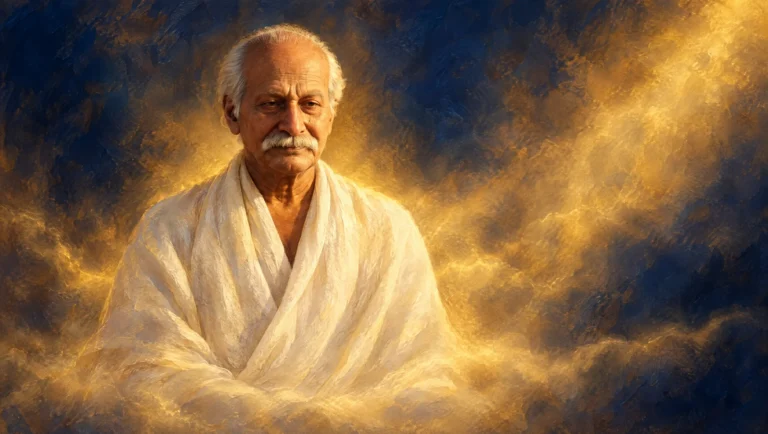
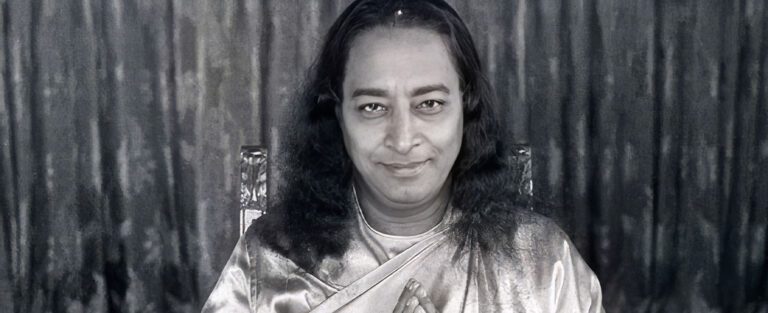
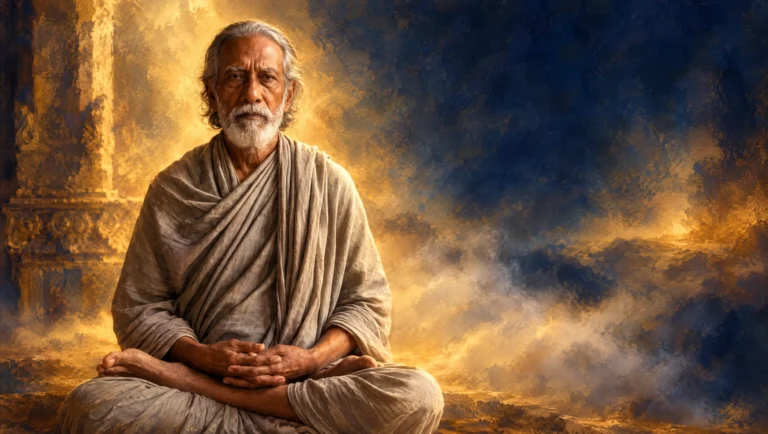
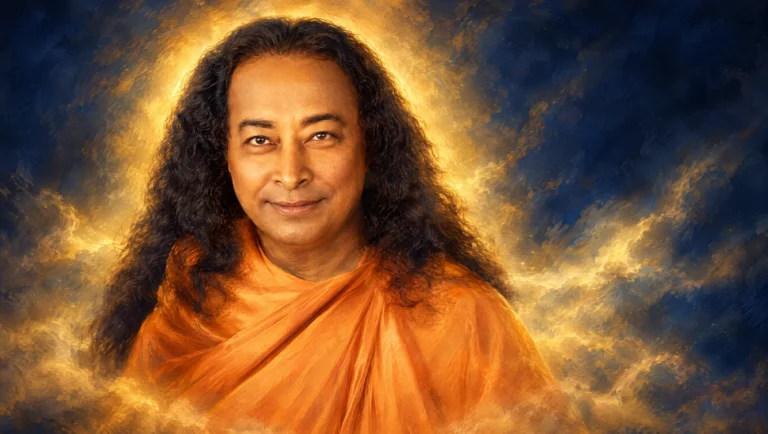
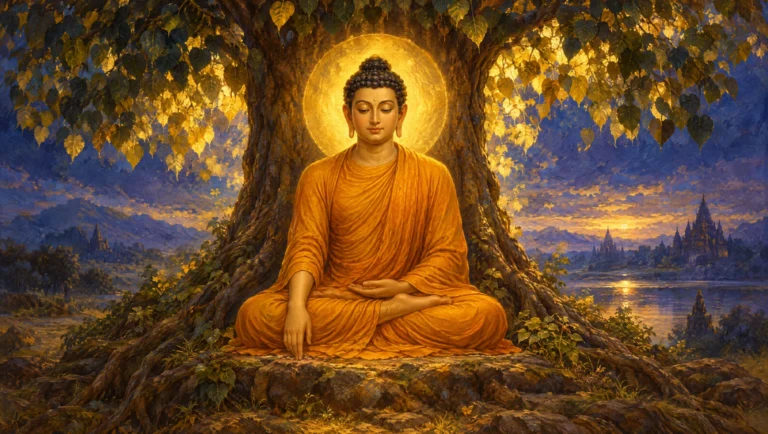
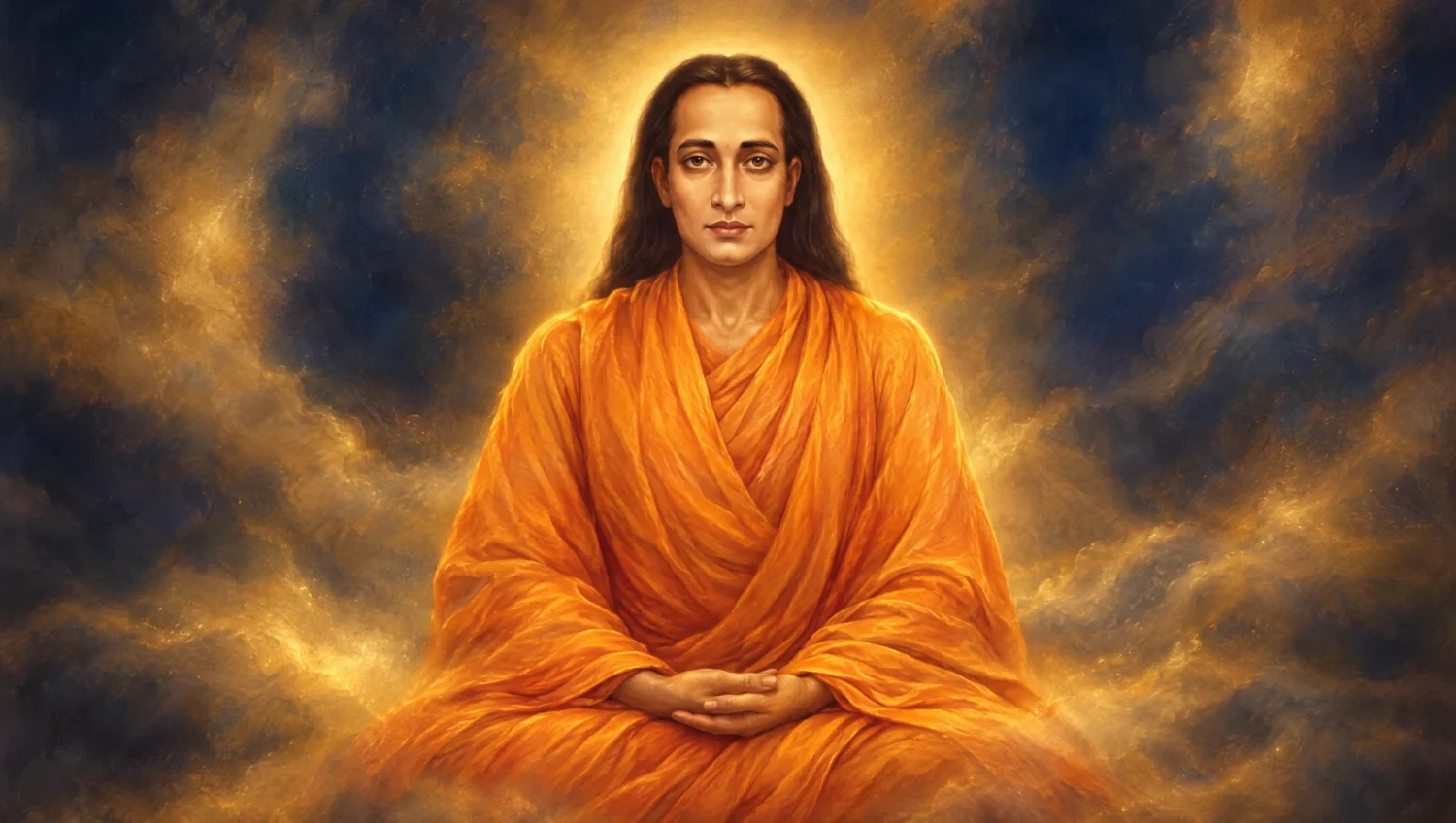
No photograph of Babaji is known to exist. Every image you have seen is an artist’s impression. The most widely reproduced one shows a serene young man seated in a lotus posture, bare to the waist, with long dark hair and an upturned gaze. It was painted in the twentieth century and has become a devotional icon.
That is worth knowing, because it changes how to look at the image. It is not a portrait of a person who was photographed. It is a painter’s attempt to convey an idea: youth, stillness, depth. The same is true of the other images that circulate online.
In the Autobiography, Yogananda describes Babaji as having a youthful appearance, fair skin, medium build and long hair, and as looking somewhat like Lahiri Mahasaya. Those descriptions are all we have, and the images are built from them.
Where He Is Said to Live
According to the tradition, Babaji lives in the Himalayas, moving among remote places and visiting the great gatherings of pilgrims. The hills near Ranikhet in the Kumaon region are associated with his meeting with Lahiri Mahasaya, and one hilltop called Dunagiri, sometimes written Drongiri, is often named as the site.
The Himalayas have held a special place in Indian spiritual imagination for thousands of years. They are the home of Shiva, the destination of pilgrims and the traditional retreat of those who seek silence. A figure who lives there fits an old pattern.
Today, pilgrims visit sites associated with Babaji in the Kumaon hills. Some travel to hear stories, to meditate in quiet places and to feel the atmosphere. Others stay home and visit him in meditation. The tradition welcomes both.
The Meeting with Lahiri Mahasaya
The central story is the meeting with a householder named Lahiri Mahasaya in 1861. According to the account, Lahiri Mahasaya, an accountant posted to Ranikhet, heard a voice calling his name while walking in the hills. He found a youthful master who greeted him as an old friend, touched his forehead and brought back the memory of a past life as Babaji’s disciple.
Babaji initiated him into Kriya Yoga and instructed him to return to Benares and teach. He was to live as a householder, and to offer the method to sincere people whatever their background. That instruction shaped the next century of the lineage. You can read the whole story in our guide to Lahiri Mahasaya.
It is the most detailed account we have of an encounter with Babaji. It comes from devotional sources, passed down through Lahiri Mahasaya’s students and recorded by Yogananda. As always, it is testimony.
The Golden Palace
In the same tradition, the golden palace story belongs to Lahiri Mahasaya’s visit. According to the account, Babaji brought a luminous palace into being so that a hidden desire in his disciple could be lived through and released. After the vision, the palace vanished.
The story is often told as a lesson about desire. It suggests that wanting is not shameful, and that the way beyond it is to see it through. It also shows the kind of teacher Babaji is said to be: not a scold, but a master who meets the student where he is.
Whether you read the story as literal or symbolic, it is a good example of how the tradition teaches. It uses images and narrative to carry ideas that are hard to state plainly.
The Revival of Kriya Yoga
The tradition holds that Kriya Yoga is a very old method, known in ancient times and then lost. The film Awake relates that the practice was buried during the Dark Ages, and that Babaji revived it for the modern world. According to this account, he first gave it to Lahiri Mahasaya and asked that it be taught openly.
What is Kriya Yoga? In the lineage, it is a method of breath and attention that quiets the mind and turns awareness inward. The word kriya means action or practice. Our guide to Kriya Yoga meditation explains where to begin.
Babaji’s role in the story is the role of a source. He does not appear to have taught large groups. He taught one person, who taught others, who taught others still. That pattern, small and quiet, is a distinct feature of the Kriya lineage.
The Kumbh Mela Meeting
In January 1894, according to the Autobiography, Babaji met Sri Yukteswar at the Kumbh Mela in Prayag. The Kumbh Mela is the great Hindu pilgrimage, held at sacred river sites and attended by millions. In the account, Babaji praised Sri Yukteswar’s devotion and asked him to write a book showing the harmony of the Christian and Hindu scriptures. The result was The Holy Science.
He is also said to have told Sri Yukteswar that a disciple would come whom he would train to carry Kriya Yoga to the West. That disciple was Yogananda. For the full story of the teacher in the middle of the chain, read our guide to Sri Yukteswar.
This meeting is a good example of how the tradition links its figures. Each one is tied to the next by a particular task. Babaji gives Lahiri Mahasaya the practice. Lahiri Mahasaya teaches Sri Yukteswar. Sri Yukteswar writes a book and trains a student. And that student takes the message abroad.
The Meeting with Yogananda
The next link in the story is the meeting with Yogananda. According to the Autobiography, in 1920, shortly before his departure for America, Yogananda was in a state of doubt and anguish in his family’s home in Calcutta. He had been invited to Boston, and he was afraid to go. In his account, Babaji appeared to him there.
The account says that Babaji told him he was the one chosen to spread Kriya Yoga in the West, that he should not be afraid and that Babaji would be with him. For Yogananda, the meeting was decisive. He went to America, and he later said that he had felt that promise throughout his life.
The film Awake and the tradition both treat this as the turning point of his mission. As with other accounts, it is spiritual testimony. What is plain is that he did go, and that the work that followed reached many.
Our guide to Paramahansa Yogananda tells the rest of his life, from childhood in Gorakhpur to Los Angeles.
Babaji and the Great Teachers
The Autobiography makes large claims about Babaji’s role in history. Yogananda writes that Babaji initiated the medieval teachers Adi Shankaracharya and Kabir, two of the most influential figures in Indian spiritual life. He also writes that Babaji is in constant communion with Christ, the two working together to guide the spiritual direction of this age.
These are claims of faith, and historians cannot verify them. But they show how the tradition imagines Babaji: not as a regional figure but as a presence that touches many streams. It is the same impulse that led Sri Yukteswar to write about the Bible and the Hindu scriptures as one.
If you are curious about the wider idea of masters who guide humanity from beyond ordinary life, our guide to ascended masters offers a broader look at how different traditions imagine them.
Deathless Masters in Indian Tradition
The idea of a master who does not die is not unique to Babaji. Indian tradition has a long list of such figures. The Hindu epics and Puranas speak of the chiranjivis, beings said to live through the ages, including the warrior-sage Parashurama, the devoted Hanuman and the sage Vyasa, who is said to have compiled the Vedas and the Mahabharata. The Siddha tradition of the south speaks of perfected masters who have mastered the body as well as the mind.
Another idea is the jivanmukta, the person who is liberated while alive. Such a person is free inside, and still moves in the world. The tradition holds that a very advanced soul may choose how and when to leave the body, or may remain in a subtle form to guide others.
Seen against this background, Babaji is part of a recognizable pattern. The tradition has long imagined that some masters stay near the world out of compassion. Whether you hold that idea literally or as a poetic way of describing the persistence of wisdom, it is an old and beautiful one.
The Autobiography’s Chapter on Babaji
For most Western readers, the doorway to Babaji is a single chapter in Autobiography of a Yogi, in which Yogananda describes the master as a kind of Christ-like figure of modern India. The chapter collects accounts from Lahiri Mahasaya and others, gives a description of Babaji’s appearance and explains the title Mahavatar.
It is worth reading with a particular eye. Yogananda is careful to say that Babaji does not seek public attention, that his date of birth is unknown, and that he appears to those he chooses. The tone is reverent but not breathless. It reads like a man trying to describe a very large idea in a small number of pages.
Many readers say that the chapter is where the book shifts for them, from memoir to something larger. If you have only seen him described in passing, the full chapter gives the clearest picture the tradition offers.
What Is the Kumbh Mela?
Since the Kumbh Mela appears in Babaji’s story, it helps to know what it is. It is a Hindu pilgrimage festival held in rotation at four sacred river sites: Prayagraj, Haridwar, Ujjain and Nashik. Each site hosts the gathering in turn, and the cycle repeats roughly every twelve years at each location, with larger events at certain points. Millions of pilgrims come to bathe, pray and hear teachers.
For centuries, the Kumbh has been a place where holy men and women gather. That makes it a natural setting for a story about a rarely seen master. In a crowd of millions, a quiet figure could pass almost unnoticed.
The meeting of 1894 took place in the Prayag Kumbh, the gathering at the confluence of the Ganges and the Yamuna. If you ever have the chance to visit, the scale and the atmosphere are hard to forget.
Three Ways to Approach a Figure Like This
People come to Babaji from different places, and it may help to name three honest ways of relating to him.
- As a living presence. You take the accounts at face value and treat Babaji as a real master who can be sought in meditation. Many devotees live this way, and it gives their practice warmth.
- As a symbol. You treat him as a picture of the deathless Self, or of the continuity of wisdom. The story becomes a teaching tool, and the question of literal truth is set aside.
- As a question. You admit that you do not know, you are curious and you keep practicing. This is a perfectly respectable stance, and it protects you from both gullibility and cynicism.
None of these is wrong. What matters is that your relationship to the story helps you practice. If it turns into a way of avoiding your own life, it has stopped doing its job. If it gives you courage to sit down and look inside, it is doing exactly what the tradition hoped.
Modern Accounts of Meeting Him
Babaji does not belong only to the past. Throughout the twentieth and twenty-first centuries, people have reported meeting him or sensing his presence. We have talked with several of them on the Next Level Soul podcast, and their stories are worth hearing.
- Paramahamsa Vishwananda speaks about early spiritual encounters, including his account that Babaji gave him a soul mission when he was a boy. Listen to the conversation with Paramahamsa Vishwananda.
- Rev. Bill McDonald shares a near-death experience in which he says he encountered Mahavatar Babaji. Listen to A Boy’s Divine Encounter with Mahavatar Babaji.
- Yogiraj SatGurunath Siddhanath, a Himalayan Kriya Yoga master, speaks about Babaji’s origins and the ancient texts. Listen to Babaji’s True Origins.
- Anjie Hipple offers what she describes as a channeled message from Babaji. Listen to Babaji’s Channeled Message to Humanity.
We offer these as the personal accounts of the guests. We cannot verify them, and we do not claim to. What we can say is that the stories are sincere, that they share certain features and that listening to them is a good way to feel how living the tradition remains.
Haidakhan Babaji and Other Claims
In 1970, a young man appeared in the village of Haidakhan in the Kumaon hills. He taught a path of truth, simplicity and work, and he attracted a following in India and abroad. He died in 1984. Many of his followers believed that he was Mahavatar Babaji returned to the world. Others said that he was a different holy man with a similar name.
Other figures have also been connected with Babaji, and some teachers claim initiation or contact. The Kriya lineage descending through Lahiri Mahasaya does not generally endorse any one of these claims. It treats Babaji as a presence that appears rarely and in private.
If you encounter a teacher who says that he or she is Babaji, or speaks for him with great certainty, a little caution is wise. The tradition itself emphasizes humility, and it values the quality of a person’s life and practice over their claims.
The Tamil Siddha Tradition
In South India, a separate stream of tradition honors Babaji Nagaraj. In this telling, he was born in the year 203 of the common era in Parangipettai, a coastal town in what is now Tamil Nadu. He became a Siddha, one of the perfected masters of the Tamil tradition, and studied under figures such as Agastya and Bogar. He is said to have gone to the Himalayas and to live there still.
This account differs from the Autobiography’s in its details, but the two share a core. Both describe a master who revived and taught Kriya. In the Tamil version, a teacher named Marshall Govindan helped bring the tradition to Western audiences in the twentieth century under the name Babaji’s Kriya Yoga.
Scholars note that the Tamil tradition has its own sources and its own style, and they treat the connection with the northern Kriya lineage as a matter of devotion rather than documented history. As always, you can value the practice without settling the question.
What He Is Said to Teach
Babaji left no books, so what we know of his teaching comes through his students. The picture that emerges is consistent.
- Practice is the path. Kriya Yoga is a method, not a belief. Try this: Choose a simple practice and keep it daily.
- Live in the world. He asked Lahiri Mahasaya to remain a householder and teach. Try this: Build your inner life inside your real schedule.
- Humility over display. The tradition places him in quiet seclusion and not in public performance. Try this: Distrust spiritual showmanship, including your own.
- Desire is understood, not shamed. The golden palace story shows desire seen through and released. Try this: Name your wants kindly and watch them.
- Reverence opens the door. Lahiri Mahasaya taught that speaking Babaji’s name with reverence brings blessing. Try this: Begin practice with a moment of gratitude.
- Serve the world’s good. He is said to work for humanity’s spiritual progress. Try this: Let your practice show up as kindness.
The Kriya Lineage at a Glance
- Mahavatar Babaji (Unknown; a deathless figure in tradition). Revived Kriya Yoga; initiated Lahiri Mahasaya.
- Lahiri Mahasaya (1828 to 1895). Householder yogi of Benares; taught Kriya to ordinary families.
- Sri Yukteswar (1855 to 1936). Author of The Holy Science; teacher of Yogananda.
- Paramahansa Yogananda (1893 to 1952). Brought Kriya Yoga to the West; wrote Autobiography of a Yogi.
On Screen: Awake
Awake: The Life of Yogananda introduces Babaji in its telling of the lineage. The narration calls him a deathless yogi who revived Kriya Yoga after it had been buried during the Dark Ages, and who instructed Lahiri Mahasaya to teach it to others. The film then follows the chain from guru to disciple until it reaches Yogananda.

It handles the material with care. It treats Babaji as part of the tradition’s own account, and it uses dreamlike imagery and archival footage to evoke what that account means. You can read our full film guide to Awake: The Life of Yogananda and then watch the film on Next Level Soul.
Honest Questions and Cautions
Did Babaji Really Exist?
There is no historical evidence either way. The tradition holds that he does, and people have given personal accounts. A skeptic can reasonably say that there is no proof. You can follow the practice and the ideas without settling the question.
Why Is There No Photograph?
The tradition says he rarely appears and keeps out of public view. Every image in circulation is an artist’s impression.
How Do I Evaluate People Who Claim to Speak for Him?
Look at their lives, their humility and their effect on those around them. The lineage places little weight on claims and a great deal on practice and character.
Is the Age Claim Meant Literally?
Some followers take it so. Others read it as a symbol of the deathless Self. Either reading can inspire, and neither is required to benefit from the practice.
Can I Learn Kriya Yoga from a Book?
Traditionally, Kriya Yoga is taught through initiation by a qualified teacher, because the breath techniques are best learned with guidance. A book can introduce the ideas.
A Mystic’s Reading: Why He Matters
Why does a figure with no photograph and no dates still draw people? Perhaps because he stands for a very old hope: that there is something in the universe that does not decay, and that it cares about us.
The story of Babaji is a story of continuity. A practice is lost, then found. A teacher is chosen, then a student, then another. Each one hands on what he received, and the line stays unbroken. It is a comforting picture for anyone who worries that the world is losing its wisdom.
And it is a picture of humility. The source of the whole tradition does not seek followers or fame. He teaches one person at a time. In an age that rewards the loudest voice, that image has a certain quiet authority.
Whatever you decide about the historical question, the invitation is the same. You do not need to find Babaji in the Himalayas. You can begin by sitting quietly and remembering that the power is within you. Every teacher, book and film is a guide, and the work is yours.
A Practice: One Week of the Quiet Name
Lahiri Mahasaya taught that speaking Babaji’s name with reverence brings blessing. You do not have to adopt that belief to try the spirit of the practice. Here is a simple, non-sectarian version. It takes ten minutes a day.
- Day 1, Sit. Find a quiet corner. Sit comfortably with an easy spine. Breathe naturally.
- Day 2, Begin with thanks. Before you sit, take one breath of gratitude for something specific.
- Day 3, Hold an image. Picture a calm young figure on a quiet hillside, or any image that suggests stillness and care. Keep it gentle.
- Day 4, Ask a small question. Hold a simple question in mind. Do not look for an answer. Just listen.
- Day 5, Write. After sitting, write down anything that came up, even if it seems minor.
- Day 6, Serve. Do one quiet kindness. Let the practice show up in the world.
- Day 7, Review. Ask what changed. Keep whatever helped.
If you want a next step, our guide to Kriya Yoga meditation is a good place to begin.
Books and Further Reading
If you want to read about Babaji and the tradition around him, start here. We use affiliate links, which means Next Level Soul may earn a small commission at no cost to you.
- Autobiography of a Yogi, which gives Babaji a full chapter and a place in many others.
- The Holy Science by Sri Yukteswar, the book Babaji is said to have requested.
- Babaji and the 18 Siddha Kriya Yoga Tradition, a book on the Tamil tradition.
- Babaji, Haidakhan Baba, books on the Haidakhan teacher.
- Yogananda: The Man Who Brought Yoga to the West by Philip Goldberg, which places the lineage in context.
Who Will Connect with This Story
It suits readers of Autobiography of a Yogi, seekers curious about the deathless masters, people drawn to the Himalayas, anyone interested in how a practice survives across centuries, and anyone who likes a story that leaves room for mystery.
Keep Exploring
Keep exploring with spiritual enlightenment, ascended masters and the Spiritual Cinema collection.
Hear Babaji’s Story in Their Own Words
A short blessing from Sri Daya Mata, one of Yogananda’s closest disciples:

A Boy’s Divine Encounter with Mahavatar Babaji with Rev. Bill McDonald
A Vietnam veteran and mystic shares a near-death experience in which he says he met Babaji.
Boy Given Soul Mission by 2,500-Year-Old Saint Babaji with Paramahamsa Vishwananda
A spiritual teacher describes early encounters and the mission he says Babaji gave him.
Ascended Master Babaji’s True Origins with Yogiraj SatGurunath Siddhanath
A Himalayan Kriya Yoga master speaks about Babaji’s origins and the ancient texts.
Babaji’s Channeled Message to Humanity with Anjie Hipple
A channeler shares what she describes as a message from Babaji.
These are the personal accounts of our guests, which we cannot verify.
Frequently Asked Questions
Who is Mahavatar Babaji?
Mahavatar Babaji is a Himalayan master of Indian tradition, said to be deathless and ageless, who revived Kriya Yoga for this age. He is the source of the Kriya lineage that runs through Lahiri Mahasaya, Sri Yukteswar and Yogananda.
What does Babaji mean?
Babaji is a respectful term that can be translated as revered father. Mahavatar means great incarnation, a title introduced to the world by Paramahansa Yogananda.
How old is Babaji?
Nobody knows. The Autobiography presents him as ageless, looking about twenty-five. A Tamil Siddha tradition gives a birth in 203 CE, and some speakers say he is thousands of years old. There is no historical record.
Is there a photograph of Babaji?
No photograph is known. Every image in circulation is an artist’s impression, including the widely reproduced painting of a young man seated in meditation.
How did Lahiri Mahasaya meet Babaji?
According to the Autobiography, in 1861 Lahiri Mahasaya heard a voice calling him in the hills near Ranikhet and found Babaji, who initiated him into Kriya Yoga. It is a spiritual account. Read our guide to Lahiri Mahasaya.
Did Babaji meet Yogananda?
According to the Autobiography, he appeared to Yogananda in Calcutta in 1920, before his departure for America, and told him he had been chosen to spread Kriya Yoga in the West. Read our guide to Paramahansa Yogananda.
What was the Kumbh Mela meeting?
According to the Autobiography, Babaji met Sri Yukteswar at the Prayag Kumbh Mela in January 1894 and asked him to write a book on the harmony of the Bible and the Hindu scriptures. The result was The Holy Science. See our guide to Sri Yukteswar.
What is Kriya Yoga?
Kriya Yoga is a method of breath and attention used to quiet the mind and turn awareness inward. The tradition says Babaji revived it. See our guide to Kriya Yoga meditation.
Who is Haidakhan Babaji?
A teacher who appeared in the Kumaon hills in 1970 and died in 1984. Many of his followers believed he was Mahavatar Babaji, while others consider him a different teacher.
Who is Babaji Nagaraj?
The name used in the Tamil Siddha tradition for Babaji. That tradition describes a birth in 203 CE in Parangipettai in what is now Tamil Nadu.
Has anyone on Next Level Soul spoken about meeting Babaji?
Yes. Listen to Paramahamsa Vishwananda, Rev. Bill McDonald, Yogiraj SatGurunath Siddhanath and Anjie Hipple. These are the personal accounts of our guests.
Where can I watch a film that tells the Babaji lineage?
Watch Awake: The Life of Yogananda on Next Level Soul. The film calls Babaji a deathless yogi and traces the lineage from him to Yogananda.
Can I learn Kriya Yoga from a book?
Traditionally, Kriya Yoga is taught through initiation by a qualified teacher, because the breath techniques are best learned with guidance. A book can introduce the ideas.