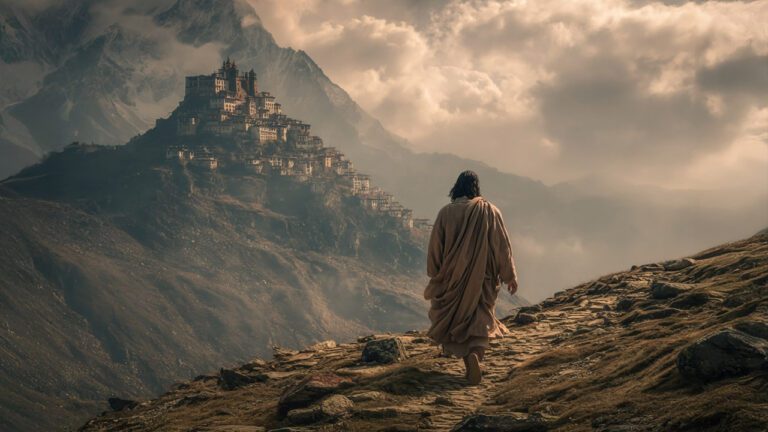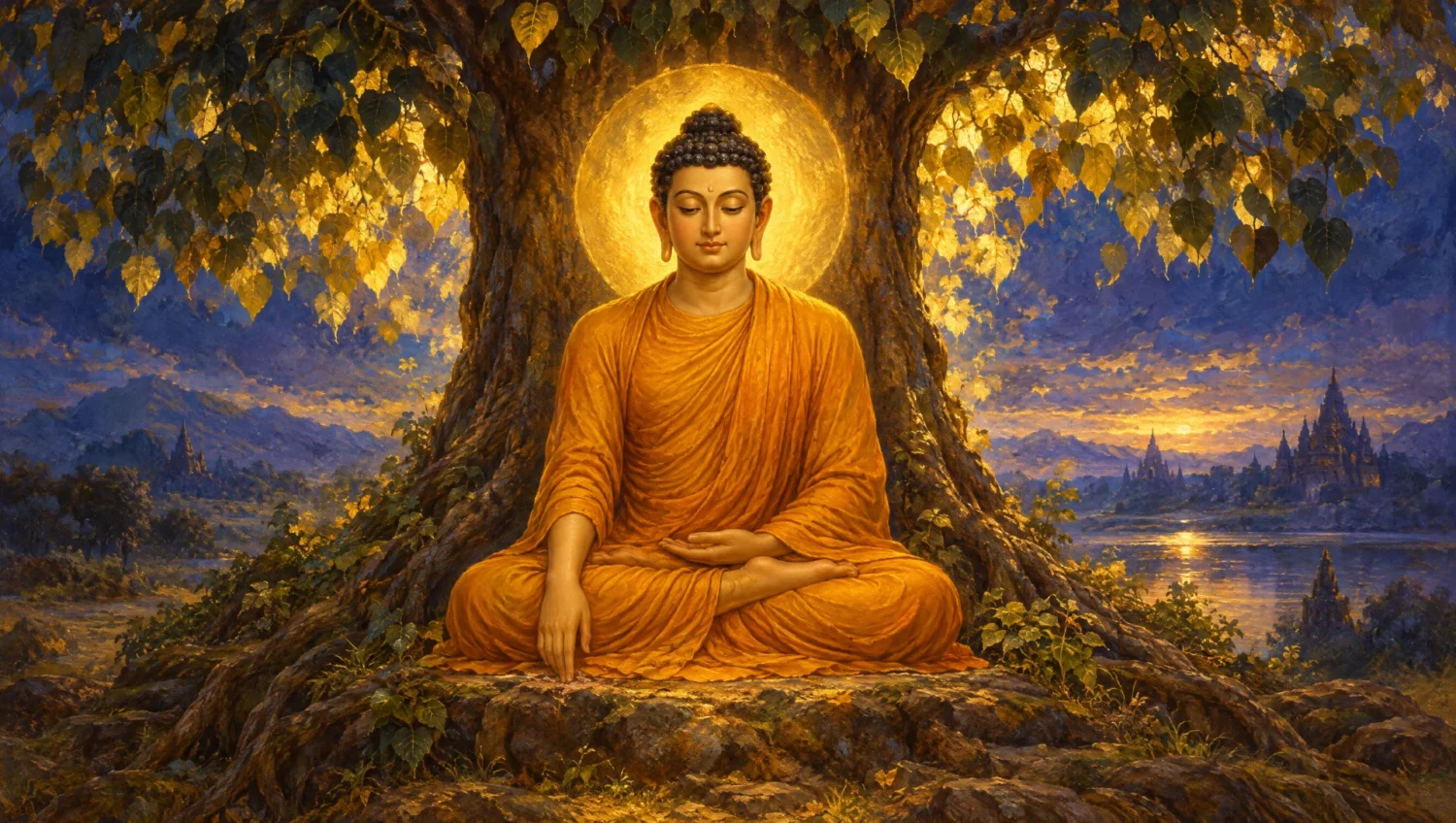
He was a prince who walked away from a palace. He was a seeker who nearly starved himself, then ate a bowl of rice milk and sat down beneath a tree. Twenty-five centuries later, hundreds of millions of people still trace their path to what he saw that night. This guide follows the story of Gautama Buddha from his birth in the foothills of the Himalayas to his final days in Kushinagar. It explains the Four Noble Truths, the Eightfold Path and the great texts, and it looks at how he is understood as one of the world’s ascended masters. We say plainly what is history, what is tradition and what is devotion.
Key Takeaways
- Who he was: Siddhartha Gautama, a teacher of the Shakya clan born in what is now Nepal. “Buddha” is a title meaning “the awakened one,” not a personal name.
- When he lived: Tradition gives 563 to 483 BCE. Many modern scholars place his death closer to 400 BCE. Nothing in his life can be dated with certainty.
- The heart of the teaching: Life contains suffering. Suffering has a cause, which is craving and clinging. It can end. There is a practical path to its ending.
- The path: The Eightfold Path joins wisdom, ethical living and meditation. He called it the Middle Way.
- The texts: His words were carried by memory and first written down in the Pali Canon. Later schools added the Mahayana sutras and Tibetan teachings.
- An ascended master: Buddhists honor him as a fully awakened teacher. Theosophy and Ascended Master teachings place him among the great Masters who guide humanity. These are different frameworks, and we keep them apart.
In This Guide
- Who Was Gautama Buddha?
- What We Know and How We Know It
- India in the Time of the Buddha
- A Prince in Kapilavastu
- The Four Sights and the Great Going Forth
- Six Years of Searching
- The Night Under the Bodhi Tree
- The First Teaching at Sarnath
- Building the Sangha
- The Four Noble Truths
- The Eightfold Path
- Impermanence, Not-Self and Dependent Origination
- Karma, Rebirth and Liberation
- What the Buddha Refused to Say
- Key Texts: From the Pali Canon to the Heart Sutra
- The Final Journey and the Great Passing
- How the Traditions Differ
- Legacy: From Ashoka to Today
- The Buddha as an Ascended Master
- Honest Questions and Cautions
- A Practice: Seven Days with the Breath and Loving-Kindness
- Books and Further Reading
- Keep Exploring
- Frequently Asked Questions
Who Was Gautama Buddha?
Gautama Buddha was an Indian teacher who lived in the Ganges plain roughly twenty-five centuries ago. He was born Siddhartha Gautama. He gave up a life of royal comfort, searched for an end to human suffering, and woke up beneath a fig tree at a place now called Bodh Gaya. The word buddha is not a name. It is a title. It comes from the Sanskrit root budh, to wake, and it means “the awakened one.”
Today hundreds of millions of people follow the path that grew from his teaching. Many more, of every faith and of none, borrow his methods for stilling the mind and softening the heart. Hindus have long counted him among the avatars of Vishnu in some traditional lists. Theosophists and students of the Ascended Masters count him among the great beings who guide the human family. You can see where he sits in that wider picture in our complete guide to the Ascended Masters.
One thing is worth saying early. He did not claim to be a god. In one well-known exchange, a traveler asked whether he was a god, an angel or a human. The Buddha answered that he was none of these. He was awake. That was all. He presented himself as a physician who had found a cure and wished to share it.
In this guide we try to hold two things together. The first is what can be checked: early texts, stone inscriptions, the places where he walked. The second is the memory and devotion of those who love him. We say which is which.
What We Know and How We Know It
Nothing the Buddha wrote survives. He almost certainly wrote nothing. He taught by speaking, for about forty-five years according to tradition. His students memorized his talks and recited them together after his death. According to the Sri Lankan chronicles, the teachings were first written down on palm leaves in the first century BCE, several hundred years after his passing.
The earliest collection is the Pali Canon, called the Tipitaka, or “three baskets.” It holds the monastic rules, the discourses and a body of philosophical analysis. Parts of it are likely very old. Other parts were clearly added later. The first connected biographies came later still. The poet Ashvaghosha wrote his Buddhacarita around the first or second century CE, and a Pali commentary retold the whole story in the fifth century.
Dates are uncertain. Tradition in the Theravada countries says he lived from 563 to 483 BCE. A scholarly symposium in Germany in 1988 leaned toward a later death, within about twenty years of 400 BCE. Most historians now work with that looser range.
Stone gives us one firm anchor. The emperor Ashoka visited the Lumbini grove around 249 BCE and raised a pillar there. Its inscription says that the Buddha, sage of the Shakyas, was born at that spot. That pillar still stands in Nepal. It is the earliest physical record we have of him.
So we have a real teacher, a real region, and a core of teaching that is very old. Around that core sit layers of poetry, legend and later theology. Honest reading means holding all three at once.
India in the Time of the Buddha
The Buddha did not appear in a vacuum. In the sixth and fifth centuries BCE, the Ganges basin was changing fast. Cities were growing. Small kingdoms such as Magadha and Kosala were absorbing older tribal republics. Trade routes carried ideas along with goods.
Religion was changing too. The older Vedic world centered on fire sacrifice and priestly ritual. Alongside it, the early Upanishads were asking quieter and deeper questions about the self and the Absolute. And a movement of wandering seekers, called shramanas, had taken to the road. They left home, gave up ritual, and searched for liberation through meditation and discipline.
The Buddha was one of these seekers. His contemporary Mahavira, the great teacher of the Jain path, was another. Debates raged about karma, rebirth, fate, free will and the nature of the self. The questions he answered were already in the air. What is the self? What happens at death? How does one get free of the wheel of birth and death?
What was new was his answer. He refused to ground liberation in ritual or in birth. He taught that freedom comes through understanding and training the mind. He opened the path to people of any caste. That was a quiet revolution.
A Prince in Kapilavastu
Siddhartha was born into the Shakya clan, in the Lumbini region near the present border of Nepal and India. His father, Suddhodana, is called a king in later tradition. Historians suspect he was more likely a leading figure in a small tribal republic. His mother, Maya, died a week after the birth. Her sister, Mahapajapati Gotami, raised the boy.
The devotional accounts are full of wonder. Queen Maya dreamed of a white elephant entering her side. The child was born standing in a grove, took seven steps, and lotuses rose where his feet touched the earth. An old seer named Asita examined the baby and wept, because he knew he would not live to hear this child teach. All this is tradition and devotion. It tells us how deeply he was loved, not what a camera would have seen.
What the early texts do tell us is that he grew up in comfort. In one discourse he recalls delicate clothing, fragrant ointments and a canopy held over him day and night. He married a woman called Yashodhara and they had a son, Rahula. By the standards of his world he had everything.
And yet something was missing. The tradition holds that his father tried to shield him from every sight of suffering. The shield did not hold.
The Four Sights and the Great Going Forth
The famous story says that at about twenty-nine he rode out from the palace with his charioteer, Channa. On four journeys he saw four things. An old man, bent and shaking. A sick man, in pain. A corpse being carried to the fire. And a calm wandering monk, who seemed at peace.
The first three showed him what all beings face. The fourth showed him that there might be a way through. The story is likely a teaching tale, shaped by later storytellers. But the early texts do preserve a first-person reflection that matches it. The Buddha recalls how foolish it is to feel proud of youth, health and life when ageing, sickness and death wait for everyone.
He left that night. According to the accounts, he looked in on his sleeping wife and baby son, and did not wake them. He rode out of the city on his horse Kanthaka, cut off his long hair with his sword, exchanged his fine clothes for a hunter’s rough robe, and sent Channa home. The tradition calls this the Great Going Forth.
It is a hard story to hear. A husband and a father walked away from his family. The tradition does not hide this. Years later the Buddha returned to Kapilavastu. His son Rahula became one of his first novices, and his father came to follow the path as well. Whatever we feel about the leaving, the story insists that it came from love, not from escape.
Six Years of Searching
For the next six years, Siddhartha searched. He went to the kingdom of Magadha and studied with two famous meditation teachers. The first, Alara Kalama, taught a state of deep concentration called the realm of nothingness. The second, Uddaka Ramaputta, taught a still subtler state, neither perception nor non-perception. He mastered both. Neither ended suffering. He thanked his teachers and moved on.
He then joined five other ascetics near Uruvela and tried the path of extreme self-denial. He ate almost nothing. He held his breath until his head split with pain. The texts describe a body so thin that when he touched his belly, he felt his spine. He later said that no one in the world had practiced harder, and that none of it brought insight.
Then came a turning point. He remembered a quiet moment from childhood, when he had sat beneath a rose-apple tree and slipped naturally into a state of calm joy. He asked himself whether this might be the way. And he realized that a starved body would never carry him there. He accepted a bowl of rice milk from a village girl named Sujata. The five ascetics, disgusted, left him.
This is the origin of the Middle Way. It is a path between sensual indulgence and self-torment. Every serious teacher after him has had to find this balance for themselves.
The Night Under the Bodhi Tree
Siddhartha bathed in the Nairanjana River and walked to a large fig tree, a Ficus religiosa, now called the Bodhi tree. He spread a mat of grass, sat facing east, and made a vow. He would not rise until he was free.
The accounts describe a night in three watches. In the first, he remembered his own countless past lives. In the second, with what the texts call the divine eye, he saw beings passing away and being reborn, shaped by their actions. In the third, toward dawn, he saw the origin of suffering and its ending. He understood the Four Noble Truths not as ideas but as direct knowing. The texts say that his mind was freed from every craving and every false view, and he knew: “Done is what had to be done.”
Tradition adds the drama of Mara, the tempter, who sent armies of fear and daughters of desire against him. When Mara challenged his right to sit there, the Buddha touched the ground with his right hand and called the earth to witness. This is the famous earth-touching gesture seen in countless statues. The Buddhist world remembers this night every year at Vesak, on the full moon of May.
It happened, by tradition, when he was thirty-five. He stayed near the tree for several weeks. The texts say he doubted that anyone could understand what he had found. Then, as the story goes, the Brahma Sahampati pleaded with him to teach, for there were those with only a little dust in their eyes. He agreed.
What woke up under that tree? The Buddhist answer is careful. It was not a god speaking. It was a human mind seeing through the illusion of a separate, fixed self, and resting in what was left. If you read the mystics of any tradition, you will recognize the territory. The Mahabodhi Temple at Bodh Gaya now marks the place. A tree there is said to descend from the original.
The First Teaching at Sarnath
He first thought of his old teachers, but they had died. So he walked about 150 miles to the Deer Park at Isipatana, near Varanasi, where his five former companions were living. They saw him coming and agreed to ignore him. When he drew near, they could not help standing to greet him.
There, on the full moon of the month the tradition calls Asalha, he gave his first sermon. It is known as Setting the Wheel of the Dhamma in Motion. He began with the Middle Way, between pleasure-seeking and self-mortification. Then he laid out the Four Noble Truths and the Eightfold Path. At the end, one of the five, Kondanna, saw the truth directly. The Buddha said: “Kondanna has understood.” From that moment there were two awakened beings in the world, teacher and student, and the Sangha, the community, had begun.
A few days later he gave a second talk, the Discourse on the Characteristic of Not-Self. By its end all five were free. The wheel of the Dhamma has remained the Buddhist symbol ever since. At Sarnath today you can walk among the ruins of the ancient monasteries and stand before the Dhamek Stupa, which marks the traditional site.
Building the Sangha
The community grew fast. A wealthy young man named Yasa joined, then his friends. Soon there were sixty awakened monks, and the Buddha sent them out to teach “for the welfare of many, for the happiness of many.” Two brilliant young seekers, Sariputta and Moggallana, became his chief disciples. His cousin Ananda served as his attendant for about twenty-five years and recalled much of what was said.
Kings gave gifts. King Bimbisara of Magadha donated a bamboo grove for the monks. A merchant named Anathapindika is said to have bought the Jeta Grove in Kosala by covering the ground with gold coins. These groves became the first monasteries. During the monsoon months the monks stayed in one place, which is the origin of the annual rains retreat.
The Buddha taught people of every class. In one discourse he says that a person is not a true priest by birth but by conduct. In an age of rigid caste, that was radical.
He also, after some hesitation, agreed to ordain women. His foster mother, Mahapajapati Gotami, asked three times and was refused three times. She then walked with a crowd of Shakya women to Vesali, with shaved heads and bare feet. Ananda pleaded for them. The texts record that the Buddha agreed, though they also record him adding conditions and a remark that this might shorten the life of the teaching. Modern readers rightly debate that passage. The poems of the early nuns, the Therigatha, survive, and they sing of real liberation. Women such as Khema and Patacara became honored teachers.
Not everyone was loyal. His cousin Devadatta tried to take over the Sangha and split it. The Buddha handled the matter with firmness and without hatred.
The Four Noble Truths
Everything he taught can be traced back to four statements. He framed them like a physician: here is the illness, here is its cause, here is the cure, here is the treatment.
| Truth | Pali name | In plain words |
|---|---|---|
| 1. There is suffering | Dukkha | Life contains pain, loss, aging, death and a deeper restlessness. Even our pleasures are unstable. |
| 2. It has a cause | Samudaya | Craving and clinging: for pleasure, for becoming someone, for pushing away what we dislike. |
| 3. It can end | Nirodha | When craving ends, suffering ends. This freedom is called nibbana, or nirvana, which means “blowing out” like a flame. |
| 4. There is a path | Magga | The Eightfold Path, a way of living and training the mind. |
A word on dukkha. It is often translated as “suffering,” and that can sound bleak. The Buddha was not saying life is nothing but misery. He pointed to three layers: the obvious pain of illness and loss, the pain of change, and the quiet unease of living inside a mind that keeps grasping. The word’s older image is a wheel that does not turn smoothly on its axle.
The Buddha was also practical about the cure. He asked for each truth to be treated in its own way. Suffering is to be understood. Its cause is to be let go. Its ending is to be realized. The path is to be walked. That last verb matters. He did not ask for belief. He asked for practice.
The Eightfold Path
The path is not a ladder of eight steps. It is eight strands that support each other, grouped into wisdom, ethical conduct and mental training. The word usually translated “right” is samma, which means complete or well-grounded.
| Group | Factor | In daily life |
|---|---|---|
| Wisdom | Right View | Seeing clearly how things are: impermanent, interdependent, shaped by intention. |
| Right Intention | Letting kindness, renunciation of harm and goodwill steer your choices. | |
| Ethical conduct | Right Speech | Truthful, kind, timely. No gossip, no cruelty. |
| Right Action | Not harming life, not stealing, not misusing sexuality. | |
| Right Livelihood | Earning a living without causing harm. | |
| Mental training | Right Effort | Cultivating wholesome states and releasing unwholesome ones, steadily and without strain. |
| Right Mindfulness | Awareness of body, feelings, mind and experience as they are. | |
| Right Concentration | Gathering the mind into stillness and absorption. |
Notice how much of the path has nothing to do with sitting. The Buddha insisted that meditation without ethics goes nowhere, and ethics without insight stays shallow. Walk all three together.
The lay path begins with five training precepts: to refrain from killing, stealing, harmful sexual conduct, false speech and intoxicants that cloud the mind. They are not commandments from a god. They are agreements you make with yourself, in order to live without remorse.
Impermanence, Not-Self and Dependent Origination
Three ideas sit underneath everything he taught. The early texts call them the three marks of existence.
- Impermanence (anicca). Everything that arises passes away. Bodies, thoughts, nations, moods. Seeing this fully, not as a sad fact but as a living truth, loosens the grip of craving.
- Unsatisfactoriness (dukkha). Whatever is impermanent cannot give lasting rest. We keep reaching for it anyway.
- Not-self (anatta). When we look closely at what we call “I,” we find body, feeling, perception, mental habits and awareness, all changing. We do not find a fixed, separate core.
The teaching of not-self is the most misunderstood. The Buddha was not saying you do not exist. He was saying that the solid, permanent “me” you protect all day long cannot be found when you look for it. The relief of this is enormous. A great deal of suffering is the effort of defending something that was never there.
Behind this stands dependent origination. It says that nothing exists on its own. Everything arises because of conditions, and ceases when its conditions cease. A traditional chain of twelve links traces how ignorance leads to craving, craving to clinging, clinging to becoming, and so to birth, aging and death. Seen the other way, it shows where the chain can be cut.
A word of care. Mystics sometimes lay the Buddha’s not-self next to the Upanishadic atman or the nondual Self, and some modern teachers see a bridge. Scholars of the traditions point out that the Buddha pointedly declined to name a permanent Self, and that Advaita Vedanta names the Self as the one reality. You will find a fuller discussion of the nondual view in our guide to what non-duality means. We think both can be honored without forcing them to agree.
Karma, Rebirth and Liberation
The Buddha accepted the Indian view that beings are reborn. He gave it his own stamp. Karma, he said, is intention. “It is intention that I call karma,” he told the monks. What you do with body, speech and mind, driven by wholesome or unwholesome roots, shapes what you become. You will find our fuller treatment of the law of cause and effect in our guide to understanding karma.
His teaching of rebirth differs from the picture many people carry. There is no soul packed up and carried from body to body. The old image is a flame passed from one candle to another. The second flame is not the first, and it is not entirely different. It depends on it. The tradition describes realms of existence, from hells to heavens, all of them impermanent. The goal is to step off the wheel altogether.
The one who has done this is called an arahant, a worthy one. When an arahant dies, there is no further rebirth. Whether you take rebirth literally or as a way of speaking about habit patterns that echo through a life, the Buddhist traditions treat it as central. Our overview of reincarnation beliefs and research sets the Buddha’s view beside others.
What the Buddha Refused to Say
Some of the most revealing moments in the early texts are the ones where he stays silent. Is the world eternal? Is it finite? Does a fully awakened being exist after death? He put these questions aside. He called them “undeclared.”
His reason is told in the parable of the poisoned arrow. A man is shot with an arrow and refuses treatment until he knows who shot it, what caste he was and what the bow was made of. He dies before he finds out. The Buddha said that his teaching was for pulling out the arrow. Speculation about metaphysics can wait.
This practical streak shows in the much-quoted advice to a group of villagers, the Kalamas. Do not believe something because it is old, or because a teacher says it, or because it is written in scripture. Look for yourself. When you know that a thing leads to harm and suffering, put it aside. When you know it leads to welfare and happiness, take it up. It is a good teaching. It is worth adding that the same discourse goes on to say that wise people praise a life of generosity, kindness and clarity. It was not a license for believing anything at all.
On the question of God, the early texts are quiet and careful. The Buddha did not teach a creator who saves. Gods, called devas, appear in his cosmos, but they are also subject to impermanence. He neither mocked them nor leaned on them. Freedom, he taught, comes from understanding, and no one can do that understanding for you. Many Buddhists, and many seekers who borrow from the path, still hold a place for the sacred in their lives. The Buddha simply asked for direct seeing.
Key Texts: From the Pali Canon to the Heart Sutra
Buddhist scripture is vast. There is no single book. Here is a map.
- The Pali Canon (Tipitaka). The oldest complete collection, preserved by the Theravada tradition. The Discourse Basket is divided into five collections, including the Long, Middle, Connected and Numerical Discourses.
- The Dhammapada. A beloved anthology of 423 short verses on mind, conduct and freedom. It is the best doorway for a newcomer.
- The Discourse on Loving-Kindness (Metta Sutta). A short, tender text on wishing all beings well.
- The Foundations of Mindfulness (Satipatthana Sutta). The classic manual for meditation on body, feeling, mind and phenomena.
- The Great Discourse on the Final Nirvana (Mahaparinibbana Sutta). The long account of his last months.
- The Mahayana sutras. Composed from about the first century BCE onward. They include the Lotus Sutra, the Diamond Sutra and the Heart Sutra, with their teaching on emptiness and the bodhisattva path. Traditional Mahayana holds that the Buddha taught these, sometimes in subtle realms. Historians see them as later compositions.
- Tibetan teachings. Tibetan Buddhism carries a huge library of commentary and tantra. The Tibetan Book of the Dead belongs to a Tibetan revealed-treasure tradition and is not counted among the Buddha’s own recorded words.
On Next Level Soul you can hear the Dhammapada in The Buddha’s Bible: Ancient Wisdom for the Modern Seeker, an audiobook edition that puts the verses in clear language for today’s listener. Hermann Hesse’s novel Siddhartha is also available as an audiobook. It is worth knowing that Hesse’s hero is a fictional contemporary of the Buddha, not the Buddha himself, though the two do meet. Read it as a meditation on the search, not as biography.
The Final Journey and the Great Passing
The Buddha taught for about forty-five years, walking the roads of northern India with his monks. In his eightieth year he fell seriously ill during the rains retreat near Vesali. He recovered enough to travel, and told Ananda that his body was like an old cart held together with straps.
At Pava he accepted a meal from a metalworker named Cunda. It is said to have made him ill. The dish is called sukaramaddava. Scholars still argue whether it was pork, a mushroom or a truffle. The Buddha asked that Cunda be told that the meal brought great merit, since it was one of two meals that closed a Buddha’s life, the one before awakening and the one before passing away.
He walked on, weak, to Kushinagar and lay down between two sala trees. Flowers fell from the sky, say the devotional accounts. Monks wept. Ananda leaned on a doorpost and cried. The Buddha called him over and comforted him. He had been a faithful attendant, he said. His last convert, a wandering seeker named Subhadda, came that night and was ordained.
His final instructions were plain. Be islands unto yourselves. Take refuge in the Dhamma, not in anyone else. The teacher after him would be the teaching. His last words, in the accounts, were: “All conditioned things are subject to decay. Strive on with diligence.”
His body was cremated, and the relics were divided into eight portions among the clans and kings who claimed them. Stupas were raised. Three months later, five hundred monks met at Rajagaha to recite what they remembered. That gathering is called the First Council.
How the Traditions Differ
The Buddha’s teaching has traveled through many cultures and has taken different shapes. The main streams are often grouped like this.
| Tradition | Where it is strong | Emphasis |
|---|---|---|
| Theravada | Sri Lanka, Myanmar, Thailand, Laos, Cambodia | The Pali Canon, monastic discipline, the arahant ideal and insight meditation (vipassana). |
| Mahayana | China, Korea, Japan, Vietnam | The bodhisattva ideal of awakening for the sake of all beings, emptiness, and devotional paths such as Pure Land. Zen (Chan) belongs here. |
| Vajrayana | Tibet, Bhutan, Mongolia, the Himalayan regions | Tantric practice, visualization, mantra, the guru-student bond and the lineage of lamas. Includes the Dalai Lama’s Gelug school. |
They disagree on some questions: how to understand emptiness, whether Buddhahood is open to all, how much weight to give later scriptures. But they share the Four Noble Truths, the Eightfold Path and the aim of liberation.
The Mahayana tradition developed a vision of the Buddha as more than a historical man. In the Lotus Sutra he reveals that his awakening happened inconceivably long ago and that his life is without limit. The visible Buddha who died at Kushinagar was a skillful appearance. Compassion became the Mahayana’s central flame, and from it came the bodhisattvas, including Avalokiteshvara, loved in East Asia as Kuan Yin.
If you want to hear a long-time Tibetan Buddhist practitioner speak about the inner work, listen to our conversation with Dr. Andrew Holecek. For another take on the mystical side, see the discussion of mystic Buddhism and parallel realities with Von Galt.
Legacy: From Ashoka to Today
Buddhism spread slowly at first, then widely. The great turning point was the emperor Ashoka, who ruled most of the Indian subcontinent in the third century BCE. After the bloody conquest of Kalinga, he was horrified by what he had done. He embraced the Dhamma, set up edicts that urged kindness, tolerance and care for the sick, and sent missionaries across Asia. His son Mahinda carried the teaching to Sri Lanka.
Along the Silk Road it entered Central Asia and China. From China it reached Korea and Japan. By sea it went to Southeast Asia. Monks carried manuscripts across deserts and mountains. In India itself the tradition faded after the twelfth century, but it was revived in modern times. In 1956 Dr. B.R. Ambedkar led hundreds of thousands in a mass conversion in Nagpur, as a path of dignity for people long denied it.
In the last two centuries it has come West. Teachers such as D.T. Suzuki, Thich Nhat Hanh and the fourteenth Dalai Lama reached beyond monasteries. Meditation entered hospitals and schools, often in forms stripped of religious language. Commonly cited estimates put the number of Buddhists worldwide between 350 and 500 million, though counts are hard because many people in East Asia blend traditions.
The Hindu world also found a place for him. In several Puranic lists, and in Jayadeva’s twelfth-century poem the Gita Govinda, the Buddha appears among the ten avatars of Vishnu. Buddhists do not generally accept this, and some Hindus read it as a gesture of respect, others as a way of absorbing a rival path. It shows how large his shadow falls.
The Buddha as an Ascended Master
Buddhists honor the Buddha as a fully awakened human being who entered final nirvana. By their own teaching, there is no further return. So when we speak of the Buddha as an “ascended master,” we are stepping into a different framework, and it is only fair to say so.
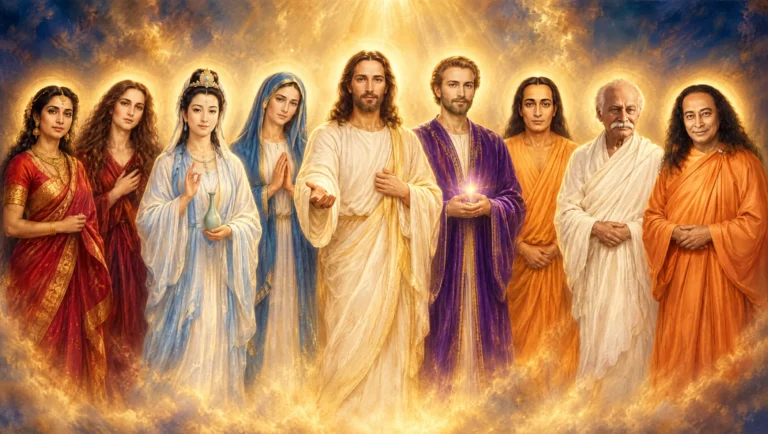
The framework comes from the Theosophical movement. In 1875 Helena Blavatsky and Henry Steel Olcott founded the Theosophical Society, and a few years later Olcott formally took the Buddhist precepts in Sri Lanka. Theosophy taught of a brotherhood of Masters, advanced souls who guide humanity’s growth. Later writers such as Alice Bailey described a spiritual Hierarchy in which Gautama Buddha holds a high place as a teacher of wisdom, and the full moon of May was held up as a time when his blessing is especially available. Other Ascended Master teachings carry the same idea, with details that vary from source to source.
In these teachings, the Buddha is not gone. He serves as a presence of compassion and clarity for the whole planet, and he is sometimes described as holding a planetary office. Students report meeting him in meditation and in dreams. Channeled sources give him a warm, plain, encouraging voice. You can hear one such message in our conversation with Genevieve Taeger on the Buddha’s channeled message of hope, and a wider survey in Anjie Hipple’s channeled meeting with many Ascended Masters. You can also watch the series Ascended Masters Channeled, available on Next Level Soul.
How should a seeker hold this? One honest way is to keep the layers separate. The historical teacher was a man who woke up. The Buddhist traditions honor him as the great pathfinder. The esoteric traditions honor him as a living guide. You do not need to settle the debate to benefit from the teaching. Practice it, and see.
Honest Questions and Cautions
Many details are uncertain. Dates, places and dialogues come from texts written down long after the events. When a story reads like a legend, it probably is one, and we have tried to mark it.
Many popular quotes are not his. A great number of lines shared online as “Buddha quotes” appear nowhere in the early texts. If a quote matters to you, look for the sutta it comes from.
Mindfulness without ethics is thin. Much modern mindfulness training leaves out the moral and wisdom parts of the path. Some Buddhist teachers worry about this, and rightly. The path is eightfold, not onefold.
No tradition is free from misuse. Buddhist communities, like all human ones, have seen abuses of power and episodes of violence carried out in the religion’s name. The Buddha’s teaching is not the same as everything done by those who bear his name.
Deep meditation can stir deep material. Long retreats can bring up grief, fear and disorientation. If this happens, slow down, find an experienced teacher, and seek professional help when you need it. Our pieces on the dark night of the soul and healing from trauma spiritually offer gentle context.
A Practice: Seven Days with the Breath and Loving-Kindness
You can taste the Buddha’s way in a week. Ten minutes a day is enough.
- Day 1: Sit and breathe. Sit comfortably. Feel the breath at the nose or belly. When the mind wanders, notice, and return. That is the whole practice.
- Day 2: Walk slowly. Walk for ten minutes, feeling each step. Let the world be as it is.
- Day 3: Note your thoughts. Sit again. When a thought arises, label it softly: planning, remembering, worrying. Then return to the breath.
- Day 4: Begin loving-kindness. Silently repeat for yourself: May I be safe. May I be well. May I be at ease. Let the words land.
- Day 5: Widen the circle. Offer the same wishes to someone you love, then someone neutral, then someone difficult, then all beings.
- Day 6: Reflect on impermanence. Look at something you are holding tightly. Remember that it will change. Notice how your body responds.
- Day 7: Sit in silence and dedicate. Sit without any technique. At the end, offer whatever peace you found to others.
Do not grade yourself. The Buddha said the path is “worthy of being seen for yourself.” Let the week speak.
Books and Further Reading
- What the Buddha Taught, by Walpola Rahula. A clear, trusted introduction to the core teachings, with selected texts.
- Old Path White Clouds, by Thich Nhat Hanh. The Buddha’s life retold as a gentle, flowing story.
- Buddha, by Karen Armstrong. A short, careful biography by a respected historian of religion.
- The Dhammapada, translated by Eknath Easwaran. A readable version of the verses, with a warm introduction.
- The audiobook The Buddha’s Bible, available on Next Level Soul.
Book links are Amazon affiliate links. If you buy through them, it supports our work at no extra cost to you.
Keep Exploring
The Buddha’s path of awareness runs through many of our guides. If you want to go further into the stillness side of the work, begin with mindfulness in daily life. To see how the Eastern wisdom streams met in one modern seeker, read our guide to Self-Realization and the teachings of Yogananda. For the story of a legend that connects India, Tibet and the West, read the lost years of Jesus.
To learn about how the Masters fit together, return to our complete guide to the Ascended Masters.
Two audio courses fit this path especially well. The Between draws on Tibetan wisdom about death and awareness, in 19 gentle chapters that ease fear. The Inner Path offers ten lessons on awakening consciousness, each with a practical step. Both are included with Next Level Soul membership. You can see the full range in the Next Level Soul Mastery overview, and you can try a teacher first through our free masterclasses.
Frequently Asked Questions
Who was Gautama Buddha?
Gautama Buddha, born Siddhartha Gautama, was an Indian spiritual teacher of the Shakya clan who lived in the Ganges plain about twenty-five centuries ago. After years of searching he awakened beneath the Bodhi tree and spent about forty-five years teaching the path to freedom from suffering.
When did the Buddha live?
Theravada tradition gives 563 to 483 BCE. Many modern scholars place his death closer to 400 BCE. The exact dates remain uncertain, because the earliest texts were written down centuries later.
What does “Buddha” mean?
It means “the awakened one,” from the Sanskrit root budh, to wake. It is a title, not a personal name. His given name was Siddhartha, and his family name was Gautama.
What are the Four Noble Truths?
They are the truth of suffering (dukkha), the truth of its cause in craving and clinging, the truth that it can end, and the truth of the path that leads to its ending. He gave them in his first sermon at Sarnath.
What is the Eightfold Path?
It is the practical path of right view, right intention, right speech, right action, right livelihood, right effort, right mindfulness and right concentration. These eight strands cover wisdom, ethical living and meditation.
Did the Buddha believe in God?
The early texts do not teach a creator god who saves. Gods appear in the Buddha’s cosmos, but they too are impermanent. He pointed to direct understanding as the way to freedom. Many Buddhists still hold a deep sense of the sacred.
Is the Buddha an ascended master?
In Theosophy and the Ascended Master teachings, Gautama Buddha is honored as one of the great Masters who guide humanity. Buddhist traditions themselves describe him as having entered final nirvana. These are different frameworks, and both can be studied with respect. See our guide to the Ascended Masters.
Where can I find the Buddha’s teachings on Next Level Soul?
You can listen to The Buddha’s Bible, an edition of the Dhammapada, on Next Level Soul. The audio course The Between adds Tibetan wisdom on death and awareness.
What is a simple way to begin practicing?
Sit for ten minutes, feel the breath, and return gently whenever the mind wanders. Add a few phrases of loving-kindness at the end of each sitting. The seven-day practice in this guide shows one way to do it.
Do I have to become a Buddhist to follow the teaching?
No. Many people use the Buddha’s methods of mindfulness, ethics and loving-kindness alongside other faiths or none. If you feel drawn to the path in full, a local teacher or sangha can help you take the next step.