The Sumerians were the people of Sumer, a group of city-states in southern Mesopotamia, in what is now Iraq, who built some of the world’s first cities and invented the earliest known writing system more than 5,000 years ago. They left behind laws, hymns, myths and thousands of clay tablets that we can still read today.
This guide explains who the Sumerians were, how their cities rose, what they invented, and what their gods, myths and texts reveal, from the Sumerian King List and the Epic of Gilgamesh to the hymns of Enheduanna. We also look at the Anunnaki debate and what Next Level Soul guests say about the ancient world. We keep it grounded, because the real invitation of a civilization this old is to wonder well.
Key Takeaways
- Who they were. Independent city-states in southern Mesopotamia, flourishing from about 4000 to 2000 BCE, with their own language and religion.
- Why they matter. Cities, cuneiform writing, schools, the oldest known law code and base-60 math all appear in their world early.
- The King List. A clay record of Sumer’s rulers that opens with mythic reigns of tens of thousands of years and a great flood.
- Myths that endure. The Descent of Inanna and the Epic of Gilgamesh explore surrender, grief and the search for immortality.
- The Anunnaki debate. Scholars read the Anunnaki as gods, while Zecharia Sitchin and others propose an ancient astronaut reading. We show both.
- A way to engage. Try the ten-minute Seven Gates practice and the journal prompts in this guide.
Who Were the Sumerians?
The Sumerians were the people of Sumer, a group of city-states in southern Mesopotamia, in what is now southern Iraq, between the Tigris and Euphrates rivers. Starting in the fourth millennium BCE, they built some of the first cities in history, developed the earliest known writing system, and left behind laws, poems, hymns and myths that are still read today. Sumer is widely described as one of the cradles of civilization.
They did not call themselves a nation or an empire. They lived in independent cities, each with its own king, its own temple and its own patron god, and they shared a language, a religion and a way of life. They called their land Kengir, and themselves the “black-headed people,” a phrase that appears in their own texts.
The Sumerians matter for two reasons. The first is practical: much of what we think of as the ingredients of civilization, such as cities, writing, schools, law codes and a system for measuring time, appears in their world early and in a recognizable form. The second is spiritual: their myths about creation, the underworld, a great flood and the search for immortality shaped the stories of the cultures that came after, and they still speak to seekers today.
| Quick Fact | What We Know |
|---|---|
| Location | Southern Mesopotamia, in present-day southern Iraq, between the Tigris and Euphrates |
| Time Period | Emerged in the 5th to 4th millennium BCE; flourished until about 2000 BCE |
| Major Cities | Eridu, Uruk, Ur, Lagash, Kish, Nippur, Umma |
| Language | Sumerian, a language isolate with no known relatives |
| Writing | Cuneiform, pressed into clay with a reed stylus, from about 3400 to 3300 BCE |
| Religion | Polytheistic, with a council of gods called the Anunnaki |
| Famous Works | Gilgamesh poems, the hymns of Enheduanna, the Code of Ur-Nammu, the Descent of Inanna |
Sumerian Timeline: From the First Cities to the Fall of Ur
Sumerian history runs for about three thousand years if you include its early roots and its long afterlife as a literary tradition. Here is a simple map of the main periods.
| Period | Approximate Dates | What Happens |
|---|---|---|
| Ubaid | About 5500 to 4000 BCE | Farming villages spread across southern Mesopotamia; early temples appear at places like Eridu |
| Uruk | About 4000 to 3100 BCE | Uruk grows into a true city; proto-cuneiform writing and the first large-scale administration emerge |
| Early Dynastic | About 2900 to 2350 BCE | Rival city-states such as Ur, Lagash and Kish compete and trade; royal tombs at Ur |
| Akkadian rule | About 2334 to 2154 BCE | Sargon of Akkad unites the region; his daughter Enheduanna serves as high priestess at Ur |
| Third Dynasty of Ur | About 2112 to 2004 BCE | A Sumerian revival: Ur-Nammu’s law code, the great ziggurat of Ur, a new golden age |
| Afterlife of Sumer | After about 2000 BCE | Sumerian fades as a spoken language but lives on in schools, temples and sacred texts for centuries |
How the First Cities Rose in Sumer
Southern Mesopotamia is flat, hot and dry, and it gets little rain. What it does have is two powerful rivers. The Sumerians learned to dig canals, build levees and guide river water onto the land, and that irrigation produced a reliable surplus of grain, dates, fish and livestock. Surplus meant that not everyone had to farm, and that opened the door to specialists: priests, scribes, potters, weavers, metalworkers, merchants and builders.
Two cities stand out. Eridu, near the southern marshes, is remembered in the Sumerian King List as the first city, and it was a sacred center of the water god Enki. Uruk, further north, became the great city of the later fourth millennium BCE. By around 3000 BCE it was among the largest settlements anywhere, with massive temples, a growing population and a complex administration. It is the home city of the legendary king Gilgamesh and the goddess Inanna.
| City | Patron Deity | Known For |
|---|---|---|
| Eridu | Enki | Traditionally the first city; a center of wisdom and sacred water |
| Uruk | Inanna and An | Early writing, monumental temples, the home of Gilgamesh |
| Ur | Nanna, the moon god | Royal tombs, the great ziggurat, the priestess Enheduanna |
| Nippur | Enlil | The religious heart of Sumer, a pilgrimage site |
| Lagash | Ningirsu | Rich written records and the reforms of King Urukagina |
| Kish | Zababa | A powerful early kingship that the King List says “descended from heaven” |
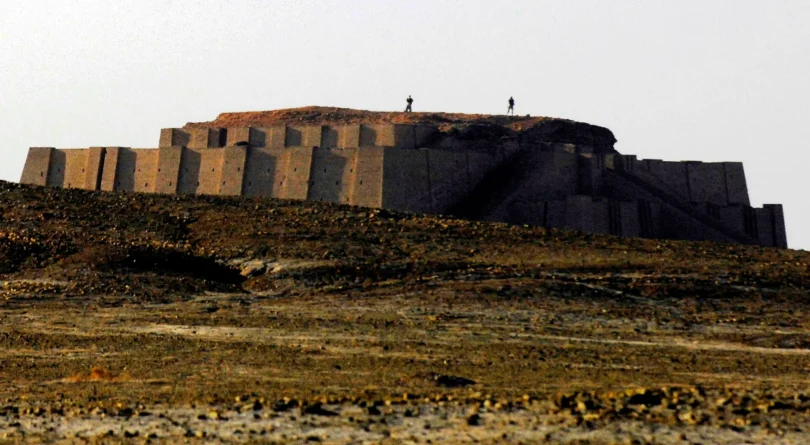
At the center of every city stood a temple, and by the third millennium BCE many were raised on tall stepped platforms called ziggurats. A temple was far more than a place of worship. It owned land, stored grain, employed workers and kept records. The gods were considered the true owners of the city, and the king and priests were their stewards. Spiritual life and daily life were not separate.
What the Sumerians Invented
It is easy to overstate what any one culture “invented,” because ideas spread and grow in many places at once. Still, the Sumerian world holds an unusually long list of firsts, or at least the earliest well-documented examples.
| Innovation | What Happened in Sumer |
|---|---|
| Writing | Cuneiform began as accounting marks on clay in Uruk around 3400 to 3300 BCE and grew into a full writing system for law, poetry and religion |
| Cities | Uruk and its neighbors are among the earliest true cities, with temples, markets and thousands of residents |
| Wheeled vehicles | Some of the earliest pictures and finds of wheeled carts and chariots come from Sumerian sites |
| Base-60 math | The sexagesimal system is the reason we still count 60 minutes in an hour and 360 degrees in a circle |
| Law codes | The Code of Ur-Nammu, from about 2100 BCE, is the oldest known surviving law code |
| Schools | The “tablet house” (edubba) trained scribes in reading, writing, math and religious texts |
| Irrigation | Networks of canals and levees turned a dry plain into rich farmland |
| Brewing | Sumerian texts include a hymn to Ninkasi, goddess of beer, and some of the oldest recipes known |
| Cylinder seals | Small carved stone rollers used to sign and seal documents, and a treasure of ancient art |
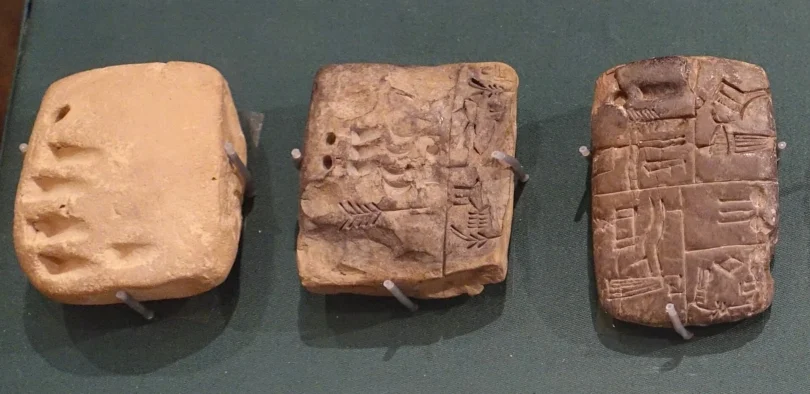
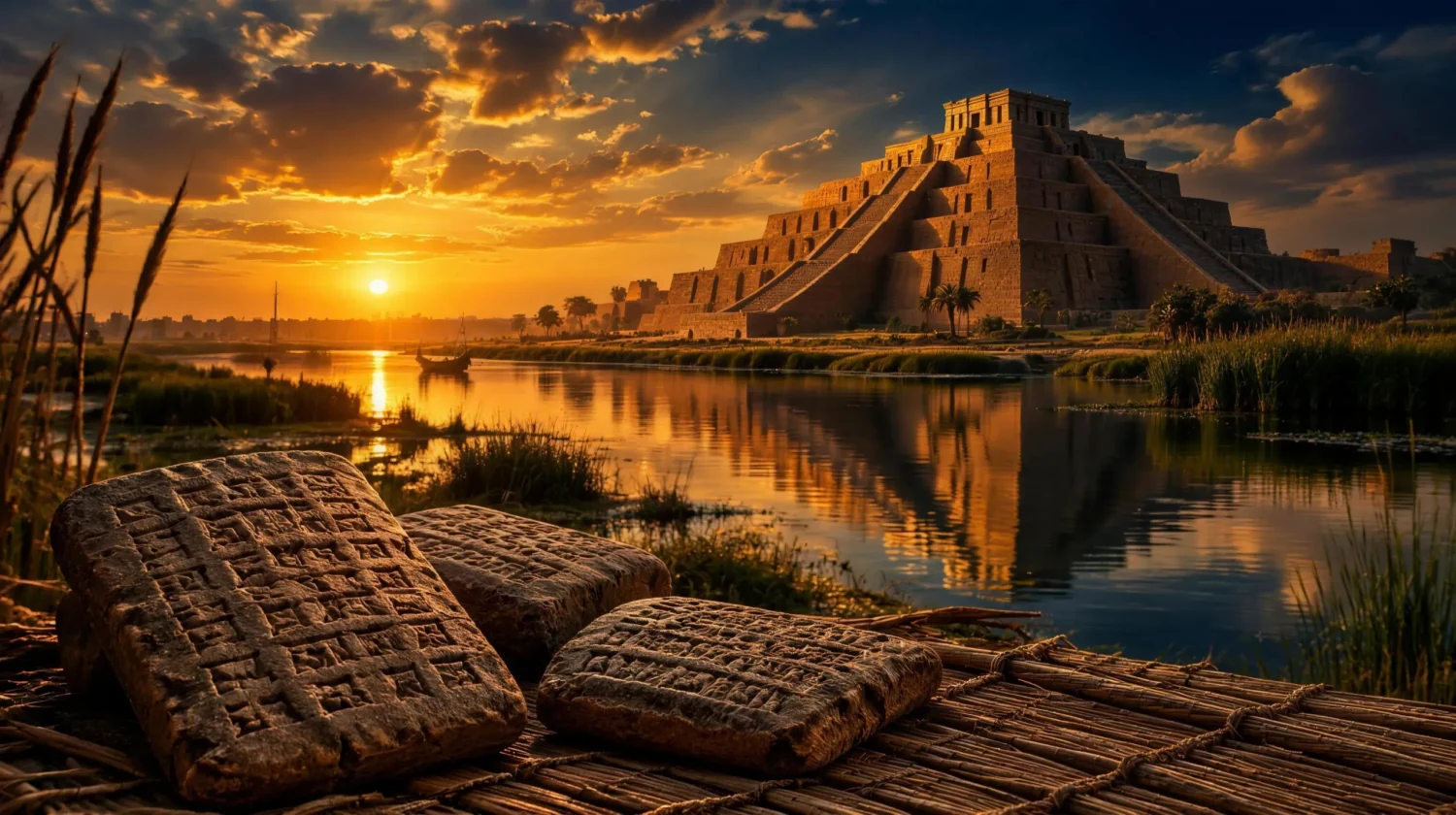
The writing system deserves a closer look, because it changed everything. Cuneiform, from the Latin for “wedge-shaped,” was written by pressing a cut reed into wet clay. It began as a way to count goods, grain and workers. Over centuries it became capable of recording poetry, prayers and legal judgments. Thousands of clay tablets survive, which is part of why we know so much about the Sumerians and so little about earlier cultures that wrote nothing down. You can find a plain-language overview of this and other terms in our spiritual glossary.
Daily Life in Sumer
Most Sumerians were farmers, herders, fishers and craftspeople. Families lived in mud-brick houses built around a courtyard. They ate barley bread, lentils, dates, fish and onions, drank beer through reed straws, and wore wool and linen. Cities were crowded and busy, with markets, workshops, canals and temples all within a short walk.
Society was layered. At the top stood the king (called an en or lugal depending on the city and era) and the temple priesthood. Below them were officials, scribes, merchants and skilled artisans, then farmers and laborers, and at the bottom the enslaved, who were often prisoners of war or people in debt. Women could own property, run businesses and serve as priestesses, and a few, like Enheduanna, held enormous religious influence.
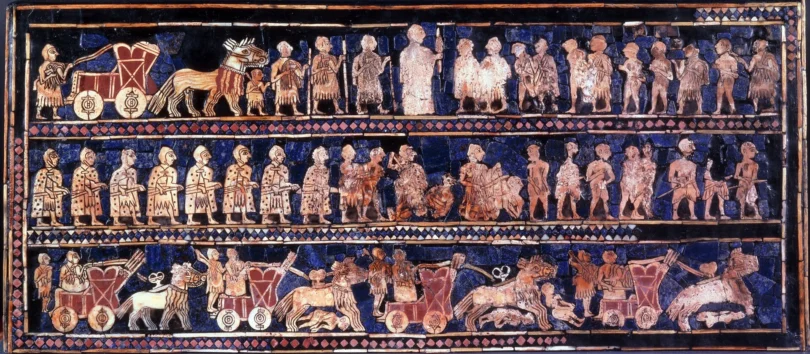
The art of the period shows a people who loved beauty and ceremony. One of the most famous objects to survive is the Standard of Ur, a small wooden box inlaid with shell, red limestone and lapis lazuli, found in a royal tomb. One side shows war, with chariots and captives. The other shows peace, with a banquet, musicians and people bringing food and goods.
The Sumerian King List
One of the most fascinating Sumerian documents is the Sumerian King List, a text that lists the rulers of Sumer city by city and gives the length of each reign. It was copied many times over several centuries. The best-known copy is the Weld-Blundell Prism, a four-sided clay prism from about 1800 BCE that is now in the Ashmolean Museum in Oxford.
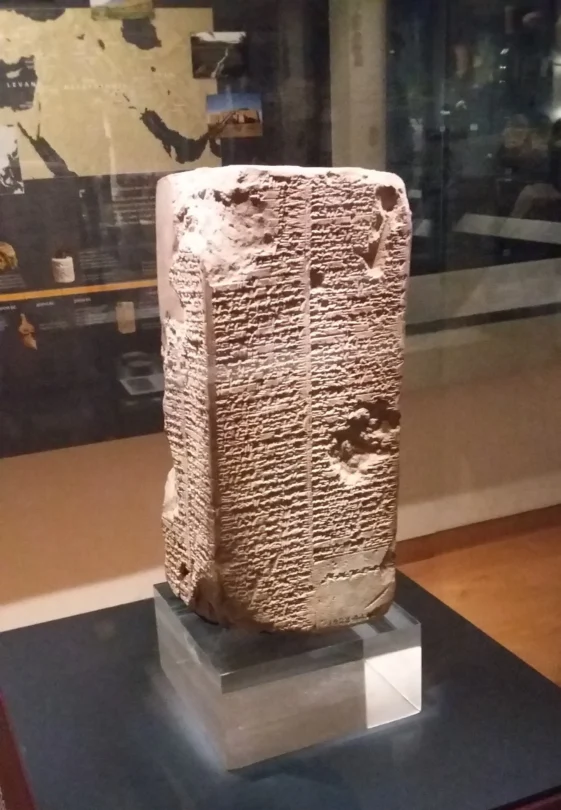
The list opens in a mythic age. It says that kingship “descended from heaven” and was first held at Eridu, where the earliest kings are credited with reigns of tens of thousands of years. After that comes a flood, and then kingship begins again, with reigns that shrink gradually until they become the lengths of ordinary human lives. Later entries line up with real historical rulers who are known from other inscriptions.
How Historians Read the King List
Scholars generally see the King List as a political document. It was composed in the late third and early second millennium BCE to support the claim that kingship was a single divine gift passed from city to city, which legitimized the rulers of the time. Many of its kings and cities are historical, while the earliest section is mythic or symbolic.
How Many Seekers Read It
Many seekers read the opening section as a memory of something older: a time of long-lived rulers, an interaction between heaven and earth, and a great flood that divided one age from the next. That reading is part of why the King List appears so often in conversations about the Anunnaki and lost history, and it is a very natural question to ask. We keep both perspectives in view and invite you to explore them. For the Anunnaki side of that conversation, see our guide to the Anunnaki and who the Sumerians said they were.
Law, Schools and Scribes
Sumerian cities ran on records. Scribes trained for years in schools called tablet houses, where students copied word lists, practiced math, memorized hymns and learned the laws. Teachers were strict, and surviving school texts include complaints from students that sound surprisingly familiar.
The law codes of Mesopotamia grew out of this scribal culture. The earliest surviving law code, written in Sumerian, is the Code of Ur-Nammu, from about 2100 BCE. It lays out penalties and compensation for injuries, theft and other offenses, and opens with a statement that the king acted to protect the weak. It predates the famous Code of Hammurabi by roughly three centuries.
The great ziggurat of Ur was built by the same king, Ur-Nammu, and it shows how law, religion and power were bound together. The tower was a monument to the moon god Nanna and the center of the city’s religious life.
Enheduanna: The First Named Author
Around 2300 BCE, Enheduanna served as high priestess of the moon god Nanna at Ur. She was the daughter of Sargon of Akkad, and she is celebrated as the earliest known named author in history. Her hymns to the goddess Inanna, written in Sumerian, speak in a personal voice about devotion, struggle and the divine feminine, and they were studied and copied for centuries.
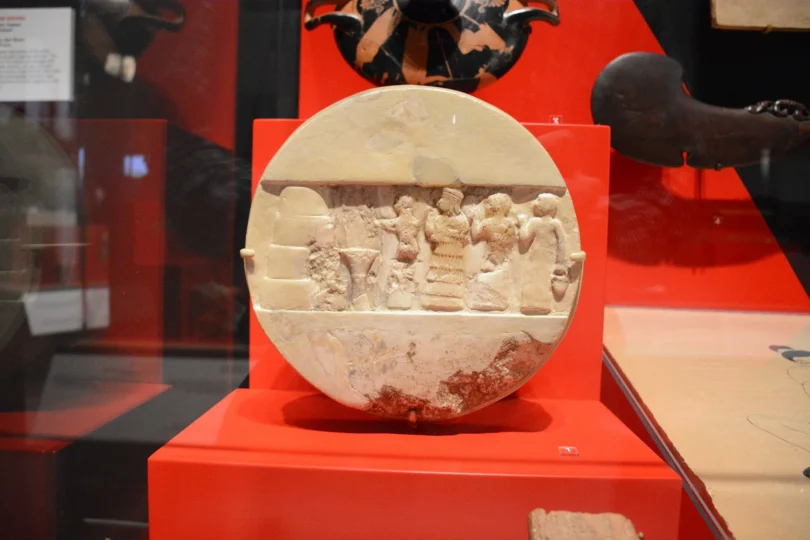
The alabaster disc carved with her image shows her in a ceremonial robe, pouring an offering while attendants stand near. For readers of this guide, she is a reminder that spiritual authority and poetry in Sumer were not only the work of kings. A woman’s voice shaped the religious imagination of the region for generations.
Sumerian Gods and the Anunnaki
Sumerian religion was polytheistic. The universe was seen as alive with powers, each connected to a part of nature or human life, and every city had a patron deity who was believed to live in the temple. A council of the great gods, called the Anunnaki, was said to decide the fate of the world. The word is often translated as something like “those of royal blood” or “offspring of the sky god An,” though the exact meaning is debated.
| Deity | Domain | City and Role |
|---|---|---|
| An | The sky, the highest heaven | Father of the gods, honored at Uruk |
| Enlil | Air, wind and command | Lord of the gods, centered at Nippur |
| Enki | Fresh water, wisdom and craft | Eridu; a clever helper of humanity |
| Inanna | Love, beauty and war; the planet Venus | Uruk; the most beloved goddess of Sumer |
| Nanna | The moon | Ur; father of Inanna and Utu |
| Utu | The sun and justice | Sippar and Larsa; judge and traveler of the sky |
| Ninhursag | The earth and mountains; mother figure | Honored as a creator of living beings |
| Ereshkigal | The underworld | Ruler of the realm of the dead |
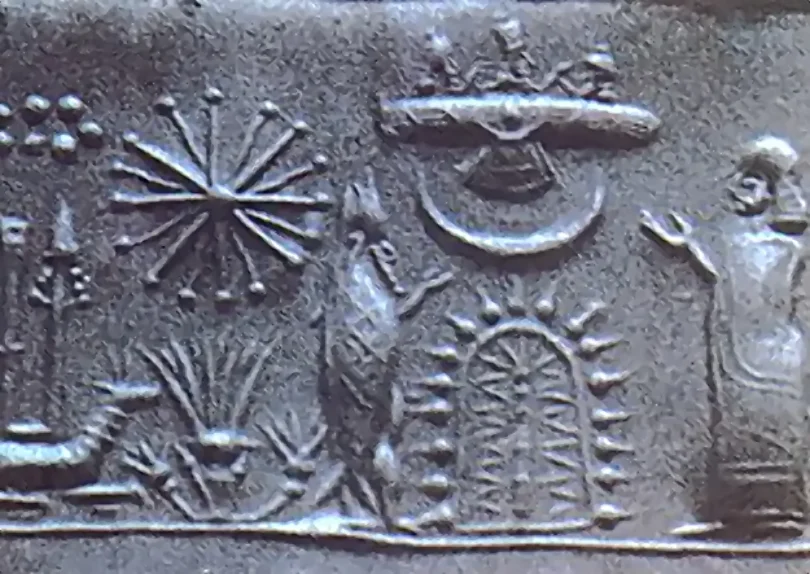
The gods in these myths act with very human emotions: they quarrel, love, bargain and make mistakes. In the stories of how people were made, the gods create humanity to share the work of tending the land and the temples. For the Sumerians, living a good life meant keeping order, honoring the gods through offerings and ritual, and doing your part for the community.
The Descent of Inanna: A Story of Initiation
One of the most moving Sumerian myths is the Descent of Inanna. The goddess decides to journey from the heavens to the underworld, the realm of her sister Ereshkigal. At each of seven gates she is asked to give up a piece of her power and finery: her crown, her jewelry, her robe. By the time she stands before her sister she is bare. She is struck down, and her body hangs on a hook, until the clever god Enki sends helpers who revive her with the food and water of life.
Seekers have read this story for thousands of years as a map of inner work. It describes surrender, letting go of the identities we wear, meeting the shadow and returning changed. It is easy to see why teachers of shadow work, death and rebirth keep coming back to it. The story belongs to ancient Sumer, and it also seems to speak to anyone who has gone through a dark night and come out the other side.
Gilgamesh, the Flood and the Search for Immortality
The Epic of Gilgamesh is the best-known work of Mesopotamian literature, and some of its oldest roots are Sumerian. Gilgamesh was a king of Uruk, probably a real ruler of the early third millennium BCE who became a legend. In the story he is a powerful but restless king. He befriends a wild man named Enkidu, and when Enkidu dies, Gilgamesh is shaken by grief and fear of death. He sets out to find the secret of eternal life.
His quest takes him to Utnapishtim, a man who survived a great flood sent by the gods by building a boat, and who was granted immortality. Utnapishtim tells Gilgamesh the story of the flood, and it echoes in the Biblical Noah. In the older Sumerian version, the hero is named Ziusudra. In the end, Gilgamesh learns that immortality is not for him. He returns home to Uruk, and his consolation is in the walls and works he has built.
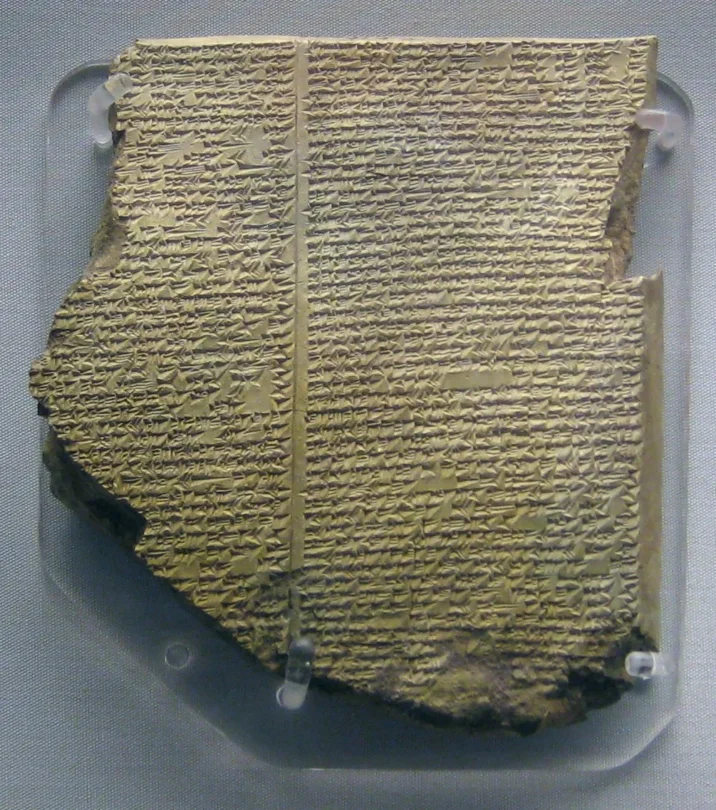
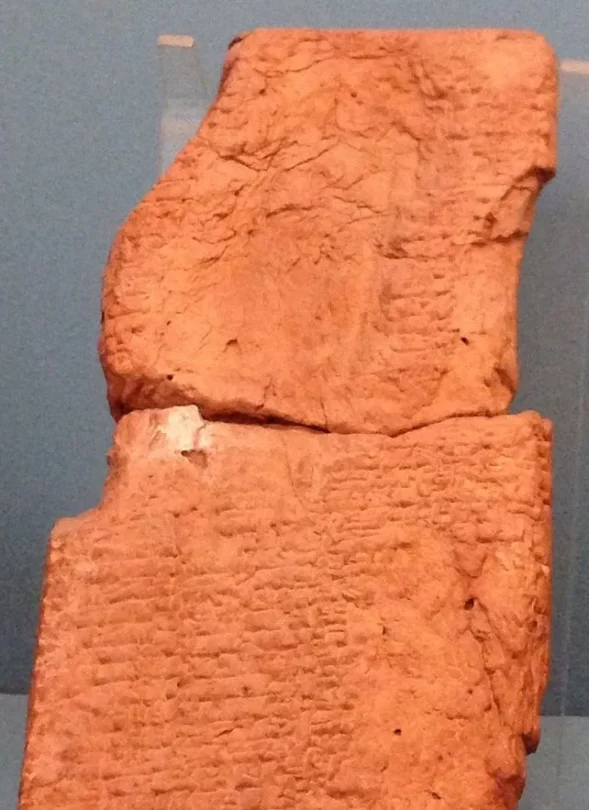
The famous Flood Tablet in the British Museum, Tablet XI of the epic, was deciphered in the 1870s by George Smith, and it caused a sensation because it seemed to tell a story much like the Biblical flood. For many readers, the epic is also a profound meditation on grief, friendship and what it means to be mortal.
What the Sumerians Believed About Death
The Sumerian afterlife was not a place of reward. The dead went to the underworld, called Kur or Irkalla, a dim realm of dust where spirits lived a shadowy existence. Offerings of food and water, poured out by living relatives, were believed to help the dead, and forgotten spirits were thought to be restless.
The scholar Greg Shushan has compared afterlife beliefs from Mesopotamia, ancient Egypt, India, China and indigenous cultures with near-death accounts, and he describes elements that recur around the world, such as leaving the body and encountering light. He joined us on the podcast to talk about what that pattern could mean for the nature of consciousness. His episode is embedded below.
The Sumerians and the Sky
The Sumerians and the cultures that followed them in Mesopotamia watched the sky closely. They tracked the moon for their calendar, followed the planet Venus as the goddess Inanna, and recorded omens in the movements of the stars. Their base-60 math was perfect for measuring angles, time and the heavens. This tradition grew into the later Babylonian astronomy and astrology, which is the root of the zodiac we know today. If you want to follow that thread, our guide to astrology, signs and cosmic cycles goes into it.
Zecharia Sitchin and the Ancient Astronaut Idea
No conversation about the Sumerians online goes very far without meeting Zecharia Sitchin. In his 1976 book The 12th Planet and the books that followed, Sitchin argued that the Anunnaki were real beings from a planet called Nibiru who came to Earth, mined gold and created humanity. His work has reached millions of readers and shaped a whole genre of ancient-mystery thinking.
Professional Assyriologists, the scholars who read cuneiform, reject his translations. They say the texts do not describe a planet called Nibiru in the way he claimed, and that his readings of key words are not supported by the language. They treat the Anunnaki as gods in a religious and mythic system. Many readers, though, find Sitchin’s central question compelling: why do the oldest civilizations speak so consistently about beings who came from the sky?
| Perspective | How It Reads Sumerian Myth |
|---|---|
| Assyriology | Religious literature of a polytheistic culture; the gods are symbols of natural and social forces |
| Ancient astronaut view | A record of contact with advanced visitors, preserved as myth |
| Spiritual and metaphysical view | Stories that encode the nature of consciousness, creation and the human relationship with the divine |
You can hold your curiosity and your discernment together. We explore the Anunnaki debate at length in our complete Anunnaki guide, including what guests on the show have said about it.
What Next Level Soul Guests Say About the Ancient World
Sumer comes up often on the Next Level Soul podcast, usually as one of the roots of a bigger question about human history. Here are three guests whose conversations connect to this territory. These are the guests’ own perspectives, offered for you to consider.
- Matt LaCroix. The author and researcher speaks about lost civilizations, hidden symbols and great cycles of time. He describes a 25,700-year cycle and says he believes the ancient world held a more sophisticated and spiritual view of who we are than we are usually taught.
- Michael Le Flem. The historian of Atlantis says the Greeks, Egyptians, Sumerians and Indians all knew that we move through ages, like the Yuga cycles. He reads that shared memory as a sign that something real lies behind the myths. For more on that cycle, see our guide to the Yugas.
- Greg Shushan. The scholar compares afterlife beliefs from Mesopotamia, Egypt, India and beyond with near-death accounts, and asks what the patterns say about consciousness.
What Happened to the Sumerians?
Sumer did not vanish overnight. Its cities were gradually absorbed over many centuries. The Akkadian Empire of Sargon conquered the Sumerian city-states around 2334 BCE, and although Sumerian culture revived under the Third Dynasty of Ur, that kingdom fell to invaders around 2004 BCE. Semitic-speaking peoples such as the Amorites rose to power, and the city of Babylon eventually became the center of the region.
Historians point to several causes working together: political rivalry among the city-states, pressure from neighboring peoples, shifts in the course of the rivers, and growing salt in the soil from centuries of irrigation, which reduced harvests. Sumerian stopped being spoken in daily life by roughly 1700 BCE, but it remained the language of religion, scholarship and ritual in Mesopotamia for well over a thousand years, much as Latin did in Europe.
The Sumerian Legacy in Our World
The Sumerians left more than ruins. Their legacy is woven into daily life:
- Time and angles. Our 60-minute hours and 360-degree circles descend from their number system.
- Writing and records. The idea that knowledge can be stored outside a single person’s memory started in places like Uruk.
- Law. The principle that a ruler is bound to justice and that penalties should be written down.
- Myth and story. Flood stories, descent-to-the-underworld stories and the quest for immortality traveled into later traditions.
- Astronomy and astrology. Their sky watching became the foundation of Babylonian and later Greek astronomy.
- Cities. The very idea of living together by the thousands, with specialized work and shared institutions.
The Spiritual Meaning of the Sumerians
What does a civilization that vanished more than four thousand years ago have to say to a seeker today? Quite a lot. Here are five ways people find meaning in Sumer.
1. We Are Part of a Long Human Story
The Sumerians were people with fears, loves and questions much like ours. Reading their poems and prayers is a way of feeling less alone in time. Their search for meaning is the same search we are on.
2. Descent Is Part of the Journey
The Descent of Inanna teaches that we sometimes have to let go of what we have built in order to be renewed. If you are in a season of loss or change, it offers a gentle map: surrender, meet what you have avoided, and return with something new.
3. Facing Mortality Gives Life Depth
Gilgamesh begins by fleeing death and ends by building something that lasts. Many of us come to a similar place. The question moves from “how do I avoid ending?” to “what am I making with the time I have?”
4. The Sacred and the Everyday Belong Together
In Sumer, temples were also granaries and schools. Spiritual life was part of work, community and care for the land. That is a useful reminder for anyone trying to bring their practice into ordinary days.
5. The Power Is Within
The Sumerian gods were powerful, and yet the myths show humans as participants, not merely servants. Enki helps, Gilgamesh strives, Inanna chooses to descend. Even in the oldest stories, transformation comes from a decision made from within.
A Ten-Minute Practice: The Seven Gates
This simple contemplation is inspired by the Descent of Inanna. You can do it in a quiet room with a notebook.
- Settle. Sit comfortably and breathe slowly for two minutes.
- Picture seven gates. Imagine walking toward a series of gates, each one a little darker and quieter than the last.
- Name what you set down. At each gate, silently name something you are carrying: a role, an expectation, a worry, a story about yourself. Imagine leaving it at the threshold.
- Rest in the quiet. Sit for a minute at the last gate with nothing to hold.
- Return slowly. Walk back through the gates and pick up only what you want to keep.
- Write. Note what you left behind and what you chose to carry back.
Journal Prompts
- What am I ready to set down this season?
- What would I want to build that outlasts me?
- Which myth or story feels like a map of my own life?
- Where do my everyday work and my sacred life meet?
Common Misconceptions About the Sumerians
| You May Have Heard | What Is Actually Known |
|---|---|
| “The Sumerians were a single empire.” | They were a group of independent city-states that shared language and culture. |
| “They invented everything.” | They have some of the earliest well-documented firsts, but ideas developed in many places and built on earlier work. |
| “They appeared from nowhere.” | Archaeology shows a long development from earlier farming villages through the Ubaid and Uruk periods. |
| “Scholars have proven the Anunnaki were aliens.” | Assyriologists read the Anunnaki as gods. The ancient astronaut view is a separate, widely discussed interpretation. |
| “Sumerian is a lost language no one can read.” | Sumerian has been deciphered, and thousands of tablets have been translated. |
| “Göbekli Tepe was a Sumerian site.” | No. It is about 6,000 years older than Sumerian writing. See our Göbekli Tepe guide. |
Where to See Sumerian Treasures Today
Many of the artifacts mentioned here can be seen in museums around the world. The Iraq Museum in Baghdad holds some of the greatest finds, and the British Museum in London has the Standard of Ur and the Flood Tablet. The Penn Museum in Philadelphia holds treasures from Ur, including the Disc of Enheduanna, and the Ashmolean Museum in Oxford has the Weld-Blundell Prism. The Louvre in Paris, the Pergamon Museum in Berlin and the Istanbul Archaeology Museums also hold major Sumerian collections. Always check each museum’s current exhibits before you visit, since displays change.
In Iraq, the ruins of Ur, with its restored ziggurat, can be visited in the south of the country. Check current travel advice and local conditions before planning a trip.
Bringing It All Together
The Sumerians remind us how much of the human story is still being read. They gave us writing, so that we could hear them. In their clay tablets we find kings and farmers, goddesses and poets, grief and wonder. Whatever you make of the debates about the Anunnaki or lost history, their world invites a sense of reverence for how far back our search for meaning goes.
If this guide opened something in you, take the next step. Watch the conversations below, follow the links in the Go Deeper section, and let your curiosity lead. We rise together.
Watch: Real Conversations on Ancient History and Consciousness
These NLS guests explore ancient cycles, lost history and what early civilizations believed about life and death.
Matt LaCroix: Ancient Spiritual Mysteries Revealed
Matt LaCroix talks about lost civilizations, hidden symbols and great cycles of time, and what he believes it says about who we are. Watch the full episode and read the show notes.

Greg Shushan: The Origins of Afterlife Beliefs
Dr. Greg Shushan compares afterlife beliefs and near-death accounts across Mesopotamia, ancient Egypt, India, China and indigenous cultures. Watch the full episode and read the show notes.
Michael Le Flem: Ancient Atlantean Prophecy
Michael Le Flem discusses Atlantis and why he says the Greeks, Egyptians, Sumerians and Indians all knew that we move through ages. Watch the full episode and read the show notes.

Watch More on Next Level Soul TV
Next Level Soul TV brings together full episodes, courses, movies, series and audiobooks, ad-free. Join Next Level Soul TV and keep exploring.
Go Deeper with Next Level Soul
- The Anunnaki: Who They Were and What the Sumerians Said
- Atlantis: The Complete Guide to the Lost Civilization
- The Yugas: The Four Ages of Time
- Astrology: Signs, Birth Charts and Cosmic Cycles
- Astral Journey: How to Explore Beyond the Body
- Spiritual Awakening: Meaning, Traditions and How to Integrate It
- Your Soul’s Blueprint with Karen Bell (NLS Mastery)
- The full spiritual glossary
Sources and Further Reading
- Sumer (Wikipedia)
- Cuneiform (Wikipedia)
- Sumerian King List (Wikipedia)
- Epic of Gilgamesh (Wikipedia)
- Enheduanna (Wikipedia)
- Code of Ur-Nammu (Wikipedia)
- Uruk (Wikipedia)
- Eridu (Wikipedia)
- Ziggurat of Ur (Wikipedia)
- Sexagesimal (Wikipedia)
- Zecharia Sitchin (Wikipedia)
Images courtesy of Wikimedia Commons under their stated licenses, credited in each caption.
Spirituality for the Rest of Us™
Movies, teachings and community on Next Level Soul TV.
Go Deeper with NLS Mastery: Your Soul’s Blueprint
If the question of where we come from calls to you, as it did to the Sumerians, this course helps you map your own soul’s origins and purpose. Karen Bell teaches it in Your Soul’s Blueprint, part of NLS Mastery. Watch the course preview below.

Not Ready Yet? Explore all free masterclasses.
Frequently Asked Questions
Who were the Sumerians?
The Sumerians were the people of Sumer, a group of independent city-states in southern Mesopotamia, in present-day Iraq. They built some of the earliest cities and invented cuneiform writing.
When did the Sumerians live?
Sumerian civilization emerged in the 5th to 4th millennium BCE and flourished until about 2000 BCE. Their language and texts continued to be used in religion and scholarship for centuries after that.
Where was Sumer located?
Sumer was in southern Mesopotamia, between the Tigris and Euphrates rivers, in what is now southern Iraq. Major cities included Eridu, Uruk, Ur, Lagash, Kish and Nippur.
What did the Sumerians invent?
They are credited with some of the earliest cities, cuneiform writing, schools, the oldest known law code, base-60 mathematics and large-scale irrigation. Many ideas developed in several places, so these are best called earliest documented examples.
What is the Sumerian King List?
It is an ancient text listing the rulers of Sumer city by city with the length of their reigns. It begins with mythic kings who rule for tens of thousands of years and a great flood, then moves into historical rulers.
What is cuneiform?
Cuneiform is a wedge-shaped writing system made by pressing a reed into wet clay. It began as an accounting tool in Uruk around 3400 to 3300 BCE and later recorded poetry, law and religion.
Who were the Anunnaki?
In Sumerian religion, the Anunnaki were a group of great gods who decided the fate of the world. Some authors, such as Zecharia Sitchin, read them as extraterrestrial visitors, a view scholars of the ancient texts reject.
What is the Epic of Gilgamesh?
It is a Mesopotamian epic about Gilgamesh, a king of Uruk, and his search for immortality after the death of his friend Enkidu. It includes a flood story that resembles the story of Noah.
Who was Enheduanna?
Enheduanna was a high priestess of the moon god Nanna at Ur around 2300 BCE and the daughter of Sargon of Akkad. She is celebrated as the earliest known named author in history.
What happened to the Sumerians?
Sumer was conquered by the Akkadians, revived under the Third Dynasty of Ur, and fell to invaders around 2004 BCE. Political rivalry, shifting rivers and salty soil also played a part, and Sumerian culture lived on through Babylon.
What did the Sumerians believe about the afterlife?
They believed the dead went to a dim underworld called Kur or Irkalla, where spirits lived a shadowy existence. Offerings from living relatives were thought to help the dead.
Is Sumer older than Göbekli Tepe?
No. Göbekli Tepe is about 6,000 years older than the first Sumerian writing and comes from a different culture.
Where can you see Sumerian artifacts?
Major collections are in the Iraq Museum in Baghdad, the British Museum, the Penn Museum, the Louvre, the Pergamon Museum and the Ashmolean Museum. Check each museum for current exhibits.