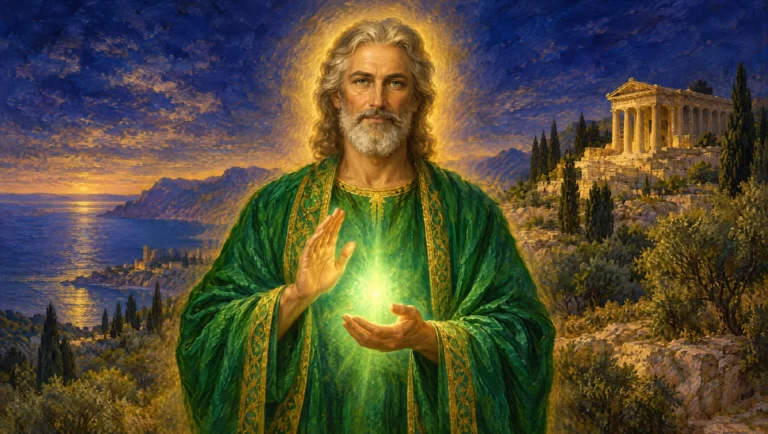
Whatever you believe about him, Jesus of Nazareth is one of the most influential spiritual teachers who ever lived. He wrote no book. He held no office. He walked the dusty roads of Galilee, ate with outcasts, healed the sick, and taught that the kingdom of God is closer than breath. Two thousand years later, Christians, Muslims, Hindus, Gnostics, Theosophists and people with no religion at all are still arguing about who he was and still being changed by what he said. This guide is faith-neutral. It follows his story, lays out what the sources do and do not tell us, sets the great traditions side by side, and asks how he is understood as one of the Ascended Masters. It ends with a seven-day practice you can try this week.
Key Takeaways
- Who he was: A first century Jewish teacher and healer from Nazareth in Galilee, executed by Roman authority in Jerusalem under Pontius Pilate, around 30 to 33 CE.
- What we know: Almost everything comes from the Gospels, written decades later, plus a few brief outside mentions. Where history is uncertain, this guide says so.
- Core teaching: The kingdom of God is within you and among you; love God and love your neighbor; forgive; pray in secret; become like a child.
- Many readings: Christians, Jews, Muslims, Gnostics, Hindu saints and Theosophists each see him differently. We present them side by side, with attribution.
- As an ascended master: Esoteric traditions hold that he completed the soul’s journey, ascended beyond rebirth, and still guides humanity. That is a devotional and esoteric claim, not a historical one.
- Try it: A seven-day practice built on the Beatitudes, open to people of any faith or none.
In This Guide
- Who Was Jesus of Nazareth?
- How to Read This Guide: Faith-Neutral, Not Faith-Free
- What We Can Actually Know: The Sources
- The World He Was Born Into
- A Life in Outline: Baptism, Ministry and Journey to Jerusalem
- The Hidden Years and the “Lost Years” Question
- The Kingdom of God Is Within and Among You
- The Heart of the Teaching: Love, Mercy and Forgiveness
- Parables: Stories That Work on the Inner Mind
- Prayer, Silence and the Lord’s Prayer in Aramaic
- Healing, Miracles and the Question of Power
- Crucifixion and Resurrection: Five Ways of Reading
- Jesus and the Christ: Two Names, One Question
- How the Traditions See Him
- Jesus as an Ascended Master
- Legacy: What Two Thousand Years Have Done with Him
- Honest Questions and Cautions
- A Practice: Seven Days with the Beatitudes
- Books and Further Reading
- Who Will Connect with This Teacher
- Keep Exploring
- Frequently Asked Questions
Who Was Jesus of Nazareth?
Jesus of Nazareth was a Jewish teacher, healer and mystic from the Galilee region, then a rural corner of the Roman province of Judea. He was born, historians generally say, sometime between 6 and 4 BCE. He died on a Roman cross around 30 to 33 CE. In between, according to the Gospels, he gathered a small circle of disciples, taught in villages and on hillsides, and drew crowds that alarmed both the Temple authorities and the Roman governor.
Billions of people call him Lord, Savior or the Son of God. Muslims honor him as Isa, the Messiah and a mighty prophet. Many Jewish scholars see a deeply Jewish teacher of his time, rooted in the Hebrew scriptures. Saints of India, from Ramakrishna to Paramahansa Yogananda, have bowed to him as a master of the highest order. And a great many spiritual seekers who never joined any church feel a pull toward him anyway.
That is a lot of weight for one man to carry. It also explains why he is hard to write about. Every group that loves him tends to see its own face in his. So before anything else, we want to be clear about how this guide works.
How to Read This Guide: Faith-Neutral, Not Faith-Free
Faith-neutral means we do not ask you to believe or disbelieve anything. If Jesus is your Lord, nothing here is meant to shake that. If you left the church you grew up in, nothing here is meant to pull you back. If you are curious about him as a teacher of consciousness, you are in the right place.
It does not mean faith-free. We take the scriptures seriously and quote them accurately. We name the tradition behind each claim: “according to the Gospels,” “the Church teaches,” “Islamic tradition holds,” “Theosophical writers say.” When something is history, we say history. When something is devotion, we say devotion. When something is esoteric teaching with no historical record behind it, we say that too.
That honesty is not a barrier to the mystical. It is what lets the mystical stand on solid ground. If you want the wider picture of how this series treats Jesus alongside other great teachers, start with our complete guide to the Ascended Masters.
What We Can Actually Know: The Sources
Start with a surprising fact. Jesus left no writings, and the earliest texts that speak of him were composed by other people, in Greek, after his death. The apostle Paul’s letters, written in the 50s CE, are the oldest. Most scholars date the four canonical Gospels later: Mark around 70 CE, Matthew and Luke in the 80s, John around 90 to 100. These are faith documents. They were written to proclaim him, not to file a neutral report.
Outside the Christian writings, the record is thin but real. The Jewish historian Josephus mentions Jesus in his Antiquities of the Jews, around 93 CE, and a passage about him there appears to have been expanded by later Christian copyists. The Roman historian Tacitus, writing around 116 CE, says that “Christus” was executed under Pontius Pilate during the reign of Tiberius. Most historians treat his existence and his crucifixion as about as secure as anything in ancient history.
Then there are the texts the early church did not include. The Gnostic Gospels found at Nag Hammadi in Egypt in 1945 include the Gospel of Thomas, a collection of 114 sayings of Jesus with no story around them. Scholars debate how early some of its material is. For many modern seekers it offers a more inward Jesus: a teacher of self-knowledge rather than a figure of sacrifice.
Finally, there are the esoteric sources, such as the Aquarian Gospel of Jesus the Christ (1908), which its author Levi Dowling said he received from what he called the Akashic Records. Scholars do not treat it as history. Spiritual readers often treat it as inspired devotional literature. We keep those categories apart.
The World He Was Born Into
Picture the Galilee of his day. Rome ruled with soldiers and taxes. Herod Antipas governed Galilee as a Roman client. The Temple in Jerusalem was the center of Jewish worship and of power. Ordinary families lived on small farms and in fishing villages like Capernaum, always one bad harvest from debt.
Jewish life then held many movements. Pharisees stressed study and the oral tradition. Sadducees, tied to the Temple, were more conservative. The Essenes, known from the Dead Sea Scrolls discovered from 1947, lived in disciplined communities. Prophets and would-be messiahs appeared often, and Rome crushed them often. Into this world Jesus spoke Aramaic, quoted Hebrew scripture, and told stories about seeds, coins, sheep and wedding feasts.
This context matters for seekers. Jesus was not a Christian. He was a Jew who taught inside Judaism, and his language of “the kingdom of God,” of Abba, of Torah, of mercy and justice, makes full sense only there. The scholar Geza Vermes made this point famously in Jesus the Jew (1973). Reading him as a Galilean mystic does not diminish him. It restores him.
A Life in Outline: Baptism, Ministry and Journey to Jerusalem
The Gospels agree on the broad shape. Jesus grew up in Nazareth, a small village. In adulthood he went to the Jordan River, where John the Baptist was calling people to repent and be immersed in water. The Gospels describe the heavens opening and a voice declaring him beloved. He then spent a time of testing in the wilderness. Tradition counts it as forty days.
His public work began in Galilee. He taught in synagogues, healed people, shared meals with tax collectors and outcasts, and called twelve disciples to travel with him. Women, including Mary Magdalene, also followed and supported him. Our guide to Mary Magdalene in the Gospels, the Gnostic texts and the legends explores her role in more depth.
How long did this last? Mark, Matthew and Luke suggest about a year. John mentions three Passover festivals, suggesting about three. Either way it was short. Then came the journey to Jerusalem for Passover, the entry into the city, the confrontation in the Temple courts, the last meal with his disciples, arrest, trial and crucifixion. That is where the Gospels slow down and give the most detail. His whole story, as told by those who loved him, is built around that final week.
The Hidden Years and the “Lost Years” Question
The Gospels tell us almost nothing between his childhood and the age of about thirty. Matthew has the flight into Egypt. Luke has the boy of twelve in the Temple, astonishing the teachers. After that, silence. Where was he?
The simplest answer is the one most historians give: in Galilee, working as a craftsman, likely in the building trade, in a family and a community. The Gospels call him a tekton, a word usually translated carpenter, and the silence may simply mean that nothing unusual was recorded.
Esoteric traditions answer differently. Some hold that he traveled to Egypt, India, Tibet or Persia to study with sages and be initiated in mystery schools. The idea took hold in the nineteenth century. Nicolas Notovitch published The Unknown Life of Jesus Christ in 1894, claiming to have seen a manuscript in Ladakh. It is widely regarded as a fabrication. The Aquarian Gospel described a very full itinerary. Later writers, including Elizabeth Clare Prophet in The Lost Years of Jesus (1984), revisited the question, as have other writers and filmmakers since.
We have gone through all of this, source by source, in our guide to the lost years of Jesus: India, Tibet, Egypt, Persia and the mystery schools. In short: no historical record places him outside the Roman world, and no mainstream historian accepts the Indian journey. Yet the Coptic Church has a strong, ancient tradition of the Holy Family’s stay in Egypt, rooted in Matthew’s Gospel. A new film on this theme, Jesus in Egypt, is releasing on Next Level Soul on November 5, and you can see its page on Next Level Soul TV.
How you hold the lost years is up to you. The wise way is to hold them lightly. Whatever happened, the man who emerged at the Jordan taught from a depth that needed no travel documents.
The Kingdom of God Is Within and Among You
Almost every teaching of Jesus circles one phrase: the kingdom of God. In the Gospels, it is the heart of his message. He does not define it in a creed. He describes it in stories. It is like a mustard seed, a hidden treasure, yeast in dough, a pearl worth selling everything to own.
In Luke 17:21, he is asked when the kingdom will come. His reply is translated in two ways: “the kingdom of God is within you,” or “the kingdom of God is among you.” The Greek entos hymon can mean either, and the ambiguity is a gift. Within: an inner realm of awareness. Among: a way of living together, here and now. Either way, it is not a place you travel to after death. It is a quality of reality available in the present.
The Gospel of Thomas, saying 3, takes the same thought in a more mystical direction: the kingdom is inside you and it is outside you, and when you know yourselves, you will be known. The Aramaic scholar Neil Douglas-Klotz, whom Alex interviewed in The True Teachings of the Aramaic Jesus Christ (also available on Next Level Soul TV), points out that the Aramaic world of Jesus did not draw a hard line between body and spirit, earth and heaven. The kingdom, in that language, is a felt sense of unity.
If you hold only one idea from this guide, hold this one. It does not require you to leave your religion or join another. It asks only that you turn toward the place the teaching points to.
The Heart of the Teaching: Love, Mercy and Forgiveness
Asked for the greatest commandment, Jesus gave an answer drawn from his own scriptures: love God with all your heart, soul and mind, and love your neighbor as yourself. These come from Deuteronomy 6 and Leviticus 19. He did not invent them. He joined them and placed them above everything else.
Then he pushed further. Love your enemies. Pray for those who persecute you. Forgive, not seven times, but seventy times seven. Do not judge, lest you be judged with the same measure. Take the plank out of your own eye first. In the Sermon on the Mount, which fills Matthew chapters 5 to 7, these demands are gathered into one long talk. Whatever your beliefs, it remains one of the most demanding and beautiful passages in world literature.
The ethic is radical because it works from the inside. The Beatitudes do not say “do this and be rewarded.” They say that blessing already belongs to the poor in spirit, the grieving, the meek, the merciful, the pure in heart, the peacemakers. They describe states of being. Seekers in many traditions hear in them the same thing a Buddhist or a Vedantin might call a shift of identity: from the small, defended self to something wider.
There is a practical side too. Forgiveness, in the way Jesus taught it, frees the forgiver. We return to that in the practice below.
Parables: Stories That Work on the Inner Mind
Jesus taught mostly in parables, short stories with an unexpected turn. A Samaritan, a despised outsider, is the one who stops for the wounded man. A father runs down the road to embrace his wasteful son. A shepherd leaves ninety-nine sheep to find one. Laborers hired at the last hour are paid the same as those who worked all day.
Parables do not hand over a conclusion. They open a question. In the Gospels, Jesus says the disciples are given the secrets of the kingdom, while others hear stories that they may or may not understand. Mystical readers have long taken this to mean the parables are keys: they open up deeper meaning for those ready to look inward. A parable asks, “Which character are you?” and then, “Which character are you being right now?”
Try reading one slowly, three times. First for the plot. Second for the surprise. Third for yourself. That alone is a complete contemplative practice.
Prayer, Silence and the Lord’s Prayer in Aramaic
Jesus is shown praying often, alone, in the early morning or at night, on mountains and in quiet places. He tells his followers not to pray to be seen, but to go into a private room, close the door, and pray to the Father in secret. Many contemplatives read “the inner room” as the inner life itself.
The best-known prayer attributed to him is the Lord’s Prayer, in Matthew 6 and in a shorter form in Luke 11. It begins with a word he likely spoke as Abwoon in Aramaic, usually translated “Our Father.” Neil Douglas-Klotz, in Prayers of the Cosmos, explores how Aramaic root meanings open the line into something broader: the source of all breath, light and being. That is one scholar’s reading, and it is beautiful, but linguists differ on how far to push it. Treat it as a contemplative doorway, not a settled translation.
In Christian monastic tradition, the Lord’s Prayer and the “Jesus Prayer” have been the foundation of silent prayer for centuries. In the Eastern Orthodox world, the short prayer “Lord Jesus Christ, have mercy on me” is repeated with the breath. Anyone, of any faith, can sense the family resemblance to a mantra.
Healing, Miracles and the Question of Power
The Gospels describe him healing the blind, the lame, lepers and those thought to be possessed. They also describe him calming a storm, feeding crowds from a few loaves, walking on water, and raising Lazarus. Historians generally agree that Jesus was remembered as a healer and exorcist during his lifetime. How to understand the specific stories is a matter of faith and interpretation.
Believers see divine action. Skeptics see legend or misunderstanding. Mystics often see something in between: a person so open to the source of life that those around him could feel restored. In the Gospel of John, Jesus says that those who believe will do the works he does, “and greater works than these.” If you take that seriously, the miracles are not only a record of what he did. They are also an invitation to consider what a human being can become.
We would add one caution. A healing story is not a medical plan. Healing in the spiritual sense may or may not cure a body. It often changes how we live with the body, with illness and with fear. Please keep seeing your doctor.
Crucifixion and Resurrection: Five Ways of Reading
This is the center of the story, and the point where traditions part ways most sharply. Here is how some of them read it, side by side.
- Traditional Christian reading: Jesus died for the sins of the world and rose bodily on the third day. The cross is atonement, and the resurrection is the victory over death.
- Historical reading: A Galilean preacher was executed by Rome, probably as a perceived threat to public order. Beyond that, historians disagree about what happened next. Most can say only that his followers became convinced they had seen him alive.
- Islamic reading: The Quran honors Jesus as a prophet and Messiah, born of the Virgin Mary, but not divine. Surah 4:157 to 158 says he was not killed or crucified, though it “appeared so,” and that God raised him up. Islamic tradition expects his return.
- Gnostic reading: Some Gnostic texts, such as the Apocalypse of Peter, describe the living Jesus as untouched by the cross. What suffered was the body, not the divine presence. These texts were rejected by the early church as heretical.
- Esoteric reading: Theosophical and related writers read the Gospel story as a map of initiations: baptism, transfiguration, the crucifixion as renunciation of the personal self, and resurrection and ascension as liberation.
Each reading answers a different question. For the mystic, the one that may matter most is this: what must die in us so that something larger can live? That question works in every tradition. It is the question beneath the symbol.
Our audio course The Hidden Teachings of Jesus Christ walks through the baptism, the wilderness, the miracles and the inner mysteries of the crucifixion and resurrection, with a spiritual rather than doctrinal focus.
Jesus and the Christ: Two Names, One Question
“Christ” is not a surname. It comes from the Greek Christos, translating the Hebrew Mashiach, “anointed one.” To say “Jesus Christ” is to say “Jesus the Anointed.” Whether he was the Messiah is one of the oldest disagreements between Jews and Christians, and it will not be settled here.
What esoteric and mystical readers add is a distinction. Jesus, they say, is the man. Christ is a consciousness, a state of realized unity with the divine, which Jesus embodied and which is also a possibility in every human being. Paul writes of “Christ in you, the hope of glory.” The Gospel of John has Jesus quote Psalm 82: “Ye are gods.” Yogananda taught a Christ-consciousness shared by all realized beings. The same idea runs through Theosophy and through modern channeled works such as A Course in Miracles.
This reading is a consistent thread in mystical Christianity, from the Desert Fathers to Meister Eckhart. It is also, for some, a difficult one. Orthodox Christianity insists on the unique divinity of Jesus. Both views can be explored with respect. The conversation with Marianne Williamson on Jesus and A Course in Miracles and Alan Cohen’s talk on the lost teachings of Jesus offer two modern windows into the inner Christ reading, and the audio course The Christ Within (18 lessons) is built around it.
How the Traditions See Him
No other figure is held in so many different lights. Here is a short tour, with each tradition speaking for itself.
| Tradition | How Jesus is understood |
|---|---|
| Christianity | The Son of God, Savior and Lord. Fully divine and fully human in most churches. The center of worship and doctrine. |
| Judaism | A first century Jewish teacher. Most Jewish thinkers do not regard him as the Messiah or as divine. Many scholars study him as a figure within Second Temple Judaism. |
| Islam | Isa ibn Maryam, a great prophet and the Messiah, born of the Virgin Mary. Not divine. His return is expected at the end of time. |
| Gnostic texts | A revealer of hidden knowledge (gnosis) who awakens people to the divine spark within. See our Gnostic Gospels guide. |
| Hinduism and yoga lineages | An avatar or jivanmukta, a fully liberated master. Ramakrishna, Vivekananda and Yogananda honored him this way. Yogananda wrote The Second Coming of Christ as a yogic commentary on the Gospels. |
| Theosophy and the ascended master teachings | A great Master who passed through the stages of initiation and now guides humanity from a higher plane. Often paired with the idea of a Christ principle in all beings. |
| Secular and historical views | An itinerant Galilean sage and prophet, a Jewish reformer, or a legend built around a real teacher. Opinions differ widely. |
Reading this table, you may notice that nearly everyone agrees on one thing: his teaching of love and forgiveness. What they disagree about is who he was and what happened to him. That agreement may be the better place to begin.
Jesus as an Ascended Master
In the Ascended Master teachings, an ascended master is a being who has completed the soul’s lessons on Earth, been freed from the wheel of rebirth, and chooses to serve humanity from a higher level of consciousness. These ideas grew out of Theosophy in the late nineteenth century and were developed by later movements. In many of these accounts, Jesus is one of the central Masters. Some channeled traditions use the name Sananda for him. Others speak of the “Master Jesus.”
In that view, the life in the Gospels is the visible tip of a longer story. The soul who incarnated as Jesus had lived before, perhaps many times (see our guide to reincarnation), and arrived with a mission. The baptism was an initiation. The wilderness was a test. The resurrection and ascension mark the full liberation of the soul from the cycle of rebirth. After that, the Master is said to continue teaching through inner guidance, dreams, visions and channeled messages.
Two NLS conversations explore this from different angles. Anjie Hipple shares a channeled message attributed to Jesus. And David Cielak discusses what Seth, the entity channeled by Jane Roberts, said about the true Jesus (also available on Next Level Soul TV). Our broader Ascended Masters, Channeled collection places him alongside others in the same lineage of guidance.
We want to be clear. This is a devotional and esoteric understanding. It cannot be proven or disproven by history. What it offers is a practical relationship: a way for people who feel a connection to Jesus to relate to him without needing a church. Whether you experience his presence as a living master, as an archetype, or as a model of how to live, the practice is the same: turn inward, soften the heart, and listen.
Related topics worth exploring include the Akashic Records, which some believe hold the memory of his life, and the law of karma, which many esoteric readers see behind his teaching on sowing and reaping.
Legacy: What Two Thousand Years Have Done with Him
His movement began as a small Jewish renewal group and, within three centuries, became the official religion of the Roman Empire. Councils at Nicaea (325 CE) and Chalcedon (451 CE) defined doctrines about his nature that still shape Christianity. Art, music, architecture, hospitals, universities and movements for justice have all claimed his inspiration.
The record is mixed. In his name, people have fed the hungry, nursed the sick, and sheltered the stranger. In his name, others have persecuted Jews, waged crusades, and burned the people they called heretics. That contradiction troubles many seekers, and some leave Christianity because of it. What many find, after they have done their grieving, is that the man in the Gospels and the institutions that bear his name are two different things.
Beyond the church, his influence is easy to miss. Gandhi called the Sermon on the Mount a major influence on his own nonviolence. Martin Luther King Jr. drew on it in the American civil rights movement. In the East, Hindu and Buddhist teachers have cited him with admiration. And on any given day, countless people who would not call themselves religious are practicing forgiveness, kindness to strangers or care for the poor, and may be doing so in ways he would recognize.
Honest Questions and Cautions
Faith-neutral writing includes uncomfortable questions. Here are some we think any thoughtful seeker should consider.
Can We Trust the Gospel Portraits?
They are faith documents written decades later. They contain tension and difference. Mark, Matthew and Luke often agree, John is distinct, and each author shapes the story for his community. Scholars separate layers of tradition from later editing. You can honor the Gospels as scripture and still read them with historical care.
Is the “Lost Years in India” Story True?
There is no historical evidence for it, and the best-known documentary claim, Notovitch’s, is widely considered a hoax. This does not mean the idea is worthless as a spiritual symbol, since many traditions of India and the Mediterranean world did meet in the Roman era. It means the claim should be labeled as tradition or inspiration, not as established fact.
What About “Jesus Told Me” Messages?
Channeled messages in his name are common, and they vary wildly. Some are warm and wise. Others are fear-based, political or self-serving. A simple test, drawn from the Gospels themselves, is to look at the fruit: does the message increase love, humility and freedom, or does it increase fear, certainty and dependence on a messenger?
Is It Okay to Love Jesus and Still Question the Church?
Many people do. The mystics of every century did. Questioning an institution is not the same as abandoning the teacher.
Does Believing in Ascended Masters Replace My Faith?
It does not have to. For some, the ascended master framework is an addition. For others it replaces older beliefs. Both are valid paths. What matters is whether your practice makes you kinder and clearer.
A Practice: Seven Days with the Beatitudes
This practice uses the blessings that open the Sermon on the Mount (Matthew 5:3 to 10). It takes about ten minutes a day. No belief is required, only attention. Sit quietly. Read the line slowly. Ask what it points to in your life today. Then do the small action listed.
- Day 1, “Blessed are the poor in spirit.” Notice where you are pretending to know. Admit one thing you do not understand. Feel the relief.
- Day 2, “Blessed are those who mourn.” Let yourself feel one grief you have been postponing. Write a few lines to the person or loss.
- Day 3, “Blessed are the meek.” Let someone else go first today, in traffic, in a conversation, in a line. Watch the ego twitch.
- Day 4, “Blessed are those who hunger and thirst for righteousness.” Name one thing you care about changing in the world. Take one small action toward it.
- Day 5, “Blessed are the merciful.” Choose a person you resent. Wish them well, silently, three times. You do not have to feel it yet.
- Day 6, “Blessed are the pure in heart.” Spend five minutes with no phone and no agenda. Simply look at something living.
- Day 7, “Blessed are the peacemakers.” Do one thing to lower the temperature in a tense situation. A kind message, a pause, an apology.
On the eighth morning, look back. What shifted? Which line was hardest? That is the one to return to.
Books and Further Reading
- The Gnostic Gospels, by Elaine Pagels. A landmark scholarly introduction to the Nag Hammadi texts and the early church’s debates.
- The Gospel of Thomas: The Hidden Sayings of Jesus, translated by Marvin Meyer. The 114 sayings in clear English, with commentary.
- Prayers of the Cosmos: Meditations on the Aramaic Words of Jesus, by Neil Douglas-Klotz. A contemplative reading of the Lord’s Prayer and Beatitudes in their Aramaic setting.
- The Second Coming of Christ: The Resurrection of the Christ Within You, by Paramahansa Yogananda. A yogic commentary on the Gospels.
- The Aquarian Gospel of Jesus the Christ, by Levi Dowling. A 1908 esoteric work; treat it as inspired devotional literature, not history.
If you buy through these links, it supports our work at no extra cost to you.
Who Will Connect with This Teacher
Jesus may speak to you if you are drawn to a path of the heart, if you value forgiveness and service, or if you want to reclaim a figure that organized religion may have made distant. He may also be a gentle bridge if you grew up Christian and want a way back that does not require rules. For those who prefer a more systematic path of meditation, the Kriya Yoga tradition offers clear steps. For those who want to see how a yogic lineage honors Jesus, our guide to Paramahansa Yogananda is a good next stop.
Keep Exploring
To go deeper into the mystery behind this story, you can also read our guides to the lost years of Jesus and the Gnostic Gospels. For the film side of the conversation, see Marketing the Messiah and what Jesus actually taught. And for another voice, hear Paul Wallis on the lost teachings of Jesus Christ, or Fr. Sean O’Laoire on Jesus’ mystical lost years.
Two audio courses fit this topic well. The Christ Within follows the eighteen “lost years” through the Aquarian Gospel and its teaching of the Christ as a seed in every soul, across 18 lessons. The Hidden Teachings of Jesus Christ offers 10 lessons, plus an introduction, on the parables, the miracles and the inner mysteries. Both are included with Next Level Soul membership. You can also explore the wider Next Level Soul Mastery courses, or begin with our free masterclasses.
More on Jesus, Available on Next Level Soul TV
Go further into the story with three titles: Jesus in India, a seeker’s 4,000-mile journey across India in search of where Jesus was during the hidden years; Jesus in Egypt, a journey through Egypt on the trail of the Holy Family, arriving November 5; and The Forgotten Christ, a two-season show on the Christ many of us were never shown.
Watch Ascended Masters, Channeled on Next Level Soul TV
An eight-episode series in which renowned channeler Genevieve Taeger brings through Buddha, Mary Magdalene, Athena, Mother Mary, Jesus, Saint Germain, Yogananda and Kuan Yin. Each episode is a channeled message, offered as spiritual guidance and not as historical record.
Episodes that connect with this guide: Ascended Master Jesus, Ascended Master Yogananda and Ascended Master Mary Magdalene.
Frequently Asked Questions
Was Jesus a real historical person?
Yes. Nearly all historians, whatever their religion, accept that Jesus of Nazareth existed and was crucified under Pontius Pilate. The Roman historian Tacitus and the Jewish historian Josephus both mention him, in addition to the Gospels and Paul’s letters. Details of his life remain debated.
When was Jesus born and when did he die?
Most scholars place his birth between 6 and 4 BCE and his death around 30 or 33 CE. The Gospels do not give exact dates, and the traditional date of December 25 for his birth was set by the church centuries later.
What is the main teaching of Jesus?
The Gospels center on the kingdom of God, love of God and neighbor, mercy, forgiveness, humility and prayer. His Sermon on the Mount, in Matthew 5 to 7, is often called the summary of his ethics.
What does it mean to call Jesus an ascended master?
In Theosophy and the Ascended Master teachings, an ascended master is a soul who has completed earthly lessons, is free from the cycle of rebirth, and guides humanity from a higher state. Jesus is often named among them. This is a spiritual and esoteric belief, not a historical claim.
Did Jesus travel to India, Tibet or Egypt?
The Gospels mention only a childhood stay in Egypt. Claims of travel to India or Tibet come from nineteenth and twentieth century writings, and mainstream historians reject them. Some seekers hold the idea as an inspirational story. Our guide to the lost years of Jesus explores it in detail.
How do Muslims see Jesus?
Muslims honor Jesus (Isa) as one of the greatest prophets and as the Messiah, born of the Virgin Mary. Islam does not regard him as divine, and the Quran says he was raised up by God. Many Muslims expect his return.
How do Jewish people see Jesus?
Most Jewish traditions do not regard Jesus as the Messiah or as divine, though many scholars study him as a Jewish teacher of his time. Jewish views vary across communities.
What is Christ consciousness?
Christ consciousness is a term used in mystical and esoteric traditions for a state of unity with the divine, which Jesus is said to have embodied and which others can awaken. It draws on scriptural phrases such as “Christ in you.” Churches that teach the unique divinity of Jesus may understand the term differently.
Do I have to be Christian to learn from Jesus?
No. Many people of other faiths and of no faith study his teachings on love, forgiveness and inner life. This guide is faith-neutral, and it holds each tradition’s view with respect.
How can I start practicing his teachings?
Try the seven-day Beatitudes practice in this guide. It takes about ten minutes a day and asks only for honest attention. If you want guided audio, our two Jesus audio courses are included with Next Level Soul membership.