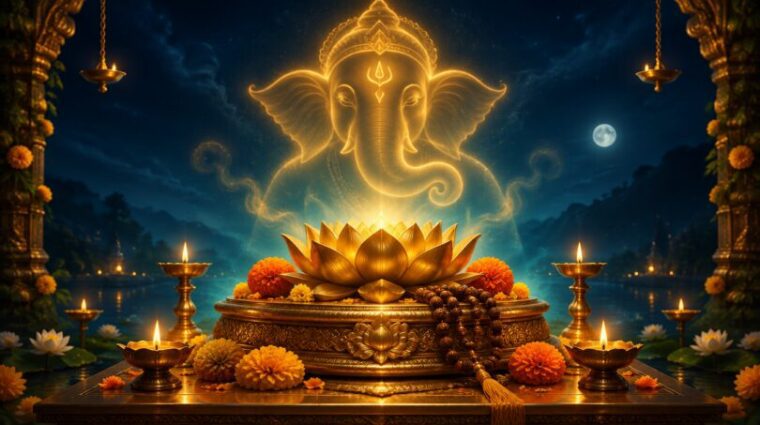
The Ganesh mantra most people mean is Om Gam Ganapataye Namaha, a Sanskrit chant that bows to Ganesha, the elephant-headed deity honored as the remover of obstacles and the lord of beginnings. It is short, easy to learn and traditionally chanted before starting something new.
This guide covers what the Ganesh mantra means word by word, how to pronounce it, five well-known Ganesha mantras, and a simple 11-minute practice. It also covers the respect this tradition deserves, because these words belong to a living faith, not a trend.
Key Takeaways
- The most widely chanted Ganesh mantra is Om Gam Ganapataye Namaha, a salutation to Ganesha, the remover of obstacles and lord of beginnings.
- Gam is the seed sound (bija) of Ganesha. Vakratunda Mahakaya is a classic verse asking for obstacle-free work.
- Traditional practice uses 108 repetitions on a mala, but a calm 11-minute round is a respectful place to begin.
- Ganesha is honored at the start of new ventures, on Wednesdays or Tuesdays in many homes, and during Ganesh Chaturthi.
- It began as devotion. Learn it with respect, and treat it as a practice, not a guarantee.
What Is the Ganesh Mantra?
A mantra is a sacred sound or phrase repeated with attention. The repetition is called japa. A Ganesh mantra, also searched as a Ganesha mantra, is any mantra addressed to Ganesha. Some are a few syllables, some are full verses, and one is a single seed sound.
The practice comes from Hinduism, where mantras are devotion first. People chant to Ganesha to ask for a clear path, steady wisdom and a good beginning. Many seekers outside the tradition also find the rhythm calming. Both can be true, and we will come back to how to hold them with respect.
Who Is Ganesha?
Ganesha, also called Ganapati, Vinayaka and Vighnaharta, is one of the most loved deities in Hinduism. He is honored first, before other prayers and ceremonies, which is why he is called the lord of beginnings. Vighnaharta means remover of obstacles. In some stories he is also the one who places obstacles, so that we learn to meet them well.
The elephant head is rich in symbolism, and traditions read it in several ways. These are common readings, not a single fixed rule:
- Large head: big thinking and wisdom.
- Large ears: listening more than speaking.
- Small eyes: focus and concentration.
- Trunk: flexibility, able to lift a tree or pick up a needle.
- One tusk: letting go of what is not essential.
- Mouse companion: mastery over restless desire.
Many traditions also place Ganesha at the root chakra, the center of stability and safety. If that interests you, our guides to the chakras and the root chakra go deeper. For the wider Hindu philosophical world he lives in, see our guide to Adi Shankara, who is traditionally credited with a famous hymn to Ganesha.
The Most-Used Ganesh Mantras at a Glance
| Mantra | Plain-English meaning | Often used for |
|---|---|---|
| Om Gam Ganapataye Namaha | Salutations to the lord of the hosts | Daily practice, new beginnings |
| Om Shri Ganeshaya Namah | Salutations to auspicious Lord Ganesha | Simple, gentle devotion |
| Vakratunda Mahakaya | Curved trunk, mighty body: free my work of obstacles | Before a project, exam or trip |
| Ganesh Gayatri | May the one-tusked, curved-trunk lord inspire our understanding | Meditative reflection |
| Gam (seed sound) | The bija, or seed, of Ganesha | Short, focused repetition |
Om Gam Ganapataye Namaha: Meaning and Word-by-Word Breakdown
This is the core Ganesha mantra. In careful transliteration it reads Oṁ Gaṁ Gaṇapataye Namaḥ. You will see Namah and Namaha both, because the final sound is an echo of breath.
| Word | Meaning |
|---|---|
| Om (Oṁ) | The primordial sound, the opening of most mantras |
| Gam (Gaṁ) | The seed sound associated with Ganesha |
| Ganapataye | To Ganapati, “lord of the ganas,” the hosts or attendants |
| Namaha (Namaḥ) | Bowing, salutation, “I honor” |
Put together: “Om. Gam. I bow to the lord of the hosts.” It is a greeting and an offering of attention, not a demand.
How Do You Pronounce Om Gam Ganapataye Namaha?
Sanskrit sounds are steady and even. The short “a” is the soft “u” in “but.” Take it slowly:
- Om: “ohm,” a long round o that ends in a closed-lip hum.
- Gam: “gum,” a hard g, ending in a nasal hum.
- Ganapataye: “guh-nuh-puh-tuh-yay,” five even syllables.
- Namaha: “nuh-muh-hah,” with a light breath at the end.
Together: ohm gum guh-nuh-puh-tuh-yay nuh-muh-hah. Listen to a teacher or a respected recording if you can, and let your ear refine it over time. Slight regional differences are normal. Sincerity matters more than a perfect accent.
Om Shri Ganeshaya Namah
Oṁ Śrī Gaṇeśāya Namaḥ means “Om, salutations to auspicious Lord Ganesha.” Shri signals something radiant and fortunate. Ganesha joins gana (host) and isha (lord). Pronounce it “ohm shree guh-NAY-shah-yah nuh-muh-hah.” This is the line many people write or say at the start of a notebook, a letter or a new venture.
Vakratunda Mahakaya: Meaning of the Classic Verse
This traditional shloka (verse) is one of the best known prayers to Ganesha:
Vakratuṇḍa mahākāya sūryakoṭi samaprabha
nirvighnaṃ kuru me deva sarvakāryeṣu sarvadā
In plain words: O lord with the curved trunk and mighty form, whose brilliance equals a million suns, please make all my undertakings free of obstacles, always. The words are close to this paraphrase, though translators phrase it a little differently.
Rough pronunciation: “vuk-ruh-TOON-duh muh-HAH-kah-yuh, SOOR-yuh-ko-tee suh-muh-PRUH-buh. neer-VIGH-nuhm KOO-roo may DAY-vuh, SUR-vuh-KAHR-yeh-shoo SUR-vuh-dah.” Read it slowly first, one line at a time.
Ganesh Gayatri Mantra
A gayatri-style mantra follows a three-part pattern: we know, we meditate, may we be inspired. A common version of the Ganesh Gayatri is Oṁ Ekadantāya vidmahe, Vakratuṇḍāya dhīmahi, tanno Dantī pracodayāt.
Roughly: “We turn our awareness to the one-tusked one. We meditate on the curved-trunk one. May that tusked lord inspire and guide our understanding.” Other versions exist in the tradition, so do not be surprised if a teacher uses different words.
Gam: The Seed Mantra of Ganesha
A bija, or seed mantra, is a single syllable considered to hold the essence of a deity or energy. Gam is Ganesha’s seed. Chanted on its own, it is a compact practice: one sound, one breath, one steady rhythm. Some people use it in the root-chakra region of the body as a focus. Others simply repeat it as an anchor for attention.
You will also meet longer forms, including a Ganesha moola mantra that adds phrases about removing all obstacles. These are best learned with a teacher or from a trusted recording, so you honor each syllable properly.
How to Chant a Ganesh Mantra
When Should You Chant It?
Tradition suggests several good moments. None is required.
- Before anything new: a project, a move, a conversation that matters.
- Mornings, when the mind is fresh.
- Wednesdays, which many households link with Ganesha, though some regions favor Tuesdays.
- Chaturthi days: the fourth day of each lunar fortnight, and above all Ganesh Chaturthi, the festival honoring his birth, held in late summer.
108 Repetitions and the Mala
Japa is traditionally counted on a mala. A standard mala has 108 beads plus a larger head bead that is not counted. You move one bead with each repetition, and when you reach the head bead you turn the mala around rather than crossing it.

Posture, Breath and Intention
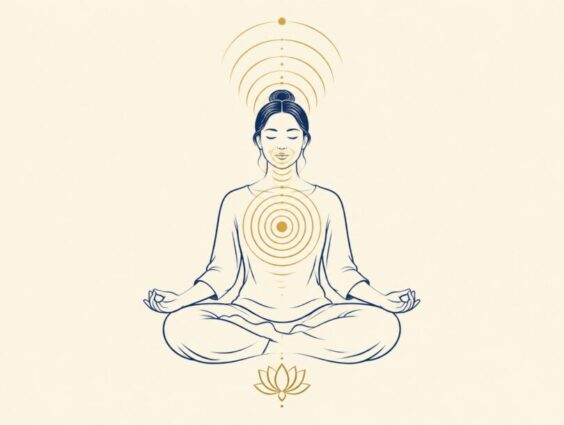
Sit comfortably on a cushion or a chair with a long, easy spine. Rest your hands on your knees or in a simple hand gesture (see our guide to mudra meanings). Let your breath settle before you begin. Chant on the exhale, and take the next breath naturally. Keep your jaw soft.
Set one clear, kind intention before the first round. “May I begin this with clarity” is plenty. Feeling thankful for the beginning itself is a good companion; our piece on the power of gratitude pairs well. If you are new to sitting still at all, start with our guide to how to meditate.
An 11-Minute Ganesh Mantra Practice
This is an original, simple routine for beginners. Use a timer if you like, and chant aloud, in a whisper or silently, whichever feels respectful and comfortable.
- Minute 1, arrive. Sit. Place a lamp or candle nearby if you wish. Take five slow breaths.
- Minute 2, set the intention. Name one thing you are beginning.
- Minutes 3 to 4, listen to the sound. Say “Om Gam Ganapataye Namaha” slowly three times, noticing the vowels.
- Minutes 5 to 9, steady rhythm. Repeat the mantra at an even pace. When the mind wanders, return gently to the next syllable, no scolding.
- Minute 10, whisper or silence. Let the sound go inward and feel the quiet after it.
- Minute 11, close. Bow your head, say thank you in your own words, and take the intention into your day.
If you would like to deepen the sitting itself, the Ancient Meditation course with Acharya Shunya teaches Vedic stillness practices step by step.
Common Mistakes to Avoid
- Rushing. A calm 11 rounds beat a hurried 108.
- Chasing perfect pronunciation. Aim for care, not performance.
- Treating it like a vending machine. It is a relationship with a quality, not a purchase.
- Forcing the breath. If you feel dizzy, stop and breathe normally.
- Mixing up the words. Learn the line once, correctly, from a good source.
- Skipping the pause. The silence after the chant is part of the practice.
Devotional Practice, Secular Use and Respect
Ganesha is a living deity for hundreds of millions of people. For them this is worship, not a wellness technique. If you are not Hindu, you can still chant with sincerity, but take care to learn the meaning, avoid joking or decorating with Ganesha images carelessly, and credit the tradition it comes from. Many Hindus ask that images of deities are never placed on the floor, on clothing or in a bathroom, so keep that in mind.
If you want to go further, seek out a Hindu teacher or a temple community. Practices like long mantra recitations, initiations and festival rituals carry lineage, and that belongs to the people who keep it. Your personal chanting at home is welcome; claiming authority over the tradition is another matter.
What People Report, and an Honest View
People who chant a Ganesh mantra often describe feeling calmer, more focused and more intentional when they start something new. Some say it gives a ritual shape to a fresh start. Others say the steady sound simply slows the mind down for a while.
That is lived experience, not a medical or scientific claim, and nobody can promise outcomes. A mantra will not remove every obstacle, and some obstacles are there to teach us. It is a practice that supports attention and intention. If you are struggling with anxiety, grief or your health, please also speak with a doctor or a licensed professional. In the US, you can call or text 988 at any time for the Suicide and Crisis Lifeline.
Conversations on Devotion, India and Sacred Tradition
Hearing from people rooted in the Indian spiritual world can bring these chants to life. Three conversations on the Next Level Soul Podcast offer a good next step.
Paramahamsa Vishwananda: Devotion and the Saint Babaji

Paramahamsa Vishwananda, a Hindu spiritual master known for the path of bhakti (devotion), speaks with Alex Ferrari about a young soul mission and the saint Babaji. It is a good window into how devotion is lived in the tradition. Watch the full episode and read the show notes.
Adam Schomer: The Himalayas and the Yogic Path

Adam Schomer shares a journey through the Himalayas and what he met along the yogic path. If the mountains and the yogis behind mantra practice call to you, start here. Watch the full episode and read the show notes.
Amish Shah: The Story of Dwarka

Amish Shah explores Dwarka, the ancient coastal city of Indian tradition linked to Lord Krishna. It offers context for the sacred world in which Ganesha and other deities are loved. Watch the full episode and read the show notes.
Sources and Further Reading
Spirituality for the Rest of Us™
Films, teachings and community on Next Level Soul TV.
Go Deeper with NLS Mastery: Ancient Meditation
Ancient meditation for inner stillness. Acharya Shunya teaches it in Ancient Meditation, part of NLS Mastery. Watch the course preview below.

Frequently Asked Questions
What is the Ganesh mantra?
The Ganesh mantra most often means Om Gam Ganapataye Namaha, a Sanskrit chant that honors Ganesha, the remover of obstacles. Other Ganesh mantras include Om Shri Ganeshaya Namah, Vakratunda Mahakaya and the Ganesh Gayatri.
What does Om Gam Ganapataye Namaha mean?
It means “Om, Gam, I bow to the lord of the hosts.” Gam is Ganesha’s seed sound, Ganapataye is “to Ganapati,” and Namaha is a salutation.
How do you pronounce Om Gam Ganapataye Namaha?
Say “ohm gum guh-nuh-puh-tuh-yay nuh-muh-hah.” The short a is soft like the u in “but,” and the final ha is a light breath.
What does Vakratunda Mahakaya mean?
It is a traditional verse that praises Ganesha as the curved-trunk, mighty-bodied lord with the brilliance of a million suns, and asks him to make our undertakings free of obstacles.
What is the most powerful Ganesh mantra?
Tradition does not rank them. Om Gam Ganapataye Namaha is the most widely used, and sincerity matters more than which one you pick.
How many times should I chant a Ganesh mantra?
The traditional count is 108, using a mala. Many beginners start with 11 repetitions or an 11-minute round, then build up.
When is the best time to chant to Ganesha?
Many people chant in the morning and before starting something new. Wednesdays are often linked with Ganesha, some regions favor Tuesdays, and Ganesh Chaturthi is the festival day.
Do I need initiation to chant a Ganesh mantra?
The simple Ganesha mantras are widely chanted without formal initiation. Longer practices and rituals are best learned from a teacher or temple community who hold the lineage.
What is the difference between Ganesha and Ganapati?
They are the same deity. Ganapati means “lord of the hosts” and Ganesha means “lord of the ganas.” Vinayaka and Vighnaharta are other names.
What does the Gam seed sound mean?
Gam is a bija, a seed syllable that tradition associates with Ganesha. It carries no dictionary meaning, and people use it as a focused, rhythmic chant.
Is it respectful for non-Hindus to chant a Ganesh mantra?
Yes, when done with sincerity and care. Learn what the words mean, honor Ganesha as a living deity, and credit the Hindu tradition it comes from.
Can mantra chanting replace medical care?
No. Chanting is a spiritual and contemplative practice, not a treatment. Please see a doctor or licensed professional for health concerns.