
The subconscious mind is the part of your mind that works below everyday awareness. It stores memories, habits, emotional reactions and beliefs, and it runs much of what you do without asking your permission first. Psychologists usually call this the unconscious or nonconscious mind. “Subconscious” is the popular word, and it is the one most seekers use.
Understanding it matters because it quietly shapes how you react, what you expect and what you keep repeating. The good news is that these patterns were learned, and what was learned can be understood, softened and rewritten. This guide walks through what the subconscious is, how beliefs form, the signs that a pattern is running the show, and gentle ways to work with it.
Key Takeaways
- The subconscious mind is the layer of mental activity outside your moment-to-moment awareness: habits, memories, emotional reactions and learned beliefs.
- Freud, Jung and modern cognitive science describe it differently, but all agree that much of mental life happens outside awareness.
- Beliefs usually form through early experience, repetition and strong emotion, long before we can question them.
- Common signs include repeating patterns, strong reactions that seem bigger than the moment, and self-sabotage.
- Gentle ways to work with it include meditation, journaling, guided hypnosis, careful affirmations and shadow work.
- Deep or painful material deserves support from a licensed professional, not just self-help.
What Is the Subconscious Mind?
Think of your mind as having a small lit room and a very large house around it. The lit room is your conscious mind: what you are noticing and thinking about right now. The rest of the house is everything else you carry. That includes memories you are not recalling this second, skills you perform without thinking, emotional reactions that fire before you decide anything, and the beliefs you absorbed about yourself and the world.
The word “subconscious” is not a formal term in most psychology textbooks. Researchers tend to speak of the unconscious, the nonconscious or implicit processes. In spiritual and self-development circles, subconscious is the everyday word for the same territory, and it is how we use it here.
It is worth saying plainly: nobody has measured the subconscious like a bucket of water. Anyone who gives you an exact percentage of how much of your day it runs is offering a figure that is repeated more often than it is proven. What we can say with confidence is that a great deal of what you do each day happens without deliberate attention, from brushing your teeth to flinching at a tone of voice.
Conscious vs Subconscious Mind at a Glance
The two are not separate rooms with a locked door between them. They work together all day. Still, it helps to see how they tend to differ.
| Quality | Conscious mind | Subconscious mind |
|---|---|---|
| Awareness | What you notice right now | Operates mostly outside awareness |
| Speed | Slower, deliberate, effortful | Fast, automatic, intuitive |
| Main job | Reasoning, choosing, planning | Habits, emotional reactions, pattern recognition |
| How it learns | Through study and logic | Through repetition, emotion and early experience |
| Everyday example | Deciding what to say in a hard conversation | Your stomach tightening before you speak |

Freud, Jung and Modern Science: How Different Thinkers See It
The idea that we are not fully aware of our own minds is old, but it entered modern thought through a few key people. Each describes it a little differently, and it is best to hold each view lightly rather than as settled fact.
Sigmund Freud
Sigmund Freud proposed that hidden wishes, memories and conflicts, especially from childhood, shape behavior even when we cannot recall them. His work opened the door to talking about the mind below awareness. Many of his specific theories have been debated or set aside since, but the central insight that we are not fully transparent to ourselves has endured.
Carl Jung
Carl Jung gave the unconscious a warmer, more spiritual face. He described a personal unconscious made from your own life, and a collective unconscious, a shared layer of symbols and patterns he called archetypes. He also named the shadow, the parts of ourselves we have pushed out of view. Jung saw the unconscious as a source of wisdom and meaning, not only a storehouse of problems. This is why shadow work, covered below, is so often tied to his name.
Modern cognitive science
Today, researchers study this territory with experiments rather than couch conversations. They look at implicit memory (what you remember without realizing it), automatic habits, and how quickly the mind sizes up a situation before you have thought it through. Some call this the adaptive unconscious. One area of study, priming, explores how subtle cues can nudge our responses. It is also a reminder to stay humble, because some well-known priming findings have been hard to reproduce.
The honest summary is this. The three views differ in tone and detail, yet they point the same direction: a lot of what moves us is happening beneath awareness, and awareness can grow.
How Do Beliefs Form in the Subconscious?
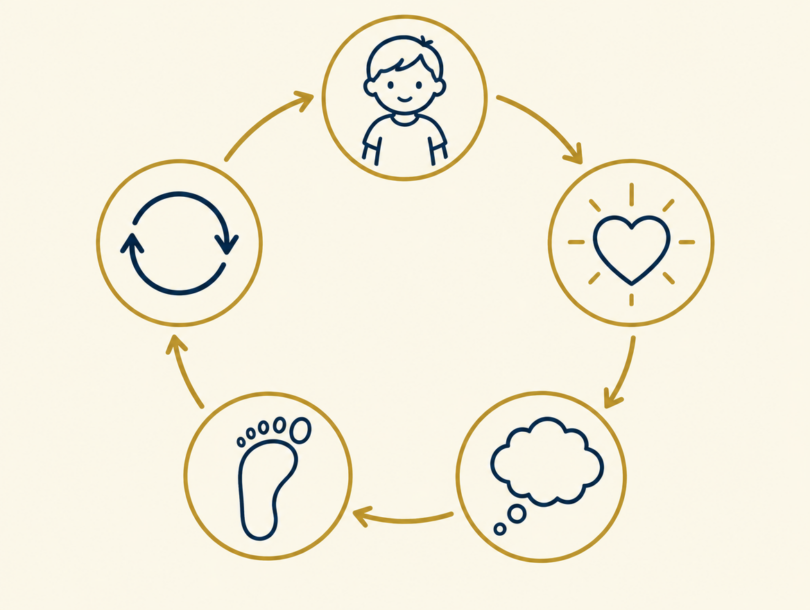
Most of our core beliefs were not chosen. They were absorbed. A child watches how the adults around them handle money, conflict, praise and love, and quietly draws conclusions: I am safe when I am quiet. Money is hard to come by. Love has to be earned. At that age we do not have the tools to question any of it, so the conclusion simply becomes the way things are.
Three ingredients tend to do most of the work:
- Early experience. The years when we are most open and least able to filter what we take in.
- Repetition. What we hear and see again and again becomes familiar, and familiar starts to feel true.
- Strong emotion. Moments of fear, shame, joy or loss tend to be remembered more deeply and can leave a lasting impression.
Once a belief is in place, it tends to protect itself. We notice evidence that fits it and overlook evidence that does not, so the belief appears to be proven by life. Then we act in line with it, which produces more of the same results.
Some teachers go further. In his Next Level Soul Podcast conversation, cell biologist Bruce Lipton describes subconscious programming as something that can pass from parent to child, and he talks about simple ways to change a program. You do not have to adopt every claim a teacher makes to find the question useful: whose voice is this, and did I ever agree to it?
What Are the Signs of Subconscious Patterns?
You cannot see a pattern from inside it, but you can see its footprints. Here are common signs that something below the surface is steering:
- The same story keeps repeating. Different job, different partner, same ending.
- Reactions bigger than the moment. A small comment lands like a punch, and you are not sure why.
- Self-sabotage. You get close to something you want, then stall, delay or talk yourself out of it.
- Automatic self-talk. A harsh inner voice that sounds like a parent, teacher or old critic.
- Knowing better but doing it anyway. Your intentions and your habits do not match.
- Body signals. A tight chest, clenched jaw or knotted stomach in certain situations, before any thought arrives.
- Strong judgments of others. Jung suggested that what irritates us in other people can point toward something we have not yet made peace with in ourselves.
Noticing one or two of these does not mean something is wrong with you. It means you are paying attention, which is the first step. If these patterns feel overwhelming or tied to painful experiences, please see a licensed mental health professional. In the United States, you can call or text 988 at any time if you are in distress.
How Can You Work With Your Subconscious Mind?
There is no single magic technique. The common thread across most approaches is the same: slow down, become aware, and offer the mind something new and believable, again and again. Here are the paths people use most often.
| Practice | What it does | A simple place to start |
|---|---|---|
| Meditation | Builds the ability to watch thoughts without being carried off by them | Five minutes of quiet breathing each morning |
| Journaling | Brings hidden beliefs into words you can read | Write what you tell yourself about a recurring problem |
| Guided hypnosis | Uses relaxed, focused attention to explore and suggest new responses | Work with a trained, qualified practitioner |
| Affirmations | Offers the mind a new statement to try on | Choose words you can believe a little |
| Shadow work | Meets the parts of yourself you have pushed away | Notice what triggers you, then ask what it touches |
Meditation
Meditation does not erase the subconscious. It helps you watch it. When you sit quietly and let thoughts come and go, you begin to notice the habitual ones: the worry loop, the self-criticism, the story you tell about yourself. That noticing is a form of freedom. If you are new to it, our guide to how to meditate is a gentle place to begin, and meditations for spiritual awakening offers more ways to sit with what arises.
Journaling
Writing slows the mind down enough to catch what usually flies by. Try finishing sentences such as “What I was taught about money is…” or “When someone criticizes me, I believe…” and write without editing. Researchers have studied expressive writing for decades, with mixed but often encouraging results. You are not looking for a perfect answer. You are collecting clues.

Hypnosis and theta states
Hypnosis is a state of relaxed, focused attention in which a person becomes more open to suggestion, while staying aware and in control. It is not mind control, and a person cannot be made to act against their values. Clinical hypnosis is studied for things such as pain and anxiety, and results vary from person to person. You can read more in this overview of hypnosis.
You will often hear hypnosis linked to theta brain waves, the slower rhythm (roughly 4 to 8 cycles per second) associated with drowsiness, dreamlike imagery and the moments between waking and sleep. Meditation and deep relaxation can also bring people into this kind of state. The research on how closely hypnosis and theta match is mixed, so it is more accurate to say that these are related ways of getting quiet enough to hear what is beneath the noise. If you try hypnosis, choose a trained, licensed practitioner and tell them about any history of trauma.
Affirmations, with care
Affirmations are positive statements repeated to shift a belief. They can help, and they can also backfire. If you say “I am completely confident” while every cell in your body disagrees, the mind may simply argue back. Some research suggests that statements too far from what a person believes can leave them feeling worse.
A kinder approach is to build a bridge. Instead of “I am wealthy,” try “I am learning to trust myself with money.” Instead of “I love my body,” try “I am willing to treat my body with respect.” Say it slowly, feel for even a small yes, and pair it with a real action. For more on why positive thinking alone does not do the whole job, see our guide to manifestation vs the law of attraction. Readers who like classic writing on the subject may also enjoy our study guide to The Game of Life and How to Play It.
Shadow work
Shadow work grows out of Jung’s idea that we all hide parts of ourselves, often the traits we were taught were unacceptable. Working with the shadow means getting curious about those parts rather than fighting them. A simple starting practice: when someone triggers you, pause and ask, What is this touching in me? When did I first learn to feel this way? Treat whatever comes up with the same kindness you would offer a friend. Shadow work can stir deep feelings, so go at your own pace and consider a therapist or experienced guide for heavier material.
How to Make Change Last
The subconscious learns through repetition and feeling, not through one big insight. That is why small, steady practice usually beats a single dramatic breakthrough. A few principles help:
- Start small. Five honest minutes a day is better than an hour you never do.
- Be consistent. The mind updates when new experiences repeat.
- Pair words with action. A new belief grows when you act in line with it, even a little.
- Be patient and kind. Harsh self-judgment tends to reinforce the very pattern you are trying to change.
- Get support when needed. A teacher, a community or a licensed professional can see what you cannot.
This is the heart of what we teach at Next Level Soul: the power is within you, and every teacher, book and practice is a guide to help you remember it. If you are curious where to go next, our list of top spiritual books and the NLS Mastery courses offer structured ways to keep going.
Podcast Conversations to Explore Next
These Next Level Soul Podcast conversations pair well with this guide.

Bruce Lipton: The Secret to Reprogramming Your Brain
Bruce Lipton, the cell biologist and author of The Biology of Belief, talks with Alex about how subconscious programming passes from one generation to the next and simple ways to change a program. A natural next listen after this guide. Watch the full episode and read the show notes.

Stephanie Kraft: Atheist Meets Jesus in a Near-Death Experience
Stephanie Kraft is a life between lives hypnotherapist and healer. She shares her spiritual awakening and her work with hypnosis. A fitting listen if you are curious how guided, relaxed states are used in practice. Watch the full episode and read the show notes.

Michael Bernard Beckwith: Being Fearless and Living with Intention
Michael Bernard Beckwith talks about asking better questions, living with intention and how changing what you look for can change what you see. A good companion for anyone working with their own beliefs. Watch the full episode and read the show notes.
Sources and Further Reading
Spirituality for the Rest of Us™
Films, teachings and community on Next Level Soul TV.
Go Deeper with NLS Mastery: The Stress Detox
What you take in, say and repeat each day shapes your inner world. In The Stress Detox, Marisa Liza Pell guides you to notice what you consume, choose what to release, and build calmer daily habits. A practical next step once you understand how your patterns form.

Frequently Asked Questions About the Subconscious Mind
What is the subconscious mind?
The subconscious mind is the part of mental activity that works outside everyday awareness. It holds habits, memories, emotional reactions and learned beliefs, and it shapes much of what you do automatically.
What is the difference between the conscious and subconscious mind?
The conscious mind is what you are aware of and can deliberately think about right now. The subconscious works in the background, faster and more automatically, and learns through repetition and emotion.
How much of the mind is subconscious?
No one knows an exact number. Researchers agree that a great deal of mental activity happens without awareness, but precise percentages repeated online are not well established.
How do subconscious beliefs form?
Most form in childhood through early experience, repetition and strong emotion. Because we absorb them before we can question them, they often feel like simple facts about life.
What are signs of subconscious patterns?
Common signs include repeating the same story in different settings, reactions bigger than the moment, self-sabotage, harsh automatic self-talk and body tension that arrives before a thought.
Can you reprogram your subconscious mind?
Many people find that patterns can soften over time with awareness, repetition and new experiences. It tends to be gradual, and no technique is guaranteed to work for everyone.
Does hypnosis work on the subconscious mind?
Hypnosis uses relaxed, focused attention and is studied for things like pain and anxiety, with varying results. It works best with a trained, licensed practitioner, and you stay aware and in control.
What are theta brain waves?
Theta is a slower brain rhythm, roughly 4 to 8 cycles per second, linked with drowsiness, dreamlike imagery and the moments between waking and sleep. It often comes up in talk of meditation and hypnosis.
Do affirmations work on the subconscious?
They can help when the words feel believable, and they can backfire when they feel far from what you believe. Gentle bridge statements paired with real action tend to land better.
What is shadow work?
Shadow work comes from Carl Jung and means getting curious about the parts of yourself you have pushed away. A simple start is to ask what a trigger is touching in you.
Is the subconscious mind the same as the unconscious mind?
They are used in much the same way. Psychologists prefer unconscious or nonconscious, while subconscious is the more common everyday term in spiritual and self-development circles.
When should I get professional help?
If your patterns feel overwhelming, tied to trauma or affect daily life, reach out to a licensed mental health professional. In the United States, you can call or text 988 at any time.