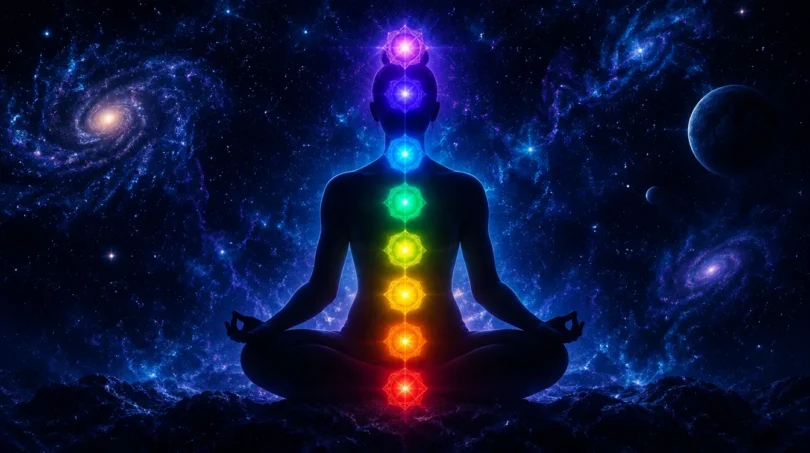
The seven chakra colors are red for the root, orange for the sacral, yellow for the solar plexus, green for the heart, blue for the throat, indigo for the third eye and violet or white for the crown. Each color points to a theme of life: safety, creativity, confidence, love, truth, insight and connection to something larger than yourself. This guide walks through every color, explains where the rainbow system actually came from, and shows simple ways to work with each one.
Most people meet chakra colors as a tidy rainbow on a poster. The deeper story is richer, and knowing it makes your practice clearer. Here you will find the meaning of each color, how it differs from your aura colors, and a gentle method for using color in meditation. For the full map of the energy system, start with our complete guide to the 7 chakras or the glossary entry on chakras.
Key Takeaways
- Seven colors, seven themes. Red is grounding, orange is creativity, yellow is confidence, green is love, blue is expression, indigo is insight and violet or white is spiritual connection.
- The rainbow is modern. The classical Sanskrit texts describe lotus petals, elements and seed sounds. The seven rainbow colors were added in the West in the twentieth century.
- Colors are a language, not a rulebook. Different teachers assign slightly different colors, so treat them as helpful symbols that you test against your own experience.
- Chakra colors differ from aura colors. Chakra colors describe fixed energy centers along the spine. Aura colors, as teachers describe them, shift with mood, health and awareness.
- Simple tools work best. Color visualization, breath, a matching crystal, a mantra or a color in your clothing and food can all support each center.
- Care comes first. If you are living with anxiety, low mood, dizziness or pain, speak with a doctor or mental health professional alongside any energy practice.
What Are Chakra Colors?
Chakra colors are the hues that modern spiritual teachers assign to the seven main energy centers of the body. The word chakra comes from Sanskrit and is usually translated as wheel or disk. In the classical yoga and tantra traditions, chakras are described as lotus-like centers stacked along the spine from the base to the crown of the head, and they are used as aids in meditation.
The colors tell you what each wheel is about. Warm colors at the bottom speak of body, survival and drive. Cool colors higher up speak of voice, vision and spirit. When you picture the colors rising from red to violet, you are tracing the same ascent that yogis describe as energy moving from earth toward awareness. The prana that practitioners work with is said to flow through all seven.
It helps to hold the colors lightly. They are a map, and a map is useful because it gives you a place to start. Your own felt sense, your breath and your life circumstances are the territory.
The 7 Chakra Colors at a Glance
This table pulls the main correspondences into one view. Colors follow the modern rainbow system. Petal counts, elements and seed sounds follow the classical lotus tradition.
| Chakra | Sanskrit name | Color | Location | Petals | Element | Seed sound | Core theme |
|---|---|---|---|---|---|---|---|
| Root | Muladhara | Red | Base of the spine | 4 | Earth | LAM | Safety and belonging |
| Sacral | Svadhisthana | Orange | Lower abdomen | 6 | Water | VAM | Creativity and pleasure |
| Solar Plexus | Manipura | Yellow | Upper abdomen | 10 | Fire | RAM | Confidence and will |
| Heart | Anahata | Green | Center of the chest | 12 | Air | YAM | Love and compassion |
| Throat | Vishuddha | Blue | Throat | 16 | Space | HAM | Truth and expression |
| Third Eye | Ajna | Indigo | Between the eyebrows | 2 | Light | OM | Insight and intuition |
| Crown | Sahasrara | Violet or white | Top of the head | 1,000 | Beyond elements | Silence or OM | Unity and spirit |
Some teachers use white at the crown, and others use violet. Both are common, and you can choose the one that feels true when you meditate. Notice that the table above includes a column most posters leave out: the petals. They are the oldest part of the system, and the colors came later.
The Meaning of Each Chakra Color
Each color carries a set of themes. Use these as prompts for reflection. If a chakra feels quiet or overactive in your life, spend a few minutes with its color and ask what it is asking you for.
Red: The Root Chakra
Muladhara, base of the spine, earth
Red is the color of blood, fire and life force, so it makes sense at the base of the spine. The root chakra governs the feeling of being safe in a body, in a home and on this planet. When teachers describe a balanced root, they describe steadiness, a sense of belonging and the ability to meet practical needs without panic.
When red feels out of tune, people describe feeling ungrounded, anxious about money or home, or disconnected from the body. To work with it, walk barefoot on the earth, eat warm, grounding foods, sit with a red stone and imagine a deep red light glowing at the base of the spine. A slow exhale as you silently say LAM is a classic touch. Our full guide to the root chakra goes further.
Orange: The Sacral Chakra
Svadhisthana, lower abdomen, water
Orange blends the vitality of red with the brightness of yellow. It is the color of creativity, pleasure, emotion and flow. The sacral chakra is linked with water, and the symbol of the moon in its lotus suggests tides and feeling. A balanced sacral center is described as playful, sensual in a healthy way and open to change.
When orange feels dim, people speak of creative blocks, numbness or a heavy relationship with pleasure. Try something that moves like water: a swim, a dance, a slow hip circle, a bath with orange slices nearby. Visualize a warm orange glow in your lower belly and let your breath rise and fall like waves.
Yellow: The Solar Plexus Chakra
Manipura, upper abdomen, fire
Yellow is the color of the sun, and manipura is often translated as jewel city. This is the center of personal power, confidence and the will to act. A balanced solar plexus is described as clear purpose, healthy boundaries and the courage to say yes and no.
If yellow feels weak, people talk about self-doubt, people-pleasing or an inability to start. If it feels overactive, they describe control and anger. Work with it through morning sunlight, a short core practice, a firm decision made and kept, and a bright yellow visualization behind the navel. Breathe in a golden light and exhale doubt. Silently chant RAM if it feels natural.
Green: The Heart Chakra
Anahata, center of the chest, air
Green is the color of living things, which is why it sits at the middle of the system, where lower and upper centers meet. Anahata means unstruck, the sound that arises without being made. The heart chakra is the seat of love, compassion, forgiveness and grief. A balanced heart is described as open and discerning at once.
When green feels closed, people describe guardedness, resentment or loneliness. Practices that tend to help include time among trees, gratitude lists, kind words to yourself and others, and a gentle hand on the chest while picturing a soft emerald light. Some teachers also use pink at the heart for tenderness. The long-form guide to the heart chakra includes a short practice.
Blue: The Throat Chakra
Vishuddha, throat, space
Blue is the color of sky and open space, so it fits the voice and the truth. Vishuddha means purest. A balanced throat center is described as speaking honestly, listening well and expressing creativity with confidence.
When blue feels blocked, people describe a tight throat, fear of speaking up or the opposite, speaking without listening. Humming, singing, chanting, journaling and honest conversation are the classic ways in. Visualize a clear sky blue light around the throat and let a long hum vibrate there. If you have a persistent sore throat or hoarseness, see a doctor first.
Indigo: The Third Eye Chakra
Ajna, between the eyebrows, light
Indigo is the deep blue of the night sky just before stars appear. Ajna means command, and in classical yoga it is where the teacher touches the seeker at initiation. Today it is linked to intuition, imagination and inner sight. Our guide to the third eye and pineal gland covers the lore and the science in depth.
When indigo is quiet, people describe confusion, lack of vision or distrust of their own knowing. Quiet time, dream journaling, candle gazing and meditation that rests attention gently between the eyebrows are common practices. Some people feel pressure or headaches when they push this center too hard, so keep it soft and short. See the glossary entry on the third eye for more.
Violet or White: The Crown Chakra
Sahasrara, top of the head, beyond the elements
Sahasrara means thousand-petaled, and it is described as the doorway to pure awareness. Violet carries the blend of red and blue, matter and spirit, and white holds every color at once. A balanced crown is described as a sense of connection to everything, a quiet trust and a feeling of being guided. Read more in the glossary entry on the crown chakra.
When violet feels distant, people speak of cynicism or spiritual restlessness. When it feels overwhelming, they describe floating and not wanting to be here. Silence, prayer, and simple meditation with a soft violet or white light above the head are classic practices. If you ever feel unmoored, return to red and green: eat, walk, call a friend.
Where Do Chakra Colors Come From?
This is the part most guides skip, and it makes your practice stronger. The classical chakra system does come from Indian tantra and yoga. A well-known text on it is the Sat-cakra-nirupana, translated into English around 1918 by Sir John Woodroffe, who wrote as Arthur Avalon. That text describes lotuses with different numbers of petals, along with elements, seed sounds and deities. It does not describe the seven-color rainbow.
The rainbow arrived in the West. According to the Theosophical Society’s Kurt Leland, the modern system came from many hands: Theosophists and clairvoyants, scholars of India, psychologists and healers. The writer Charles W. Leadbeater, a Theosophist, published The Chakras in 1927 and gave the centers their colors, and Leland notes that the rainbow colors and the list of qualities first appeared together in 1977. Wikipedia summarizes this history and notes that the colors are modern.
That does not make the colors meaningless. Symbols can be useful without being ancient, and countless people find that the color language gives them a quick, felt way to check in with the body. A fair approach is to honor the lineage, use the colors as a modern teaching tool and let your own experience be the test. Our chakra guide sets out the traditional framework in more detail.
Chakra Colors and Aura Colors
People often mix up chakra colors and aura colors. They are related ideas but they are not the same. Chakra colors are fixed correspondences, the same seven hues for the same seven centers. Aura colors are described as shifting, a field of color around the body that reflects mood, health and awareness at a given moment. In some teachings, each chakra radiates a layer of the aura, and that is where the two systems meet.
| Chakra colors | Aura colors | |
|---|---|---|
| What they describe | Seven energy centers along the spine | The energy field around the whole body |
| Do they change? | The color assignments stay fixed | The colors are said to shift with mood and health |
| How people work with them | Meditation, visualization, mantra, stones | Seeing, sensing, cleansing and protecting the field |
| Where to read more | Chakras guide | Aura colors guide |
If you want to go further into the field around the body, the Human Aura study guide and the glossary entry on the aura are good next steps.
How to Work With Chakra Colors
You do not need special equipment. The simplest way is a short color visualization, done at the end of a quiet sit.
A Five-Minute Color Meditation
- Sit comfortably and take three slow breaths. Let your shoulders drop.
- Bring your attention to the base of the spine and picture a warm red light. Breathe with it for about four breaths.
- Move up one center at a time: orange in the lower belly, yellow behind the navel, green in the chest, blue at the throat, indigo between the eyebrows and violet or white above the head.
- Rest for a moment with all seven colors glowing as one column of light.
- Return to the base, feel your seat on the floor, and open your eyes.
If one color feels blurry, thin or hard to picture, that can be a clue about where your attention needs to go that day. Do not force it. For more structured sits, try the meditation glossary entry and our mantra page.
Other Ways to Bring Color In
- Food. Eat a rainbow: red fruits and roots, orange citrus, yellow squash, leafy greens, blueberries and purple cabbage.
- Clothing and space. Wear or surround yourself with the color of the center you want to support.
- Stones. Many people pair a crystal with each color. See our guide to chakra stones and the broader guide to crystals for healing.
- Sound. Chant the seed sounds from the table above, or hum on a note that feels natural.
- Nature. Sunrise for red and orange, sunlight for yellow, forests for green, sky for blue, dusk for indigo and violet.
- Reflection. If several centers feel stuck, read our guide to blocked chakras for signs and gentle ways forward.
From the NLS Podcast: Energy, Light and Frequency
Color is one way of talking about energy, and several guests on the Next Level Soul Podcast describe the same territory in their own words. These episodes are not about chakra colors alone, but they show how teachers think about the energy body, vibration and light.
Julie Ryan on the Energy Field
Julie Ryan is a psychic medium and medical intuitive who came to this work from a career in the hospital supply business. She explains the energy field with the idea that the body is inside the spirit, and she believes thoughts carry a frequency. Watch the full episode and read the show notes.

Yogi Anand Mehrotra on Vibration and Layers of Reality
Yogi Anand Mehrotra talks with Alex Ferrari about Vedanta, consciousness, vibration and the many layers of reality. His view is that consciousness is the foundation, and that reality conforms to the perceiver. It is a good companion to the yogic roots of the chakra system. Watch the full episode and read the show notes.

Mariko Frederick on Frequency and Light Codes
Mariko Frederick is the author of Soul Priority and the guide behind astral therapy. She describes an astral imprint, a download that brings teachings through words, frequency and light codes. Watch the full episode and read the show notes.

A Note on Care
Chakra work is a reflective practice, not a medical one. Color visualization is gentle for most people, yet strong emotions, dizziness or a sense of disconnection can arise with any inward work. If you are experiencing persistent anxiety, low mood, chest pain, headaches, sleep problems or anything that worries you, please speak with a doctor or mental health professional. A good practitioner will welcome your spiritual practice alongside care. In the US you can call or text 988 at any time if you are in distress.
Go Deeper
- Chakras: The Complete Guide to the 7 Energy Centers
- Blocked Chakras: Signs, Causes and Gentle Ways to Restore Balance
- Aura Colors and Meanings
- Chakra Stones: Which Crystal Goes With Each of the 7 Chakras
- Energy healing in the glossary
- Kundalini in the glossary
Sources and Further Reading
Spirituality for the Rest of Us™
Movies, teachings and community on Next Level Soul TV.
Go Deeper with NLS Mastery: Raising Your Frequency
If you are ready to move from one level to the next with practical tools, this course is a direct path. Asil, a channeler and healer, guides you through raising your frequency step by step. Asil Toksal teaches it in Raising Your Frequency, part of NLS Mastery. Watch the course preview below.
Not Ready Yet? Explore the Free Masterclasses.
Frequently Asked Questions
What are the 7 chakra colors?
Red (root), orange (sacral), yellow (solar plexus), green (heart), blue (throat), indigo (third eye) and violet or white (crown).
What does each chakra color mean?
Red means safety and grounding, orange means creativity and pleasure, yellow means confidence, green means love, blue means honest expression, indigo means intuition and violet or white means spiritual connection.
Where do chakra colors come from?
The classical Indian texts describe petals, elements and seed sounds. The seven rainbow colors were added in the West, notably in Charles Leadbeater’s 1927 book The Chakras, and the modern system took shape over the following decades.
Are chakra colors the same as aura colors?
No. Chakra colors are fixed correspondences for seven energy centers. Aura colors are described as a changing field around the body that reflects mood and health.
What is the order of the chakra colors?
From the base of the spine upward: red, orange, yellow, green, blue, indigo, violet. This follows the order of the rainbow.
Is the crown chakra violet or white?
Both are used. Violet is the common rainbow assignment, and white is chosen by teachers who see the crown as holding every color at once.
What color is the third eye chakra?
Indigo, a deep blue-violet, is the usual color. Some teachers use deep purple.
Which chakra color is for love?
Green is the color of the heart chakra, linked with love, compassion and forgiveness. Some teachers add pink for tenderness.
How can I use chakra colors in meditation?
Sit quietly and picture each color glowing at its location, from red at the base of the spine to violet above the head, spending a few breaths on each. A five-minute version is outlined above.
Do I need crystals to work with chakra colors?
No. Crystals are optional. Color visualization, breath, sound, food and time in nature all work well, and many people enjoy adding a stone as a focus.
Can chakra colors be wrong or different for me?
Teachers differ, and colors are symbols rather than rules. If another shade feels true in your own practice, that is part of how the system lives.
Where can I learn more from Next Level Soul?
Start with the chakras guide, then explore the podcast episodes above on Next Level Soul TV and the NLS Mastery courses.