
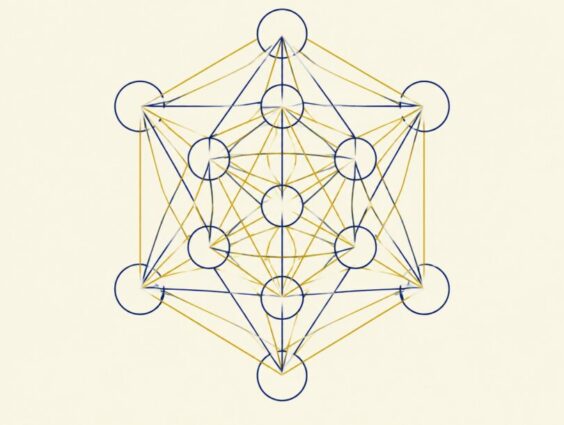
Metatron’s Cube is a sacred geometry symbol made of thirteen equal circles, with a straight line drawn from the center of each circle to the center of every other. Inside that web of lines, people trace flat outlines of all five Platonic solids, the basic building blocks of three-dimensional form. It takes its name from the archangel Metatron, though the symbol itself is a modern teaching and not an ancient Hebrew diagram.
That short answer carries a lot. This guide walks through how the symbol is built, who Metatron is in Jewish mystical tradition, how the cube relates to the Seed of Life and the Merkaba, what people say it means, and how to work with it in a simple, grounded way. We will also be honest about what is tradition and what is modern.
No gatekeeping here. You do not need a belief system, a pendant or a teacher to sit with a beautiful pattern and let it settle you. You only need a few quiet minutes.
Key Takeaways
- Metatron’s Cube is thirteen equal circles with straight lines joining the center of every circle to every other center.
- Its lines can be read as flat outlines of all five Platonic solids: the tetrahedron, cube, octahedron, dodecahedron and icosahedron.
- It is named for Archangel Metatron, but the symbol itself is a modern sacred geometry teaching, not an ancient Hebrew diagram.
- It grows out of the Seed of Life and the Flower of Life, and it holds the shape behind the Merkaba.
- People work with it as a focus for meditation, a reminder of wholeness and order, and a symbol to keep in view. It is a support, not a cure or a shield.
What Is Metatron’s Cube?
Metatron’s Cube is a figure built from thirteen circles of the same size: one in the center, six in a ring around it, and six more in an outer ring. Every circle center is then joined by a straight line to every other center. That gives 78 pairings, though many lie along the same line, so the finished picture looks calmer than the number suggests.
The result is a pattern of triangles, squares, hexagons and a six-pointed star, all nested and perfectly symmetrical. Spiritual teachers often describe it as a map of how one source divides into many forms while staying whole. That is a symbolic reading, and it is a lovely one to hold while you look.
How Is Metatron’s Cube Built?
The pattern grows in stages, and each stage has its own name in sacred geometry.
| Stage | What you draw | Circles |
|---|---|---|
| Seed of Life | One circle, then six more around it, each centered where the circles meet | 7 |
| Flower of Life | The same overlapping pattern repeated outward, commonly shown with | 19 |
| Fruit of Life | Thirteen of those circles, taken as a set of equal spheres | 13 |
| Metatron’s Cube | Lines connecting the centers of the thirteen Fruit of Life circles | 13 |
So the cube is not a separate invention that sits apart from the other symbols. It is the same family of circles, with a new layer of lines drawn through their centers. Our guide to the Seed of Life shows the very first step of that growth.
The Five Platonic Solids Inside the Cube
A Platonic solid is a three-dimensional shape whose faces are all the same regular polygon and whose corners all look alike. There are exactly five of them. In the lines of Metatron’s Cube you can pick out the outline of each one, drawn flat, the way a shadow shows the shape of an object.
| Solid | Faces | Corners | Edges | Plato linked it to |
|---|---|---|---|---|
| Tetrahedron | 4 | 4 | 6 | Fire |
| Cube (hexahedron) | 6 | 8 | 12 | Earth |
| Octahedron | 8 | 6 | 12 | Air |
| Dodecahedron | 12 | 20 | 30 | The heavens, or the whole cosmos |
| Icosahedron | 20 | 12 | 30 | Water |
That last column comes from the Greek philosopher Plato, who matched four of the solids to the classical elements and the fifth to the cosmos itself. It is a nice bridge between geometry and symbolism, and our guide to the four elements explores the elements side of that idea.
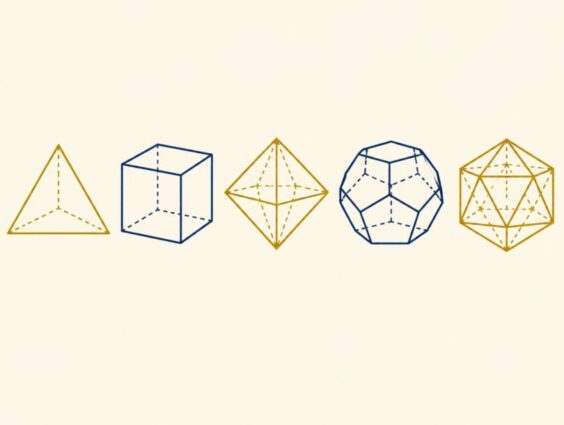
One note of care. The cube is a two-dimensional drawing, so these are projections, not the solids themselves. Even so, finding all five inside one figure is why teachers call it a pattern of the whole.
Who Is Archangel Metatron?
Metatron is an angel in Jewish tradition. He is named in the Talmud and appears again in the Hekhalot texts of early Jewish mysticism, especially the work known as Third Enoch. There he is described as the figure Enoch became after being taken up to heaven, and he is often pictured as a heavenly scribe and a prince close to the divine presence.
Later Kabbalistic writing and modern angel teaching have added more. Today Metatron is often linked with record keeping, sacred geometry and the flow of light into form. If you would like the wider picture of how angels are described across traditions, start with our guides to the archangels and angels.
Here is the honest part. No ancient text draws a thirteen-circle cube and calls it Metatron’s. The pairing of the name and the pattern is a modern one, popularized in late twentieth century sacred geometry teaching. That does not make it empty. It means the symbol should be met as a modern contemplative tool, not presented as a relic.
Metatron’s Cube, the Seed of Life and the Merkaba
These three symbols are close cousins, and people often meet them together.
| Symbol | Shape | How it connects |
|---|---|---|
| Seed of Life | Seven overlapping circles | The first stage of the pattern, and the root of the cube |
| Flower of Life | Repeating overlapping circles | The larger field the thirteen circles are drawn from |
| Merkaba | Star tetrahedron, two interlocking tetrahedra | Appears inside the cube as the six-pointed star |
| Metatron’s Cube | Thirteen circles joined by lines | The container that holds the other forms |
The six-pointed star in the middle of the cube is the flat outline of a star tetrahedron, which is the symbol many teachers call the Merkaba. If you want the origin of that word in the Book of Ezekiel and the modern light-body teaching, read our full guide to the Merkaba.
What Does Metatron’s Cube Mean Spiritually?
Meaning here is a matter of tradition and personal resonance, not proof. These are the readings people most often bring to the symbol.
Wholeness within variety
Thirteen circles, one pattern. The cube pictures many separate points that all belong to a single design. For many seekers it is a quiet reminder that nothing in the picture is left out.
Order beneath form
The Platonic solids are the simplest regular shapes in three dimensions. Seeing them inside one figure suggests an underlying order, which is a comforting idea when life feels scattered.
Balance and centering
The pattern is perfectly balanced around its center. People often use that symmetry to practice steadiness, returning attention to a single middle point.
Protection, held loosely
Some traditions treat Metatron as a protector, and the cube is sometimes worn or displayed with that intention. We would hold this one gently. A symbol can be a meaningful anchor for your intention, but it does not replace practical care for your safety and wellbeing.
How to Use Metatron’s Cube: Four Simple Ways
You do not need to do all of these. Pick the one that feels natural and keep it simple.
1. A gazing meditation
Place a printed image of the cube at eye level, about an arm’s length away. Sit comfortably, let your eyes soften, and rest your gaze on the center circle. Breathe slowly. When your attention drifts, return to the center. Five to ten minutes is plenty. If you are new to sitting practice, our guide to how to meditate is a good companion.
2. A visualization
Close your eyes and picture a single point of gold light at your heart. Let it expand into a circle, then see six more circles bloom around it, then six more. Finally, see fine lines of light join them. Hold the whole figure for a few breaths, then let it dissolve and rest in the quiet.

3. A practice we call Thirteen Breaths
This is an original practice for this guide, not a traditional rite. Sit and breathe naturally. On the first breath, rest attention on the center circle. On breaths two through seven, move attention around the inner ring, one circle per breath. On breaths eight through thirteen, move around the outer ring. Finish with one slow breath that holds the whole figure at once. If you like, rest your hands in a comfortable gesture; our guide to mudra meanings offers gentle options.
4. Placing the symbol
Some people keep the cube as a print on a wall, a sketch in a journal, a pendant or a small tile on a desk. Treat it as a visual cue that brings you back to your center. Choose a spot you see often, and let it remind you to pause and breathe.
A short care note: if any visualization leaves you anxious, dizzy or unsettled, open your eyes, feel your feet on the floor and stop. These practices are for reflection and are not a substitute for medical or mental health care. If you are in crisis in the United States, call or text 988.
What Is Tradition and What Is Modern?
| Claim | Where it stands |
|---|---|
| Metatron is an angel in Jewish tradition | Well supported by the Talmud and Hekhalot texts |
| Enoch became Metatron | A teaching found in Third Enoch |
| Overlapping circle patterns are ancient | Similar patterns appear in art from many places; their meaning varies |
| The thirteen-circle cube is Metatron’s symbol | A modern association from sacred geometry teaching |
| All five Platonic solids appear in outline | True as a geometric drawing |
| The cube gives guaranteed protection | A personal belief, not a verified effect |
Holding these lines clearly lets you enjoy the symbol fully, without being asked to believe more than is true.
Common Misconceptions About Metatron’s Cube
It is not a 3D cube. The name is a nod to the cube hidden among the solids, but the figure itself is flat.
It is not an ancient Hebrew seal. The angel is traditional. The pattern’s name is modern.
It is not a magic shield. Treating any symbol as a guarantee can pull attention away from your own steadiness, which is where the power lives.
More lines do not mean more power. A simple sketch you actually sit with serves you better than an elaborate print you never look at.
You do not need to be religious. People from many backgrounds, and from none, use geometry as a way to quiet the mind.
Podcast Conversations to Explore Next
These Next Level Soul podcast conversations touch the ideas around Metatron, Enoch and sacred geometry.

Robert Edward Grant: The True Story of St. Germain and Metatron
Robert Edward Grant is a researcher and author known for his work on geometry, number patterns and ancient sites. Here he turns to the figure of Metatron. A natural listen for anyone curious about the angel behind the cube. Watch the full episode and read the show notes.

Ibrahim Karim: BioGeometry and Accessing Different Realms of Reality
BioGeometry founder Ibrahim Karim explains how human perception changed, what multi-dimensional time means, and how to live in serenity. Hear the episode. Watch the full episode and read the show notes.

Randall Carlson: Cataclysms, Atlantis and Gobekli Tepe
Randall Carlson is a builder and researcher widely known for teaching sacred geometry and for his work on ancient history. A good companion if the geometry itself is what draws you. Watch the full episode and read the show notes.
Sources and Further Reading
Spirituality for the Rest of Us™
Films, teachings and community on Next Level Soul TV.
Go Deeper with NLS Mastery: The Language of Angels
Metatron is often described as the angel of sacred geometry. If you feel drawn to the angelic realm, you can learn how to hear its language and receive guidance. David Christopher Lewis teaches it in The Language of Angels, part of NLS Mastery. Watch the course preview below.
Frequently Asked Questions About Metatron’s Cube
What is Metatron’s Cube?
Metatron’s Cube is a sacred geometry symbol of thirteen equal circles joined by straight lines through their centers. Its lines contain flat outlines of all five Platonic solids. It is named for the archangel Metatron.
How many circles are in Metatron’s Cube?
There are thirteen: one in the center, six in an inner ring and six in an outer ring. This thirteen-circle set is taken from the Flower of Life and is sometimes called the Fruit of Life.
What does Metatron’s Cube mean spiritually?
People most often read it as a symbol of wholeness, order, balance and centering. Those meanings come from modern sacred geometry teaching and personal resonance, not from a single ancient source.
Who is Archangel Metatron?
Metatron is an angel named in the Talmud and described in Third Enoch, a work of early Jewish mysticism, as the figure Enoch became. He is often pictured as a heavenly scribe close to the divine presence.
What are the Platonic solids in Metatron’s Cube?
They are the tetrahedron, cube, octahedron, dodecahedron and icosahedron. Each can be traced in outline within the lines of the figure, drawn flat like a shadow.
What is the difference between Metatron’s Cube and the Flower of Life?
The Flower of Life is a larger field of repeating overlapping circles. Metatron’s Cube uses thirteen of those circles and adds straight lines joining their centers.
Is Metatron’s Cube related to the Merkaba?
Yes. The six-pointed star inside the cube is the flat outline of a star tetrahedron, the shape many teachers call the Merkaba. The two symbols are often studied together.
Is Metatron’s Cube ancient?
The angel Metatron appears in ancient Jewish texts, and overlapping circle patterns appear in art from many cultures. The specific thirteen-circle figure named Metatron’s Cube is a modern association.
How do you meditate with Metatron’s Cube?
Place an image at eye level, soften your gaze and rest attention on the center circle while breathing slowly. When your mind wanders, return to the center. Five to ten minutes is enough.
Is Metatron’s Cube a symbol of protection?
Some people treat it as a protective symbol and keep it in view for that intention. It works best as an anchor for your own focus, and it does not replace practical care for your safety.
Why is it called a cube if it is flat?
The figure itself is flat. The name nods to the cube that can be found among the five Platonic solids inside its lines.
Can I use Metatron’s Cube if I am not religious?
Yes. Many people use sacred geometry purely as a calming focus for attention, with no religious framework at all.