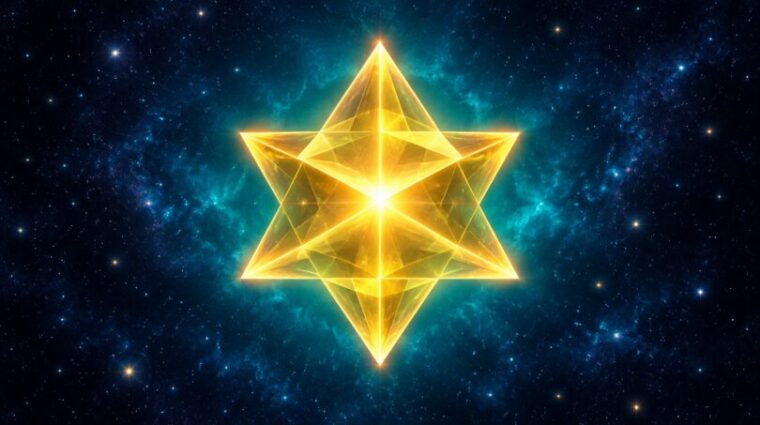
Merkaba meaning depends on who you ask. In Jewish tradition, merkavah (also spelled merkabah) is the Hebrew word for chariot, and it names the divine throne-chariot the prophet Ezekiel saw in a vision. In modern spiritual teaching, a merkaba is a field of light shaped like a star tetrahedron: two interlocking pyramids, one pointing up and one pointing down, often described as a vehicle for body, mind and spirit.
Both meanings are real, and they are not the same thing. One comes from ancient scripture and a mystical lineage. The other grew out of twentieth century New Age teaching and sacred geometry. This guide keeps them side by side so you can see where each one begins, what the shape actually is, what people find meaningful in it, and how to sit with it in a gentle, grounded way.
No gatekeeping here. Whether you met the merkaba in a book, a meditation or a necklace, you are welcome to explore it with curiosity and keep what rings true for you.
Key Takeaways
- In Hebrew, merkavah means chariot, the throne-chariot in the first chapter of the Book of Ezekiel.
- The modern merkaba symbol is a star tetrahedron: two interlocking tetrahedra, one up and one down.
- The idea of the merkaba as a light body comes from modern teachers, not from ancient Egyptian sources.
- People often link it to balance, protection and ascension, and to the Seed of Life and Metatron’s Cube.
- A gentle merkaba meditation needs only grounding, easy breathing and imagination. Never hold your breath.
What Is a Merkaba?
A merkaba is two things depending on the setting. Historically, it is the chariot-throne of God in Jewish mystical writing. In modern sacred geometry and spiritual practice, it is a luminous, counter-balanced shape made of two tetrahedra, usually pictured spinning around the body like a field of light.
People who work with the modern idea often describe the merkaba as a vehicle. It carries awareness the way a chariot carries a rider. That is a metaphor many seekers find helpful, and it is worth holding as a metaphor first.
Where Does the Word Merkaba Come From?
The word is Hebrew. Merkavah (מרכבה) means chariot or vehicle. It appears in the Hebrew Bible in the sense of a chariot, and it became a technical term in Jewish mysticism for the heavenly chariot described in the opening chapter of the Book of Ezekiel.
In that vision, Ezekiel sees four living creatures, wheels within wheels, a sapphire throne and a figure of radiant fire above it. Later Jewish mystics meditated on this scene. A body of writing known as the Hekhalot literature describes visionary journeys through heavenly palaces toward the throne. Scholars call this tradition Merkabah mysticism, and its roots reach back to the early centuries of the common era.
Notice what is not in that picture. There is no star tetrahedron, no spinning pair of pyramids, and no breathing technique. The chariot is a vision of divine presence and the soul’s ascent toward it.
How Did the Merkaba Become a Light-Body Symbol?
In the late twentieth century, the word was picked up by modern spiritual teachers and joined with sacred geometry. The most widely known version comes from Drunvalo Melchizedek and his Flower of Life teachings, which present the merkaba as a counter-rotating field of light around the human body. In his teaching, the word is split into three parts, often explained as light, spirit and body.
That breakdown, and the claim that it comes from ancient Egypt, is a modern teaching. It is not drawn from surviving ancient Egyptian texts, and Egyptologists do not recognize it as an Egyptian term. It is best understood as a contemporary spiritual framework that borrowed a Hebrew word and a geometric shape.
That does not make it meaningless. Plenty of living traditions are modern. It just helps to be clear about the source, so respect goes where it belongs: to Jewish mysticism for the word, to geometry for the shape, and to modern teachers for the light-body practice.
The Star Tetrahedron: The Geometry Behind the Merkaba
A tetrahedron is the simplest solid in three-dimensional space: four triangular faces, four corners, six edges. Place a second tetrahedron upside down inside the first so the two interlock, and you get the star tetrahedron, which mathematicians call the stella octangula. Seen from the side, it looks like a six-pointed star.
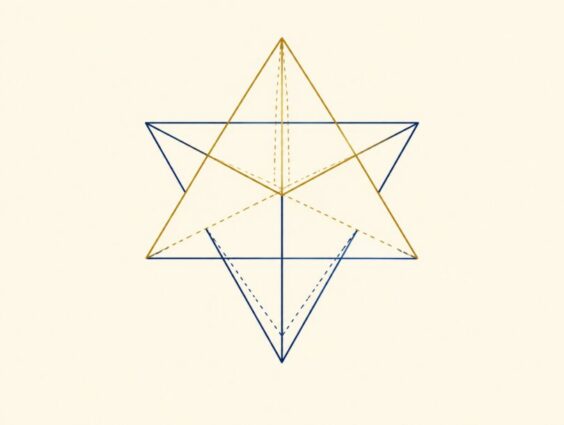
| Feature | Star tetrahedron at a glance |
|---|---|
| Parts | Two tetrahedra, one pointing up and one pointing down |
| Corners | Eight in total, the same eight corners as a cube |
| Shared center | Where the two shapes overlap, they form an octahedron |
| Symmetry | Perfectly balanced, each shape mirrors the other |
| Family | Built from the tetrahedron, the first of the five Platonic solids |
The five Platonic solids are the tetrahedron, cube, octahedron, dodecahedron and icosahedron. They are the only solids whose faces are all identical regular shapes. Many sacred geometry teachers treat them as basic building blocks of form, which is part of why the star tetrahedron feels so foundational to people.
Merkaba and the Seed of Life, Flower of Life and Metatron’s Cube
Sacred geometry teachers like to show how simple shapes grow into one another. It usually starts with circles. The Seed of Life is seven overlapping circles: one in the center and six around it. Keep repeating the pattern and you get the Flower of Life, a larger field of overlapping circles. Connect the centers of thirteen of those circles with straight lines and you get Metatron’s Cube, a figure named for the archangel Metatron.
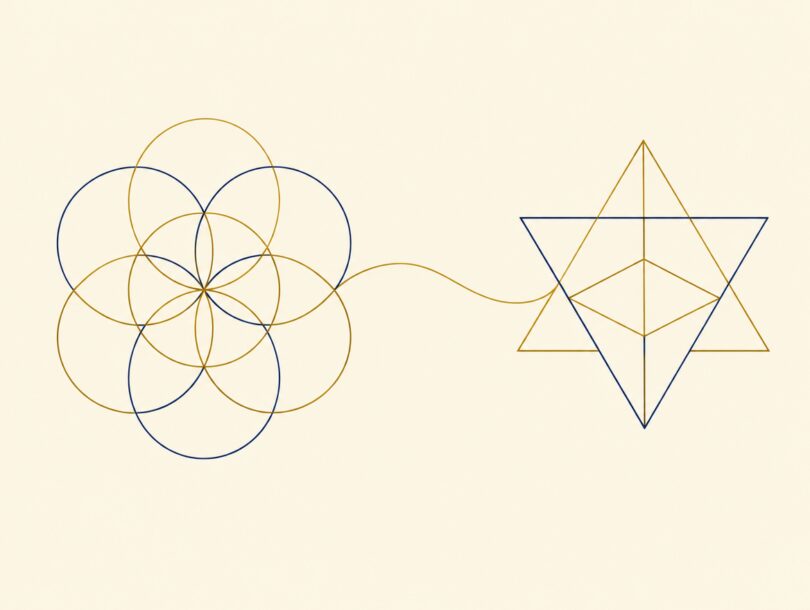
Inside those line drawings, people find the outlines of the Platonic solids, including the star tetrahedron. That is the link the merkaba draws on. The circles stand for the field, the lines stand for structure, and the star tetrahedron stands for a balanced vehicle moving through it. If you want the circle side of the story, our guide to the Seed of Life walks through the pattern step by step.
Metatron has his own place in spiritual lore, and the figure bearing his name is usually presented as a map of all the Platonic solids in one drawing. For more on the archangel, see our guide to angels and archangels.
What Does the Merkaba Symbolize?
Meanings differ from teacher to teacher. These are the themes that come up most often, offered as ways people interpret the symbol rather than as facts about the world.
A vehicle or light body
The most common idea is that the merkaba is a field of light around the body, a kind of vehicle for the spirit. If you know the energy body language of auras and chakras, it may feel familiar. Our human aura study guide and chakras guide explore similar territory.
Balance of masculine and feminine
Two triangles, one reaching up and one reaching down, are read as complementary forces: giving and receiving, spirit and matter, sun and earth. Neither is greater than the other. The symbol only works because they hold each other in place.
Protection and centeredness
Many people picture the shape as a boundary of light that keeps them steady. Treat that as an image for feeling grounded, not as a guarantee of safety. Real protection still looks like rest, good boundaries and good people around you.
Ascension and higher dimensions
In modern teachings the merkaba is also called a vehicle for moving between states of awareness or dimensions. If that idea interests you, explore the third dimension and fifth dimension guides for the wider map those teachings use.
Jewish Merkabah Mysticism vs Modern Merkaba
The two uses of the word are easy to blur together. This table keeps them apart.
| Question | Jewish Merkabah mysticism | Modern New Age merkaba |
|---|---|---|
| What it is | The divine throne-chariot from Ezekiel’s vision | A star tetrahedron field of light around the body |
| Where it comes from | Hebrew Bible and Hekhalot texts | Twentieth century sacred geometry and light-body teachings |
| Main purpose | Visionary ascent toward the divine throne | Balance, protection and expanded awareness |
| Key image | Living creatures, wheels, throne | Two interlocking tetrahedra |
| Practice | Contemplation, prayer and visionary meditation within a Jewish framework | Visualization and, in some teachings, specific breathing methods |
| Source of the word | Hebrew merkavah, chariot | Borrowed from Hebrew and reinterpreted |
A Gentle Merkaba Meditation
Some modern merkaba teachings use detailed breathing patterns, including holding the breath. This meditation does not. It uses grounding, easy natural breathing and imagination, so you can try it safely and let your own experience guide you. It takes about ten minutes.
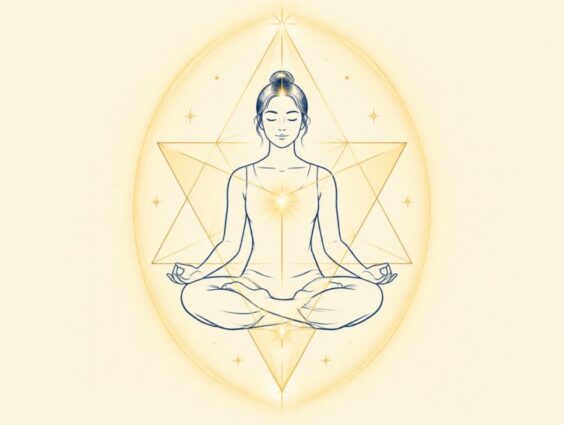
- Settle. Sit comfortably with your spine tall and your hands resting in your lap. If you like, try a gesture from our guide to mudra meanings. Let your eyes close.
- Ground. Feel your weight in the chair or floor. Picture a soft gold cord from the base of your spine into the earth.
- Breathe naturally. Let the breath move on its own, easy and unforced. Do not hold it, and do not change it. Simply notice it for a minute or two.
- Imagine the upward triangle. Picture a pyramid of gold light with its point above your head and its base beneath your feet, resting around your body.
- Imagine the downward triangle. Picture a second pyramid, softer and blue-white, pointing toward the earth below you and spreading its base around your shoulders.
- Let them interlock. See the two shapes meet at your heart as one balanced star. There is no need to spin it or speed it up. Let it rest, glowing quietly.
- Rest in the field. Stay for a few minutes. Notice any warmth, steadiness or stillness. If nothing stands out, that is fine.
- Return. Let the image soften and fade. Feel your feet and hands, take a slow breath, and open your eyes.
Care note: This meditation is for relaxation and reflection, not medical advice. Never hold your breath or push your breathing during any meditation. Stop and return to normal breathing if you feel dizzy, lightheaded or anxious. If you live with panic attacks, a respiratory condition or a heart condition, skip any breathing exercises and keep to simple visualization, and check with your doctor first. If you are in distress, reach out to a trusted person or call or text 988 in the United States. For more options, see our guide to how to meditate.
What Is Tradition and What Is Evidence?
The geometry of the star tetrahedron is solid mathematics. The history of Merkabah mysticism is a real field of scholarship. The idea of the merkaba as an energy field around the human body belongs to spiritual tradition, and science has not measured it, so hold it as a lived practice and a symbol rather than a proven fact.
Nothing here asks you to believe anything. Many seekers find that quiet visualization helps them feel centered, and that is a perfectly good reason to practice.
Common Mistakes and Myths About the Merkaba
- Myth: It is an ancient Egyptian symbol. The light-body version is a modern teaching. The word itself is Hebrew.
- Myth: Merkabah mysticism is the same as New Age merkaba. They share a word, not a practice.
- Mistake: Forcing the breath. No visualization needs breath-holding. Anything that makes you dizzy is a signal to stop.
- Mistake: Treating it as a shield. It is an image for steadiness, not a substitute for rest, boundaries or care.
- Mistake: Chasing special experiences. Quiet and calm are enough. Visions are optional.
- Mistake: Skipping the source. If the Jewish tradition fascinates you, read it on its own terms and with respect.
How to Bring the Merkaba Into Daily Life
You do not need a special ritual. The merkaba’s gift is balance, and balance can be practiced anywhere.
Before a hard conversation, picture the two triangles meeting at your heart and take one easy breath. When you feel scattered, find your feet on the floor and let your shoulders drop. At night, imagine a soft light settling around you and let the day go. If you like symbolic maps, you might also enjoy our guide to astrology, another way people look for patterns that help them understand themselves.
The point is not to build a perfect spinning shape. It is to remember that you already hold both sides: effort and ease, reaching and receiving.
Podcast Conversations to Explore Next
These Next Level Soul Podcast conversations pair well with this guide.

Amanda Ellis: Channeling Metatron and Humanity’s Future
Amanda Ellis is a channel and color therapist. She shares messages she says come from Archangel Metatron about living from the heart and what humanity may create once fear is released. A fitting listen if the Metatron side of sacred geometry draws you. Watch the full episode and read the show notes.

Geoffrey Drumm: The Great Pyramid and Lost Ancient Technology
Geoffrey Drumm shares his research into the Great Pyramid and what he says it was built to do. A good companion for anyone curious about ancient design, geometry and the claims people attach to Egypt. Watch the full episode and read the show notes.

Jonathan Goldman: Sound, Humming and Prayer
Author and sound healing teacher Jonathan Goldman explores sound, music, humming and prayer, and shares a simple humming practice anyone can try. A gentle way to work with frequency and the body. Watch the full episode and read the show notes.
Sources and Further Reading
Spirituality for the Rest of Us™
Films, teachings and community on Next Level Soul TV.
Go Deeper with NLS Mastery: Raising Your Frequency
Explore what frequency really means, settle into stillness, and learn to witness your inner state with gentle awareness. Asil Toksal teaches it in Raising Your Frequency, part of NLS Mastery. Watch the course preview below.

Frequently Asked Questions About the Merkaba
What does merkaba mean?
In Hebrew, merkavah means chariot, and it refers to the divine throne-chariot in the Book of Ezekiel. In modern spiritual teaching, a merkaba is a field of light shaped like a star tetrahedron.
What is a merkaba?
A merkaba is either the heavenly chariot of Jewish mysticism or, in modern New Age teaching, a counter-balanced field of light made of two interlocking tetrahedra. The two uses share a word but not a practice.
What is the merkaba symbol?
The merkaba symbol is the star tetrahedron: two tetrahedra, one pointing up and one pointing down, interlocked so that they look like a six-pointed star from the side.
What is a star tetrahedron?
A star tetrahedron, or stella octangula, is a compound of two tetrahedra with eight corners in total. It is a well-known shape in geometry and sacred geometry.
Is the merkaba from ancient Egypt?
The word is Hebrew. The idea that it comes from ancient Egyptian words is a modern teaching, popularized by Drunvalo Melchizedek, and it is not drawn from surviving ancient Egyptian texts.
What is the difference between Merkabah mysticism and the modern merkaba?
Merkabah mysticism is a Jewish tradition of visionary ascent toward the divine throne described in Ezekiel. The modern merkaba is a light-body and sacred geometry idea from the twentieth century.
What does the merkaba symbolize spiritually?
People commonly read it as a vehicle or light body, a balance of masculine and feminine energies, a sense of protection and a path of expanded awareness. These are interpretations, not proven facts.
How does the merkaba relate to the Seed of Life and Flower of Life?
The Seed of Life grows into the Flower of Life, and drawings within it and within Metatron’s Cube can trace the Platonic solids, including the star tetrahedron. Teachers use this to show how simple circles lead to balanced forms.
What is merkaba meditation?
Merkaba meditation is a visualization of two interlocking tetrahedra of light around the body. Some teachings add specific breathing patterns, but a gentle version needs only grounding and natural breathing.
Is merkaba meditation safe?
A simple visualization with natural breathing is generally gentle. Never hold your breath, stop if you feel dizzy, and skip breathing exercises if you have panic, respiratory or heart conditions. This is not medical advice, so check with your doctor if unsure.
Is the merkaba scientifically proven?
The geometry is mathematics, but the idea of a merkaba as an energy field around the body is a spiritual teaching that science has not measured. It works best as a symbol and a contemplative practice.
How do I use the merkaba in daily life?
Use it as a reminder of balance. Picture the two triangles meeting at your heart before a hard moment, ground your feet, and take one easy breath.