
Shadow work prompts are journaling questions that help you notice, name and understand the parts of yourself you have hidden, denied or judged. In Carl Jung’s language, those hidden parts are called the shadow. Answering a prompt slowly and honestly is one of the simplest, most private ways to begin shadow work, and this guide gives you more than 60 of them, grouped by theme, plus a safe way to use them.
Key Takeaways
- Shadow work prompts are written questions that bring unconscious patterns, triggers and hidden strengths into view.
- The idea of the shadow comes from Swiss psychiatrist Carl Jung, who described it as the part of the personality the conscious ego does not identify with.
- This guide offers 64 prompts across ten themes: triggers, childhood, projection, anger, shame, relationships, money, the golden shadow, dreams and the body.
- Start small: one prompt, ten to fifteen minutes, a quiet space and a gentle ending ritual.
- A 7-day starter sequence and a meditation pairing are included, along with steps for when a prompt stirs something heavy.
- Shadow work can stir difficult emotions. If you are struggling, please reach out to a licensed therapist, or call or text 988 (the US Suicide and Crisis Lifeline).
New to the idea? Read our short glossary entries on shadow work and the shadow self first, then come back here to start writing.
What Are Shadow Work Prompts?
A shadow work prompt is a question written to meet the part of you that usually stays out of sight. It might ask what you judge most harshly in other people, what you were taught never to feel, or which of your gifts you have learned to play down. You write the first honest answer that comes, then you look at it with curiosity instead of criticism.
Why use prompts instead of just thinking? Thoughts tend to circle the same familiar loops. A written question slows the mind down and gives it a direction. When you put a pen to paper, you often discover that you know more than you thought you knew, and that some of what you carry is older than the situation that set it off.
Prompts are a tool, not a test. There are no right answers, and you do not have to finish a list. Many people work with a single prompt for a whole week. Others pick a theme that matches what life is showing them right now. Either way, the goal is awareness, and awareness is the first step of shadow work.
What Is the Shadow, and Where Does Shadow Work Come From?
The word shadow was brought into modern psychology by Carl Jung, the Swiss psychiatrist who founded analytical psychology. In his framework, the shadow is the unconscious part of the personality that does not match the self-image we like to present. It is made of traits, feelings and impulses we were taught to reject, hide or outgrow. You can read an overview of the concept in the Wikipedia entry on the shadow.
Jungian writers describe a related idea, the persona, which is the face we show the world. The more polished the persona becomes, the more material tends to collect in the shadow. In this view the shadow is not evil. It is simply whatever we pushed out of sight, and it can include anger, envy and fear as well as creativity, power and joy.
The shadow often reveals itself through projection, the habit of seeing in other people the qualities we cannot yet see in ourselves. If one person in your life irritates you far more than the facts seem to justify, Jungian teachers suggest that the strong reaction is a clue worth following. Psychological projection is a well-known concept in psychology more broadly, and shadow work uses it as a doorway.
In spiritual circles, the shadow is also seen as a teacher. Many traditions describe a stage when what we have avoided rises to the surface for healing. If you recognize that kind of season in your own life, our guide to the dark night of the soul and our overview of spiritual awakening may speak to you. For the part of the mind that stores old beliefs and memories, see the subconscious mind.
The Shadow in Plain Language
Think of the shadow as everything you learned was not safe or acceptable to be. A child who was told to stop crying may bury sadness. A child who was praised only for being good may bury anger. A child who was told not to brag may bury confidence. None of these parts disappear. They go underground, and they steer from the back seat.
What Are the Signs Your Shadow Is Asking for Attention?
You do not need a crisis to begin. Most people notice small, repeating signals long before anything dramatic. The table below pairs common signs with the kind of prompt theme that often fits them.
| Sign you may notice | What it can point to | Start with this theme |
|---|---|---|
| A strong, instant reaction to a comment or a person | A tender spot or an old story | Triggers |
| Repeating the same conflict with different people | A pattern carried from early life | Childhood and relationships |
| Intense dislike of a trait in someone else | A disowned quality you may share | Projection |
| Sudden outbursts or long, quiet resentment | Anger with nowhere safe to go | Anger |
| Heavy self-criticism or fear of being seen | Shame guarding something raw | Shame |
| Tension around earning, spending or receiving | Inherited beliefs about worth | Money |
| Envy or awe toward people you admire | Your own unlived gifts | The golden shadow |
| Recurring dream figures or settings | Messages from the inner world | Dreams |
| Tight shoulders, a clenched jaw, a heavy chest | Feeling held in the body | The body |
If you see yourself in several rows, that is normal. The shadow is not a single problem to solve. It is a relationship to build, one honest page at a time.
Go Deeper with NLS Mastery: Becoming Nobody
If shadow work shows you how much of your identity was built to feel safe, this course shifts the focus from fixing yourself to freeing yourself. Kyle Cease teaches it in Becoming Nobody, part of NLS Mastery. Watch the course preview below.

How Do You Journal Safely Through Shadow Work?
Shadow work asks you to look at what is tender. That deserves care. A few simple habits make the practice steadier and kinder, and they matter more than any single prompt.
- Choose your timing. Avoid starting when you are exhausted, in the middle of a crisis or about to face a stressful event. Pick a calm window with no rush at the end.
- Set a time limit. Ten to twenty minutes is plenty. Set a timer so you know the practice has a clear beginning and end.
- Make a safe space. A quiet room, a warm drink, a candle or soft music if you like. Let your body know this is not an emergency.
- Start with lighter themes. Begin with triggers, projection or the golden shadow before moving to childhood, shame or grief.
- Write, do not analyze. Let the first answer land on the page. You can reflect later. Skip any prompt that feels like too much today.
- Close gently. Finish with a few slow breaths, a stretch, a glass of water or a walk. Never end in the middle of a hard feeling and go straight back to work.
- Protect your privacy. Keep your journal somewhere only you can reach, so you can write without editing yourself.
- Bring in support. A licensed therapist can help you with anything you find too heavy to carry alone, especially trauma, which deserves professional care.
A care note. Shadow work can stir difficult emotions and memories. It is a reflective practice, not a replacement for mental health care. If you are struggling, please reach out to a licensed therapist or a crisis line. In the United States you can call or text 988 to reach the Suicide and Crisis Lifeline at any hour. If you are in immediate danger, call your local emergency number.
How Do You Use Shadow Work Prompts Step by Step?
You can use the prompts below in any order, but a simple routine helps. Here is a gentle five-step flow that many people find workable.
- Arrive. Sit down and take three slow breaths. Place a hand on your chest or belly and notice how you feel before you read the prompt.
- Read one prompt. Read it twice, slowly. Do not choose the hardest one. Choose the one that gently catches your attention.
- Write without stopping. Keep the pen moving for ten minutes. If you get stuck, write the prompt again or write “I notice” and continue.
- Name what you feel. When you finish, add one line: “Right now I feel…” Naming the feeling helps it settle.
- Return to the present. Put the pen down, look around the room, name three things you can see and take a few steady breaths.
Come back to your answer a day later and read it as if a close friend had written it. What do you feel toward that writer? Compassion is the aim. Shadow work is not about proving that you are flawed. It is about welcoming back the parts of you that were sent away. For a deeper practice of kindness toward yourself, see our guide to self love.

The 64 Shadow Work Prompts, Grouped by Theme
Each theme below has its own short introduction and a numbered list of prompts. You do not need to work through them in order. Pick one theme that fits the season you are in, choose a single prompt, and give it your honest attention.
Shadow Work Prompts for Triggers
A trigger is a quick, strong reaction that seems bigger than the moment. In shadow work, a trigger is treated like a flashlight: it shows you where something unfinished is waiting. Approach it with the curiosity of a detective, not the harshness of a judge.
- What situation or comment has set me off most in the last month, and what exactly did I feel in my body when it happened?
- What story did I tell myself in that moment about the other person, and what story did I tell about myself?
- When have I felt this same feeling before, as far back as I can remember?
- What do I most fear people will think of me, and where did I first learn to fear it?
- Which type of person or behavior pushes my buttons every time, and what does it threaten in me?
- What am I trying to protect when I get defensive?
- If my trigger could speak, what would it ask me to notice or to change?
Shadow Work Prompts for Childhood
Many shadow patterns begin early, when we learned what earned love and what earned distance. These prompts are not about blaming anyone. They are about seeing how a young part of you adapted, and thanking that part for doing its best. Go gently here, and skip any prompt that feels too heavy.
- What feelings were welcome in my family growing up, and which ones were quietly or loudly discouraged?
- What did I have to do or be to feel loved or safe as a child?
- What messages about myself did I absorb before I was ten years old?
- Which of my parents or caregivers did I try hardest to please, and what did that cost me?
- What did I want to say as a child but never felt allowed to say?
- What part of my personality did I hide at school or with friends to fit in?
- If I could sit beside my younger self today, what would I want that child to hear?
Many teachers describe the inner child as the part of us that still carries early experiences. Psychologist Dr. Shefali, author of The Conscious Parent, speaks about how our unfinished inner work shows up in the way we relate to children and to ourselves. Her conversation on the Next Level Soul Podcast is a thoughtful companion to the childhood prompts above.

Conscious Parenting with Dr. Shefali
Clinical psychologist Dr. Shefali explains why being seen as whole matters, how children mirror our ego and unfinished inner work, and why pain can become a portal to wholeness.
Shadow Work Prompts for Projection
Projection is one of the clearest ways the shadow speaks. What we dislike, envy or admire intensely in others often says something about what we have not yet claimed in ourselves. These prompts invite you to turn the mirror around, with kindness. Remember that the other person’s behavior may be real too. The prompt only asks what is also true for you.
- Who annoys me most right now, and which specific quality of theirs do I react to?
- Where might that same quality live in me, even in a smaller or quieter form?
- What did I learn about that quality growing up, and was it allowed or forbidden in my home?
- Whom do I judge as selfish, lazy, loud or fake, and what would it mean to allow myself a little of that?
- What do I praise in others that I secretly believe I could never have?
- When have I blamed someone else for a feeling that I could have owned?
- What would I do differently this week if I treated my reaction as information about me rather than proof about them?
Shadow Work Prompts for Anger
Many of us were taught that anger is bad, unspiritual or unsafe. Anger that is pushed down does not vanish. It tends to leak out as sarcasm, tiredness, procrastination or sudden outbursts. Anger can also be a messenger that points to a boundary, a loss or a need. Write about it as honestly as you can, and keep your focus on understanding rather than attacking.
- What was I taught about anger, and who in my life showed me how it was handled?
- Where do I hold anger that I have never fully admitted, even to myself?
- What does my anger want me to protect, say or stop?
- How do I act when I am angry but pretending I am not?
- What boundary have I failed to set because I feared how someone else would react?
- If my anger had a voice and a kind of wisdom, what would it say to me today?
Shadow Work Prompts for Shame
Shame says “I am wrong,” while guilt says “I did something wrong.” Shame is quiet and heavy, and it often hides the most tender parts of the shadow. Move slowly. If a prompt feels like too much, write one sentence and stop. Shame loosens a little each time you bring it into gentle light.
- What am I most afraid people would find out about me?
- When did I first feel that I was too much, not enough or somehow wrong?
- What do I do to keep from being seen, and what has that protected me from?
- Which of my past choices do I still judge harshly, and what was I trying to meet in myself back then?
- What would I say to a close friend who carried the same shame I carry?
- What would change in my life if I believed I was already worthy of love?
Teacher and author Kyle Cease speaks openly about fear, worthiness and the identities we build to feel safe. In his Next Level Soul Podcast episode, he shares his belief that your worthiness is simply that you exist. It is a helpful companion to the shame prompts above.

A Turning Point for Humanity’s Soul in 2026 with Kyle Cease
Comedian turned transformational teacher Kyle Cease shares why he says fear wants to be seen, why worthiness comes from simply existing, and what he believes 2026 is asking of us.
Shadow Work Prompts for Relationships
Relationships are where the shadow gets the most practice. Partners, friends, family and coworkers reflect our patterns back to us, sometimes tenderly and sometimes sharply. These prompts help you see your own part in the dance without turning it into self-blame.
- What role do I tend to play in close relationships: the helper, the fixer, the peacemaker, the one who leaves, the one who clings?
- What do I fear will happen if I ask for exactly what I need?
- Where do I say yes when I mean no, and what am I afraid of losing?
- What pattern from my family shows up in my closest relationships today?
- What do I hide from the people I love so that they will keep loving me?
- Which relationship ended or changed because of a pattern I am only now beginning to see?
- What would it look like to be fully honest and fully kind in the same conversation?
Shadow Work Prompts for Money
Money carries deep emotional weight. Many people inherit beliefs about wealth, worth and safety long before they earn a single dollar. These prompts are not about financial advice. They are about the feelings and stories that sit under your relationship with money.
- What did I hear about money growing up, spoken or unspoken?
- When I think about having more than I need, what feelings come up in my body?
- Do I believe that wealth and spirituality can live together? Where did that belief come from?
- What do I judge in people who have a lot of money, and what do I judge in people who have very little?
- How do I feel when I receive: a gift, a compliment, a payment?
- What would I do, and who might I become, if I felt completely safe about money?
Shadow Work Prompts for the Golden Shadow
The shadow is not only what is dark. Jungian writers use the term golden shadow for the positive qualities we have disowned: talents, confidence, beauty, leadership, creativity and joy. We often see them first in other people, as admiration or envy. Reclaiming the golden shadow is as important as meeting the difficult parts, and it is often a joyful place to begin.
- Whom do I admire most, and which of their qualities do I secretly long to live?
- Which of my strengths do I minimize when others compliment me?
- What dream or creative gift did I set aside because it felt too big, too risky or too selfish?
- When was I told not to shine, and by whom?
- What would my life look like if I allowed myself to be seen at my best?
- What am I afraid will happen if I fully own my gifts?
- If my highest self wrote me a letter, what would it thank me for and what would it ask of me?

For many people, the golden shadow connects with the sense of a deeper calling. If that speaks to you, our guide to connecting with your higher self offers another way to listen inward.
Shadow Work Prompts for Dreams
Jung considered dreams a natural way for the unconscious to speak, and his autobiography Memories, Dreams, Reflections is full of them. You do not need a dictionary of symbols. You need a notebook by the bed, a few quiet minutes after waking and a willingness to wonder. For more on how Jung viewed meaningful patterns in life, see our article on Jung and synchronicity.
- What dream have I had more than once, and what feeling stays with me after it?
- Which figure in my dream felt unfamiliar, frightening or strangely compelling, and what quality does that figure carry?
- If every person and object in my dream were a part of me, what would each one represent?
- What was I avoiding, chasing or running from in the dream?
- What emotion did I feel most strongly in the dream, and where in my waking life do I feel it?
- If the dream were a message to me from my own deeper mind, what would it say?
Shadow Work Prompts for the Body
The body keeps a record of what the mind would rather not feel. Tight shoulders, a knot in the stomach, a clenched jaw or a heavy chest can all be signals. Gentle attention to the body can make shadow work more grounded. If you have a history of trauma, please move through this theme with the support of a licensed professional.
- Where do I feel tension in my body right now, and what happens if I breathe toward it?
- If that sensation had a color, a shape or a message, what would it be?
- Which emotion do I carry most in my body: fear, sadness, anger, grief or something else?
- When do I disconnect from my body, and what am I escaping when I do?
- What does my body need from me today that I keep postponing?
Sarah K. Grace, known as the Psychic Paramedic, speaks about trauma and taking back your power, and she says it starts with grounding in the body. Her Next Level Soul Podcast conversation pairs well with the body prompts above. Please remember that her words are one person’s view and that trauma deserves qualified professional support.

The Psychic Paramedic: Trauma, Death, and Taking Back Your Power with Sarah K. Grace
Sarah K. Grace shares her path from a volatile childhood to emergency work, and why she believes taking back your power starts with grounding in the body.
What Is a Simple 7-Day Shadow Work Starter Sequence?
If a long list feels like a lot, begin with one prompt a day for seven days. This order moves from lighter, curious themes toward deeper ones and ends with integration. Each day takes about fifteen minutes. If you need to pause on any day, simply repeat it the next day. There is no deadline.
| Day | Theme | Prompt to write | Closing step |
|---|---|---|---|
| 1 | Triggers | What situation or comment has set me off most in the last month, and what exactly did I feel in my body when it happened? | Three slow breaths and a glass of water |
| 2 | Projection | Who annoys me most right now, and which specific quality of theirs do I react to? | Write one sentence of compassion for yourself |
| 3 | The golden shadow | Whom do I admire most, and which of their qualities do I secretly long to live? | Name one gift you will use this week |
| 4 | Anger | What does my anger want me to protect, say or stop? | Shake out your hands and walk for five minutes |
| 5 | Childhood | What feelings were welcome in my family growing up, and which ones were discouraged? | Place a hand on your heart for one minute |
| 6 | The body | Where do I feel tension in my body right now, and what happens if I breathe toward it? | Gentle stretching or a warm shower |
| 7 | Integration | What have I learned about myself this week that I am ready to welcome instead of hide? | Reread your seven entries, then close with a thank-you note to yourself |
Notes for Each Day
Day 1 and 2 are about noticing. Do not try to fix anything. You are collecting information. Day 3 is a deliberate lift. Admiration is a doorway to your own potential, and starting the week with it keeps the practice balanced. Day 4 may bring heat. Keep your pen moving, and let the page hold what you cannot say aloud. Day 5 asks you to look back with softness. If it brings up painful memories, stop at any time and consider talking with a licensed therapist. Day 6 brings you into your body, which often calms the mind after the emotional days. Day 7 is for gathering and thanking.
At the end of the week, notice which day stirred the most energy, positive or difficult. That theme is a good place to spend the next week, with a gentle pace and, if you wish, professional support.
How Do You Use Shadow Work Prompts With Meditation?
Meditation and journaling work well together. Meditation quiets the noise and builds the ability to observe a feeling without being swept away. Journaling then gives that feeling a place to land. Together they form a rhythm: settle, notice, write, release.
If you are new to sitting practice, begin with our complete guide to meditation, and see the glossary entries on meditation and mindfulness. Here is a simple 20-minute pairing you can try.
- Settle (3 minutes). Sit comfortably, close your eyes and follow your breath. When thoughts arrive, gently return to the breath.
- Invite (2 minutes). Silently read your chosen prompt. Do not answer it yet. Let the question sit in your awareness like a stone dropped into still water.
- Notice (3 minutes). Observe what rises: an image, a memory, a feeling in the body. Do not judge it. Just say to yourself, “I see you.”
- Write (10 minutes). Open your eyes slowly and write whatever comes.
- Release (2 minutes). Close your eyes again. Breathe out slowly, and imagine setting the page down. Thank yourself for showing up.
A body-based practice can help too. Somatic transformation guide Marisa Liza Pell teaches that spirituality can stay an idea if the body is still carrying old wounds, and she describes the nervous system moving through states such as shutdown, fight or flight and a settled state she calls ventral. Her Next Level Soul Podcast episode offers a useful frame for pairing inner work with grounding practices.

Spiritual Stress Detox: Releasing What No Longer Serves You with Marisa Liza Pell
Psychic, medium and somatic transformation guide Marisa Liza Pell explains why disconnection runs deep, how old patterns show up when the nervous system senses danger, and why embodiment matters for change.
What Should You Do When a Prompt Brings Up Something Heavy?
Sometimes a simple question opens a door to grief, fear or a painful memory. That does not mean you are doing it wrong. It does mean it is time to slow down. Use these steps.
- Pause the writing. Put the pen down. You do not have to finish the page.
- Ground yourself. Press your feet into the floor. Look around the room and name five things you can see, four you can feel, three you can hear. Take slow breaths with a longer exhale than inhale.
- Change the scene. Stand up, drink water, step outside or wash your face with cool water.
- Reach for support. Call or message a trusted friend. Even a short chat with someone safe can shift how you feel.
- Come back to the present. Remind yourself of today’s date, where you are and that you are safe in this moment.
- Return to lighter ground. Write about something that brings ease, such as a gift you have, a place you love or a person who supports you.
- Get professional help when you need it. A licensed therapist is trained to help you work through memories and emotions safely.
If you are in crisis. If you feel overwhelmed, unsafe or are thinking about harming yourself, stop journaling and reach out right away. In the United States, call or text 988 to connect with the Suicide and Crisis Lifeline, which is available at any hour. If you are in immediate danger, call your local emergency number. Outside the US, please contact your local crisis line or emergency service.
You can also bring your questions to our Help Center for support using the site, and to a licensed professional for support with your emotional wellbeing. Shadow work is meant to make life gentler, not harder. You always have permission to stop.
What Are Common Shadow Work Mistakes to Avoid?
| Common mistake | A gentler approach |
|---|---|
| Doing too much, too fast | One prompt a day, ten to twenty minutes |
| Judging what you write | Treat every answer as information, not a verdict |
| Using the shadow to blame yourself or others | Aim for understanding and compassion |
| Skipping the closing ritual | End with breath, water, movement or a short walk |
| Going alone with heavy trauma | Work with a licensed therapist alongside journaling |

Where Can You Go Deeper After the Prompts?
Prompts are a beginning. As you gather pages, you may see the same themes returning. That is a sign of what is ready to be tended. Many readers pair journaling with guided teaching, a daily meditation and good company. Explore our free masterclasses, browse NLS Mastery or learn about Next Level Soul TV. You can also listen to the Next Level Soul Podcast for conversations with teachers who explore healing, identity and the inner life.
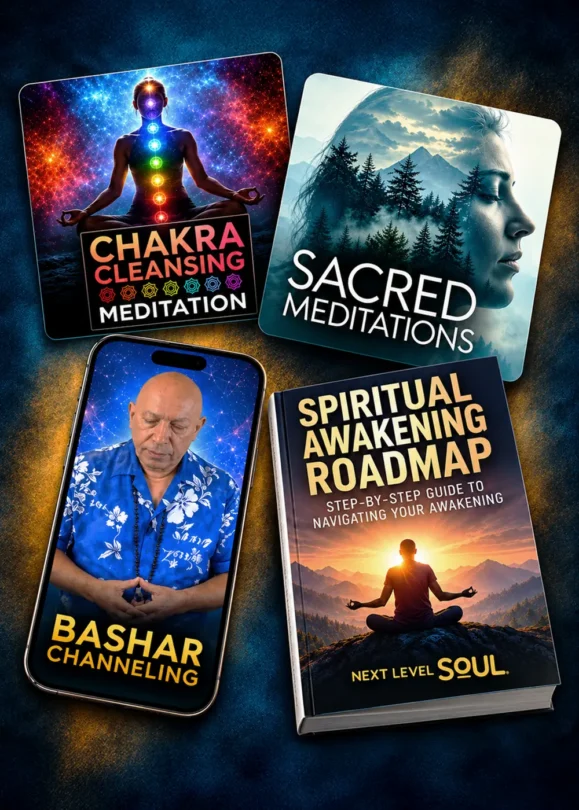
A Free Gift
Pair your journaling with a quiet inner practice.
The free Sacred Awakening Toolkit offers meditations and teachings to help you find calm and clarity.
- Exclusive Bashar Channeling (20 Min). An original channeling recorded exclusively for Next Level Soul, with direct insights from one of the most influential channeled teachings of our time.
- 5 Sacred Meditations. Calm the mind, open the heart and reconnect with inner presence.
- Bonus: Cosmic Chakra Meditation (30 Min). Align and activate your energy centers.
- Spiritual Awakening Roadmap PDF. A clear, grounded guide to the awakening process.
Free. Unsubscribe anytime. Your email is safe with us.
Frequently Asked Questions About Shadow Work Prompts
What are shadow work prompts?
Shadow work prompts are journaling questions that help you notice and understand the parts of yourself you have hidden, denied or judged. They guide you to write honestly about triggers, patterns and hidden strengths.
What is shadow work?
Shadow work is the practice of getting to know the unconscious parts of your personality. The idea comes from Carl Jung, who called these hidden parts the shadow. It involves noticing, naming and gradually accepting them.
How do I start shadow work journaling?
Choose a quiet time, set a timer for ten to twenty minutes and pick one prompt that gently catches your attention. Write without editing, name how you feel, and close with breath, water or a short walk.
How often should I do shadow work prompts?
Many people write once a day for a week, then a few times a week afterward. Go at the pace your body and mind can manage. Rest days are part of the practice.
How long does shadow work take?
There is no fixed timeline. Shadow work is an ongoing relationship with yourself rather than a task with an end date. Many people notice small shifts in awareness within a few weeks of steady, gentle practice.
What are some examples of shadow work questions?
Examples include: Who triggers me most right now, and what quality do I react to? What feelings were not welcome in my family? What gift do I play down when others praise me?
What is the golden shadow?
The golden shadow is a term used by Jungian writers for the positive qualities we have disowned, such as creativity, confidence and leadership. We often notice them first as admiration or envy toward other people.
Can shadow work be dangerous?
Shadow work can stir difficult emotions and memories, so it deserves care. Go slowly, skip prompts that feel too heavy and seek a licensed therapist if you have trauma. If you are struggling, call or text 988 in the US.
Is shadow work the same as therapy?
No. Shadow work journaling is a self-reflection practice. A licensed therapist offers training, safety and personalized care. Many people use the two together, and therapy is the better choice for trauma or severe distress.
What should I do if a prompt makes me cry or feel overwhelmed?
Stop writing, plant your feet on the floor, breathe slowly and name things you can see around you. Drink water, move your body and reach out to someone you trust. Seek professional help if the feelings persist.
Should I write by hand or type my shadow work?
Either works. Many people prefer handwriting because it slows the mind and feels more personal. Choose the method that lets you be most honest, and keep your writing private.
What is the best time of day for shadow work?
Choose a time when you are calm and not rushed. Some people like the quiet of the morning, while others prefer the evening. Avoid starting right before a stressful event or when you are exhausted.
How do I know my shadow work is helping?
Many people report noticing triggers sooner, reacting less sharply, feeling more compassion for themselves and others, and recognizing their strengths. Progress is often quiet and gradual rather than dramatic.
Can I combine shadow work prompts with meditation?
Yes. A short sitting practice before writing can help you settle, and a closing breath afterward can help you release. Try three minutes of breath, a silent reading of the prompt, a few minutes of observation, then writing.
Books for Further Reading
These books are good starting points. Each link below goes to Amazon, and we may earn a small commission at no cost to you.
Owning Your Own Shadow by Robert A. Johnson

A short, readable introduction to the shadow from a Jungian analyst, focused on how to recognize and integrate it. See it on Amazon.
The Dark Side of the Light Chasers by Debbie Ford

A popular guide to meeting disowned parts of yourself, with exercises for reclaiming them. See it on Amazon.
Meeting the Shadow by Connie Zweig and Jeremiah Abrams (editors)

A collection of essays on the shadow from many voices in psychology and spirituality. See it on Amazon.
Memories, Dreams, Reflections by C. G. Jung

Jung’s reflective autobiography, where you can see the thinker behind the shadow concept in his own words. See it on Amazon.
Sources and Further Reading
Shadow (psychology) (Wikipedia) · Carl Jung (Wikipedia) · Psychological projection (Wikipedia) · Inner child (Wikipedia) · Writing therapy (Wikipedia)