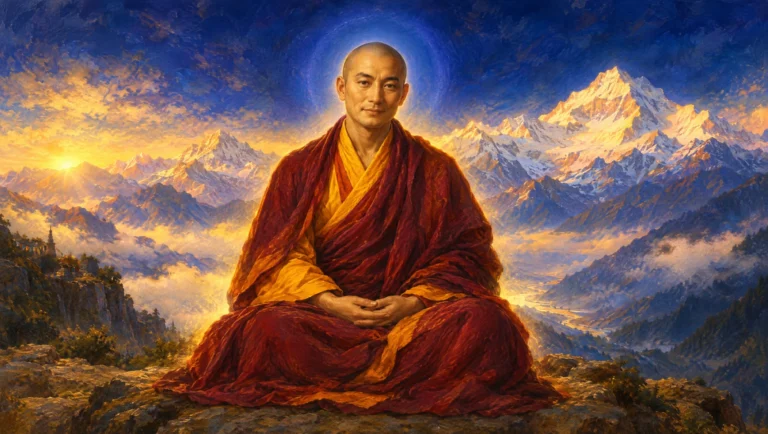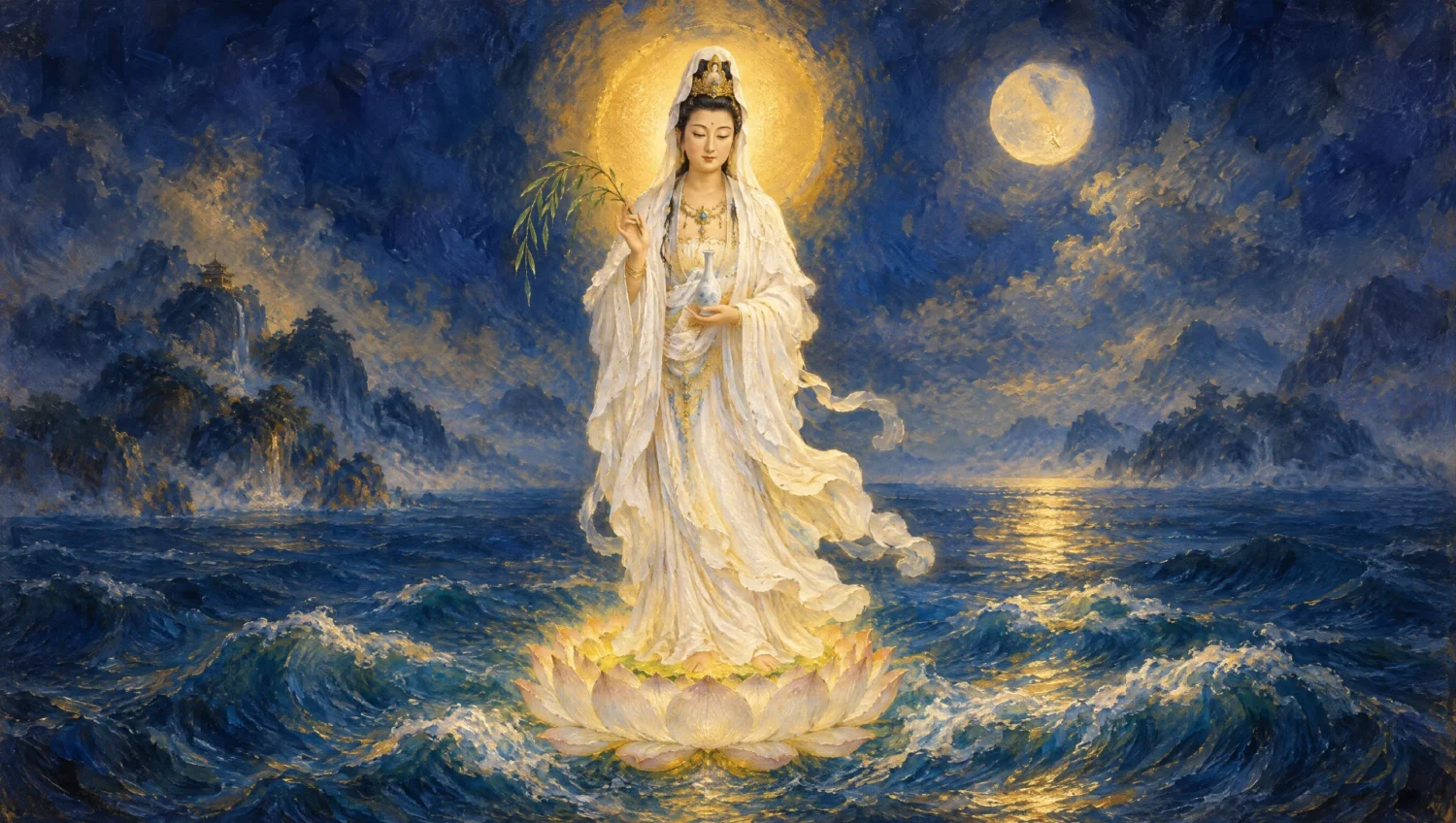
She is the one who hears the cries of the world. In China she is Guanyin. In Japan she is Kannon, in Korea Gwaneum, in Vietnam Quan Am. In Tibet he is Chenrezig, the lord who looks with unwavering eyes. Behind all these names stands one ancient figure of Buddhist devotion, Avalokiteshvara, the bodhisattva of compassion. People pray to this presence in times of illness, fear, childbirth and grief, often without knowing a single line of doctrine. This guide traces the journey from the Indian sutras to the temples of the East and the altars of the modern West. It explains the mantra, the legends and the teaching, and it looks at how Kuan Yin is understood as an ascended master. We say what is scripture, what is legend and what is devotion.
Key Takeaways
- Who she is: Kuan Yin (Guanyin) is the East Asian form of Avalokiteshvara, the bodhisattva who embodies the compassion of all the Buddhas.
- Where it began: In India, Avalokiteshvara appears in Mahayana sutras from about the first to fourth centuries CE, depicted as a male or beyond-gender figure. The Lotus Sutra chapter on him was a major source of devotion.
- How she became a woman: In China, from about the tenth to twelfth centuries, Guanyin was increasingly portrayed as female. The legend of Princess Miaoshan helped fix the image.
- The mantra: Om Mani Padme Hum is the six-syllable mantra of Avalokiteshvara, central to Tibetan Buddhism and loved across the world.
- The teaching: Compassion is not softness. It is clear seeing joined with a vow to help. Listening is the first act of love.
- An ascended master: Theosophy and Ascended Master teachings honor Kuan Yin as a Lady Master of mercy. Buddhist traditions honor a bodhisattva. We keep these frames separate.
In This Guide
- Who Is Kuan Yin?
- One Presence, Many Names
- The Indian Roots
- The Lotus Sutra: Hearing the Cries
- The Vow and the Thousand Arms
- Arrival in China and the Transformation
- The Legend of Princess Miaoshan
- The Many Forms of Guanyin
- Chenrezig in Tibet
- Om Mani Padme Hum
- Kannon in Japan, Korea and Vietnam
- What Kuan Yin Teaches
- Devotion Today: Festivals and Prayer
- Kuan Yin as an Ascended Master
- Honest Questions and Cautions
- A Practice: Seven Days of Listening
- Books and Further Reading
- Keep Exploring
- Frequently Asked Questions
Who Is Kuan Yin?
Kuan Yin is the figure of compassion most loved in East Asia. Her image stands in temples, on home altars, in restaurants and in roadside shrines. She wears flowing white. She holds a small vase of pure water and often a willow branch. She stands upon a lotus or a wave, and she looks on the world with calm and tender eyes.
Her Chinese name, Guanyin, means roughly “the one who perceives the sounds of the world.” The idea is simple and moving. She hears every cry, from every being, in every realm, and she comes.
Within Buddhism she is a bodhisattva, a being who has awakened out of compassion and who remains in the world to help others do the same. The Mahayana traditions say she has the power to take any form necessary, so that every kind of being can receive help in a way they understand.
She is also honored well beyond Buddhism. Taoists have adopted her. Many people who follow other paths, or none, pray to her. As with every sacred figure who belongs to a living tradition, we write as a guide, with respect. We do not ask you to believe anything. We ask you to listen as she does. You can also see where she fits among the other great beings in our complete guide to the Ascended Masters.
One Presence, Many Names
The names of this figure show how widely the devotion spread.
| Region | Name | Meaning or note |
|---|---|---|
| India (Sanskrit) | Avalokiteshvara | Often read as “the lord who looks down” with compassion. An older reading is “the sound that is perceived.” |
| China | Guanyin, Kuan Yin | “Perceiver of sounds.” Earlier: Guanshiyin, “perceiver of the sounds of the world.” |
| Tibet | Chenrezig | “Looking with unwavering eye.” Patron of Tibet; the Dalai Lamas are held to be his emanations. |
| Japan | Kannon | The Japanese reading of the Chinese name. |
| Korea | Gwaneum | The Korean reading. |
| Vietnam | Quan Am | The Vietnamese reading. Quan The Am Bo Tat is the full form. |
The Sanskrit name has a small puzzle in it. Early Indian manuscripts suggest the original form may have been Avalokitasvara, “the sound that is seen” or perceived. Later, as it was written down as Avalokiteshvara, it came to mean “the lord who looks down.” The Chinese translator Kumarajiva, in 406 CE, rendered it as the “perceiver of sounds,” which suggests he knew the older form. In China the full name Guanshiyin was shortened to Guanyin in the Tang dynasty, probably to avoid writing the personal name of an emperor.
The Indian Roots
Avalokiteshvara emerges in India with the rise of the Mahayana, in the early centuries of the common era. He is not found in the older Pali Canon. He belongs to a new wave of devotion, which taught that the path was not only for monks seeking personal liberation but for all beings. The ideal figure was the bodhisattva.
He appears in several important sutras. In the Lotus Sutra, a whole chapter praises him. In the Heart Sutra, he is the one who sees that all things are empty of fixed nature, and by that vision is freed from all suffering. In the Pure Land sutras he stands at the right hand of Amitabha Buddha, the Buddha of infinite light, as one of two great attendants. In the Karandavyuha Sutra, composed perhaps around the fourth or fifth century, he is the master of the mantra Om Mani Padme Hum. This sutra also gives him a tender legend. He sets out to free every being from hell realms, and he teaches by compassion even to those who suffer most.
In Indian art, from Ajanta to Kanheri, he appears as a graceful man, a crowned prince holding a lotus. He is often shown with an image of Amitabha in his headdress. There is nothing in the early images to suggest a woman. The feminine form comes later, and it comes from the East.
The Lotus Sutra: Hearing the Cries
The twenty-fifth chapter of the Lotus Sutra is called “The Universal Gateway of the Bodhisattva Who Perceives the Sounds of the World.” It is often copied and recited as a separate scripture. It is among the most loved sacred texts in East Asia.
The chapter tells of a seeker who asks why this bodhisattva is called by that name. The Buddha answers that if beings in suffering call on his name with a whole heart, he hears their voices and rescues them. Those who face fire find the flames cool. Those caught in a flood find shallow ground. Those at sea find the winds gentle. Those taken captive are released. Those who long for a child may receive a child.
The chapter then describes how he appears in many forms: a Buddha to those who need a Buddha, a king to those who need a king, a monk, a householder, a woman, a child, or a spirit. In the tradition he appears in thirty-three forms. Each is chosen to fit the person who needs help.
How do we read this? Devout Buddhists take it as a promise. A mystic can also read it as a statement about attention. When we truly listen to the cry of another being, we become a channel of rescue. And when we ourselves cry out, something in the universe is listening.
The Vow and the Thousand Arms
One of the most affecting legends in the whole tradition comes from the Tibetan and Chinese sources. Avalokiteshvara, so the story goes, made a vow before the Buddhas to not rest until every being was free of suffering. He worked for countless ages. Then he looked out and saw how many were still lost. In grief and exhaustion his head split into eleven pieces, and his arms shattered.
The Buddha Amitabha gathered the broken pieces and made them whole. He gave Avalokiteshvara eleven heads to see all suffering from every direction, and a thousand arms, with an eye in the palm of each hand, so that wisdom would guide every helping touch. The thousand-armed form is a picture of compassion that has found its strength.
There is a lesson here for anyone who has tried to care for others and felt overwhelmed. Compassion is not endless willpower. It is a gift that must be renewed. The legend says that the helper too can be broken, and that help comes to the helper as well.
The Great Compassion Mantra, called the Dabei Zhou in Chinese, is linked with the thousand-armed form. It has eighty-four phrases and is chanted daily in many Chinese, Korean and Vietnamese monasteries.
Arrival in China and the Transformation
Buddhism reached China by the first century CE or soon after. The translations of the Lotus Sutra and the Pure Land sutras in the third to fifth centuries opened the way for Guanyin devotion. Cave temples at Dunhuang and Longmen preserve early images, often a slender male figure with a faint mustache.
Over the following centuries something remarkable happened. The figure became feminine. By the Song dynasty (960 to 1279), paintings and sculptures showed a graceful woman, in the white robe and veil that became the classic icon. The change was gradual and it was not decreed. It happened in the hearts of ordinary people.
Scholars offer several reasons. The sutra says the bodhisattva can appear as a woman, and he was loved for his mercy, a quality that East Asian culture tended to associate with the mother. Women prayed to Guanyin for children and safe delivery. Other maternal figures, in folk religion and Taoist tradition, may have blended in. The historian Chun-fang Yu, whose book on the subject is the standard study, describes this as a long process of “domestication,” the transformation of an Indian bodhisattva into a Chinese goddess-like figure.
It is worth noting how the faith itself describes this. Devotees do not see a change from male to female. They see the same compassion taking the form the people most need. The tradition adds that Guanyin appears as whatever a being requires.
The Legend of Princess Miaoshan
The story that made Guanyin a woman in popular memory is the tale of Miaoshan. It is a legend, not a recorded history, and it has many versions. A text on a stone tablet from around the year 1100, attributed to the scholar Jiang Zhiqi, preserves the earliest full account we have. It says it draws on an older source.
In the story, Miaoshan is the youngest of three daughters of a king named Miaozhuang. She is gentle and devout, and wants only to become a nun. Her father is furious. He insists on marrying her to a nobleman, and when she refuses, he sends her to work as a servant in a monastery, hoping to break her will. When the nuns cannot make her give up, he burns the monastery. She is executed or banished, depending on the version.
She travels through hell, and where she walks, the suffering of the dead is eased and the place becomes bright. She is then returned to life. Later, her father falls gravely ill, and only a medicine made from the arms and eyes of a person without anger can cure him. Miaoshan, in disguise, offers her own. Her father is healed. When he learns who gave the gift, he repents. In the traditional ending, Miaoshan takes a thousand arms and a thousand eyes and becomes Guanyin on the island of Putuo.
The story sits uneasily with modern readers in its violence, but it spoke powerfully to women who had little say in their own lives. A woman could refuse the path laid down for her, choose the life of the spirit and become a saint. Whatever its history, it gave Guanyin a face that people recognized.
Putuo Shan, a small island off the coast of Zhejiang, is the traditional place of her awakening. It has been a pilgrimage center for over a thousand years. The names of the four sacred Buddhist mountains of China each belong to a bodhisattva, and Putuo belongs to Guanyin.
The Many Forms of Guanyin
Artists and devotees have given her dozens of forms. A few are best known.
- White-robed Guanyin (Baiyi Guanyin). Seated or standing in a white robe, often with a veil. A symbol of purity and the figure most associated with mothers and children.
- Willow and vase. She holds a vase of pure water and a willow branch. The water is the nectar of compassion, and the willow sprinkles it on those who suffer.
- Thousand-armed Guanyin. The mighty form of the vow, with an eye in each palm.
- Eleven-headed Guanyin. Each face looks in a different direction. Some are gentle and some fierce.
- Water-moon Guanyin. Relaxed on a rock by the sea, a moon reflected in the water. A symbol of the dreamlike quality of all appearances.
- Child-giving Guanyin. She holds a baby. Women pray to her for children.
- Guanyin of the South Sea. She stands on a wave or a dragon, sometimes with the youth Sudhana and the dragon girl by her side.
Each form teaches something different. Together they say that compassion has no single face.
Chenrezig in Tibet
In Tibet, Avalokiteshvara is Chenrezig, and he is the patron of the whole land. Tradition holds that he took form as the great king Songtsen Gampo in the seventh century, who brought Buddhism to the plateau. Each Dalai Lama is considered a living emanation of Chenrezig, as is the Karmapa in a different lineage. The Potala Palace in Lhasa takes its name from Mount Potalaka, the legendary pure land where the bodhisattva dwells.
The Tibetan image is typically a white figure, either with four arms or with the thousand arms and eleven heads. Two hands are pressed together at the heart, holding a wish-fulfilling jewel. The other two hold a crystal rosary and a lotus. The jewel and the lotus are the heart of the mantra.
Tibetan practice includes long visualization rituals. The practitioner imagines the bodhisattva in front of them, in a body of light. Rays of white light stream from his heart and purify all beings. Then the practitioner becomes Chenrezig and offers that purifying light to all. It is a way of moving from receiving compassion to becoming it.
For a firsthand look at the inner side of Tibetan practice, listen to our conversation with Dr. Andrew Holecek, a long-time student of the Tibetan Buddhist tradition.
Om Mani Padme Hum
The mantra of Avalokiteshvara is six syllables: Om Mani Padme Hum. You can see it carved on stones, painted on prayer wheels and printed on flags across the Himalayas. Mantras are sacred sounds, and no translation fully captures them. The words are often rendered as “the jewel in the lotus.” Mani is a jewel, padme is a lotus.
The meaning is layered. The jewel is compassion and the wish for awakening for the sake of all beings. The lotus is wisdom, the understanding that grows in the mud of the world and opens untouched by it. The two together say that wisdom and compassion cannot be separated. The syllables are also said to purify the six realms of existence, one for each syllable. Teachers differ on how to explain the details.
The Dalai Lama has said that the entire path to awakening is contained in this mantra. For a beginner, the practice is simple. Say it aloud or silently. Let the sound settle in the chest. Say it with the wish that all beings be free. Some people use a string of 108 beads. Others simply repeat it when they walk.
Compassion mantras are an old path. You can find many more across the traditions, and the principle remains the same. The sound becomes a way of keeping the heart open.
Kannon in Japan, Korea and Vietnam
In Japan, Kannon arrived with Buddhism in the sixth and seventh centuries. She is among the most loved figures of the land, with temples such as Asakusa in Tokyo and Kiyomizu-dera in Kyoto. At Sanjusangendo in Kyoto, a hall built in the twelfth century and rebuilt in 1266 holds 1,001 statues of the thousand-armed Kannon, standing in rows in golden light.
There is a poignant side to her story in Japan. During the centuries when Christianity was forbidden, hidden Christian communities in Nagasaki prayed to statues of Kannon holding a child. They called them Maria Kannon. The mother of compassion became a mask for another mother. It is a powerful reminder that grace does not always respect the boundaries of religions.
In Korea, Gwaneum is honored in temples on mountain slopes and by the sea. In Vietnam, Quan Am is beloved in temples and homes, and a Vietnamese legend tells of Thi Kinh, a young woman wrongly accused, who lived disguised as a monk and was later revealed as Quan Am. Everywhere she is offered incense, flowers and fruit, and the prayers are the same: for health, for peace, for the safety of the people we love.
What Kuan Yin Teaches
There is no book called the teachings of Kuan Yin. But the tradition around her speaks clearly.
Listen first. Her name means the one who hears. In a world where everyone is trying to speak, the first act of compassion is attention. Before advice, before fixing, hear what the person is truly saying.
Compassion and wisdom go together. The Heart Sutra shows her seeing emptiness and in the same breath freeing all beings. Compassion without wisdom can drown in another person’s pain. Wisdom without compassion can turn cold. She holds both.
Respond in the form that is needed. The thirty-three forms in the Lotus Sutra remind us that help takes many shapes. Sometimes the right action is gentle. Sometimes it is firm. Sometimes it is simply staying close.
Do not abandon yourself. The legend of the broken body says even the helper needs help. Self-compassion is not selfishness. It is how the work of caring continues.
The water of purification. The vase of water is a symbol of forgiveness and renewal. Every moment offers a chance to start again. Kuan Yin does not ask for perfection. She asks for turning.
Devotion Today: Festivals and Prayer
Chinese tradition honors three days for Guanyin in the lunar calendar. The nineteenth day of the second month marks her birth. The nineteenth day of the sixth month marks her attainment, or her leaving home. The nineteenth day of the ninth month marks her entering the monastic life. On these days temples are full. Pilgrims light incense, bow, and recite her name.
The most common act of devotion is simply reciting her name. In Chinese, Namo Guanshiyin Pusa, honor to the bodhisattva who perceives the world’s sounds. Devout people recite it for hours, in hospitals, at sickbeds and at funerals. Many keep a small statue in a corner of the home, with a glass of fresh water and a flower or a stick of incense.
Another tradition is releasing life: gently freeing animals such as fish or birds. Care is needed, since poorly planned releases can harm the animals and local ecology. Many teachers now encourage compassion that is wise. Feed the hungry. Care for the sick. Visit someone who is alone.
Vegetarianism is also associated with Guanyin devotion in many communities. It is an offering of non-harm.
Kuan Yin as an Ascended Master
In Buddhist teaching, Avalokiteshvara is a bodhisattva, a being of awakened compassion who vowed to remain until all beings are free. That is already something like an ascended master: a being who has passed beyond suffering and who stays near to help. The Western esoteric traditions saw the connection quickly.
Helena Blavatsky, the founder of Theosophy, wrote of Kwan-Yin in works such as The Voice of the Silence. Later teachings built on this. In the Ascended Master traditions, Kuan Yin is honored as a Lady Master, a being of mercy and compassion who serves humanity. Some teachings associate her with forgiveness and the transmutation of karma, and she is often paired in devotion with Mother Mary as an East-West pair of compassionate mothers. Details differ widely from source to source.
Many modern channels report Kuan Yin’s voice as strongly maternal, warm and clear. The audiobook Kuan Yin on Mercy, Forgiveness and the Bodhisattva Path, available on Next Level Soul, collects dozens of channeled messages on these themes. You can also hear her named in our conversation, Channeling Female Ascended Masters with Genevieve Taeger. And the series Ascended Masters Channeled brings several masters together on Next Level Soul.
How should we hold these claims? Buddhists would say Avalokiteshvara is not an individual that can be summoned by a medium, but the compassion of all Buddhas. Channeled sources describe an individual voice with a personality. We do not think you have to choose. In our view, the best test of any teaching is what it does in your heart. Does it make you gentler, wiser, more useful to others? If so, it is doing what Kuan Yin does. For the wider story of how East and West met in these ideas, see our guide to the Ascended Masters and our guide to Mary Magdalene and the divine feminine.
Honest Questions and Cautions
Her story evolved. The figure we know today is the product of many centuries and many cultures. The Indian bodhisattva, the Chinese goddess-like figure and the modern channeled master are not the same in every respect. We have tried to name the shifts.
Some stories are legend. The Miaoshan tale, in particular, is folklore with a religious purpose. It is told with reverence, not with the aim of recording history.
Not a wish-granting machine. Devotion to Kuan Yin can bring real comfort, but the tradition does not promise that bad things will not happen. It promises presence and compassion, and a path through suffering. Please keep seeking medical and practical help when it is needed.
Be gentle with animal release. As noted above, mass animal releases, done without care, can cause harm. Compassion should be informed.
Grief is not a problem to fix. If you are carrying heavy loss, a statue and a mantra can help, and so can a counselor or a trusted friend. Our pieces on the dark night of the soul and healing from trauma spiritually offer gentle support.
A Practice: Seven Days of Listening
This week is built around Kuan Yin’s central gift: hearing.
- Day 1: Settle and listen. Sit for five minutes. Do not meditate on anything. Simply listen to every sound around you without naming it.
- Day 2: Listen to one person. In one conversation today, do not interrupt, advise or plan your reply. Hear them.
- Day 3: Say the mantra. Repeat Om Mani Padme Hum, aloud or silently, for ten minutes. Place a hand on your heart.
- Day 4: Listen to yourself. Ask: what am I feeling right now? Name it kindly. Say: May I be held in compassion.
- Day 5: Offer water. Place a glass of fresh water on a table. Offer it to all beings who are thirsty or afraid. In the evening, pour it on a plant.
- Day 6: One act of mercy. Do something small and practical for someone who is struggling. Do not announce it.
- Day 7: Forgive one thing. Choose a small grievance. Imagine Kuan Yin pouring clear water over it. Let it go as far as you honestly can today.
If you feel nothing, that is fine. The practice works in small ways, over time.
Books and Further Reading
- Kuan-yin: The Chinese Transformation of Avalokitesvara, by Chun-fang Yu. The scholarly standard on how an Indian bodhisattva became China’s beloved Guanyin.
- The Promise of Kuan Yin, by Martin Palmer and Jay Ramsay. An accessible look at the legends, miracles and wisdom of Guanyin.
- The Lotus Sutra, translated by Burton Watson. Includes the chapter on the Universal Gateway.
- The audiobook Kuan Yin on Mercy, Forgiveness and the Bodhisattva Path, available on Next Level Soul.
- The Buddha’s Bible, an audiobook of the Dhammapada, for the wider teaching on compassion.
Book links are Amazon affiliate links. If you buy through them, it supports our work at no extra cost to you.
Keep Exploring
The thread of compassion runs through many of our guides. For the cause-and-effect view that sits behind her work with karma, read understanding karma. For a gentle companion in daily life, try mindfulness in daily life. And for the story of another figure who walked the roads of India and Asia, read the lost years of Jesus.
Two audio courses fit this path well. The Between draws on Tibetan wisdom about death and awareness, in 19 gentle chapters that ease fear and open the heart. Rumi’s Eternal Dance offers 27 lessons on love, presence and silence. Both are included with Next Level Soul membership. Explore the Next Level Soul Mastery overview, or start with a free masterclass.
Watch Ascended Masters, Channeled on Next Level Soul TV
An eight-episode series in which renowned channeler Genevieve Taeger brings through Buddha, Mary Magdalene, Athena, Mother Mary, Jesus, Saint Germain, Yogananda and Kuan Yin. Each episode is a channeled message, offered as spiritual guidance and not as historical record.
Episodes that connect with this guide: Ascended Master Kuan Yin, Ascended Master Buddha and Ascended Master Mary Magdalene.
Frequently Asked Questions
Who is Kuan Yin?
Kuan Yin, or Guanyin, is the East Asian form of Avalokiteshvara, the bodhisattva of compassion. The name means roughly “the one who perceives the sounds of the world.” She is honored across China, Japan, Korea and Vietnam.
Is Kuan Yin a goddess or a bodhisattva?
In Buddhist teaching she is a bodhisattva, a being of awakened compassion. In popular devotion, and in Taoist and folk traditions, she is often honored as a goddess of mercy. Both views have long histories.
Why is Kuan Yin female?
Avalokiteshvara was depicted as male or beyond gender in India. In China, from about the tenth to twelfth centuries, Guanyin increasingly appeared as a woman, shaped by the sutra’s teaching on many forms, devotion to maternal compassion and the legend of Princess Miaoshan.
What is the difference between Avalokiteshvara, Chenrezig and Kuan Yin?
They are regional names for the same bodhisattva. Avalokiteshvara is the Sanskrit name, Chenrezig the Tibetan, and Kuan Yin the Chinese. Each culture has its own images and stories.
What does Om Mani Padme Hum mean?
It is the six-syllable mantra of Avalokiteshvara, often rendered as “the jewel in the lotus.” It joins compassion (the jewel) and wisdom (the lotus). Its meaning is layered, and teachers explain it in different ways.
What does the vase of water mean?
The vase holds the pure water of compassion, sometimes called nectar. Together with the willow branch, it stands for healing, purification and the relief of suffering.
Is Kuan Yin an ascended master?
In Theosophy and Ascended Master teachings, Kuan Yin is honored as a Lady Master of mercy. Buddhist traditions honor her as a bodhisattva. See our guide to the Ascended Masters for how these views relate.
How do I pray to Kuan Yin?
Many people simply sit quietly, bring her image to mind, and speak from the heart. Others recite her name or the mantra Om Mani Padme Hum. There is no required form.
Where can I find Kuan Yin teachings on Next Level Soul?
Listen to Kuan Yin on Mercy, Forgiveness and the Bodhisattva Path, available on Next Level Soul. The audio course The Between adds Tibetan wisdom for the heart.
When is Kuan Yin’s birthday?
In Chinese tradition it is the nineteenth day of the second lunar month. Two more days, in the sixth and ninth lunar months, honor her attainment and her entering the monastic life.