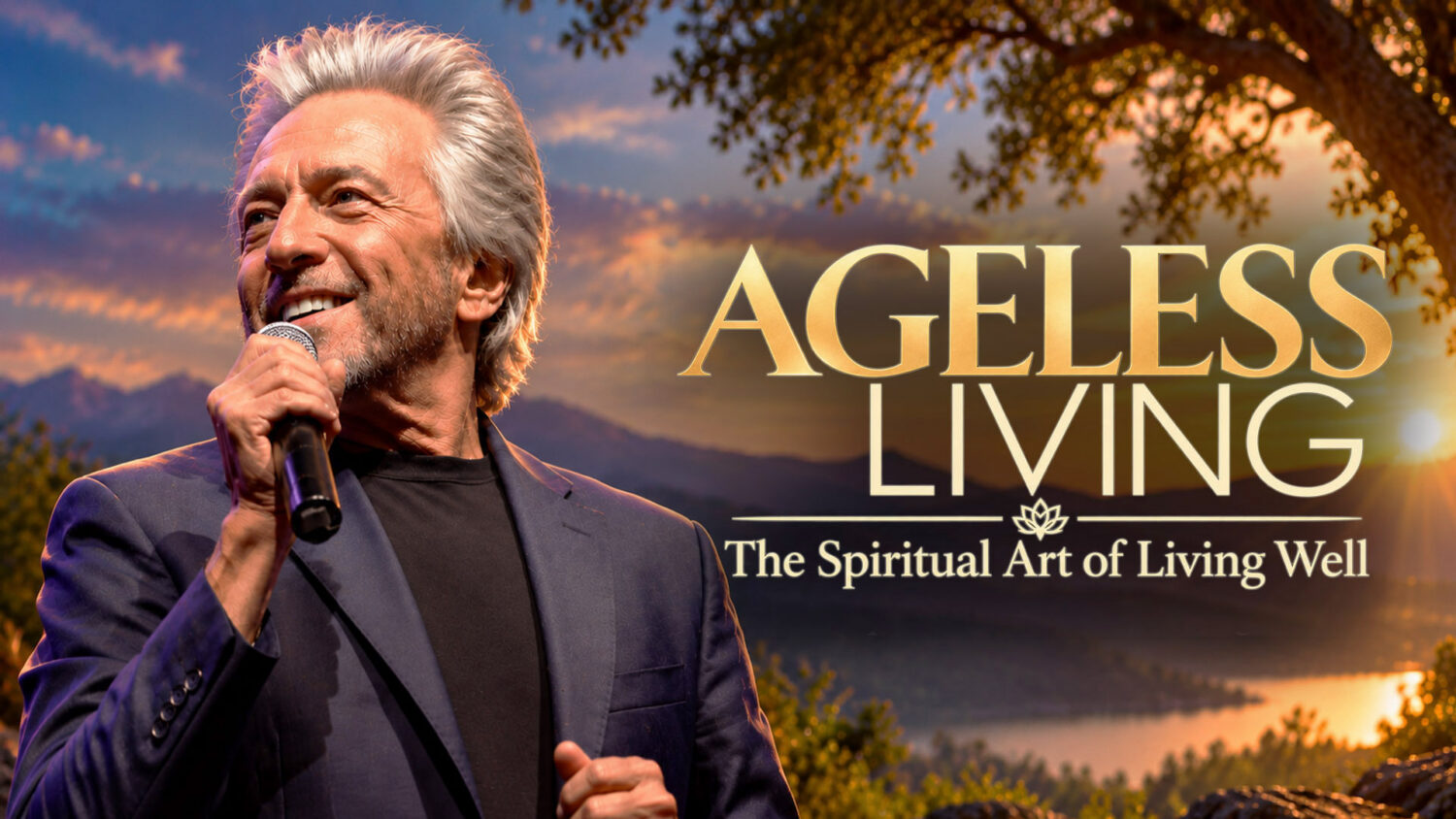
Some series entertain you. A few quietly change how you think about the years ahead. Ageless Living: The Spiritual Art of Living Well belongs in the second group.
Filmed live before an audience in Santa Fe around 2018, it gathers twenty talks across forty episodes. George and Sedena Cappannelli, who directed and co-produced the series, host. The speakers include scientists, physicians, authors, an activist and the creator of a famous television series. They share one question: what if growing older is a chapter of becoming, not a countdown?
This review walks through every talk. For each one you will find what it covers, one thing to try, and one thing worth keeping a clear head about. Where a speaker has a conversation on Next Level Soul, the link is right there. The whole series is available on Next Level Soul.
How the Series Is Built
Every talk runs across two episodes. Each episode opens with a short montage of lines from the talk, the sung theme “Brand New Day”, and an introduction, then the speaker takes the stage. A sign-off from George or Sedena closes it and points toward what is next.
The audience is part of the experience. People breathe together, say words aloud, turn to a neighbor and answer questions out loud. It feels less like watching lectures and more like sitting in a room full of people who are ready to think differently.
A word on how to watch. These are big ideas from many voices. Some are well supported, some are personal belief, and some are bold claims. Take what rings true, check what matters (especially anything about your health), and let your own judgment lead. The power is within you.
Rewriting the Story of Aging
These four talks go straight at the cultural story that growing older means decline, and offer a different one.
George and Sedena Cappannelli: “Do Not Go Quietly” (Episodes 3 and 4)
The hosts take the stage themselves. George Cappannelli and Sedena begin with a personal story: a conference on aging, and the moment they realized how little we prepare for the second half of life. From there they define ageless living as a moment by moment choice to grow and thrive without regard to time, and they hold up long, creative lives as proof, from Carl Jung to Michelangelo to Martha Graham. The second episode turns practical and ends with a rousing call and response. It plays like a rally, with warmth, humor and a good deal of heart.
- Try this: Write a list of your unfinished business, cross off what no longer matters, and pick one thing to complete. Then say “no” and “yes” out loud and notice how each feels in your body.
- Worth knowing: The statistics and political commentary in the first episode come without sources. Hear them as a call to action, not as research.
Ashton Applewhite: “This Chair Rocks: A Manifesto to End Ageism” (Episodes 31 and 32)
This may be the most on-theme talk in the series. Ashton Applewhite defines ageism plainly, shows how we absorb it as children, and explains how it shapes how we treat ourselves. Her images stay with you: a baby elephant tied to a rope it could easily break, a bull that looks different once you step into the ring, a curb cut that helps everyone. Her message is that most of the barriers we blame on age are failures of design and attitude, not personal failures.
- Try this: Look for the ways you are ageist, in your jokes, your assumptions and your circle of friends. Then make a friend who is a different age than you.
- Worth knowing: Many figures are stated without a source, and the link between attitude and health is framed as cause and effect more firmly than the research may support.
Thomas Moore: “Ageless Soul” (Episodes 17 and 18)
Thomas Moore, the author of Care of the Soul, brings a gentler register. He talks about his plumber father, a bin of aged cheese, a morning in a monastery when he knew it was time to leave, and a friendship with an Irish art director that shaped his life. His point is that aging is becoming. Soul is the depth your life keeps bubbling up from, and difficulty is part of how it is made. It is poetic, wry and humane.
- Try this: Make your “soul line,” a list of the people who gave you your soul, and honor them in some small way this week.
- Worth knowing: This is reflection, not method. Several of his claims are opinion, and the talk leaves you with images rather than steps.
Barbara Marx Hubbard: “Getting Newer Every Day” (Episodes 39 and 40)
The series closes with futurist Barbara Marx Hubbard, who tells the 13.7 billion year story of evolution as something alive in each of us. She leads the audience through her Wheel of Co-creation, takes wishes called out from the seats, and offers a new name for the next stage of humanity. A tribute added after her passing in 2019 makes the final episode land softly. It is exuberant and big-hearted.
- Try this: Name one specific thing you want to create, what you need, and what you can give. Then invite two or three people into a small circle around it.
- Worth knowing: Her account of evolution with a built-in purpose is visionary rather than scientific, and the talk moves quickly from biology to spirituality to the internet.
Mind, Body and Belief
Four talks on how what you believe and practice can shape how you feel as the years go by.
Gregg Braden: “The New Human Story” (Episodes 1 and 2)
Gregg Braden opens the series with a hopeful premise: the stories we believe about ourselves shape how we live and age. He contrasts the old idea of a fixed tank of life force that runs out with the idea that the body can repair and renew. The second episode becomes practical, with a heart-centered breathing practice. If you want more, his conversations here and here are on Next Level Soul.
- Try this: Place a hand on your heart, breathe in for five seconds, pause, breathe out for five, and settle into a feeling of gratitude or care. Bring your question to that place.
- Worth knowing: The science is asserted rather than shown. Claims about organs storing emotion, or an image of a tumor healing in minutes, are best treated as ideas to explore, not as medical fact.
Dr. Bruce Lipton: “Aging: A Belief to Grow Old By” (Episodes 7 and 8)
Cell biologist Dr. Bruce Lipton is a gifted teacher. He walks you through the cell step by step and offers a memorable picture: you are a skin-covered culture dish, and the environment you place your cells in matters. He explains how most of our habits run on programs installed in childhood, and why simply wishing to change often does not work. Then the talk ends just before the how-to.
- Try this: Notice a belief you hold about getting older and ask where it came from. Whose voice is it?
- Worth knowing: He states some strong positions as settled, including that genes do not act and that illness is largely a matter of belief. Mainstream genetics sees it differently, and the idea can shade into blaming people who are sick.
Dr. Joan Borysenko: “Mind Over Aging: 5 Steps to Turn Back the Clock” (Episodes 19 and 20)
Dr. Joan Borysenko gives a warm, funny tour of mind-body research. You meet an octopus in Naples, a retreat where men lived as if it were 1959, plants in a nursing home, and two poodles. Her habits are simple and kind: stay engaged, keep your people close, move a little throughout the day, savor good moments, sleep well and keep a sense of purpose.
- Try this: When something good happens, stay with it for ten to twenty seconds so it has time to sink in.
- Worth knowing: Many numbers and cause-and-effect statements go beyond what was shown, and the five steps in the title are never listed neatly. Enjoy it as an inspiring overview and check health decisions with your own clinician.
Mingtong Gu: “The Healing Power of Qigong” (Episodes 25 and 26)
Master Mingtong Gu makes qigong feel welcoming. Qi means life energy, gong means cultivation, and the practice is something anyone can begin at any age. He teaches two short exercises with the audience and explains how to adapt: use movement if you can, sound if movement is hard, and visualization when you need stillness. A story about a woman who began practicing in her eighties is a highlight.
- Try this: Sit with a straight spine and hold your hands as if cradling a ball of light. Open and close them slowly and notice what you feel.
- Worth knowing: Historical and scientific claims are loose, and his personal healing story is told without detail. Treat qigong as a companion to medical care, not a replacement.
Love, Money and the Living Earth
Four talks on the relationships, resources and responsibilities that make a long life meaningful.
John Gray: “Beyond Mars and Venus” (Episodes 9 and 10)
John Gray speaks only days after losing his wife, and he dedicates the talk to her. That honesty gives the whole hour a tenderness. His relationship habits are down to earth: listen without fixing, offer many small gestures instead of one big one, and shift from “I have to” to “I get to.”
- Try this: The next time your partner shares something, say “help me understand that better” before you offer any advice.
- Worth knowing: The hormone figures and the sweeping statements about men and women are given as fact without evidence, and the framing feels dated. Keep the human advice and hold the biology loosely.
Gay and Katie Hendricks: “Creating Lifelong Magic in Your Relationships” (Episodes 21 and 22)
The Hendrickses bring humor, banter and real practice. They describe the Upper Limit Problem, the habit of sabotaging a good moment when we have reached the edge of how much love we feel we can take in. They offer a remedy: breathe, recommit quickly, and meet conflict with a curious “Hmm.” You can hear more from Gay Hendricks on Next Level Soul.
- Try this: Say aloud, “I am willing to expand my capacity to give and receive more love every day,” and share it with someone nearby.
- Worth knowing: Some statistics are loosely cited, the captions blur who is speaking in the personal stories, and a few ideas repeat across the two episodes.
Lynne Twist: “The Soul of Money, Living a Committed Life” (Episodes 15 and 16)
Lynne Twist ties a committed life to ageless living. Her story of a moment with Mother Teresa is the emotional center, and her framework is clear: name the three myths of scarcity (there is not enough, more is better, that is just the way it is) and practice sufficiency instead. “What you appreciate, appreciates” is the line you will carry out of the room.
- Try this: Catch yourself thinking “not enough,” then name one thing in your life that is enough today.
- Worth knowing: Statistics and historical claims are stated loosely, some quotes are attributed from memory, and the Mother Teresa story runs long for the point it makes.
David Suzuki: “An Elder’s Vision for a Sustainable Future” (Episodes 5 and 6)
David Suzuki speaks as a scientist, a grandfather and an elder, and he is blunt and funny. His story of bacteria doubling in a test tube makes exponential growth feel real, and his idea of four sacred things (air, water, soil and energy) gives hard conversations a place to start. He asks elders to use what they have learned and to say it plainly.
- Try this: Begin a difficult conversation from what you both need: clean air, clean water, healthy soil and energy.
- Worth knowing: It is the least tied to the theme of aging, many figures are unsourced, and it leaves you with urgency more than practical steps.
Fear, Freedom and Creativity
Five talks about loosening what holds us back.
Anita Moorjani: “Dying to Be Me” (Episodes 11 and 12)
Anita Moorjani tells the story of her near-death experience, and she tells it simply and with humor. Her flashlight image is memorable: where you point your awareness feels like all of reality. She then runs a quick exercise with the audience that shows how selective our attention is. Her closing points are easy to remember, including “Fear sells, so don’t buy it.”
- Try this: Look around the room and count everything red, then close your eyes and name what was blue. Notice what your attention skipped.
- Worth knowing: This is one person’s account. Her statements linking fear to illness, and about reaching for medication, should not guide anyone’s treatment. Keep health decisions with your care team.
Kyle Cease: “Evolving Out Loud” (Episodes 13 and 14)
Kyle Cease appears twice in the series, with different material under the same title. In this first session he improvises, jokes and teaches. The idea: the problem is never the fear, it is our resistance to the fear. He offers a simple phrase to add after a scary thought (“and I love that”), a timeline for sitting still each morning, and a decision rule: does this expand me or contract me?
- Try this: The next time a fearful thought shows up, add “and I love that” and notice what shifts in your body.
- Worth knowing: The structure meanders and the promise that loving a thought makes it vanish is an oversimplification. It is not a substitute for care if anxiety is a real struggle.
Kyle Cease: “Evolving Out Loud, Part Two” (Episodes 29 and 30)
In his second session, Kyle asks, “What if you’re in purpose? Now?” He uses a caterpillar and butterfly image, tells the story of a hotel room where he noticed his mind was separate from him, and explains how a leap away from comfort led to a new path. Two audience volunteers join him. His more recent conversation, A Turning Point for Humanity’s Soul, is on Next Level Soul.
- Try this: Ask yourself, “What expands my soul?” and notice what you are keeping only because you can justify it.
- Worth knowing: The quick stage exchanges are demonstrations, not therapy, and a couple of moments sidestep a worry someone raised rather than meeting it.
Lee Zlotoff: “The MacGyver Secret” (Episodes 27 and 28)
Lee Zlotoff, who created MacGyver, brings a storyteller’s timing and one of the most useful methods in the series. The idea is to hand your question to the part of your mind that works below awareness, then step away. He gives four steps and a list of activities that help and ones that do not. It fits creative work, but also everyday problems, and it is fun to try with the audience.
- Try this: Write your question by hand, do something low-demand like a walk or the dishes for a set time, then return and free-write for a minute.
- Worth knowing: The figures about mind speeds and the number of studies are repeated claims without clear sources, and the link to aging is loose.
Joe Gagnon: “Living the High Performance Life” (Episodes 23 and 24)
Joe Gagnon is a high-energy endurance athlete and leadership speaker. His stories are vivid: a teenager nicknamed “Minnie Mouse” at a fast-food job, a hard fall at age 39, a race that went wrong, and an unlikely run across six continents. His tools are simple: a daily minimum, a public commitment and tiny goals.
- Try this: Choose a small daily minimum, such as ten push-ups or a ten-minute walk, and tell someone you will do it.
- Worth knowing: He is an extreme athlete. Finishing a race with serious injuries is a story, not advice, and a strict no-excuses stance may not fit every body.
Consciousness and What Comes Next
Three talks that ask what the mind is, and what might continue.
Dr. Larry Dossey: “Visions of Immortality” (Episodes 35 and 36)
Dr. Larry Dossey makes the case that healthy aging should include a vision of death. He gathers stories, from twins who share sensations to a woman who rose from a hospice bed, and he offers a simple way to see consciousness as something that works through the brain, not just inside it. The close on kindness is lovely: be kind to others because in some sense they are you.
- Try this: Put the phone away, sit down, and pay attention for ten minutes. Notice what comes up.
- Worth knowing: It is a chain of anecdotes and quotations. The longevity figure is unsourced, and the conclusion that science requires immortality goes beyond the evidence.
Dr. Eben Alexander and Karen Newell: “Living in a Mindful Universe” (Episodes 37 and 38)
Neurosurgeon Dr. Eben Alexander tells the story of his coma and near-death experience, then makes the case that consciousness is primary. Karen Newell follows with a gentler, practical thread: find your calm inner observer, look back at past hardships and see how you grew, and use sound to settle the mind. His second conversation is on Next Level Soul too.
- Try this: Sit quietly and look for the part of you that watches your thoughts without joining them.
- Worth knowing: Several science claims are stacked together and presented as settled. The speakers have a book and a sound-meditation company, which the talk does not mention, and the anxiety study they cite is a small pilot.
Jeddah Mali: “Natural Intelligence: The Hidden Design Behind Our Evolution” (Episodes 33 and 34)
Jeddah Mali, an intuitive teacher from England with a dry sense of humor, asks why a species that has been here 200,000 years still struggles with peace. She proposes that life runs on a kind of operating system she calls natural intelligence, and she walks the audience through five principles: everything is energy, the present moment, thought, sensation and consciousness. The simple chain from thought to sensation to experience is easy to grasp and quick to test.
- Try this: Notice the sensations in your feet right now. That is consciousness turning sensation into experience.
- Worth knowing: The energy and percentage claims are asserted, the figures shift between the two episodes, and the promised universal laws are only partly delivered.
Common Threads
After forty episodes, a few ideas keep returning in different voices.
- Your story matters. Beliefs about age shape how we live it.
- Connection helps. Friends, family, pets and community appear in almost every talk.
- Purpose keeps you moving. Many speakers describe a reason to get up in the morning.
- Stillness and attention. Breath, sound, movement and quiet are offered again and again.
- Kindness. Several talks end in the same place: be a little kinder.
Who This Series May Be For
It may speak to you if you are in the second half of life and sensing that it holds more than you were told. It may also suit you if you are caring for someone older, or if you simply want to understand how mindset, relationships and meaning shape the years.
If you prefer one voice at a time, the structure helps. Each talk stands on its own across two episodes, so you can choose a speaker that calls to you and start there.
Questions to Carry With You
- What story about aging did I inherit, and am I ready to rewrite it?
- Whose voice do I hear when I say “I am too old for that”?
- What is one thing I could complete, forgive or begin this month?
- Who in my life is a different age, and what might we learn from each other?
Keep Exploring
Keep exploring with near-death experiences, spiritual enlightenment and connecting with your higher self.
Frequently Asked Questions
What is Ageless Living?
Ageless Living: The Spiritual Art of Living Well is a series of twenty talks across forty episodes, filmed live in Santa Fe around 2018. It explores how mindset, relationships, purpose and spirit shape the second half of life.
Who hosts the series?
George and Sedena Cappannelli host. George directed the series and Sedena co-produced it.
Who are the speakers?
They include Gregg Braden, David Suzuki, Dr. Bruce Lipton, John Gray, Anita Moorjani, Kyle Cease, Lynne Twist, Thomas Moore, Dr. Joan Borysenko, Gay and Katie Hendricks, Joe Gagnon, Mingtong Gu, Lee Zlotoff, Ashton Applewhite, Jeddah Mali, Dr. Larry Dossey, Dr. Eben Alexander with Karen Newell, and Barbara Marx Hubbard.
Is any of this medical advice?
No. The talks share personal stories and perspectives. For any health concern, please speak with a qualified health professional.
Where can I watch Ageless Living?
Ageless Living is available on Next Level Soul. Watch Ageless Living on Next Level Soul TV.