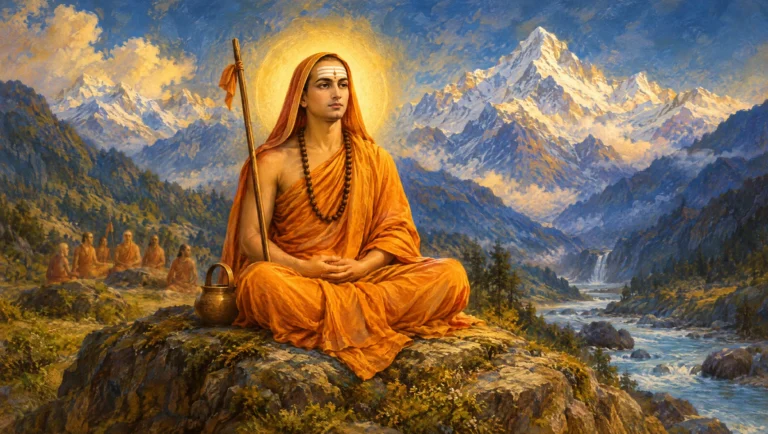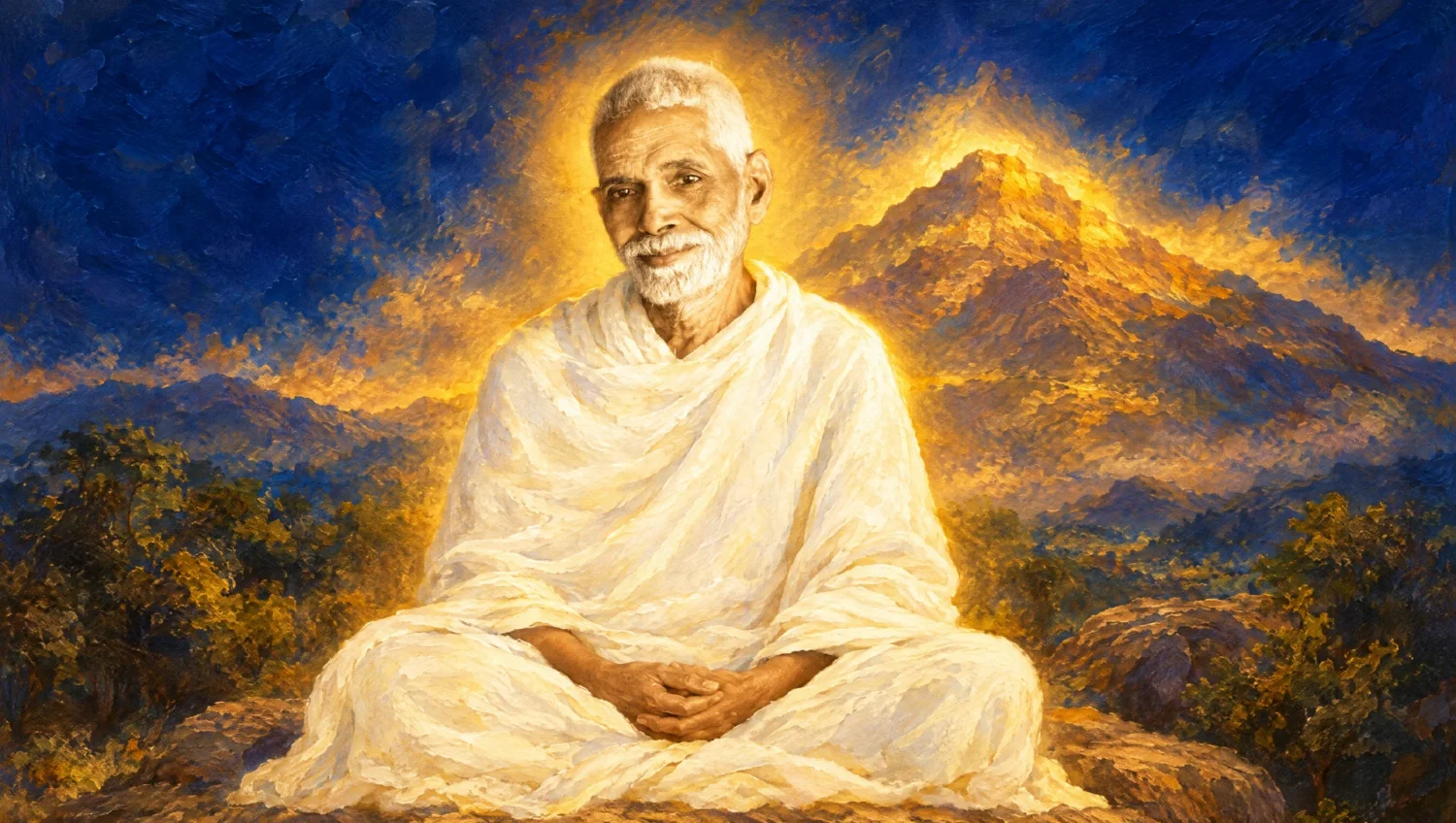
At sixteen, a schoolboy in southern India lay down on the floor of his uncle’s house, convinced he was about to die. He did not panic. He asked himself what would be left when the body was gone, and what he found changed the rest of his life. Six weeks later, he walked out of his home and took a train to the sacred mountain Arunachala, where he stayed for fifty-four years. Ramana Maharshi taught almost nothing in words that a child could not understand: ask yourself Who am I? Then stay with the asking until the asker dissolves. This guide follows his life from Tiruchuzhi to the ashram at the foot of the mountain, explains self-inquiry in plain language, and sorts what is documented from what is devotion. It also asks where he fits within the Ascended Masters tradition, and answers honestly.
Key Takeaways
- Who he was: A Tamil Brahmin boy born Venkataraman Iyer on December 30, 1879, who became one of the most respected sages of modern India. He died on April 14, 1950.
- The awakening: In July 1896, at sixteen, he went through a spontaneous “death experience” and recognized himself as awareness, not the body.
- Core teaching: Self-inquiry (atma-vichara). Ask “Who am I?” and trace the sense of “I” back to its source. Surrender and devotion are also valid paths.
- His method: Mostly silence. Many visitors reported a deep stillness in his presence, with or without words.
- As an ascended master: Ramana did not use that language and taught that no separate self exists to ascend. Devotees call him a jivanmukta, a liberated being, and some see him as an avatar. We distinguish these views.
- Try it: A seven-day practice of self-inquiry, with plain instructions and cautions.
In This Guide
- Who Was Ramana Maharshi?
- What Is Documented and What Is Devotion
- A Sleepy Boy in Tiruchuzhi
- The Death Experience of 1896
- The Journey to Arunachala
- Caves on the Mountain: 1899 to 1922
- Sri Ramanasramam: Daily Life with Bhagavan
- Self-Inquiry: What “Who Am I?” Really Means
- Teaching Through Silence
- Devotion: Arunachala as Guru
- Practical Teachings for Everyday Life
- From Paul Brunton to Carl Jung: The West Discovers Ramana
- How Ramana Compares to Other Paths
- Illness and Mahanirvana: The Final Years
- Legacy: A Mountain That Keeps Teaching
- Ramana and the Ascended Masters: An Honest Answer
- Honest Questions and Cautions
- A Practice: Seven Days of Asking “Who Am I?”
- Books and Further Reading
- Who Will Connect with This Teacher
- Keep Exploring
- Frequently Asked Questions
Who Was Ramana Maharshi?
Ramana Maharshi (1879 to 1950) was an Indian sage who lived almost his entire adult life at the foot of Arunachala, a sacred hill in Tiruvannamalai, Tamil Nadu. He is widely regarded, by followers and by many scholars of Advaita Vedanta, as a jivanmukta, a person liberated while alive. The word Maharshi means “great seer.” His devotees call him Bhagavan, a term of deep reverence meaning something like “Lord” or “the blessed one.”
He wrote very little. He gave no initiation, started no movement and did not set out to teach. People came to him, sat in his presence, asked questions, and left changed. Those who sat in the Old Hall of his ashram often described a silence that seemed to answer the question before he did.
What makes him matter to modern seekers is the clarity of his central point. Many spiritual paths ask you to add something: a practice, a belief, a ritual, a mantra. Ramana invites you to subtract. Find the one who thinks he is separate and look at him directly. Do that, he said, and the problem dissolves.
What Is Documented and What Is Devotion
Ramana left a rich record, which is unusual for a mystic of his stature. His own short writings exist, including Who Am I?, Forty Verses on Reality, Upadesa Saram and the Five Hymns to Arunachala. His one account of his awakening exists in his own words. Hundreds of conversations with visitors were recorded by attendants, notably in Talks with Sri Ramana Maharshi.
Early biographies include B. V. Narasimha’s Self-Realization (1931), the Englishman Paul Brunton’s A Search in Secret India (1934), and Arthur Osborne’s Ramana Maharshi and the Path of Self-Knowledge (1954). The writer David Godman, who lived at the ashram for years, has spent decades collecting firsthand accounts and correcting popular myths.
Devotion adds another layer. Many followers regard him as an avatar of Skanda or Dakshinamurti, forms of the divine in Tamil and Hindu tradition, and tell stories of miracles and of animals who attained liberation. We label these as devotional memory. Where the record is clear, we follow it.
A Sleepy Boy in Tiruchuzhi
He was born Venkataraman Iyer on December 30, 1879, in the village of Tiruchuzhi near Madurai, in what is now Tamil Nadu. His father, Sundaram Iyer, was a local pleader, and his mother, Azhagammal, ran a devout household. He had an older brother, Nagaswami, a younger brother, Nagasundaram, and a younger sister, Alamelu.
The boy was ordinary in most ways. He was good at sports, indifferent to school, and famous in his family for sleeping so deeply that nothing could wake him. In 1892, when he was twelve, his father died suddenly. The family broke up, and Venkataraman and his brother went to live with an uncle in Madurai.
In November 1895, something stirred. He overheard a relative say they had come from Arunachala and was struck by awe that the sacred mountain was a real place. A little later he read a book about the sixty-three Tamil saints, the Nayanmars, and it left a mark. He later said he had been uninterested in religion before the events of 1896.
The Death Experience of 1896
In July 1896, at sixteen, Venkataraman was sitting alone in a room on the upper floor of his uncle’s house. He was not ill. Suddenly, he was gripped by an overwhelming fear of death. He did not call for help. He decided to find out what death was.
The accounts based on his own description say he lay down, stretched out his limbs stiff like a corpse, held his breath and shut his mouth, and watched what happened. He asked himself: this body is dead; it will be carried to the burning ground and burned. But with the death of the body, am I dead? He realized that the body was silent and inert, and yet the “I” was fully present, aware and vibrant. That awareness, he understood, was the Self. It was not touched by death.
He said that from that moment, he never lost the sense of this Self, and that absorption in it continued regardless of what he did. Years later, he called this experience akrama mukti, sudden liberation, as opposed to the gradual path. He also said he did not think of it as the product of any practice or teaching. It came, and it stayed.
We should be careful with the details. They come from his own late recollections and from biographies. Scholars note that Ramana later identified the “current” or “force” he felt with the personal God, Ishvara. That is not the same as a purely impersonal reading. Whichever way one reads it, the central fact stands: a teenage boy with no spiritual training experienced a radical shift of identity, and everything he later taught flowed from it.
The Journey to Arunachala
For six weeks he lived as before, but the boy was gone. He lost interest in school and friends and sat for hours with his eyes closed. His brother noticed and mocked him. On August 29, 1896, Venkataraman told his family he had to attend a class, left a short note saying that he had gone in search of his Father, and boarded a train with a few coins. He reached Tiruvannamalai on September 1.
He went straight to the great temple of Arunachaleswara. For the first weeks he sat in the thousand-pillared hall. Later he went down into the underground Patala Lingam vault, where it was dark and insects bit him, and he sat absorbed in deep samadhi, unaware of his body. Local people found him and carried him out. For some months afterward, food had to be put into his mouth. He shaved his head, threw away his money and wore only a loincloth.
He then moved to a nearby temple, Gurumurtam, where a sadhu named Palaniswami became his attendant and protector. His family eventually found him, and his uncle begged him to come home. Ramana sat motionless and did not answer. Eventually the family left him. In February 1899 he moved up the slope of Arunachala itself.
Caves on the Mountain: 1899 to 1922
For the next two decades he lived on the mountain, mostly at Virupaksha Cave and later at Skandashram. Visitors began to climb the hill to see the young swami who never spoke. In 1902, a government official named Sivaprakasam Pillai came with a slate and fourteen questions about the Self. Ramana’s written answers became the text later known as Who Am I?, the first statement of his teaching on self-inquiry.
In 1907 a Sanskrit scholar and poet, Kavyakantha Ganapati Muni, came, asked what real tapas is, and received an answer about watching where the sense of “I” arises. Ganapati Muni was overwhelmed and proclaimed him “Sri Ramana Maharshi.” The name stuck. In 1916, his mother, Azhagammal, and his younger brother joined him at Skandashram. She took over the kitchen, and Ramana gave her intense personal instruction. She died on May 19, 1922, with Ramana beside her.
His mother’s tomb became the center of a new ashram at the foot of the mountain. In December 1922, Ramana did not climb back up. He settled below, and Sri Ramanasramam began.
Sri Ramanasramam: Daily Life with Bhagavan
What was it like? The popular picture is of a motionless sage who spent his days in samadhi. David Godman, who studied the ashram archive in depth, says this is quite inaccurate. Ramana was active in the ashram: cooking in the early morning, cutting vegetables, stitching leaf plates, supervising building projects and answering letters. He rose before dawn, helped in the kitchen, and spent most of the day in the Old Hall with visitors.
The hall was simple: a couch, an incense burner, a pile of visitors seated on the floor. People of all castes, religions and nationalities sat together. He insisted that everyone be fed the same food. He refused any special seat or privilege and discouraged people from prostrating before his body. When a devotee asked about touching his feet, he replied, as it was recorded, that his real feet existed only in the heart of the devotee. Accounts also tell of his tenderness for animals, which still feeds the ashram’s traditions.
The ashram that grew up around him had a library, a hospital, a post office and a school. Ramana was often asked to bless projects, but he had little interest in the institution. More than once he tried to leave. By his own account, three attempts to find solitude failed, and the crowd and the ashram were the result.
Self-Inquiry: What “Who Am I?” Really Means
Here is the heart of his teaching in plain words. Every experience you have comes with a sense of “I”: I am thinking, I am tired, I am worried. Ramana asks you to look at that “I” directly. Where does it arise? What is it, apart from thoughts and feelings? If you stay with it, he said, the “I”-thought sinks back into its source, and what remains is not a thought but a simple, peaceful awareness that was always there.
He called this atma-vichara, self-inquiry, or Self-enquiry. It is not intellectual analysis, and it is not the repetition of the words “Who am I?” as a mantra. The question is a pointer. When a thought arises, ask, “To whom does this thought come?” The answer is “To me.” Then ask, “Who am I?” and turn your attention toward the feeling of “I” itself. Do not answer in words. Rest in the looking.
Ramana taught that this is the direct path. All other practices, he said, work on the mind, but the mind is the problem. Inquiry goes to the root. He also taught that for those who find the method too difficult, there are other ways: devotion, surrender, mantra, breath control. His consistent message was that all paths lead to the same place, if they quiet the mind and loosen the sense of a separate self.
He located the source of “I” in the spiritual Heart, which he described as a center on the right side of the chest. He said this is not the physical heart but the seat of awareness. Many practitioners experience inquiry as a shift of attention from the head toward the middle of the chest.
This teaching fits closely with what is described as nonduality. If you want to explore that wider field, start with our plain-language guide to non-duality, and listen to Rupert Spira on awareness, consciousness and the nature of the Self (also on Next Level Soul TV).
Teaching Through Silence
Ramana often answered a question with silence. Visitors said that the silence itself had an effect: doubts dissolved, the mind quieted. He said that silence is the highest teaching and the most direct. He translated into Tamil the Dakshinamurti Stotra, a Sanskrit hymn attributed to Adi Shankara. In it, the divine teacher is a youth seated under a banyan tree, his disciples are aged seekers, and the teacher’s silence alone clears their doubts.
This is a very old idea in India: that the presence of a realized being can transmit a state without words. It is hard to prove and easy to romanticize. Many who sat with him described a feeling of peace that seemed to be their own, only uncovered. Others felt nothing and said so. Ramana himself said that his state was not a power he held but the nature of everyone, merely unobscured.
For a practical reader, there is a quieter version of the lesson. The more you stop adding noise, the more you notice what remains when the noise stops. Silence is not the absence of something. It is the background of everything.
Devotion: Arunachala as Guru
It would be wrong to reduce Ramana to a dry philosopher. He was a poet, and a devout one. His five hymns to Arunachala, especially the Akshara Mana Malai (Marital Garland of Letters), pour out love in the voice of a soul calling to the beloved. He walked around the mountain on the pilgrim path, giri pradakshina, regularly and encouraged others to do so. When asked who his guru was, he pointed to the mountain.
Self-inquiry and surrender, he said, lead to the same place. The inquirer asks who the “I” is. The devotee surrenders the “I” to God. In both, the “I” disappears. His devotees took him as Skanda, Dakshinamurti or Shiva. He himself, according to those who asked, said he had no guru other than the Self, and no disciples.
This broadness is part of why he continues to speak to people of very different temperaments. A thinker can use inquiry. A lover can use surrender. Both are welcome.
Practical Teachings for Everyday Life
People asked him the same questions that people ask today. Some answers recorded in the conversations include the following ideas.
- You need not leave your life. Many asked whether they must renounce home and work. He usually said no: the real renunciation is giving up the sense of “I am the doer,” and that can be done anywhere.
- Do not chase powers. Psychic abilities, he said, are not liberation and can become a trap.
- Diet and simple living help. Ashram food was vegetarian and light. He said a calm diet supports a calm mind but warned against fixation on rules.
- Reincarnation is not the main point. When asked about rebirth and heaven and hell, he usually brought the question back to “Who is asking?” Our guide to reincarnation covers the topic across traditions.
- Grace is real. The guru, the mountain and the Self itself are one force, and in the end the effort of inquiry meets grace.
- Be as you are. His most famous summary: there is nothing to attain, since you are already the Self. The only work is to stop forgetting.
For a practical understanding of karma, which he treated as a mental construct in the end, you may want to read our introduction to understanding karma.
From Paul Brunton to Carl Jung: The West Discovers Ramana
Ramana was almost unknown outside southern India until the early 1930s. Then a British journalist named Paul Brunton visited in January 1931, and his best-selling A Search in Secret India (1934) made the sage famous. Brunton described a man with no pretension, whom he liked “because he makes no claims to occult powers.” Brunton also described a moment of illumination he experienced in Ramana’s presence.
Other visitors followed. The novelist Somerset Maugham visited in 1938, and the guru in his novel The Razor’s Edge (1944) is modeled on Ramana. Paramahansa Yogananda visited the ashram on his 1935 trip to India. Carl Jung wrote an essay, “The Holy Men of India,” in which he praised Ramana as a man of rare authenticity, and, in a phrase often quoted, called him the whitest spot in a white space. Jung, as far as we know, did not meet him in person.
Arthur Osborne, a British writer who settled in Tiruvannamalai, edited the ashram’s journal The Mountain Path and wrote a major English biography. David Godman’s work gave later readers a rigorous picture. The line also continues through teachers such as H. W. L. Poonja, known as Papaji, who met Ramana in 1944 and later taught many Western seekers.
If you are drawn to the history of Indian spirituality coming West, you will like our guide to Paramahansa Yogananda and our conversation on the teachings of Self-Realization.
How Ramana Compares to Other Paths
| Path | Method | How it differs from Ramana |
|---|---|---|
| Self-inquiry (Ramana) | Trace the sense of “I” to its source. Rest as awareness. | No technique to learn, no object of meditation. Direct looking. |
| Kriya Yoga (Yogananda lineage) | Breath, energy and meditation techniques taught through initiation. | Systematic, stepwise and energetic. See our guide to Kriya Yoga meditation. |
| Mantra meditation (such as Transcendental Meditation) | Silent repetition of a sound to settle the mind. | Uses an object; self-inquiry leaves no object. |
| Bhakti and devotion | Love, chanting, surrender to a divine form. | Ramana accepted this path fully, and his own life was devotional. |
| Modern nondual teaching | Direct pointing to awareness; dialogue. | Often indebted to Ramana. Differences in emphasis exist; some teachers drop practice altogether, which Ramana did not. |
No path is better in every case. Choose the one that you can actually keep doing.
Illness and Mahanirvana: The Final Years
In late 1948, a small lump appeared on Ramana’s left arm. It was removed in February 1949, but it returned. It proved to be a cancer. Several operations and treatments followed, and the surgeons recommended amputation. He refused. Devotees begged him to heal himself for their sake, and he is reported to have replied that the body was not worth the fuss.
In his last days, he could no longer go to the hall. He allowed visitors to file past his small room for a last darshan, even when he was very weak. As devotees wept, he is said to have said, “They say that I am going away, but where can I go? I am here.” He died at 8:47 on the evening of April 14, 1950. At that moment, many people at the ashram and elsewhere reported seeing a bright star or meteor moving slowly across the sky and disappearing behind Arunachala. Some took it as a sign. Others call it coincidence. The report is widely repeated in the sources.
His samadhi shrine now stands at the ashram, and visitors still sit in the Old Hall. The ashram is run by a trust, and pilgrims walk the hill every full moon.
Legacy: A Mountain That Keeps Teaching
Ramana’s effect on modern spirituality is large and often unseen. Many contemporary nondual teachers trace their understanding to him, directly or through Papaji. The question “Who am I?” has become a common phrase in meditation circles across the world. His ashram in Tiruvannamalai still draws thousands of visitors, many of whom come for a week and stay for years.
His life also gave the West a model of what a teacher without an organization can look like: no fees, no initiation, no recruiting. He took no money, claimed no special powers, and told people they were not different from him. That is a rare example in an age where spiritual teaching is a business.
Ramana and the Ascended Masters: An Honest Answer
In the Ascended Master tradition, a master is a soul who has finished the cycle of earthly lessons and now serves humanity from a higher plane. Ramana, as far as we know, never used this language. His teaching points the other way. In Advaita Vedanta, no separate person exists to ascend or descend. The individual is a case of mistaken identity. When the mistake is seen through, nothing ascends.
That said, there are bridges. Hindu tradition honors a jivanmukta, a person liberated while living, and Ramana is the modern example. Some devotees regard him as an avatar of Skanda or as Dakshinamurti, the silent divine teacher. Western seekers have sometimes placed him among the great teachers who watch over humanity. If you are drawn to that way of seeing, our complete guide to the Ascended Masters and Ascended Masters, Channeled offer the broader context.
We think the honest framing is this. The word “master” fits Ramana in the sense of someone who has mastered the question of who he is. The word “ascended” does not fit his own words. You can hold both thoughts and still benefit from his teaching.
Honest Questions and Cautions
Is self-inquiry right for everyone?
No. Ramana himself said that for some people, devotion or other practices are more suitable. Self-inquiry can become a mental loop for some, or a way to dodge emotions. If you are struggling with trauma or depression, please seek qualified support, and do not treat the practice as a replacement.
Does nonduality mean nothing matters?
Some people use “nothing is real” as an excuse to avoid responsibility. Ramana did not live that way. He worked in the kitchen, cared for animals and was kind to everyone. The recognition of the Self, in his life, increased compassion rather than reducing it.
How accurate are the recorded conversations?
Most were written down by attendants, often translated from Tamil, Telugu or Malayalam into English, and some were edited by Ramana himself. Scholars like Godman point out discrepancies and advise reading several sources. Maharshi’s Gospel (1939) is the one English text he personally proofread.
Is the “death experience” story fully reliable?
It rests on his own recollection years later and on biographies. The core is consistent across sources, but the details, including his later interpretation of the “current” he felt, vary.
Are the miracle stories true?
Ramana discouraged interest in miracles. Stories of him healing animals or reading minds come mostly from devotees. We treat them as devotional memory.
Can I learn from him without moving to India?
Yes. Most people who follow his teaching do so at home, with books, recordings and a daily practice.
A Practice: Seven Days of Asking “Who Am I?”
This practice needs about fifteen minutes a day, a quiet place and an open mind. Please read the cautions above first. If at any point it feels anxious or disorienting, stop, breathe, open your eyes and look around the room.
- Day 1, Settle. Sit comfortably. Let the breath be natural. For ten minutes, simply notice sounds and sensations without trying to change them. Notice that you are aware of all of it.
- Day 2, Find the “I.” Think of something you are worried about. Notice the sense of “I” that owns the worry. Where do you feel that “I”? In the head? In the chest? Just notice.
- Day 3, Ask “To whom?” When a thought arises, quietly ask, “To whom does this come?” The answer is “To me.” Then ask, “Who am I?” and drop the question. Rest.
- Day 4, Trace the thought. Choose one recurring thought. Ask where it begins. Is there a moment before it appears when you are just aware? Stay in that gap.
- Day 5, Not a mantra. Today, avoid repeating the words. Let the question be a quiet turning of attention toward the sense of being.
- Day 6, Everyday inquiry. Between tasks, stop for ten seconds and ask, “Who is doing this?” Then continue. Practice during one conversation.
- Day 7, Rest as you are. Sit for twenty minutes with no technique. Let whatever arises arise. Ramana’s advice, in the end, was to simply be what you are.
Do not expect fireworks. The signs of progress, according to him, are quiet: less reactivity, more ease, a growing sense that the self you defend is not so solid. Our audio course The Art of Self-Realization (8 lessons) pairs well with this practice.
Books and Further Reading
- Be As You Are: The Teachings of Sri Ramana Maharshi, edited by David Godman. The best single introduction, organized by theme.
- Talks with Sri Ramana Maharshi, recorded by Munagala Venkataramiah. The classic record of conversations with visitors.
- A Search in Secret India, by Paul Brunton. The 1934 book that introduced Ramana to the West.
- Ramana Maharshi and the Path of Self-Knowledge, by Arthur Osborne. A devoted and readable biography.
- The Spiritual Teaching of Ramana Maharshi, with a foreword by C. G. Jung. A short collection of his core teachings.
If you buy through these links, it supports our work at no extra cost to you.
Who Will Connect with This Teacher
Ramana may speak to you if you are tired of complicated systems, if you suspect that who you are is simpler than you have been told, or if you like direct questions more than rituals. He may also help if you are drawn to silence and to the mountains. If you prefer structure and step-by-step guidance, the Kriya Yoga path may suit you better. If you want something closer to heart-centered devotion, consider Anandamayi Ma, who also taught in an utterly simple way.
Keep Exploring
For more, read our guide to spiritual enlightenment across traditions, the practical guide to how to meditate, and our introduction to connecting with your higher self. Our guide to Sri Yukteswar Giri follows another great teacher from India.
Three audio courses fit. The Art of Self-Realization offers 8 lessons on recognizing who you are beyond doubt. The Yogi’s Guide to the Infinite has 14 lessons on consciousness and inner stillness. The World Within offers 24 lessons on stillness, presence and self-awareness. All are included with Next Level Soul membership. You can also explore the wider Next Level Soul Mastery courses or begin with our free masterclasses.
Watch Ascended Masters, Channeled on Next Level Soul TV
An eight-episode series in which renowned channeler Genevieve Taeger brings through Buddha, Mary Magdalene, Athena, Mother Mary, Jesus, Saint Germain, Yogananda and Kuan Yin. Each episode is a channeled message, offered as spiritual guidance and not as historical record.
Episodes that connect with this guide: Ascended Master Yogananda.
Frequently Asked Questions
Who was Ramana Maharshi?
Ramana Maharshi (1879 to 1950) was an Indian sage who lived at the foot of Arunachala in Tiruvannamalai, Tamil Nadu. At sixteen he had a spontaneous awakening, and he went on to teach self-inquiry, the practice of asking “Who am I?” to find the source of the sense of self.
What is self-inquiry?
Self-inquiry (atma-vichara) is the practice of turning attention to the sense of “I” and tracing it to its source. When thoughts arise, you ask, “To whom does this come?” and then, “Who am I?” The aim is to rest as pure awareness, not to find an intellectual answer.
What happened to Ramana at age sixteen?
In July 1896 he was seized by a fear of death, lay down and imagined his body dead. He realized that awareness continued, and that this awareness was his true Self. He later called it a sudden liberation. Six weeks later he left home for Arunachala.
Is Ramana Maharshi an ascended master?
Ramana did not use the language of ascended masters, and his teaching holds that there is no separate self to ascend. Hindu tradition calls him a jivanmukta, a liberated being, and some devotees see him as an avatar. Western esoteric traditions sometimes place him among great teachers, but that is outside his own framework.
Did Ramana Maharshi have disciples?
He did not formally initiate anyone and said he had no disciples. Yet many devotees lived near him, and later teachers, such as Papaji, said they realized the Self in his presence.
How did Ramana Maharshi die?
He died of cancer in his arm on April 14, 1950, at 8:47 p.m. He had refused amputation. Many people reported seeing a bright shooting star move toward Arunachala at that moment. He is reported to have told devotees, “Where can I go? I am here.”
What books should I read first?
Start with Be As You Are, edited by David Godman, and then try Talks with Sri Ramana Maharshi for his conversations. For his story, read Arthur Osborne’s biography or Paul Brunton’s A Search in Secret India.
Is self-inquiry the same as meditation?
It resembles meditation but has no object of focus. Where mantra meditation repeats a sound and Kriya uses techniques, self-inquiry looks at the sense of “I” itself. Ramana said other practices were also valid, depending on the person.
Can I practice self-inquiry without a teacher?
Many people do, using books and recordings. Ramana said the real teacher is the Self within. If the practice stirs up distress, find a qualified teacher or counselor, and ease off.
Can I visit Sri Ramanasramam?
Yes. The ashram in Tiruvannamalai welcomes visitors. It is wise to check current guidelines for accommodation and visiting hours directly with the ashram before planning a trip.