Human Design is a self-knowledge system that reads your birth date, time and place to map how your energy is built and how you make decisions best. It sorts people into five energy types, gives each a strategy for moving through life, and names an inner authority, the part of you that gives the truest yes or no. If you have ever felt that the advice that works for everyone else never works for you, Human Design offers a language for why.
This guide walks through the whole system in plain terms: where it came from, how a chart is calculated, the five types and their strategies, the seven kinds of authority, the twelve profiles, the nine centers, and how to try it without losing your own good sense. We treat it the way we treat astrology and numerology on Next Level Soul: as a mirror for reflection, not a rulebook.
Human Design is a spiritual framework, not clinical science, and Wikipedia classes it as a pseudoscience. Its value is in the questions it makes you ask about your energy, your choices and your rhythm.
Key Takeaways
- Human Design blends astrology, the I Ching, the Kabbalah, the chakra system and modern physics into one chart called a bodygraph.
- There are five types: Generator, Manifesting Generator, Projector, Manifestor and Reflector. Your type sets your strategy.
- Strategy is how you engage life (respond, wait for the invitation, inform). Authority is how you decide.
- You need an accurate birth time for a reliable chart; a few minutes can change a type, authority or profile.
- Use it as a practice of self-observation. Experiment for a few weeks and keep what proves true in your own life.
What Is Human Design?
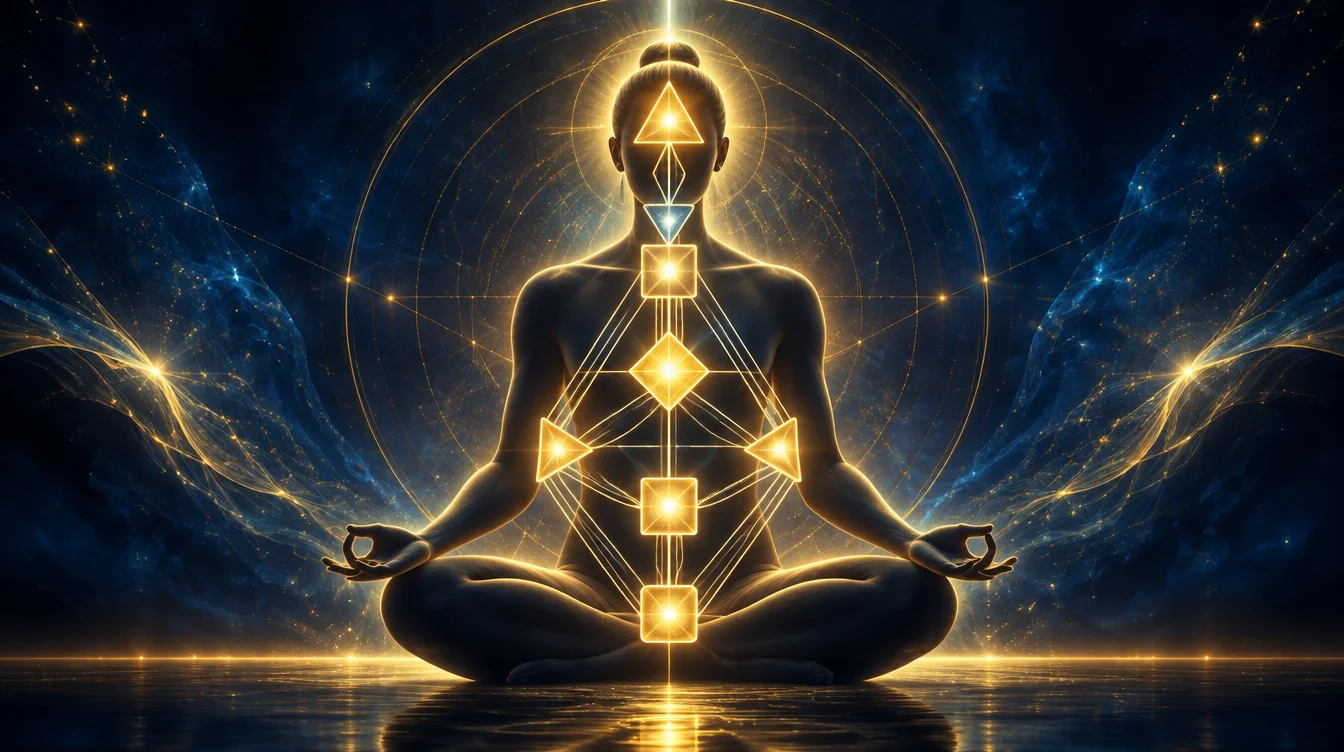
Human Design is a system that claims to describe your energetic blueprint from the moment of your birth. Practitioners call the chart a bodygraph. It looks like a human figure made of nine geometric shapes, called centers, joined by lines called channels. Some centers are colored in (defined) and some are left white (open). That pattern is said to show where your energy is steady and consistent, and where you take in and amplify the energy of the people around you.
The teaching rests on four ideas. First, you have a type that describes how your energy works. Second, each type has a strategy, a simple way of engaging with life that reduces resistance. Third, you have an inner authority, a built-in guidance system for making decisions. Fourth, you have a profile, which describes the role you play and the themes you learn through. Everything else, the gates, channels and incarnation crosses, adds detail to those four.
People who take to Human Design often describe the same experience. They have spent years trying to be more disciplined, more spontaneous, more social or more driven, and none of it fit. The system offers a different suggestion: stop trying to become someone else, and learn the specific way you are designed to work. Whether you read that literally or as a metaphor, it is a healthy shift in attitude, and it is the reason the system has grown so quickly.
Human Design at a Glance
| Element | What it describes | How many |
|---|---|---|
| Type | How your energy is built to work | 5 (Generator, Manifesting Generator, Projector, Manifestor, Reflector) |
| Strategy | How to engage with life and other people | 1 per type |
| Authority | How you make correct decisions | 7 commonly taught |
| Profile | The role you play and your life themes | 12 |
| Centers | Energy hubs that are defined or open | 9 |
| Gates | Points tied to the 64 hexagrams of the I Ching | 64 |
| Channels | Links between two gates in two centers | 36 |
| Chart inputs | Birth date, exact birth time, birth place | 3 |
Where Human Design Came From
Human Design is young compared with astrology or the I Ching. According to Wikipedia, it was presented in 1992 in a book published under the pseudonym Ra Uru Hu, after what its founder described as a mystical experience in 1987. He taught it through the following decades, and certified teachers have carried it forward since. The Jovian Archive and several independent schools now train practitioners around the world.
The system draws on older traditions. From Western and Vedic astrology it takes planetary positions at birth. From the I Ching it takes the 64 hexagrams, which become the 64 gates on your chart. From the Kabbalah it borrows the Tree of Life layout, which shapes the way the centers connect. From the Hindu chakra system it takes the idea of energy centers in the body, reduced and rearranged from seven to nine. Modern physics enters through the idea of neutrinos, which the founder described as carrying information that shapes the design.
That mixture is why Human Design appeals to people who like structure. It feels like a technical manual for the soul. It also explains the criticism. Mainstream scientists do not accept its physical claims, and many spiritual teachers point out that it blends traditions that were never meant to be fused. We will come back to that near the end, because it matters for how you use it.
If you are new to the older systems it draws on, our guides to astrology, Vedic astrology and the chakras are good places to start.
What Teachers on Our Show Say About Human Design
Human Design has come up in a few conversations on the Next Level Soul podcast. Here are two guests who speak to where it came from and how it connects to other maps of the self. Both are their own words and views, shared here as perspectives to explore, not as proof.

Richard Rudd on Human Design and the Gene Keys
Richard Rudd, author of the Gene Keys, tells Alex that Human Design was one of the systems he explored early on. He says “I used human design as well” while contemplating the I Ching and the 64-part code behind it, and that he studied with its founder. From there he wove what he learned into the Gene Keys, a map of your shadow patterns and how they can become gifts.
Pam Gregory on Ra Uru Hu and a Possible Human Shift
Astrologer Pam Gregory credits Ra Uru Hu, the founder of Human Design, as the inspiration behind the system. She recounts his view that a new kind of human, with a shifted genetic makeup, would emerge around 2027, tied to a roughly 17,000 year cycle. It is one teacher’s reading of the cycle, and you are free to hold it lightly.
Watch the full episode: The Great Alignment with Pam Gregory
If you want a guided path into your own chart and higher self, the Mastery course below pairs well with what you have just read.
How Your Human Design Chart Is Calculated
A chart needs three things: your birth date, your birth time and your birth place. The software converts them into the position of the Sun, Moon and planets at the moment you were born. It then calculates a second set of positions for a moment about 88 days before birth, when the Sun was 88 degrees earlier on its path. The first set is called the Personality and is shown in black. The second is called the Design and is shown in red.
The idea is that the Personality is the part of you that you know, the conscious self, and the Design is the part that works underneath, the body and the unconscious patterns. Where black and red lines overlap on a gate, you get a stronger, more repeated theme. Gates sit in the nine centers. When two gates at opposite ends of a channel are both activated, the channel is complete and the two centers it joins become defined.
Birth time matters. A birth time that is off by even a few minutes can change a gate, a line, and sometimes a type or an authority. If you do not know your birth time, check your birth certificate or ask the hospital for the record. Many people use a rectification service when the exact minute is unknown, but treat the result as a working hypothesis and test it in daily life.
The Five Human Design Types
Your type is the first thing to look up and the single most useful part of the system. It describes how your aura, your energetic field, engages with the world. Teachers often cite rough population shares: Generators and Manifesting Generators together make up about 70 percent of people, Projectors about 20 percent, Manifestors about 9 percent and Reflectors about 1 percent. Those numbers come from the Human Design community, not from independent research, so read them as a rough teaching guide.
| Type | Rough share | Strategy | Signature (when aligned) | Not-self theme (when out of alignment) |
|---|---|---|---|---|
| Generator | About 37% | Wait to respond | Satisfaction | Frustration |
| Manifesting Generator | About 33% | Respond, then inform | Satisfaction and peace | Frustration and anger |
| Projector | About 20% | Wait for the invitation | Success | Bitterness |
| Manifestor | About 9% | Inform before you act | Peace | Anger |
| Reflector | About 1% | Wait a lunar cycle | Surprise | Disappointment |
Generator
Generators have a defined sacral center, the engine of life force in this system. They are built to work, to build, to master things, and they have a lot of sustainable energy when they spend it on work that lights them up. The strategy is to wait to respond. That does not mean sitting still. It means letting life put a question or an opportunity in front of you, then checking your gut response before you commit. The sacral speaks in sounds, a quick “uh-huh” for yes and “uh-uh” for no, long before the mind weighs in.
When a Generator says yes to things that do not light them up, the result is frustration. The remedy is not to do less work, it is to do the right work.
Manifesting Generator
A Manifesting Generator has a defined sacral and a motor connected to the throat. They are fast, multi-passionate and often skip steps because they see the shortcut. Their strategy is to respond first, then inform the people their actions will affect. They tend to change direction quickly, and the system treats that as a feature, not a flaw. Quitting something that no longer lights you up is part of how they find their craft.
Frustration and anger show up when they force themselves to finish things out of obligation or when they act without responding.
Projector
Projectors have no defined sacral. They do not have the steady engine that Generators have, so they are built to guide, direct and manage energy rather than produce it in bulk. Their gift is seeing people clearly. The strategy is to wait for the invitation, especially to the big things: a job, a relationship, a move, a role. An invitation means someone recognizes your gift and asks for it. Without it, a Projector’s advice tends to land as pushiness.
When Projectors overwork or push where they were not asked, they feel bitterness. When they are recognized and rest well, they feel success. Rest is not laziness for a Projector. It is part of the design.
Manifestor
Manifestors have a motor connected to the throat and no defined sacral. They are the initiators, the people who start things. Their aura closes and repels, which tends to make others cautious around them. The strategy is to inform: tell the people your action will touch what you are about to do, before you do it. That removes resistance and keeps the peace that is their signature.
The not-self theme is anger, often rising when they feel controlled or blocked, or when people are surprised by their moves.
Reflector
Reflectors have no defined centers at all. Every center on the chart is open. They take in the world and reflect its health back, which is why teachers call them the mirrors of a community. The strategy is to wait through a full lunar cycle, about 28 days, before making a major decision, because the open centers sample the Moon’s changing influence as it passes through all the gates.
Reflectors do best in healthy environments and with people they enjoy. Their signature, surprise, shows up when they feel the world as a source of wonder instead of pressure.
Strategy: How Each Type Moves Through Life
Strategy is the practical heart of Human Design. It is a short rule for how to engage, and the system claims that following it lowers resistance because you stop pushing against your own design. A few simple examples show how it changes ordinary choices.
- Generator: a friend asks you to join a project. You do not decide in the moment. You notice your body’s response, a yes or no that arrives before the thinking starts, and you act on that.
- Manifesting Generator: you feel a rush to start something. You respond to what is in front of you, then tell the people who are affected what you are doing so they are not caught off guard.
- Projector: you see a better way to run your team. You wait until you are asked for your view, and when invited you speak with confidence.
- Manifestor: you decide to change a plan. You send a quick message ahead so others can adjust, and you move on without waiting for permission.
- Reflector: you are offered a big move. You note the choice, live with it for a lunar cycle, and talk it through with trusted people before you decide.
Human Design teachers suggest a short experiment: choose one small area, such as plans with friends or work requests, and apply your strategy for a month. Keep a note of what changes. That is a better test of the system than any theory.
Inner Authority: How You Decide
Strategy tells you how to engage. Authority tells you how to decide. In Human Design, authority is the part of your body that holds the most reliable awareness for you, and it is assigned in a set order based on which centers are defined. The mind is never the authority for most people. It is a good advisor, not the decision maker.
| Authority | Who has it | How it speaks | How to use it |
|---|---|---|---|
| Emotional (solar plexus) | Many Generators, Manifesting Generators, Projectors and Manifestors with a defined solar plexus | Through a wave of feeling that rises and falls | Wait for emotional clarity before big choices, and sleep on it |
| Sacral | Generators and Manifesting Generators without a defined solar plexus | Through an immediate gut sound, “uh-huh” or “uh-uh” | Ask yes or no questions and listen for the first response |
| Splenic | Some Projectors and Manifestors | Through a quiet, one-time intuitive hit in the moment | Act on the first spontaneous knowing, because it does not repeat |
| Ego (heart) | A few Manifestors and Projectors | Through what you truly want and are willing to commit to | Ask whether you truly want it, and what it costs |
| Self-projected | Some Projectors | Through your own voice as you speak | Talk it out loud with a trusted listener |
| Mental or environmental | Some Projectors | Through conversation with different people in different places | Sound it out with several people and settings |
| Lunar | Reflectors | Through a full cycle of the Moon | Take about 28 days for major decisions |
Emotional authority is the most common, and it asks for patience. If you are an emotional-authority person, the clearest decisions come after the highs and lows have passed. If you are a sacral person, speed is on your side. If you are splenic, your intuition is fast and quiet, and it will not repeat itself, so practice trusting the first sense.
If these ideas about inner knowing interest you, our guide to the third eye and the page on meditations for spiritual awakening pair well with authority work, because both train you to notice what your body says before your mind explains.
Human Design Profiles: The Role You Play
Your profile is two numbers separated by a slash, such as 1/3 or 5/1. The numbers come from the lines of your Sun in the Personality and Design. The first number is your conscious role. The second is your unconscious role. Together they describe the theme of your life and how other people tend to relate to you. The six lines are the same building blocks used throughout the system.
| Line | Name | Core theme |
|---|---|---|
| 1 | Investigator | Needs a solid foundation of knowledge before feeling safe |
| 2 | Hermit | Natural talent that needs time alone and a call from others to come out |
| 3 | Martyr (Experimenter) | Learns by trial and error and finds out what works by what does not |
| 4 | Opportunist | Builds a network and influences through relationships |
| 5 | Heretic | Carries other people’s projections and is called on to solve problems |
| 6 | Role Model | Moves through three life phases toward a grounded wisdom |
The twelve profiles are 1/3, 1/4, 2/4, 2/5, 3/5, 3/6, 4/6, 4/1, 5/1, 5/2, 6/2 and 6/3. A 1/3 is a researcher who learns through experiments. A 2/4 is a private talent who thrives inside a close circle. A 5/1 is a practical problem solver whom people look to in a crisis. A 6/2 is a late bloomer whose wisdom deepens with age. Every profile includes a gift and a shadow, and the shadow usually points at what you do when you ignore your type and your authority.
The Nine Centers: Defined and Open
The nine centers are the geometric shapes on the bodygraph. When a center is colored in, it is defined. It works the same way every day, and it is the part of you that other people feel as consistent. When a center is white, it is open. It is where you absorb and amplify the energy of others, and it is where conditioning tends to gather.
| Center | Theme | Defined means | Open means |
|---|---|---|---|
| Head | Inspiration and questions | A steady flow of mental pressure | You feel pulled by other people’s questions |
| Ajna | Conceptualizing and certainty | A fixed way of thinking | Flexible thinking, with a risk of feigning certainty |
| Throat | Communication and manifestation | A consistent voice | You may talk to be heard |
| G (Identity) | Love, direction and identity | A fixed sense of self and path | A flexible identity shaped by place and people |
| Heart (Will) | Willpower and worth | Reliable willpower | Pressure to prove your worth |
| Solar plexus | Emotion and sensitivity | An emotional wave that rises and falls | Absorbing and amplifying others’ feelings |
| Sacral | Life force and sexuality | Sustainable energy for work | Energy that comes in bursts and needs rest |
| Spleen | Intuition, health and fear | Steady instinct and a strong sense of survival | Holding on to what is not good for you |
| Root | Drive and pressure | Steady pressure that you handle well | Rushing to get rid of pressure |
The practical lesson of the open centers is this: the parts of you that feel the most reactive are usually where you are taking in energy that is not yours. The invitation is to ask, “Is this mine?” Many people find this is the most freeing part of the whole system, because it gives them permission to put down a burden they never owned.
If you enjoy the energy-center model, compare it with our guides to the seven chakras and blocked chakras.
Definition, Gates and Channels
The pattern of connected centers is called definition. A single definition links all defined centers in one group. A split definition leaves two groups, which often means you feel you need other people to bridge the gap. Gates are the 64 points tied to the I Ching hexagrams, and channels form when two gates connect two centers. A channel gives you a fixed, reliable trait. The incarnation cross is a larger purpose theme drawn from the Sun and Earth gates, and beginners can safely set it aside.
The Not-Self Theme and Conditioning
Human Design uses the phrase not-self for everything you took on from family, school and culture that did not come from your own design. It shows up as a theme in the body: frustration for Generators, bitterness for Projectors, anger for Manifestors, disappointment for Reflectors. The theme is a signal that you are acting against your strategy or authority. The process called deconditioning is simple to describe and slow to live. Teachers often say it takes about seven years, and anyone who has changed a deep habit knows it takes patience.
To find your own chart, enter your birth date, time and place into a free generator run by a Human Design school. Start with your type, strategy and authority, and leave the gates and cross for later.
Using Human Design in Daily Life
The best use of Human Design is as a set of small daily experiments. A Generator can practice checking the gut response before saying yes. A Projector can practice waiting for an invitation and resting without guilt. A Manifestor can send a quick heads-up before acting. A Reflector can sleep on decisions. Pick one experiment for two weeks, and keep a short note of the decision, how your authority spoke and what happened. After a month you will have your own data, which is worth more than any theory.
Human Design vs Astrology, Numerology and Personality Tests
| System | Based on | What it gives you | Best for |
|---|---|---|---|
| Human Design | Birth date, time and place, converted into a bodygraph | Type, strategy, authority, profile | Decision-making and energy management |
| Astrology | Planet and sign positions at birth | Sun, Moon and rising signs, houses, aspects | Character, timing and life themes |
| Numerology | Birth date and name converted to numbers | Life path, expression and soul numbers | Purpose and personal cycles |
| Personality tests such as Myers-Briggs | Answers to questions about preferences | A four-letter type | Work style and communication |
The key difference is that Human Design is a decision system, not only a personality description. Astrology and Human Design share the same sky data, so many people use both. For the older framework, see our guide to astrology.
Criticism and a Grounded Way to Use It
Human Design draws real criticism. Wikipedia describes it as pseudoscientific, scientists do not accept its physical claims about neutrinos, and some teachers point out that it fuses traditions never meant to be merged. A grounded way to use it is as a structured practice of self-observation, like journaling. Experiment for a few weeks, keep what proves true and let go of the rest. Never use a chart to excuse harmful behavior or to avoid medical or psychological help. If a teacher tells you what you must do with your life based on your chart, step back. The point is more agency, not less.
If you are exploring where you stand on the wider path, our guide to the spiritual awakening journey is a good next read.
Go Deeper with NLS Mastery: Connecting to Your Higher Self
Your design is a map, and your higher self is the guide who reads it with you. Reconnect with your higher self and awaken the clarity and guidance that have always lived within you. Genevieve Taeger teaches it in Connecting to Your Higher Self, part of NLS Mastery. Watch the course preview below.

Frequently Asked Questions
What is Human Design in simple terms?
Human Design is a system that uses your birth date, time and place to create a chart called a bodygraph. The chart assigns you one of five energy types, a strategy for engaging with life, and an inner authority for making decisions.
How many Human Design types are there?
There are five: Generator, Manifesting Generator, Projector, Manifestor and Reflector. Some teachers count only four, treating the Manifesting Generator as a hybrid of Generator and Manifestor.
What is the most common Human Design type?
Generators are the most common, followed by Manifesting Generators. Teachers commonly say the two together make up about 70 percent of people. These figures come from the Human Design community, not from independent research.
What is strategy in Human Design?
Strategy is a short rule for how your type engages with life. Generators respond, Manifesting Generators respond and inform, Projectors wait for the invitation, Manifestors inform before acting, and Reflectors wait through a lunar cycle before major decisions.
What is authority in Human Design?
Authority is your built-in decision-making guide. The main kinds taught are emotional, sacral, splenic, ego, self-projected, mental or environmental, and lunar. It is assigned by which centers are defined on your chart.
What are the nine centers in Human Design?
They are the Head, Ajna, Throat, G (Identity), Heart (Will), Solar Plexus, Sacral, Spleen and Root. Each can be defined, meaning consistent, or open, meaning receptive to the energy around you.
What is a Human Design profile?
A profile is a pair of numbers, such as 3/5, that describes the role you play and the themes you learn through. There are twelve profiles built from six lines, from the Investigator to the Role Model.
Is Human Design scientific?
No. Wikipedia describes Human Design as pseudoscience, and its claims about neutrinos and the body are not supported by mainstream science. Many people use it as a self-reflection practice rather than a scientific tool.
How is Human Design different from astrology?
Both use the sky at your birth. Astrology describes character and timing through signs and houses. Human Design converts the same data into a bodygraph that focuses on how to make decisions and manage energy.
Do I need my exact birth time for Human Design?
Yes. An inaccurate birth time can change your type, authority or profile. Check your birth certificate or hospital records for the exact time.
Sources and Further Reading
Spirituality for the Rest of Us™
Movies, teachings and community on Next Level Soul TV.