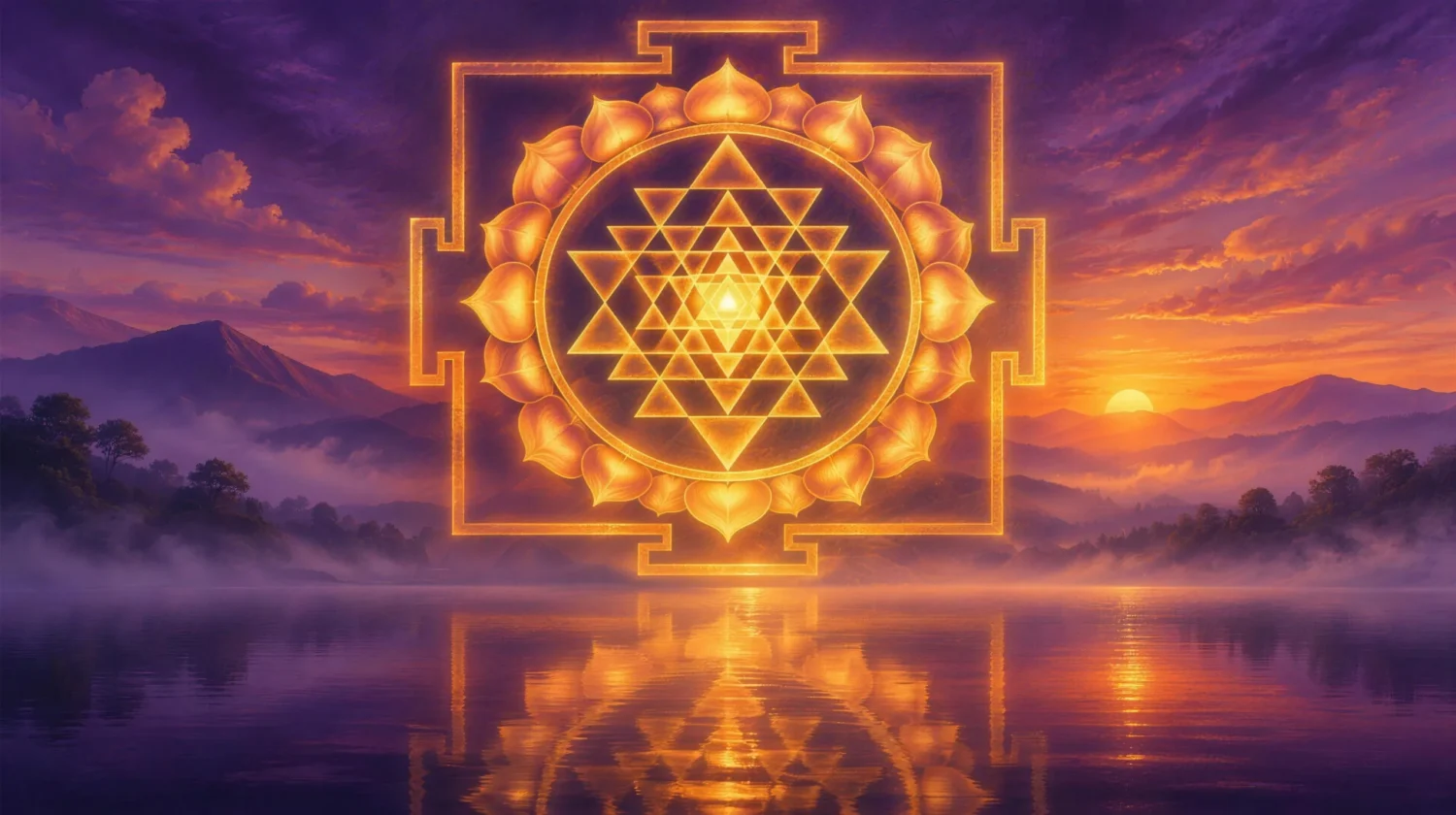
The Sri Yantra is a sacred diagram from Hindu Tantric tradition, built from nine interlocking triangles that meet around a single central point called the bindu. In Shakta tradition it represents the goddess Tripura Sundari and the whole of creation, held together as one pattern. People use it as a focus for meditation, and it sits at the heart of the broader world of sacred geometry.
Key Takeaways
- What it is: A geometric diagram of nine interlocking triangles, two rings of lotus petals and a square gate, all radiating from a central point.
- Core meaning: In Hindu Tantric tradition, upward triangles stand for Shiva and downward triangles for Shakti. Their union is read as the source of all manifestation.
- Where it comes from: It is central to Sri Vidya, a Shakta Tantric school that worships the goddess Lalita Tripura Sundari. Exact dates are debated.
- How people use it: As a focus for gazing meditation, ritual worship, or quiet reflection. Traditional use is often taught by a guru and includes mantra.
- Honest limits: It is a spiritual and contemplative tool, not a treatment or a guarantee. Claims about wealth or healing belong to tradition, not to evidence.
What Is the Sri Yantra?
A yantra is a diagram used as a support for ritual and meditation in Tantric Hinduism, and in related forms in Buddhism and Jainism. The word comes from Sanskrit and is often translated as “instrument” or “support.” A yantra is a map you can look at. It points the mind toward something that words only circle around.
The Sri Yantra, also called the Sri Chakra or Shri Yantra, is the most famous of them all. Look at one and you see a set of triangles pointing up and down, wrapped in a ring of lotus petals and held inside a square with four gates. At the very center sits a single dot.
Do not confuse the Sri Chakra with the body’s energy centers. The word chakra here means “wheel” or “circle” of the diagram. If you are curious about the seven body centers, our guide to the chakras covers them separately.
Sri Yantra at a Glance
| Question | Quick answer |
|---|---|
| What is it? | A sacred geometric diagram used for meditation and worship in Hindu Tantra. |
| Other names | Sri Chakra, Shri Yantra, Shri Chakra. In three dimensions it is the Sri Meru. |
| Main shapes | Nine interlocking triangles, 8 and 16 petal lotuses, a square frame with four gates. |
| Triangle count | Four point upward and five point downward, forming 43 smaller triangles in all. |
| Center | The bindu, a single point that stands for the source of creation. |
| Tradition | Shaktism, especially the Sri Vidya school devoted to Lalita Tripura Sundari. |
| Common use | Gazing meditation, ritual worship, home altars, and study of sacred symbols. |
The Anatomy of the Sri Yantra, Layer by Layer
The easiest way to read the Sri Yantra is from the outside in, the way a traveler would walk toward a temple. Each layer is a threshold. The tradition calls these levels avaranas, which means “enclosures” or “coverings.” There are nine, and the walk ends at the point where all the lines meet.
| Layer | Shape | Traditional meaning |
|---|---|---|
| Bhupura | Square frame with four gates | The outer boundary, like a temple precinct open to the four directions. It marks the threshold between the everyday world and the sacred space. |
| Sixteen-petal lotus | Outer ring of petals | The outer of the two lotus rings, read in tradition as part of creation unfolding outward. |
| Eight-petal lotus | Inner ring of petals | The inner lotus ring. Both rings are read as symbols of creation and vital force. |
| Outer triangle rings | Fourteen, ten and ten small triangles | Layers of the interlocking triangles, each tied in tradition to a named goddess form, a mantra and a mudra. |
| Eight small triangles | Inner ring of triangles | The penultimate layers before the center. Each level has its own name and presiding energy. |
| Central triangle | One small downward triangle | The innermost enclosure around the point. |
| Bindu | A single dot | The still center. The source from which the whole pattern is said to unfold. |
The nine triangles
The heart of the design is nine triangles that cross each other. Four point upward. In tradition these stand for Shiva, the masculine principle of pure awareness. Five point downward. These stand for Shakti, the feminine principle of creative energy. Where they overlap, they create 43 smaller triangles arranged in concentric levels.
The idea is union, not opposition. Awareness and energy are not two rival forces. They are two faces of one reality. This is one reason the Sri Yantra is so often linked with non-duality, the teaching that the separation between self and cosmos is not the final truth.
The lotus petals
Around the triangles are two rings of lotus petals, one with eight petals and one with sixteen. The lotus appears across Indian art because it grows from mud and opens clean above the water. In the Sri Yantra, the petals are read as the unfolding of creation outward from the center.
The square and its four gates
The outer square is called the bhupura. The four openings on its sides can be read as doors to the four directions. The picture is of a temple that is open on every side. The layout also echoes the idea behind a mandala: a sacred space with a protected center. See our guide to spiritual symbols and their meanings for how these shapes appear in other traditions.
The bindu: the point at the center
Everything leads to the bindu. It is a dot with no size, and in tradition it is the seed from which the whole pattern grows and the place it returns to. In practice it is also the gentlest instruction in the whole design: look here, and let everything else go quiet.
Where the Sri Yantra Comes From
The Sri Yantra belongs to Sri Vidya, one of the best-known schools of Shakta Tantra. Shaktism is the Hindu tradition that honors the divine feminine as ultimate reality. Sri Vidya centers on the goddess Lalita Tripura Sundari, also called Shodashi or Rajarajeshvari. In this tradition the Sri Yantra is regarded as her subtle form, her body made of geometry.
Texts associated with the goddess include the Lalita Sahasranama, a hymn of a thousand names found within the Brahmanda Purana. Practice of the yantra is traditionally linked to mantra and is usually taught by a guru after initiation.
Dating the diagram itself is harder. Some traditions attribute the first drawings of the complex yantra to the philosopher Adi Shankara. Some modern writers claim far older roots. There is no firm historical evidence for the earliest dates, and the honest answer is that the origin is uncertain. What we can say is that it has been central to Sri Vidya worship for many centuries and remains a living tradition today, especially in South India.
From drawing to mountain: the Sri Meru
The Sri Yantra can be drawn flat, or built as a stepped pyramid called the Sri Meru (also Mahameru), named for the mythic cosmic mountain. The pyramid form turns the same pattern into a three-dimensional object. Both forms are used in worship.
What the Sri Yantra Symbolizes
Different teachers read the same diagram in different ways. These are the readings you will meet most often, each attributed to tradition.
- Union of Shiva and Shakti. The upward and downward triangles show awareness and energy as one.
- The cosmos in one picture. The expanding layers are read as creation unfolding from a single point. Following them inward reverses that journey.
- The goddess herself. In Sri Vidya the yantra is not only a symbol of Tripura Sundari. It is understood as her form.
- The inner journey. Moving through nine enclosures to the center mirrors a path from outer life to the still point of awareness.
- The human being as a microcosm. This echoes the Hermetic idea of as above, so below, though the two traditions are separate.
It is worth noticing that none of these readings asks you to believe anything first. Each is an invitation to look and see what happens.
How to Meditate With the Sri Yantra
Traditional Sri Vidya practice is detailed and is usually learned from a teacher. What follows is a simple gazing practice for beginners, a contemplative exercise rather than a ritual. It is a spiritual and relaxation practice, not a treatment for any condition.
- Choose your image. A printed Sri Yantra at eye level works. Make sure the lines are clear and the center is easy to find.
- Set the space. Sit comfortably, a meter or so from the image, with a steady light. Silence your phone.
- Settle first. Take a few slow breaths with your eyes closed. Let your shoulders drop.
- Soften your gaze. Open your eyes and rest them on the bindu. Do not strain. Blink when you need to.
- Let the pattern breathe. Let your attention widen to the triangles, then the petals, then the square. Then return to the center.
- Close your eyes. Hold the afterimage for a moment if one appears. Rest in the quiet.
- Keep it short. Five to ten minutes is plenty. Note one word about how you feel.
If your mind wanders, that is normal. Come back to the dot. To build a steadier base, try pairing this with a guided practice from our guided meditations, or explore hand gestures in our guide to mudra meanings.
Stop if gazing causes eye strain, dizziness or distress. If you live with a health condition or a history of trauma, check in with a qualified professional before adding intense meditation practices.
What traditional practice adds
In Sri Vidya, the yantra is typically consecrated by a priest with mantras, because practitioners hold that an unconsecrated yantra is just a drawing. The practice may include the goddess’s mantras, offerings and visualization, taught step by step. If this calls to you, seek an authentic teacher in the lineage instead of learning from a video alone.
Using the Sri Yantra in Everyday Life
You do not need a shrine to bring the Sri Yantra into daily life. Many people simply keep an image where they can see it, as a quiet reminder of the center.
- Desk or altar. Place it where your eyes land at a natural pause. Look at the dot for three breaths before starting work.
- Material choices. Yantras are made on paper, in metal, in wood, or as the Meru in crystal or brass. In tradition, material matters less than clarity of the lines and respect for the object.
- Respect. Treat it as a sacred object, not a decoration to be ignored. Keep it clean and off the floor.
- Tattoos and jewelry. Many people wear it. If you do, learn what it means first. Wearing it respectfully matters.
Some people connect the Sri Yantra to kundalini energy, the coiled energy of yoga tradition. Tradition describes such links, but they are teachings, not measured facts, and they sit best in the hands of a skilled teacher.
Sri Yantra Compared With Other Sacred Geometry
Sacred geometry shows up across cultures. The Sri Yantra shares ideas with other patterns, but each has its own roots.
| Symbol | Tradition | Core shapes | Common reading |
|---|---|---|---|
| Sri Yantra | Hindu Tantra (Sri Vidya) | Nine interlocking triangles, lotus petals, square | Union of Shiva and Shakti; the goddess as geometry |
| Flower of Life | Modern sacred geometry; ancient motif in many cultures | Overlapping circles | Interconnection of all life |
| Metatron’s Cube | Modern esoteric (Kabbalistic imagery) | Circles joined by straight lines | Hidden structure within creation |
| Merkaba | Modern spiritual use of a Jewish mystical term | Two interlocked tetrahedra | A vehicle of light for the soul |
| Seed of Life | Modern sacred geometry | Seven overlapping circles | The days or stages of creation |
What sets the Sri Yantra apart is that it comes with a living practice, a lineage and a named goddess. It is not only a pattern to admire. In Sri Vidya, it is something to worship and to meditate on.
Common Misconceptions and Honest Limits
- “It is just a pretty pattern.” In its tradition it is a sacred object with detailed practice, not a decoration.
- “It guarantees wealth or healing.” Many sellers claim this. Tradition speaks of blessings and inner benefits, but no evidence shows a diagram produces money or cures. Treat these claims with caution.
- “It is 12,000 years old.” Some writers say so. This is a claim of tradition, not an established date.
- “The Sri Chakra is a chakra of the body.” It is a diagram, not one of the body’s energy centers.
- “Any print works the same.” Practitioners differ. Some stress careful geometry and consecration. Others use a simple print for gazing. Both are honest choices if you know the difference.
- “You must be Hindu to use it.” Many people from all backgrounds meditate with it. Respect for its roots is what matters.
If you buy a Sri Yantra, look for clear, well-drawn lines and honest descriptions. Be wary of anything promising guaranteed results.
Go Deeper
The Sri Yantra rewards slow attention. You might start with a few minutes of gazing, then widen your study to the wider family of symbols. If you enjoy mantra, our guide to mantras will pair well with this practice.
On Next Level Soul TV you can explore spiritual teachers, series and guided meditations, all in one library. It is a spiritual library, not a dedicated yantra course, but it can support a steady inner practice.
Go Deeper with NLS Mastery: Ancient Meditation for Inner Stillness
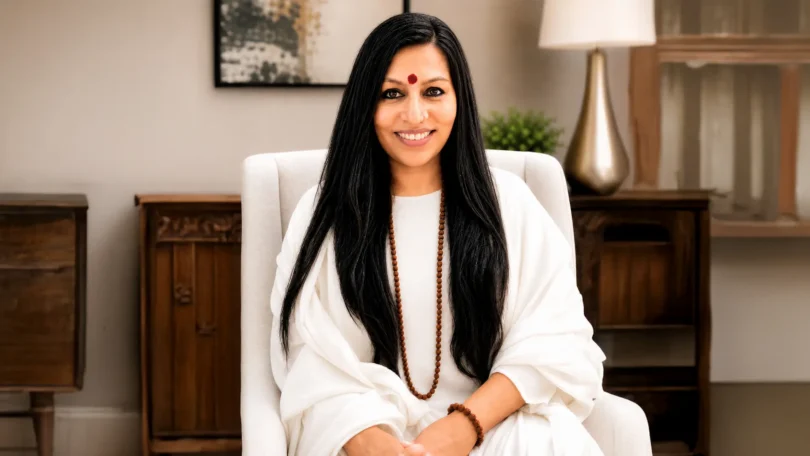
Acharya’s meditation course gives you a steady, step-by-step way to build the kind of focused stillness that gazing practices like the Sri Yantra invite. Acharya Shunya teaches it in Ancient Meditation for Inner Stillness, part of NLS Mastery. Watch the course preview below.
Frequently Asked Questions
What is the Sri Yantra?
The Sri Yantra is a sacred diagram of nine interlocking triangles, lotus petals and a square frame around a central point. It comes from Hindu Tantric tradition and is used for meditation and worship.
What does the Sri Yantra represent?
In tradition it represents the goddess Tripura Sundari and the union of Shiva and Shakti. It is also read as the whole cosmos unfolding from a single point.
What do the nine triangles mean?
Four upward triangles stand for Shiva and five downward triangles stand for Shakti. Together they form 43 smaller triangles, which express the meeting of awareness and energy.
What is the bindu in the Sri Yantra?
The bindu is the central dot. In tradition it is the source of creation and the still point where meditation comes to rest.
Is Sri Yantra the same as Sri Chakra?
Yes. Sri Chakra and Shri Yantra are alternate names for the same diagram. The word chakra here means wheel or circle, not a body energy center.
How old is the Sri Yantra?
No one knows for certain. Tradition links it to the philosopher Adi Shankara, and some writers claim far older roots, but firm historical dates are uncertain.
How do you meditate on the Sri Yantra?
Sit comfortably, rest a soft gaze on the central bindu, let your attention widen across the pattern, then close your eyes and rest. Five to ten minutes is plenty.
Can anyone use a Sri Yantra?
Many people from all backgrounds meditate with it. Traditional worship is often taught by a guru, and respect for its Hindu roots is important.
Does the Sri Yantra bring wealth or luck?
Some traditions and sellers claim it does, but there is no scientific evidence. It is best approached as a contemplative tool rather than a guarantee.
What is the Sri Meru?
The Sri Meru is the three-dimensional, pyramid form of the Sri Yantra, named for the mythic Mount Meru. It is used in worship much like the flat diagram.
Where should I place a Sri Yantra?
Many people place it on a clean altar or desk at eye level, away from the floor. Tradition emphasizes respect for the object more than a strict location.
Sources and Further Reading
Spirituality for the Rest of Us™
Movies, series, documentaries, audiobooks, audio courses and guided meditations on awakening and consciousness, all in one place. 14-day money-back guarantee.