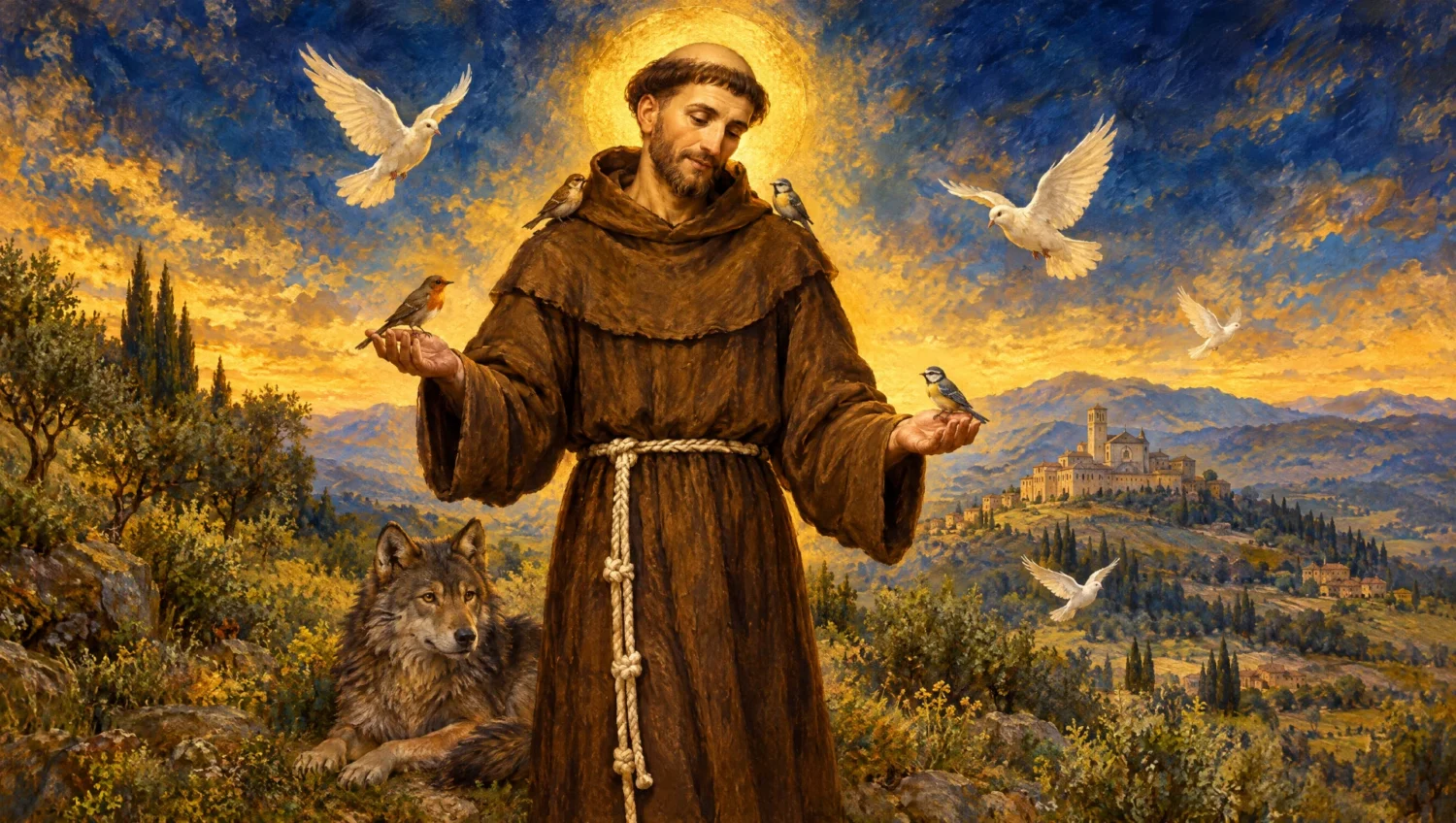
He was a rich young man who wanted to be a knight. Then he kissed a leper, gave away his father’s cloth, and walked into the hills in a rough brown tunic. Within a few years, thousands of people were following Francis of Assisi, and the Church that had tried to ignore him could not. He preached to birds and to a sultan. He wrote one of the first great poems in the Italian language to praise the sun, the wind and the earth as his brothers and sisters. And he died singing. This guide follows the real man behind the garden statue: his life, his own words, the legends that grew around him, what is documented and what is devotion, and how his path of radical simplicity is understood within the Ascended Masters stream. It ends with a seven-day practice drawn from his best-loved poem.
Key Takeaways
- Who he was: Francesco di Pietro di Bernardone, born around 1181 in Assisi, Italy. Founder of the Franciscans. Died October 3, 1226, at about age 44. Declared a saint in 1228.
- What is documented: His own writings survive, including the Canticle of the Creatures, the Admonitions and his Testament. Many famous stories, such as the wolf of Gubbio, come from later sources.
- Core teaching: Radical simplicity, joyful humility, kinship with all creatures, and peace made by example, not argument.
- The mystic: Tradition holds that he received the stigmata, the wounds of Christ, on Mount La Verna in September 1224.
- As an ascended master: Some esoteric teachings count Francis among the great Masters. Catholic tradition honors him as a saint in heaven. We keep the two views distinct.
- Try it: A seven-day walk through the Canticle of the Creatures, from Brother Sun to Sister Death.
In This Guide
- Who Was Saint Francis of Assisi?
- What Is Documented and What Is Devotion
- The World of Assisi
- The Merchant’s Son Who Wanted to Be a Knight
- The Leper, the Crucifix and the Town Square
- Brothers, Clare and the Rule
- The Saint and the Sultan
- Lady Poverty: Why He Gave Everything Away
- Brother Sun, Sister Moon: The Canticle of the Creatures
- Birds, a Wolf and a Manger: What the Stories Say
- Core Teachings: Joy, Humility and Peace
- La Verna and the Stigmata
- Sister Death
- The Franciscan Legacy
- How Francis Compares to Other Teachers
- Francis as an Ascended Master
- Honest Questions and Cautions
- A Practice: Seven Days with Brother Sun
- Books and Further Reading
- Who Will Connect with This Teacher
- Keep Exploring
- Frequently Asked Questions
Who Was Saint Francis of Assisi?
Francis of Assisi was an Italian friar, mystic and poet of the early thirteenth century. He founded the Order of Friars Minor, known as the Franciscans, and inspired the Poor Clares and a lay movement that still exists today. He is one of the most beloved figures in all of Christianity, and one of the few Christian saints who is also warmly loved by Buddhists, Hindus, Muslims, Jews and people with no religion at all.
Part of this love comes from the stories. A man who strips naked in the town square. A sermon to the birds. A wolf who becomes tame. A manger scene at Christmas. A gentle visit to a Muslim sultan in the middle of a crusade. Part of it comes from something harder to name: the sense that Francis actually lived what he said. He did not simply teach poverty or love of creation. He gave up everything and kissed the leper.
Over time, he has become a symbol. He is the patron saint of animals, of ecology, of Italy. Statues of him with a bird on his hand stand in many gardens. The real man was fiercer and more complicated. This guide tries to meet him.
What Is Documented and What Is Devotion
Francis is unusually well documented for a medieval figure, and unusually wrapped in legend. It helps to sort the sources into three kinds.
- His own writings. A small number of texts survive, including the Canticle of the Creatures, the Admonitions, letters, two versions of the Rule, the Praises of God written for Brother Leo, and his Testament. These are the closest we can come to his own voice.
- Early biographies. Thomas of Celano wrote the first life soon after Francis’s canonization, in 1228 to 1229. Later, Saint Bonaventure wrote the Major Legend in the 1260s, which became the Order’s official biography. These are works of devotion as well as history.
- Later legends. The Little Flowers of Saint Francis (the Fioretti), compiled in the fourteenth century, includes the wolf of Gubbio and the story of perfect joy. They are beautiful, and they are much later.
Modern biographers, such as Augustine Thompson, work carefully through these layers. When we say “tradition holds,” we mean the stories come from the later layers. When we say “Francis wrote,” we are quoting a text that scholars attribute to him. We will mark the difference as we go.
The World of Assisi
Assisi in the late twelfth century was a hill town in Umbria, proud and quarrelsome, part of a patchwork of Italian city-states that fought with their neighbors. Money was newly powerful. Merchants were rising. Popes and emperors were competing. Europe was sending armies to the Holy Land. At the same time, ordinary people were hungry for a more authentic spiritual life. Movements of voluntary poverty, such as the Waldensians, were spreading, and the Church sometimes welcomed them and sometimes condemned them.
Francis was born into this restless world around 1181 or 1182. His father, Pietro di Bernardone, was a prosperous cloth merchant. His mother, Pica, is said to have come from Provence. He was baptized Giovanni, and his father later called him Francesco, “the Frenchman,” possibly in honor of his business trips to France. He grew up with money, fine clothes and the songs of the troubadours.
The Merchant’s Son Who Wanted to Be a Knight
The young Francis was charming, generous and fond of a good party. He dreamed of knighthood and glory. Around 1202, he joined Assisi’s war against Perugia and was captured at Collestrada. He spent about a year as a prisoner, and an illness during that time seems to have shaken something loose.
Back home, he tried to return to his old life. In 1205, he set off to join a military expedition in southern Italy. The early biographies say a strange dream or voice sent him home. He began to spend time in caves and abandoned chapels, praying and wrestling with a question: What do you want of me?
This is a recognizable moment in many spiritual lives. The old story no longer fits, and no new one has arrived. The gap can last months or years. Francis stayed in the gap. Mystics sometimes call this stage a dark night, and our guide to the dark night of the soul describes how it feels and how people move through it.
The Leper, the Crucifix and the Town Square
Three moments define his conversion. The first, in his own words from the Testament, was meeting a leper. Francis had always found lepers repulsive. One day, he wrote, the Lord led him among them, and he showed mercy to them, and “what had seemed bitter was changed into sweetness of soul and body.” Tradition holds that he dismounted from his horse, embraced a leper on the road, and kissed him.
The second was in the broken little church of San Damiano, outside Assisi. According to the early biographies, as he prayed before a painted crucifix, he heard a voice say: “Francis, go and repair my house, which, as you see, is falling into ruin.” He took it literally and began rebuilding the chapel with his own hands. He later understood a larger meaning, that the whole Church needed renewing.
The third was in the public square of Assisi, in about 1206. His father, furious that Francis had sold some of his cloth to pay for stones, took him before the bishop. Francis handed back his money, and the biographies say he took off his clothes and returned them too. In Bonaventure’s telling, Francis declared that from now on he could say, without reservation, “Our Father who art in heaven.” The bishop wrapped him in his own cloak.
Whether every detail happened as told, we cannot say. What is clear is that Francis broke with his family and his class, and chose to live among the poor. He worked on chapels, cared for lepers, and begged for his food.
Brothers, Clare and the Rule
In about 1208, at a small chapel called the Porziuncola, Francis heard the Gospel passage where Jesus sends out his disciples with no purse, no bag and no spare tunic. He took it as his call. He put on a plain wool tunic tied with a rope and began to preach repentance and peace to anyone who would listen. Companions joined him. By 1209 or 1210 there were a dozen, and Francis led them to Rome to ask Pope Innocent III for approval.
The pope, according to tradition, approved the little community after a dream in which he saw Francis holding up a leaning cathedral. The group became the Order of Friars Minor, the “lesser brothers.” The word “minor” mattered. Francis wanted his followers to be below, not above: servants of all.
In 1212, a young noblewoman named Clare slipped out of her family’s palace on the night of Palm Sunday and joined Francis at the Porziuncola. Her community of women at San Damiano became the Poor Clares. Their friendship, and their shared commitment to poverty, is one of the great spiritual partnerships of the Middle Ages. For people who could not leave family and work, Francis also created a Third Order, a lay fellowship still active today.
The order grew faster than anyone had planned. Francis, never a natural administrator, found himself writing rules and watching them be reshaped. A final Rule was approved by Pope Honorius III on November 29, 1223. Francis gradually stepped back from leadership and returned to prayer and solitude.
The Saint and the Sultan
In 1219, in the middle of the Fifth Crusade, Francis sailed to Egypt. A crusader army was besieging the city of Damietta. Francis crossed the lines, with one companion, to meet the Muslim ruler, Sultan al-Kamil. The early biographies say he hoped either to convert the Sultan or to be martyred.
What actually happened is unknown. Christian sources say the Sultan received Francis kindly, listened to him, and sent him back unharmed. No Arabic source mentions the meeting. Later legends say the Sultan secretly converted, which is almost certainly embellishment. What matters, historians say, is that in a time of holy war, Francis walked unarmed into the enemy camp, talking about peace.
His own Rule of 1221 contains a short passage for friars who live among Muslims: they may live quietly, being subject, and not argue; or, when it pleases God, speak openly of the faith. It is remarkable for its time. Today, the encounter is often cited in interfaith conversations, and many Franciscans and Muslims point to it as a model of respectful meeting.
Lady Poverty: Why He Gave Everything Away
Francis called poverty his bride, “Lady Poverty.” It is easy to romanticize this and hard to practice. For him it was not self-punishment or a rule to be admired. It was freedom. If you own nothing, no one can take anything from you. If you need nothing, you can hear everything.
He also saw poverty as solidarity with Jesus, who in the Gospels “had nowhere to lay his head,” and with the poor around him. The early friars worked with their hands for food and accepted alms only when work did not suffice. They avoided handling money. They owned no buildings. When they were given a house, they asked whether they could use it, not own it.
There is a lesson here that is not only for monks. Many of us feel buried under possessions, subscriptions and obligations. Francis shows a different way of asking the question. Instead of “How much can I get?” he asks “How little do I need to be free?” Our guide to the power of gratitude offers a gentle companion for that inquiry.
Brother Sun, Sister Moon: The Canticle of the Creatures
Toward the end of his life, nearly blind and in pain, Francis composed a hymn of praise. It is called the Canticle of the Creatures or Canticle of Brother Sun, written in Umbrian Italian rather than Latin, around 1224 to 1225. It is among the earliest great poems in the Italian language.
The poem praises God through creation: Brother Sun, who gives the day; Sister Moon and the stars; Brother Wind and the air; Sister Water, humble and precious; Brother Fire, bright and strong; and Sister Mother Earth, who sustains us. Later he added verses for those who forgive and endure, and finally for Sister Bodily Death, “from whom no one living can escape.” It begins with the line “Most High, all-powerful, good Lord.”
The word “brother” is not decoration. In Francis’s world, all creatures were related because all came from one Source. He extended kinship to wind and fire, which is something few Christian writers had done before. Modern readers feel in it an early ecological spirit. In 1979, Pope John Paul II named him patron saint of ecology. In 2013, a cardinal from Argentina chose the name Francis as pope, and his 2015 encyclical Laudato Si’ takes its title from the refrain of the Canticle.
Mystics in many traditions would recognize what the poem is doing. It is not worship of nature. It is seeing the Divine in and through nature, with gratitude. If you want to feel this practically, our guide to earthing and grounding explores simple ways of reconnecting with the earth. And our practice below uses the Canticle itself.
Birds, a Wolf and a Manger: What the Stories Say
The animal stories are the best known. Celano and Bonaventure both report that Francis preached to a flock of birds, who listened and then rose in the shape of a cross. In the Fioretti, a fierce wolf terrorizes the town of Gubbio until Francis meets him, speaks to him as “Brother Wolf,” and arranges a truce: the townspeople will feed him, and he will stop attacking. These tales come from later layers of tradition and are told as parables.
They carry real teaching. In the Franciscan vision, animals are not objects. They are fellow creatures with their own relationship to God. Humans are called to be companions and stewards, not masters. For centuries, people have turned to Francis for the blessing of animals, which is still held every year around his feast day on October 4.
In December 1223, at Greccio, Francis arranged the first known living nativity scene: a real manger, hay, an ox and a donkey, and a Mass held over the manger. According to Celano, Francis wanted to “see with bodily eyes” the humble reality of the birth of Jesus. The tradition of the Christmas crèche that millions of families set out each year traces back to that night.
Core Teachings: Joy, Humility and Peace
Francis was not a systematic teacher. He taught by example and short sayings. A few threads are consistent.
- Joy. He wanted his friars to be “God’s jesters,” according to later tradition, and to avoid long faces. In the story of perfect joy from the Fioretti, Francis tells Brother Leo that true joy is not miracles or learning, but staying peaceful when you are turned away from a door in the cold.
- Humility. The friars were called “minor.” Francis urged them to be subject to all, and to treat every person as a master.
- Simplicity. He preferred plain speech and plain living. One of his Admonitions says, “Where there is charity and wisdom, there is neither fear nor ignorance.”
- Peace. The greeting he gave was “May the Lord give you peace.” He preached reconciliation in feuding towns, and he asked his followers to be peacemakers by their manner.
- Care for the body and the senses. Contrary to the stern ascetic image, he rejoiced in sun and song, and late in life regretted treating his own body, which he called “Brother Ass,” too harshly. Some accounts say he asked its forgiveness.
These are small things. That is the point. The path he points to is made of small acts, repeated.
La Verna and the Stigmata
In September 1224, Francis went to the mountain of La Verna to fast and pray. According to the Franciscan tradition, in the days around the feast of the Exaltation of the Cross, he saw a vision of a six-winged seraph with the figure of a crucified man among its wings. When the vision faded, he found marks in his hands, feet and side that resembled the wounds of Christ. Brother Leo, who was with him, left an early account. Francis is regarded as the first stigmatic in Christian history.
How should we hold this? Three views are worth stating. The Church accepts the stigmata as a miraculous sign. Some historians have suggested natural explanations; one theory points to a disease Francis may have suffered, and points out the marks are first recorded after his death. Mystics, meanwhile, often read the stigmata as the most intense form of identification with a beloved teacher: a body marked by the contemplation of suffering and love.
After La Verna, Francis wrote a short blessing and a hymn, the Praises of God, on a small piece of parchment for Brother Leo. It still survives in Assisi. It is the closest we come to seeing his handwriting.
Sister Death
In his last years, Francis was nearly blind and weak, probably from a trachoma-like eye infection and malaria. He endured painful treatments, including cauterization of the eyes, and, according to Celano, felt little. He was carried to a hut near the Porziuncola. There he dictated his Testament, a spiritual farewell asking the friars to remain faithful to simplicity.
He greeted death as a sister. He asked the friars to lay him naked on the earth when the time came. He died on the evening of Saturday, October 3, 1226, singing a psalm. Larks, according to a later legend, circled the roof. He was about 44. Pope Gregory IX, a friend of his, declared him a saint on July 16, 1228, and laid the cornerstone of the basilica in Assisi the next day.
The Franciscan Legacy
Within a generation, the Franciscans were one of the largest orders in the Church. They became preachers, teachers, philosophers, missionaries and healers. Bonaventure and Duns Scotus were Franciscans, as was the English scientist Roger Bacon. The Franciscans have kept a presence in the Holy Land since 1217.
The success carried a tension. How could a movement founded on owning nothing manage schools, churches and libraries? Within decades, the order split between those who wanted to follow the strictest poverty (the Spirituals) and those who accepted a more moderate path. The argument lasted for centuries. Francis himself, in his Testament, forbade any gloss that would soften the Rule, but the pope soon declared the Testament non-binding.
Beyond the order, his influence reaches far. Artists from Giotto’s circle painted his life on the walls of Assisi. Poets and composers have drawn from him. The ecology movement honors him. Interfaith leaders gather in Assisi, as Pope John Paul II first invited them to do for a day of prayer for peace in 1986. And ordinary people light candles to him and pray when they are ill, when they have lost a pet, or when they need courage to simplify.
How Francis Compares to Other Teachers
Francis belongs to a family of teachers who found the Divine through love, humility and joy, rather than through intellect. Here are a few comparisons.
- With Jesus, whom he sought to imitate as literally as possible. Read how the esoteric traditions picture the unknown years of Jesus in our guide to the lost years of Jesus.
- With Anandamayi Ma, the joy-permeated Mother of Bengal, who also lived without possessions, delighted in simplicity and seemed to radiate gladness. Compare the two in our film about her life.
- With Rumi and the Sufis, in the language of love and the dance of creation. Our audio course Rumi’s Eternal Dance (27 lessons) holds that stream.
- With the Buddhist ideal of loving-kindness and the yogic idea of ahimsa, or nonharming, which echo his kinship with every creature.
- With the yogic saints of India, whom Paramahansa Yogananda honored alongside Christian saints in his own teaching.
Seen together, they suggest that the heart of the mystical path is not far from one tradition to another. It is a loosening of self-importance and a widening of love.
Francis as an Ascended Master
In the Catholic and Orthodox imagination, Francis is a saint in heaven who can be asked for help. In the Ascended Master teachings, which grew out of Theosophy, a master is a soul who has completed the cycle of earthly lessons and continues to serve humanity from a higher plane. The two ideas overlap in spirit, though not in doctrine.
Some esoteric teachings, including those associated with Elizabeth Clare Prophet’s Summit Lighthouse, name Francis among earlier lifetimes of the master Kuthumi, one of the Theosophical Masters of the Wisdom. Others simply honor him as a being of great love who still inspires. These are devotional and esoteric claims with no basis in the medieval record. We mention them because they matter to many readers, and because they show how widely his example has traveled.
If you are drawn to this view, our Anjie Hipple conversation on the most ascended masters ever channeled and the Ascended Masters, Channeled collection place many such voices side by side. The mystical Christian view appears in The Mystical Christ Revealed with Fr. Seán Ó Laoire, and our guide to spiritual enlightenment across traditions gives context for the idea of a realized being.
Whatever the framework, the practical meaning is the same. Francis offers a living example that a human being can let go of ambition and still be fully alive.
Honest Questions and Cautions
Is the “Prayer of Saint Francis” Really His?
No. The beloved “Lord, make me an instrument of your peace” first appeared in 1912 in a small French Catholic magazine, without a named author. It was later tied to Francis’s name. It fits his spirit, but it is not in any medieval source.
Did He Say “Preach the Gospel at All Times; Use Words If Necessary”?
There is no record of it in his writings or the early biographies. Franciscan scholars say it is a modern paraphrase. It also oversimplifies him. Francis was a passionate preacher who used many words.
How Reliable Are the Animal Stories?
The wolf of Gubbio is a later legend. The sermon to the birds appears in earlier biographies. Either way, the stories show how people saw him, and what they hoped to learn from him.
Was He Too Severe with Himself?
Many Franciscan writers say so. His extreme fasting, sleeping on the ground and lack of medical care likely harmed his health. Late in life he regretted it. A path of simplicity does not require self-neglect. Please take care of your body.
Was He an Obedient Churchman or a Rebel?
Both, and that tension is the interesting part. He insisted on loyalty to the Church and to priests, even unworthy ones. Yet his life of voluntary poverty was a living challenge to a wealthy Church. Readers today draw different conclusions, depending on their own view of the institution.
Is It Okay to Love Francis If I Am Not Christian?
Many people of other faiths do. His love of creation and his humility belong to everyone, and Franciscans have always welcomed that.
A Practice: Seven Days with Brother Sun
This practice uses the Canticle of the Creatures. It takes about ten minutes a day. You do not need to believe anything. You need only a place to step outside, even briefly.
- Day 1, Brother Sun. Greet the morning light. Step outside, face it, close your eyes and say thank you in your own words.
- Day 2, Sister Moon and the stars. After dark, look up for five minutes. Notice your size in the universe, and your belonging.
- Day 3, Brother Wind and Air. Take ten slow breaths outdoors. Feel each breath as something given.
- Day 4, Sister Water. Drink a glass of water slowly. Wash your hands as if for a ceremony. Remember everyone who has no clean water.
- Day 5, Brother Fire. Light a candle. Sit with it for five minutes. Let it teach you warmth and attention.
- Day 6, Sister Mother Earth. Put your hands in soil, or lay them on a tree or a rock. Say thank you for what the earth gives.
- Day 7, Sister Death. Sit quietly and think about the end of life, not with fear, but as a teacher. What would you want to forgive? Whom would you want to call? Do one of those things.
If you want to hear the poem aloud, search for a recording of the Canticle in Italian or English. Keep the practice simple. Francis wrote it when he had almost nothing, and that is why it still sounds true.
Books and Further Reading
- Francis of Assisi: A New Biography, by Augustine Thompson. A careful, readable modern life that separates sources from legend.
- Francis and Clare: The Complete Works, edited by Regis Armstrong and Ignatius Brady. Francis’s own writings, including the Canticle and the Testament.
- Eager to Love: The Alternative Way of Francis of Assisi, by Richard Rohr. A contemporary Franciscan reading of Francis as a mystic and teacher.
- St. Francis of Assisi, by G. K. Chesterton. A lively classic from 1923; wonderful prose, not strict history.
- The Little Flowers of St. Francis, translated by Raphael Brown. The much-loved later legends, including the wolf of Gubbio.
If you buy through these links, it supports our work at no extra cost to you.
Who Will Connect with This Teacher
Francis may speak to you if you are overwhelmed by possessions or noise, if you love animals and wild places, or if you carry a quiet grief and want a faith that sings. He is a good companion for caregivers, for people in recovery, and for anyone who wants less and wants to love more. If you prefer a clear technique over devotion, a path like Kriya Yoga meditation may fit better.
Keep Exploring
To go further, read about the Christian mystics in The Mystical Christ Revealed with Fr. Seán Ó Laoire and Jesus’ mystical lost years with Fr. Sean O’Laoire. For companions on the same path of the heart, see our guide to Mahavatar Babaji and Paramahansa Yogananda.
Two audio courses suit this path. Rumi’s Eternal Dance offers 27 lessons on presence, silence and love. The Hidden Teachings of Jesus Christ gives 10 lessons plus an introduction on the Gospel life Francis tried to follow. Both are included with Next Level Soul membership. You can also explore the wider Next Level Soul Mastery courses or begin with our free masterclasses.
Watch Ascended Masters, Channeled on Next Level Soul TV
An eight-episode series in which renowned channeler Genevieve Taeger brings through Buddha, Mary Magdalene, Athena, Mother Mary, Jesus, Saint Germain, Yogananda and Kuan Yin. Each episode is a channeled message, offered as spiritual guidance and not as historical record.
Episodes that connect with this guide: Ascended Master Jesus and Ascended Master Yogananda.
Frequently Asked Questions
Who was Saint Francis of Assisi?
Francis (c. 1181 to 1226) was an Italian friar and mystic who founded the Franciscan order. Born to a wealthy merchant family in Assisi, he gave up his wealth to live in poverty, preach peace and care for the poor and sick. He was declared a saint in 1228.
What is Saint Francis the patron saint of?
He is the patron saint of animals, ecology and Italy. Pope John Paul II named him patron of ecology in 1979. His feast day is October 4, often marked with blessings of animals.
What is the Canticle of the Creatures?
It is a hymn of praise written by Francis around 1224 to 1225 in Umbrian Italian. It thanks God for Brother Sun, Sister Moon, Brother Wind, Sister Water, Brother Fire and Mother Earth, and ends with Sister Death.
Did Saint Francis really receive the stigmata?
Franciscan tradition says he received wounds like those of Christ at La Verna in September 1224. The Church accepts this as a miracle. Some historians propose natural explanations. It remains a matter of faith and interpretation.
Did Saint Francis write the Peace Prayer?
No. The “Prayer of Saint Francis” first appeared in 1912 in a French Catholic magazine without an author. It was later attributed to him. It reflects his spirit but is not found in his writings.
Did Saint Francis talk to animals?
Early biographies say he preached to birds, and later legends tell of the wolf of Gubbio. These stories express his sense of kinship with all creatures. Historians treat them as tradition, not documented fact.
What did Francis do in Egypt?
In 1219, during the Fifth Crusade, Francis crossed enemy lines and met Sultan al-Kamil near Damietta. Christian sources say he was received kindly and returned safely. No Muslim sources record the meeting, and later claims that the Sultan converted are legendary.
Is Saint Francis an ascended master?
Catholic tradition honors Francis as a saint in heaven. Some esoteric and Ascended Master teachings associate him with great masters such as Kuthumi. These are spiritual claims, not historical ones, and different traditions use different language.
How can I follow his path today?
You do not need to join an order. People often start by simplifying possessions, spending time in nature, serving someone in need, and practicing gratitude. Our seven-day Canticle practice is a gentle way to begin.
Where can I read Francis in his own words?
Try Francis and Clare: The Complete Works, which includes the Canticle, the Admonitions, his Rule and his Testament. For a modern biography, Francis of Assisi: A New Biography by Augustine Thompson is excellent.