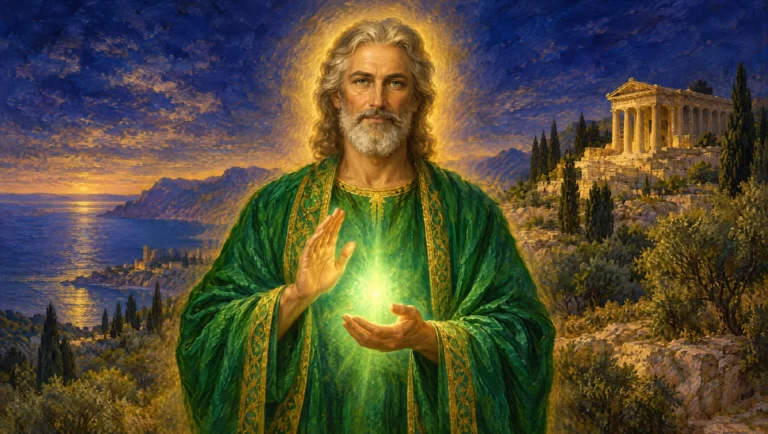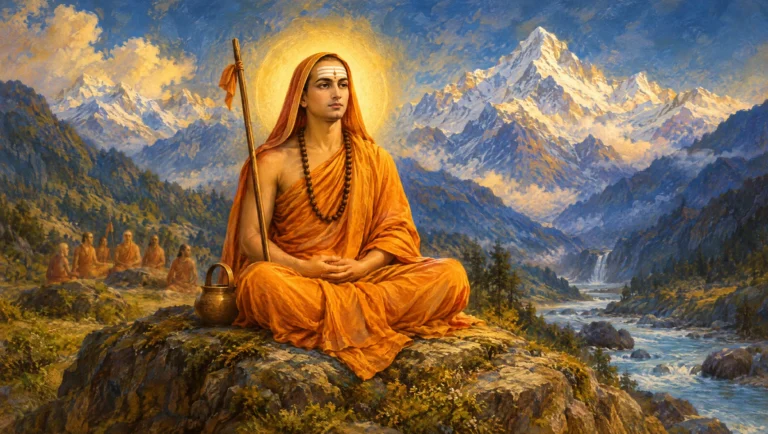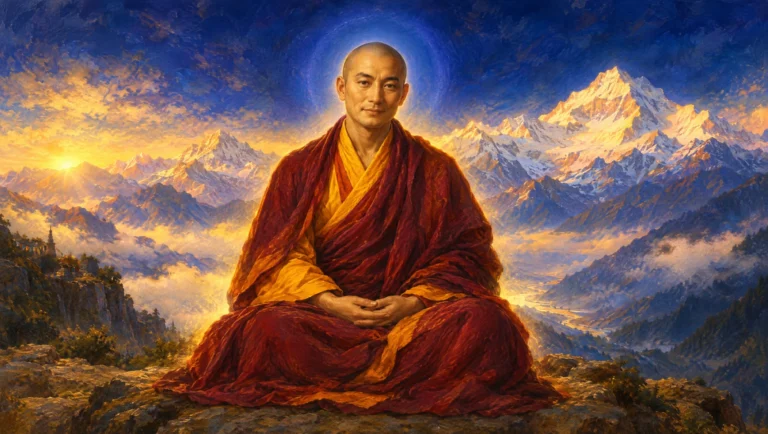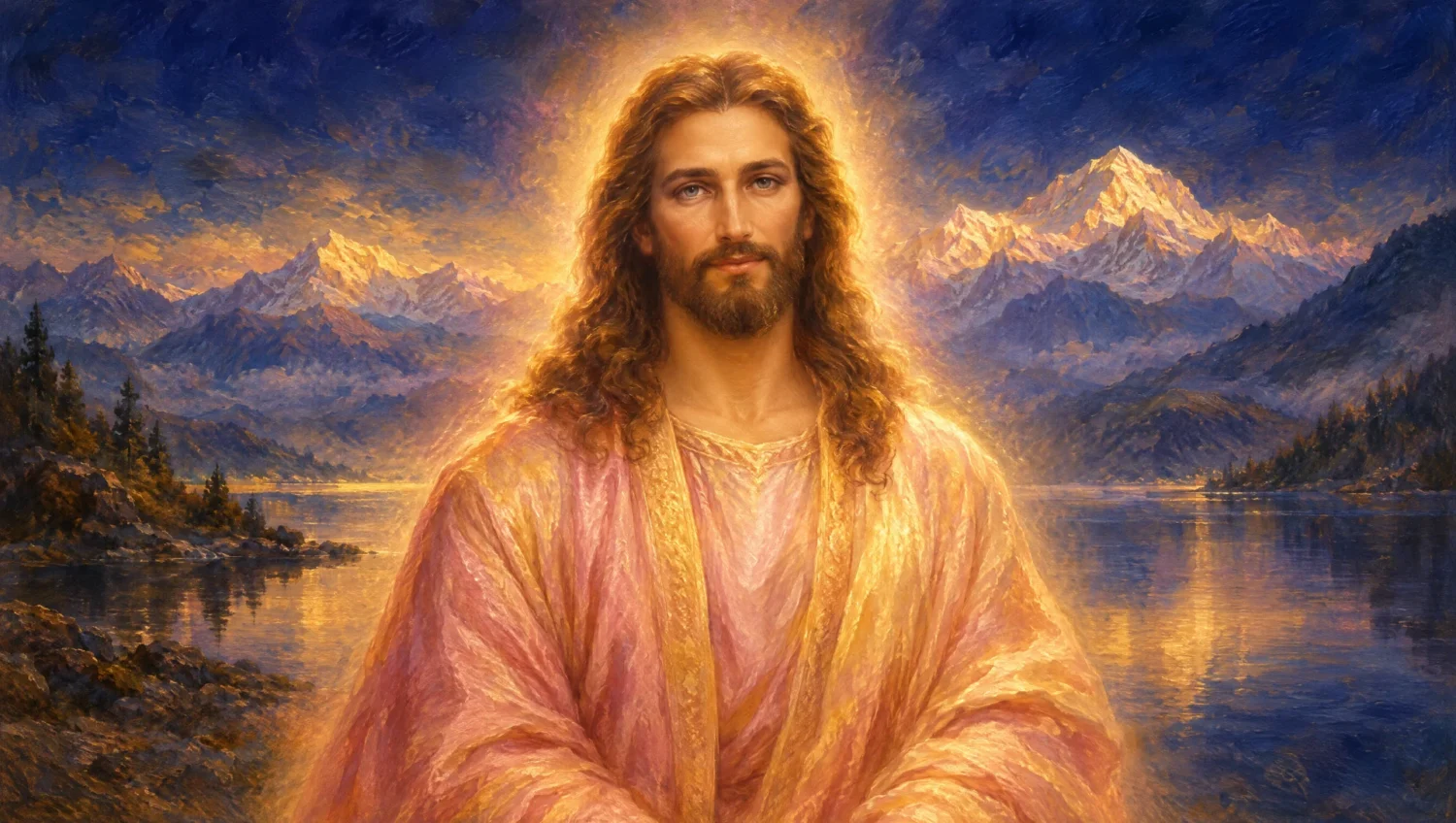
Of all the Masters named in the modern esoteric tradition, Kuthumi is the one most often described as kind. Blavatsky’s friend Colonel Olcott called the handwriting of his letters that of a gentle, cultivated, strong willed man. Readers of the Mahatma Letters still talk about his patience, his scholarship and his sorrow over the world’s cruelty. Later traditions made him a World Teacher, a Master of the Second Ray of wisdom, and, in some accounts, the soul who once walked as Pythagoras and as Saint Francis of Assisi. This guide separates the documented story from the claims, and shows how to meet the teaching without needing to settle every debate. For the wider picture, begin with our complete guide to the Ascended Masters.
Key Takeaways
- Who he is: Kuthumi, or Koot Hoomi (K.H.), a Master of the Wisdom in Theosophy and later an Ascended Master of the Second Ray of love, wisdom and illumination.
- His voice: about 195 letters, mostly to A. P. Sinnett and A. O. Hume, published as The Mahatma Letters in 1923. They are the main source for his thought.
- Claims about his lives: Pythagoras (Theosophists), and Thutmose III, Balthazar, Saint Francis of Assisi and Shah Jahan (I AM, Bridge to Freedom and Summit Lighthouse teaching).
- The debates: whether he existed, who wrote the letters, and whether he can be identified with a real person such as Thakar Singh Sandhanwalia, as K. Paul Johnson argued.
- His role: in the Ascended Master Teachings he has been World Teacher alongside Jesus since 1 January 1956. Other schools of Theosophy dispute this.
- Our stance: reverent, not credulous. We name sources, flag claims and keep the heart of the teaching in view.
In This Guide
- Who Is Kuthumi?
- A Name with Many Spellings
- The Kashmiri Brahmin Who Studied in Europe
- Alfred Sinnett, Allan Hume and the Letters
- What the Letters Teach
- Three Months in Samadhi, 1881
- The Coulombs, Hodgson and the Collapse of Koot Hoomi
- Could K.H. Be Thakar Singh Sandhanwalia?
- The Second Ray: Love, Wisdom and Illumination
- Kuthumi as World Teacher
- Alice Bailey, the Tibetan and the Master K.H.
- The Lives Attributed to Kuthumi
- Pythagoras: Brotherhood, Number and Harmony
- Kuthumi and Saint Francis
- Shah Jahan and the Taj Mahal
- Meeting Kuthumi Today: Channeled Voices
- How Kuthumi Compares with Other Masters
- Honest Questions and Cautions
- A Mystic’s Reading: The Gentle Strength of the Teacher
- A Practice: Seven Days of the Gentle Heart
- Books and Further Reading
- Who Will Connect with This Master
- Keep Exploring
- Frequently Asked Questions
Who Is Kuthumi?
Imagine a scholar who loves the world and weeps over it. He writes in careful English, in blue ink, to a newspaper editor in British India who cannot quite understand him. He explains patiently. He apologizes for limits. He pleads for a larger heart. Then, in the next paragraph, he is gently funny. That is the Koot Hoomi of the Mahatma Letters, and it is the picture that has drawn so many readers to him.
In the Theosophical tradition he is one of the Mahatmas, a Master of the Wisdom, said to live in a body prolonged by yogic discipline in the Himalayan region. He is paired with Master Morya, who is his senior and who is stern where he is gentle. Together they are named as the principal Masters behind the founding of the Theosophical Society in 1875.
Later movements made him one of the Ascended Masters. The Summit Lighthouse teaches that he now serves with Jesus as World Teacher and that his ray is the second, the ray of divine love and illumination. Other traditions say he stays embodied and works behind the scenes. We treat these as differing views inside the same family of belief.
As with all the Masters, nearly everything we know comes through other people. We have the letters, we have testimonies, and we have more than a century of devotion. We will keep those apart.
A Name with Many Spellings
You will see Kuthumi, Koot Hoomi, Koothoomi, K.H. and even Kut Humi. Early letters were signed Koot Hoomi Lal Sing. Later the Master wrote that the second part, Lal Sing, was added by a disciple of his, Djwal Khool, and he stopped using it. This is the same Djwal Khul who later appears in Alice Bailey’s books.
The name itself may be a pseudonym. Blavatsky noted that a sage called Kuthumi appears in the Puranas, the ancient Hindu scriptures, including the Vishnu Purana, but she said she did not know whether the Master was connected to him. She also noted that the Puranic Kuthumi was a northern Brahmin, while Morya’s name suggested a different caste. Skeptics have offered other explanations. In the 1880s the writer Moncure Conway suggested the name had been invented by joining parts of the names Olcott and Hume, an idea that has not found wide support.
The spelling matters less than the figure behind it. Whenever you meet K.H., Kuthumi or Koot Hoomi in this tradition, the same Master is meant. We use Koot Hoomi for the Theosophical letters and Kuthumi for the Ascended Master teachings.
The Kashmiri Brahmin Who Studied in Europe
Blavatsky and Olcott described Koot Hoomi as a Kashmiri Brahmin by birth. His fellow Theosophist Mohini Chatterji, who met him in the 1880s, also called him a Kashmiri Brahmin. C. W. Leadbeater, who claimed to have seen him later, gave a vivid portrait: fair skin, brown hair and beard, and blue eyes. Leadbeater’s description is not firsthand evidence in any ordinary sense. It is a clairvoyant report.
More surprising was a claim about education. In the letters and in the testimony of others, Koot Hoomi appears to have spent time in Europe as a young man, perhaps in Germany. He wrote excellent English and French and probably knew German. Morya called him a fine scholar, and once joked that he was somewhat Frenchified.
The Leipzig story was tested during the 1880s. A member of the Society, C. C. Massey, inquired with Professor Gustav Fechner of Leipzig about a Hindu student who might have been K.H. Fechner replied that the Hindu in Leipzig was Nisi Kanta Chattopadhyaya, a different man. That part of the legend did not survive the check, although it does not exclude that K.H. studied elsewhere.
If you have read novels about hidden Masters in the Himalayas, this portrait may feel surprising. The Master here is cosmopolitan: a Himalayan sage who has read Western science, argues with a Scottish editor about Darwin and writes with polished English phrases. That mixture of East and West is the heart of his appeal.
Alfred Sinnett, Allan Hume and the Letters
The letters began in 1880. Alfred Percy Sinnett, editor of The Pioneer in Allahabad, was a prominent figure in Anglo-Indian society. Blavatsky visited him that year, and he asked whether he could correspond with one of her Masters. After a series of tests and delays, he received a reply from Koot Hoomi. A. O. Hume, a senior official with scientific interests and a founder of the movement that became the Indian National Congress, joined him.
What followed was an extraordinary correspondence of about two hundred letters. They arrived, the Masters said, by precipitation: impressed on paper by thought, rather than written in the ordinary way. They appeared in unexpected places. In some cases they came from distant locations. Sinnett used them to write two books, The Occult World (1881) and Esoteric Buddhism (1883), which introduced the idea of the Masters to a wide English readership. The letters themselves were published only in 1923, edited by A. T. Barker, as The Mahatma Letters to A. P. Sinnett.
The correspondence was not easy. Sinnett and Hume wanted proof, practical results and answers to scientific questions. The Master wanted to teach them a larger view, and to test how much the pair could receive. Many letters begin with a refusal and end with a lesson. For a reader today, the combination of colonial era English politics and Himalayan mysticism is strange and often fascinating.
What the Letters Teach
Three themes run through K.H.’s writing.
The Unity of Humanity
Again and again he comes back to universal brotherhood. The first object of the Theosophical Society, to form a nucleus of the brotherhood of humanity without distinction of race, creed, sex, caste or color, is said to have been framed by the Masters. K.H. argues that the world’s greatest sorrow is selfishness, and that any teaching which leaves a person more cut off from others has missed the point.
The Shape of the Afterlife and Rebirth
The letters describe a human being as made of several principles, and a journey after death that passes through a phase of purification and then a long period of rest and assimilation called devachan, followed by a new birth. This framework influenced almost every later esoteric system in the West. It is a reinterpretation of Hindu and Buddhist ideas that the Theosophists then fed back into world culture. For a straightforward overview of the idea, see our guide to reincarnation.
Reasons and Limits of Mastery
K.H. explains why the Masters do not simply hand over knowledge or intervene in world affairs. He says they are bound by laws of their own order, that the knowledge is only safe in the hands of the trained, and that humanity must learn through its own effort. This earned him both devoted readers and impatient critics.
If you remember one thing, remember this: the K.H. of the letters is not a miracle worker who solves your problems. He is a teacher who asks you to grow big enough to solve them.
Three Months in Samadhi, 1881
One of the odd episodes in the story is a silence. In 1881, according to Blavatsky, Koot Hoomi withdrew for a period of intense preparation for a higher initiation. In a letter of October 1881 she wrote that he had entered a three month trance, his body kept in a stone tower or cell while he underwent the process. Morya described the way to the retreat as a perilous grass bridge over a chasm. An unpublished letter later found by the researcher Daniel Caldwell indicates that he awoke on 24 December 1881 and resumed his correspondence with Sinnett on the first of January 1882.
These details come from testimony by Blavatsky and Morya. There is no outside evidence. Still, the idea of the great teacher who withdraws, goes through a transformation and returns is deeply rooted in world mysticism. We see it in the forty days of Jesus in the desert, in the Buddha’s night under the tree, and in the retreats of many saints.
For readers, the point is not to prove the tower or the bridge. It is to see how the Theosophical story presents spiritual growth: there are stages, they are costly, and even a Master must retire to renew. That message gently corrects any picture of enlightenment as a single event.
The Coulombs, Hodgson and the Collapse of Koot Hoomi
The golden age of the letters ended in scandal. In 1884, a Christian missionary publication in Madras published letters from Emma Coulomb, a former housekeeper at the Adyar headquarters, accusing Blavatsky of faking the Shrine phenomena. In the same year the Reverend George Patterson published a series titled The Collapse of Koot Hoomi, arguing that K.H. did not exist. Some critics took things further and suggested that a cloth dummy with a painted face had been used to impersonate him. Blavatsky denied all fraud.
The Society for Psychical Research sent Richard Hodgson to investigate. His 1885 report concluded that the Mahatma Letters were written by Blavatsky with the help of confederates. For a century that was the official verdict. In 1986, however, the handwriting expert Vernon Harrison argued that Hodgson’s methods were seriously flawed, and the Society published his critique. It is fair to say that the case is not closed.
Be wary of both certainties. There is real evidence that some of the phenomena were staged. There is also real reason to doubt that the whole structure was nothing but fraud. The letters contain ideas that Sinnett and Hume themselves found demanding, and the teachings did not simply echo what Blavatsky had already said. Some Theosophists find the question settled in the Masters’ favor. Most scholars find it unresolved. You can read the letters, as many do, as a classic of modern spiritual literature, whoever wrote them.
Could K.H. Be Thakar Singh Sandhanwalia?
If K.H. existed as a historical man, who might he have been? In The Masters Revealed (1994), K. Paul Johnson proposed that K.H. was Thakar Singh Sandhanwalia, a Sikh nobleman and the founder of the Singh Sabha reform movement in Amritsar. Johnson noted that Blavatsky said K.H. was a Punjabi family long settled in Kashmir, and that Olcott had reported a Master serving as a guardian at the Golden Temple in Amritsar.
The theory is intriguing, and it has been challenged. Daniel Caldwell has argued that the timeline does not fit. In October 1880, for example, K.H. is recorded as having been far beyond Rawalpindi, and as sending a telegram from Jhelum within hours, then arriving at Amritsar a few days later. Olcott’s account of the Golden Temple visit mentions only an unnamed brother who gave them a rose. It does not say that K.H. was officiating.
Our summary is simple. This is a scholarly hypothesis, not an established fact. Treat it as one possible way to imagine a real person behind the legend.
The Second Ray: Love, Wisdom and Illumination
In the system of seven rays, Kuthumi serves the Second Ray. Alice Bailey called it the Ray of Love-Wisdom. The Summit Lighthouse describes it as the yellow ray of wisdom, understanding and illumination, and links it to teaching, education and the healing of the mind.
The Second Ray joins two things we tend to keep apart: knowing and loving. The person on this ray wants to understand, but not for cold curiosity. They want to understand so that they can serve. Teachers, counselors, writers, healers and librarians are often drawn to it. Its virtues are patience, clarity, empathy and a tireless interest in other people’s growth. Its shadow, according to the tradition, is a scholar’s detachment, or a tendency to absorb pain from others without protection.
In the Summit tradition, the Chohan of the Second Ray is Lord Lanto, and Kuthumi works within the same current of wisdom as one of the great teachers. In the Bailey scheme, K.H. is among the Masters of the Second Ray, working in the department of the World Teacher. Different schools, different arrangements. What they share is the idea that wisdom without love is incomplete, and that love without wisdom can be foolish.
For the colors connected to this ray and how they relate to the body, see our guide to the seven chakras.
Kuthumi as World Teacher
In the Theosophical writings of Besant and Leadbeater, the title World Teacher belongs to Maitreya, the being who is expected to appear as a great teacher for humanity, as Christ and Buddha did before. In the early twentieth century this expectation became a vast public project. Besant and Leadbeater declared a young Indian boy, Jiddu Krishnamurti, to be the vehicle for the coming World Teacher. In 1929, Krishnamurti dissolved the organization built around him and said that truth is a pathless land. He went on to become one of the great independent teachers of the century.
The Ascended Master Teachings tell a different story. According to Elizabeth Clare Prophet, on 1 January 1956 Kuthumi and Jesus took the office of World Teachers, succeeding Maitreya. In this view, they are the guides of the spiritual education of humanity during the Aquarian Age. Their work includes teaching about the soul, the aura and the path of self-mastery. The Summit Lighthouse published a series of dictations from Kuthumi, including a book on the human aura.
Not everyone agrees. Traditional Theosophists and the followers of Alice Bailey hold that Maitreya remains World Teacher, and that Jesus and Kuthumi work in different offices. The difference is typical of the larger split between the Mahatma tradition and the Ascended Master tradition, which a Theosophical writer, Pablo Sender, explored in a 2011 article in Quest called “Mahatmas vs. Ascended Masters.” A thoughtful response from a former Summit Lighthouse staff member argued that the two should talk rather than quarrel.
You do not need to pick a side. What the idea of a World Teacher offers is a hope: that the education of the human heart has patient guides who are not in a hurry.
Alice Bailey, the Tibetan and the Master K.H.
Alice Bailey, who wrote under the guidance of the Tibetan Master Djwal Khul, described Koot Hoomi as a Master of the Second Ray who heads the ashram, or spiritual community, to which Djwal Khul belongs. She said she first met the Master K.H. in 1895, when she was a teenager and a tall man in a turban appeared to her. In her autobiography she later identified him as K.H.
In her system the Masters are not remote deities. They are older brothers on the same path. K.H. is part of the Hierarchy and works especially with the World Teacher on the cultivation of love and wisdom in the human family. Bailey’s books treat him as an organizer and mentor rather than as a figure of devotion.
If you wish to read her work, listen to Initiation, Human and Solar on Next Level Soul. For a modern channeled perspective on Djwal Khul, listen to Ascended Master Djwal Khul channeled with Kathlyn Kingdon.
The Lives Attributed to Kuthumi
Different groups name different past lives. According to the Theosophists, K.H. was once Pythagoras, the Greek philosopher and founder of a mystical brotherhood. The I AM Activity, the Bridge to Freedom and the Summit Lighthouse add more:
- Thutmose III, the great pharaoh of the fifteenth century before the common era.
- Balthazar, one of the three Magi who visited Jesus.
- Saint Francis of Assisi (1181 or 1182 to 1226).
- Shah Jahan (1592 to 1666), the Mughal emperor who built the Taj Mahal.
The first thing to say is that none of these can be shown from historical records. The second is that the choice of names is revealing. Pythagoras was a seeker of harmony and number. Saint Francis was a lover of creation. Shah Jahan gave the world a monument to love. Together they form the picture of a soul who learns, again and again, to translate the beauty of the divine into human forms.
The Gospels do not name the Magi or give their number. The familiar names Melchior, Caspar and Balthazar come from later Christian tradition, and a sixth century mosaic at Ravenna labels them. The Ascended Master tradition assigns Melchior to El Morya, Balthazar to Kuthumi and Caspar to Djwal Khul. It is a fitting trio, since the three Masters are so closely linked in the older Theosophical story.
Pythagoras: Brotherhood, Number and Harmony
Pythagoras of Samos (c. 570 to c. 495 before the common era) founded a community in Croton, in southern Italy, that mixed philosophy, mathematics, ritual and a shared way of life. Its members followed strict rules about diet, silence and study. They believed that numbers were the key to the harmony of the cosmos, and that the soul passes through many bodies. Later writers said he heard the music of the spheres.
There are close echoes with the Theosophical image of K.H. The brotherhood, the study of the cosmos, the belief in rebirth, the shared discipline: all of these appear in the Mahatma Letters. Theosophists such as Blavatsky saw in Pythagoras a Western guardian of the same ancient wisdom they traced to India and Egypt. For more on this lineage, see our guide to the mystery schools and the lost years of Jesus, and the audio course Mystery Schools of the Ancients.
A scholar will remind us that the historical Pythagoras is hard to recover. Our sources were written centuries later, and much of what is said about him is legend. That is also true of K.H. In both cases the figure is partly a person, partly a symbol.
Kuthumi and Saint Francis
The Saint Francis claim is the one that touches people most. Francis was born in Assisi in 1181 or 1182, the son of a cloth merchant. As a young man he was a cheerful party leader and an aspiring knight. After a period of illness and a string of spiritual experiences, including a voice from a crucifix in the ruined chapel of San Damiano, he gave up his inheritance in front of the bishop in about 1206 and chose a life of poverty. Followers gathered. Pope Innocent III approved his Rule around 1209 or 1210. With Clare of Assisi, he helped found the Poor Clares. In 1219 he crossed the lines of the Fifth Crusade to meet the sultan al-Kamil in Egypt. He set up the first living Nativity scene at Greccio in 1223, and in 1224 he received the stigmata at La Verna. He died on 3 October 1226 and was canonized in 1228. His Canticle of the Creatures, written near the end of his life, praises brother sun and sister moon.
How does this compare with K.H.? On the surface, they are opposites. Francis was a barefoot street preacher. K.H., as we know him, was a scholar writing letters to newspaper editors. Francis lived on alms. K.H. lived in a mountain retreat. But the tradition sees the same current: a soul whose basic gift is tenderness. Both are about the sacredness of every creature. Both ask for simplicity. Both refuse to dominate.
Neither Franciscan historians nor Theosophical historians have any record linking the two. The claim belongs to the Summit tradition’s reading of past lives. If you want to meet Francis himself, rather than the claim about him, Augustine Thompson’s Francis of Assisi: A New Biography is a careful scholarly life.
Shah Jahan and the Taj Mahal
The Shah Jahan claim is more surprising still. Shah Jahan ruled the Mughal Empire from 1628 to 1658. After the death of his wife Mumtaz Mahal in 1631, he commissioned the Taj Mahal in Agra, completed in the early 1650s. In 1658 his son Aurangzeb took the throne and held him in the Agra Fort until his death in 1666.
Why would a tradition connect the gentle Master with an emperor? One reading is symbolic: the Taj Mahal is a monument to love and to beauty made enduring. Another reading is the tradition’s own: the Master has taken many roles, including rulers. Either way, we are in the realm of belief. No historian links the sage of the Mahatma Letters with a Mughal emperor.
Meeting Kuthumi Today: Channeled Voices
Kuthumi is one of the voices most often brought through by modern channelers. On Next Level Soul, you can hear Hope Messages for Humanity from the Ascended Masters with Chanel Lingenfelder, a gentle introduction to several Masters. Genevieve Taeger’s live channeling of the Ascended Masters and the series Ascended Masters Channeled offer a wider circle of voices, and Anjie Hipple’s interview ranges across many Masters in one conversation.
A word of discernment applies here as it does anywhere. Different channelers describe Kuthumi in different ways, and none of them can be verified. Some emphasize the gentle teacher. Some emphasize the scholar. Some speak of him as a guide to psychology and the aura. Notice the fruit. Does the message leave you steadier, kinder and clearer? Does it respect your freedom? Or does it lean on fear, urgency or flattery? The old test remains the best one: by their fruits.
How Kuthumi Compares with Other Masters
Place Kuthumi beside his fellow Masters and the differences sharpen. El Morya is will, direction, the commanding presence. Kuthumi is understanding, the patient teacher. When the two appear together in the letters, Morya is the senior partner who sometimes steps in with a sharp remark, and Kuthumi is the one who explains.
Saint Germain works with form, ritual and the transmutation of the past. Kuthumi works with understanding and the heart. If you carry a heavy memory, Saint Germain offers a flame. If you carry a confusing question, Kuthumi offers an explanation. Djwal Khul is Kuthumi’s disciple in the Bailey scheme, a brilliant systematizer who writes with a scholar’s thoroughness.
The outside comparison is with the great teachers of tenderness in other traditions. Saint Francis in Christianity, Kuan Yin in East Asia, Thich Nhat Hanh in our own day: each has shown that power does not have to be loud. If you want to explore that quiet strength, our The Christ Within audio course offers 18 chapters on the divine seed in every soul.
Honest Questions and Cautions
Did Koot Hoomi Really Exist?
We do not know. There is no independent record of a Himalayan Master of that name. There is a body of letters whose authorship is debated, and there are witnesses who said they met him. The Hodgson Report concluded that Blavatsky forged the letters. Later critics have disputed its methods. The question remains open.
Are the Mahatmas the Same as the Ascended Masters?
Not necessarily. Theosophists use Mahatma and Master of the Wisdom for members of an ancient order who may still live in physical bodies. The Ascended Master Teachings use ascended master for souls who have completed their earthly lessons and ascended. Some Theosophists feel this distorts their older idea. Others see the two as complementary. This is the live debate behind the 2011 Quest article by Pablo Sender.
What About the Racial Theories in This Literature?
Some of the Theosophical writings of the period, including the doctrine of root races, carry the racial assumptions of the nineteenth century. Modern readers should name this plainly and set it aside. The teaching of universal brotherhood stands in tension with it, and it is the part worth keeping.
Can I Trust Past Life Claims?
No one can verify them. They are part of a devotional tradition that likes to place its Masters in memorable roles. Hold them lightly. The teaching does not depend on whether Kuthumi was Pythagoras or Francis.
Should I Pay for Access to Kuthumi?
Be careful. Many valuable books and talks are inexpensive or free. Organizations that charge large sums for private access to the Masters, or that say you need their mediation, deserve scrutiny. The sources in this guide are open to anyone.
A Mystic’s Reading: The Gentle Strength of the Teacher
There is a particular kind of person who changes your life by being gentle. They are not charismatic. They do not shout. They listen to you with full attention, and in the quiet something in you straightens. If you have ever met someone like that, you know what Kuthumi represents.
The Koot Hoomi of the letters carries a quiet sadness. He sees clearly how much suffering comes from ignorance and selfishness, and he does not despair. He explains again. He writes another letter. He hopes that a few people, in time, will understand.
That is a model for any teacher, parent or friend. You do not have to win an argument. You only need to keep telling the truth with kindness, and to trust that seeds grow in their own season.
If you feel drawn to Kuthumi, you may be someone who is called to study and to share, who learns best by explaining, and who is moved by beauty and by the small kindnesses of ordinary people. The teaching asks you to protect that tenderness, not to harden it.
A Practice: Seven Days of the Gentle Heart
This is a contemplative exercise inspired by the Second Ray and by Saint Francis. You do not need to believe in any Master to try it.
- Day one: Study. Read ten minutes from a text that nourishes you. It could be a page of the Mahatma Letters, a psalm, or a poem. Read slowly.
- Day two: Listen. In one conversation, listen without preparing your reply. Let the other person finish.
- Day three: Thank creation. Step outside. Thank the sun, the air, the water and the ground, one by one, in the spirit of Francis.
- Day four: Simplify. Give away or set aside one object you do not need.
- Day five: Ask a question. Write down one honest question about your life. Sit with it for five minutes. Do not rush to answer.
- Day six: Teach something. Explain something you know to someone younger, or write it down for a stranger.
- Day seven: Rest in rose-gold light. Sit quietly for five minutes and imagine a warm rose-gold light around your heart. Let it be soft. Write what you noticed this week.
If any step stirs up strong feeling, be gentle with yourself and talk to someone you trust.
Books and Further Reading
- The Mahatma Letters to A. P. Sinnett. The primary source for Koot Hoomi.
- The Masters Revealed, by K. Paul Johnson. A contested scholarly attempt to identify the historical figures behind the Masters.
- Madame Blavatsky: The Mother of Modern Spirituality, by Gary Lachman. A balanced biography.
- Madame Blavatsky’s Baboon, by Peter Washington. A lively, skeptical history of Theosophy.
- Francis of Assisi: A New Biography, by Augustine Thompson. A scholarly life of the saint.
- Initiation, Human and Solar, by Alice A. Bailey. The Hierarchy and the Second Ray in her teaching.
- Lords of the Seven Rays, by Mark and Elizabeth Clare Prophet. The rays in the Summit tradition.
- Studies of the Human Aura, attributed to Kuthumi through the Summit Lighthouse.
If you buy through these Amazon links, it supports our work at no extra cost to you.
Who Will Connect with This Master
Kuthumi may speak to you if you are a student at heart, if you love ideas and also people, or if you want a spirituality that is both thoughtful and kind. He may suit you if you teach, counsel, write or care for others. He may also be a companion if you have grown tired of loud authority and want a gentler example.
If you prefer a more fiery or ritual approach, you might look to Morya or Saint Germain. If you want a devotional path with a living tradition behind it, you might find more support in a lineage such as Kriya Yoga. Our guide to Kriya Yoga meditation is a good place to begin.
Keep Exploring
To read the Theosophical sources behind the Master tradition, listen to Theosophy and The Ocean of Theosophy, both available on Next Level Soul.
Three Mastery audio courses fit this study. The Christ Within offers 18 chapters on the divine seed in every soul. Mystery Schools of the Ancients offers 22 chapters on the universal laws taught by the old schools. The Hidden Science of the Soul offers 13. All are included with Next Level Soul membership. You can also explore NLS Mastery and our free masterclasses.
Watch Ascended Masters, Channeled on Next Level Soul TV
An eight-episode series in which renowned channeler Genevieve Taeger brings through Buddha, Mary Magdalene, Athena, Mother Mary, Jesus, Saint Germain, Yogananda and Kuan Yin. Each episode is a channeled message, offered as spiritual guidance and not as historical record.
Episodes that connect with this guide: Ascended Master Jesus, Ascended Master Saint Germain and Ascended Master Buddha.
Frequently Asked Questions
Who is Kuthumi?
Kuthumi, or Koot Hoomi (K.H.), is a Master of the Wisdom in Theosophy and an Ascended Master of the Second Ray in later teachings. He is known through the Mahatma Letters and through the Summit Lighthouse tradition, which calls him World Teacher alongside Jesus.
Are Kuthumi and Koot Hoomi the same?
Yes. Kuthumi and Koot Hoomi are two spellings of the same name. The Theosophical writings use Koot Hoomi or K.H., and the Ascended Master teachings usually use Kuthumi.
Did Kuthumi really exist?
There is no independent proof. Blavatsky, Olcott and others said they met him, and about 195 letters carry his name. Skeptics argue Blavatsky wrote them, and later critics have challenged that verdict. The question is open.
Was Kuthumi Saint Francis of Assisi?
The Summit Lighthouse, the I AM Activity and the Bridge to Freedom teach that Kuthumi once lived as Saint Francis. There is no historical evidence for the link. It is a devotional claim.
Was Kuthumi Pythagoras?
Theosophists have identified K.H. with Pythagoras. Other traditions agree and add more names, including Thutmose III, Balthazar and Shah Jahan. These are claims of belief rather than history.
What is the Second Ray?
The Second Ray is the ray of love-wisdom. In the Summit tradition its color is yellow, with the qualities of wisdom, understanding and illumination. Kuthumi works in this current, which is linked to teaching and the education of the heart.
What are the Mahatma Letters?
They are about two hundred letters written between 1880 and the mid 1880s to A. P. Sinnett and A. O. Hume, said to come from the Masters Koot Hoomi and Morya. They were published in 1923.
Could Koot Hoomi have been Thakar Singh Sandhanwalia?
K. Paul Johnson proposed it in 1994. Other researchers, such as Daniel Caldwell, dispute it on timeline grounds. It is a hypothesis and not an established fact.
How can I connect with Kuthumi?
There is no required method. Many people read the letters, practice study and gentleness, and spend time in nature. You can also listen to channeled messages, such as Hope Messages for Humanity with Chanel Lingenfelder, while keeping your own discernment.