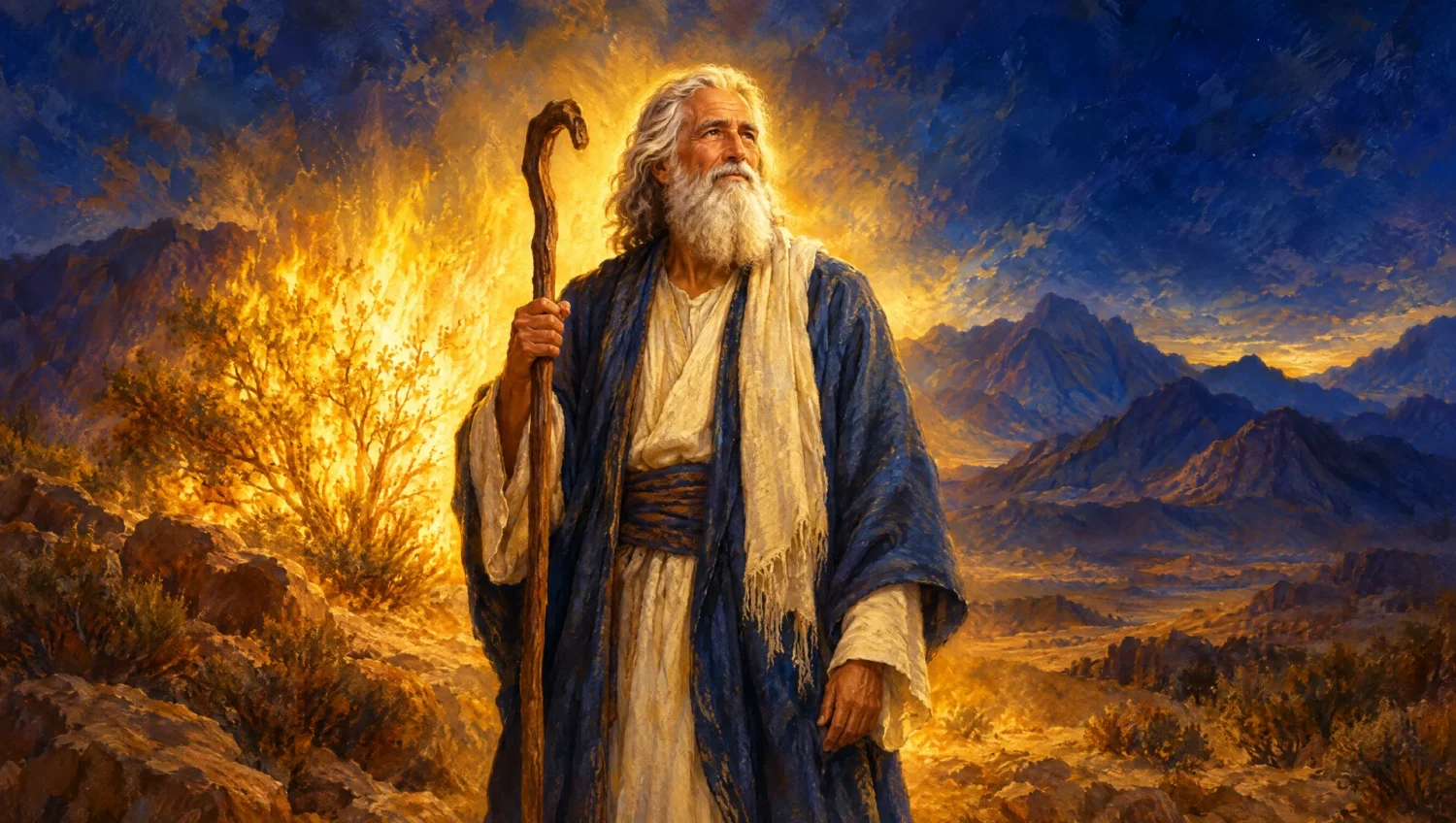
Moses is the man who heard a voice from a bush that burned and was not consumed. He is the baby in the basket, the prince who became a fugitive, the shepherd who walked back into Egypt and said “let my people go.” He stood at Sinai, came down with the tablets, and spent forty years leading a frightened people through the wilderness. For Jews he is Moshe Rabbeinu, Moses our teacher. For Christians he is the lawgiver. For Muslims he is Musa, the prophet to whom God spoke. This guide is faith-neutral. It walks through the story, separates scripture from history and from esoteric tradition, and asks what Moses can teach any seeker about liberation, the Name, and the long walk toward freedom. It sits within our guide to the Ascended Masters.
Key Takeaways
- Who he was: The central prophet of the Torah, said to have led the Israelites out of Egypt, received the Law at Sinai, and died on the edge of the Promised Land at age 120.
- What is history and what is scripture: The Exodus story is a foundational narrative. Archaeology has found no direct evidence for Moses himself, and scholars are divided. We say so plainly.
- Core teaching: One reality, one source. Liberation from every kind of Egypt, inner and outer. A life lived with justice, rest and compassion.
- Sacred across faiths: Judaism, Christianity and Islam all honor him. Mystics in Kabbalah, Sufism, Hermetic and Theosophical streams add their own readings.
- As an ascended master: Esoteric writers portray Moses as an initiate of the Egyptian mysteries and a guide who continues to serve. That is a spiritual claim, not a historical one.
- Try it: Seven days of “turning aside,” a practice taken from the burning bush story.
In This Guide
- Who Was Moses?
- How to Read This Guide: Faith-Neutral, Not Faith-Free
- What We Can Know: Torah, Tradition and Archaeology
- Born in Egypt, Raised in a Palace
- The Burning Bush and the Name
- The Exodus: Plagues, Passover and the Sea
- Sinai: The Ten Words and the Covenant
- Forty Years in the Wilderness
- Core Teachings: One Source, Liberation, Rest and Justice
- Moses and the Egyptian Mysteries
- How the Traditions See Moses
- Mystical Moses: Kabbalah, Sufism and the Inner Journey
- Moses as an Ascended Master
- Legacy: Law, Freedom and the Long Walk
- Honest Questions and Cautions
- A Practice: Seven Days of Turning Aside
- Books and Further Reading
- Who Will Connect with This Teacher
- Keep Exploring
- Frequently Asked Questions
Who Was Moses?
In the Hebrew Bible, Moses is the greatest of the prophets. The Torah, the first five books of the Bible, is called the Five Books of Moses and presents him as its central figure. According to its account, he was born a Hebrew slave in Egypt, raised in Pharaoh’s household, and called by God at a burning bush to free his people. He led them across the sea, brought them to Mount Sinai, and received the commandments that shaped Jewish life. He died within sight of the land he had walked toward all his life.
Few figures sit at the root of so many spiritual streams. Jewish tradition places him at the head of an unbroken chain of teaching. The New Testament speaks of him dozens of times. The Quran mentions him more than any other prophet. Seekers who never opened any scripture still know the phrase “let my people go,” which has echoed through spirituals, sermons and freedom movements for centuries.
He is also a surprisingly human guide. The Torah says he stammered, doubted himself, lost his temper, and made mistakes that cost him dearly. It also calls him very humble. A teacher who was frightened, flawed and faithful is one many of us can understand.
How to Read This Guide: Faith-Neutral, Not Faith-Free
We are not asking you to believe the Exodus happened exactly as written, or to doubt it. We are asking you to read with honesty about three different layers: what scripture says, what historians and archaeologists can show, and what mystics and esoteric traditions have added.
When we say “the Torah tells us,” we are describing the text. When we say “tradition holds,” we mean Jewish, Christian or Islamic interpretation over the centuries. When we say “esoteric writers claim,” we are describing Theosophical, Hermetic or related ideas, which have their own history and no record in ancient sources. You can accept any or none of these layers. We just want to keep them clear.
If you are Jewish, Christian or Muslim, nothing here asks you to leave your tradition. If you are not religious, you are equally welcome. Moses belongs to everyone who has ever longed to be free.
What We Can Know: Torah, Tradition and Archaeology
Our only detailed source for the life of Moses is the Torah itself, especially Exodus, Leviticus, Numbers and Deuteronomy. Jewish and Christian tradition long held that Moses wrote it. Most modern biblical scholars see the Torah as a composite text, assembled over centuries from several strands of tradition by multiple authors and editors. This approach, often associated with the Documentary Hypothesis, is debated in its details but widely used.
Archaeology adds complexity. No Egyptian record names Moses. No excavation has located the Israelites’ forty years in Sinai. The earliest known mention of “Israel” outside the Bible is the Merneptah Stele, an Egyptian victory monument from about 1208 BCE, which places a people called Israel in Canaan. Scholars who study the Exodus fall into several camps. Some see a story with a historical kernel, perhaps a smaller group who escaped from Egypt and joined other tribes. Others read it as a founding myth shaped much later. Some traditional scholars defend a historical reading, using either an “early date” around 1446 BCE (from 1 Kings 6:1) or a “late date” in the thirteenth century BCE, in the age of Ramesses II.
One small clue deserves mention. The name “Moses” sounds Egyptian. The Egyptian word mes or mose means “born” or “child” and appears in royal names such as Thutmose and Ramesses. The Torah explains the name through a Hebrew pun, “I drew him out of the water.” Many scholars see the Egyptian meaning as a sign that the name may reflect real memory. It does not prove anything, but it is a thread worth noticing.
In short: Moses is as certain in tradition as any figure can be, and as uncertain in archaeology as any figure can be. The honest position for a seeker is to hold both. A story can be spiritually true without being a courtroom record.
Born in Egypt, Raised in a Palace
The book of Exodus opens with a king who “did not know Joseph.” Pharaoh fears the growing Hebrew population, forces them into hard labor, and orders the newborn boys to be thrown into the Nile. A Levite woman, named in later verses as Jochebed, hides her baby for three months. Then she places him in a basket of papyrus reeds, sets it among the river grasses, and lets his sister Miriam watch from a distance.
The daughter of Pharaoh finds the child, takes pity, and raises him as her own. The Hebrew word for the basket, tevah, is the same word used for Noah’s ark. Both are small vessels carrying life through a flood. Readers of every century have noticed the echo.
The Torah skips straight to adulthood. Moses sees an Egyptian beating a Hebrew worker, strikes him dead, and buries the body. When the deed becomes known, he flees across the wilderness to Midian. There he rescues seven sisters at a well, marries one of them, Zipporah, and works for years as a shepherd for her father Jethro, described as a priest of Midian. Their son is named Gershom, from a phrase meaning “a stranger there.”
Notice what the story is saying. The future liberator is raised in the house of the oppressor. He is a prince, an outlaw, and then a nobody tending sheep. Mystics have long read this as a pattern of the soul’s path: we grow up inside systems, we rebel, we fall, and in the quiet of the desert, we are finally ready to be called.
The Burning Bush and the Name
One day, leading his flock toward Mount Horeb, Moses sees a bush on fire that does not burn up. The Torah gives his response in a short line that many teachers love: “I will turn aside and see this great sight.” The voice calls his name twice. He is told to take off his sandals, for the ground is holy.
The voice names its purpose. The cry of the enslaved has been heard, and Moses is being sent to Pharaoh. Moses objects with every excuse he can think of: Who am I? Who shall I say sent me? What if they do not believe me? I am slow of speech. The Divine answers each, and then gives the most famous of all biblical self-descriptions: Ehyeh asher ehyeh. It is often translated “I Am That I Am,” and also as “I Will Be What I Will Be.” The Hebrew verb is being itself.
For seekers, this is a remarkable moment. The deepest Name of God in this scene is not a title or an image. It is a verb of existence. Teachers in the nondual traditions, including our own conversation on what non-duality is, hear in it a pointer to the pure “I am” that underlies all experience. You do not need to agree with that reading to feel its power.
The bush also gives us a practical teaching. It is a small fire in a wild place that anyone could have walked past. Moses had to be willing to stop. Much of spiritual life begins with a simple act of attention: turning aside, once, from the usual route.
The Exodus: Plagues, Passover and the Sea
Moses and his brother Aaron go before Pharaoh. The story that follows is one of the best known in the world: ten plagues, from water turning to blood to the death of the firstborn; the Passover night, with its blood on the doorposts and bread baked without time to rise; the hurried departure; the pursuit; and the crossing of the sea.
The Hebrew name for the body of water is Yam Suf, usually translated “Red Sea” but more literally “Sea of Reeds.” Where exactly it was is unknown. Jewish tradition celebrates the event every spring at Passover, and the seder meal is one of the oldest continuously practiced teaching rituals in the world. The command is not “remember that your ancestors were free.” It is to see yourself as if you personally left Egypt.
That second sentence is where the mystics begin. In Hebrew, Egypt is Mitzrayim, which sounds like “narrow places.” Hasidic and Kabbalistic teachers have read the Exodus as a journey from every inner constriction: fear, addiction, shame, limiting beliefs. Pharaoh becomes the voice that says you cannot change. The plagues become the breaking of the mind’s habits. The crossing becomes the terrifying step you take before the way appears.
Whether you hold the story as history, as sacred memory or as a map of consciousness, it speaks to the human longing to leave a place that is too small.
Sinai: The Ten Words and the Covenant
Three months after leaving Egypt, the people camp at the foot of Mount Sinai. The Torah describes thunder, smoke, fire and a trumpet sound. Moses climbs the mountain and remains there for forty days and forty nights. From that encounter come the Ten Commandments, which the Hebrew calls aseret ha-dibrot, “the ten utterances” or “ten words.”
The Ten Words begin not with a command but with a statement of relationship: “I am the Lord your God, who brought you out of the land of Egypt.” They then name a God without images, honor the Sabbath, honor parents, and forbid murder, adultery, theft, false witness and coveting. Many scholars see in this a bridge between spiritual and social life: worship and ethics in one breath.
While Moses is on the mountain, the people grow anxious and make a golden calf. Moses descends, sees the idol, and breaks the tablets in anger. After he pleads for the people, he is given a second set. When he comes down again, the Torah says the skin of his face shone with light. The Hebrew word karan was rendered in the Latin Vulgate as “horned,” which is why Michelangelo’s famous statue gives Moses horns. The original meaning is “radiant.” We prefer the light.
Forty Years in the Wilderness
What follows Sinai is not triumph. It is a long, difficult walk. The people complain about thirst and hunger. They long for Egypt’s food. They rebel. Moses begs for them, rules on disputes, appoints judges, and sets up a tent of meeting where he speaks with God. The Torah says God spoke to him “face to face, as one speaks to a friend.”
The wilderness is where most of the teaching happens. Manna falls each morning, enough for one day, teaching trust in daily provision. A Sabbath rhythm is built into the week. A generation that grew up as slaves must die out, or be transformed, before a free generation can enter the land. Jewish tradition reads this as the slow pace of inner change: freedom takes a moment, and becoming free takes a lifetime.
Moses is not spared. He loses his temper at Meribah and strikes a rock instead of speaking to it, as instructed. He is told he will not enter the land. The book of Numbers also calls him “very humble, more than all the people who were on the face of the earth,” which is an odd line for a text attributed to him. Readers have taken it as a sign of later editing, or as a deliberately ironic honesty.
At the end of Deuteronomy he climbs Mount Nebo, sees the land across the Jordan, and dies at the age of 120. “No one knows his burial place to this day.” The text closes with a famous line: no prophet has arisen since like Moses, whom the Lord knew face to face.
Core Teachings: One Source, Liberation, Rest and Justice
If we try to distill the teaching attributed to Moses, several threads stand out.
- One reality. The central prayer of Judaism, the Shema, comes from Deuteronomy 6: “Hear, O Israel: the Lord our God, the Lord is one.” Behind the language of tradition is a large idea: the universe is not a battleground of rival powers. It is one thing, and it can be known.
- Love as the response. The line that follows the Shema commands love of the Eternal with all your heart, soul and might. Leviticus 19 adds love of the neighbor as oneself. Jesus later quoted both.
- Liberation is sacred. The Ten Words begin with freedom. The whole story says that what oppresses human beings is not the will of the divine.
- Rest is part of the design. The Sabbath, one day in seven set apart from work, is one of the most radical spiritual technologies ever invented. Everyone rests, including servants, foreigners and animals.
- Justice for the stranger. “You shall not oppress a stranger, for you know the heart of a stranger, having been strangers in the land of Egypt.” Compassion is rooted in memory.
- Humility. The man who spoke with God was also the man who said he was not eloquent. Greatness in this tradition is bound up with smallness.
These are not abstractions. They are structures for living, from how to treat the poor to how to treat the land. A seeker who never joins any religion can still use them as a daily compass.
Moses and the Egyptian Mysteries
If Moses grew up in Pharaoh’s household, what did he learn there? The New Testament’s Book of Acts says he “was instructed in all the wisdom of the Egyptians.” The first century Jewish philosopher Philo of Alexandria, in his Life of Moses, adds that he was taught arithmetic, geometry, music and the sacred writing of the priests.
Esoteric traditions have run with this. Hermetic writers of the Renaissance sometimes linked Moses with Hermes Trismegistus. Helena Blavatsky and other Theosophical authors portrayed him as an initiate of the Egyptian mystery schools, one who carried hidden knowledge out of Egypt and encoded it in the symbols of the Torah. Our guide to the mystery schools in the story of Jesus follows a related thread. And the audio course Mystery Schools of the Ancients (21 lessons, plus an introduction) takes the hidden teachings of the ancient world as its subject.
Another strand is more academic. In 1939, Sigmund Freud published Moses and Monotheism, arguing that Moses was an Egyptian who had followed the radical sun-worshipping pharaoh Akhenaten. Most historians reject Freud’s argument as speculation. But the Egyptologist Jan Assmann, in Moses the Egyptian, traced how the memory of Egypt has haunted Western monotheism, and why the idea refuses to die.
How should you hold this? With curiosity, and without forcing it. Nothing in ancient records proves that Moses was an Egyptian initiate. The idea is a story told by later seekers who saw in him a bridge between ancient wisdom and revelation. It may point to something real about the age-old unity of spiritual insight.
How the Traditions See Moses
| Tradition | How Moses is understood |
|---|---|
| Judaism | Moshe Rabbeinu, Moses our teacher. The greatest of the prophets, and the one through whom the Torah was given. Maimonides’ thirteen principles of faith include this belief. Rabbinic tradition holds that an Oral Torah was also given at Sinai. |
| Christianity | The lawgiver and prophet who foreshadows Christ. At the Transfiguration, Moses and Elijah appear with Jesus. The Gospel of Matthew presents Jesus as a new Moses, teaching on a mountain. |
| Islam | Musa, a great prophet, often called Kalimullah, “the one to whom God spoke.” He is the most frequently named prophet in the Quran, and his story appears in several chapters. Muslims also remember a mysterious journey he took with a wise servant of God, often identified as Khidr (Surah 18). |
| Baháʼí Faith | One of the Manifestations of God, alongside Abraham, Krishna, Buddha, Zoroaster, Jesus, Muhammad and others. |
| Kabbalah | A mystical archetype: the “faithful shepherd” of the Zohar, the one who reached the highest level of prophecy and whose soul is reincarnated in the leaders of each generation, according to some teachers. |
| Theosophy and esoteric currents | An initiate of the Egyptian mysteries and a teacher of law, will and liberation, sometimes counted among the Masters. |
| Historians and archaeologists | A figure shrouded in layers of tradition. Some see a historical person, others a composite or legend. |
Look at what these views share. Almost everyone sees Moses as someone who stood close to the Divine and brought something back for the community. That bringing-back is the essence of a guide.
Mystical Moses: Kabbalah, Sufism and the Inner Journey
In Jewish mysticism, the Exodus is more than ancient history. It repeats in every soul. The Kabbalistic and Hasidic traditions read the burning bush as the point where the infinite touches the finite, and Sinai as the revelation that happens whenever a person becomes truly open to the Divine. Our podcast conversation on spiritual alchemy and the Kabbalah with Dr. Theresa Bullard offers an accessible entry point into this stream.
The Zohar, a central book of Kabbalah, gives Moses a special title: the faithful shepherd. In its pages he is described as the one who shepherds the soul’s ascent through the divine worlds as well as a people. Some Kabbalists even say that a spark of Moses’ soul appears in the great teachers of each generation.
Sufi tradition honors Musa as well. Rumi sings of Moses and the shepherd in the Masnavi, a story in which God rebukes Moses for scolding a humble man who prays in simple words. The lesson is that sincerity matters more than proper form. If you want to meet a living Sufi voice, hear Salima Adelstein’s Sufi message to humanity, and consider the audio course Rumi’s Eternal Dance (27 lessons).
All of these paths treat the story of Moses as an inner map. Egypt is where you are stuck. The wilderness is where you are changed. The Promised Land is a state you can glimpse long before you arrive.
Moses as an Ascended Master
In the Ascended Master teachings, a master is a soul who has completed the earthly cycle and now serves from a higher state of being. In this view, Moses is among those who remain close to humanity, often connected to law, will and liberation. Some Christian readers find a hint of this in the Gospels, where Moses appears alive and radiant on the mountain with Jesus. The Torah’s statement that no one knows his burial place has also fed legends that he did not die like others.
Where do these ideas come from? Mostly from Theosophy and its offshoots, and from channeled messages in the twentieth century. They are not part of Jewish, Christian or Islamic teaching, and they are not historical claims. They belong to the esoteric stream that this series calls the Ascended Masters tradition.
If you are curious about how Theosophy sees the Masters and the stages of initiation, our Theosophy collection on Next Level Soul TV and Initiation, Human and Solar offer a starting point. Our Ascended Masters, Channeled series presents modern channeled voices, and our guide to the Akashic Records explores the idea of a field that stores the memory of every life.
A practical note. If you work with Moses as a living guide, you might simply sit with the question “What am I being asked to leave behind?” and notice what rises. That is a clear and sufficient use of the archetype.
Legacy: Law, Freedom and the Long Walk
Moses gave Western civilization some of its deepest ideas: that the divine is one, that moral law applies to kings and slaves alike, that a society is judged by how it treats the vulnerable, and that freedom is sacred. The Passover story shaped the spirituals sung by enslaved people in America. Harriet Tubman, the abolitionist, was called “Moses” by those she led north. Dr. Martin Luther King Jr. ended his final speech by saying he had seen the Promised Land and might not get there with his people.
Law, too, is part of his inheritance. Ideas of covenant, of a written code known to all, and of the rest day have echoed through legal and social history. Historians and religious people disagree about how directly, but most agree the influence is large.
And yet this is also a legacy with dark edges, which brings us to the next section.
Honest Questions and Cautions
Did the Exodus Really Happen?
The honest answer is that we do not know. There is no direct archaeological evidence for a mass exodus from Egypt or a forty-year trek through Sinai. Some scholars hold that a small group left Egypt and shaped a larger national memory. Others think the story is mainly literary and theological. Many believers hold that the story is literally true. All three groups include thoughtful people.
What About the Violent Passages?
The Torah and the following books contain commands of war and harsh punishments that are painful to read, including the conquest of Canaan. Readers in every tradition have wrestled with these texts. Many Jewish, Christian and Muslim thinkers read them historically, symbolically or as the product of their time. A spiritual reading of Moses does not require you to approve every verse. It does ask you to engage honestly.
Is “Moses as Ascended Master” a Jewish Teaching?
No. Jewish tradition honors Moses as the greatest of prophets but does not use the language of ascended masters, and some Jewish readers feel uneasy when Moses is claimed by outside movements. The respectful approach is to say plainly where an idea comes from and not to attribute it to Jewish teaching.
Can I Learn from Moses Without Joining a Religion?
Yes. His story offers practices, such as stopping to look, naming what enslaves you, and keeping a day of rest, that work for anyone.
A Practice: Seven Days of Turning Aside
The burning bush story rests on a simple act: Moses turns aside. This seven-day practice takes ten to fifteen minutes a day. You need no belief.
- Day 1, Take off your shoes. Stand barefoot on grass, soil or floor. Say to yourself, “This ground is holy.” Let the body absorb it.
- Day 2, Find your burning bush. Look for something ordinary that holds your attention a little longer than expected: a tree in the light, a face, a flame. Stay with it for three minutes.
- Day 3, Sit with the Name. Quietly repeat “I am,” and notice what is aware that you are saying it. No need to interpret.
- Day 4, Keep a Sabbath hour. Turn off screens for one hour. Eat, walk or sit. Do nothing productive.
- Day 5, Hear the Ten Words. Choose one of the commandments. Ask what it points to inside you, beyond its surface.
- Day 6, Name your Egypt. Write down one narrow place where you feel stuck. Beside it, write what freedom would look like.
- Day 7, Take one step across. Do one small thing that moves you out of the narrow place. Send the message, make the call, say the sentence.
Our audio course The World Within (24 lessons) is a good companion for building the daily stillness this practice invites.
Books and Further Reading
- The Five Books of Moses: A Translation with Commentary, by Robert Alter. A rich, literary translation of the Torah with a scholar’s notes.
- Moses: A Human Life, by Avivah Gottlieb Zornberg. A reflective, psychologically alive portrait drawing on rabbinic and literary sources.
- Moses the Egyptian: The Memory of Egypt in Western Monotheism, by Jan Assmann. A scholarly look at why Egypt and Moses are bound together in the Western imagination.
- The Essential Kabbalah: The Heart of Jewish Mysticism, by Daniel C. Matt. An accessible anthology of mystical writings.
- Moses, Man of the Mountain, by Zora Neale Hurston. A 1939 novel retelling the Exodus through African American folk tradition.
If you buy through these links, it supports our work at no extra cost to you.
Who Will Connect with This Teacher
Moses may speak to you if you are in the middle of a transition, leaving a job, a belief, a relationship or a former self. He may speak to you if you value justice, or if you want to understand the roots of the Western spiritual tradition. He may also speak to you if you have felt like an unlikely choice for any calling. If you prefer a gentler, more devotional figure, you might find more ease with Lahiri Mahasaya or the voices gathered in Anjie Hipple’s Ascended Masters conversation.
Keep Exploring
To continue, you could read our guide to the Gnostic Gospels to see how another ancient stream handled hidden wisdom, or listen to Gregg Braden on hidden truths about the Bible. The wider story of ancient wisdom runs through our Ascended Masters guide.
Two audio courses fit well. Mystery Schools of the Ancients gives 21 lessons plus an introduction on the arcane teachings, universal laws and mental alchemy. The World Within offers 24 lessons on stillness, presence and self-awareness. Both are included with Next Level Soul membership. You can also explore the wider Next Level Soul Mastery courses or begin with our free masterclasses.
Watch Ascended Masters, Channeled on Next Level Soul TV
An eight-episode series in which renowned channeler Genevieve Taeger brings through Buddha, Mary Magdalene, Athena, Mother Mary, Jesus, Saint Germain, Yogananda and Kuan Yin. Each episode is a channeled message, offered as spiritual guidance and not as historical record.
Episodes that connect with this guide: Ascended Master Jesus and Ascended Master Buddha.
Frequently Asked Questions
Who was Moses?
Moses is the central prophet of the Hebrew Bible, said to have led the Israelites out of Egypt, received the Ten Commandments at Mount Sinai, and guided his people for forty years in the wilderness. He is honored in Judaism, Christianity and Islam.
Was Moses a real historical person?
Scholars are divided. The Torah is our main source, and no Egyptian or archaeological record names him directly. Some historians see a historical kernel behind the tradition, while others see a figure shaped by later memory. Believers often hold the account as literal history.
When did Moses live?
Tradition places him in the second millennium BCE. Some date the Exodus to about 1446 BCE (the “early date”), others to the thirteenth century BCE under Ramesses II (the “late date”). Traditional Jewish chronology gives yet another count. Nothing is certain.
What does the burning bush story mean?
Literally, it is the account of God calling Moses at Mount Horeb. Mystically, it has been read as the meeting of the infinite and finite, a call to pay attention, and the revelation of the divine Name as pure being: Ehyeh asher ehyeh, “I am that I am.”
What are the Ten Commandments?
They are the ten utterances given at Sinai according to Exodus 20 and Deuteronomy 5: one God, no images, no misuse of the Name, keeping the Sabbath, honoring parents, and prohibitions on murder, adultery, theft, false witness and coveting. Jewish, Catholic and Protestant traditions number them slightly differently.
Was Moses an Egyptian?
The Torah says he was born a Hebrew and raised in Pharaoh’s household. His name sounds Egyptian, and Freud argued he was an Egyptian follower of Akhenaten. Most historians reject Freud’s theory. It remains an intriguing question, not an established fact.
How do Muslims view Moses?
Muslims revere Musa as one of the greatest prophets and call him Kalimullah, “the one to whom God spoke.” His name appears in the Quran more than any other prophet’s, and his story is told in several chapters.
Is Moses an ascended master?
In Theosophical and Ascended Master teachings, Moses is sometimes counted among the great Masters or initiates. This is an esoteric belief outside Jewish, Christian and Islamic teaching, and it is not a historical claim. Our guide presents it with attribution.
Can I learn from Moses if I am not religious?
Yes. The themes of liberation from what confines us, paying attention to what is sacred in the ordinary, keeping a day of rest and caring for the stranger work for anyone. The seven-day practice in this guide needs no belief.
Where can I read more?
Start with Robert Alter’s translation of the Torah and Avivah Zornberg’s Moses: A Human Life. For a mystical angle, try Daniel Matt’s The Essential Kabbalah. On Next Level Soul, the audio course Mystery Schools of the Ancients is included with membership.