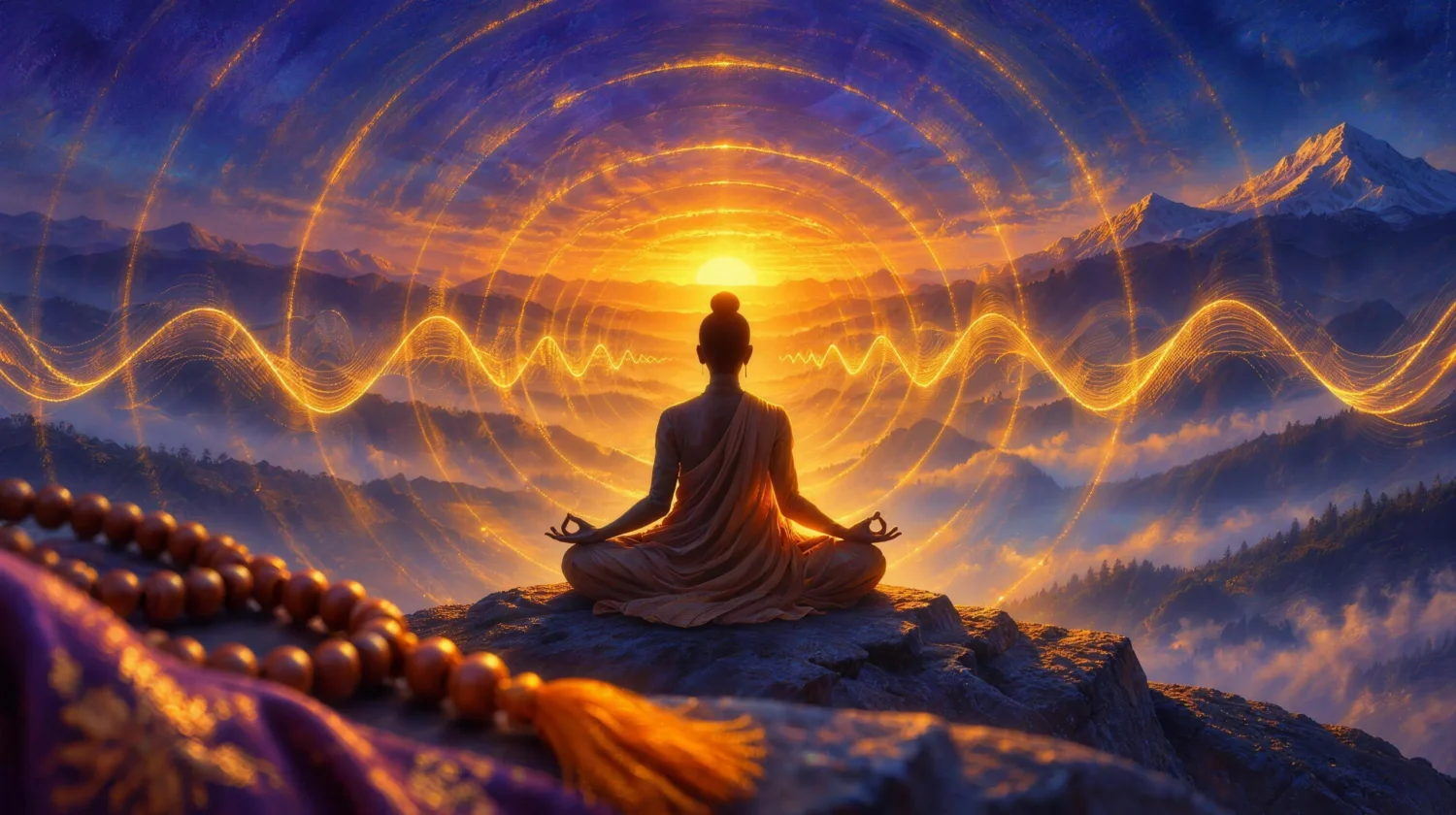
Mantras are sacred sounds, syllables or phrases that people repeat to steady the mind and turn attention inward. The word comes from Sanskrit, where it is usually read as “mind” plus “tool,” and the practice runs through Hindu, Buddhist, Sikh and Jain traditions. You can start with one short phrase, a comfortable seat and five minutes, and pair it with a simple guided meditation if you like.
Key Takeaways
- Definition: A mantra is a sacred sound or phrase repeated to focus the mind. Scholars say there is no single agreed definition.
- Origin: Mantras appear in the Vedas of ancient India and trace back to a shared Indo-Iranian root around 2000 BCE.
- Famous examples: Om, Om Mani Padme Hum, the Gayatri Mantra, the Mahamrityunjaya Mantra, So Hum and Nam Myoho Renge Kyo.
- Practice: Choose one mantra, sit comfortably, repeat it aloud, in a whisper or silently, and gently return when the mind wanders.
- Honest limits: Reviews find small to moderate benefits for stress and anxiety, but the studies are mostly weak in quality. Mantras are a spiritual and relaxation practice, not a treatment.
What Is a Mantra?
A mantra is a sacred utterance. It can be a single syllable like Om, a name of the divine, a short phrase, or a longer verse. People repeat it aloud, in a whisper or silently, and the repetition becomes an anchor for the mind.
The Sanskrit word is usually broken into man (mind) and tra (tool or instrument). A mantra is a tool for the mind. That is a lovely, practical way to hold it. You do not need to believe anything grand to try it. You only need something to come back to.
In the traditions that created them, mantras are more than relaxation aids. Practitioners believe the sounds carry spiritual power, and many mantras are tied to a particular deity, teaching or lineage. In other words, a mantra can be a doorway to devotion as well as a way to calm down. Both are valid, and which one speaks to you is part of your own path.
| Question | Quick answer |
|---|---|
| What is a mantra? | A sacred sound, word or phrase repeated to focus the mind or invoke a quality or deity. |
| What does the word mean? | From Sanskrit man (mind) and tra (tool), often translated as “instrument of thought.” |
| Where did they begin? | The Vedas of ancient India, with roots in a shared Indo-Iranian tradition around 2000 BCE. |
| Which traditions use them? | Hinduism, Buddhism, Jainism, Sikhism and others. |
| How are they repeated? | Aloud, in a whisper, silently or in writing; often 108 times with a mala. |
| How long should I practice? | Five to ten minutes is a good start. |
| Do I need a teacher? | Many mantras are open to all. Some tantric traditions pass certain mantras only through initiation. |
| Is it medical treatment? | No. It is a spiritual and relaxation practice. |
Throughout this guide we name the tradition each mantra comes from. These are living practices for millions of people, so approach them with respect and curiosity.
Where Mantras Come From
The earliest mentions of mantras are in the Vedas of ancient India. Scholars connect the term to a Proto-Indo-Iranian root dating to roughly 2000 BCE, and similar sacred utterances appear in the Avesta of ancient Iran. Vedic mantras came in different forms, including verses from the Rig Veda and melodic chants known as saman.
Over the centuries the practice grew. Tantric traditions placed mantras at the center of their methods, and Mahayana Buddhism carried them across Asia. In Japan, the monk Kukai founded the Shingon school, which treats mantras as expressions of ultimate reality. In Nichiren Buddhism a single phrase, Nam Myoho Renge Kyo, became the heart of daily practice.
Sound or meaning?
Scholars still disagree about what a mantra actually does. The linguist Frits Staal argued that many mantras are close to meaningless sound structures, more like birdsong than sentences. Others, such as Harvey Alper, argue that mantras are meaningful instruments of thought. Both camps agree that mantras are carefully built, have a kind of melody, and affect people in ways similar to wordless music.
You can hold both views at once. Some people chant for the sound and the feeling in the body. Others chant for the meaning and the devotion. Neither is wrong.
If you enjoy this kind of background, the same sound-first approach shows up in the Ganesh mantra and in the chakra seed syllables.
Famous Mantras and Their Meanings
Here are six widely known mantras, with the tradition each belongs to. Translations vary, and the notes below follow scholarly sources.
| Mantra | Tradition | Meaning in brief |
|---|---|---|
| Om (Aum) | Hindu, Buddhist, Jain, Sikh | The primordial sound and seed syllable. The Mandukya Upanishad opens by calling it “this whole world.” |
| Om Mani Padme Hum | Tibetan and wider Mahayana Buddhism | The mantra of Avalokiteshvara, the bodhisattva of compassion. Often rendered “praise to the jewel in the lotus.” |
| Gayatri Mantra | Hindu (Rig Veda 3.62.10) | A prayer to the sun deity Savitr, asking that our insight be guided by his radiance. |
| Mahamrityunjaya Mantra | Hindu (Rig Veda 7.59.12) | Addressed to Tryambaka, an epithet of Rudra (Shiva). Often called the great death-conquering mantra. |
| So Hum | Hindu and yoga traditions | “I am That” or “I am He.” Often paired with the natural breath. |
| Nam Myoho Renge Kyo | Nichiren Buddhism | “Homage to the Lotus Sutra,” chanted as the central practice. |
Om
Om is the best known of all mantras. In Hindu thought it is the primordial sound and a symbol of Brahman, the ultimate reality. The Mandukya Upanishad breaks it into A, U and M plus the silence that follows, and links each part to states of consciousness. Buddhist mantras often begin with Om as well, and in Sikhism the phrase Ik Onkar opens the Mul Mantar.
Om Mani Padme Hum
This six-syllable mantra is the most widely recited in Tibetan Buddhism and appears on prayer flags and carved mani stones. The earliest known source is the Karandavyuha Sutra, roughly from the fourth to fifth centuries. Tibetan teachers have read each syllable in different ways. The 14th Dalai Lama, for example, has described Om, Ma Ni, Pad Me and Hum as body, speech and mind, method, wisdom and their union.
Gayatri and Mahamrityunjaya
Both come from the Rig Veda, the oldest Hindu scripture. The Gayatri is the more widely chanted at dawn and in daily worship. We have a full guide with the Sanskrit and a line-by-line meaning in our Gayatri Mantra article. The Mahamrityunjaya is a verse to Rudra. Its second line asks to be released from death “like a cucumber from its stem,” not from deathlessness. It is often chanted in times of illness or grief as a prayer, not as a medical remedy.
So Hum and Nam Myoho Renge Kyo
So Hum is a breath mantra. “So” on the inhale and “Hum” on the exhale, with the meaning “I am That.” It is popular in modern meditation classes because it needs no equipment and fits the breath. Nam Myoho Renge Kyo is the signature chant of Nichiren Buddhism, usually recited aloud in a steady rhythm, alone or in groups.
How to Practice a Mantra: Step by Step
The practice of repeating a mantra is called japa in Sanskrit. It does not need to be complicated. Here is a simple, grounded way to begin on a real Tuesday.
- Choose one mantra. Pick something you feel drawn to, and stay with it for a few weeks. Changing it daily keeps the mind busy.
- Set a small time. Five to ten minutes is enough. A consistent short sitting beats an occasional long one.
- Sit comfortably. Chair, cushion or floor. Spine tall but not stiff. Hands resting in your lap, or in a mudra if you like.
- Settle your breath. Take a few slow breaths. If you want help, try guided breathwork first.
- Begin repeating. Say it aloud, whisper it, or repeat it silently. Let the rhythm be natural.
- Return gently. When your mind wanders, and it will, simply come back to the mantra. That return is the practice.
- Close quietly. Stop repeating, sit in silence for a minute, and notice how you feel before you move on.
Aloud, whispered or silent
Traditional teachers describe several styles of japa. Saying the mantra aloud (vaikhari) is considered the easiest place to begin, especially if your mind is restless. Whispering (upamshu) is quieter and more inward, and silent repetition sits deeper still. Some practitioners also write the mantra out, which is called likhita japa. Most people move between the styles depending on the day.
Using a mala
A mala is a string of beads used to count repetitions. Most have 108 beads plus a larger guru bead. You move one bead with each repetition, and when you reach the guru bead you turn the mala around rather than crossing it. Counting is optional. Many people set a timer instead and let the mind rest in the sound.
| Style | How it feels | Good for |
|---|---|---|
| Aloud | Resonant, physical, easy to follow | Beginners, restless days |
| Whispered | Soft and intimate | Calming down before sleep |
| Silent | Subtle and inward | Longer sits, quiet spaces |
| Written | Slow and tactile | People who focus better with their hands |
| With breath | Rhythmic and simple | So Hum, short mantras |
For a gentler start, you can pair a short phrase with your footsteps as you walk. Many people find this easier than sitting still, especially on restless days, and it carries the practice into ordinary life instead of keeping it on the cushion.
How to Choose a Mantra
There is no single correct answer. Here are practical ways people choose.
- By tradition. If you already feel at home in a spiritual path, use a mantra from it. A Buddhist might choose Om Mani Padme Hum; a Hindu devotee might choose a deity’s name.
- By meaning. Choose a phrase whose meaning you want to live with, such as “I am That” or a word like peace.
- By sound. Some people simply like the feel of a syllable like Om in the chest.
- By teacher. In some traditions a teacher gives you a mantra after initiation. If you feel called to that path, it is worth seeking one out.
It is also fine to use an everyday word or phrase as a personal mantra. That is common in modern, secular mindfulness. Just remember that this differs from a traditional mantra, which carries a lineage.
If you borrow a mantra from a living tradition, take a few minutes to learn what it means and how its practitioners use it. Respect keeps the practice honest.
What Research Says About Mantra Meditation
A 2022 systematic review and meta-analysis published in the International Journal of Environmental Research and Public Health looked at 51 randomized controlled trials of mantra-based meditation. Compared with control groups, it found small to moderate reductions in anxiety, depression, stress and PTSD symptoms, and a small improvement in mental-health-related quality of life.
The authors were careful, and so should we be. None of the studies were rated at low risk of bias, few involved people with psychiatric diagnoses, and long-term follow-up was scarce. When mantra meditation was compared with relaxation or psychotherapy, no significant differences were found. Only four studies reported safety data, and none observed harm from the practice.
What does that mean in plain terms? Mantra practice may help many people feel calmer, and it seems low risk, but the evidence is early. It is a spiritual and relaxation practice. It is not a replacement for professional care. If you live with anxiety, depression or trauma, please work with a qualified professional and treat mantras as a supportive addition.
Common Misconceptions and Honest Limits
- “A mantra must be in Sanskrit.” Many are, but mantras exist in Tibetan, Japanese, Punjabi and other languages, and people also use phrases in their own language.
- “If my mind wanders I am doing it wrong.” Noticing and returning is the practice.
- “More repetitions mean more power.” Traditions often count in 108s, but a calm five minutes is worthwhile. Do not turn it into a performance.
- “Mantras guarantee results.” They do not. No tradition promises a cure, and neither do we.
- “Chanting loudly is dangerous.” There is no evidence of that. Still, if you feel dizzy or distressed during any practice, stop and rest.
If breath-linked practices make you uncomfortable, simply chant at your natural pace and skip any breath holding. Pace yourself.
Go Deeper With Mantras
A few next steps if this resonates:
- Read about the Gayatri Mantra in its own guide, with Sanskrit, transliteration and a line-by-line meaning.
- Explore how sound relates to the body in our guide to chakra colors, where each center has a seed syllable.
- Try a short guided meditation to settle before your mantra practice, and write down what you notice afterward.
- Practice a short phrase while you walk with our walking meditation guide.
Mantra is one of the oldest ways humans have found to meet the mind. It asks very little of you: a sound, a few minutes, and a willingness to come back again and again. Start small. Stay curious. Let the sound do its quiet work.
Go Deeper with NLS Mastery: Ancient Meditation for Inner Stillness
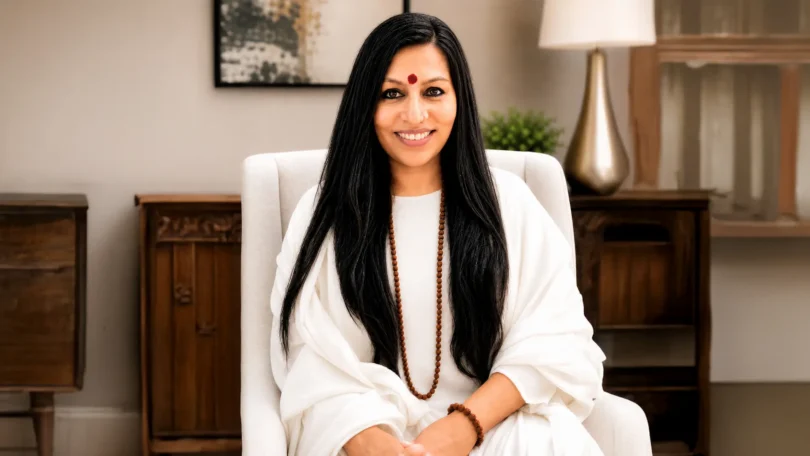
Mantra works best inside a steady practice, and this course helps you build that foundation of stillness. Acharya Shunya teaches it in Ancient Meditation for Inner Stillness, part of NLS Mastery. Watch the course preview below.
Frequently Asked Questions
What is a mantra in simple terms?
A mantra is a sacred word, syllable or phrase that you repeat to focus the mind. The Sanskrit word is often read as “mind tool.”
What does mantra mean in Sanskrit?
It is usually broken into man (mind) and tra (tool or instrument), so a mantra is an instrument of thought.
What are the most famous mantras?
Om, Om Mani Padme Hum, the Gayatri Mantra, the Mahamrityunjaya Mantra, So Hum and Nam Myoho Renge Kyo are among the best known.
How do you practice a mantra?
Choose one mantra, sit comfortably, and repeat it aloud, in a whisper or silently for five to ten minutes. When your mind wanders, gently return to the mantra.
Why are mantras repeated 108 times?
Malas traditionally have 108 beads, and 108 is a number with long-standing significance in Hindu and Buddhist traditions. It is a customary count, and a shorter practice is perfectly fine.
Do you need to be initiated to use a mantra?
Many mantras are open to everyone. Some tantric traditions give certain mantras only through initiation from a teacher.
Do mantras have to be in Sanskrit?
No. Mantras exist in several languages, and many people use a short phrase in their own language as a personal mantra.
Can mantra meditation reduce anxiety?
A 2022 meta-analysis found small to moderate reductions in anxiety and stress, but the underlying studies had a high risk of bias. It is a relaxation practice, not a treatment.
What is the difference between a mantra and an affirmation?
A traditional mantra is a sacred sound with a lineage and is often meaningful in sound as well as in words. An affirmation is a positive statement in everyday language.
How long does it take for a mantra to work?
There is no set timeline. Many people notice a calmer feeling after a few minutes, while deeper effects come from regular practice over weeks.
What is the easiest mantra for beginners?
Om and So Hum are common starting points because they are short and fit easily with the breath.
Sources and Further Reading
Spirituality for the Rest of Us™
Movies, series, documentaries, audiobooks, audio courses and guided meditations on awakening and consciousness, all in one place. 14-day money-back guarantee.